
Accounting Standards Update
Hot Topics and Latest Developments
Ryan Siebel, CPA
September 16, 2015
- 2 -
• Contributed services to NFPs (2013-06)
• Discontinued operations (2014-08)
• Development Stage Entities (2014-10)
• Pushdown Accounting (2014-17)
• PCC Standards
– Goodwill (2014-02)
– Derivatives (2014-03)
– Related Party Leasing Entities (2014-07)
NEW FOR 2015!
- 3 -
Discontinued Operations
ASU 2014-08
- 4 -
• When is this applicable to me?
– You have sold or discontinued a component of your company
• What has changed?
– Higher threshold for discontinued operations treatment
– More requirements for actual discontinued operations
– More disclosures for disposals that are not discontinued
operations
DISCONTINUED
OPERATIONS
- 5 -
• Intended to reduce number of transactions qualifying as
discontinued operations
• New rule: disposals of a component or group of
components that represents a strategic shift that has or
will have a major impact on an entity’s operations or
financial results
• New disclosure requirements
DISCONTINUED
OPERATIONS
- 6 -
• Requires reclassification of balance sheet assets and
liabilities for all periods
• Required cash flow disclosures (operating and investing)
DISCONTINUED
OPERATIONS
- 7 -
Development Stage Entities
ASU 2014-10
- 8 -
• When is this applicable to me?
– Your company has previously presented its financial statements
as a “Development Stage Entity”
• What has changed?
– This classification is no longer recognized in GAAP
– The old “from inception” financial statements not applicable
DEVELOPMENT
STAGE ENTITIES
- 9 -
Pushdown Accounting
ASU 2014-17
- 10 -
• When is this applicable to me?
– You are presenting standalone financial statements of an entity
that has been previously acquired by a parent entity
• What has changed?
– You can elect to apply or not apply pushdown accounting (i.e.
basis step-up) at any change in control
– You can elect to apply pushdown accounting to most recent
previous change in control if preferable
PUSHDOWN ACCOUNTING
- 11 -
• What is pushdown accounting?
– Changing the accounting basis within an acquired subsidiary to
reflect the acquirer’s basis in that subsidiary
– “Push down” the goodwill, step-up in fair values, etc.
• Previous guidance is not prescriptive and SEC specific
– Allowable when 80-95% of a business is acquired
– Not allowed at less than 80%
– Required at more than 95%
PUSHDOWN ACCOUNTING
- 12 -
• New guidance
– Allowable on any change in control
– Companies can take the option at each change in control
• Bargain purchase gain not allowed
PUSHDOWN ACCOUNTING
• Parent company debt cannot be
pushed down
- 13 -
• May retroactively elect pushdown accounting from most
recent change in control upon adoption of the standard
• Undoing previous pushdown accounting is not permitted
• No disclosures required for change in control event when
pushdown accounting is not applied
PUSHDOWN ACCOUNTING
- 14 -
PCC Standard - Goodwill
ASU 2014-02
- 15 -
• When is this applicable to me?
– Your company is privately held
– Your balance sheet has goodwill
• What has changed?
– Upon adoption, amortize goodwill over a ten year period rather
than testing annually for impairment
GOODWILL
- 16 -
• Effective for periods beginning on
or after December 15, 2014 (early
adoption permitted)
• Existing goodwill can be amortized
prospectively (no restatement or
“catch-up”)
GOODWILL
- 17 -
• Current Standard:
 Require at least annual impairment
testing
 Compare the implied fair value with the
carrying value
 Perform a hypothetical application of
the acquisition method
 Record any impairment as a current
charge to earnings
GOODWILL
- 18 -
• Updated Standard:
 Amortize goodwill
 Test for impairment with triggering event
 No hypothetical application of the acquisition
method; impairment is excess of carrying
amount over fair value
 Impairment still a charge against current
earnings
GOODWILL
- 19 -
• Test for impairment
• Triggering events:
 Significant change in general economic conditions
 Deterioration in the business’ environment
 Significant increases in costs that would impact the
company negatively
 Downturn in overall performance
GOODWILL
- 20 -
• Example One:
 Alvin Co. acquires the assets of Simon, Inc. for $2MM. The fair
value of Simon’s net assets is $1.8MM, resulting in residual
goodwill of $200,000
 Alvin can amortize the $200k of goodwill over 10 years,
resulting in annual amortization expense of $20,000
GOODWILL
- 21 -
• Example One (continued):
 In Year 2, Simon’s primary supplier of materials ceases
operations, and the only option is to purchase from a supplier that
charges 50% more for materials (this is significant)
 Triggering event, requiring impairment test, which indicates that
the carrying amount exceeds fair value by $50,000
 Current year impairment charge of $50k
GOODWILL
- 22 -
• Example One (continued):
 Remaining net goodwill of $130k (original $200k, less year
one amortization of $20k, less impairment of $50k) is
amortized over the remaining nine years
GOODWILL
- 23 -
• Example Two:
 Theodore, LLC has $1,000,000 of goodwill
on its balance sheet from an acquisition
effected in a prior year
 Theodore, LLC elects to adopt the new
standard
 Goodwill is amortized from the beginning
of the year of adoption, and $100,000 of
amortization is recorded in current year
GOODWILL
- 24 -
PCC Standard - Derivatives and
Hedging
ASU 2014-03
- 25 -
• When is this applicable to me?
– Your company is privately held
– Your company has variable-rate debt and a swap to “fix” the
interest rate
• What has changed?
– Upon adoption, fewer stipulations to qualify for hedge accounting
DERIVATIVES
- 26 -
• New alternative for accounting for receive-variable, pay-
fixed interest rate swap agreements
– The “shortcut to the shortcut”
• Previous requirements to strip out fluctuations in fair value
from earnings were complex and arbitrary
• Available for all entities, except public companies, not-for-
profit entities, benefit plans, and financial institutions
DERIVATIVES
- 27 -
• Criteria to apply new shortcut
– Both debt and swap are indexed on same rate (i.e. LIBOR)
– “Plain vanilla” swap
– Dates on swap and debt match or are at least close
– Fair value of swap at inception is at or near zero
– Notional amount of swap matches amount of debt hedged
– Interest payments are designated as hedged
• Documentation required by date on which financial statements are
available to be issued
– Previous standard required documentation at inception of hedge (i.e. “day one”)
DERIVATIVES
- 28 -
Consolidation – Common
Control Leasing Arrangements
ASU 2014-07
- 29 -
• When is this applicable to me?
– Your company is privately held
– You rent a building from a related party and have previously
consolidated that related party entity in your financial statements
• What has changed?
– Upon election, no longer required to consolidate related party
lessor
LEASING
- 30 -
• Third Party Users (e.g. banks)
will ask for consolidating
schedules to break out entities
• Focus is on user-relevance and
cost-benefit
LEASING
- 31 -
• Variable Interest Entities / Common Control Leasing
• Alternative to the old “FIN 46(R)”
• Applies to all entities, other than public companies,
not-for-profit, and employee benefit plans
LEASING
- 32 -
• Private companies set up separate entities to own real
property for estate planning, tax planning, or legal
liability purposes
• Consolidation for common control can distort the financial
statements of the lessee
LEASING
- 33 -
• Main Provisions:
 Lessee and Lessor are under common control
 Lessee has a lease arrangement with Lessor
 Substantially all of the activities between the
entities relate to leasing
 Lessee explicitly guarantees or provides
collateral for any obligations of the lessor
related to the leased property
LEASING
- 34 -
• Accounting policy election – applies to
current and future
• Normal VIE disclosures not required
• Normal related party disclosures
still apply
LEASING
- 35 -
• Debt Issuance Costs (ASU 2015-03)
• Extraordinary Items (ASU 2015-01)
• Going Concern (ASU 2014-15)
• Measuring Stock Compensation (ASU
2014-12)
• Disclosures for Investments Accounted at
NAV (ASU 2015-07)
• Cloud Computing Arrangements (ASU
2015-05)
COMING SOON
- 36 -
• Measurement Date for Pension Liabilities
(ASU 2015-04)
• Consolidation Amendments (ASU 2015-02)
• PCC Option – Accounting for Intangibles
Acquired in Business Combination (ASU
2014-18)
• Revenue Recognition (ASU 2014-09)
• Deferred Tax Presentation
• Share Based Compensation Simplification
• Lease Accounting
COMING SOON
- 37 -
Debt Issuance Costs
ASU 2015-03
- 38 -
• When is this applicable to me?
– You have capitalized debt issuance costs as an asset on the
company’s balance sheet
• What has changed?
– These costs are now presented as a deduction from the related
debt liability
DEBT ISSUANCE COSTS
- 39 -
• Consistent with presentation of debt discounts
• Amortization is interest expense
• Costs related to revolving debt agreements are generally
assets
• Costs that are incurred before funding is received are
assets, which are then reclassified
• Early adoption allowed
DEBT ISSUANCE COSTS
- 40 -
Extraordinary Items
ASU 2015-01
- 41 -
• When is this applicable to me?
– You have had accounting gains/losses that have been considered
“infrequent and unusual”
• What has changed?
– No longer required to present separately on income statement if a
transaction meets the above criteria
EXTRAORDINARY ITEMS
- 42 -
Going Concern
ASU 2014-15
- 43 -
• When is this applicable to me?
– There is uncertainty as to whether your company can continue as
a going concern
• What has changed?
– Management required to perform assessment
– Outlook period is one year from report issuance date, not balance
sheet date
– Added required disclosures
GOING CONCERN
- 44 -
• Substantial doubt
– “Conditions and events, considered in the aggregate, indicate that
it is probable that the entity will be unable to meet its obligations
as they become due within one year after the date that the
financial statements are issued”
– The term probable is used consistently with its use in ASC 450 on
contingencies
GOING CONCERN
- 45 -
• Factors that could create substantial doubt
– Negative financial trends
– Default on debt/loans or need to restructure such agreements
– Work stoppages, uneconomic long-term commitments
– Adverse legal judgments, loss of key customer
GOING CONCERN
- 46 -
• Standard setters have indicated they expect fewer going
concern disclosures under the new model
• Look forward period one year from financial statement
issue date
– Will you have debt covenant issues in the new assessment
period?
GOING CONCERN
- 47 -
• Disclosures
– Principle events and conditions
– Management’s evaluation
– Management’s plans
– If management’s plans do not alleviate substantial doubt, a
statement is issued stating that there is “substantial doubt about
the entity’s ability to continue as a going concern”
GOING CONCERN
- 48 -
Intangible Assets Recognized in
a Business Combination
ASU 2014-18
- 49 -
• When is this applicable to me?
– Your company is privately held
– You have recently completed a business combination
• What has changed?
– Upon adoption, no longer required to separately value acquired
customer lists and non-compete agreements
– Such intangibles are included in goodwill
INTANGIBLE ASSETS
- 50 -
• Available for all entities, except public companies and not-
for-profit entities
• Reduces number of intangible assets to recognize in a
business combination
• Only recognizes those arising from contractual and/or
legal rights
• Qualitatively discloses intangibles acquired but not
recognized (included in goodwill)
• Effective prospectively on acquisitions made after final
issuance of standard
INTANGIBLE ASSETS
- 51 -
• What would be recognized under the new standard?
– Registered trademarks, trade names
– Registered internet domain names
– Patented technology
– Licensed computer software
– Trade secrets and processes that are legally registered
– Artistic-related intangible assets
INTANGIBLE ASSETS
- 52 -
• What would be recognized under the new standard?
– Order backlog
– Customer contracts
– Licensing, royalty, and franchise agreements
– Advertising, construction, supply contracts
– Lease agreements
– Unregistered trade secrets and processes
INTANGIBLE ASSETS
- 53 -
• What would not be recognized under the new standard?
– Customer lists
– Customer relationships
– Research and development
– Unpatented technology
– Databases
All of the above can be identifiable intangible assets to the extent
that the agreements are noncancelable.
INTANGIBLE ASSETS
- 54 -
Revenue Recognition
ASU 2014-09
- 55 -
• When is this applicable to me?
– Whenever you have recorded revenue
• What has changed?
– Entirely new model for recognizing revenue
– Dispenses with prior industry-specific guidance
REVENUE RECOGNITION
- 56 -
• Effective for private companies for annual periods
beginning after December 15, 2018
• This means the 12/31/19 annual financial statements for a
calendar year end company will be the first to comply with
the new standard
• Initial adoption can be full retrospective or modified
– Full – adjust prior period column
– Modified – adjust retained earnings at 1/1/19
REVENUE RECOGNITION
- 57 -
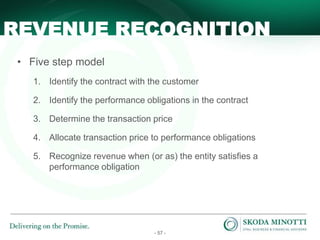
• Five step model
1. Identify the contract with the customer
2. Identify the performance obligations in the contract
3. Determine the transaction price
4. Allocate transaction price to performance obligations
5. Recognize revenue when (or as) the entity satisfies a
performance obligation
REVENUE RECOGNITION
- 58 -
• Performance obligations
– Goods or services
– Identify those that are distinct within the context of the contract
– Interdependent or interrelated goods and services can be
aggregated into one performance obligation
REVENUE RECOGNITION
- 59 -
• Transaction price
– Includes an estimate of variable consideration
– May adjust for time value of money
• Allocating the transaction price
– Needed when multiple performance obligations are in one
contract
– Based on relative stand-alone selling price
– Can be estimated
– Maximize use of observable inputs
REVENUE RECOGNITION
- 60 -
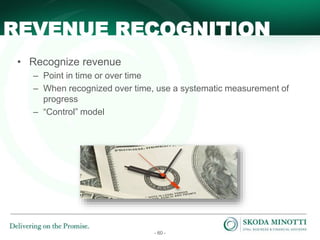
• Recognize revenue
– Point in time or over time
– When recognized over time, use a systematic measurement of
progress
– “Control” model
REVENUE RECOGNITION
- 61 -
• Other provisions
– Capitalize incremental contract costs
– Contract modifications
– Warranties
– Licenses – right to use vs. right to access
REVENUE RECOGNITION
- 62 -
Ryan Siebel
Principal – Skoda Minotti
(440) 449-6800
rsiebel@skodaminotti.com
CONTACT ME

Accounting Standards Update

  • 1.
    Accounting Standards Update HotTopics and Latest Developments Ryan Siebel, CPA September 16, 2015
  • 2.
    - 2 - •Contributed services to NFPs (2013-06) • Discontinued operations (2014-08) • Development Stage Entities (2014-10) • Pushdown Accounting (2014-17) • PCC Standards – Goodwill (2014-02) – Derivatives (2014-03) – Related Party Leasing Entities (2014-07) NEW FOR 2015!
  • 3.
    - 3 - DiscontinuedOperations ASU 2014-08
  • 4.
    - 4 - •When is this applicable to me? – You have sold or discontinued a component of your company • What has changed? – Higher threshold for discontinued operations treatment – More requirements for actual discontinued operations – More disclosures for disposals that are not discontinued operations DISCONTINUED OPERATIONS
  • 5.
    - 5 - •Intended to reduce number of transactions qualifying as discontinued operations • New rule: disposals of a component or group of components that represents a strategic shift that has or will have a major impact on an entity’s operations or financial results • New disclosure requirements DISCONTINUED OPERATIONS
  • 6.
    - 6 - •Requires reclassification of balance sheet assets and liabilities for all periods • Required cash flow disclosures (operating and investing) DISCONTINUED OPERATIONS
  • 7.
    - 7 - DevelopmentStage Entities ASU 2014-10
  • 8.
    - 8 - •When is this applicable to me? – Your company has previously presented its financial statements as a “Development Stage Entity” • What has changed? – This classification is no longer recognized in GAAP – The old “from inception” financial statements not applicable DEVELOPMENT STAGE ENTITIES
  • 9.
    - 9 - PushdownAccounting ASU 2014-17
  • 10.
    - 10 - •When is this applicable to me? – You are presenting standalone financial statements of an entity that has been previously acquired by a parent entity • What has changed? – You can elect to apply or not apply pushdown accounting (i.e. basis step-up) at any change in control – You can elect to apply pushdown accounting to most recent previous change in control if preferable PUSHDOWN ACCOUNTING
  • 11.
    - 11 - •What is pushdown accounting? – Changing the accounting basis within an acquired subsidiary to reflect the acquirer’s basis in that subsidiary – “Push down” the goodwill, step-up in fair values, etc. • Previous guidance is not prescriptive and SEC specific – Allowable when 80-95% of a business is acquired – Not allowed at less than 80% – Required at more than 95% PUSHDOWN ACCOUNTING
  • 12.
    - 12 - •New guidance – Allowable on any change in control – Companies can take the option at each change in control • Bargain purchase gain not allowed PUSHDOWN ACCOUNTING • Parent company debt cannot be pushed down
  • 13.
    - 13 - •May retroactively elect pushdown accounting from most recent change in control upon adoption of the standard • Undoing previous pushdown accounting is not permitted • No disclosures required for change in control event when pushdown accounting is not applied PUSHDOWN ACCOUNTING
  • 14.
    - 14 - PCCStandard - Goodwill ASU 2014-02
  • 15.
    - 15 - •When is this applicable to me? – Your company is privately held – Your balance sheet has goodwill • What has changed? – Upon adoption, amortize goodwill over a ten year period rather than testing annually for impairment GOODWILL
  • 16.
    - 16 - •Effective for periods beginning on or after December 15, 2014 (early adoption permitted) • Existing goodwill can be amortized prospectively (no restatement or “catch-up”) GOODWILL
  • 17.
    - 17 - •Current Standard:  Require at least annual impairment testing  Compare the implied fair value with the carrying value  Perform a hypothetical application of the acquisition method  Record any impairment as a current charge to earnings GOODWILL
  • 18.
    - 18 - •Updated Standard:  Amortize goodwill  Test for impairment with triggering event  No hypothetical application of the acquisition method; impairment is excess of carrying amount over fair value  Impairment still a charge against current earnings GOODWILL
  • 19.
    - 19 - •Test for impairment • Triggering events:  Significant change in general economic conditions  Deterioration in the business’ environment  Significant increases in costs that would impact the company negatively  Downturn in overall performance GOODWILL
  • 20.
    - 20 - •Example One:  Alvin Co. acquires the assets of Simon, Inc. for $2MM. The fair value of Simon’s net assets is $1.8MM, resulting in residual goodwill of $200,000  Alvin can amortize the $200k of goodwill over 10 years, resulting in annual amortization expense of $20,000 GOODWILL
  • 21.
    - 21 - •Example One (continued):  In Year 2, Simon’s primary supplier of materials ceases operations, and the only option is to purchase from a supplier that charges 50% more for materials (this is significant)  Triggering event, requiring impairment test, which indicates that the carrying amount exceeds fair value by $50,000  Current year impairment charge of $50k GOODWILL
  • 22.
    - 22 - •Example One (continued):  Remaining net goodwill of $130k (original $200k, less year one amortization of $20k, less impairment of $50k) is amortized over the remaining nine years GOODWILL
  • 23.
    - 23 - •Example Two:  Theodore, LLC has $1,000,000 of goodwill on its balance sheet from an acquisition effected in a prior year  Theodore, LLC elects to adopt the new standard  Goodwill is amortized from the beginning of the year of adoption, and $100,000 of amortization is recorded in current year GOODWILL
  • 24.
    - 24 - PCCStandard - Derivatives and Hedging ASU 2014-03
  • 25.
    - 25 - •When is this applicable to me? – Your company is privately held – Your company has variable-rate debt and a swap to “fix” the interest rate • What has changed? – Upon adoption, fewer stipulations to qualify for hedge accounting DERIVATIVES
  • 26.
    - 26 - •New alternative for accounting for receive-variable, pay- fixed interest rate swap agreements – The “shortcut to the shortcut” • Previous requirements to strip out fluctuations in fair value from earnings were complex and arbitrary • Available for all entities, except public companies, not-for- profit entities, benefit plans, and financial institutions DERIVATIVES
  • 27.
    - 27 - •Criteria to apply new shortcut – Both debt and swap are indexed on same rate (i.e. LIBOR) – “Plain vanilla” swap – Dates on swap and debt match or are at least close – Fair value of swap at inception is at or near zero – Notional amount of swap matches amount of debt hedged – Interest payments are designated as hedged • Documentation required by date on which financial statements are available to be issued – Previous standard required documentation at inception of hedge (i.e. “day one”) DERIVATIVES
  • 28.
    - 28 - Consolidation– Common Control Leasing Arrangements ASU 2014-07
  • 29.
    - 29 - •When is this applicable to me? – Your company is privately held – You rent a building from a related party and have previously consolidated that related party entity in your financial statements • What has changed? – Upon election, no longer required to consolidate related party lessor LEASING
  • 30.
    - 30 - •Third Party Users (e.g. banks) will ask for consolidating schedules to break out entities • Focus is on user-relevance and cost-benefit LEASING
  • 31.
    - 31 - •Variable Interest Entities / Common Control Leasing • Alternative to the old “FIN 46(R)” • Applies to all entities, other than public companies, not-for-profit, and employee benefit plans LEASING
  • 32.
    - 32 - •Private companies set up separate entities to own real property for estate planning, tax planning, or legal liability purposes • Consolidation for common control can distort the financial statements of the lessee LEASING
  • 33.
    - 33 - •Main Provisions:  Lessee and Lessor are under common control  Lessee has a lease arrangement with Lessor  Substantially all of the activities between the entities relate to leasing  Lessee explicitly guarantees or provides collateral for any obligations of the lessor related to the leased property LEASING
  • 34.
    - 34 - •Accounting policy election – applies to current and future • Normal VIE disclosures not required • Normal related party disclosures still apply LEASING
  • 35.
    - 35 - •Debt Issuance Costs (ASU 2015-03) • Extraordinary Items (ASU 2015-01) • Going Concern (ASU 2014-15) • Measuring Stock Compensation (ASU 2014-12) • Disclosures for Investments Accounted at NAV (ASU 2015-07) • Cloud Computing Arrangements (ASU 2015-05) COMING SOON
  • 36.
    - 36 - •Measurement Date for Pension Liabilities (ASU 2015-04) • Consolidation Amendments (ASU 2015-02) • PCC Option – Accounting for Intangibles Acquired in Business Combination (ASU 2014-18) • Revenue Recognition (ASU 2014-09) • Deferred Tax Presentation • Share Based Compensation Simplification • Lease Accounting COMING SOON
  • 37.
    - 37 - DebtIssuance Costs ASU 2015-03
  • 38.
    - 38 - •When is this applicable to me? – You have capitalized debt issuance costs as an asset on the company’s balance sheet • What has changed? – These costs are now presented as a deduction from the related debt liability DEBT ISSUANCE COSTS
  • 39.
    - 39 - •Consistent with presentation of debt discounts • Amortization is interest expense • Costs related to revolving debt agreements are generally assets • Costs that are incurred before funding is received are assets, which are then reclassified • Early adoption allowed DEBT ISSUANCE COSTS
  • 40.
    - 40 - ExtraordinaryItems ASU 2015-01
  • 41.
    - 41 - •When is this applicable to me? – You have had accounting gains/losses that have been considered “infrequent and unusual” • What has changed? – No longer required to present separately on income statement if a transaction meets the above criteria EXTRAORDINARY ITEMS
  • 42.
    - 42 - GoingConcern ASU 2014-15
  • 43.
    - 43 - •When is this applicable to me? – There is uncertainty as to whether your company can continue as a going concern • What has changed? – Management required to perform assessment – Outlook period is one year from report issuance date, not balance sheet date – Added required disclosures GOING CONCERN
  • 44.
    - 44 - •Substantial doubt – “Conditions and events, considered in the aggregate, indicate that it is probable that the entity will be unable to meet its obligations as they become due within one year after the date that the financial statements are issued” – The term probable is used consistently with its use in ASC 450 on contingencies GOING CONCERN
  • 45.
    - 45 - •Factors that could create substantial doubt – Negative financial trends – Default on debt/loans or need to restructure such agreements – Work stoppages, uneconomic long-term commitments – Adverse legal judgments, loss of key customer GOING CONCERN
  • 46.
    - 46 - •Standard setters have indicated they expect fewer going concern disclosures under the new model • Look forward period one year from financial statement issue date – Will you have debt covenant issues in the new assessment period? GOING CONCERN
  • 47.
    - 47 - •Disclosures – Principle events and conditions – Management’s evaluation – Management’s plans – If management’s plans do not alleviate substantial doubt, a statement is issued stating that there is “substantial doubt about the entity’s ability to continue as a going concern” GOING CONCERN
  • 48.
    - 48 - IntangibleAssets Recognized in a Business Combination ASU 2014-18
  • 49.
    - 49 - •When is this applicable to me? – Your company is privately held – You have recently completed a business combination • What has changed? – Upon adoption, no longer required to separately value acquired customer lists and non-compete agreements – Such intangibles are included in goodwill INTANGIBLE ASSETS
  • 50.
    - 50 - •Available for all entities, except public companies and not- for-profit entities • Reduces number of intangible assets to recognize in a business combination • Only recognizes those arising from contractual and/or legal rights • Qualitatively discloses intangibles acquired but not recognized (included in goodwill) • Effective prospectively on acquisitions made after final issuance of standard INTANGIBLE ASSETS
  • 51.
    - 51 - •What would be recognized under the new standard? – Registered trademarks, trade names – Registered internet domain names – Patented technology – Licensed computer software – Trade secrets and processes that are legally registered – Artistic-related intangible assets INTANGIBLE ASSETS
  • 52.
    - 52 - •What would be recognized under the new standard? – Order backlog – Customer contracts – Licensing, royalty, and franchise agreements – Advertising, construction, supply contracts – Lease agreements – Unregistered trade secrets and processes INTANGIBLE ASSETS
  • 53.
    - 53 - •What would not be recognized under the new standard? – Customer lists – Customer relationships – Research and development – Unpatented technology – Databases All of the above can be identifiable intangible assets to the extent that the agreements are noncancelable. INTANGIBLE ASSETS
  • 54.
    - 54 - RevenueRecognition ASU 2014-09
  • 55.
    - 55 - •When is this applicable to me? – Whenever you have recorded revenue • What has changed? – Entirely new model for recognizing revenue – Dispenses with prior industry-specific guidance REVENUE RECOGNITION
  • 56.
    - 56 - •Effective for private companies for annual periods beginning after December 15, 2018 • This means the 12/31/19 annual financial statements for a calendar year end company will be the first to comply with the new standard • Initial adoption can be full retrospective or modified – Full – adjust prior period column – Modified – adjust retained earnings at 1/1/19 REVENUE RECOGNITION
  • 57.
    - 57 - •Five step model 1. Identify the contract with the customer 2. Identify the performance obligations in the contract 3. Determine the transaction price 4. Allocate transaction price to performance obligations 5. Recognize revenue when (or as) the entity satisfies a performance obligation REVENUE RECOGNITION
  • 58.
    - 58 - •Performance obligations – Goods or services – Identify those that are distinct within the context of the contract – Interdependent or interrelated goods and services can be aggregated into one performance obligation REVENUE RECOGNITION
  • 59.
    - 59 - •Transaction price – Includes an estimate of variable consideration – May adjust for time value of money • Allocating the transaction price – Needed when multiple performance obligations are in one contract – Based on relative stand-alone selling price – Can be estimated – Maximize use of observable inputs REVENUE RECOGNITION
  • 60.
    - 60 - •Recognize revenue – Point in time or over time – When recognized over time, use a systematic measurement of progress – “Control” model REVENUE RECOGNITION
  • 61.
    - 61 - •Other provisions – Capitalize incremental contract costs – Contract modifications – Warranties – Licenses – right to use vs. right to access REVENUE RECOGNITION
  • 62.
    - 62 - RyanSiebel Principal – Skoda Minotti (440) 449-6800 rsiebel@skodaminotti.com CONTACT ME

Editor's Notes

  • #3 Under current GAAP (without adopting this), you have to test goodwill for impairment on at least an annual basis. This can sometimes be complex and costly.
  • #17 We have done this for current clients already. It’s a change in accounting method – no prior period adjustment necessary.
  • #18 Performing a hypothetical application of the acquisition method – what does that mean?
  • #20 You still have to test for impairment if there is a triggering event.
  • #22 Now, let’s say there is a triggering event.
  • #24 So again, there is NO restatement of prior years, and goodwill is amortized from day one of the year of adoption.
  • #31 The other relevant ASU issued in 2014 thus far is for consolidations. The infamous “FIN 46”! Often, banks will ask for supplementary schedules (consolidating schedules) so they can break out the VIE from the operating company. What is relevant to the users of the financial statements?
  • #33 For example, the owners of an operating company will set up a separate legal entity that owns the real estate. Then, the operating company will lease the real property from that second entity. Normally under GAAP, this would require consolidation of both companies. However, this Update may allow the de-consolidation of the real estate entity.
  • #35 So, in comparative statements you would NOT restate the prior year. Just present the current year, under the new updated standard and disclose the accounting policy election.
  • #36 Under current GAAP (without adopting this), you have to test goodwill for impairment on at least an annual basis. This can sometimes be complex and costly.
  • #37 Under current GAAP (without adopting this), you have to test goodwill for impairment on at least an annual basis. This can sometimes be complex and costly.