Sean Saari, CPA/ABV, CVA, MBA
Robert A. Ranallo, CPA/ABV, JD, CVA, CFF
July 9, 2019
Valuation Issues in Developing
and Executing Buy-Sell
Agreements
2
Learning Objectives
After completing the session,
participants will be able to…
• Draft and review buy-sell agreements
with an understanding of the related
valuation considerations
• Proactively plan with clients to address
valuation-related issues that arise in
connection with buy-sell agreements
“In the long run, men hit only what they aim at.” – Henry David Thoreau
3
Quote of the Day
“There is no such thing as an absolute
value in this world. You can only estimate
what a thing is worth to you.”
Charles Dudley Warner 1829-1900, American Writer
4
Overview of Buy-Sell Agreements
A best practice for closely-held businesses
with multiple owners is to have a buy-sell
agreement in place to govern the purchase
and sale of ownership interests
When an ownership transaction is not
imminent, the valuation provisions included in
buy-sell agreements are oftentimes not
heavily scrutinized, but…
When an ownership transaction occurs and
the buy-sell must be followed, VALUATION is
often the most significant issue
5
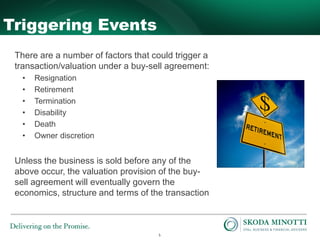
Triggering Events
There are a number of factors that could trigger a
transaction/valuation under a buy-sell agreement:
• Resignation
• Retirement
• Termination
• Disability
• Death
• Owner discretion
Unless the business is sold before any of the
above occur, the valuation provision of the buy-
sell agreement will eventually govern the
economics, structure and terms of the transaction
6
Key Valuation Factors
Standard of value
• Will drive the structure and assumptions used
in valuation
Valuation date
• Value may vary significantly based on the
valuation date and what was “known or
knowable” at that time
Level of value
• Inclusion/exclusion of discounts for lack of
control and lack of marketability can have a
material impact on value
7
Standard of Value
Fair Market Value
• Most common standard of value (and typically most appropriate as
well)
• “The price at which property would change hands between a willing
buyer and a willing seller, when the former is not under any
compulsion to buy, the latter is not under any compulsion to sell,
and both parties have reasonable knowledge of the relevant facts” –
Revenue Ruling 59-60
• “Hypothetical willing buyer and willing seller”
8
Standard of Value
Strategic Value
• Value to a particular buyer including potential synergies that may be
created as a result of an acquisition
Another “Defined” Standard of Value
• Buy-sell agreements may include a definition of a “non-standard”
standard of value
 “Market Value”
 “Value”
• Beware of defining a standard of value in the buy-sell agreement rather
than relying on Fair Market Value
 Standards of value created specifically for buy-sell agreements often have
no basis in financial theory and are not generally accepted in the valuation
profession
 The definition may be open to interpretation and could result in materially
different conclusions of value depending upon how it is interpreted
9
Valuation Date
Any number of valuation dates could be assigned
in the buy-sell agreement
• End/beginning of year
• End of month/quarter immediately preceding
triggering event (most common)
• Date of the triggering event
• Any date identified in the buy-sell agreement
Be aware that valuation standards prevent an
appraiser from considering in his or her conclusion
of value any facts that were not “known or
knowable” as of the valuation date
Values are not static and will change depending
upon the valuation date
10
Level of Value
Not all values are created equal – the level of value being
determined has a significant impact on value
• Controlling or non-controlling (majority interest vs. minority interest)
• Marketable or non-marketable
“Fair Market Value” generally includes consideration of any
applicable discounts for lack of control and lack of marketability
Best practice is to specify in buy-sell agreement whether discounts
for lack of control, lack of marketability or any other factors will be
considered
11
Level of Value
Lack of Control
• Reflects the potential impairment to value
as a result of a non-controlling ownership
interest not being able to control the
company and its decisions
 Distributions
 Management/owner compensation
 Management/owner perks
 Major business decisions
 Redemption of the ownership interest
 Liquidation of the company
12
Level of Value
Lack of Marketability
• Reflects the impairment to value resulting
from the fact that an ownership interest in a
privately-held company has no ready
market for resale (which creates increased
uncertainty, longer holding periods and
additional costs to convert the ownership
interest into cash)
• Significantly higher discounts applied when
valuing non-controlling (minority) ownership
interests (compared to controlling
ownership interests)
13
Level of Value
What impact does the inclusion/exclusion of lack of control and
lack of marketability discounts have?
• Inclusion – Favors buyer
 Pro: Provides most accurate indication of “fair market value” and
reflects what the ownership interest could likely be sold for to a third
party
 Con: May allow a controlling owner to obtain additional controlling
ownership at a discounted value
• Exclusion – Favors seller
 Pro: Allows the selling party to be bought out at a value that reflects the
amount that would be received if the company as a whole were to be
sold
 Con: Penalizes the buyer and causes them to pay more for the
ownership interest than what a third party would likely pay for it
14
Valuation Approaches
Appraisal
• Valuation prepared by third-party valuation
expert
Formula
• Valuation based on formula outlined in buy-
sell agreement
Agreed-upon value
• Valuation based on agreed-upon value
determined by owners
15
Appraisal
Key Considerations
• Standard of value/valuation date/level of value
• What credentials must the valuation expert
possess?
• Will the valuation be prepared in accordance with
a particular set of valuation standards?
• Will a single-appraiser or multiple-appraiser
model be used?
• If a multiple-appraiser model is used, how will the
final value be selected?
• How will the valuation expert be selected?
• Must the valuation expert be independent from
the company’s accountant?
• How will appraisal costs be allocated among the
parties involved?
• What level of analysis/deliverable will be
required?
16
Appraisal
Pros
• Most accurate value
 Considers current status of
business, industry and economy
as of the valuation date
 No “winner” or “loser” based on
the value/transaction price
• Value should be transparent and
understandable to all parties
Cons
• Time-consuming
• Expensive
• Can be burdensome if multiple
appraisers are involved
17
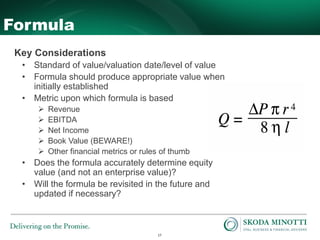
Formula
Key Considerations
• Standard of value/valuation date/level of value
• Formula should produce appropriate value when
initially established
• Metric upon which formula is based
 Revenue
 EBITDA
 Net Income
 Book Value (BEWARE!)
 Other financial metrics or rules of thumb
• Does the formula accurately determine equity
value (and not an enterprise value)?
• Will the formula be revisited in the future and
updated if necessary?
18
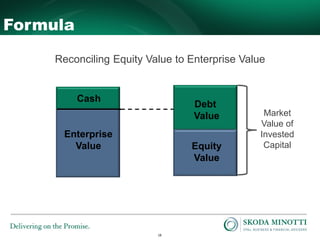
Formula
Cash
Enterprise
Value
Debt
Value
Equity
Value
Market
Value of
Invested
Capital
Reconciling Equity Value to Enterprise Value
19
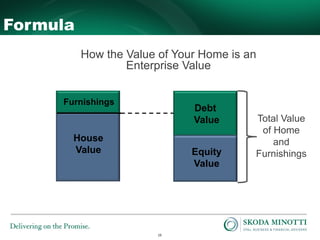
Formula
Furnishings
House
Value
Debt
Value
Equity
Value
Total Value
of Home
and
Furnishings
How the Value of Your Home is an
Enterprise Value
20
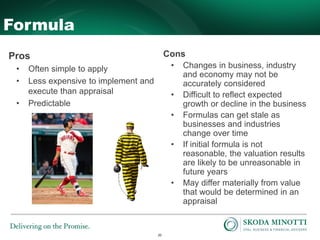
Formula
Pros
• Often simple to apply
• Less expensive to implement and
execute than appraisal
• Predictable
Cons
• Changes in business, industry
and economy may not be
accurately considered
• Difficult to reflect expected
growth or decline in the business
• Formulas can get stale as
businesses and industries
change over time
• If initial formula is not
reasonable, the valuation results
are likely to be unreasonable in
future years
• May differ materially from value
that would be determined in an
appraisal
21
Agreed-Upon Value
Key Considerations
• Standard of value/valuation date/level of value
• How often will the agreed-upon value be
updated?
• Are there any mechanisms in place to ensure
that updates to the agreed-upon value are
made as required?
• What happens if there has been no recent
update to the agreed-upon value before a
triggering event?
• How will the agreed-upon value be
determined?
• What happens if the parties cannot agree on a
value?
22
Agreed-Upon Value
Pros
• Simple to apply (at least in theory)
• Least expensive to implement
and execute
• Agreement of parties on value
avoids valuation issues
Cons
• The agreed-upon redemption
price will likely become stale over
time
• Requires agreement of parties to
set and update the agreed-upon
redemption price, which can be
difficult to obtain in practice
• May differ materially from value
that would be determined in an
appraisal
23
Other Considerations
Who will acquire the selling party’s
ownership?
• Other owner(s)
• Company
• Some combination of other owner(s) and the
company?
Treatment of life insurance proceeds
• Included or excluded in the value of the
business?
24
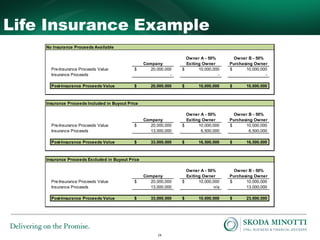
Life Insurance Example
No Insurance Proceeds Available
Owner A - 50% Owner B - 50%
Company Exiting Owner Purchasing Owner
Pre-Insurance Proceeds Value 20,000,000$ 10,000,000$ 10,000,000$
Insurance Proceeds - - -
Post-Insurance Proceeds Value 20,000,000$ 10,000,000$ 10,000,000$
Insurance Proceeds Included in Buyout Price
Owner A - 50% Owner B - 50%
Company Exiting Owner Purchasing Owner
Pre-Insurance Proceeds Value 20,000,000$ 10,000,000$ 10,000,000$
Insurance Proceeds 13,000,000 6,500,000 6,500,000
Post-Insurance Proceeds Value 33,000,000$ 16,500,000$ 16,500,000$
Insurance Proceeds Excluded in Buyout Price
Owner A - 50% Owner B - 50%
Company Exiting Owner Purchasing Owner
Pre-Insurance Proceeds Value 20,000,000$ 10,000,000$ 10,000,000$
Insurance Proceeds 13,000,000 n/a 13,000,000
Post-Insurance Proceeds Value 33,000,000$ 10,000,000$ 23,000,000$
25
Suggestions/Takeaways
1. Get input from a qualified, credentialed valuation expert when
drafting buy-sell agreements
2. Define the standard of value, valuation date and level of value
3. Utilize the appraisal methodology for the most accurate value
4. Avoid imprecise language and clearly define the valuation
provisions
5. Address how insurance proceeds will be treated in the
valuation
26
Summing It Up
After completing the session,
participants will be able to…
• Draft and review buy-sell agreements
with an understanding of the related
valuation considerations
• Proactively plan with clients to address
valuation-related issues that arise in
connection with buy-sell agreements
27
Closing Quote
“It’s the little details that
are vital. Little things
make big things happen.”
– John Wooden
28
Questions?
Bob Ranallo, CPA/ABV, JD, CVA, CFF
Partner
Phone - (440) 449-6800 x7131
Email - branallo@skodaminotti.com
Sean Saari, CPA/ABV, CVA, MBA
Partner
Phone - (440) 449-6800 x7221
Email - ssaari@skodaminotti.com

Valuation Issues in Developing and Executing Buy-Sell Agreements

  • 1.
    Sean Saari, CPA/ABV,CVA, MBA Robert A. Ranallo, CPA/ABV, JD, CVA, CFF July 9, 2019 Valuation Issues in Developing and Executing Buy-Sell Agreements
  • 2.
    2 Learning Objectives After completingthe session, participants will be able to… • Draft and review buy-sell agreements with an understanding of the related valuation considerations • Proactively plan with clients to address valuation-related issues that arise in connection with buy-sell agreements “In the long run, men hit only what they aim at.” – Henry David Thoreau
  • 3.
    3 Quote of theDay “There is no such thing as an absolute value in this world. You can only estimate what a thing is worth to you.” Charles Dudley Warner 1829-1900, American Writer
  • 4.
    4 Overview of Buy-SellAgreements A best practice for closely-held businesses with multiple owners is to have a buy-sell agreement in place to govern the purchase and sale of ownership interests When an ownership transaction is not imminent, the valuation provisions included in buy-sell agreements are oftentimes not heavily scrutinized, but… When an ownership transaction occurs and the buy-sell must be followed, VALUATION is often the most significant issue
  • 5.
    5 Triggering Events There area number of factors that could trigger a transaction/valuation under a buy-sell agreement: • Resignation • Retirement • Termination • Disability • Death • Owner discretion Unless the business is sold before any of the above occur, the valuation provision of the buy- sell agreement will eventually govern the economics, structure and terms of the transaction
  • 6.
    6 Key Valuation Factors Standardof value • Will drive the structure and assumptions used in valuation Valuation date • Value may vary significantly based on the valuation date and what was “known or knowable” at that time Level of value • Inclusion/exclusion of discounts for lack of control and lack of marketability can have a material impact on value
  • 7.
    7 Standard of Value FairMarket Value • Most common standard of value (and typically most appropriate as well) • “The price at which property would change hands between a willing buyer and a willing seller, when the former is not under any compulsion to buy, the latter is not under any compulsion to sell, and both parties have reasonable knowledge of the relevant facts” – Revenue Ruling 59-60 • “Hypothetical willing buyer and willing seller”
  • 8.
    8 Standard of Value StrategicValue • Value to a particular buyer including potential synergies that may be created as a result of an acquisition Another “Defined” Standard of Value • Buy-sell agreements may include a definition of a “non-standard” standard of value  “Market Value”  “Value” • Beware of defining a standard of value in the buy-sell agreement rather than relying on Fair Market Value  Standards of value created specifically for buy-sell agreements often have no basis in financial theory and are not generally accepted in the valuation profession  The definition may be open to interpretation and could result in materially different conclusions of value depending upon how it is interpreted
  • 9.
    9 Valuation Date Any numberof valuation dates could be assigned in the buy-sell agreement • End/beginning of year • End of month/quarter immediately preceding triggering event (most common) • Date of the triggering event • Any date identified in the buy-sell agreement Be aware that valuation standards prevent an appraiser from considering in his or her conclusion of value any facts that were not “known or knowable” as of the valuation date Values are not static and will change depending upon the valuation date
  • 10.
    10 Level of Value Notall values are created equal – the level of value being determined has a significant impact on value • Controlling or non-controlling (majority interest vs. minority interest) • Marketable or non-marketable “Fair Market Value” generally includes consideration of any applicable discounts for lack of control and lack of marketability Best practice is to specify in buy-sell agreement whether discounts for lack of control, lack of marketability or any other factors will be considered
  • 11.
    11 Level of Value Lackof Control • Reflects the potential impairment to value as a result of a non-controlling ownership interest not being able to control the company and its decisions  Distributions  Management/owner compensation  Management/owner perks  Major business decisions  Redemption of the ownership interest  Liquidation of the company
  • 12.
    12 Level of Value Lackof Marketability • Reflects the impairment to value resulting from the fact that an ownership interest in a privately-held company has no ready market for resale (which creates increased uncertainty, longer holding periods and additional costs to convert the ownership interest into cash) • Significantly higher discounts applied when valuing non-controlling (minority) ownership interests (compared to controlling ownership interests)
  • 13.
    13 Level of Value Whatimpact does the inclusion/exclusion of lack of control and lack of marketability discounts have? • Inclusion – Favors buyer  Pro: Provides most accurate indication of “fair market value” and reflects what the ownership interest could likely be sold for to a third party  Con: May allow a controlling owner to obtain additional controlling ownership at a discounted value • Exclusion – Favors seller  Pro: Allows the selling party to be bought out at a value that reflects the amount that would be received if the company as a whole were to be sold  Con: Penalizes the buyer and causes them to pay more for the ownership interest than what a third party would likely pay for it
  • 14.
    14 Valuation Approaches Appraisal • Valuationprepared by third-party valuation expert Formula • Valuation based on formula outlined in buy- sell agreement Agreed-upon value • Valuation based on agreed-upon value determined by owners
  • 15.
    15 Appraisal Key Considerations • Standardof value/valuation date/level of value • What credentials must the valuation expert possess? • Will the valuation be prepared in accordance with a particular set of valuation standards? • Will a single-appraiser or multiple-appraiser model be used? • If a multiple-appraiser model is used, how will the final value be selected? • How will the valuation expert be selected? • Must the valuation expert be independent from the company’s accountant? • How will appraisal costs be allocated among the parties involved? • What level of analysis/deliverable will be required?
  • 16.
    16 Appraisal Pros • Most accuratevalue  Considers current status of business, industry and economy as of the valuation date  No “winner” or “loser” based on the value/transaction price • Value should be transparent and understandable to all parties Cons • Time-consuming • Expensive • Can be burdensome if multiple appraisers are involved
  • 17.
    17 Formula Key Considerations • Standardof value/valuation date/level of value • Formula should produce appropriate value when initially established • Metric upon which formula is based  Revenue  EBITDA  Net Income  Book Value (BEWARE!)  Other financial metrics or rules of thumb • Does the formula accurately determine equity value (and not an enterprise value)? • Will the formula be revisited in the future and updated if necessary?
  • 18.
  • 19.
  • 20.
    20 Formula Pros • Often simpleto apply • Less expensive to implement and execute than appraisal • Predictable Cons • Changes in business, industry and economy may not be accurately considered • Difficult to reflect expected growth or decline in the business • Formulas can get stale as businesses and industries change over time • If initial formula is not reasonable, the valuation results are likely to be unreasonable in future years • May differ materially from value that would be determined in an appraisal
  • 21.
    21 Agreed-Upon Value Key Considerations •Standard of value/valuation date/level of value • How often will the agreed-upon value be updated? • Are there any mechanisms in place to ensure that updates to the agreed-upon value are made as required? • What happens if there has been no recent update to the agreed-upon value before a triggering event? • How will the agreed-upon value be determined? • What happens if the parties cannot agree on a value?
  • 22.
    22 Agreed-Upon Value Pros • Simpleto apply (at least in theory) • Least expensive to implement and execute • Agreement of parties on value avoids valuation issues Cons • The agreed-upon redemption price will likely become stale over time • Requires agreement of parties to set and update the agreed-upon redemption price, which can be difficult to obtain in practice • May differ materially from value that would be determined in an appraisal
  • 23.
    23 Other Considerations Who willacquire the selling party’s ownership? • Other owner(s) • Company • Some combination of other owner(s) and the company? Treatment of life insurance proceeds • Included or excluded in the value of the business?
  • 24.
    24 Life Insurance Example NoInsurance Proceeds Available Owner A - 50% Owner B - 50% Company Exiting Owner Purchasing Owner Pre-Insurance Proceeds Value 20,000,000$ 10,000,000$ 10,000,000$ Insurance Proceeds - - - Post-Insurance Proceeds Value 20,000,000$ 10,000,000$ 10,000,000$ Insurance Proceeds Included in Buyout Price Owner A - 50% Owner B - 50% Company Exiting Owner Purchasing Owner Pre-Insurance Proceeds Value 20,000,000$ 10,000,000$ 10,000,000$ Insurance Proceeds 13,000,000 6,500,000 6,500,000 Post-Insurance Proceeds Value 33,000,000$ 16,500,000$ 16,500,000$ Insurance Proceeds Excluded in Buyout Price Owner A - 50% Owner B - 50% Company Exiting Owner Purchasing Owner Pre-Insurance Proceeds Value 20,000,000$ 10,000,000$ 10,000,000$ Insurance Proceeds 13,000,000 n/a 13,000,000 Post-Insurance Proceeds Value 33,000,000$ 10,000,000$ 23,000,000$
  • 25.
    25 Suggestions/Takeaways 1. Get inputfrom a qualified, credentialed valuation expert when drafting buy-sell agreements 2. Define the standard of value, valuation date and level of value 3. Utilize the appraisal methodology for the most accurate value 4. Avoid imprecise language and clearly define the valuation provisions 5. Address how insurance proceeds will be treated in the valuation
  • 26.
    26 Summing It Up Aftercompleting the session, participants will be able to… • Draft and review buy-sell agreements with an understanding of the related valuation considerations • Proactively plan with clients to address valuation-related issues that arise in connection with buy-sell agreements
  • 27.
    27 Closing Quote “It’s thelittle details that are vital. Little things make big things happen.” – John Wooden
  • 28.
    28 Questions? Bob Ranallo, CPA/ABV,JD, CVA, CFF Partner Phone - (440) 449-6800 x7131 Email - branallo@skodaminotti.com Sean Saari, CPA/ABV, CVA, MBA Partner Phone - (440) 449-6800 x7221 Email - ssaari@skodaminotti.com