Statement of Financial Analysis
Statement of Financial Analysis - MBA
Course Outline
 Financial Statements: An Overview
 The Balance Sheet
 Income Statement
 Statement of Stockholders Equity
 Statement of Cashflows
 Guide to Earnings and Financial Reporting Quality
 Analysis of Financial Statements
 Valuations
 Case Studies
Statement of Financial Analysis
Statement of Financial Analysis - MBA
Break-up of Financial Statements
 Management Discussion & Analysis
 Auditor’s Report
 Balance Sheet
 Income Statement
 Statement of Cashflows
 Statement of Shareholder’s Equity
 Notes to the Financial Statements
Statement of Financial Analysis
Statement of Financial Analysis - MBA
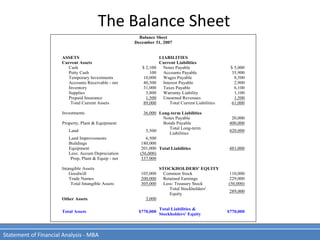
The Balance Sheet “What is it?”
 The balance sheet represents a record of a company's assets, liabilities and
equity at a particular point in time. The balance sheet is named by the fact
that a business’s financial structure balances in the following manner:
Assets = Liabilities + Shareholders' Equity
 Assets represent the resources that the business owns or controls at a given
point in time. This includes items such as cash, inventory, machinery and
buildings.
 The other side of the equation represents the total value of the financing the
company has used to acquire those assets. Liabilities represent debt, while
equity represents the total value of money that the owners have contributed
to the business - including retained earnings, which is the profit made in
previous years.
The Balance Sheet
Statement of Financial Analysis - MBA
= +
ASSETS
Cash
Inventory
Land/Bldgs
Equipment
Accts Rcvbl
Securities
LIABILITIES
Accts Payable
Wages Payable
Taxes Payable
Notes Payable
Short term
Long Term
EQUITY
Pref Stock
Common Stk
Retained
Earnings
The Balance Sheet
Statement of Financial Analysis - MBA
Balance Sheet
December 31, 2007
ASSETS LIABILITIES
Current Assets Current Liabilities
Cash $ 2,100 Notes Payable $ 5,000
Petty Cash 100 Accounts Payable 35,900
Temporary Investments 10,000 Wages Payable 8,500
Accounts Receivable - net 40,500 Interest Payable 2,900
Inventory 31,000 Taxes Payable 6,100
Supplies 3,800 Warranty Liability 1,100
Prepaid Insurance 1,500 Unearned Revenues 1,500
Total Current Assets 89,000 Total Current Liabilities 61,000
-
Investments 36,000 Long-term Liabilities
Notes Payable 20,000
Property, Plant & Equipment Bonds Payable 400,000
Land 5,500
Total Long-term
Liabilities
420,000
Land Improvements 6,500
Buildings 180,000
Equipment 201,000 Total Liabilities 481,000
Less: Accum Depreciation (56,000)
Prop, Plant & Equip - net 337,000
-
Intangible Assets STOCKHOLDERS' EQUITY
Goodwill 105,000 Common Stock 110,000
Trade Names 200,000 Retained Earnings 229,000
Total Intangible Assets 305,000 Less: Treasury Stock (50,000)
Total Stockholders'
Equity
289,000
Other Assets 3,000
-
Total Assets $770,000
Total Liabilities &
Stockholders' Equity
$770,000
The Balance Sheet
Statement of Financial Analysis - MBA
“Why do we care?”
 The balance sheet provides investors with a snapshot of a
company's health as of the date provided on the financial
statement.
Generally, if a company assets are large relative to
liabilities, it's in good shape. Conversely, just as you would
be cautious loaning money to a friend who is burdened with
large debts, a company with a large amount of liabilities
relative to assets should be scrutinized more carefully.
The Income Statement
Statement of Financial Analysis - MBA
“What is it?”
 The income statement measures a company's performance over a
specific time frame and presents information about the revenues,
expenses and profit that was generated as a result of the business'
operations for that period.
 Components of the Income Statement include:
Revenue (how much the company earned)
Expenses (how much the company has spent, sort of)
Net Income before and after Tax (the profits of the company)
This statement contains the information you'll most often see
mentioned in the press or in financial reports - figures such as total
revenue, net income, or earnings per share.
The Income Statement
Statement of Financial Analysis - MBA
Sample Income Statement
(in $1,000s)
Q2 Q1
Sales Revenue
Widgets $4,125 $4,330
Repair kits 143 20
Service 1,443 1,102
Total Sales Revenue 5,711 5,452
Sales Costs
Widgets 2,204 2,111
Repair kits 18 4
Service 1,189 947
Total Sales Costs 3,411 3,062
Gross Profit (Loss) 2,300 2,390
Operating Expenses
General & Administrative 292 301
Sales & Marketing 1,389 1,414
Research & Development 214 214
Other Operating Expenses 5 7
Total Operating Expenses 1,900 1,936
Operating Income 400 454
Interest Paid 1 2
Income before Taxes 399 452
Taxes 127 144
Net Income from Operations $272 $308
The Income Statement
Statement of Financial Analysis - MBA
“Why do we care?”
 The income statement answers the question, "How well is
the company's business performing?" Basically, "Is it making
money?"
 Firms with low expenses and high profits relative to
revenues are typically more desirable for investment
because bringing in more dollars directly benefits you as a
shareholder.
The Statement of Cash-flows
Statement of Financial Analysis - MBA
“What is it?”
The statement of cash flows represents a record of a business' cash inflows and
outflows over a period of time. It is the most sensitive of the statements and focuses
on the following cash-related activities:
 Operating Cash Flow: Cash generated from day-to-day business operations.
 Cash from Investing: Cash used for investing in assets, as well as the proceeds
from the sale of other businesses, equipment or long-term assets
 Cash from financing: Cash paid or received from the issuing and borrowing of
funds
The cash flow statement is important because it's very difficult for a business to
manipulate its cash situation. Earnings can be manipulated, but it's tough to “fake”
cash in the bank. For this reason some investors use the cash flow statement as a more
conservative measure of a company's performance.
The Statement of Cash-flows
Statement of Financial Analysis - MBA
Cash Flow Statement
(dollar figures are in thousands) 1997 1996
Net Income $ 1,911 $ 1,374
Non-cash Adjustments:
Depreciation 1,024 783
Other Adjustments to Earnings 43 (16)
Net Cash provided from Operations 2,978 2,141
Proceeds from Issuing New Stock 384 247
Payments to Repurchase Stock (396) (278)
Stock Dividends Paid (10)
Net Cash provided from Financing (22) (31)
Additions to Property, Plant & Equipment (2,478) (1,987)
Net Cash used for Investing (2,478) (1,987)
Change in cash and equivalents during year 478 123
Cash and Equivalents, beginning of year 2,260 2,137
Cash and Equivalents, end of year 2,738 2,260
The Statement of Cash-flows
Statement of Financial Analysis - MBA
“Why do we care?”
The statement of cash flows is very important to investors
because it shows how much actual cash a company has
generated. The income statement includes non-cash
revenues or expenses, which the statement of cash flows
excludes.
One of the most important traits to look for is the firm's
ability to generate cash. Many companies have shown
“profits” on the income statement but struggled later
because of insufficient cash flows.
Analysis of Profitability
Statement of Financial Analysis - MBA
Profitability is a subtle and complex
concept. “Doing well” may be measured by
different standards. Three concepts of
profitability are given by:
Return on assets
Return on common equity
Earnings per common share
Earnings per Share or EPS
Statement of Financial Analysis - MBA
Most income statements include a calculation
of earnings per share or EPS. This calculation
tells you how much money shareholders would
receive for each share of stock they own if the
company distributed all of its net income for
the period.
To calculate EPS, you take the total net income
and divide it by the number of outstanding
shares of the company.
Bringing it all together
Statement of Financial Analysis - MBA
 The three financial statements we have discussed are
all related.
 The changes in assets and liabilities that you see on the
balance sheet are also reflected in the revenues and
expenses that you see on the income statement, which
result in the company’s gains or losses.
 Cash flows provide more information about cash assets
listed on a balance sheet and are related, but not
equivalent, to net income shown on the income
statement. Therefore, no one financial statement tells
the complete story.
Reporting Framework
Statement of Financial Analysis - MBA
 GAAP starts with a conceptual framework of standards that anchor
financial reports to a set of principles (such as materiality- the degree
to which the transaction is big enough to matter) and verifiability (the
degree to which different people agree on how to measure the
transaction).
 The basic goal is to provide users – equity investors, creditors,
regulators and the public - with "relevant, reliable and useful"
information for making good decisions.
 Sitting on top of the “simple” framework is a growing pile of literally
hundreds of accounting standards.
Reporting Framework
Statement of Financial Analysis - MBA
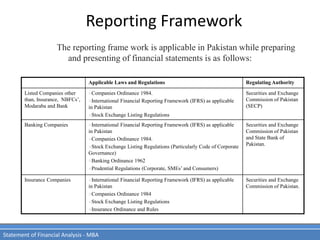
The reporting frame work is applicable in Pakistan while preparing
and presenting of financial statements is as follows:
Applicable Laws and Regulations Regulating Authority
Listed Companies other
than, Insurance, NBFCs’,
Modaraba and Bank
Companies Ordinance 1984.
International Financial Reporting Framework (IFRS) as applicable
in Pakistan
Stock Exchange Listing Regulations
Securities and Exchange
Commission of Pakistan
(SECP)
Banking Companies International Financial Reporting Framework (IFRS) as applicable
in Pakistan
Companies Ordinance 1984.
Stock Exchange Listing Regulations (Particularly Code of Corporate
Governance)
Banking Ordinance 1962
Prudential Regulations (Corporate, SMEs’ and Consumers)
Securities and Exchange
Commission of Pakistan
and State Bank of
Pakistan.
Insurance Companies International Financial Reporting Framework (IFRS) as applicable
in Pakistan
Companies Ordinance 1984
Stock Exchange Listing Regulations
Insurance Ordinance and Rules
Securities and Exchange
Commission of Pakistan.
Reporting Framework
Statement of Financial Analysis - MBA
Applicable Laws and Regulations Regulating
Authority
Non Banking Finance
Companies (Leasing
Companies, Investment
Companies,
International Financial Reporting Framework (IFRS).
Companies Ordinance 1984.
Stock Exchange Listing Regulations (Particularly Code
of Corporate Governance)
NBFC Rules.
Prudential Regulations for NBFCs’
Prudential Regulations for Leasing Company
Securities and
Exchange
Commission of
Pakistan.
Modarba International Financial Reporting Framework (IFRS).
Companies Ordinance 1984.
Stock Exchange Listing Regulations (Particularly Code
of Corporate Governance)
Modarba Act and Rules
Securities and
Exchange
Commission of
Pakistan and
Registrar of Modarba
User of Financial Statements
Statement of Financial Analysis - MBA
User of the financial statements Interest of the user
Equity investors (existing and potential) They are interested whether buy, hold or sell the shares in hand
and also enable them in payment of dividends.
Loan creditors ie, existing and potential
holders of debentures and loan stock, and
providers of short-term loans
The amount will be paid when due and for continuation of the
business.
Employees (existing, potential and past) Interested in stability and profitability for employment
opportunities, remuneration and retirement benefits.
Business contacts including customers,
trade creditors, competitors and potential
take-over bidders
Whether the payment of loan will be made in due dates and
enable sustainability of business for future business with the
enterprise.
Government, including tax authorities,
government departments and local
authorities
Interested in allocation of resources and also to regulate the
activities of an enterprise and determining tax policies and as a
basis for national income.
Public, including tax payers, ratepayers and
environmental groups
Trends and recent development in the prosperity of the entity
and range of it’s activities.

Financial analysis

  • 1.
    Statement of FinancialAnalysis Statement of Financial Analysis - MBA Course Outline  Financial Statements: An Overview  The Balance Sheet  Income Statement  Statement of Stockholders Equity  Statement of Cashflows  Guide to Earnings and Financial Reporting Quality  Analysis of Financial Statements  Valuations  Case Studies
  • 2.
    Statement of FinancialAnalysis Statement of Financial Analysis - MBA Break-up of Financial Statements  Management Discussion & Analysis  Auditor’s Report  Balance Sheet  Income Statement  Statement of Cashflows  Statement of Shareholder’s Equity  Notes to the Financial Statements
  • 3.
    Statement of FinancialAnalysis Statement of Financial Analysis - MBA The Balance Sheet “What is it?”  The balance sheet represents a record of a company's assets, liabilities and equity at a particular point in time. The balance sheet is named by the fact that a business’s financial structure balances in the following manner: Assets = Liabilities + Shareholders' Equity  Assets represent the resources that the business owns or controls at a given point in time. This includes items such as cash, inventory, machinery and buildings.  The other side of the equation represents the total value of the financing the company has used to acquire those assets. Liabilities represent debt, while equity represents the total value of money that the owners have contributed to the business - including retained earnings, which is the profit made in previous years.
  • 4.
    The Balance Sheet Statementof Financial Analysis - MBA = + ASSETS Cash Inventory Land/Bldgs Equipment Accts Rcvbl Securities LIABILITIES Accts Payable Wages Payable Taxes Payable Notes Payable Short term Long Term EQUITY Pref Stock Common Stk Retained Earnings
  • 5.
    The Balance Sheet Statementof Financial Analysis - MBA Balance Sheet December 31, 2007 ASSETS LIABILITIES Current Assets Current Liabilities Cash $ 2,100 Notes Payable $ 5,000 Petty Cash 100 Accounts Payable 35,900 Temporary Investments 10,000 Wages Payable 8,500 Accounts Receivable - net 40,500 Interest Payable 2,900 Inventory 31,000 Taxes Payable 6,100 Supplies 3,800 Warranty Liability 1,100 Prepaid Insurance 1,500 Unearned Revenues 1,500 Total Current Assets 89,000 Total Current Liabilities 61,000 - Investments 36,000 Long-term Liabilities Notes Payable 20,000 Property, Plant & Equipment Bonds Payable 400,000 Land 5,500 Total Long-term Liabilities 420,000 Land Improvements 6,500 Buildings 180,000 Equipment 201,000 Total Liabilities 481,000 Less: Accum Depreciation (56,000) Prop, Plant & Equip - net 337,000 - Intangible Assets STOCKHOLDERS' EQUITY Goodwill 105,000 Common Stock 110,000 Trade Names 200,000 Retained Earnings 229,000 Total Intangible Assets 305,000 Less: Treasury Stock (50,000) Total Stockholders' Equity 289,000 Other Assets 3,000 - Total Assets $770,000 Total Liabilities & Stockholders' Equity $770,000
  • 6.
    The Balance Sheet Statementof Financial Analysis - MBA “Why do we care?”  The balance sheet provides investors with a snapshot of a company's health as of the date provided on the financial statement. Generally, if a company assets are large relative to liabilities, it's in good shape. Conversely, just as you would be cautious loaning money to a friend who is burdened with large debts, a company with a large amount of liabilities relative to assets should be scrutinized more carefully.
  • 7.
    The Income Statement Statementof Financial Analysis - MBA “What is it?”  The income statement measures a company's performance over a specific time frame and presents information about the revenues, expenses and profit that was generated as a result of the business' operations for that period.  Components of the Income Statement include: Revenue (how much the company earned) Expenses (how much the company has spent, sort of) Net Income before and after Tax (the profits of the company) This statement contains the information you'll most often see mentioned in the press or in financial reports - figures such as total revenue, net income, or earnings per share.
  • 8.
    The Income Statement Statementof Financial Analysis - MBA Sample Income Statement (in $1,000s) Q2 Q1 Sales Revenue Widgets $4,125 $4,330 Repair kits 143 20 Service 1,443 1,102 Total Sales Revenue 5,711 5,452 Sales Costs Widgets 2,204 2,111 Repair kits 18 4 Service 1,189 947 Total Sales Costs 3,411 3,062 Gross Profit (Loss) 2,300 2,390 Operating Expenses General & Administrative 292 301 Sales & Marketing 1,389 1,414 Research & Development 214 214 Other Operating Expenses 5 7 Total Operating Expenses 1,900 1,936 Operating Income 400 454 Interest Paid 1 2 Income before Taxes 399 452 Taxes 127 144 Net Income from Operations $272 $308
  • 9.
    The Income Statement Statementof Financial Analysis - MBA “Why do we care?”  The income statement answers the question, "How well is the company's business performing?" Basically, "Is it making money?"  Firms with low expenses and high profits relative to revenues are typically more desirable for investment because bringing in more dollars directly benefits you as a shareholder.
  • 10.
    The Statement ofCash-flows Statement of Financial Analysis - MBA “What is it?” The statement of cash flows represents a record of a business' cash inflows and outflows over a period of time. It is the most sensitive of the statements and focuses on the following cash-related activities:  Operating Cash Flow: Cash generated from day-to-day business operations.  Cash from Investing: Cash used for investing in assets, as well as the proceeds from the sale of other businesses, equipment or long-term assets  Cash from financing: Cash paid or received from the issuing and borrowing of funds The cash flow statement is important because it's very difficult for a business to manipulate its cash situation. Earnings can be manipulated, but it's tough to “fake” cash in the bank. For this reason some investors use the cash flow statement as a more conservative measure of a company's performance.
  • 11.
    The Statement ofCash-flows Statement of Financial Analysis - MBA Cash Flow Statement (dollar figures are in thousands) 1997 1996 Net Income $ 1,911 $ 1,374 Non-cash Adjustments: Depreciation 1,024 783 Other Adjustments to Earnings 43 (16) Net Cash provided from Operations 2,978 2,141 Proceeds from Issuing New Stock 384 247 Payments to Repurchase Stock (396) (278) Stock Dividends Paid (10) Net Cash provided from Financing (22) (31) Additions to Property, Plant & Equipment (2,478) (1,987) Net Cash used for Investing (2,478) (1,987) Change in cash and equivalents during year 478 123 Cash and Equivalents, beginning of year 2,260 2,137 Cash and Equivalents, end of year 2,738 2,260
  • 12.
    The Statement ofCash-flows Statement of Financial Analysis - MBA “Why do we care?” The statement of cash flows is very important to investors because it shows how much actual cash a company has generated. The income statement includes non-cash revenues or expenses, which the statement of cash flows excludes. One of the most important traits to look for is the firm's ability to generate cash. Many companies have shown “profits” on the income statement but struggled later because of insufficient cash flows.
  • 13.
    Analysis of Profitability Statementof Financial Analysis - MBA Profitability is a subtle and complex concept. “Doing well” may be measured by different standards. Three concepts of profitability are given by: Return on assets Return on common equity Earnings per common share
  • 14.
    Earnings per Shareor EPS Statement of Financial Analysis - MBA Most income statements include a calculation of earnings per share or EPS. This calculation tells you how much money shareholders would receive for each share of stock they own if the company distributed all of its net income for the period. To calculate EPS, you take the total net income and divide it by the number of outstanding shares of the company.
  • 15.
    Bringing it alltogether Statement of Financial Analysis - MBA  The three financial statements we have discussed are all related.  The changes in assets and liabilities that you see on the balance sheet are also reflected in the revenues and expenses that you see on the income statement, which result in the company’s gains or losses.  Cash flows provide more information about cash assets listed on a balance sheet and are related, but not equivalent, to net income shown on the income statement. Therefore, no one financial statement tells the complete story.
  • 16.
    Reporting Framework Statement ofFinancial Analysis - MBA  GAAP starts with a conceptual framework of standards that anchor financial reports to a set of principles (such as materiality- the degree to which the transaction is big enough to matter) and verifiability (the degree to which different people agree on how to measure the transaction).  The basic goal is to provide users – equity investors, creditors, regulators and the public - with "relevant, reliable and useful" information for making good decisions.  Sitting on top of the “simple” framework is a growing pile of literally hundreds of accounting standards.
  • 17.
    Reporting Framework Statement ofFinancial Analysis - MBA The reporting frame work is applicable in Pakistan while preparing and presenting of financial statements is as follows: Applicable Laws and Regulations Regulating Authority Listed Companies other than, Insurance, NBFCs’, Modaraba and Bank Companies Ordinance 1984. International Financial Reporting Framework (IFRS) as applicable in Pakistan Stock Exchange Listing Regulations Securities and Exchange Commission of Pakistan (SECP) Banking Companies International Financial Reporting Framework (IFRS) as applicable in Pakistan Companies Ordinance 1984. Stock Exchange Listing Regulations (Particularly Code of Corporate Governance) Banking Ordinance 1962 Prudential Regulations (Corporate, SMEs’ and Consumers) Securities and Exchange Commission of Pakistan and State Bank of Pakistan. Insurance Companies International Financial Reporting Framework (IFRS) as applicable in Pakistan Companies Ordinance 1984 Stock Exchange Listing Regulations Insurance Ordinance and Rules Securities and Exchange Commission of Pakistan.
  • 18.
    Reporting Framework Statement ofFinancial Analysis - MBA Applicable Laws and Regulations Regulating Authority Non Banking Finance Companies (Leasing Companies, Investment Companies, International Financial Reporting Framework (IFRS). Companies Ordinance 1984. Stock Exchange Listing Regulations (Particularly Code of Corporate Governance) NBFC Rules. Prudential Regulations for NBFCs’ Prudential Regulations for Leasing Company Securities and Exchange Commission of Pakistan. Modarba International Financial Reporting Framework (IFRS). Companies Ordinance 1984. Stock Exchange Listing Regulations (Particularly Code of Corporate Governance) Modarba Act and Rules Securities and Exchange Commission of Pakistan and Registrar of Modarba
  • 19.
    User of FinancialStatements Statement of Financial Analysis - MBA User of the financial statements Interest of the user Equity investors (existing and potential) They are interested whether buy, hold or sell the shares in hand and also enable them in payment of dividends. Loan creditors ie, existing and potential holders of debentures and loan stock, and providers of short-term loans The amount will be paid when due and for continuation of the business. Employees (existing, potential and past) Interested in stability and profitability for employment opportunities, remuneration and retirement benefits. Business contacts including customers, trade creditors, competitors and potential take-over bidders Whether the payment of loan will be made in due dates and enable sustainability of business for future business with the enterprise. Government, including tax authorities, government departments and local authorities Interested in allocation of resources and also to regulate the activities of an enterprise and determining tax policies and as a basis for national income. Public, including tax payers, ratepayers and environmental groups Trends and recent development in the prosperity of the entity and range of it’s activities.