Sean Saari, CPA/ABV, CVA, MBA
Dan Golish, CPA/ABV, CVA, CFF
January 17, 2019
Business Valuation Basics
2
Learning Objectives
After completing the session,
participants will be able to…
• Understand the basic concepts that need
to be addressed in scoping a valuation
engagement
• Recognize the methods typically utilized
to value a business or ownership interest
and understand their basic application
• Identify normalizing adjustments and
assess their impact on value
• Reconcile values derived from multiple
valuation approaches
“In the long run, men hit only what they aim at.” – Henry David Thoreau
3
Agenda
• Valuation Basics
• Case Study / Valuation Analysis
Valuation Approaches
‒ Asset Approach
‒ Income Approach
‒ Market Approach
‒ Rules of Thumb
Control and Marketability Considerations
4
Quote of the Day
“There is no such thing as an absolute
value in this world. You can only estimate
what a thing is worth to you.”
Charles Dudley Warner 1829-1900, American Writer
5
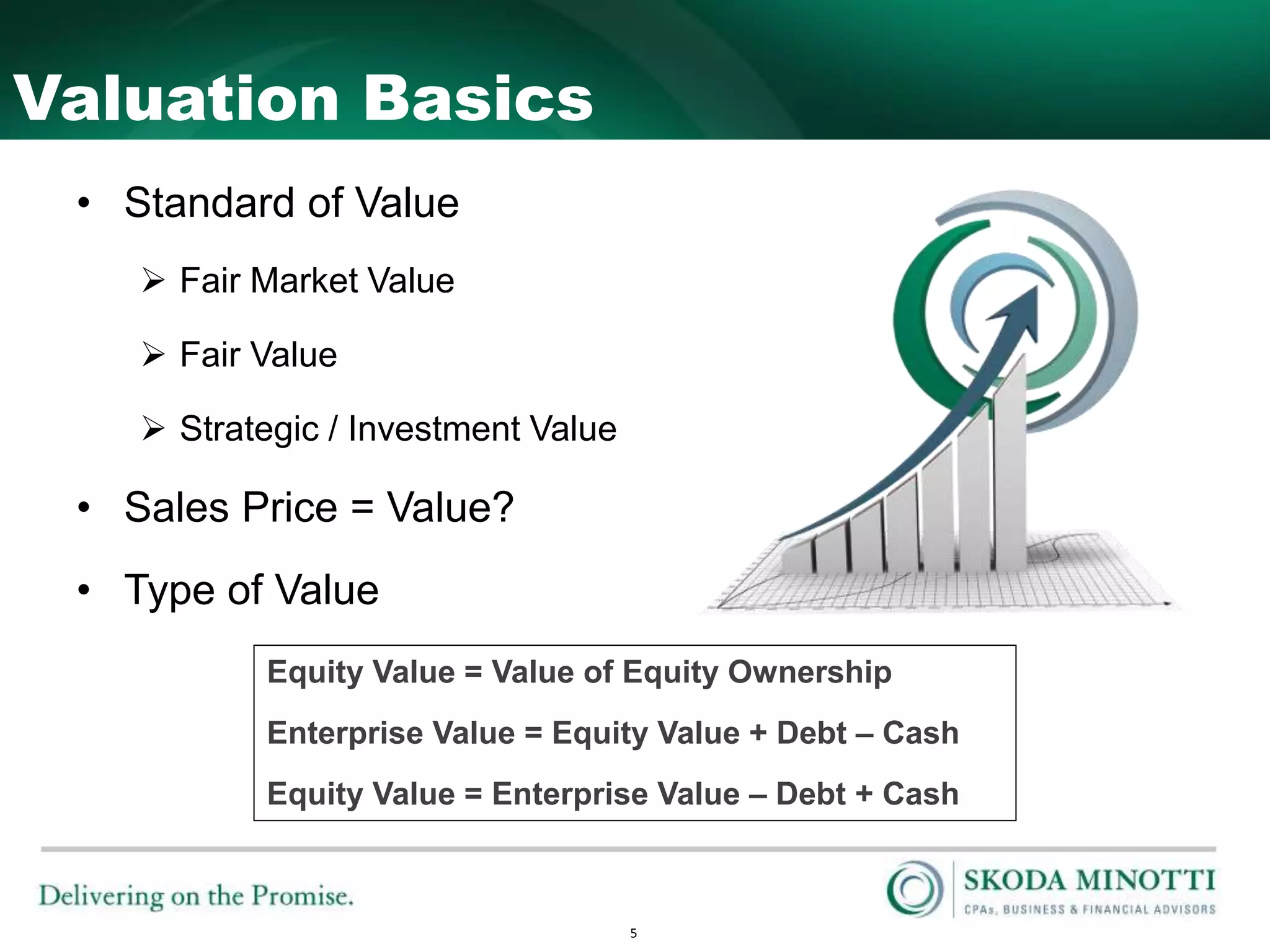
Valuation Basics
• Standard of Value
 Fair Market Value
 Fair Value
 Strategic / Investment Value
• Sales Price = Value?
• Type of Value
Equity Value = Value of Equity Ownership
Enterprise Value = Equity Value + Debt – Cash
Equity Value = Enterprise Value – Debt + Cash
6
Valuation Basics
Cash
Enterprise
Value
Debt
Value
Equity
Value
Market
Value of
Invested
Capital
Reconciling Equity Value to Enterprise Value
7
Valuation Basics
Furnishings
House
Value
Debt
Value
Equity
Value
Total Value
of Home
and
Furnishings
How the Value of Your Home is an
Enterprise Value
8
Valuation Basics
• Valuation Date
 Valuation standards generally
indicate that only information that
was “known or knowable” as of the
valuation date can be considered
 Values can change materially based
on the valuation date used
• Purpose of Engagement
 Important to identify at outset, as the
purpose of an engagement often
drives the standard of value,
valuation date, etc.
9
Valuation Approaches
• Asset Approach
• Income Approach
• Market Approach
• Rules of Thumb
10
Asset Approach
Valuation Methodologies
• Adjusted net asset method
Basic Steps
• Adjust assets to fair market value
• Adjust liabilities to fair market value
Pros
• Provides “floor value” of the company
• Relatively simple analysis
Cons
• Often not indicative of value for healthy businesses
• May be necessary to obtain fixed asset and real
estate appraisals
11
Income Approach
Valuation Methodologies
• Discounted cash flow method
• Capitalization of cash flow method
• Capitalization of earnings / Discounted future earnings
Basic Steps
• Determine benefit stream and make normalizing
adjustments as appropriate
• Determine cash flow adjustments
• Determine discount/capitalization rate
• Discount / capitalize cash flows
Pros
• Provides most “company-specific” value
• Can appropriately incorporate projected growth of the business
Cons
• Most involved of the valuation analyses
• May be disagreements over likelihood of meeting projections
12
Normalizing Adjustments
• FMV vs. strategic normalizing adjustments
• Compensation
 Family members paid other than FMV
 Officers paid other than FMV
• Personal expenses
• Related party transactions other than FMV
• Non-operating income or expenses
• Non-recurring income or expenses
• Expense trends
13
Market Approach
Valuation Methodologies
• Guideline transaction method
• Guideline public company method
Basic Steps
• Determine benefit stream and make normalizing adjustments as appropriate
• Find comparable transactions/guideline public companies
• Calculate valuation multiples and apply to subject company
• Make adjustments as necessary to arrive at equity value (if necessary)
14
Market Approach
Pros
• Incorporates market conditions and prices
paid in recent relative transactions
• Easy to explain and apply
Cons
• Can be misleading if debt not appropriately
considered
 EBITDA multiples typically result in an
enterprise value, not an equity value
• In certain industries, there may be a lack of
comparable transactions or public companies
15
Rule of Thumb
Valuation Methodologies
• Rule of thumb
Basic Steps
• Identify rule of thumb valuation metrics
• Apply rule of thumb to the subject company
Pros
• Simple application
Cons
• Can result in misleading values
• Often lacks support
• Not permitted to be used as a sole valuation
method by most valuation standards
16
Control Considerations
Control Discounts / Premiums
• Two options
 Model in cash flows
 Discreet discount / premium
How Are Adjustments Supported?
• Mergerstat Control Premium Study
• Closed-end mutual fund data (for
investment holding companies)
17
Marketability Considerations
Marketability Discounts
• Controlling ownership interest
• Non-controlling ownership interest
How are Adjustments Supported?
• Restricted stock studies
• Pre-IPO studies
• FMV opinions study
• Option-based models
• Qualitative analysis (e.g., Mandelbaum factors)
18
Summing It Up
After completing the session,
participants will be able to…
• Understand the basic concepts that need
to be addressed in scoping a valuation
engagement
• Recognize the methods typically utilized to
value a business or ownership interest and
understand their basic application
• Identify normalizing adjustments and
assess their impact on value
• Reconcile values derived from multiple
valuation approaches
19
Closing Quote
“Things only have the value that we
give them.”
Moliere 1622-1673, French Actor/Playwright
20
Questions?
Sean Saari, CPA/ABV, CVA, MBA
Partner
Phone – (440) 449-6800 x7221
Email – ssaari@skodaminotti.com
Dan Golish, CPA/ABV, CVA, CFF
Partner
Phone – (440) 449-6800 x7307
Email – dgolish@skodaminotti.com

Business Valuation Basics

  • 1.
    Sean Saari, CPA/ABV,CVA, MBA Dan Golish, CPA/ABV, CVA, CFF January 17, 2019 Business Valuation Basics
  • 2.
    2 Learning Objectives After completingthe session, participants will be able to… • Understand the basic concepts that need to be addressed in scoping a valuation engagement • Recognize the methods typically utilized to value a business or ownership interest and understand their basic application • Identify normalizing adjustments and assess their impact on value • Reconcile values derived from multiple valuation approaches “In the long run, men hit only what they aim at.” – Henry David Thoreau
  • 3.
    3 Agenda • Valuation Basics •Case Study / Valuation Analysis Valuation Approaches ‒ Asset Approach ‒ Income Approach ‒ Market Approach ‒ Rules of Thumb Control and Marketability Considerations
  • 4.
    4 Quote of theDay “There is no such thing as an absolute value in this world. You can only estimate what a thing is worth to you.” Charles Dudley Warner 1829-1900, American Writer
  • 5.
    5 Valuation Basics • Standardof Value  Fair Market Value  Fair Value  Strategic / Investment Value • Sales Price = Value? • Type of Value Equity Value = Value of Equity Ownership Enterprise Value = Equity Value + Debt – Cash Equity Value = Enterprise Value – Debt + Cash
  • 6.
  • 7.
    7 Valuation Basics Furnishings House Value Debt Value Equity Value Total Value ofHome and Furnishings How the Value of Your Home is an Enterprise Value
  • 8.
    8 Valuation Basics • ValuationDate  Valuation standards generally indicate that only information that was “known or knowable” as of the valuation date can be considered  Values can change materially based on the valuation date used • Purpose of Engagement  Important to identify at outset, as the purpose of an engagement often drives the standard of value, valuation date, etc.
  • 9.
    9 Valuation Approaches • AssetApproach • Income Approach • Market Approach • Rules of Thumb
  • 10.
    10 Asset Approach Valuation Methodologies •Adjusted net asset method Basic Steps • Adjust assets to fair market value • Adjust liabilities to fair market value Pros • Provides “floor value” of the company • Relatively simple analysis Cons • Often not indicative of value for healthy businesses • May be necessary to obtain fixed asset and real estate appraisals
  • 11.
    11 Income Approach Valuation Methodologies •Discounted cash flow method • Capitalization of cash flow method • Capitalization of earnings / Discounted future earnings Basic Steps • Determine benefit stream and make normalizing adjustments as appropriate • Determine cash flow adjustments • Determine discount/capitalization rate • Discount / capitalize cash flows Pros • Provides most “company-specific” value • Can appropriately incorporate projected growth of the business Cons • Most involved of the valuation analyses • May be disagreements over likelihood of meeting projections
  • 12.
    12 Normalizing Adjustments • FMVvs. strategic normalizing adjustments • Compensation  Family members paid other than FMV  Officers paid other than FMV • Personal expenses • Related party transactions other than FMV • Non-operating income or expenses • Non-recurring income or expenses • Expense trends
  • 13.
    13 Market Approach Valuation Methodologies •Guideline transaction method • Guideline public company method Basic Steps • Determine benefit stream and make normalizing adjustments as appropriate • Find comparable transactions/guideline public companies • Calculate valuation multiples and apply to subject company • Make adjustments as necessary to arrive at equity value (if necessary)
  • 14.
    14 Market Approach Pros • Incorporatesmarket conditions and prices paid in recent relative transactions • Easy to explain and apply Cons • Can be misleading if debt not appropriately considered  EBITDA multiples typically result in an enterprise value, not an equity value • In certain industries, there may be a lack of comparable transactions or public companies
  • 15.
    15 Rule of Thumb ValuationMethodologies • Rule of thumb Basic Steps • Identify rule of thumb valuation metrics • Apply rule of thumb to the subject company Pros • Simple application Cons • Can result in misleading values • Often lacks support • Not permitted to be used as a sole valuation method by most valuation standards
  • 16.
    16 Control Considerations Control Discounts/ Premiums • Two options  Model in cash flows  Discreet discount / premium How Are Adjustments Supported? • Mergerstat Control Premium Study • Closed-end mutual fund data (for investment holding companies)
  • 17.
    17 Marketability Considerations Marketability Discounts •Controlling ownership interest • Non-controlling ownership interest How are Adjustments Supported? • Restricted stock studies • Pre-IPO studies • FMV opinions study • Option-based models • Qualitative analysis (e.g., Mandelbaum factors)
  • 18.
    18 Summing It Up Aftercompleting the session, participants will be able to… • Understand the basic concepts that need to be addressed in scoping a valuation engagement • Recognize the methods typically utilized to value a business or ownership interest and understand their basic application • Identify normalizing adjustments and assess their impact on value • Reconcile values derived from multiple valuation approaches
  • 19.
    19 Closing Quote “Things onlyhave the value that we give them.” Moliere 1622-1673, French Actor/Playwright
  • 20.
    20 Questions? Sean Saari, CPA/ABV,CVA, MBA Partner Phone – (440) 449-6800 x7221 Email – ssaari@skodaminotti.com Dan Golish, CPA/ABV, CVA, CFF Partner Phone – (440) 449-6800 x7307 Email – dgolish@skodaminotti.com