Accounting
Standards
         Presented by
          -Nirooj Fidin
            -Priha Jha
       -Amrita Kumari
Importance of AS
O Smooth operations.
O Protect investors
O Promotes transparency
O Assess business performance
Accounting Standard 10
O Deals with accounting of fixed assets so that users
  of the financial statements can discern information
  about a business’s investment in its property, plant
  and equipment and the changes in such investment.
O Does not cover assets held for sale, biological
  assets for agricultural activity, livestock, expenditure
  on real estate development, minerals and non-
  regenerative resources, and govt. grants, subsidies
  and assets under leasing.
Terminology
O Fixed Asset: An asset held with the intention of
  being used for the purpose of producing or
  providing goods or services and is not held for sale
  in the normal course of business.
O Fair Market Value: It is the price agreed between
  knowledgeable and willing parties in an open and
  unrestricted market.
O Gross Book Value: It is the historical cost or the
  amount substitutes for historical cost. It is termed
  net book value, when shown as net of accumulated
  depreciation.
Identification of fixed assets
O Individually insignificant items may be aggregated
  for their value.
O Am item may be expensed even if it could have
  been included as fixed asset.
O Spares are usually credited to P/L statement unless
  only used in connection with the fixed asset.
O To improve accounting, items of fixed assets are
  treated separately, provided they are separable and
  has independent useful life.
Components of cost
O Consist of all the cost attributed to the asset in order
  to bring it to working condition for the intended
  purpose.
O Administration and other general overload expenses
  are excluded.
O All expenses incurred between completion of setting
  up asset and actual usage of asset for production
  are charged to P/L account.
O However, it is also referred sometimes as deferred
  revenue and is to be amortized within 3-5 years
  after commencement
Non-monetary consideration

O When a fixed asset is acquired in exchange of
  another asset, fair value of the asset which is more
  evident is to be considered.
O Similarly, the same is applicable in case of a fixed
  asset acquired in exchange of shares or securities
  of the business.
Improvement and repairs
O Confusion whether repair expenses ought to be
  added to the gross book value or P/L account.
O Only expenses that increases the benefits accrued
  from the asset is included in the gross book value.
O Also, the cost of addition or extension to an
  existing asset, which becomes integral to the
  asset is to be included in the gross book value.
O Any addition, which has a separate identity is to be
  accounted separately.
Amount substituted for
            historical costs
O Some costs of assets are valued in substitution for
    the historical costs.
O   Usually done by appraisal and reference to current
    price.
O   Either restate both gross book value and
    accumulated depreciation.
O   Or restate the net book value by adding the net
    increase.
O   Different methods for different items.
O   Increase is credited to owners’ interest as
    revaluation reserves. Decrease is credited in P/L
    account.
Retirement and Disposal
O Retired items are state at their lower net book value
  and net realizable value and are shown separately.
O Gains or losses incurred on disposal is shown in
  the P/L statement.
O Difference between net disposal proceeds and net
  book value is credited to P/L statement in case of
  loss or transferred to general reserve in case of
  gain.
Special Assets and Cases
 O Goodwill
 O Jointly owned fixed assets
 O Fixed Assets on hire

                Disclosure
O Gross and net book value, including acquisitions,
  disposal and other movements.
O Expenditure incurred in course of construction or
  acquisition.
O Revalued     amounts, method used, whether
  outsourced.
Accounting Standard 20
    Earnings per share
Objective
O To  set principles    for   the   determination   &
 presentation of EPS.

O To improve comparison of performance amongst
 enterprises for the same period and amongst
 different accounting periods for the same
 enterprise.
Applicability
O Enterprises whose equity shares or potential equity
 share are listed on Recognized Stock Exchange.

O Other enterprises which disclose earnings per
 share in financial statements.

O In the case of consolidated financial statements it
 should be determined & presented based on
 consolidated information
Presentation Requirements
            (Disclosures)
An enterprise should present on the face of P&L Account.
  O Basic EPS                w.r.t. equity shares
  O Diluted EPS              w.r.t. potential equity shares

Potential equity share: A financial instrument or contract that
  entitles or may entitle, its holder to equity share e.g.
   O Convertible debentures or preference shares
   O Share warrants or options
   O Shares issuable upon satisfaction of certain conditions
Presentation Requirements
          (Disclosures)

O Disclosure to be made for all periods
 presented.

O Both the amounts to be disclosed with equal
 prominence.

O The information is to be presented even if the
 amount disclosed are negative (a loss per
 share).
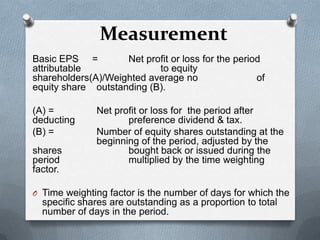
Measurement
Basic EPS =         Net profit or loss for the period
attributable               to equity
shareholders(A)/Weighted average no                 of
equity share outstanding (B).

(A) =         Net profit or loss for the period after
deducting            preference dividend & tax.
(B) =         Number of equity shares outstanding at the
              beginning of the period, adjusted by the
shares               bought back or issued during the
period               multiplied by the time weighting
factor.

O Time weighting factor is the number of days for which the
  specific shares are outstanding as a proportion to total
  number of days in the period.
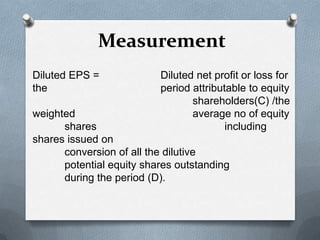
Measurement
Diluted EPS =             Diluted net profit or loss for
the                       period attributable to equity
                                 shareholders(C) /the
weighted                         average no of equity
      shares                             including
shares issued on
      conversion of all the dilutive
      potential equity shares outstanding
      during the period (D).
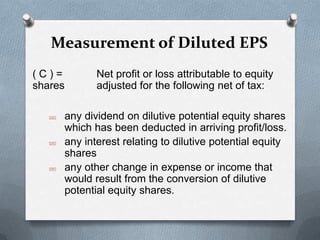
Measurement of Diluted EPS
(C)=        Net profit or loss attributable to equity
shares      adjusted for the following net of tax:

   any dividend on dilutive potential equity shares
    which has been deducted in arriving profit/loss.
   any interest relating to dilutive potential equity
    shares
   any other change in expense or income that
    would result from the conversion of dilutive
    potential equity shares.
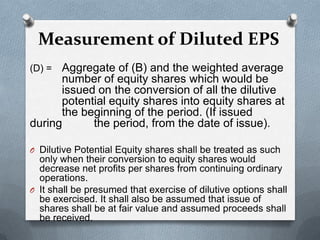
Measurement of Diluted EPS
(D) = Aggregate of (B) and the weighted average
      number of equity shares which would be
      issued on the conversion of all the dilutive
      potential equity shares into equity shares at
      the beginning of the period. (If issued
during      the period, from the date of issue).

O Dilutive Potential Equity shares shall be treated as such
  only when their conversion to equity shares would
  decrease net profits per shares from continuing ordinary
  operations.
O It shall be presumed that exercise of dilutive options shall
  be exercised. It shall also be assumed that issue of
  shares shall be at fair value and assumed proceeds shall
  be received.
ASI 12
Every company, required to give information under
part IV of schedule VI to the Companies Act, 1956 to
calculate and disclose EPS in accordance with AS
20, even if otherwise not applicable to it.
Accounting Standard 26

 (accounting for Intangible Assets)
Introduction
O The Institute of Chartered Accountants of India
  (ICAI) has issued an accounting standard for
  intangible assets which will be mandatory for listed
  companies and for companies planning an initial
  public offer. As per the guideline, companies will
  have to report in their financial statements on
  expenses incurred on research and development,
  intellectual property rights, customer relations and
  brand development activities.
O Called AS 26, the accounting standard came into
  effect from April 1, 2003.
Definition
Definition of Intangible Assets
Intangible assets is:
O Identifiable non monetary assets
O Without physical substance
O Held for use in production or supply of goods or
  services
O Examples: Licenses, Intellectual property rights,
  Brand names, publishing titles, Computer software,
  Patents, copy rights, Motion picture licenses,
  Customers lists, Franchises, Mortgage services
  rights,    Import    quotas,  Customer    supplier
  relationships, Customer loyalty, Market share and
  marketing right
Objective
O The objective of this Statement is to prescribe the
  accounting treatment for intangible assets that are
  not dealt with specifically in another Accounting
  Standard.

O This Statement requires an enterprise to recognize
  an intangible asset if, and only if, certain criteria
  are met.

O The Statement also specifies how to measure the
  carrying amount of intangible assets and requires
  certain disclosures about intangible assets.
Scope
This Statement should be applied by all enterprises
in accounting for intangible assets, except:

- Intangible assets that are covered by another
Accounting Standard

- Financial assets; mineral rights and expenditure
on the exploration for, or development and
extraction of, minerals, oil, natural gas and similar
non-regenerative resources; and intangible assets
arising in insurance enterprises from contracts with
policyholders.
Conditions for Recognition
O Identifiability :            O Control :


 Distinguishable from          Power to obtain future
  goodwill.                      economic benefits.
                                Legal rights over the use of
 Enterprise can rent, sale,     assets.
  exchange or distribute the
  future economic benefits
                               O Future economic benefits
  from assets without
                                 :
  disposing the same
                                Revenue, cost savings or
                                 other benefits
                                flowing from the assets.
Cost of Intangible Assets
O Recognize if, and only if, Probability of flow of future economic
  benefits
   Cost can be reliably measured
O Intangible Assets should be recognized only at cost.

O Separate acquisition : Recognize at cost of acquisition
O Cost of acquisition includes:
 Purchase price (net of any discounts, rebates etc)
 Non recoverable import duties and other taxes
 Direct expenses to make assets ready for intended use

 Internally Generated Intangible Assets :
O Goodwill : Not to be recognized as Intangible Asset as; Not an
  identifiable resource controlled by the entity.
O cost can not be measured reliably.
Internally Generated Intangible Assets
Others
• Internal generation of Intangible Assets classified into two
  phases:
 Research Phase
• Recognize expenditure incurred during Research phase as an
  expense.
 Development Phase
• Recognize Intangible Assets if entity can demonstrate all the
  following conditions:
• Technical feasibility to complete the Intangible Assets so that it
  will be available for use.
• Intention and Availability of adequate technical, financial and
  other resources to complete the assets.
• Ability to use / sell it.
• Demonstration of probable future economic benefits.
• Ability to measure reliably the expenditure attributable to
  Intangible Assets.
 Cost:
 Cost of Internally generated Intangible Assets is calculated
    from the time when the Intangible Assets first meet the
    recognition criteria till the asset becomes ready for use.

 Amortisation : the systematic allocation of the depreciable
    amount of an intangible asset over its useful life.
O   Period :
O   Amortise over the best estimated useful life of the asset.
O   Rebuttable presumption is that useful life can not exceed more
    than 10 years.
O   Persuasive evidence required to justify useful life of more than
    10 years.
O   Straight Line Method is considered as most appropriate.
Disclosure Requirement

O Disclose for each class & separately for internally
  generated and others:
O Useful lives or amortization rate; Amortization
  method;
O Gross carrying amount & accumulated
  amortization.
O Reconciliation of carrying amount showing:
  Additions/ retirement and disposals; Impairment
  losses recognized/ reversed, if any Amortization
  recognized; Other changes in the carrying amount.
  Changes in accounting policy as per AS 5.
contd.
O Where useful life is more than ten years, the
    reasons thereof.
O   Description, carrying amount and remaining period
    for an Intangible Assets of material amount.
O   Details of Intangible Assets that are pledged or
    have other restrictions.
O   Commitments for acquisition of Intangible Assets.
O   Research and Development expenses recognised
    as expenses.
O   The entity is encouraged to give description of fully
    amortized Intangible Assets, still in use.
Thank You
 That’s all folks.

Accounting standards

  • 1.
    Accounting Standards Presented by -Nirooj Fidin -Priha Jha -Amrita Kumari
  • 2.
    Importance of AS OSmooth operations. O Protect investors O Promotes transparency O Assess business performance
  • 3.
    Accounting Standard 10 ODeals with accounting of fixed assets so that users of the financial statements can discern information about a business’s investment in its property, plant and equipment and the changes in such investment. O Does not cover assets held for sale, biological assets for agricultural activity, livestock, expenditure on real estate development, minerals and non- regenerative resources, and govt. grants, subsidies and assets under leasing.
  • 4.
    Terminology O Fixed Asset:An asset held with the intention of being used for the purpose of producing or providing goods or services and is not held for sale in the normal course of business. O Fair Market Value: It is the price agreed between knowledgeable and willing parties in an open and unrestricted market. O Gross Book Value: It is the historical cost or the amount substitutes for historical cost. It is termed net book value, when shown as net of accumulated depreciation.
  • 5.
    Identification of fixedassets O Individually insignificant items may be aggregated for their value. O Am item may be expensed even if it could have been included as fixed asset. O Spares are usually credited to P/L statement unless only used in connection with the fixed asset. O To improve accounting, items of fixed assets are treated separately, provided they are separable and has independent useful life.
  • 6.
    Components of cost OConsist of all the cost attributed to the asset in order to bring it to working condition for the intended purpose. O Administration and other general overload expenses are excluded. O All expenses incurred between completion of setting up asset and actual usage of asset for production are charged to P/L account. O However, it is also referred sometimes as deferred revenue and is to be amortized within 3-5 years after commencement
  • 7.
    Non-monetary consideration O Whena fixed asset is acquired in exchange of another asset, fair value of the asset which is more evident is to be considered. O Similarly, the same is applicable in case of a fixed asset acquired in exchange of shares or securities of the business.
  • 8.
    Improvement and repairs OConfusion whether repair expenses ought to be added to the gross book value or P/L account. O Only expenses that increases the benefits accrued from the asset is included in the gross book value. O Also, the cost of addition or extension to an existing asset, which becomes integral to the asset is to be included in the gross book value. O Any addition, which has a separate identity is to be accounted separately.
  • 9.
    Amount substituted for historical costs O Some costs of assets are valued in substitution for the historical costs. O Usually done by appraisal and reference to current price. O Either restate both gross book value and accumulated depreciation. O Or restate the net book value by adding the net increase. O Different methods for different items. O Increase is credited to owners’ interest as revaluation reserves. Decrease is credited in P/L account.
  • 10.
    Retirement and Disposal ORetired items are state at their lower net book value and net realizable value and are shown separately. O Gains or losses incurred on disposal is shown in the P/L statement. O Difference between net disposal proceeds and net book value is credited to P/L statement in case of loss or transferred to general reserve in case of gain.
  • 11.
    Special Assets andCases O Goodwill O Jointly owned fixed assets O Fixed Assets on hire Disclosure O Gross and net book value, including acquisitions, disposal and other movements. O Expenditure incurred in course of construction or acquisition. O Revalued amounts, method used, whether outsourced.
  • 12.
    Accounting Standard 20 Earnings per share
  • 13.
    Objective O To set principles for the determination & presentation of EPS. O To improve comparison of performance amongst enterprises for the same period and amongst different accounting periods for the same enterprise.
  • 14.
    Applicability O Enterprises whoseequity shares or potential equity share are listed on Recognized Stock Exchange. O Other enterprises which disclose earnings per share in financial statements. O In the case of consolidated financial statements it should be determined & presented based on consolidated information
  • 15.
    Presentation Requirements (Disclosures) An enterprise should present on the face of P&L Account. O Basic EPS w.r.t. equity shares O Diluted EPS w.r.t. potential equity shares Potential equity share: A financial instrument or contract that entitles or may entitle, its holder to equity share e.g. O Convertible debentures or preference shares O Share warrants or options O Shares issuable upon satisfaction of certain conditions
  • 16.
    Presentation Requirements (Disclosures) O Disclosure to be made for all periods presented. O Both the amounts to be disclosed with equal prominence. O The information is to be presented even if the amount disclosed are negative (a loss per share).
  • 17.
    Measurement Basic EPS = Net profit or loss for the period attributable to equity shareholders(A)/Weighted average no of equity share outstanding (B). (A) = Net profit or loss for the period after deducting preference dividend & tax. (B) = Number of equity shares outstanding at the beginning of the period, adjusted by the shares bought back or issued during the period multiplied by the time weighting factor. O Time weighting factor is the number of days for which the specific shares are outstanding as a proportion to total number of days in the period.
  • 18.
    Measurement Diluted EPS = Diluted net profit or loss for the period attributable to equity shareholders(C) /the weighted average no of equity shares including shares issued on conversion of all the dilutive potential equity shares outstanding during the period (D).
  • 19.
    Measurement of DilutedEPS (C)= Net profit or loss attributable to equity shares adjusted for the following net of tax:  any dividend on dilutive potential equity shares which has been deducted in arriving profit/loss.  any interest relating to dilutive potential equity shares  any other change in expense or income that would result from the conversion of dilutive potential equity shares.
  • 20.
    Measurement of DilutedEPS (D) = Aggregate of (B) and the weighted average number of equity shares which would be issued on the conversion of all the dilutive potential equity shares into equity shares at the beginning of the period. (If issued during the period, from the date of issue). O Dilutive Potential Equity shares shall be treated as such only when their conversion to equity shares would decrease net profits per shares from continuing ordinary operations. O It shall be presumed that exercise of dilutive options shall be exercised. It shall also be assumed that issue of shares shall be at fair value and assumed proceeds shall be received.
  • 21.
    ASI 12 Every company,required to give information under part IV of schedule VI to the Companies Act, 1956 to calculate and disclose EPS in accordance with AS 20, even if otherwise not applicable to it.
  • 22.
    Accounting Standard 26 (accounting for Intangible Assets)
  • 23.
    Introduction O The Instituteof Chartered Accountants of India (ICAI) has issued an accounting standard for intangible assets which will be mandatory for listed companies and for companies planning an initial public offer. As per the guideline, companies will have to report in their financial statements on expenses incurred on research and development, intellectual property rights, customer relations and brand development activities. O Called AS 26, the accounting standard came into effect from April 1, 2003.
  • 24.
    Definition Definition of IntangibleAssets Intangible assets is: O Identifiable non monetary assets O Without physical substance O Held for use in production or supply of goods or services O Examples: Licenses, Intellectual property rights, Brand names, publishing titles, Computer software, Patents, copy rights, Motion picture licenses, Customers lists, Franchises, Mortgage services rights, Import quotas, Customer supplier relationships, Customer loyalty, Market share and marketing right
  • 25.
    Objective O The objectiveof this Statement is to prescribe the accounting treatment for intangible assets that are not dealt with specifically in another Accounting Standard. O This Statement requires an enterprise to recognize an intangible asset if, and only if, certain criteria are met. O The Statement also specifies how to measure the carrying amount of intangible assets and requires certain disclosures about intangible assets.
  • 26.
    Scope This Statement shouldbe applied by all enterprises in accounting for intangible assets, except: - Intangible assets that are covered by another Accounting Standard - Financial assets; mineral rights and expenditure on the exploration for, or development and extraction of, minerals, oil, natural gas and similar non-regenerative resources; and intangible assets arising in insurance enterprises from contracts with policyholders.
  • 27.
    Conditions for Recognition OIdentifiability : O Control :  Distinguishable from  Power to obtain future goodwill. economic benefits.  Legal rights over the use of  Enterprise can rent, sale, assets. exchange or distribute the future economic benefits O Future economic benefits from assets without : disposing the same  Revenue, cost savings or other benefits  flowing from the assets.
  • 28.
    Cost of IntangibleAssets O Recognize if, and only if, Probability of flow of future economic benefits Cost can be reliably measured O Intangible Assets should be recognized only at cost. O Separate acquisition : Recognize at cost of acquisition O Cost of acquisition includes:  Purchase price (net of any discounts, rebates etc)  Non recoverable import duties and other taxes  Direct expenses to make assets ready for intended use  Internally Generated Intangible Assets : O Goodwill : Not to be recognized as Intangible Asset as; Not an identifiable resource controlled by the entity. O cost can not be measured reliably.
  • 29.
    Internally Generated IntangibleAssets Others • Internal generation of Intangible Assets classified into two phases: Research Phase • Recognize expenditure incurred during Research phase as an expense. Development Phase • Recognize Intangible Assets if entity can demonstrate all the following conditions: • Technical feasibility to complete the Intangible Assets so that it will be available for use. • Intention and Availability of adequate technical, financial and other resources to complete the assets. • Ability to use / sell it. • Demonstration of probable future economic benefits. • Ability to measure reliably the expenditure attributable to Intangible Assets.
  • 30.
     Cost:  Costof Internally generated Intangible Assets is calculated from the time when the Intangible Assets first meet the recognition criteria till the asset becomes ready for use.  Amortisation : the systematic allocation of the depreciable amount of an intangible asset over its useful life. O Period : O Amortise over the best estimated useful life of the asset. O Rebuttable presumption is that useful life can not exceed more than 10 years. O Persuasive evidence required to justify useful life of more than 10 years. O Straight Line Method is considered as most appropriate.
  • 31.
    Disclosure Requirement O Disclosefor each class & separately for internally generated and others: O Useful lives or amortization rate; Amortization method; O Gross carrying amount & accumulated amortization. O Reconciliation of carrying amount showing: Additions/ retirement and disposals; Impairment losses recognized/ reversed, if any Amortization recognized; Other changes in the carrying amount. Changes in accounting policy as per AS 5.
  • 32.
    contd. O Where usefullife is more than ten years, the reasons thereof. O Description, carrying amount and remaining period for an Intangible Assets of material amount. O Details of Intangible Assets that are pledged or have other restrictions. O Commitments for acquisition of Intangible Assets. O Research and Development expenses recognised as expenses. O The entity is encouraged to give description of fully amortized Intangible Assets, still in use.
  • 33.