Non-Qualified Deferred
Compensation Programs for
Private Companies
Ted Ginsburg, Principal, Skoda Minotti
Terry Bork, Aurum Insurance Services
August 15, 2019
2
Today’s Topics
• Why should employers use long-
term incentive compensation
programs (LTIP)?
• What types of LTIPs are commonly
used by privately held companies?
• How do LTIPs operate?
• How does an employer pay for
an LTIP?
3
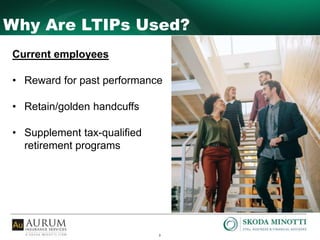
Why Are LTIPs Used?
Current employees
• Reward for past performance
• Retain/golden handcuffs
• Supplement tax-qualified
retirement programs
4
Why Are LTIPs Used?
Attract New Employees
• Both new and current—
 Focus on long-term results
 Motivate
• Employer—cash flow
5
How Do LTIPs Operate?
Form: A written agreement between employer and employee
setting out
• What must be accomplished to earn the award
• Defining the award—form and amount
• Terms for payment
Administration: legal formalities; employee communication
• Financial statement/tax consequences depend on the form
of the award
6
Award Forms Used By
Privately Held Companies
• Equity-related
 Actual shares
(outright/restricted)
 Stock options/incentive
stock options
 Phantom shares/stock
appreciation rights
• Fixed/variable dollar payments
7
How Do LTIPs Operate?
Design issues:
• Who participates?
• What must occur for the award to be paid?
• Form of the award
• How much should be awarded to each participant and to
the participants as a group?
• Employee choice and Internal Revenue Code Section
409A
8
Benefit Security
• “Top Hat Plans” for select group of
highly-compensated key executives
• Nonqualified benefits are
contractual obligations of the
employer
• Plan Participants are unsecured
creditors
9
Benefit Security
Unlike qualified plan benefits,
nonqualified plan benefits are
subject to risks arising from:
• Change of Heart
• Change in Control
• Change in Financial Condition
• Insolvency/Bankruptcy
10
Why Secure
Nonqualified Benefits?
• As discussed, the primary
purpose of plan is to attract,
retain, reward and motivate
key employees
• Benefit may be a significant
element in participant’s
retirement resources
• Secure benefits increase the
value of the promise.
11
Why Companies Choose
Not to Secure Benefits
• Corporate philosophy
• Many are rethinking
securitization because of:
 Stock Market Performance
 Business Cycle Risks
 Growing nature of the liability
 Cash flow management
12
Informal Funding
• Plan is technically “unfunded”
 54% of companies surveyed informally funded the plan*
• Employer sets up sinking fund to match future
benefit liability (Asset/Liability Matching)
• Asset subject to claims of creditor
• Asset held by the employer or a trust
* From responding employers of the Newport Corp 2-17 benefit survey
13
Trust Held Assets
• Irrevocable Grantor Trust
(Rabbi Trust)
• Assets may only be used
to pay benefits
• Assets remain subject to
claims of creditors
• Assets and income reflected on
balance sheet and income statement
14
Trust Held Assets
• No deduction for contribution
• Unused assets revert back to
employer
• Use is prevalent and
consistent with section 409A
15
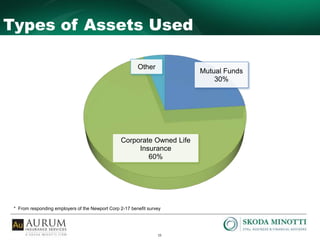
Types of Assets Used
Mutual Funds
30%
Corporate Owned Life
Insurance
60%
Other
* From responding employers of the Newport Corp 2-17 benefit survey
16
Mutual Funds:
The Tax Problem
• Capital Gains created when employer sells share to:
 Generate fund for benefit payments
 Fund transfer for asset allocation purposes
• Pass-through income distributed by fund
 Dividends
 Interest Income
 Capital Gains
• Employer has no control on timing
• Taxation can occur when fund has negative returns
17
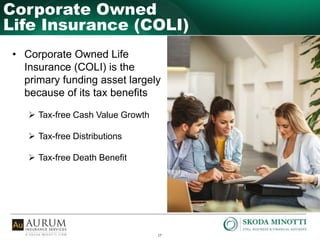
Corporate Owned
Life Insurance (COLI)
• Corporate Owned Life
Insurance (COLI) is the
primary funding asset largely
because of its tax benefits
 Tax-free Cash Value Growth
 Tax-free Distributions
 Tax-free Death Benefit
18
COLI- Pricing & Design
• Retail products
 Available to broad segment of the market
 Low face amount/premium requirements
 Relatively higher policy expenses
• Institutional products
 Not generally available to individual purchasers
 High minimum face amount/premium/case size
 Reduced expenses reflecting favorable mortality experience and
economy of scale
• Defined contribution funding
• Minimum death benefit design
19
COLI Implementation
• Insure some or all participants
• Premium determined by funding objectives
• Employer/Trust is owner & beneficiary
• Individuals must consent to be insured
• Guaranteed and simplified issue underwriting may
be available
20
COLI Advantages
• Institutional pricing and design minimize expenses and
maximize policy cash value
 Cash value may equal or exceed premium in first year
 Expenses generally less than taxes in mutual fund alternative
• Death benefit is a cost recovery mechanism
• Flexible options to determine cash value growth
 Fixed
 Variable
 Equity Indexing
21
COLI Disadvantages
• Investment losses are
not deductible
• Legislation risk that
favorable tax treatment
could be modified
• Participant may need
to qualify medically
22
Summary
• Informal funding can increase the value of the promise as
well as help:
 Manage the expense liability
 Provide better overall cost management
 Provide source of funds for future benefit payments
• COLI may be a better funding asset:
 Expenses in the contract are less than taxes on taxable mutual
fund alternative
 Death benefit provides cost recovery mechanism to reduce plan
costs
23
The Design Process
• Determine what the employer
expects the participants to do to
earn the reward
• Analyze reward choices from
employer and employee viewpoint
• Model award amounts in total and
per employee for financial
statement/tax/cash flow impact
• Determine funding methodology
24
Contact
Terry Bork CLU, ChFC
Aurum Insurance Services LLC
tbork@auruminsurance.com
Ted Ginsburg, CPA, JD
Skoda Minotti
tginsburg@skodaminotti.com

Non-Qualified Deferred Compensation Programs for Private Companies

  • 1.
    Non-Qualified Deferred Compensation Programsfor Private Companies Ted Ginsburg, Principal, Skoda Minotti Terry Bork, Aurum Insurance Services August 15, 2019
  • 2.
    2 Today’s Topics • Whyshould employers use long- term incentive compensation programs (LTIP)? • What types of LTIPs are commonly used by privately held companies? • How do LTIPs operate? • How does an employer pay for an LTIP?
  • 3.
    3 Why Are LTIPsUsed? Current employees • Reward for past performance • Retain/golden handcuffs • Supplement tax-qualified retirement programs
  • 4.
    4 Why Are LTIPsUsed? Attract New Employees • Both new and current—  Focus on long-term results  Motivate • Employer—cash flow
  • 5.
    5 How Do LTIPsOperate? Form: A written agreement between employer and employee setting out • What must be accomplished to earn the award • Defining the award—form and amount • Terms for payment Administration: legal formalities; employee communication • Financial statement/tax consequences depend on the form of the award
  • 6.
    6 Award Forms UsedBy Privately Held Companies • Equity-related  Actual shares (outright/restricted)  Stock options/incentive stock options  Phantom shares/stock appreciation rights • Fixed/variable dollar payments
  • 7.
    7 How Do LTIPsOperate? Design issues: • Who participates? • What must occur for the award to be paid? • Form of the award • How much should be awarded to each participant and to the participants as a group? • Employee choice and Internal Revenue Code Section 409A
  • 8.
    8 Benefit Security • “TopHat Plans” for select group of highly-compensated key executives • Nonqualified benefits are contractual obligations of the employer • Plan Participants are unsecured creditors
  • 9.
    9 Benefit Security Unlike qualifiedplan benefits, nonqualified plan benefits are subject to risks arising from: • Change of Heart • Change in Control • Change in Financial Condition • Insolvency/Bankruptcy
  • 10.
    10 Why Secure Nonqualified Benefits? •As discussed, the primary purpose of plan is to attract, retain, reward and motivate key employees • Benefit may be a significant element in participant’s retirement resources • Secure benefits increase the value of the promise.
  • 11.
    11 Why Companies Choose Notto Secure Benefits • Corporate philosophy • Many are rethinking securitization because of:  Stock Market Performance  Business Cycle Risks  Growing nature of the liability  Cash flow management
  • 12.
    12 Informal Funding • Planis technically “unfunded”  54% of companies surveyed informally funded the plan* • Employer sets up sinking fund to match future benefit liability (Asset/Liability Matching) • Asset subject to claims of creditor • Asset held by the employer or a trust * From responding employers of the Newport Corp 2-17 benefit survey
  • 13.
    13 Trust Held Assets •Irrevocable Grantor Trust (Rabbi Trust) • Assets may only be used to pay benefits • Assets remain subject to claims of creditors • Assets and income reflected on balance sheet and income statement
  • 14.
    14 Trust Held Assets •No deduction for contribution • Unused assets revert back to employer • Use is prevalent and consistent with section 409A
  • 15.
    15 Types of AssetsUsed Mutual Funds 30% Corporate Owned Life Insurance 60% Other * From responding employers of the Newport Corp 2-17 benefit survey
  • 16.
    16 Mutual Funds: The TaxProblem • Capital Gains created when employer sells share to:  Generate fund for benefit payments  Fund transfer for asset allocation purposes • Pass-through income distributed by fund  Dividends  Interest Income  Capital Gains • Employer has no control on timing • Taxation can occur when fund has negative returns
  • 17.
    17 Corporate Owned Life Insurance(COLI) • Corporate Owned Life Insurance (COLI) is the primary funding asset largely because of its tax benefits  Tax-free Cash Value Growth  Tax-free Distributions  Tax-free Death Benefit
  • 18.
    18 COLI- Pricing &Design • Retail products  Available to broad segment of the market  Low face amount/premium requirements  Relatively higher policy expenses • Institutional products  Not generally available to individual purchasers  High minimum face amount/premium/case size  Reduced expenses reflecting favorable mortality experience and economy of scale • Defined contribution funding • Minimum death benefit design
  • 19.
    19 COLI Implementation • Insuresome or all participants • Premium determined by funding objectives • Employer/Trust is owner & beneficiary • Individuals must consent to be insured • Guaranteed and simplified issue underwriting may be available
  • 20.
    20 COLI Advantages • Institutionalpricing and design minimize expenses and maximize policy cash value  Cash value may equal or exceed premium in first year  Expenses generally less than taxes in mutual fund alternative • Death benefit is a cost recovery mechanism • Flexible options to determine cash value growth  Fixed  Variable  Equity Indexing
  • 21.
    21 COLI Disadvantages • Investmentlosses are not deductible • Legislation risk that favorable tax treatment could be modified • Participant may need to qualify medically
  • 22.
    22 Summary • Informal fundingcan increase the value of the promise as well as help:  Manage the expense liability  Provide better overall cost management  Provide source of funds for future benefit payments • COLI may be a better funding asset:  Expenses in the contract are less than taxes on taxable mutual fund alternative  Death benefit provides cost recovery mechanism to reduce plan costs
  • 23.
    23 The Design Process •Determine what the employer expects the participants to do to earn the reward • Analyze reward choices from employer and employee viewpoint • Model award amounts in total and per employee for financial statement/tax/cash flow impact • Determine funding methodology
  • 24.
    24 Contact Terry Bork CLU,ChFC Aurum Insurance Services LLC tbork@auruminsurance.com Ted Ginsburg, CPA, JD Skoda Minotti tginsburg@skodaminotti.com