

INDIAN ACCOUNTING STANDARDS
VS

IFRS
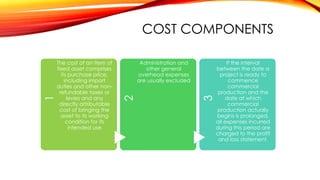
Administration and
other general
overhead expenses
are usually excluded

3

The cost of an item of
fixed asset comprises
its purchase price,
including import
duties and other nonrefundable taxes or
levies and any
directly attributable
cost of bringing the
asset to its working
condition for its
intended use

2

1

COST COMPONENTS
If the interval
between the date a
project is ready to
commence
commercial
production and the
date at which
commercial
production actually
begins is prolonged,
all expenses incurred
during this period are
charged to the profit
and loss statement.
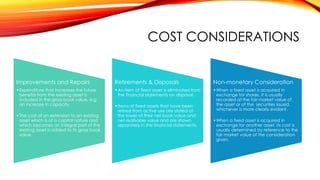
COST CONSIDERATIONS

Improvements and Repairs

Retirements & Disposals

Non-monetary Consideration

•Expenditure that increases the future
benefits from the existing asset is
included in the gross book value, e.g
an increase in capacity.

•An item of fixed asset is eliminated from
the financial statements on disposal.

•When a fixed asset is acquired in
exchange for shares, it is usually
recorded at the fair market value of
the asset or of the securities issued,
whichever is more clearly evident.

•The cost of an extension to an existing
asset which is of a capital nature and
which becomes an integral part of the
existing asset is added to its gross book
value.

•Items of fixed assets that have been
retired from active use are stated at
the lower of their net book value and
net realisable value and are shown
separately in the financial statements.

•When a fixed asset is acquired in
exchange for another asset, its cost is
usually determined by reference to the
fair market value of the consideration
given.
•Goodwill, in general, is
recorded in the books
only when some
consideration in money
or money’s worth has
been paid for it.
•As a matter of financial
prudence, goodwill is
written off over a period.

Disclosures

•In the case of fixed assets
acquired on hire, such
assets are recorded at
their cash value, which, if
not readily available, is
calculated by assuming
an appropriate rate of
interest.

Special Types

Special Cases

•Where an enterprise
owns fixed assets jointly,
the extent of its share in
such assets, and the
proportion in the original
cost, accumulated
depreciation and written
down value are stated in
the balance sheet.

•gross and net book
values of fixed assets at
the beginning and end
of an accounting period
showing additions,
disposals, acquisitions
and other movements
•expenditure incurred on
account of fixed assets in
the course of
construction or
acquisition
•revalued amounts
substituted for historical
costs of fixed assets
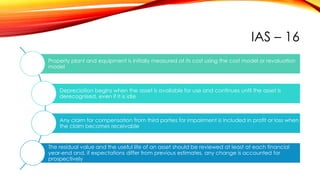
IAS – 16
Property plant and equipment is initially measured at its cost using the cost model or revaluation
model

Depreciation begins when the asset is available for use and continues until the asset is
derecognised, even if it is idle

Any claim for compensation from third parties for impairment is included in profit or loss when
the claim becomes receivable

The residual value and the useful life of an asset should be reviewed at least at each financial
year-end and, if expectations differ from previous estimates, any change is accounted for
prospectively
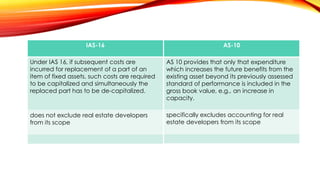
IAS-16

AS-10

Under IAS 16, if subsequent costs are
incurred for replacement of a part of an
item of fixed assets, such costs are required
to be capitalized and simultaneously the
replaced part has to be de-capitalized.

AS 10 provides that only that expenditure
which increases the future benefits from the
existing asset beyond its previously assessed
standard of performance is included in the
gross book value, e.g., an increase in
capacity.

does not exclude real estate developers
from its scope

specifically excludes accounting for real
estate developers from its scope
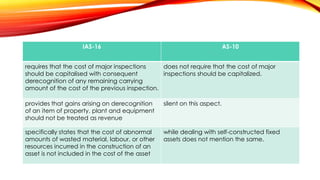
IAS-16

AS-10

requires that the cost of major inspections
does not require that the cost of major
should be capitalised with consequent
inspections should be capitalized.
derecognition of any remaining carrying
amount of the cost of the previous inspection.
provides that gains arising on derecognition
of an item of property, plant and equipment
should not be treated as revenue

silent on this aspect.

specifically states that the cost of abnormal
amounts of wasted material, labour, or other
resources incurred in the construction of an
asset is not included in the cost of the asset

while dealing with self-constructed fixed
assets does not mention the same.
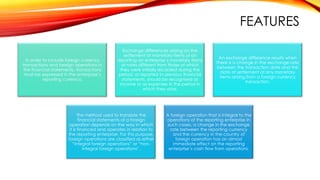
FEATURES
In order to include foreign currency
transactions and foreign operations in
the financial statements, transactions
must be expressed in the enterprise’s
reporting currency.

Exchange differences arising on the
settlement of monetary items or on
reporting an enterprise’s monetary items
at rates different from those at which
they were initially recorded during the
period, or reported in previous financial
statements, should be recognised as
income or as expenses in the period in
which they arise.

The method used to translate the
financial statements of a foreign
operation depends on the way in which
it is financed and operates in relation to
the reporting enterprise. For this purpose,
foreign operations are classified as either
“integral foreign operations” or “nonintegral foreign operations”.

An exchange difference results when
there is a change in the exchange rate
between the transaction date and the
date of settlement of any monetary
items arising from a foreign currency
transaction.

A foreign operation that is integral to the
operations of the reporting enterprise In
such cases, a change in the exchange
rate between the reporting currency
and the currency in the country of
foreign operation has an almost
immediate effect on the reporting
enterprise’s cash flow from operations.
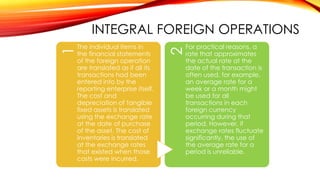
The individual items in
the financial statements
of the foreign operation
are translated as if all its
transactions had been
entered into by the
reporting enterprise itself.
The cost and
depreciation of tangible
fixed assets is translated
using the exchange rate
at the date of purchase
of the asset. The cost of
inventories is translated
at the exchange rates
that existed when those
costs were incurred.

2

1

INTEGRAL FOREIGN OPERATIONS
For practical reasons, a
rate that approximates
the actual rate at the
date of the transaction is
often used, for example,
an average rate for a
week or a month might
be used for all
transactions in each
foreign currency
occurring during that
period. However, if
exchange rates fluctuate
significantly, the use of
the average rate for a
period is unreliable.
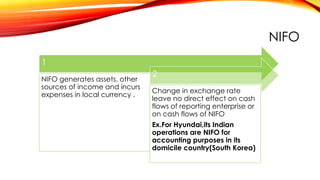
NIFO
1
NIFO generates assets, other
sources of income and incurs
expenses in local currency .

2
Change in exchange rate
leave no direct effect on cash
flows of reporting enterprise or
on cash flows of NIFO
Ex.For Hyundai,its Indian
operations are NIFO for
accounting purposes in its
domicile country(South Korea)
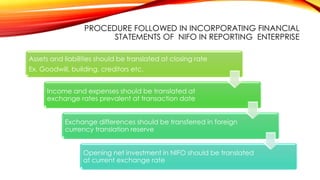
PROCEDURE FOLLOWED IN INCORPORATING FINANCIAL
STATEMENTS OF NIFO IN REPORTING ENTERPRISE
Assets and liabilities should be translated at closing rate
Ex. Goodwill, building, creditors etc.
Income and expenses should be translated at
exchange rates prevalent at transaction date
Exchange differences should be transferred in foreign
currency translation reserve

Opening net investment in NIFO should be translated
at current exchange rate
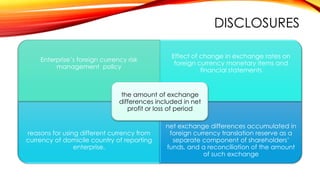
DISCLOSURES
Enterprise’s foreign currency risk
management policy

Effect of change in exchange rates on
foreign currency monetary items and
financial statements

the amount of exchange
differences included in net
profit or loss of period

reasons for using different currency from
currency of domicile country of reporting
enterprise,

net exchange differences accumulated in
foreign currency translation reserve as a
separate component of shareholders’
funds, and a reconciliation of the amount
of such exchange
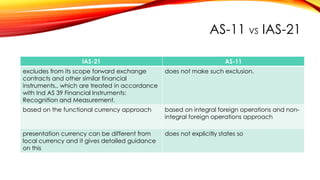
AS-11 VS IAS-21
IAS-21

AS-11

excludes from its scope forward exchange
contracts and other similar financial
instruments., which are treated in accordance
with Ind AS 39 Financial Instruments:
Recognition and Measurement.

does not make such exclusion.

based on the functional currency approach

based on integral foreign operations and nonintegral foreign operations approach

presentation currency can be different from
local currency and it gives detailed guidance
on this

does not explicitly states so
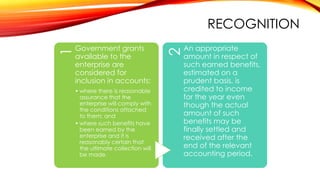
Government grants
available to the
enterprise are
considered for
inclusion in accounts:
• where there is reasonable
assurance that the
enterprise will comply with
the conditions attached
to them; and
• where such benefits have
been earned by the
enterprise and it is
reasonably certain that
the ultimate collection will
be made.

2

1

RECOGNITION
An appropriate
amount in respect of
such earned benefits,
estimated on a
prudent basis, is
credited to income
for the year even
though the actual
amount of such
benefits may be
finally settled and
received after the
end of the relevant
accounting period.
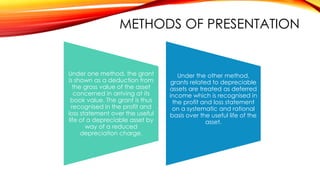
METHODS OF PRESENTATION

Under one method, the grant
is shown as a deduction from
the gross value of the asset
concerned in arriving at its
book value. The grant is thus
recognised in the profit and
loss statement over the useful
life of a depreciable asset by
way of a reduced
depreciation charge.

Under the other method,
grants related to depreciable
assets are treated as deferred
income which is recognised in
the profit and loss statement
on a systematic and rational
basis over the useful life of the
asset.
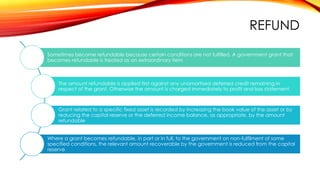
REFUND
Sometimes become refundable because certain conditions are not fulfilled. A government grant that
becomes refundable is treated as an extraordinary item

The amount refundable is applied first against any unamortised deferred credit remaining in
respect of the grant. Otherwise the amount is charged immediately to profit and loss statement.

Grant related to a specific fixed asset is recorded by increasing the book value of the asset or by
reducing the capital reserve or the deferred income balance, as appropriate, by the amount
refundable
Where a grant becomes refundable, in part or in full, to the government on non-fulfilment of some
specified conditions, the relevant amount recoverable by the government is reduced from the capital
reserve
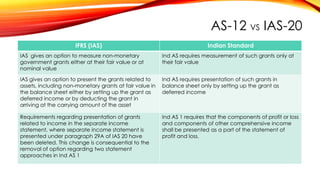
AS-12 VS IAS-20
IFRS (IAS)

Indian Standard

IAS gives an option to measure non-monetary
government grants either at their fair value or at
nominal value

Ind AS requires measurement of such grants only at
their fair value

IAS gives an option to present the grants related to
assets, including non-monetary grants at fair value in
the balance sheet either by setting up the grant as
deferred income or by deducting the grant in
arriving at the carrying amount of the asset

Ind AS requires presentation of such grants in
balance sheet only by setting up the grant as
deferred income

Requirements regarding presentation of grants
related to income in the separate income
statement, where separate income statement is
presented under paragraph 29A of IAS 20 have
been deleted. This change is consequential to the
removal of option regarding two statement
approaches in Ind AS 1

Ind AS 1 requires that the components of profit or loss
and components of other comprehensive income
shall be presented as a part of the statement of
profit and loss.
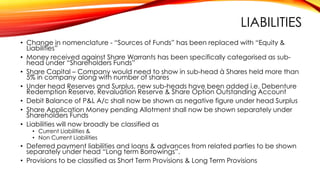
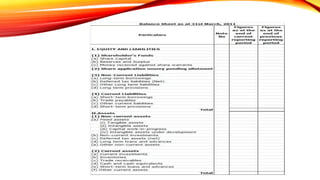
LIABILITIES
• Change in nomenclature - “Sources of Funds” has been replaced with “Equity &
Liabilities”
• Money received against Share Warrants has been specifically categorised as subhead under “Shareholders Funds”
• Share Capital – Company would need to show in sub-head à Shares held more than
5% in company along with number of shares
• Under head Reserves and Surplus, new sub-heads have been added i.e. Debenture
Redemption Reserve, Revaluation Reserve & Share Option Outstanding Account
• Debit Balance of P&L A/c shall now be shown as negative figure under head Surplus
• Share Application Money pending Allotment shall now be shown separately under
Shareholders Funds
• Liabilities will now broadly be classified as
• Current Liabilities &
• Non Current Liabilities

• Deferred payment liabilities and loans & advances from related parties to be shown
separately under head “Long term Borrowings”.
• Provisions to be classified as Short Term Provisions & Long Term Provisions
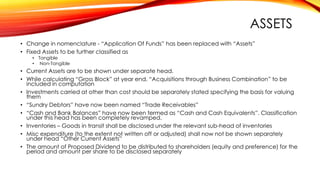
ASSETS
• Change in nomenclature - “Application Of Funds” has been replaced with “Assets”
• Fixed Assets to be further classified as
• Tangible
• Non-Tangible

• Current Assets are to be shown under separate head.
• While calculating “Gross Block” at year end, “Acquisitions through Business Combination” to be
included in computation
• Investments carried at other than cost should be separately stated specifying the basis for valuing
them
• “Sundry Debtors” have now been named “Trade Receivables”
• “Cash and Bank Balances” have now been termed as “Cash and Cash Equivalents”. Classification
under this head has been completely revamped.
• Inventories – Goods in transit shall be disclosed under the relevant sub-head of inventories
• Misc expenditure (to the extent not written off or adjusted) shall now not be shown separately
under head “Other Current Assets”
• The amount of Proposed Dividend to be distributed to shareholders (equity and preference) for the
period and amount per share to be disclosed separately
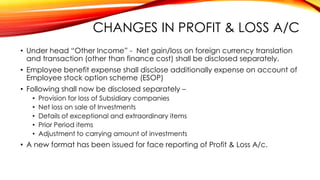
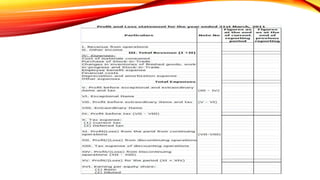
CHANGES IN PROFIT & LOSS A/C
• Under head “Other Income” - Net gain/loss on foreign currency translation
and transaction (other than finance cost) shall be disclosed separately.
• Employee benefit expense shall disclose additionally expense on account of
Employee stock option scheme (ESOP)
• Following shall now be disclosed separately –
•
•
•
•
•

Provision for loss of Subsidiary companies
Net loss on sale of Investments
Details of exceptional and extraordinary items
Prior Period items
Adjustment to carrying amount of investments

• A new format has been issued for face reporting of Profit & Loss A/c.
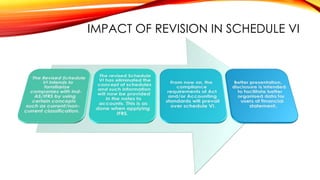
IMPACT OF REVISION IN SCHEDULE VI
THANK YOU!

Indian accounting standards IFRS

  • 1.
  • 3.
    Administration and other general overheadexpenses are usually excluded 3 The cost of an item of fixed asset comprises its purchase price, including import duties and other nonrefundable taxes or levies and any directly attributable cost of bringing the asset to its working condition for its intended use 2 1 COST COMPONENTS If the interval between the date a project is ready to commence commercial production and the date at which commercial production actually begins is prolonged, all expenses incurred during this period are charged to the profit and loss statement.
  • 4.
    COST CONSIDERATIONS Improvements andRepairs Retirements & Disposals Non-monetary Consideration •Expenditure that increases the future benefits from the existing asset is included in the gross book value, e.g an increase in capacity. •An item of fixed asset is eliminated from the financial statements on disposal. •When a fixed asset is acquired in exchange for shares, it is usually recorded at the fair market value of the asset or of the securities issued, whichever is more clearly evident. •The cost of an extension to an existing asset which is of a capital nature and which becomes an integral part of the existing asset is added to its gross book value. •Items of fixed assets that have been retired from active use are stated at the lower of their net book value and net realisable value and are shown separately in the financial statements. •When a fixed asset is acquired in exchange for another asset, its cost is usually determined by reference to the fair market value of the consideration given.
  • 5.
    •Goodwill, in general,is recorded in the books only when some consideration in money or money’s worth has been paid for it. •As a matter of financial prudence, goodwill is written off over a period. Disclosures •In the case of fixed assets acquired on hire, such assets are recorded at their cash value, which, if not readily available, is calculated by assuming an appropriate rate of interest. Special Types Special Cases •Where an enterprise owns fixed assets jointly, the extent of its share in such assets, and the proportion in the original cost, accumulated depreciation and written down value are stated in the balance sheet. •gross and net book values of fixed assets at the beginning and end of an accounting period showing additions, disposals, acquisitions and other movements •expenditure incurred on account of fixed assets in the course of construction or acquisition •revalued amounts substituted for historical costs of fixed assets
  • 7.
    IAS – 16 Propertyplant and equipment is initially measured at its cost using the cost model or revaluation model Depreciation begins when the asset is available for use and continues until the asset is derecognised, even if it is idle Any claim for compensation from third parties for impairment is included in profit or loss when the claim becomes receivable The residual value and the useful life of an asset should be reviewed at least at each financial year-end and, if expectations differ from previous estimates, any change is accounted for prospectively
  • 8.
    IAS-16 AS-10 Under IAS 16,if subsequent costs are incurred for replacement of a part of an item of fixed assets, such costs are required to be capitalized and simultaneously the replaced part has to be de-capitalized. AS 10 provides that only that expenditure which increases the future benefits from the existing asset beyond its previously assessed standard of performance is included in the gross book value, e.g., an increase in capacity. does not exclude real estate developers from its scope specifically excludes accounting for real estate developers from its scope
  • 9.
    IAS-16 AS-10 requires that thecost of major inspections does not require that the cost of major should be capitalised with consequent inspections should be capitalized. derecognition of any remaining carrying amount of the cost of the previous inspection. provides that gains arising on derecognition of an item of property, plant and equipment should not be treated as revenue silent on this aspect. specifically states that the cost of abnormal amounts of wasted material, labour, or other resources incurred in the construction of an asset is not included in the cost of the asset while dealing with self-constructed fixed assets does not mention the same.
  • 11.
    FEATURES In order toinclude foreign currency transactions and foreign operations in the financial statements, transactions must be expressed in the enterprise’s reporting currency. Exchange differences arising on the settlement of monetary items or on reporting an enterprise’s monetary items at rates different from those at which they were initially recorded during the period, or reported in previous financial statements, should be recognised as income or as expenses in the period in which they arise. The method used to translate the financial statements of a foreign operation depends on the way in which it is financed and operates in relation to the reporting enterprise. For this purpose, foreign operations are classified as either “integral foreign operations” or “nonintegral foreign operations”. An exchange difference results when there is a change in the exchange rate between the transaction date and the date of settlement of any monetary items arising from a foreign currency transaction. A foreign operation that is integral to the operations of the reporting enterprise In such cases, a change in the exchange rate between the reporting currency and the currency in the country of foreign operation has an almost immediate effect on the reporting enterprise’s cash flow from operations.
  • 12.
    The individual itemsin the financial statements of the foreign operation are translated as if all its transactions had been entered into by the reporting enterprise itself. The cost and depreciation of tangible fixed assets is translated using the exchange rate at the date of purchase of the asset. The cost of inventories is translated at the exchange rates that existed when those costs were incurred. 2 1 INTEGRAL FOREIGN OPERATIONS For practical reasons, a rate that approximates the actual rate at the date of the transaction is often used, for example, an average rate for a week or a month might be used for all transactions in each foreign currency occurring during that period. However, if exchange rates fluctuate significantly, the use of the average rate for a period is unreliable.
  • 13.
    NIFO 1 NIFO generates assets,other sources of income and incurs expenses in local currency . 2 Change in exchange rate leave no direct effect on cash flows of reporting enterprise or on cash flows of NIFO Ex.For Hyundai,its Indian operations are NIFO for accounting purposes in its domicile country(South Korea)
  • 14.
    PROCEDURE FOLLOWED ININCORPORATING FINANCIAL STATEMENTS OF NIFO IN REPORTING ENTERPRISE Assets and liabilities should be translated at closing rate Ex. Goodwill, building, creditors etc. Income and expenses should be translated at exchange rates prevalent at transaction date Exchange differences should be transferred in foreign currency translation reserve Opening net investment in NIFO should be translated at current exchange rate
  • 15.
    DISCLOSURES Enterprise’s foreign currencyrisk management policy Effect of change in exchange rates on foreign currency monetary items and financial statements the amount of exchange differences included in net profit or loss of period reasons for using different currency from currency of domicile country of reporting enterprise, net exchange differences accumulated in foreign currency translation reserve as a separate component of shareholders’ funds, and a reconciliation of the amount of such exchange
  • 16.
    AS-11 VS IAS-21 IAS-21 AS-11 excludesfrom its scope forward exchange contracts and other similar financial instruments., which are treated in accordance with Ind AS 39 Financial Instruments: Recognition and Measurement. does not make such exclusion. based on the functional currency approach based on integral foreign operations and nonintegral foreign operations approach presentation currency can be different from local currency and it gives detailed guidance on this does not explicitly states so
  • 18.
    Government grants available tothe enterprise are considered for inclusion in accounts: • where there is reasonable assurance that the enterprise will comply with the conditions attached to them; and • where such benefits have been earned by the enterprise and it is reasonably certain that the ultimate collection will be made. 2 1 RECOGNITION An appropriate amount in respect of such earned benefits, estimated on a prudent basis, is credited to income for the year even though the actual amount of such benefits may be finally settled and received after the end of the relevant accounting period.
  • 19.
    METHODS OF PRESENTATION Underone method, the grant is shown as a deduction from the gross value of the asset concerned in arriving at its book value. The grant is thus recognised in the profit and loss statement over the useful life of a depreciable asset by way of a reduced depreciation charge. Under the other method, grants related to depreciable assets are treated as deferred income which is recognised in the profit and loss statement on a systematic and rational basis over the useful life of the asset.
  • 20.
    REFUND Sometimes become refundablebecause certain conditions are not fulfilled. A government grant that becomes refundable is treated as an extraordinary item The amount refundable is applied first against any unamortised deferred credit remaining in respect of the grant. Otherwise the amount is charged immediately to profit and loss statement. Grant related to a specific fixed asset is recorded by increasing the book value of the asset or by reducing the capital reserve or the deferred income balance, as appropriate, by the amount refundable Where a grant becomes refundable, in part or in full, to the government on non-fulfilment of some specified conditions, the relevant amount recoverable by the government is reduced from the capital reserve
  • 21.
    AS-12 VS IAS-20 IFRS(IAS) Indian Standard IAS gives an option to measure non-monetary government grants either at their fair value or at nominal value Ind AS requires measurement of such grants only at their fair value IAS gives an option to present the grants related to assets, including non-monetary grants at fair value in the balance sheet either by setting up the grant as deferred income or by deducting the grant in arriving at the carrying amount of the asset Ind AS requires presentation of such grants in balance sheet only by setting up the grant as deferred income Requirements regarding presentation of grants related to income in the separate income statement, where separate income statement is presented under paragraph 29A of IAS 20 have been deleted. This change is consequential to the removal of option regarding two statement approaches in Ind AS 1 Ind AS 1 requires that the components of profit or loss and components of other comprehensive income shall be presented as a part of the statement of profit and loss.
  • 23.
    LIABILITIES • Change innomenclature - “Sources of Funds” has been replaced with “Equity & Liabilities” • Money received against Share Warrants has been specifically categorised as subhead under “Shareholders Funds” • Share Capital – Company would need to show in sub-head à Shares held more than 5% in company along with number of shares • Under head Reserves and Surplus, new sub-heads have been added i.e. Debenture Redemption Reserve, Revaluation Reserve & Share Option Outstanding Account • Debit Balance of P&L A/c shall now be shown as negative figure under head Surplus • Share Application Money pending Allotment shall now be shown separately under Shareholders Funds • Liabilities will now broadly be classified as • Current Liabilities & • Non Current Liabilities • Deferred payment liabilities and loans & advances from related parties to be shown separately under head “Long term Borrowings”. • Provisions to be classified as Short Term Provisions & Long Term Provisions
  • 24.
    ASSETS • Change innomenclature - “Application Of Funds” has been replaced with “Assets” • Fixed Assets to be further classified as • Tangible • Non-Tangible • Current Assets are to be shown under separate head. • While calculating “Gross Block” at year end, “Acquisitions through Business Combination” to be included in computation • Investments carried at other than cost should be separately stated specifying the basis for valuing them • “Sundry Debtors” have now been named “Trade Receivables” • “Cash and Bank Balances” have now been termed as “Cash and Cash Equivalents”. Classification under this head has been completely revamped. • Inventories – Goods in transit shall be disclosed under the relevant sub-head of inventories • Misc expenditure (to the extent not written off or adjusted) shall now not be shown separately under head “Other Current Assets” • The amount of Proposed Dividend to be distributed to shareholders (equity and preference) for the period and amount per share to be disclosed separately
  • 25.
    CHANGES IN PROFIT& LOSS A/C • Under head “Other Income” - Net gain/loss on foreign currency translation and transaction (other than finance cost) shall be disclosed separately. • Employee benefit expense shall disclose additionally expense on account of Employee stock option scheme (ESOP) • Following shall now be disclosed separately – • • • • • Provision for loss of Subsidiary companies Net loss on sale of Investments Details of exceptional and extraordinary items Prior Period items Adjustment to carrying amount of investments • A new format has been issued for face reporting of Profit & Loss A/c.
  • 26.
    IMPACT OF REVISIONIN SCHEDULE VI
  • 29.