Labor : controlling & accounting
for costs
Presented by :
 Agnes K
 Ahmad S
 Nugroho W
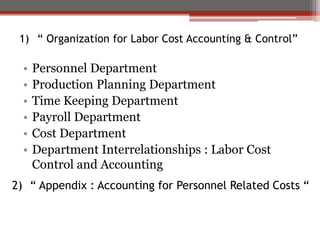
1) “ Organization for Labor Cost Accounting & Control”
• Personnel Department
• Production Planning Department
• Time Keeping Department
• Payroll Department
• Cost Department
• Department Interrelationships : Labor Cost
Control and Accounting
2) “ Appendix : Accounting for Personnel Related Costs “
“Organization for Labor Cost
Accounting and Control”
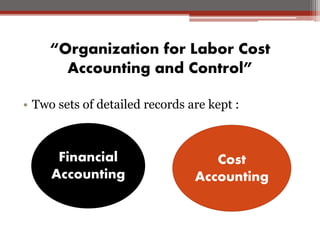
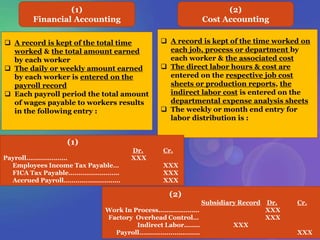
• Two sets of detailed records are kept :
Financial
Accounting
Cost
Accounting
 A record is kept of the total time
worked & the total amount earned
by each worker
 The daily or weekly amount earned
by each worker is entered on the
payroll record
 Each payroll period the total amount
of wages payable to workers results
in the following entry :
 A record is kept of the time worked on
each job, process or department by
each worker & the associated cost
 The direct labor hours & cost are
entered on the respective job cost
sheets or production reports, the
indirect labor cost is entered on the
departmental expense analysis sheets
 The weekly or month end entry for
labor distribution is :
(1)
Financial Accounting
(2)
Cost Accounting
(1)
Dr. Cr.
Payroll………………… XXX
Employees Income Tax Payable… XXX
FICA Tax Payable…………………….. XXX
Accrued Payroll……………………….. XXX
(2)
Subsidiary Record Dr. Cr.
Work In Process………………… XXX
Factory Overhead Control… XXX
Indirect Labor…….. XXX
Payroll…………………………. XXX
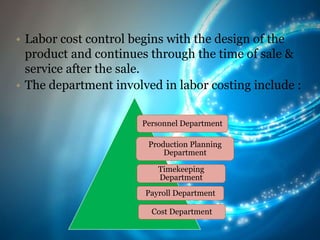
• Labor cost control begins with the design of the
product and continues through the time of sale &
service after the sale.
• The department involved in labor costing include :
Personnel Department
Production Planning
Department
Timekeeping
Department
Payroll Department
Cost Department
Personnel Department
• The chief function of a personnel department is to
provide an efficient labor force and ensure that the
entire organization follows appropiate personnel
policies.
• Personnel function include : Recruiting,
Hiring, Training, Evaluation, Retirement
counseling, Termination and
Outplacement.
Production Planning
Department
• A production planning department is responsible
for scheduling work and releasing work orders to
the producing department.
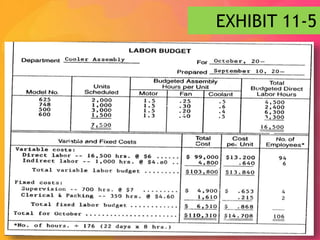
EXHIBIT 11-5
Timekeeping Department
• Securing an accurate record of the time worked by
each employees is the first step in labor costing.
• Accurate timekeeping is usually achieved by the
following :
1) A clock card or time card provides the employee’s
presence in the plant from time of entry to the
departure.
2) Time tickets or job tickets secure information as to
the type and duration of worked performance.
Divided into three :
BarCodingTechnology
TimeTicketorReport
TimeClock
Is an
instrument
that records
employee’s
time in and
out of the
office or
factory.
Is shows the
spesific use
of the time
purchased
and it is
comparable
to a material
requisitions.
Are symbols
processed
electronically
to identify
numbers ,
letters or
other
characters
Payroll Department
• Payroll department responsible for recording the
job classification, department and wage rate for
each employee.
• The payroll department also prepares paychecks
or provides the cashier or treasurer with the data
necessary to make the payment.
Divided into two :
Payroll Computation &
Preparation
• The payroll is prepared from
clock cards. The final
computed payroll is recorded
in a payroll journal or payroll
record.
• The record shows total
wages, deductions and the
net payroll
Payroll Distribution
• Either the payroll
department or the cost
department may prepare the
payroll distribution. Labor
cost distributed to jobs &
departments must agree with
the total payroll recorded.
• The distribution also shows
labor hours if they a basis for
allocating overhead.
Cost Department
• On the basis of the labor distribution summary or
the time ticket, the cost department records direct
labor cost on job cost sheets or departmental
production reports and rcords indirect labor cost on
detailed departmental overhead records.
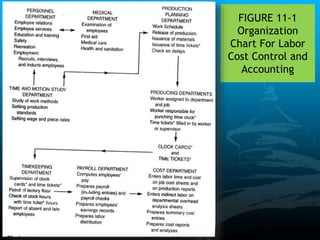
• The departmental interrelationships
required for effective labor cost control
and accounting.
• See the next figure 
Department Interrelationships :
Labor Cost Control and Accounting
FIGURE 11-1
Organization
Chart For Labor
Cost Control and
Accounting
“ Appendix : Accounting for
Personnel Related Costs “
• During the middle of the twentieth century, workers
in the U.S. and several other developed countries
enjoyed spectacular growth in nonwage benefits.
• This increase was demonstrated by the following :
1) Benefits cost increased
2) The duration of benefits increased
3) More employees were covered by benefits
4) New benefits were introduced such as vision and
dental insurance and personal legal counsel
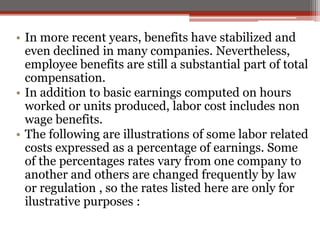
• In more recent years, benefits have stabilized and
even declined in many companies. Nevertheless,
employee benefits are still a substantial part of total
compensation.
• In addition to basic earnings computed on hours
worked or units produced, labor cost includes non
wage benefits.
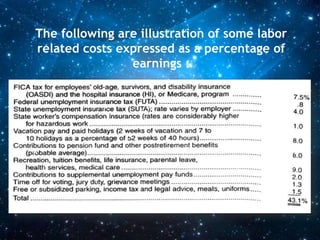
• The following are illustrations of some labor related
costs expressed as a percentage of earnings. Some
of the percentages rates vary from one company to
another and others are changed frequently by law
or regulation , so the rates listed here are only for
ilustrative purposes :
The following are illustration of some labor
related costs expressed as a percentage of
earnings :
• Some of the percentages such as those for FICA,
FUTA and state unemployment insurance tax,
apply to a limited base that may be less than
total annual wages of some employees. This has
the effect of lowering the overall annual
percentage.

Accounting (Controlling & Accounting for Costs)

  • 1.
    Labor : controlling& accounting for costs Presented by :  Agnes K  Ahmad S  Nugroho W
  • 2.
    1) “ Organizationfor Labor Cost Accounting & Control” • Personnel Department • Production Planning Department • Time Keeping Department • Payroll Department • Cost Department • Department Interrelationships : Labor Cost Control and Accounting 2) “ Appendix : Accounting for Personnel Related Costs “
  • 3.
    “Organization for LaborCost Accounting and Control” • Two sets of detailed records are kept : Financial Accounting Cost Accounting
  • 4.
     A recordis kept of the total time worked & the total amount earned by each worker  The daily or weekly amount earned by each worker is entered on the payroll record  Each payroll period the total amount of wages payable to workers results in the following entry :  A record is kept of the time worked on each job, process or department by each worker & the associated cost  The direct labor hours & cost are entered on the respective job cost sheets or production reports, the indirect labor cost is entered on the departmental expense analysis sheets  The weekly or month end entry for labor distribution is : (1) Financial Accounting (2) Cost Accounting (1) Dr. Cr. Payroll………………… XXX Employees Income Tax Payable… XXX FICA Tax Payable…………………….. XXX Accrued Payroll……………………….. XXX (2) Subsidiary Record Dr. Cr. Work In Process………………… XXX Factory Overhead Control… XXX Indirect Labor…….. XXX Payroll…………………………. XXX
  • 5.
    • Labor costcontrol begins with the design of the product and continues through the time of sale & service after the sale. • The department involved in labor costing include : Personnel Department Production Planning Department Timekeeping Department Payroll Department Cost Department
  • 6.
    Personnel Department • Thechief function of a personnel department is to provide an efficient labor force and ensure that the entire organization follows appropiate personnel policies. • Personnel function include : Recruiting, Hiring, Training, Evaluation, Retirement counseling, Termination and Outplacement.
  • 7.
    Production Planning Department • Aproduction planning department is responsible for scheduling work and releasing work orders to the producing department.
  • 8.
  • 9.
    Timekeeping Department • Securingan accurate record of the time worked by each employees is the first step in labor costing. • Accurate timekeeping is usually achieved by the following : 1) A clock card or time card provides the employee’s presence in the plant from time of entry to the departure. 2) Time tickets or job tickets secure information as to the type and duration of worked performance.
  • 10.
    Divided into three: BarCodingTechnology TimeTicketorReport TimeClock Is an instrument that records employee’s time in and out of the office or factory. Is shows the spesific use of the time purchased and it is comparable to a material requisitions. Are symbols processed electronically to identify numbers , letters or other characters
  • 11.
    Payroll Department • Payrolldepartment responsible for recording the job classification, department and wage rate for each employee. • The payroll department also prepares paychecks or provides the cashier or treasurer with the data necessary to make the payment.
  • 12.
    Divided into two: Payroll Computation & Preparation • The payroll is prepared from clock cards. The final computed payroll is recorded in a payroll journal or payroll record. • The record shows total wages, deductions and the net payroll Payroll Distribution • Either the payroll department or the cost department may prepare the payroll distribution. Labor cost distributed to jobs & departments must agree with the total payroll recorded. • The distribution also shows labor hours if they a basis for allocating overhead.
  • 13.
    Cost Department • Onthe basis of the labor distribution summary or the time ticket, the cost department records direct labor cost on job cost sheets or departmental production reports and rcords indirect labor cost on detailed departmental overhead records.
  • 14.
    • The departmentalinterrelationships required for effective labor cost control and accounting. • See the next figure  Department Interrelationships : Labor Cost Control and Accounting
  • 15.
    FIGURE 11-1 Organization Chart ForLabor Cost Control and Accounting
  • 16.
    “ Appendix :Accounting for Personnel Related Costs “ • During the middle of the twentieth century, workers in the U.S. and several other developed countries enjoyed spectacular growth in nonwage benefits. • This increase was demonstrated by the following : 1) Benefits cost increased 2) The duration of benefits increased 3) More employees were covered by benefits 4) New benefits were introduced such as vision and dental insurance and personal legal counsel
  • 17.
    • In morerecent years, benefits have stabilized and even declined in many companies. Nevertheless, employee benefits are still a substantial part of total compensation. • In addition to basic earnings computed on hours worked or units produced, labor cost includes non wage benefits. • The following are illustrations of some labor related costs expressed as a percentage of earnings. Some of the percentages rates vary from one company to another and others are changed frequently by law or regulation , so the rates listed here are only for ilustrative purposes :
  • 18.
    The following areillustration of some labor related costs expressed as a percentage of earnings :
  • 19.
    • Some ofthe percentages such as those for FICA, FUTA and state unemployment insurance tax, apply to a limited base that may be less than total annual wages of some employees. This has the effect of lowering the overall annual percentage.