
AMITY BUSINESS SCHOOL
ACCOUNTING FOR MANAGERS PROJECT
ASSIGNMENT
ACCOUNTING FOR LABOR
SUBMITTED BY: SAKSHI TIWARI
MBA (GEN)
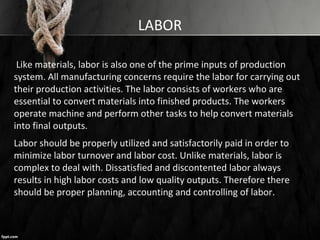
LABOR
Like materials, labor is also one of the prime inputs of production
system. All manufacturing concerns require the labor for carrying out
their production activities. The labor consists of workers who are
essential to convert materials into finished products. The workers
operate machine and perform other tasks to help convert materials
into final outputs.
Labor should be properly utilized and satisfactorily paid in order to
minimize labor turnover and labor cost. Unlike materials, labor is
complex to deal with. Dissatisfied and discontented labor always
results in high labor costs and low quality outputs. Therefore there
should be proper planning, accounting and controlling of labor.
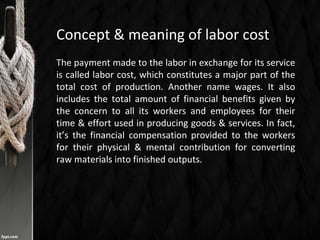
Concept & meaning of labor cost
The payment made to the labor in exchange for its service
is called labor cost, which constitutes a major part of the
total cost of production. Another name wages. It also
includes the total amount of financial benefits given by
the concern to all its workers and employees for their
time & effort used in producing goods & services. In fact,
it’s the financial compensation provided to the workers
for their physical & mental contribution for converting
raw materials into finished outputs.
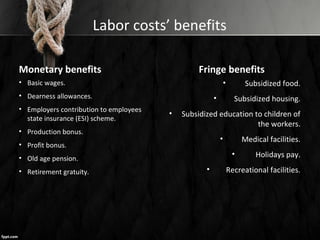
Labor costs’ benefits
Monetary benefits
• Basic wages.
• Dearness allowances.
• Employers contribution to employees
state insurance (ESI) scheme.
• Production bonus.
• Profit bonus.
• Old age pension.
• Retirement gratuity.
Fringe benefits
• Subsidized food.
• Subsidized housing.
• Subsidized education to children of
the workers.
• Medical facilities.
• Holidays pay.
• Recreational facilities.
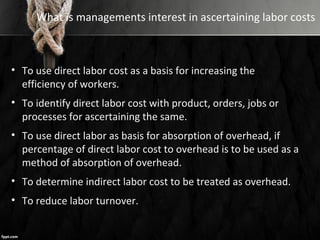
What is managements interest in ascertaining labor costs
• To use direct labor cost as a basis for increasing the
efficiency of workers.
• To identify direct labor cost with product, orders, jobs or
processes for ascertaining the same.
• To use direct labor as basis for absorption of overhead, if
percentage of direct labor cost to overhead is to be used as a
method of absorption of overhead.
• To determine indirect labor cost to be treated as overhead.
• To reduce labor turnover.
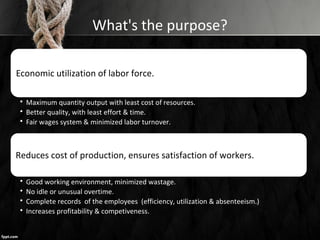
Economic utilization of labor force.
• Maximum quantity output with least cost of resources.
• Better quality, with least effort & time.
• Fair wages system & minimized labor turnover.
Reduces cost of production, ensures satisfaction of workers.
• Good working environment, minimized wastage.
• No idle or unusual overtime.
• Complete records of the employees (efficiency, utilization & absenteeism.)
• Increases profitability & competiveness.
What's the purpose?
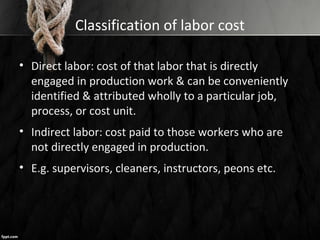
Classification of labor cost
• Direct labor: cost of that labor that is directly
engaged in production work & can be conveniently
identified & attributed wholly to a particular job,
process, or cost unit.
• Indirect labor: cost paid to those workers who are
not directly engaged in production.
• E.g. supervisors, cleaners, instructors, peons etc.
Labor cost control factors.
• Production planning.
• Setting up of standards.
• Use of labor budgets.
• Study of the effectiveness
of wage policy.
• Labor performance
reports.
Org’ for accounting & control
of labor cost.
• Personnel dept.
• Engg. & work study dept.
• Time keeping dept.
• Payroll dept.
• Cost accounting dept.
Labor turnover & its causes
The rate of change in the composition of the labor force in an org’
during a specific period.
• Low wages & allowances.
• Bad working conditions & lack of facilities.
• Dissatisfaction, inadequate job security & retirement benefits.
• Change of job..marriage in case of female workers.
• Seasonal character of industry, death or retirement of worker.
control & measurement methods
• Devise suitable wage policy.
• Working conditions conducive to health & efficiency.
• Impartial & sympathetic attitude of personnel mgmt.
• Introducing incentive plans.
• Promotional opportunities.
• Encouraging labor participation.
• Effective grievance procedure.
• Strengthening welfare measures.
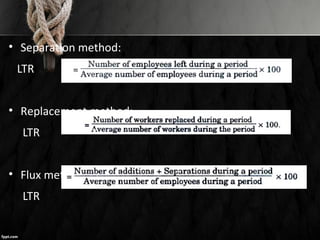
• Separation method:
LTR
• Replacement method:
LTR
• Flux method:
LTR
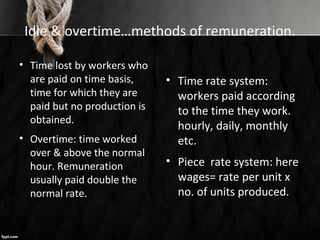
Idle & overtime…methods of remuneration.
• Time lost by workers who
are paid on time basis,
time for which they are
paid but no production is
obtained.
• Overtime: time worked
over & above the normal
hour. Remuneration
usually paid double the
normal rate.
• Time rate system:
workers paid according
to the time they work.
hourly, daily, monthly
etc.
• Piece rate system: here
wages= rate per unit x
no. of units produced.
Various incentives schemes
1. Halsey Premium Plan: - In this system, a standard time is fixed for
each job. Wages are paid for actual time spent on the job and bonus
or premium is paid in a fixed proportion to time saved, i.e. 50% or
40%
Total earnings = Time Rate x Time Taken + 50% of [time saved x
Time Rate]
2. Halsey Weir Plan: - Same as above except that the bonus is equal
to 30% the time saved.
3. Rowan Plan: -
Total earnings = [Time Rate x Time Taken] + Bonus
Bonus = [Time Rate x Time Taken x Time saved Time
Allowed
4. Taylor’s different Piece Rate Plan: - In this system
i. Day wages are not guaranteed
ii. Standard time is set for each job
iii. Two piece rates are fixed for each job – Higher and Lower
rate The lower piece rate is payable where a worker takes longer
time than the standard time and higher rate is payable where a
worker completed the work within the standards time.
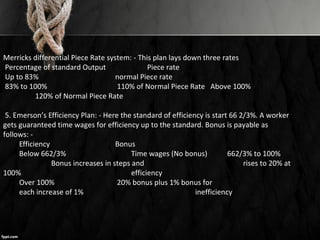
Merricks differential Piece Rate system: - This plan lays down three rates
Percentage of standard Output Piece rate
Up to 83% normal Piece rate
83% to 100% 110% of Normal Piece Rate Above 100%
120% of Normal Piece Rate
5. Emerson’s Efficiency Plan: - Here the standard of efficiency is start 66 2/3%. A worker
gets guaranteed time wages for efficiency up to the standard. Bonus is payable as
follows: -
Efficiency Bonus
Below 662/3% Time wages (No bonus) 662/3% to 100%
Bonus increases in steps and rises to 20% at
100% efficiency
Over 100% 20% bonus plus 1% bonus for
each increase of 1% inefficiency
6. Gantt’s Task and bonus Plan: - In this plan,
a. Day wages on time basis are guaranteed
b. A standard is set and remuneration is calculated as follows: -
i. When output is below standard – payment at time rate
ii. When output is at standard – payment at time rate plus 20%
bonus
iii. When output is above standard: - payment at higher piece
rate
8. Bedeaux Point Premium Plan: - In this plan standard time of each
job is determined in minutes known as Bedeaux points or B’s. One B
unit represents the amount of work which an average worker can do
in one minute.
Total Earnings = Time rate x Time Taken + [Hourly rate x No. of B’s Saved x 75 ]
60 100
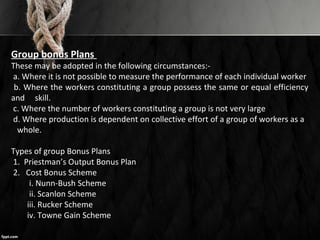
Group bonus Plans
These may be adopted in the following circumstances:-
a. Where it is not possible to measure the performance of each individual worker
b. Where the workers constituting a group possess the same or equal efficiency
and skill.
c. Where the number of workers constituting a group is not very large
d. Where production is dependent on collective effort of a group of workers as a
whole.
Types of group Bonus Plans
1. Priestman’s Output Bonus Plan
2. Cost Bonus Scheme
i. Nunn-Bush Scheme
ii. Scanlon Scheme
iii. Rucker Scheme
iv. Towne Gain Scheme
• Co-Partnership and Profit sharing
Co-Partnership is a scheme whereby employees are given
an opportunity to share in the capital of the business and
to receive a part of the profit that accrues to their share of
ownership. Under the profit sharing schemes, the workers
are paid in addition to wages a predetermined share of
the profits of the undertaking.
THANK YOU

ACCOUNTANCY LABOR LAWS

  • 1.
    AMITY BUSINESS SCHOOL ACCOUNTINGFOR MANAGERS PROJECT ASSIGNMENT
  • 2.
    ACCOUNTING FOR LABOR SUBMITTEDBY: SAKSHI TIWARI MBA (GEN)
  • 3.
    LABOR Like materials, laboris also one of the prime inputs of production system. All manufacturing concerns require the labor for carrying out their production activities. The labor consists of workers who are essential to convert materials into finished products. The workers operate machine and perform other tasks to help convert materials into final outputs. Labor should be properly utilized and satisfactorily paid in order to minimize labor turnover and labor cost. Unlike materials, labor is complex to deal with. Dissatisfied and discontented labor always results in high labor costs and low quality outputs. Therefore there should be proper planning, accounting and controlling of labor.
  • 4.
    Concept & meaningof labor cost The payment made to the labor in exchange for its service is called labor cost, which constitutes a major part of the total cost of production. Another name wages. It also includes the total amount of financial benefits given by the concern to all its workers and employees for their time & effort used in producing goods & services. In fact, it’s the financial compensation provided to the workers for their physical & mental contribution for converting raw materials into finished outputs.
  • 5.
    Labor costs’ benefits Monetarybenefits • Basic wages. • Dearness allowances. • Employers contribution to employees state insurance (ESI) scheme. • Production bonus. • Profit bonus. • Old age pension. • Retirement gratuity. Fringe benefits • Subsidized food. • Subsidized housing. • Subsidized education to children of the workers. • Medical facilities. • Holidays pay. • Recreational facilities.
  • 6.
    What is managementsinterest in ascertaining labor costs • To use direct labor cost as a basis for increasing the efficiency of workers. • To identify direct labor cost with product, orders, jobs or processes for ascertaining the same. • To use direct labor as basis for absorption of overhead, if percentage of direct labor cost to overhead is to be used as a method of absorption of overhead. • To determine indirect labor cost to be treated as overhead. • To reduce labor turnover.
  • 7.
    Economic utilization oflabor force. • Maximum quantity output with least cost of resources. • Better quality, with least effort & time. • Fair wages system & minimized labor turnover. Reduces cost of production, ensures satisfaction of workers. • Good working environment, minimized wastage. • No idle or unusual overtime. • Complete records of the employees (efficiency, utilization & absenteeism.) • Increases profitability & competiveness. What's the purpose?
  • 8.
    Classification of laborcost • Direct labor: cost of that labor that is directly engaged in production work & can be conveniently identified & attributed wholly to a particular job, process, or cost unit. • Indirect labor: cost paid to those workers who are not directly engaged in production. • E.g. supervisors, cleaners, instructors, peons etc.
  • 9.
    Labor cost controlfactors. • Production planning. • Setting up of standards. • Use of labor budgets. • Study of the effectiveness of wage policy. • Labor performance reports. Org’ for accounting & control of labor cost. • Personnel dept. • Engg. & work study dept. • Time keeping dept. • Payroll dept. • Cost accounting dept.
  • 10.
    Labor turnover &its causes The rate of change in the composition of the labor force in an org’ during a specific period. • Low wages & allowances. • Bad working conditions & lack of facilities. • Dissatisfaction, inadequate job security & retirement benefits. • Change of job..marriage in case of female workers. • Seasonal character of industry, death or retirement of worker.
  • 11.
    control & measurementmethods • Devise suitable wage policy. • Working conditions conducive to health & efficiency. • Impartial & sympathetic attitude of personnel mgmt. • Introducing incentive plans. • Promotional opportunities. • Encouraging labor participation. • Effective grievance procedure. • Strengthening welfare measures.
  • 12.
    • Separation method: LTR •Replacement method: LTR • Flux method: LTR
  • 13.
    Idle & overtime…methodsof remuneration. • Time lost by workers who are paid on time basis, time for which they are paid but no production is obtained. • Overtime: time worked over & above the normal hour. Remuneration usually paid double the normal rate. • Time rate system: workers paid according to the time they work. hourly, daily, monthly etc. • Piece rate system: here wages= rate per unit x no. of units produced.
  • 14.
    Various incentives schemes 1.Halsey Premium Plan: - In this system, a standard time is fixed for each job. Wages are paid for actual time spent on the job and bonus or premium is paid in a fixed proportion to time saved, i.e. 50% or 40% Total earnings = Time Rate x Time Taken + 50% of [time saved x Time Rate] 2. Halsey Weir Plan: - Same as above except that the bonus is equal to 30% the time saved.
  • 15.
    3. Rowan Plan:- Total earnings = [Time Rate x Time Taken] + Bonus Bonus = [Time Rate x Time Taken x Time saved Time Allowed 4. Taylor’s different Piece Rate Plan: - In this system i. Day wages are not guaranteed ii. Standard time is set for each job iii. Two piece rates are fixed for each job – Higher and Lower rate The lower piece rate is payable where a worker takes longer time than the standard time and higher rate is payable where a worker completed the work within the standards time.
  • 16.
    Merricks differential PieceRate system: - This plan lays down three rates Percentage of standard Output Piece rate Up to 83% normal Piece rate 83% to 100% 110% of Normal Piece Rate Above 100% 120% of Normal Piece Rate 5. Emerson’s Efficiency Plan: - Here the standard of efficiency is start 66 2/3%. A worker gets guaranteed time wages for efficiency up to the standard. Bonus is payable as follows: - Efficiency Bonus Below 662/3% Time wages (No bonus) 662/3% to 100% Bonus increases in steps and rises to 20% at 100% efficiency Over 100% 20% bonus plus 1% bonus for each increase of 1% inefficiency
  • 17.
    6. Gantt’s Taskand bonus Plan: - In this plan, a. Day wages on time basis are guaranteed b. A standard is set and remuneration is calculated as follows: - i. When output is below standard – payment at time rate ii. When output is at standard – payment at time rate plus 20% bonus iii. When output is above standard: - payment at higher piece rate 8. Bedeaux Point Premium Plan: - In this plan standard time of each job is determined in minutes known as Bedeaux points or B’s. One B unit represents the amount of work which an average worker can do in one minute. Total Earnings = Time rate x Time Taken + [Hourly rate x No. of B’s Saved x 75 ] 60 100
  • 18.
    Group bonus Plans Thesemay be adopted in the following circumstances:- a. Where it is not possible to measure the performance of each individual worker b. Where the workers constituting a group possess the same or equal efficiency and skill. c. Where the number of workers constituting a group is not very large d. Where production is dependent on collective effort of a group of workers as a whole. Types of group Bonus Plans 1. Priestman’s Output Bonus Plan 2. Cost Bonus Scheme i. Nunn-Bush Scheme ii. Scanlon Scheme iii. Rucker Scheme iv. Towne Gain Scheme
  • 19.
    • Co-Partnership andProfit sharing Co-Partnership is a scheme whereby employees are given an opportunity to share in the capital of the business and to receive a part of the profit that accrues to their share of ownership. Under the profit sharing schemes, the workers are paid in addition to wages a predetermined share of the profits of the undertaking.
  • 20.