22/12/2023
1
COST
ACCOUNTING
UNIT-3
LABOUR COST
22/12/2023
2
LABOUR
INTRODUCTION
• The term "labour" generally refers to
human effort or work, especially when it
is done in the context of producing goods
and services.
• The concept of labour encompasses
various types of activities, ranging from
physical tasks to intellectual pursuits, all
of which contribute to the creation and
development of societies.
22/12/2023
3
Meaning of Labour
The term "labour" refers to the human
effort, skill, and work involved in the
production of goods.
Labour is a crucial factor in the
manufacturing process, and it
encompasses various activities
performed by workers to transform raw
materials into finished products.
22/12/2023
4
Meaning of Labour Cost
• Labour cost in the manufacturing industry
refers to the total expenses incurred by a
company in compensating its workforce
for the production of goods.
• It encompasses the wages, salaries,
benefits, and other expenses associated
with employing workers involved in the
manufacturing process.
TYPES OF LABOUR
22/12/2023
5
TYPES OF EMPLOYEES BASED ON SKILLS
1.Direct Wages or Salaries:
• Hourly Wages: Payments based on the number of hours worked.
• Salaried Wages: Fixed payments regardless of the number of hours worked.
2.Overtime Pay:
• Extra compensation for hours worked beyond the standard workweek or workday.
3.Bonuses and Commissions:
• Additional payments based on performance, sales targets, or other criteria.
4.Benefits:
• Health Insurance: Costs associated with providing medical coverage to employees.
• Retirement Plans: Contributions to pension or 401(k) plans.
• Paid Time Off: Vacation days, sick leave, and other paid time off benefits.
5.Social Security and Medicare Taxes:
• Employer contributions to social security and Medicare based on employees' wages.
TYPES OF LABOUR COST
22/12/2023
6
6. Workers' Compensation Insurance:
• Insurance providing coverage for work-related injuries or illnesses.
7. Training and Development:
• Costs associated with employee training and skill development programs.
8. Recruitment and Hiring Costs:
• Expenses related to finding, interviewing, and hiring new employees.
9. Severance Pay:
• Payments made to employees upon termination or retirement.
10. Payroll Processing Costs:
• Administrative costs associated with processing payroll, including software, personnel, and other
related expenses.
11. Employee Assistance Programs (EAPs):
• Costs related to providing support services for employees dealing with personal or work-related
issues.
Continue…
ATTENDANCE
PROCEDURE
Time
Keeping
Time
Booking
22/12/2023
7
DIFFERENCE BETWEEN TIME KEEPING AND TIME BOOKING
1.Timekeeping:
• Employees record their working hours through methods such as time cards, biometric systems, or
electronic timekeeping software.
2.Attendance Tracking:
• HR or relevant personnel track employee attendance, including leaves, vacations, and any other time off.
3.Salary Structure and Deductions:
• Establish a clear salary structure that includes base pay, bonuses, overtime, and other allowances.
• Deduct applicable taxes, social security contributions, and other deductions.
4.Employee Information:
• Maintain accurate and up-to-date employee records, including personal details, tax information, and
benefit elections.
5.Calculate Gross Pay:
• Calculate the total earnings for each employee based on the hours worked, overtime, and any additional
bonuses.
6.Deductions:
• Deduct applicable taxes, social security contributions, health insurance premiums, retirement
contributions, and any other authorized deductions.
PAYROLL PROCEDURE
22/12/2023
8
7. Net Pay Calculation:
• Subtract all deductions from the gross pay to determine the net pay that the employee will receive.
8. Payment Methods:
• Choose a payment method (e.g., direct deposit, physical check) and distribute payments to
employees on the scheduled payday.
9. Tax Filings and Payments:
• Ensure timely filing of payroll taxes with relevant government agencies and make required
payments.
10. Payroll Reports:
• Generate payroll reports for internal record-keeping and compliance purposes. This may include
summaries of gross pay, deductions, and net pay.
11. Compliance:
• Stay updated on tax laws labor laws and labor regulations to ensure compliance with local, state, and
federal requirements.
12. Record Keeping:
• Maintain accurate and organized records of payroll transactions, including employee earnings,
deductions, and tax filings.
Continue…
Meaning of Idle Time
• Labor idle time refers to the
period during which workers
are not engaged in
productive activities or tasks.
• Idle time is generally
considered undesirable in a
business or production setting
because it represents a loss of
potential productivity and
efficiency.
22/12/2023
9
1.Scheduled Breaks
2.Meal Breaks
3.Shift Changes
4.Planned Maintenance
5. Meetings
Normal Idle Time
Causes Treatment
1.Efficient Scheduling
2.Cross-Training
3.Synchronized Maintenance
1.Equipment Failure
2.Supply Chain Issues
3.Unplanned Absenteeism
4.Poor Planning
5.External Factors
Abnormal Idle Time
Causes Treatment
1.Preventive Maintenance
2.Inventory Management
3.Employee Engagement
4.Strategic Planning
5.Contingency Plans
22/12/2023
10
MEANING OF OVER TIME
"overtime" refers to the additional hours that employees
work beyond their regular, standard working hours.
Standard working hours typically constitute the normal,
agreed-upon hours of a full-time employment contract.
1.Workload and Deadlines
2.Inadequate Resources
3.Poor Time Management
4.Culture of Overwork
5.Lack of Work-Life Balance
6.Unclear Expectations
Over Time
Causes Treatment
1.Effective Work Planning
2.Resource Allocation
3.Training on Time Management
4.Promoting a Healthy Work Culture
5.Flexible Work Arrangements
6.Performance Evaluation
7.Clear Communication
8.Employee Assistance Programs (EAPs)
9.Monitoring and Feedback
10.Policy Review
22/12/2023
11
LABOUR TURNOVER
MEANING OF LABOUR TURNOVER
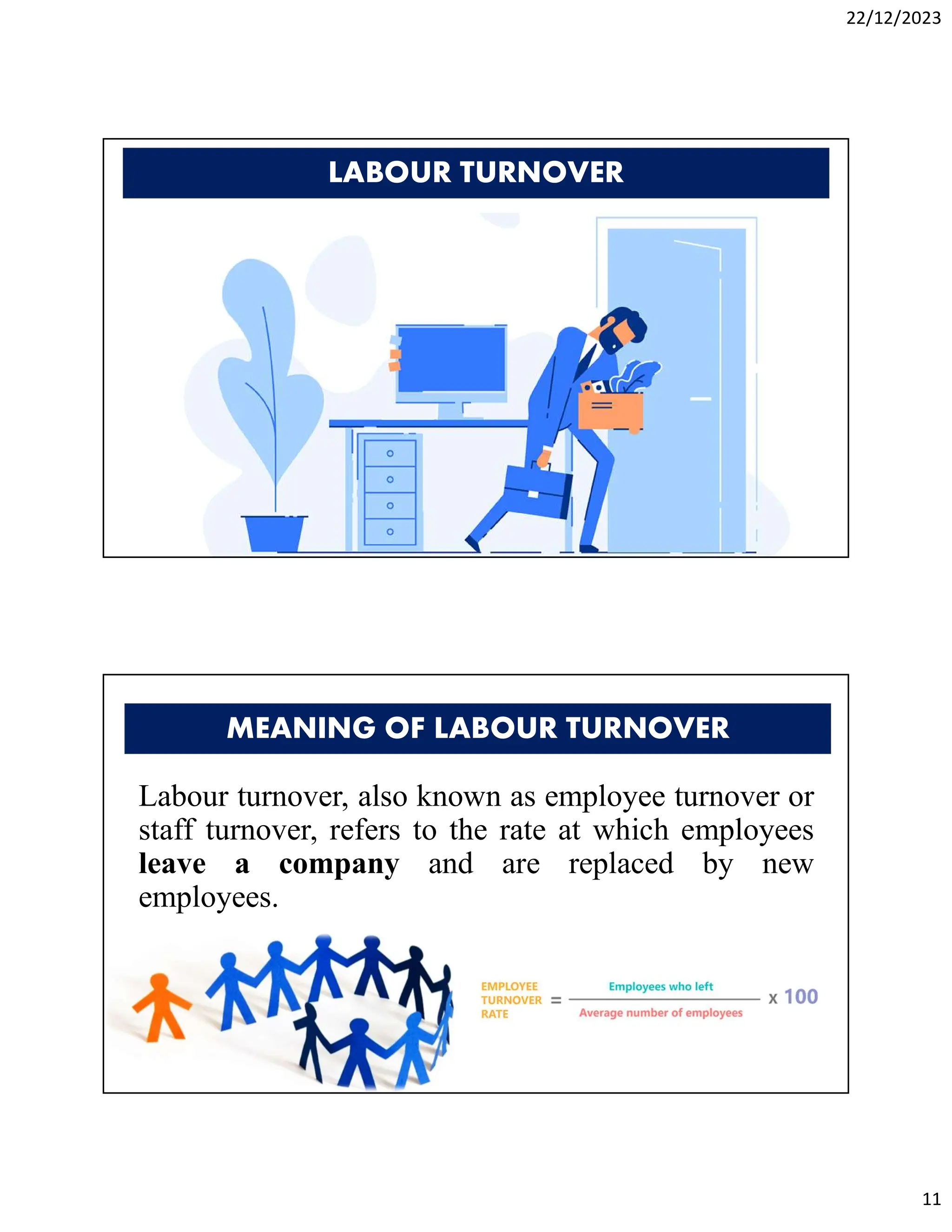
Labour turnover, also known as employee turnover or
staff turnover, refers to the rate at which employees
leave a company and are replaced by new
employees.
22/12/2023
12
Labor Turnover
1.Job Dissatisfaction
2.Better Opportunities
3.Lack of Career Advancement
4.Poor Work-Life Balance
5.Inadequate Training and Development
6.Poor Management
7.Personal Reasons
Reasons Effects
1.Financial Costs
2.Decreased Morale
3.Loss of Institutional Knowledge
4.Disruption in Operations
5.Impact on Customer Relationships
6.Reputation Damage
7.Reduced Employee Engagement
METHODS OF WAGE PAYMENT
• Wage payment methods refer to the
various ways in which employees
receive their compensation for work
performed.
• The method of wage payment can
vary depending on factors such as
industry practices, company policies,
and legal regulations.
22/12/2023
13
Methods of Wage Payment
1. Time rate system
2. Piece rate system
3. Incentive schemes
- Halsey plan
-Rowan plan
-Taylor differential piece rate system
- Merrick’s Differential piece rate system

Cost Accounting: Unit-3 - Labour Cost

  • 1.
  • 2.
    22/12/2023 2 LABOUR INTRODUCTION • The term"labour" generally refers to human effort or work, especially when it is done in the context of producing goods and services. • The concept of labour encompasses various types of activities, ranging from physical tasks to intellectual pursuits, all of which contribute to the creation and development of societies.
  • 3.
    22/12/2023 3 Meaning of Labour Theterm "labour" refers to the human effort, skill, and work involved in the production of goods. Labour is a crucial factor in the manufacturing process, and it encompasses various activities performed by workers to transform raw materials into finished products.
  • 4.
    22/12/2023 4 Meaning of LabourCost • Labour cost in the manufacturing industry refers to the total expenses incurred by a company in compensating its workforce for the production of goods. • It encompasses the wages, salaries, benefits, and other expenses associated with employing workers involved in the manufacturing process. TYPES OF LABOUR
  • 5.
    22/12/2023 5 TYPES OF EMPLOYEESBASED ON SKILLS 1.Direct Wages or Salaries: • Hourly Wages: Payments based on the number of hours worked. • Salaried Wages: Fixed payments regardless of the number of hours worked. 2.Overtime Pay: • Extra compensation for hours worked beyond the standard workweek or workday. 3.Bonuses and Commissions: • Additional payments based on performance, sales targets, or other criteria. 4.Benefits: • Health Insurance: Costs associated with providing medical coverage to employees. • Retirement Plans: Contributions to pension or 401(k) plans. • Paid Time Off: Vacation days, sick leave, and other paid time off benefits. 5.Social Security and Medicare Taxes: • Employer contributions to social security and Medicare based on employees' wages. TYPES OF LABOUR COST
  • 6.
    22/12/2023 6 6. Workers' CompensationInsurance: • Insurance providing coverage for work-related injuries or illnesses. 7. Training and Development: • Costs associated with employee training and skill development programs. 8. Recruitment and Hiring Costs: • Expenses related to finding, interviewing, and hiring new employees. 9. Severance Pay: • Payments made to employees upon termination or retirement. 10. Payroll Processing Costs: • Administrative costs associated with processing payroll, including software, personnel, and other related expenses. 11. Employee Assistance Programs (EAPs): • Costs related to providing support services for employees dealing with personal or work-related issues. Continue… ATTENDANCE PROCEDURE Time Keeping Time Booking
  • 7.
    22/12/2023 7 DIFFERENCE BETWEEN TIMEKEEPING AND TIME BOOKING 1.Timekeeping: • Employees record their working hours through methods such as time cards, biometric systems, or electronic timekeeping software. 2.Attendance Tracking: • HR or relevant personnel track employee attendance, including leaves, vacations, and any other time off. 3.Salary Structure and Deductions: • Establish a clear salary structure that includes base pay, bonuses, overtime, and other allowances. • Deduct applicable taxes, social security contributions, and other deductions. 4.Employee Information: • Maintain accurate and up-to-date employee records, including personal details, tax information, and benefit elections. 5.Calculate Gross Pay: • Calculate the total earnings for each employee based on the hours worked, overtime, and any additional bonuses. 6.Deductions: • Deduct applicable taxes, social security contributions, health insurance premiums, retirement contributions, and any other authorized deductions. PAYROLL PROCEDURE
  • 8.
    22/12/2023 8 7. Net PayCalculation: • Subtract all deductions from the gross pay to determine the net pay that the employee will receive. 8. Payment Methods: • Choose a payment method (e.g., direct deposit, physical check) and distribute payments to employees on the scheduled payday. 9. Tax Filings and Payments: • Ensure timely filing of payroll taxes with relevant government agencies and make required payments. 10. Payroll Reports: • Generate payroll reports for internal record-keeping and compliance purposes. This may include summaries of gross pay, deductions, and net pay. 11. Compliance: • Stay updated on tax laws labor laws and labor regulations to ensure compliance with local, state, and federal requirements. 12. Record Keeping: • Maintain accurate and organized records of payroll transactions, including employee earnings, deductions, and tax filings. Continue… Meaning of Idle Time • Labor idle time refers to the period during which workers are not engaged in productive activities or tasks. • Idle time is generally considered undesirable in a business or production setting because it represents a loss of potential productivity and efficiency.
  • 9.
    22/12/2023 9 1.Scheduled Breaks 2.Meal Breaks 3.ShiftChanges 4.Planned Maintenance 5. Meetings Normal Idle Time Causes Treatment 1.Efficient Scheduling 2.Cross-Training 3.Synchronized Maintenance 1.Equipment Failure 2.Supply Chain Issues 3.Unplanned Absenteeism 4.Poor Planning 5.External Factors Abnormal Idle Time Causes Treatment 1.Preventive Maintenance 2.Inventory Management 3.Employee Engagement 4.Strategic Planning 5.Contingency Plans
  • 10.
    22/12/2023 10 MEANING OF OVERTIME "overtime" refers to the additional hours that employees work beyond their regular, standard working hours. Standard working hours typically constitute the normal, agreed-upon hours of a full-time employment contract. 1.Workload and Deadlines 2.Inadequate Resources 3.Poor Time Management 4.Culture of Overwork 5.Lack of Work-Life Balance 6.Unclear Expectations Over Time Causes Treatment 1.Effective Work Planning 2.Resource Allocation 3.Training on Time Management 4.Promoting a Healthy Work Culture 5.Flexible Work Arrangements 6.Performance Evaluation 7.Clear Communication 8.Employee Assistance Programs (EAPs) 9.Monitoring and Feedback 10.Policy Review
  • 11.
    22/12/2023 11 LABOUR TURNOVER MEANING OFLABOUR TURNOVER Labour turnover, also known as employee turnover or staff turnover, refers to the rate at which employees leave a company and are replaced by new employees.
  • 12.
    22/12/2023 12 Labor Turnover 1.Job Dissatisfaction 2.BetterOpportunities 3.Lack of Career Advancement 4.Poor Work-Life Balance 5.Inadequate Training and Development 6.Poor Management 7.Personal Reasons Reasons Effects 1.Financial Costs 2.Decreased Morale 3.Loss of Institutional Knowledge 4.Disruption in Operations 5.Impact on Customer Relationships 6.Reputation Damage 7.Reduced Employee Engagement METHODS OF WAGE PAYMENT • Wage payment methods refer to the various ways in which employees receive their compensation for work performed. • The method of wage payment can vary depending on factors such as industry practices, company policies, and legal regulations.
  • 13.
    22/12/2023 13 Methods of WagePayment 1. Time rate system 2. Piece rate system 3. Incentive schemes - Halsey plan -Rowan plan -Taylor differential piece rate system - Merrick’s Differential piece rate system