Labour Cost
By:- Sagar Wadhawani
Chinmay Vichare
Rohit Umrao
Mamta Thakur
Objectives
• Direct and indirect labours.
• Labour turnover.
• Time keeping and time booking.
• Overtime.
• Payroll.
• Idle time
• Remuneration.
• Incentives plans.
Direct and Indirect labour
• Direct.
• Indirect.
Organization for accounting and control
of labour cost
• Departments –
 Personal
 Engineering
 Time keeping
 Payroll
 Cost accounting
Labour Turnover
• Measurement methos
1. Seperation
2. Replacement
3. Flux
Causes of Labour Turnover
• Avoidable causes.
• Unavoidable causes.
Reduction and control
• Suitable wage policy.
• Healthy and efficient working condition.
• Impartial and systematic attitude of personal management.
• Promotional opportunities.
• Labour participation.
• Taking welfare measures.
Till here by sagar
Time keeping & Time Booking
• Time keeping – recording arrival and departure time of workers for
attendence purpose and for calculations of wages,
• Time booking – recording time send by workers on different jobs or
processess for determining labour cost of job/process.
Methods
Time keeping
• Attendence register.
• Token or disc method.
• Time recording cocks
Time booking
• Job ticket
• Daily time sheet
• Weekly time sheet
• Piece work card
Overtime
Disadvantages
 Excessive labour cost.
 Decrease in labour productivity.
 Increase in lighting cost.
 Effect on health of workers.
 Increase in wages.
Treatment of overtime
• When overtime is job specific.
• When overtime is due to general pressure.
• When overtime is due to abnornal reasons.
Control of overtime
• All overtime premium should be authorised by works manager.
• It should be seperatly recorded for future planning.
• Total overtime premiun should be daily reported to the manager.
• When overtime becomes permanent feature, then steps should be
taken to cope wid additional work.
Till here by chinmay
Payroll department
• Responsible for computation and disbursement of wages payable.
• Records hours worked and wages earned.
Functions of payroll department
 To maintain records of job classification.
 To verify and summarize the time of each worker.
 To prepare the payroll and compute the wages.
 To compute payroll deduction
 To maintain payroll record of each employee.
Wage Sheet
Causual
workers
Out-worker
Payroll Department
Idle Time
• ‘Idle time represents time lost by workers who are paid on time bais’.
Causes
• Productive
• Administrative
• economic
Treatment
• Normal
• abnormal
Till here rohit
Remuneration
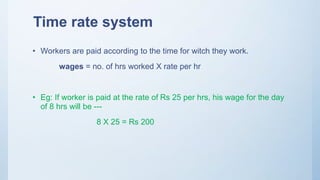
Time rate system
• Workers are paid according to the time for witch they work.
wages = no. of hrs worked X rate per hr
• Eg: If worker is paid at the rate of Rs 25 per hrs, his wage for the day
of 8 hrs will be ---
8 X 25 = Rs 200
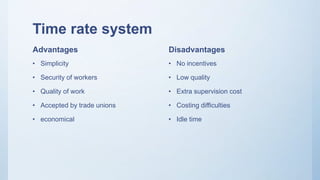
Time rate system
Advantages
• Simplicity
• Security of workers
• Quality of work
• Accepted by trade unions
• economical
Disadvantages
• No incentives
• Low quality
• Extra supervision cost
• Costing difficulties
• Idle time
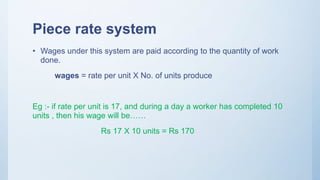
Piece rate system
• Wages under this system are paid according to the quantity of work
done.
wages = rate per unit X No. of units produce
Eg :- if rate per unit is 17, and during a day a worker has completed 10
units , then his wage will be……
Rs 17 X 10 units = Rs 170
Piece rate system
Advantages
• Incentives to efficient workers.
• Increase in production.
• Lower cost.
• Equitable.
• Decrease in supervision.
• Simple.
Disadvantages
• Poor quality of work
• No security of wages.
• Misuse of material and equipment.
• Injurious to health of workers.
• Opposed by trade unions.
Incentive planes
Halsey premiun plan & Halsey Weird
plan.
• Paid at a rate per hour.
• If worker takes standard time or more time he is paid for the actual time taken at
the time rate.
• If worker takes less than the standard time , then he is paid a bonus equal to 50%
of the time saved.
Eg:- std time = 50 hrs
Wage rate per hour = Rs 3
actual time taken =42 hrs
time saved = 50 -42 =8 hrs
Earnings = 3 X 42 + 50% 0f [8 hrs X 3]
=126+12 =Rs138
Rowan Plan
• Wages are paid on time bases.
• If worker takes standard time or more time he is paid for the actual time taken.
• If worker takes less than the standard time , then he is paid a bonus.
Eg:- std time = 50 hrs
Wage rate per hour = Rs 3
actual time taken =42 hrs
time saved = 50 -42 =8 hrs
Bonus = time saved /time allowed X time taken X time rate ==20.16
Earnings = 3 X 42 + bonus
=126+20.16 =Rs146.16
Taylor’s differential piece rate
system
• Day wages are not guaranteed.
• Lower rate & higher rate.
• Eg :- std production = 8 units per hr
working hrs per day = 8 hrs
lower rate = Rs 5 per unit
higher rate = Rs 8.75 per unit
worker X = 7 units
worker Y = 9 units
:- wages of worker X --- 7 X 5 = Rs 35
Wages of worker Y ---- 9 X 8.75 = Rs 78.75
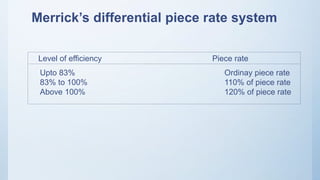
Merrick’s differential piece rate system
Level of efficiency Piece rate
Upto 83%
83% to 100%
Above 100%
Ordinay piece rate
110% of piece rate
120% of piece rate
References
• http://en.wikipedia.org/wiki/Incentive_program
• http://smallbusiness.chron.com/incentive-plans-1776.html
• http://managementstudyguide.com/employee-remuneration.htm
• http://www.business-case-analysis.com/direct-labor.html
• http://dictionary.reference.com/browse/Incentives.
Labour cost

Labour cost

  • 1.
    Labour Cost By:- SagarWadhawani Chinmay Vichare Rohit Umrao Mamta Thakur
  • 2.
    Objectives • Direct andindirect labours. • Labour turnover. • Time keeping and time booking. • Overtime. • Payroll. • Idle time • Remuneration. • Incentives plans.
  • 3.
    Direct and Indirectlabour • Direct. • Indirect.
  • 4.
    Organization for accountingand control of labour cost • Departments –  Personal  Engineering  Time keeping  Payroll  Cost accounting
  • 5.
    Labour Turnover • Measurementmethos 1. Seperation 2. Replacement 3. Flux
  • 6.
    Causes of LabourTurnover • Avoidable causes. • Unavoidable causes.
  • 7.
    Reduction and control •Suitable wage policy. • Healthy and efficient working condition. • Impartial and systematic attitude of personal management. • Promotional opportunities. • Labour participation. • Taking welfare measures. Till here by sagar
  • 8.
    Time keeping &Time Booking • Time keeping – recording arrival and departure time of workers for attendence purpose and for calculations of wages, • Time booking – recording time send by workers on different jobs or processess for determining labour cost of job/process.
  • 9.
    Methods Time keeping • Attendenceregister. • Token or disc method. • Time recording cocks Time booking • Job ticket • Daily time sheet • Weekly time sheet • Piece work card
  • 10.
    Overtime Disadvantages  Excessive labourcost.  Decrease in labour productivity.  Increase in lighting cost.  Effect on health of workers.  Increase in wages.
  • 11.
    Treatment of overtime •When overtime is job specific. • When overtime is due to general pressure. • When overtime is due to abnornal reasons.
  • 12.
    Control of overtime •All overtime premium should be authorised by works manager. • It should be seperatly recorded for future planning. • Total overtime premiun should be daily reported to the manager. • When overtime becomes permanent feature, then steps should be taken to cope wid additional work. Till here by chinmay
  • 13.
    Payroll department • Responsiblefor computation and disbursement of wages payable. • Records hours worked and wages earned.
  • 14.
    Functions of payrolldepartment  To maintain records of job classification.  To verify and summarize the time of each worker.  To prepare the payroll and compute the wages.  To compute payroll deduction  To maintain payroll record of each employee.
  • 15.
  • 16.
    Idle Time • ‘Idletime represents time lost by workers who are paid on time bais’.
  • 17.
    Causes • Productive • Administrative •economic Treatment • Normal • abnormal Till here rohit
  • 18.
  • 19.
    Time rate system •Workers are paid according to the time for witch they work. wages = no. of hrs worked X rate per hr • Eg: If worker is paid at the rate of Rs 25 per hrs, his wage for the day of 8 hrs will be --- 8 X 25 = Rs 200
  • 20.
    Time rate system Advantages •Simplicity • Security of workers • Quality of work • Accepted by trade unions • economical Disadvantages • No incentives • Low quality • Extra supervision cost • Costing difficulties • Idle time
  • 21.
    Piece rate system •Wages under this system are paid according to the quantity of work done. wages = rate per unit X No. of units produce Eg :- if rate per unit is 17, and during a day a worker has completed 10 units , then his wage will be…… Rs 17 X 10 units = Rs 170
  • 22.
    Piece rate system Advantages •Incentives to efficient workers. • Increase in production. • Lower cost. • Equitable. • Decrease in supervision. • Simple. Disadvantages • Poor quality of work • No security of wages. • Misuse of material and equipment. • Injurious to health of workers. • Opposed by trade unions.
  • 23.
  • 24.
    Halsey premiun plan& Halsey Weird plan. • Paid at a rate per hour. • If worker takes standard time or more time he is paid for the actual time taken at the time rate. • If worker takes less than the standard time , then he is paid a bonus equal to 50% of the time saved. Eg:- std time = 50 hrs Wage rate per hour = Rs 3 actual time taken =42 hrs time saved = 50 -42 =8 hrs Earnings = 3 X 42 + 50% 0f [8 hrs X 3] =126+12 =Rs138
  • 25.
    Rowan Plan • Wagesare paid on time bases. • If worker takes standard time or more time he is paid for the actual time taken. • If worker takes less than the standard time , then he is paid a bonus. Eg:- std time = 50 hrs Wage rate per hour = Rs 3 actual time taken =42 hrs time saved = 50 -42 =8 hrs Bonus = time saved /time allowed X time taken X time rate ==20.16 Earnings = 3 X 42 + bonus =126+20.16 =Rs146.16
  • 26.
    Taylor’s differential piecerate system • Day wages are not guaranteed. • Lower rate & higher rate. • Eg :- std production = 8 units per hr working hrs per day = 8 hrs lower rate = Rs 5 per unit higher rate = Rs 8.75 per unit worker X = 7 units worker Y = 9 units :- wages of worker X --- 7 X 5 = Rs 35 Wages of worker Y ---- 9 X 8.75 = Rs 78.75
  • 27.
    Merrick’s differential piecerate system Level of efficiency Piece rate Upto 83% 83% to 100% Above 100% Ordinay piece rate 110% of piece rate 120% of piece rate
  • 28.
    References • http://en.wikipedia.org/wiki/Incentive_program • http://smallbusiness.chron.com/incentive-plans-1776.html •http://managementstudyguide.com/employee-remuneration.htm • http://www.business-case-analysis.com/direct-labor.html • http://dictionary.reference.com/browse/Incentives.