Reconciliation 
PRESENTED BY 
DEEPANJOL SAWRA 1010 
MANVENDRA MISHRA 2310 
SILVESTER TOPNO 2810
Contents of Presentation 
• Definition. 
• Definition of Cost & Financial Accounting. 
• Need of reconciliation. 
• Reason for disagreement of profit. 
• Methods of reconciliation. 
• Procedure of reconciliation. 
• Memorandum reconciliation account. 
• Bibliography.
Definition 
Reconciliation of Cost Accounts and Financial 
Accounts involves the process of identifying and 
accounting for the items which have led to the 
difference in working results as shown by the Cost 
Accounts and Financial Accounts.
Definition of Cost & Financial Accounting 
Cost Accounting is the classifying, recording and 
appropriating allocation of expenditure for the determination of 
the costs of products and services and for the presentation of 
suitablely arranged data for purpose of control and guidance of 
management. 
Financial Accounting is connected with the recording and 
summarizing of financial transactions and preparation of 
financial statements in accordance with GAAP. It reports on 
financial condition and profitability of the business to owners.
Need for Reconciliation 
I. To find out the reasons for the difference in profit or loss 
in Cost or Financial accounts. 
II. To ensure the mathematical accuracy and reliability of 
Cost accounts in order to have cost ascertainment, cost 
control, and to have a check on Financial accounts. 
III. To contribute to the standardization of policies regarding 
stock valuation, deprecation and overheads. 
IV. To facilitate coordination and promote better 
cooperation between the activities of financial and cost 
sections of the accounting department. 
V. To place management in better position to acquaint itself 
with the reasons for the variation in profits paving the 
way to more effective internal control.
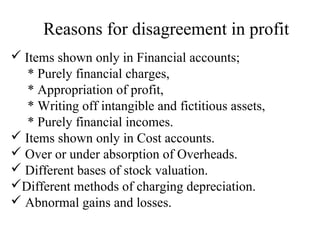
Reasons for disagreement in profit 
 Items shown only in Financial accounts; 
* Purely financial charges, 
* Appropriation of profit, 
* Writing off intangible and fictitious assets, 
* Purely financial incomes. 
 Items shown only in Cost accounts. 
 Over or under absorption of Overheads. 
 Different bases of stock valuation. 
Different methods of charging depreciation. 
 Abnormal gains and losses.
Methods of Reconciliation 
The reconciliation of costing and financial profits can be 
attempted either: 
1. By preparing a Reconciliation statement. 
2. By preparation of a Memorandum Reconciliation Account. 
Reconciliation Statement: 
While preparing a reconciliation statement, profit shown by one 
set of accounts is taken as base profit & items of differences are 
added to it or deducted from it to arrive at the figure of profit 
shown by other set of accounts.
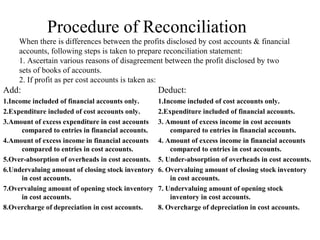
Procedure of Reconciliation 
When there is differences between the profits disclosed by cost accounts & financial 
accounts, following steps is taken to prepare reconciliation statement: 
1. Ascertain various reasons of disagreement between the profit disclosed by two 
sets of books of accounts. 
2. If profit as per cost accounts is taken as: 
Add: 
1.Income included of financial accounts only. 
2.Expenditure included of cost accounts only. 
3.Amount of excess expenditure in cost accounts 
compared to entries in financial accounts. 
4.Amount of excess income in financial accounts 
compared to entries in cost accounts. 
5.Over-absorption of overheads in cost accounts. 
6.Undervaluing amount of closing stock inventory 
in cost accounts. 
7.Overvaluing amount of opening stock inventory 
in cost accounts. 
8.Overcharge of depreciation in cost accounts. 
Deduct: 
1.Income included of cost accounts only. 
2.Expenditure included of financial accounts. 
3. Amount of excess income in cost accounts 
compared to entries in financial accounts. 
4. Amount of excess income in financial accounts 
compared to entries in cost accounts. 
5. Under-absorption of overheads in cost accounts. 
6. Overvaluing amount of closing stock inventory 
in cost accounts. 
7. Undervaluing amount of opening stock 
inventory in cost accounts. 
8. Overcharge of depreciation in cost accounts.
Memorandum Reconciliation Account 
MEMORANDUM RECONCILIATION ACCOUNT 
To financial expenses By profit as per cost A/C 
Discount Financial Income 
Fines & penalties Rent 
Bank Interest Interest 
Underwriter’s commission Dividend 
Donations Profit on sales of assets 
Goodwill written off By Items charged in cost accounts 
To under absorption of overheads Interest on own capital 
To under valuation of opening stock Rent on own building 
in cost accounts By over absorption of overheads 
To over valuation of closing account By over valuation of opening stock in 
in cost accounts cost accounts 
under charge of depreciation in By under valuation of closing stock in 
cost accounts cost accounts 
To profit as per Financial Accounts By Over charge of depreciation in cost A/c 
cost A/c
Bibliography 
• Jain,S.P,K.L Narang,2002.”Cost Accounting 
principles & practice”, 17th revised Edition, 
Kalyani Publishers-Ludhiana, pg. III-29-III-32.

Reconciliation

  • 1.
    Reconciliation PRESENTED BY DEEPANJOL SAWRA 1010 MANVENDRA MISHRA 2310 SILVESTER TOPNO 2810
  • 2.
    Contents of Presentation • Definition. • Definition of Cost & Financial Accounting. • Need of reconciliation. • Reason for disagreement of profit. • Methods of reconciliation. • Procedure of reconciliation. • Memorandum reconciliation account. • Bibliography.
  • 3.
    Definition Reconciliation ofCost Accounts and Financial Accounts involves the process of identifying and accounting for the items which have led to the difference in working results as shown by the Cost Accounts and Financial Accounts.
  • 4.
    Definition of Cost& Financial Accounting Cost Accounting is the classifying, recording and appropriating allocation of expenditure for the determination of the costs of products and services and for the presentation of suitablely arranged data for purpose of control and guidance of management. Financial Accounting is connected with the recording and summarizing of financial transactions and preparation of financial statements in accordance with GAAP. It reports on financial condition and profitability of the business to owners.
  • 5.
    Need for Reconciliation I. To find out the reasons for the difference in profit or loss in Cost or Financial accounts. II. To ensure the mathematical accuracy and reliability of Cost accounts in order to have cost ascertainment, cost control, and to have a check on Financial accounts. III. To contribute to the standardization of policies regarding stock valuation, deprecation and overheads. IV. To facilitate coordination and promote better cooperation between the activities of financial and cost sections of the accounting department. V. To place management in better position to acquaint itself with the reasons for the variation in profits paving the way to more effective internal control.
  • 6.
    Reasons for disagreementin profit  Items shown only in Financial accounts; * Purely financial charges, * Appropriation of profit, * Writing off intangible and fictitious assets, * Purely financial incomes.  Items shown only in Cost accounts.  Over or under absorption of Overheads.  Different bases of stock valuation. Different methods of charging depreciation.  Abnormal gains and losses.
  • 7.
    Methods of Reconciliation The reconciliation of costing and financial profits can be attempted either: 1. By preparing a Reconciliation statement. 2. By preparation of a Memorandum Reconciliation Account. Reconciliation Statement: While preparing a reconciliation statement, profit shown by one set of accounts is taken as base profit & items of differences are added to it or deducted from it to arrive at the figure of profit shown by other set of accounts.
  • 8.
    Procedure of Reconciliation When there is differences between the profits disclosed by cost accounts & financial accounts, following steps is taken to prepare reconciliation statement: 1. Ascertain various reasons of disagreement between the profit disclosed by two sets of books of accounts. 2. If profit as per cost accounts is taken as: Add: 1.Income included of financial accounts only. 2.Expenditure included of cost accounts only. 3.Amount of excess expenditure in cost accounts compared to entries in financial accounts. 4.Amount of excess income in financial accounts compared to entries in cost accounts. 5.Over-absorption of overheads in cost accounts. 6.Undervaluing amount of closing stock inventory in cost accounts. 7.Overvaluing amount of opening stock inventory in cost accounts. 8.Overcharge of depreciation in cost accounts. Deduct: 1.Income included of cost accounts only. 2.Expenditure included of financial accounts. 3. Amount of excess income in cost accounts compared to entries in financial accounts. 4. Amount of excess income in financial accounts compared to entries in cost accounts. 5. Under-absorption of overheads in cost accounts. 6. Overvaluing amount of closing stock inventory in cost accounts. 7. Undervaluing amount of opening stock inventory in cost accounts. 8. Overcharge of depreciation in cost accounts.
  • 9.
    Memorandum Reconciliation Account MEMORANDUM RECONCILIATION ACCOUNT To financial expenses By profit as per cost A/C Discount Financial Income Fines & penalties Rent Bank Interest Interest Underwriter’s commission Dividend Donations Profit on sales of assets Goodwill written off By Items charged in cost accounts To under absorption of overheads Interest on own capital To under valuation of opening stock Rent on own building in cost accounts By over absorption of overheads To over valuation of closing account By over valuation of opening stock in in cost accounts cost accounts under charge of depreciation in By under valuation of closing stock in cost accounts cost accounts To profit as per Financial Accounts By Over charge of depreciation in cost A/c cost A/c
  • 10.
    Bibliography • Jain,S.P,K.LNarang,2002.”Cost Accounting principles & practice”, 17th revised Edition, Kalyani Publishers-Ludhiana, pg. III-29-III-32.