Timekeeping &
Labor Distribution
We Know Government
Contract Accounting
Who we are
Left Brain Professionals is a boutique accounting firm that serves
government contractors. We specialize in accounting system design
& implementation, audit support, training, and cybersecurity
compliance.
Our Services
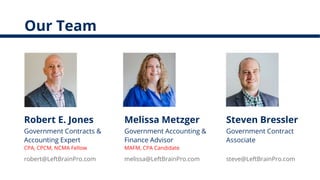
Our Team
Robert E. Jones
Government Contracts &
Accounting Expert
CPA, CPCM, NCMA Fellow
Melissa Metzger
Government Accounting &
Finance Advisor
MAFM, CPA Candidate
Steven Bressler
Government Contract
Associate
steve@LeftBrainPro.commelissa@LeftBrainPro.comrobert@LeftBrainPro.com
Learning
Objectives
• List key components of a timekeeping
system.
• Describe labor distribution.
• Explain the effect of labor distribution
on financial reporting & indirect rates.
• Select an appropriate method for
total time accounting.
• List timekeeping solutions.
Room Poll
What is your level of knowledge on timekeeping & labor
distribution?
A. What is timekeeping & labor distribution?
B. I know some, but don’t have a process or system in place.
C. I’m fairly knowledgeable but could use a better understanding.
D. I’m an expert on the subject.
Components of a
Timekeeping System
DCAA’s Information for Contractors
Download and read DCAA’s Information for Contractors.
100 pages of information every accountant and owner/executive in your
company should know.
Unlike other costs, labor is not supported by external documentation or
physical evidence to provide an independent check or balance.
Timekeeping Procedures
1. Segregation of responsibilities for labor-related activities
a. Procedures must be evident, clear-cut and reasonable
b. Maintenance of controls must be continually verified
2. Individual employees must be constantly, although unobtrusively,
made aware of controls that act as an effective deterrent against
violations
Timesheet Preparation
Detailed instructions for timesheet preparation should be
established through a timekeeping manual and/or company
procedure.
1. Employee records her/his time daily
2. Record time on the timesheet
3. The correct distribution of time by project numbers, contract
number or name, or other identifiers for a particular assignment
4. Changes to the timesheet
5. Recording all hours worked whether they are paid or not
6. Certifying the hours on the timesheet
Recommended Timekeeping Policy
1. The supervisor should approve and co-sign, all timesheets.
2. The supervisor is prohibited from completing an employee’s
timesheet.
3. The nature of the work determines the proper distribution of
time, not availability of funding, type of contract, or other
factors.
4. The accurate and complete preparation of timesheet is the
employee’s responsibility.
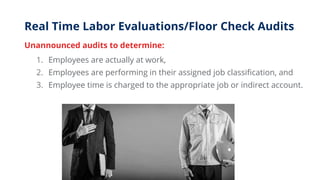
Real Time Labor Evaluations/Floor Check Audits
Unannounced audits to determine:
1. Employees are actually at work,
2. Employees are performing in their assigned job classification, and
3. Employee time is charged to the appropriate job or indirect account.
Room Poll
All the following are included in timesheet preparation except:
A. Employee records her/his time daily.
B. Record time on the timesheet.
C. Verification employees are actually at work.
D. Recording all hours worked whether they are paid or not.
Labor Distribution
Labor Distribution
Labor distribution involves converting
hours into dollars and distributing
those dollars:
1. Across the G/L among the
appropriate cost pools (direct,
fringe, overhead, G&A)
2. Among all jobs (direct and indirect)
Labor Distribution – Across the G/L
Need payroll dollars in Fringe, Overhead and G&A in order to properly
calculate rates.
You need G/L accounts for:
1. Direct Labor
2. Paid Absences (Fringe – PTO, holiday, etc.)
3. Overhead Labor (supervisors, training, idle time)
4. G&A Labor
Cont…
Labor Distribution – Across the G/L, Continued…
Tips:
1. Use “Labor” in the title/description
2. Ensure homogeneous account – only include labor
3. G/L labor accounts should tie to your W-3/941 at the end of the year
Labor Distribution – Among All Jobs
Total payroll dollars need to match amounts charged across all jobs,
direct and indirect.
1. You cannot charge the government more than you paid.
2. See tip #3 on previous slide and Total Time Accounting (next section).
We recommend use of jobs/projects for all direct and indirect expenses:
1. Same process for time and expense entry.
2. Easy to run reports.
Room Poll
In Labor Distribution Across the G/L, you need G/L accounts for:
A. Direct Labor
B. Paid Absences
C. Overhead Labor
D. All the Above
Total Time Accounting
Methods
Total Time Accounting Methods
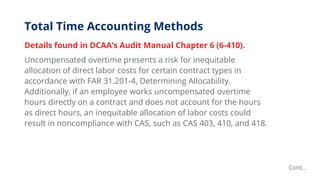
Details found in DCAA’s Audit Manual Chapter 6 (6-410).
Uncompensated overtime presents a risk for inequitable
allocation of direct labor costs for certain contract types in
accordance with FAR 31.201-4, Determining Allocability.
Additionally, if an employee works uncompensated overtime
hours directly on a contract and does not account for the hours
as direct hours, an inequitable allocation of labor costs could
result in noncompliance with CAS, such as CAS 403, 410, and 418.
Cont…
Total Time Accounting Methods, Continued…
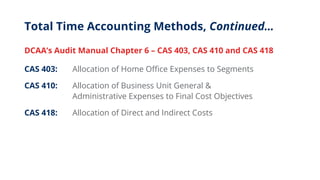
DCAA’s Audit Manual Chapter 6 – CAS 403, CAS 410 and CAS 418
CAS 403: Allocation of Home Office Expenses to Segments
CAS 410: Allocation of Business Unit General &
Administrative Expenses to Final Cost Objectives
CAS 418: Allocation of Direct and Indirect Costs
Acceptable Methods
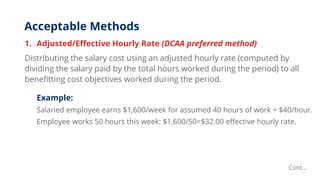
1. Adjusted/Effective Hourly Rate (DCAA preferred method)
Distributing the salary cost using an adjusted hourly rate (computed by
dividing the salary paid by the total hours worked during the period) to all
benefitting cost objectives worked during the period.
Example:
Salaried employee earns $1,600/week for assumed 40 hours of work = $40/hour.
Employee works 50 hours this week: $1,600/50=$32.00 effective hourly rate.
Cont…
Acceptable Methods, Continued…
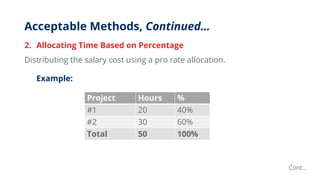
2. Allocating Time Based on Percentage
Distributing the salary cost using a pro rate allocation.
Example:
Cont…
Project Hours %
#1 20 40%
#2 30 60%
Total 50 100%
Room Poll
“Uncompensated overtime presents a risk for inequitable
allocation of ______labor costs.
A. Indirect
B. Unallowable
C. Direct
D. G&A
Acceptable Methods, Continued…
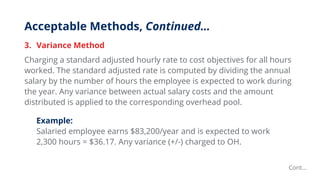
3. Variance Method
Charging a standard adjusted hourly rate to cost objectives for all hours
worked. The standard adjusted rate is computed by dividing the annual
salary by the number of hours the employee is expected to work during
the year. Any variance between actual salary costs and the amount
distributed is applied to the corresponding overhead pool.
Example:
Salaried employee earns $83,200/year and is expected to work
2,300 hours = $36.17. Any variance (+/-) charged to OH.
Cont…
Acceptable Methods, Continued…
3. Variance Method, Continued…
NOTES:
• Requires good estimate of hours worked.
• Large variances will be questioned and
need to be reconciled.
• Adds another layer of complexity to annual
budgets and still requires pay period
monitoring of actual hours worked.
FAR 52.237-10
Room Poll
The DCAA’s preferred Total Time Accounting method is:
A. Adjusted/Effective Hourly Rate
B. Allocating Time Based on Percentage
C. Variance Method
D. Real Time Labor
Financial Reporting
and Indirect Rates
Financial Reporting & Indirect Rates
Distribution of labor dollars across the G/L looks different for your tax
CPA as they are often used to a single “labor expense” account.
Distribution of labor dollars across the G/L allows for accurate
calculation of indirect rates.
Cont…
Financial Reporting & Indirect Rates, Continued…
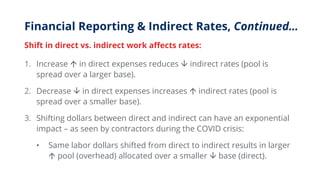
Shift in direct vs. indirect work affects rates:
1. Increase  in direct expenses reduces  indirect rates (pool is
spread over a larger base).
2. Decrease  in direct expenses increases  indirect rates (pool is
spread over a smaller base).
3. Shifting dollars between direct and indirect can have an exponential
impact – as seen by contractors during the COVID crisis:
• Same labor dollars shifted from direct to indirect results in larger
 pool (overhead) allocated over a smaller  base (direct).
Room Poll
Which of the following is a true statement:
A. Increase in direct expenses increases indirect rates.
B. Decrease in direct expenses increases indirect rates.
C. Shifting dollars between direct and indirect has no impact.
D. None of the above
Timekeeping Solutions
Payroll Platform Timekeeping Tools
Often rudimentary and lack advanced functionality and reporting:
1. Unable to calculate or provide labor distribution reports
(conversion of hours to dollars) across G/L accounts and jobs.
2. Lack adequate integration with your G/L software resulting in
manual journal entries.
You need hours and dollars to generate client invoices & job
cost reports.
3. Lack sufficient audit trail and notes to track changes.
4. Lack the ability to enforce certain requirements.
5. Unable to track & report on labor by both individual & labor
category, especially when labor categories vary by contract.
GovCon Timekeeping Solutions
Designed to meet the requirements
of government contractors:
• TSheets
• Harvest
• BigTime
• Hour Timesheet
• Spring Ahead
Timekeeping by Labor Category
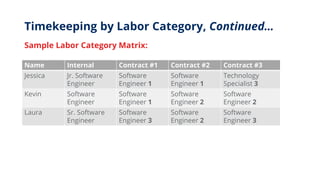
Government contracts often include invoicing and reporting
requirements by labor category. This means your system needs to track
time by individual and by labor category.
This process is complicated by the fact that you may have multiple
people in a single labor category and a single individual may qualify for
different labor categories across all of your contracts.
Cont…
Timekeeping by Labor Category, Continued…
Sample Labor Category Matrix:
Name Internal Contract #1 Contract #2 Contract #3
Jessica Jr. Software
Engineer
Software
Engineer 1
Software
Engineer 1
Technology
Specialist 3
Kevin Software
Engineer
Software
Engineer 1
Software
Engineer 2
Software
Engineer 2
Laura Sr. Software
Engineer
Software
Engineer 3
Software
Engineer 2
Software
Engineer 3
Labor is the number one expense of most
companies and the largest expense to the
government when purchasing supplies and
services. This is why timekeeping is so
important for an organization. Accurately
capturing and reporting all time worked and
the assignment of that time to intermediate
or final cost objectives, is critical when
translating hours from timekeeping into
dollars (i.e., labor distribution) for detailed
financial analysis.
Timekeeping and Labor Distribution
Room Poll
Given what we’ve covered, what’s your comfort level on
timekeeping and labor distribution?
A. I’ve got it down!
B. Still a little fuzzy, but I can manage.
C. I would like additional help.
D. Completely confused, can you do this for me?
Connect
with us
Download the presentation
Left Brain
Professionals Inc.
@LeftBrainPro
Email us
Support@LeftBrainPro.com
@LeftBrainPro
Left Brain Pro
LeftBrainPro
www.LeftBrainPro.com/presentations
For information on our upcoming webinars, visit us at
LeftBrainPro.com/events for more details.

Govology Webinar: Timekeeping & Labor Distribution

  • 1.
  • 2.
  • 3.
    Who we are LeftBrain Professionals is a boutique accounting firm that serves government contractors. We specialize in accounting system design & implementation, audit support, training, and cybersecurity compliance.
  • 4.
  • 5.
    Our Team Robert E.Jones Government Contracts & Accounting Expert CPA, CPCM, NCMA Fellow Melissa Metzger Government Accounting & Finance Advisor MAFM, CPA Candidate Steven Bressler Government Contract Associate steve@LeftBrainPro.commelissa@LeftBrainPro.comrobert@LeftBrainPro.com
  • 6.
    Learning Objectives • List keycomponents of a timekeeping system. • Describe labor distribution. • Explain the effect of labor distribution on financial reporting & indirect rates. • Select an appropriate method for total time accounting. • List timekeeping solutions.
  • 7.
    Room Poll What isyour level of knowledge on timekeeping & labor distribution? A. What is timekeeping & labor distribution? B. I know some, but don’t have a process or system in place. C. I’m fairly knowledgeable but could use a better understanding. D. I’m an expert on the subject.
  • 8.
  • 9.
    DCAA’s Information forContractors Download and read DCAA’s Information for Contractors. 100 pages of information every accountant and owner/executive in your company should know. Unlike other costs, labor is not supported by external documentation or physical evidence to provide an independent check or balance.
  • 10.
    Timekeeping Procedures 1. Segregationof responsibilities for labor-related activities a. Procedures must be evident, clear-cut and reasonable b. Maintenance of controls must be continually verified 2. Individual employees must be constantly, although unobtrusively, made aware of controls that act as an effective deterrent against violations
  • 11.
    Timesheet Preparation Detailed instructionsfor timesheet preparation should be established through a timekeeping manual and/or company procedure. 1. Employee records her/his time daily 2. Record time on the timesheet 3. The correct distribution of time by project numbers, contract number or name, or other identifiers for a particular assignment 4. Changes to the timesheet 5. Recording all hours worked whether they are paid or not 6. Certifying the hours on the timesheet
  • 12.
    Recommended Timekeeping Policy 1.The supervisor should approve and co-sign, all timesheets. 2. The supervisor is prohibited from completing an employee’s timesheet. 3. The nature of the work determines the proper distribution of time, not availability of funding, type of contract, or other factors. 4. The accurate and complete preparation of timesheet is the employee’s responsibility.
  • 13.
    Real Time LaborEvaluations/Floor Check Audits Unannounced audits to determine: 1. Employees are actually at work, 2. Employees are performing in their assigned job classification, and 3. Employee time is charged to the appropriate job or indirect account.
  • 14.
    Room Poll All thefollowing are included in timesheet preparation except: A. Employee records her/his time daily. B. Record time on the timesheet. C. Verification employees are actually at work. D. Recording all hours worked whether they are paid or not.
  • 15.
  • 16.
    Labor Distribution Labor distributioninvolves converting hours into dollars and distributing those dollars: 1. Across the G/L among the appropriate cost pools (direct, fringe, overhead, G&A) 2. Among all jobs (direct and indirect)
  • 17.
    Labor Distribution –Across the G/L Need payroll dollars in Fringe, Overhead and G&A in order to properly calculate rates. You need G/L accounts for: 1. Direct Labor 2. Paid Absences (Fringe – PTO, holiday, etc.) 3. Overhead Labor (supervisors, training, idle time) 4. G&A Labor Cont…
  • 18.
    Labor Distribution –Across the G/L, Continued… Tips: 1. Use “Labor” in the title/description 2. Ensure homogeneous account – only include labor 3. G/L labor accounts should tie to your W-3/941 at the end of the year
  • 19.
    Labor Distribution –Among All Jobs Total payroll dollars need to match amounts charged across all jobs, direct and indirect. 1. You cannot charge the government more than you paid. 2. See tip #3 on previous slide and Total Time Accounting (next section). We recommend use of jobs/projects for all direct and indirect expenses: 1. Same process for time and expense entry. 2. Easy to run reports.
  • 20.
    Room Poll In LaborDistribution Across the G/L, you need G/L accounts for: A. Direct Labor B. Paid Absences C. Overhead Labor D. All the Above
  • 21.
  • 22.
    Total Time AccountingMethods Details found in DCAA’s Audit Manual Chapter 6 (6-410). Uncompensated overtime presents a risk for inequitable allocation of direct labor costs for certain contract types in accordance with FAR 31.201-4, Determining Allocability. Additionally, if an employee works uncompensated overtime hours directly on a contract and does not account for the hours as direct hours, an inequitable allocation of labor costs could result in noncompliance with CAS, such as CAS 403, 410, and 418. Cont…
  • 23.
    Total Time AccountingMethods, Continued… DCAA’s Audit Manual Chapter 6 – CAS 403, CAS 410 and CAS 418 CAS 403: Allocation of Home Office Expenses to Segments CAS 410: Allocation of Business Unit General & Administrative Expenses to Final Cost Objectives CAS 418: Allocation of Direct and Indirect Costs
  • 24.
    Acceptable Methods 1. Adjusted/EffectiveHourly Rate (DCAA preferred method) Distributing the salary cost using an adjusted hourly rate (computed by dividing the salary paid by the total hours worked during the period) to all benefitting cost objectives worked during the period. Example: Salaried employee earns $1,600/week for assumed 40 hours of work = $40/hour. Employee works 50 hours this week: $1,600/50=$32.00 effective hourly rate. Cont…
  • 25.
    Acceptable Methods, Continued… 2.Allocating Time Based on Percentage Distributing the salary cost using a pro rate allocation. Example: Cont… Project Hours % #1 20 40% #2 30 60% Total 50 100%
  • 26.
    Room Poll “Uncompensated overtimepresents a risk for inequitable allocation of ______labor costs. A. Indirect B. Unallowable C. Direct D. G&A
  • 27.
    Acceptable Methods, Continued… 3.Variance Method Charging a standard adjusted hourly rate to cost objectives for all hours worked. The standard adjusted rate is computed by dividing the annual salary by the number of hours the employee is expected to work during the year. Any variance between actual salary costs and the amount distributed is applied to the corresponding overhead pool. Example: Salaried employee earns $83,200/year and is expected to work 2,300 hours = $36.17. Any variance (+/-) charged to OH. Cont…
  • 28.
    Acceptable Methods, Continued… 3.Variance Method, Continued… NOTES: • Requires good estimate of hours worked. • Large variances will be questioned and need to be reconciled. • Adds another layer of complexity to annual budgets and still requires pay period monitoring of actual hours worked. FAR 52.237-10
  • 29.
    Room Poll The DCAA’spreferred Total Time Accounting method is: A. Adjusted/Effective Hourly Rate B. Allocating Time Based on Percentage C. Variance Method D. Real Time Labor
  • 30.
  • 31.
    Financial Reporting &Indirect Rates Distribution of labor dollars across the G/L looks different for your tax CPA as they are often used to a single “labor expense” account. Distribution of labor dollars across the G/L allows for accurate calculation of indirect rates. Cont…
  • 32.
    Financial Reporting &Indirect Rates, Continued… Shift in direct vs. indirect work affects rates: 1. Increase  in direct expenses reduces  indirect rates (pool is spread over a larger base). 2. Decrease  in direct expenses increases  indirect rates (pool is spread over a smaller base). 3. Shifting dollars between direct and indirect can have an exponential impact – as seen by contractors during the COVID crisis: • Same labor dollars shifted from direct to indirect results in larger  pool (overhead) allocated over a smaller  base (direct).
  • 33.
    Room Poll Which ofthe following is a true statement: A. Increase in direct expenses increases indirect rates. B. Decrease in direct expenses increases indirect rates. C. Shifting dollars between direct and indirect has no impact. D. None of the above
  • 34.
  • 35.
    Payroll Platform TimekeepingTools Often rudimentary and lack advanced functionality and reporting: 1. Unable to calculate or provide labor distribution reports (conversion of hours to dollars) across G/L accounts and jobs. 2. Lack adequate integration with your G/L software resulting in manual journal entries. You need hours and dollars to generate client invoices & job cost reports. 3. Lack sufficient audit trail and notes to track changes. 4. Lack the ability to enforce certain requirements. 5. Unable to track & report on labor by both individual & labor category, especially when labor categories vary by contract.
  • 36.
    GovCon Timekeeping Solutions Designedto meet the requirements of government contractors: • TSheets • Harvest • BigTime • Hour Timesheet • Spring Ahead
  • 37.
    Timekeeping by LaborCategory Government contracts often include invoicing and reporting requirements by labor category. This means your system needs to track time by individual and by labor category. This process is complicated by the fact that you may have multiple people in a single labor category and a single individual may qualify for different labor categories across all of your contracts. Cont…
  • 38.
    Timekeeping by LaborCategory, Continued… Sample Labor Category Matrix: Name Internal Contract #1 Contract #2 Contract #3 Jessica Jr. Software Engineer Software Engineer 1 Software Engineer 1 Technology Specialist 3 Kevin Software Engineer Software Engineer 1 Software Engineer 2 Software Engineer 2 Laura Sr. Software Engineer Software Engineer 3 Software Engineer 2 Software Engineer 3
  • 39.
    Labor is thenumber one expense of most companies and the largest expense to the government when purchasing supplies and services. This is why timekeeping is so important for an organization. Accurately capturing and reporting all time worked and the assignment of that time to intermediate or final cost objectives, is critical when translating hours from timekeeping into dollars (i.e., labor distribution) for detailed financial analysis. Timekeeping and Labor Distribution
  • 40.
    Room Poll Given whatwe’ve covered, what’s your comfort level on timekeeping and labor distribution? A. I’ve got it down! B. Still a little fuzzy, but I can manage. C. I would like additional help. D. Completely confused, can you do this for me?
  • 41.
    Connect with us Download thepresentation Left Brain Professionals Inc. @LeftBrainPro Email us Support@LeftBrainPro.com @LeftBrainPro Left Brain Pro LeftBrainPro www.LeftBrainPro.com/presentations
  • 42.
    For information onour upcoming webinars, visit us at LeftBrainPro.com/events for more details.