Chapter 3
Accounting for Labor
Learning Objectives
LO1 Distinguish between features of hourly rate
and piece-rate plans.
LO2 Specify procedures for controlling labor
costs.
LO3 Account for labor costs and payroll taxes.
LO4 Prepare accruals for payroll earnings and
taxes.
LO5 Account for special problems in labor
costing.
Payroll Accounting
System for a Manufacturer
1. Record the hours worked or quantity of
output by employees in total and by job,
process, or department.
2. Analyze the hours worked by employees to
determine how labor time is to be charged.
3. Charge payroll time to jobs, processes,
departments, and factory overhead.
4. Prepare the payroll.
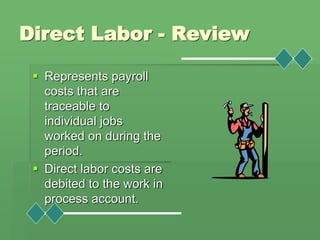
Direct Labor - Review
 Represents payroll
costs that are
traceable to
individual jobs
worked on during the
period.
 Direct labor costs are
debited to the work in
process account.
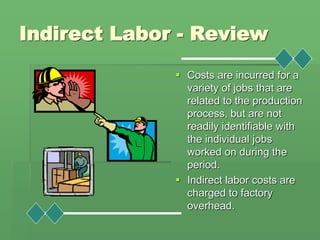
Indirect Labor - Review
 Costs are incurred for a
variety of jobs that are
related to the production
process, but are not
readily identifiable with
the individual jobs
worked on during the
period.
 Indirect labor costs are
charged to factory
overhead.
Hourly Rate Plan
 The employee’s wages are calculated by
multiplying the established rate per hour
by the number of hours worked.
 This plan does not provide an incentive
for the employee to achieve a high level
of productivity.
Piece-Rate Plan
 Employee’s wages based on the
employer’s quantity of production.
 Number of units produced is multiplied by
a predetermined rate.
 May be referred to as incentive wage
plan or piece-rate plan.
 Quality may be sacrificed in order to
maximize quantity.
Modified Wage Plan
 Minimum hourly wage is set even if an established
quota is not attained.
 If quota is exceeded, a bonus is added to the
minimum wage level.
 On days when the quota is not met, the difference
(make-up guarantee) would be charged to factory
overhead.
 When production work teams are utilized, a single
incentive for the group would be appropriate.
Labor Time Records
 Given the magnetic card reading
technology available today, the time
record typically takes the form of a
computer file.
 The labor hours recorded should be
reviewed by a production supervisor for
accuracy.
Payroll Function
 Primary responsibility is to compute the wages
and salaries earned by the employees.
 Forms should include a payroll record and
employees’ earnings records.
 A summary of the payroll is sent to accounting to
record the payroll in the accounting records.
 The payroll record is sent to the treasurer’s
department for making payments to employees.
Payroll Records
Payroll XX
FICA Tax Payable XX
Employees Income Tax Payable XX
Health Insurance Payable XX
Employee Receivable XX
Wages Payable XX
 Forms used by companies will vary, but all
forms possess some common characteristics.
 Entry to record payroll.
Employee Earnings
Records
 Company maintains a record of the
earnings for each employee.
 The cumulative record of earnings is
needed to compute earnings subject to
many types of taxes.
 Information is also used to prepare Form
W-2 and Form W-3.
Payment of Net Earnings
 Accounting department sends the payroll
record to the treasurer’s office.
 The treasurer’s office is responsible for making
the payments to employees.
Wages Payable XX
Cash XX
Entry to pay employees.
Recording Salaries and
Wages
 Labor-time records are sent to the payroll
department on a daily basis.
 The labor costs are charged to the appropriate
jobs or departments and factory overhead.
 This analysis is recorded on a labor cost summary,
in the job cost ledger, and in the factory overhead
ledger.
 Earnings of salaried employees are recorded in
the factory overhead ledger accounts and on the
labor cost summary.
Labor Cost Summary
 Hourly workers should be recording their time
on a labor time record.
 Labor costs are recorded on a labor cost
summary.
 This summarizes the direct labor and indirect
labor charges to a department for the period.
 Salaried employees are often not required to
prepare labor time records.
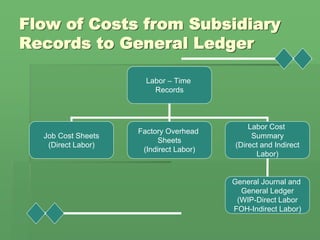
Flow of Costs from Subsidiary
Records to General Ledger
Labor – Time
Records
Job Cost Sheets
(Direct Labor)
Factory Overhead
Sheets
(Indirect Labor)
Labor Cost
Summary
(Direct and Indirect
Labor)
General Journal and
General Ledger
(WIP-Direct Labor
FOH-Indirect Labor)
Employer’s Payroll Taxes
 Federal Insurance
Contributions Act
(FICA)
 Federal
Unemployment Tax
Act (FUTA)
 State Unemployment
Tax Act (SUTA)
Payroll Accrual
 When the end of the period does not coincide
with the ending date for a payroll period, an
accrual for payroll earnings should be made.
Payroll XX
Wages Payable XX
Entry to record accrual of payroll.
Illustration of Accounting
for Labor Costs
 General Journal Entry to Record Payroll
 Payroll xx
 FICA Tax Payable xx
 Employees Income Tax Payable xx
 Health Insurance Premiums Payable xx
 Wages Payable xx
 Record Payment of Net Earnings
 to Employees
 Wages Payable xx
 Cash xx
 Distribution of Payroll
 Work in Process xx
 Factory Overhead xx
 Sales Salaries xx
 Administrative Salaries xx
 Payroll xx
 Employer’s Payroll Taxes
 Factory Overhead xx
 Payroll Tax Expense – Sales Salaries xx
 Payroll Tax Expense – Admin Salaries xx
 FICA Tax Payable xx
 Federal Unemployment Tax Payable xx
 State Unemployment Tax Payable xx
Special Labor Cost
Problems
 Shift Premiums
 Employee Pension
Costs
 Bonuses
 Vacation and Holiday
Pay
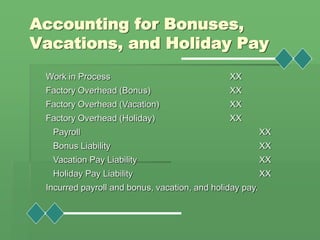
Accounting for Bonuses,
Vacations, and Holiday Pay
Work in Process XX
Factory Overhead (Bonus) XX
Factory Overhead (Vacation) XX
Factory Overhead (Holiday) XX
Payroll XX
Bonus Liability XX
Vacation Pay Liability XX
Holiday Pay Liability XX
Incurred payroll and bonus, vacation, and holiday pay.

Chapter3.ppt

  • 1.
  • 2.
    Learning Objectives LO1 Distinguishbetween features of hourly rate and piece-rate plans. LO2 Specify procedures for controlling labor costs. LO3 Account for labor costs and payroll taxes. LO4 Prepare accruals for payroll earnings and taxes. LO5 Account for special problems in labor costing.
  • 3.
    Payroll Accounting System fora Manufacturer 1. Record the hours worked or quantity of output by employees in total and by job, process, or department. 2. Analyze the hours worked by employees to determine how labor time is to be charged. 3. Charge payroll time to jobs, processes, departments, and factory overhead. 4. Prepare the payroll.
  • 4.
    Direct Labor -Review  Represents payroll costs that are traceable to individual jobs worked on during the period.  Direct labor costs are debited to the work in process account.
  • 5.
    Indirect Labor -Review  Costs are incurred for a variety of jobs that are related to the production process, but are not readily identifiable with the individual jobs worked on during the period.  Indirect labor costs are charged to factory overhead.
  • 6.
    Hourly Rate Plan The employee’s wages are calculated by multiplying the established rate per hour by the number of hours worked.  This plan does not provide an incentive for the employee to achieve a high level of productivity.
  • 7.
    Piece-Rate Plan  Employee’swages based on the employer’s quantity of production.  Number of units produced is multiplied by a predetermined rate.  May be referred to as incentive wage plan or piece-rate plan.  Quality may be sacrificed in order to maximize quantity.
  • 8.
    Modified Wage Plan Minimum hourly wage is set even if an established quota is not attained.  If quota is exceeded, a bonus is added to the minimum wage level.  On days when the quota is not met, the difference (make-up guarantee) would be charged to factory overhead.  When production work teams are utilized, a single incentive for the group would be appropriate.
  • 9.
    Labor Time Records Given the magnetic card reading technology available today, the time record typically takes the form of a computer file.  The labor hours recorded should be reviewed by a production supervisor for accuracy.
  • 10.
    Payroll Function  Primaryresponsibility is to compute the wages and salaries earned by the employees.  Forms should include a payroll record and employees’ earnings records.  A summary of the payroll is sent to accounting to record the payroll in the accounting records.  The payroll record is sent to the treasurer’s department for making payments to employees.
  • 11.
    Payroll Records Payroll XX FICATax Payable XX Employees Income Tax Payable XX Health Insurance Payable XX Employee Receivable XX Wages Payable XX  Forms used by companies will vary, but all forms possess some common characteristics.  Entry to record payroll.
  • 12.
    Employee Earnings Records  Companymaintains a record of the earnings for each employee.  The cumulative record of earnings is needed to compute earnings subject to many types of taxes.  Information is also used to prepare Form W-2 and Form W-3.
  • 13.
    Payment of NetEarnings  Accounting department sends the payroll record to the treasurer’s office.  The treasurer’s office is responsible for making the payments to employees. Wages Payable XX Cash XX Entry to pay employees.
  • 14.
    Recording Salaries and Wages Labor-time records are sent to the payroll department on a daily basis.  The labor costs are charged to the appropriate jobs or departments and factory overhead.  This analysis is recorded on a labor cost summary, in the job cost ledger, and in the factory overhead ledger.  Earnings of salaried employees are recorded in the factory overhead ledger accounts and on the labor cost summary.
  • 15.
    Labor Cost Summary Hourly workers should be recording their time on a labor time record.  Labor costs are recorded on a labor cost summary.  This summarizes the direct labor and indirect labor charges to a department for the period.  Salaried employees are often not required to prepare labor time records.
  • 16.
    Flow of Costsfrom Subsidiary Records to General Ledger Labor – Time Records Job Cost Sheets (Direct Labor) Factory Overhead Sheets (Indirect Labor) Labor Cost Summary (Direct and Indirect Labor) General Journal and General Ledger (WIP-Direct Labor FOH-Indirect Labor)
  • 17.
    Employer’s Payroll Taxes Federal Insurance Contributions Act (FICA)  Federal Unemployment Tax Act (FUTA)  State Unemployment Tax Act (SUTA)
  • 18.
    Payroll Accrual  Whenthe end of the period does not coincide with the ending date for a payroll period, an accrual for payroll earnings should be made. Payroll XX Wages Payable XX Entry to record accrual of payroll.
  • 19.
    Illustration of Accounting forLabor Costs  General Journal Entry to Record Payroll  Payroll xx  FICA Tax Payable xx  Employees Income Tax Payable xx  Health Insurance Premiums Payable xx  Wages Payable xx  Record Payment of Net Earnings  to Employees  Wages Payable xx  Cash xx  Distribution of Payroll  Work in Process xx  Factory Overhead xx  Sales Salaries xx  Administrative Salaries xx  Payroll xx  Employer’s Payroll Taxes  Factory Overhead xx  Payroll Tax Expense – Sales Salaries xx  Payroll Tax Expense – Admin Salaries xx  FICA Tax Payable xx  Federal Unemployment Tax Payable xx  State Unemployment Tax Payable xx
  • 20.
    Special Labor Cost Problems Shift Premiums  Employee Pension Costs  Bonuses  Vacation and Holiday Pay
  • 21.
    Accounting for Bonuses, Vacations,and Holiday Pay Work in Process XX Factory Overhead (Bonus) XX Factory Overhead (Vacation) XX Factory Overhead (Holiday) XX Payroll XX Bonus Liability XX Vacation Pay Liability XX Holiday Pay Liability XX Incurred payroll and bonus, vacation, and holiday pay.