Communicative Competence’ s recent
trends have put more attention to language
as interactive communication among
individuals, each with a sociocultural
identity..
communicative competence enables us to
convey and interpret messages and to
negotiate meanings interpersonally within
specific contexts.
Paulston- Hymes
Linguistic- forms
communicative
competence- knowledge
that enable to
communicate.
James Cummins
CALP- Context-
reduced- forms
BICS- Context-
embedded- face to face
communication.
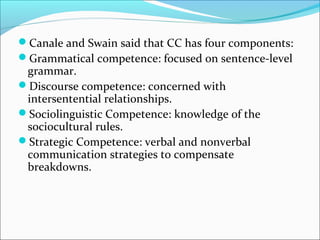
Canale and Swain said that CC has four components:
Grammatical competence: focused on sentence-level
grammar.
Discourse competence: concerned with
intersentential relationships.
Sociolinguistic Competence: knowledge of the
sociocultural rules.
Strategic Competence: verbal and nonverbal
communication strategies to compensate
breakdowns.
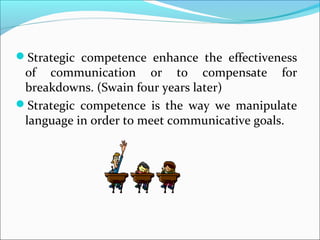
Strategic competence enhance the effectiveness
of communication or to compensate for
breakdowns. (Swain four years later)
Strategic competence is the way we manipulate
language in order to meet communicative goals.
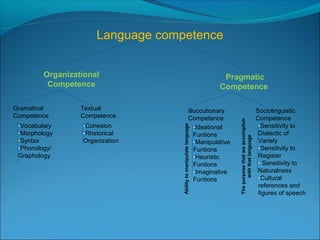
Language competence
Organizational
Competence
Pragmatic
Competence
Gramatical
Competence
Textual
Competence
-Vocabulary
-Morphology
-Syntax
-Phonology/
Graphology
-Cohesion
-Rhetorical
Organization
illuocutionary
Competence
Sociolinguistic
Competence
-Ideational
Funtions
-Manipulative
Funtions
-Heuristic
Funtions
-Imaginative
Funtions
-Sensitivity to
Dialectic of
Variety
-Sensitivity to
Register
- Sensitivity to
Naturalness
-Cultural
references and
figures of speech
Abilitytomanipulatelanguage
Thepurposethatweaccomplish
withthatlanguage
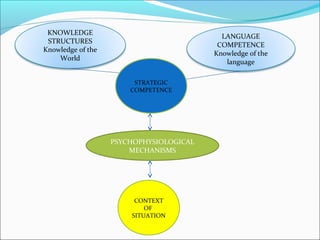
KNOWLEDGE
STRUCTURES
Knowledge of the
World
LANGUAGE
COMPETENCE
Knowledge of the
language
STRATEGIC
COMPETENCE
PSYCHOPHYSIOLOGICAL
MECHANISMS
CONTEXT
OF
SITUATION
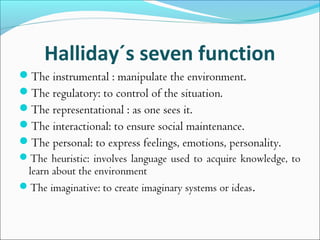
Halliday´s seven function
The instrumental : manipulate the environment.
The regulatory: to control of the situation.
The representational : as one sees it.
The interactional: to ensure social maintenance.
The personal: to express feelings, emotions, personality.
The heuristic: involves language used to acquire knowledge, to
learn about the environment
The imaginative: to create imaginary systems or ideas.
A single sentence or conversation might incorporate
many different functions simultaneously.
Curricula were organized around different functions: identifying,
reporting, denying, declining an invitation, asking permission,
apologizing, etc. Now it is referred to as functional syllabuses.
(Van EK and Alexander 1975)
Berns went on to show how context is the real key to giving meaning
to both form and function.
THANKS FOR YOUR ATTENTION!!!
It has been a nice opportunity to share our ideas with
you. We hope it has been a meaningful experience for
you as it has been for us.
PATRICIA CUBILLOS MUÑOZ
DIANA MARCELA ESCOBAR

Communicative Competence Patricia and Diana