Tayeb Rabahi
Outline
 Inroduction
 Rationale
 Early connection
 Sociolinguistics activism in education
 A dialect awareness curriculum
 Impacts
 Moving on
 conclusion
introduction
The issue:
 A strong link between linguistic research and
potential contributions to issues that are basic to
building human capital
 There are many social and educational issues
related to diversity
 Better understanding of language variation is
needed
Rationale
 In an attempt to extend their influence, researchers
put principles for sociolinguistic research
The principle of error correction: bringing the error to the
attention of the widest possible audience.
The principle of the debt incurred: an obligation to use
knowledge based on linguistic data for the benefit of the
community which data are taken from.
The principle of linguistic gratuity: it views linguistic data as
a favor, and researchers should pursue positive ways to return
linguistic favors for the community.
Early Connection
 Labov’s contributions:
Poor children lack the amount of linguistic stimulation
needed for cognitive development.
Mismatch between linguistic environment in
communities and schools was a disadvantage.
 Wolfram’s contributions:
Children’s linguistic development was tested in
Standard English.
Children who learn to read in their dominant language
are more successful.
 a speaker of African American English might more easily
read Version 2 below than Version 1.
Version 1: Standard English
“Look down here,” said Suzy.
“I can see a girl in here.
The girl looks like me.
Come here and look, David.
Can you see that girl?”
Version 2: Vernacular Black English
Susan say, “Hey you-all, look down here!
I can see a girl in here.
The girl, she look like me.
Come here and look, David!
Could you see the girl?”
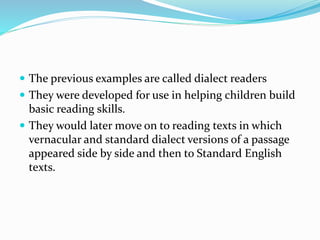
 The previous examples are called dialect readers
 They were developed for use in helping children build
basic reading skills.
 They would later move on to reading texts in which
vernacular and standard dialect versions of a passage
appeared side by side and then to Standard English
texts.
Sociolinguistics Activism in
Education
 Bias in favor of a standard dialect was placing speakers
of vernacular dialects at a disadvantage in high stakes
educational endeavors such as testing and literacy
learning.
 The case of Martin Luther King Junior Elementary
School Children:
Predictable vernacular features in their speech led to
children’s classification as learning disabled.
The story was taken up, debated, and discussed in the
court and national media.
A Dialect Awareness Curriculum
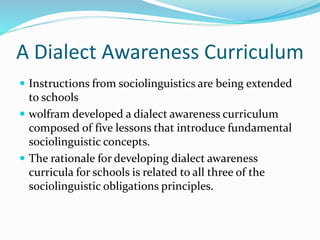
 Instructions from sociolinguistics are being extended
to schools
 wolfram developed a dialect awareness curriculum
composed of five lessons that introduce fundamental
sociolinguistic concepts.
 The rationale for developing dialect awareness
curricula for schools is related to all three of the
sociolinguistic obligations principles.
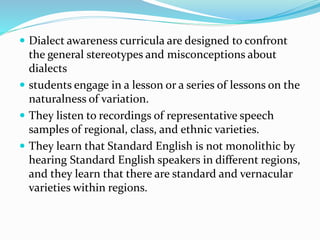
 Dialect awareness curricula are designed to confront
the general stereotypes and misconceptions about
dialects
 students engage in a lesson or a series of lessons on the
naturalness of variation.
 They listen to recordings of representative speech
samples of regional, class, and ethnic varieties.
 They learn that Standard English is not monolithic by
hearing Standard English speakers in different regions,
and they learn that there are standard and vernacular
varieties within regions.
 in the example below as students discuss the contrasts,
they learn that they exemplify not only different levels
of language but also language differences associated
with regional, social, and age groups.
1. That feller sure was tall
That fellow sure was tall
2. That road sure is sigogglin
That road sure is crooked
3. They usually be doing their homework
They usually do their homework
4. I was hanging out with my peeps
I was hanging out with my friends
Impact
 Despite the fifty-year history of sociolinguistic
applications in educational domains, disciplinary
perspectives and research findings seem not to have
been as fully embraced and integrated into
educational processes as the authors of the
applications have hoped.
 the impact of sociolinguistics is limited.
Moving on
 there is need for more collaboration between
sociolinguists and educators.
 the collaboration should build on goals and needs
recognized by educators.
 A fourth principle:
sociolinguists with information to contribute must work
with partners within the field of education who can help
determine how best to represent that mission to others
in the field and who can verify or correct their
perceptions of what educators need to know.
Conclusion
 It is hard to think of any real-world that do not have a
crucial component of language use, for language is a
central issue in most human endeavor.
 There should be collaboration between
sociolinguistics and other fields to solve diversity-
related issues.
 Educational sociolinguistics could be a rich field of
research.

Sociolinguistic variation and education

  • 1.
  • 2.
    Outline  Inroduction  Rationale Early connection  Sociolinguistics activism in education  A dialect awareness curriculum  Impacts  Moving on  conclusion
  • 3.
    introduction The issue:  Astrong link between linguistic research and potential contributions to issues that are basic to building human capital  There are many social and educational issues related to diversity  Better understanding of language variation is needed
  • 4.
    Rationale  In anattempt to extend their influence, researchers put principles for sociolinguistic research The principle of error correction: bringing the error to the attention of the widest possible audience. The principle of the debt incurred: an obligation to use knowledge based on linguistic data for the benefit of the community which data are taken from. The principle of linguistic gratuity: it views linguistic data as a favor, and researchers should pursue positive ways to return linguistic favors for the community.
  • 5.
    Early Connection  Labov’scontributions: Poor children lack the amount of linguistic stimulation needed for cognitive development. Mismatch between linguistic environment in communities and schools was a disadvantage.  Wolfram’s contributions: Children’s linguistic development was tested in Standard English. Children who learn to read in their dominant language are more successful.
  • 6.
     a speakerof African American English might more easily read Version 2 below than Version 1. Version 1: Standard English “Look down here,” said Suzy. “I can see a girl in here. The girl looks like me. Come here and look, David. Can you see that girl?” Version 2: Vernacular Black English Susan say, “Hey you-all, look down here! I can see a girl in here. The girl, she look like me. Come here and look, David! Could you see the girl?”
  • 7.
     The previousexamples are called dialect readers  They were developed for use in helping children build basic reading skills.  They would later move on to reading texts in which vernacular and standard dialect versions of a passage appeared side by side and then to Standard English texts.
  • 8.
    Sociolinguistics Activism in Education Bias in favor of a standard dialect was placing speakers of vernacular dialects at a disadvantage in high stakes educational endeavors such as testing and literacy learning.  The case of Martin Luther King Junior Elementary School Children: Predictable vernacular features in their speech led to children’s classification as learning disabled. The story was taken up, debated, and discussed in the court and national media.
  • 9.
    A Dialect AwarenessCurriculum  Instructions from sociolinguistics are being extended to schools  wolfram developed a dialect awareness curriculum composed of five lessons that introduce fundamental sociolinguistic concepts.  The rationale for developing dialect awareness curricula for schools is related to all three of the sociolinguistic obligations principles.
  • 10.
     Dialect awarenesscurricula are designed to confront the general stereotypes and misconceptions about dialects  students engage in a lesson or a series of lessons on the naturalness of variation.  They listen to recordings of representative speech samples of regional, class, and ethnic varieties.  They learn that Standard English is not monolithic by hearing Standard English speakers in different regions, and they learn that there are standard and vernacular varieties within regions.
  • 11.
     in theexample below as students discuss the contrasts, they learn that they exemplify not only different levels of language but also language differences associated with regional, social, and age groups. 1. That feller sure was tall That fellow sure was tall 2. That road sure is sigogglin That road sure is crooked 3. They usually be doing their homework They usually do their homework 4. I was hanging out with my peeps I was hanging out with my friends
  • 12.
    Impact  Despite thefifty-year history of sociolinguistic applications in educational domains, disciplinary perspectives and research findings seem not to have been as fully embraced and integrated into educational processes as the authors of the applications have hoped.  the impact of sociolinguistics is limited.
  • 13.
    Moving on  thereis need for more collaboration between sociolinguists and educators.  the collaboration should build on goals and needs recognized by educators.  A fourth principle: sociolinguists with information to contribute must work with partners within the field of education who can help determine how best to represent that mission to others in the field and who can verify or correct their perceptions of what educators need to know.
  • 14.
    Conclusion  It ishard to think of any real-world that do not have a crucial component of language use, for language is a central issue in most human endeavor.  There should be collaboration between sociolinguistics and other fields to solve diversity- related issues.  Educational sociolinguistics could be a rich field of research.