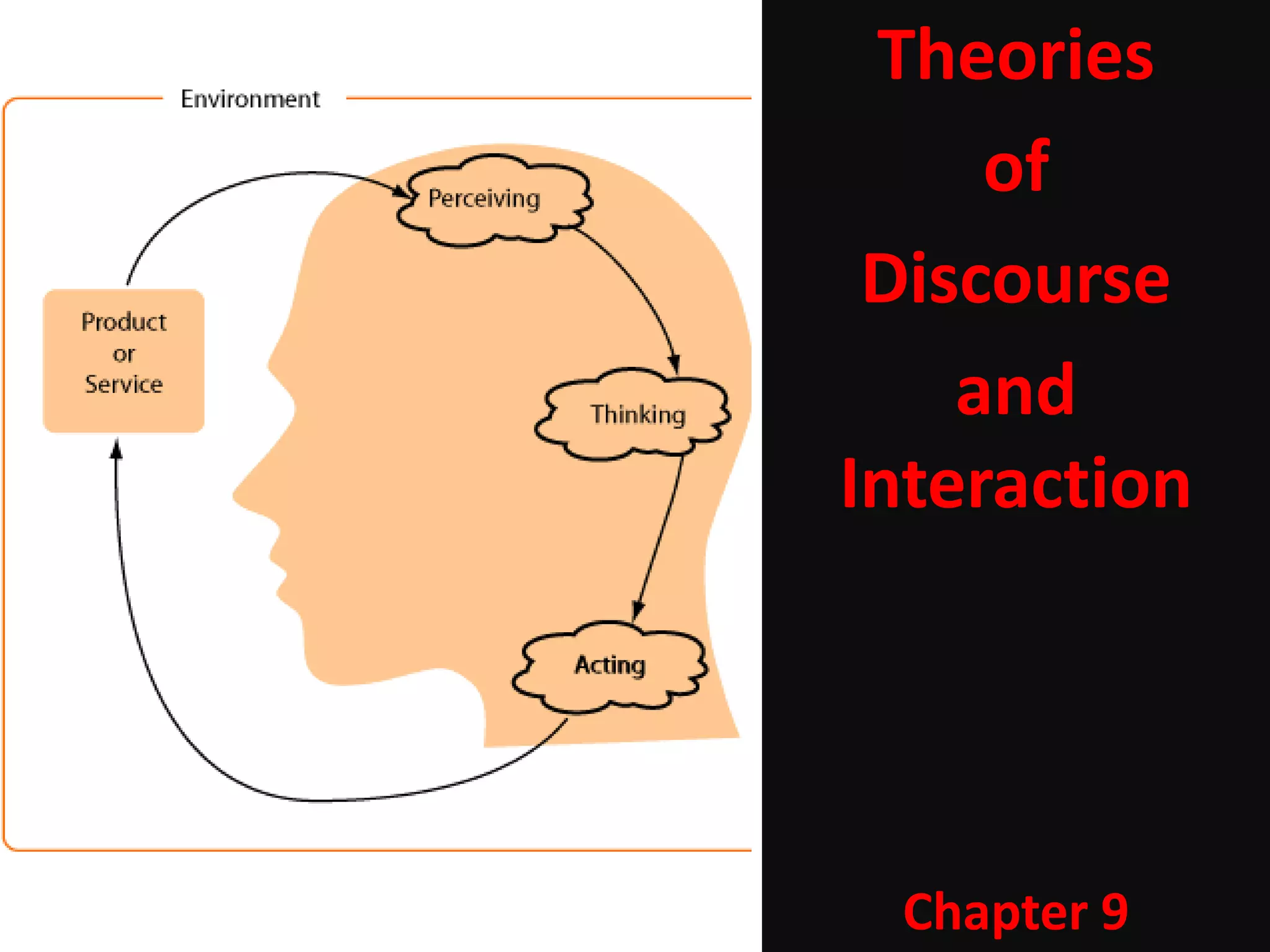
Theories
                 of
             Discourse
                and
            Interaction

Chapter 9

             Chapter 9
Communication
Is a transactional process in which the ones
actions have wide-ranging influences on the
Actions of others.

      Mutual influence = Two way impact
Key Terms
Speech Act Theory

Coordinated Management of Meaning Theory
(CMM)

Communication Accommodation Theory

Expectancy Violation Theory
Speech Act Theory
Performing an Action         5 Types of Speech Acts

1. Assertives
          2. Directives
                   3. Commissive
                           4. Expressives
                                    5. Declaratives
Assertives
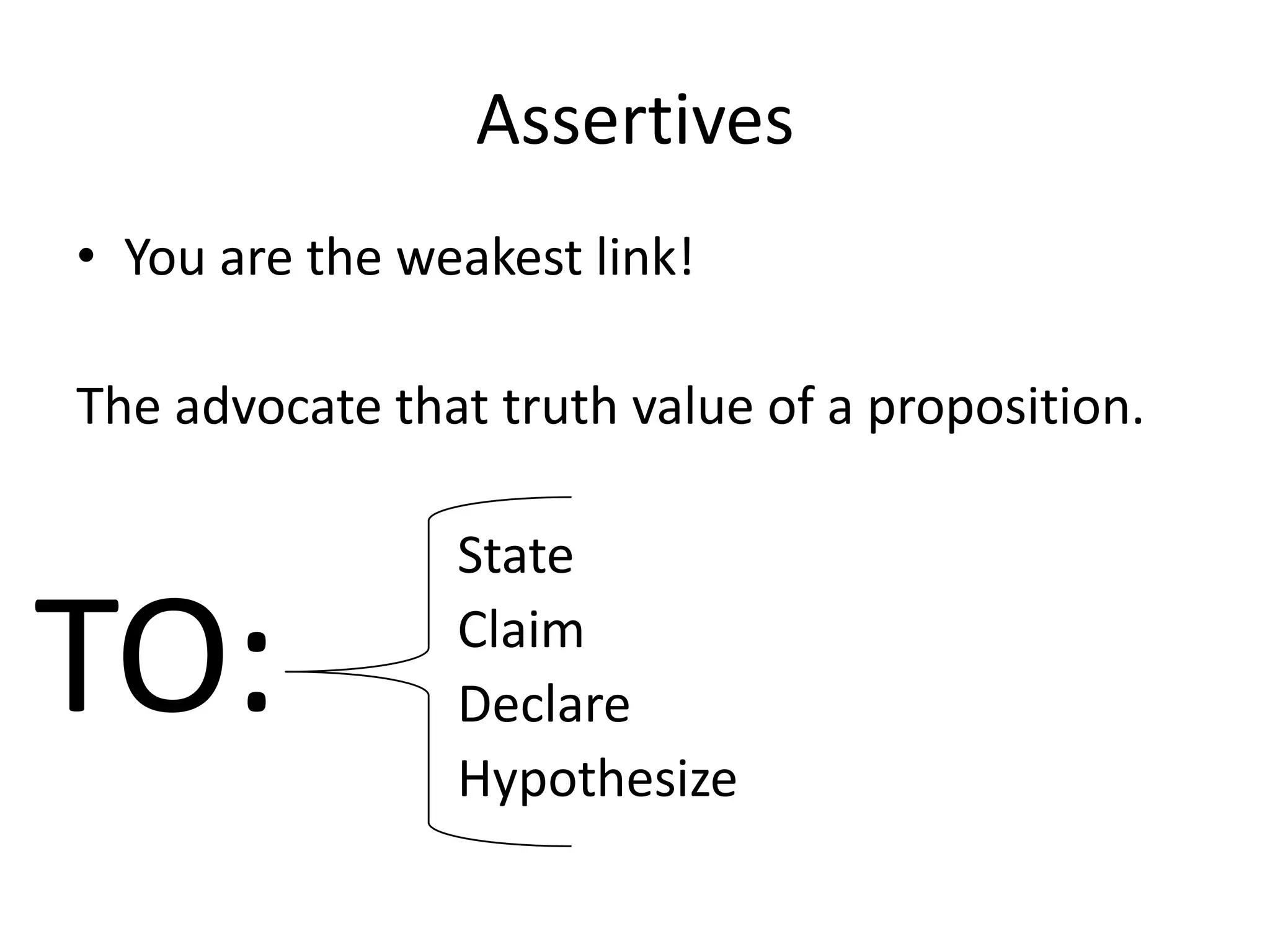
• You are the weakest link!

The advocate that truth value of a proposition.

                State

TO:             Claim
                Declare
                Hypothesize
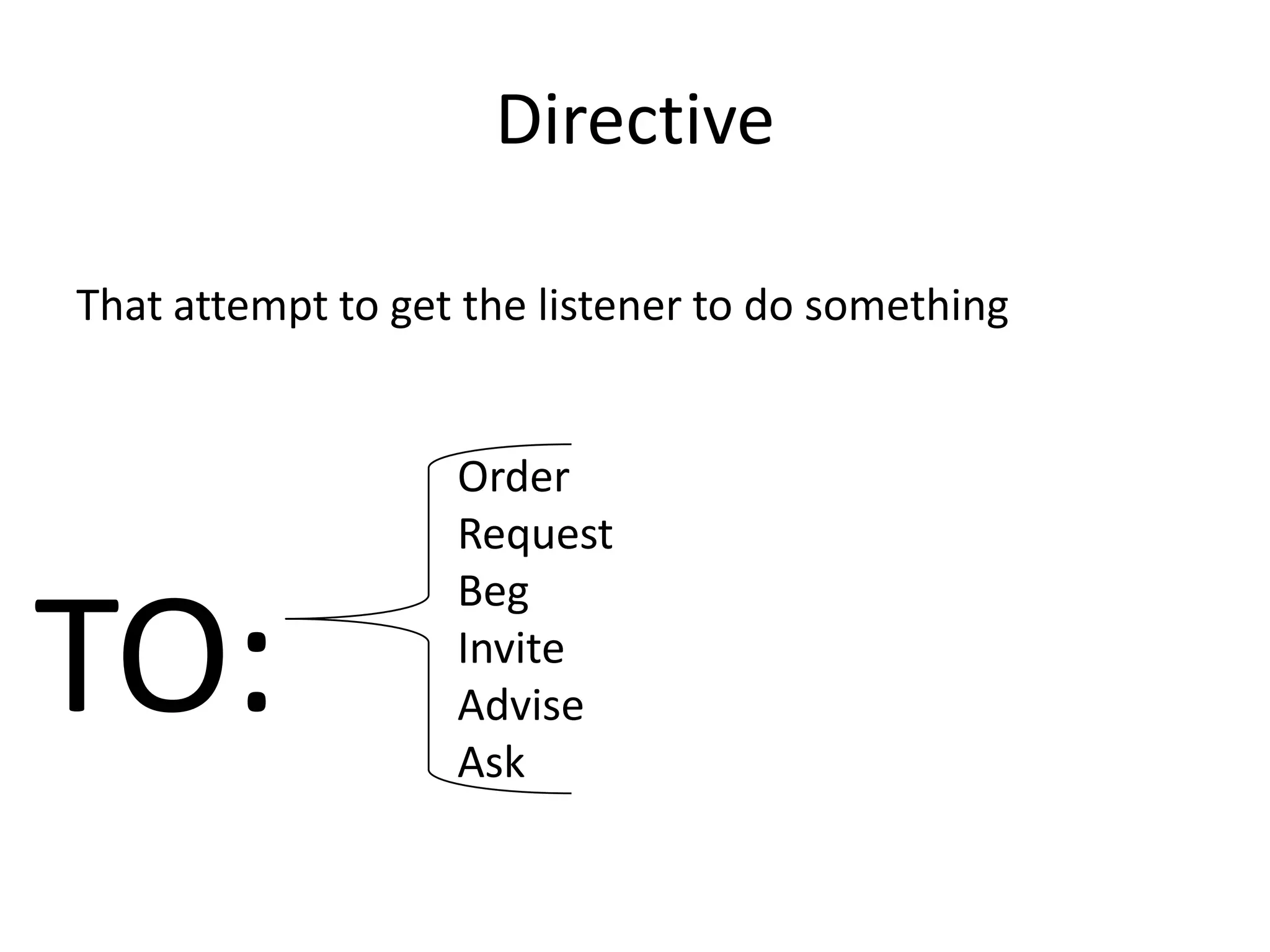
Directive

That attempt to get the listener to do something


                   Order
                   Request
                   Beg

TO:                Invite
                   Advise
                   Ask
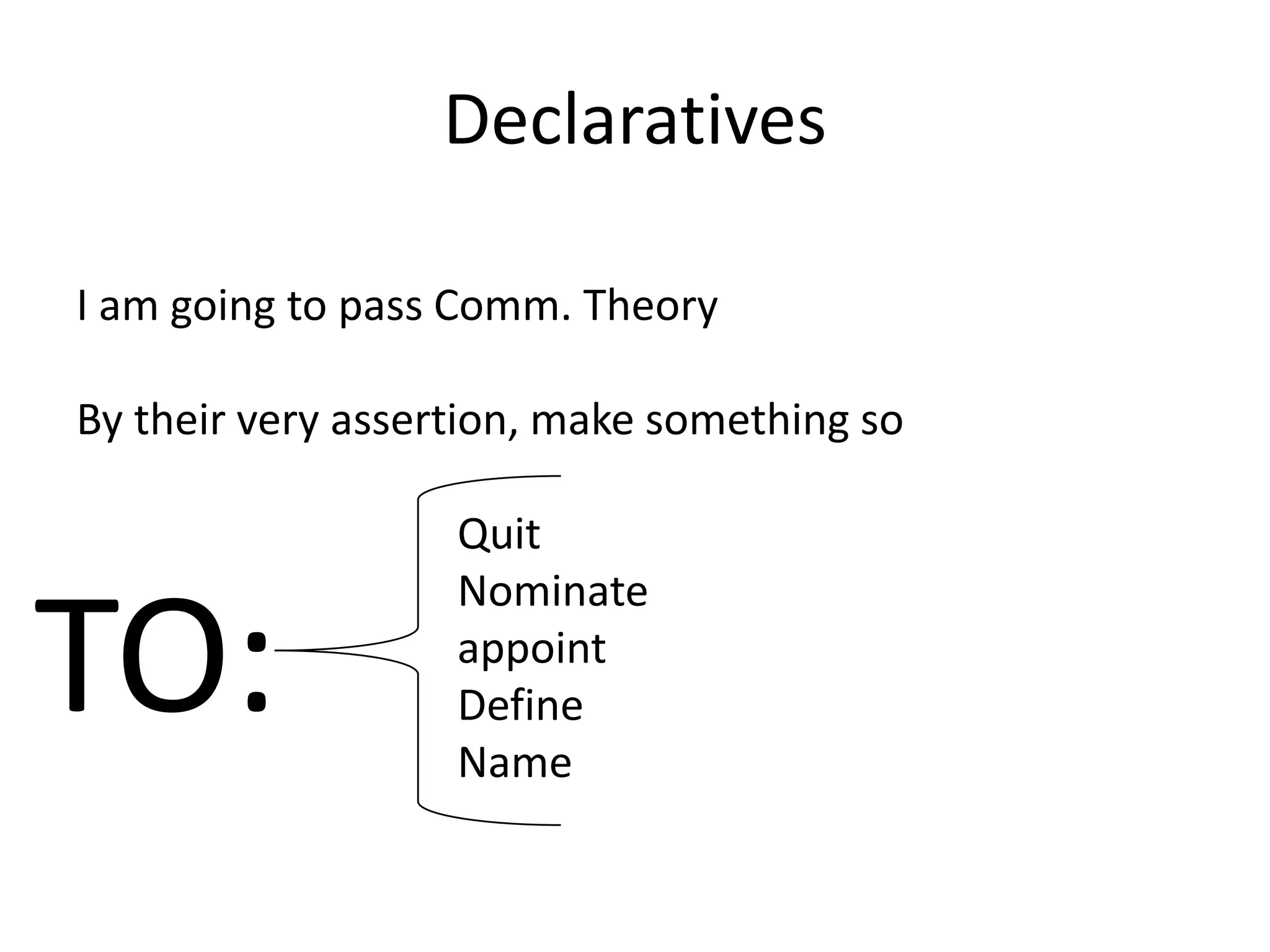
Declaratives

I am going to pass Comm. Theory

By their very assertion, make something so

                   Quit
                   Nominate

TO:                appoint
                   Define
                   Name
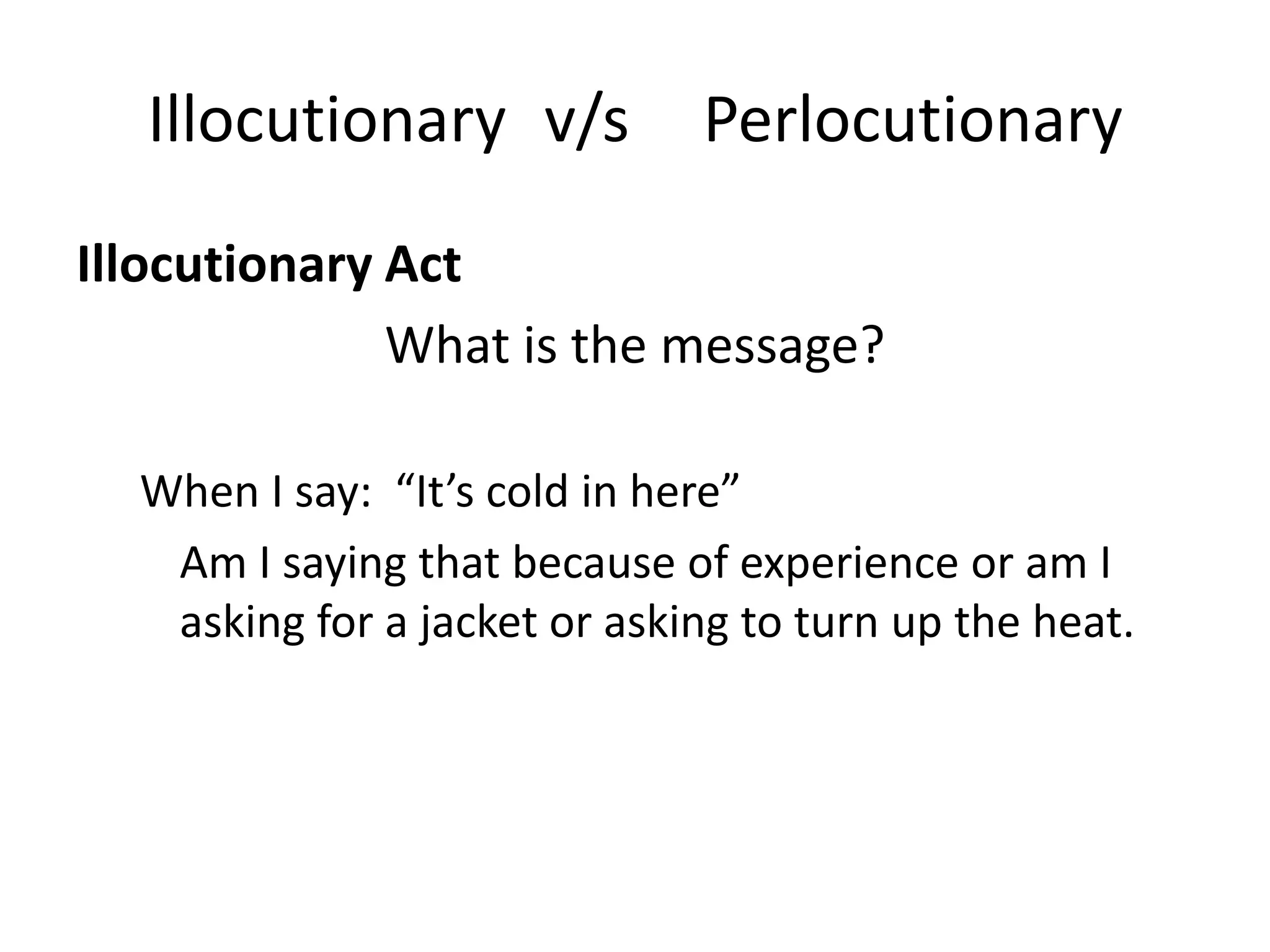
Illocutionary v/s           Perlocutionary
Illocutionary Act
              What is the message?

  When I say: “It’s cold in here”
   Am I saying that because of experience or am I
   asking for a jacket or asking to turn up the heat.
Illocutionary v/s       Perlocutionary
Perlocutionay

       Deals with the effect on the receiver

Deals with the impact on the impact of the receiver

Causing the receiver to put another log on the fire
             or turn of the thermostat
Coordinated Management of Meaning Theory
                  (CMM)
Providing some understanding of how meanings
  are created, coordinated, and managed in the
  social world.

    Management – Meaning – Coordination

The hierarchy of meaning will change depending
  on how well you know someone
Coordinated Management of Meaning Theory
                        (CMM)


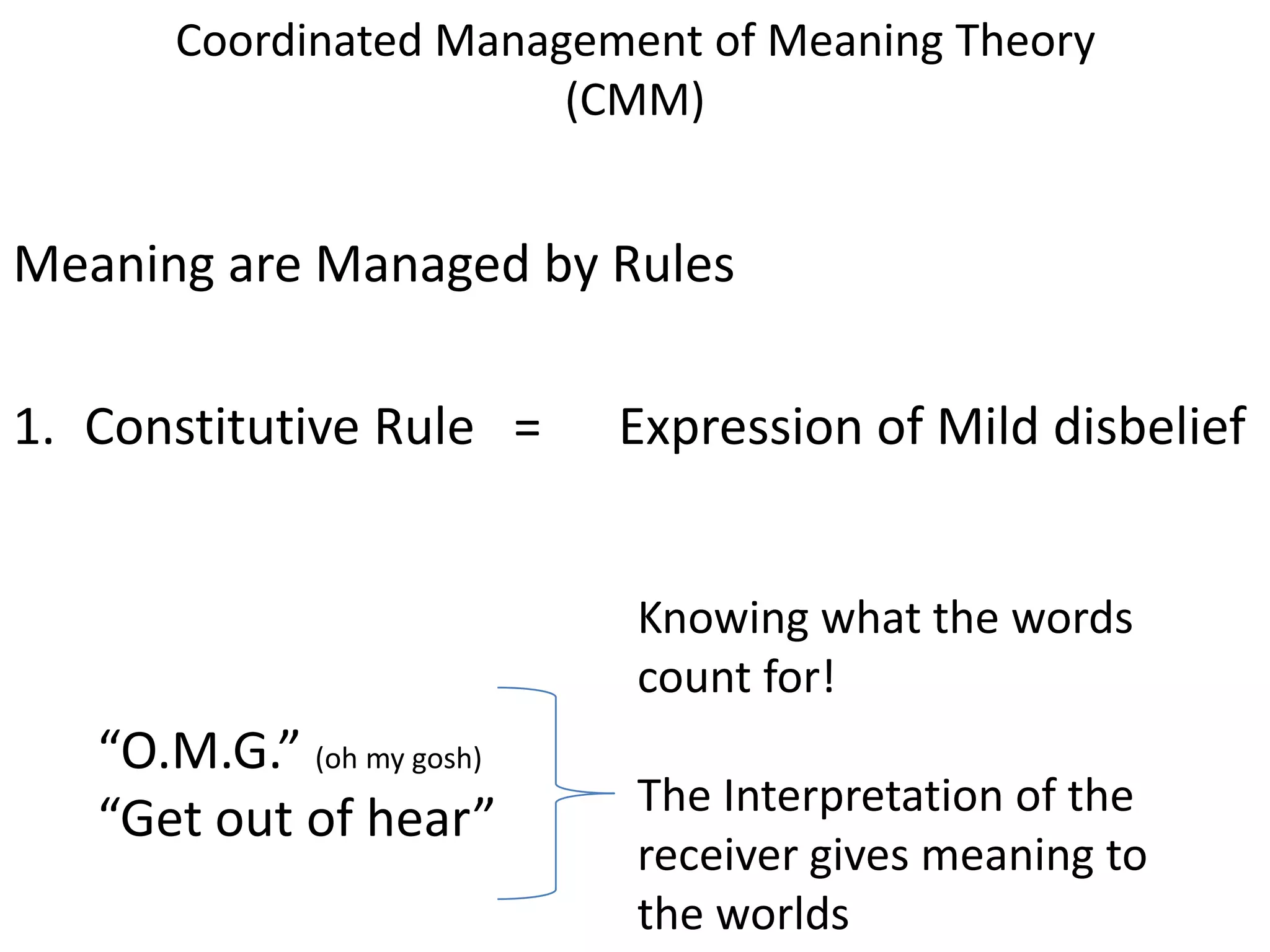
Meaning are Managed by Rules

1. Constitutive Rule =     Expression of Mild disbelief


                           Knowing what the words
                           count for!
   “O.M.G.” (oh my gosh)
                           The Interpretation of the
   “Get out of hear”
                           receiver gives meaning to
                           the worlds
Coordinated Management of Meaning Theory
                        (CMM)

Meaning are Managed by Rules cont.

  2. Regulative Rules = Patterns of regular behavior
                        within certain situations


  If you say “O.M.G.” all the time when someone tells
  you a story, O.M.G switching from a constitutive word
  or phase to a Regulative word of phase because of the
  repetition of the use of that word or phase.
Hierarchy of meaning
• A kiss in church or “You can count on me” can
  take on different meaning as the relationship
  changes.

At the introduction phase of a relationship words or
  phases could take different meaning that a
  relationship of many years.

From Dictionary content to Relationship experience
Meshing
• How intentions and interpretation mesh

        Meaning + Action = Coordinate

Two people having an argument and both
  people thinking that they came out on top
Communication Accommodation Theory
Originated in Communication

Seeks to explain with monitors and adjustment

Change your style of talk or word based on the
  person you are talking with.

Talk slow to with old people,
Speak with a southern drawl in the south,
Baby talk
Communication Accommodation Theory

 Speaker Attune:

   Matching someone else speech characteristics;

 Accent
 Length of utterances,
 Speech rate,
 Tone
Communication Accommodation Theory

Convergence:

To make similar to someone else

Individuals adapt to each other’s speech

Changing you word to sound like your: professor,
  friend from England or your Cajun roommate
Communication Accommodation Theory
Divergence:   When interactants try to highlight differences
              between themselves and others in the interactions.


Full:         individual matches the communication
              behavior of the other
Partial:      individual come close to the other but
              does not match the behavior of the other
Hyper:        the individual goes beyond the behavior of
              the other (know as mocking) aka … cross-over
Unimodal:     converging the vocabulary (Uni = one)
Multimodal:   several dimensions of behavior
Symmetrical          vs.   Asymmetrical


Symmetrical :                Asymmetrical:

Both parties in the          Only one party
Interaction attempt          in the interaction
                             attempts to
to converge towards          converge
each other
Antecedents to Accommodation
Antecedents (aka)      “Cause” to Accommodation

Wanting to be like another

Need for social approval, especially if future
 interaction is likely

Status & Power
Consequences of Accommodation
Depends of the interpretation we make of others
                 accommodation

Negative consequences for convergence if we
perceive that the person is accommodating to
curry favor.

Doctor – patient interaction
Expectancy Violation Theory

Began as a theory of nonverbal communication


Arousal – causes us to pay more attention to
          the violation than other elements of
          the interaction
Expectancy Violation Theory
          Violation of Expectation

Depends on 2 Factors;

     1. Your evaluation of the violation itself
     2. Your evaluation of the person committing
        the violation
Expectancy Violation Theory

• Negative Valance ~ Does less than expected
• Positive Valance ~ Does more than expected

   Threshold level is the behavior recognized as
              violating the expectation

Arousal = causes an alertness that diverts attention
Expectancy Violation Theory
Communicator reward valence

Reward valence is based on a host of factors that
  influence assessment of the violation;

  1.   Personality,
  2.   Physical attractiveness
  3.   Likelihood of future interaction
  4.   Status or power
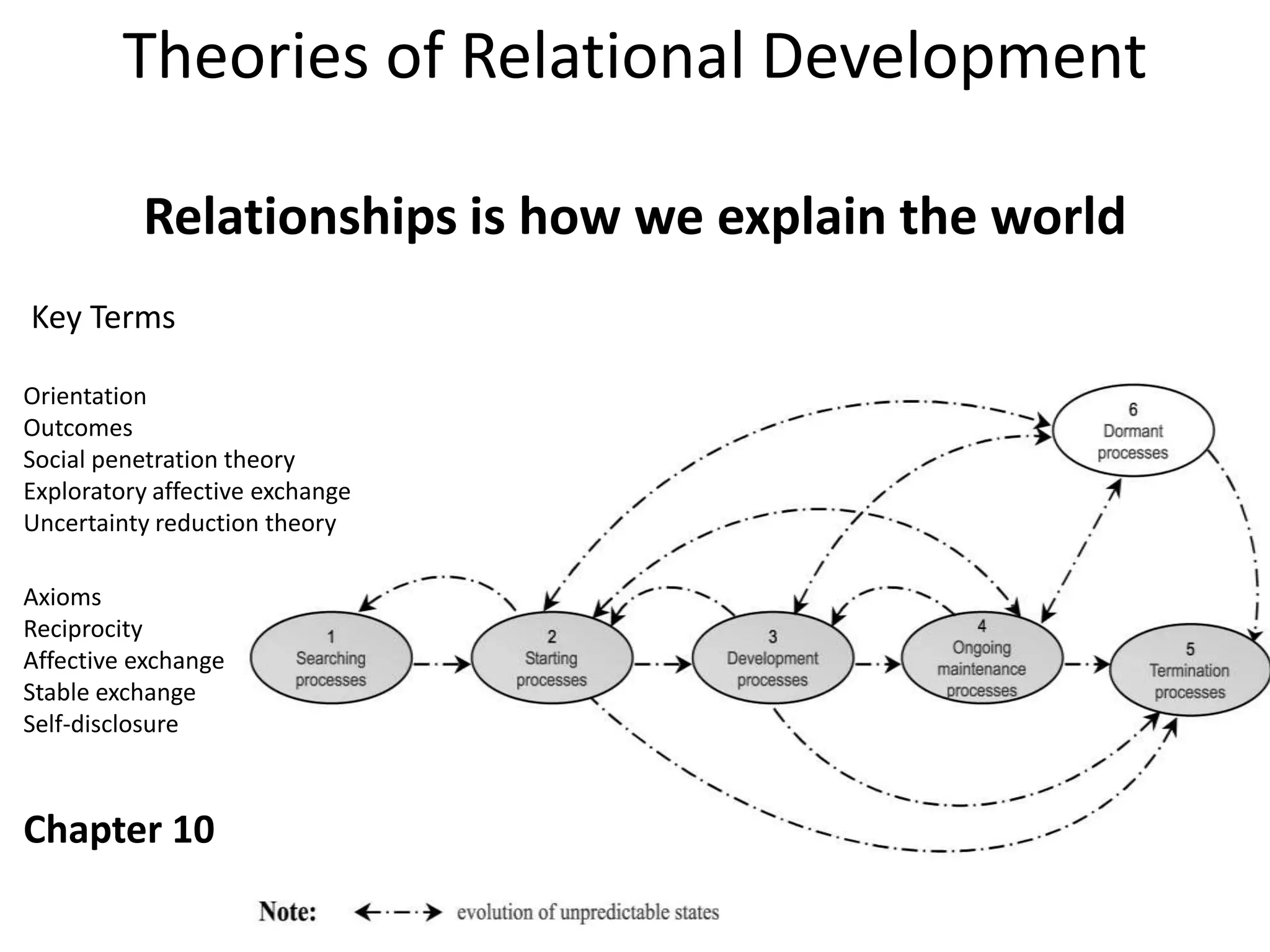
Theories of Relational Development

          Relationships is how we explain the world
Key Terms

Orientation
Outcomes
Social penetration theory
Exploratory affective exchange
Uncertainty reduction theory

Axioms
Reciprocity
Affective exchange
Stable exchange
Self-disclosure


Chapter 10
Social Penetration Theory
The development of relationships and self-disclosure

         4 sequential stages of relationship

1. Orientation
    2. Exploratory affective
          3. Affective exchange
                4. Stable exchange
Social Penetration Theory
Orientation:

The earliest stage were cautions and
 tentative in their interaction of
 sharing information.

Surface and Small Talk
Social Penetration Theory
Exploratory affective exchange:

The individuals begin to relax and share
 some information beyond small.

Family and Back ground
Social Penetration Theory
Affective exchange:

Many barriers have been crossed with a
 great deal of open exchange occurs.

Close friends and Romantic
Social Penetration Theory
Stable exchange:

Continued openness and interactions.
 Communication occurs often and can be
 nonverbal level

Solid and stable Friendship. Rate of self-
  disclosure is slowing down.
Social Penetration Theory


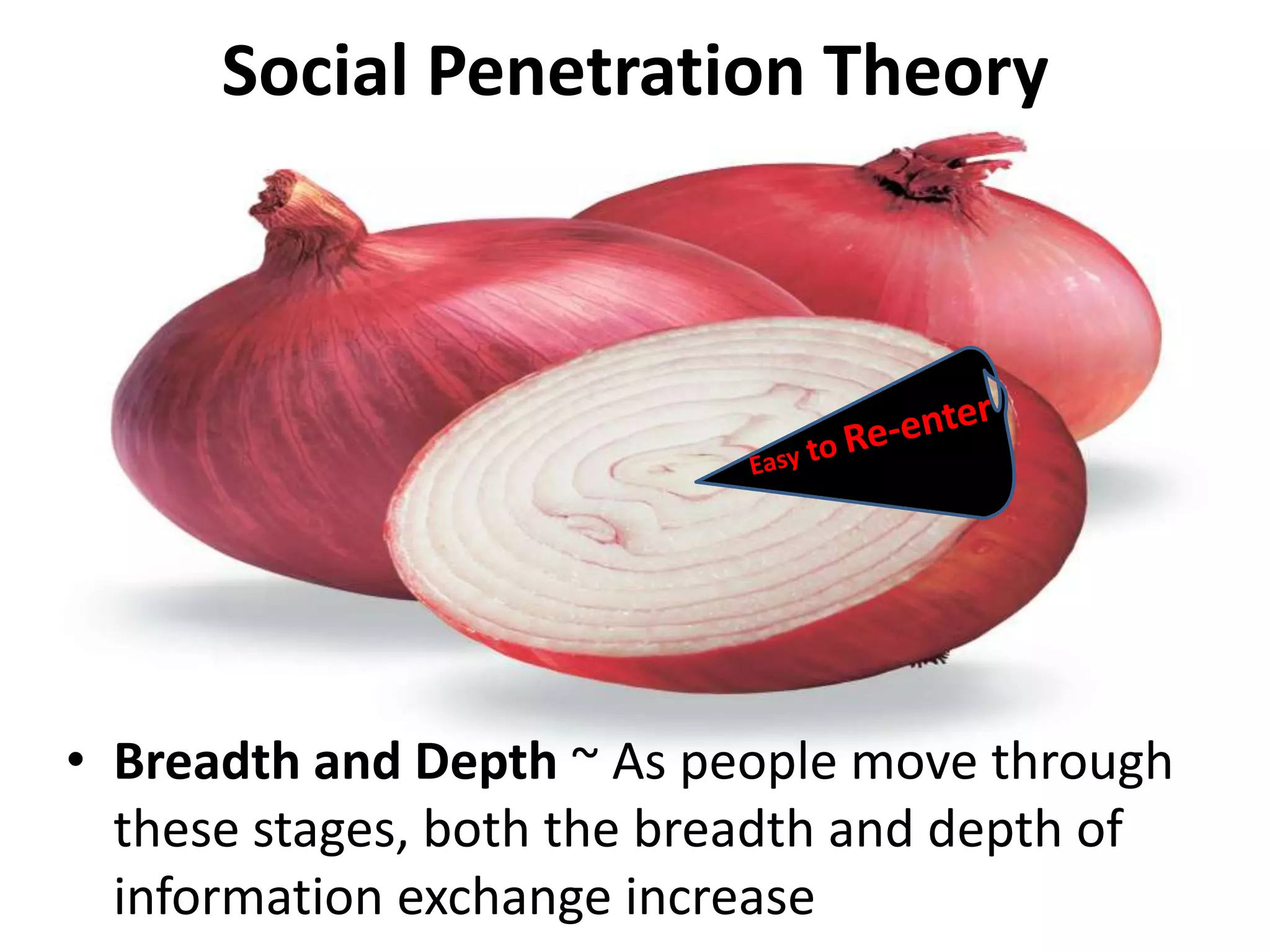
• Breadth and Depth ~ As people move through
  these stages, both the breadth and depth of
  information exchange increase
Social Penetration Theory
Self Disclosure: involves communication about
                  self and can be both intimate
                  and non-intimate.
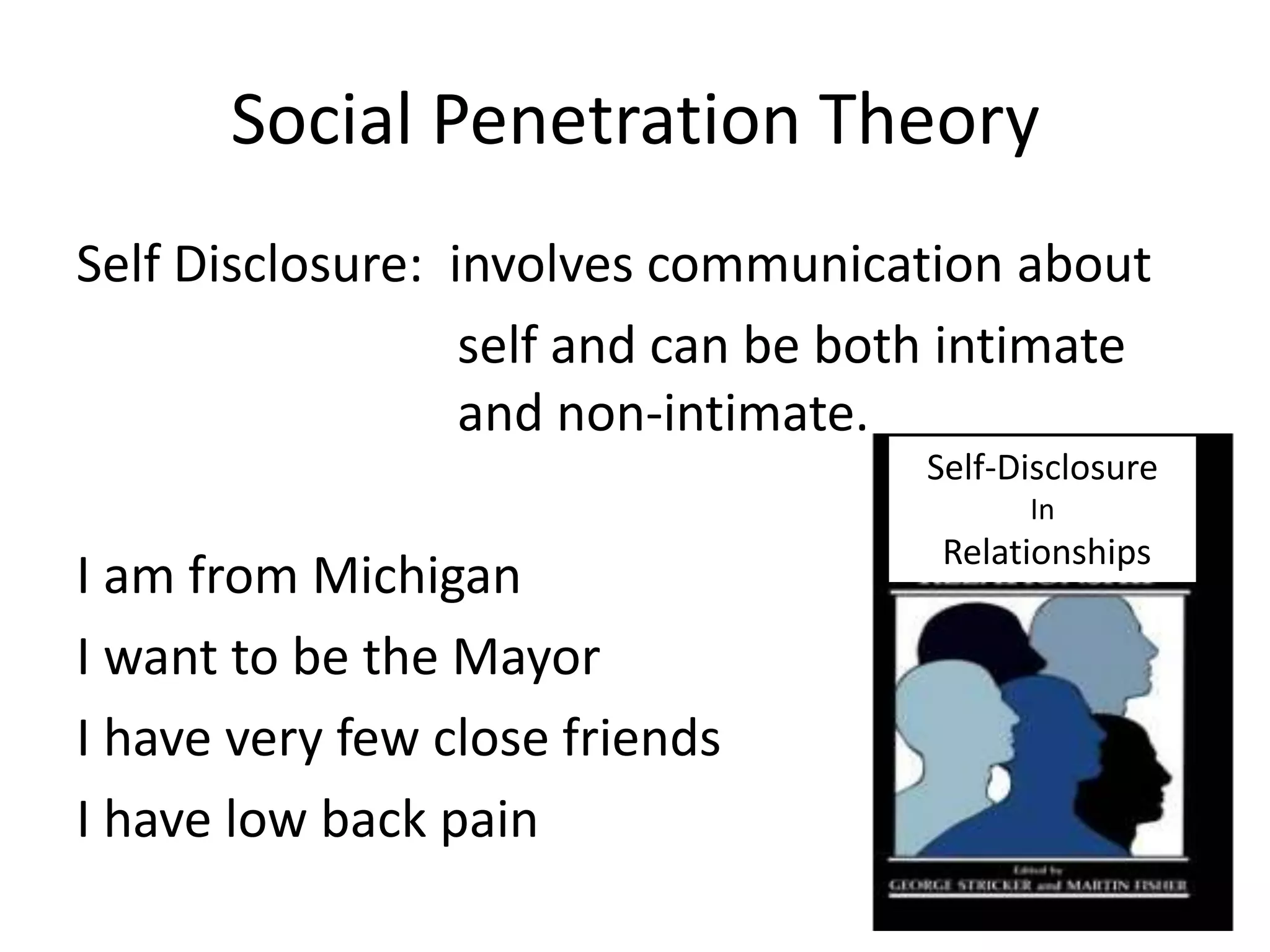
                                     Self-Disclosure
                                           In
                                      Relationships
I am from Michigan
I want to be the Mayor
I have very few close friends
I have low back pain
Social Penetration Theory
Reciprocity ~ When one person reveals
  something about themselves, the other
  person will tend to feel an obligation to reply
  with similar information.

Is not automatic
Not tit-for-tat
Reply can accrue later in the relationship
Social
                      Penetration
                               Theory

Self Disclosure and Reciprocity

The rate of exchange changes as individuals move
through relational stages.
Social Exchange Theory


             Cost – Rewards = Outcome


We compare our outcomes in a current
relationship to past relationships and to possible
Future relationships

Evaluating relationships in an economic fashion
Social Exchange Situation
Outcomes ~ involves a consideration of both        The outcome
               the rewards derived from the        will lead to a
                                                     decision
               relationship and the cost.


Comparison level (CL) ~ Our assessment of part relationships

Comparison level of alternatives (CLalt) ~ Assessment of
                                              possible future
                                              relationships

Past, Present and what else is available
Uncertainly Reduction Theory

Uncertainly Reduction: A process of increasing
                         predictability outcomes
                         of complete strangers


  Going through certain steps and checkpoints in order to
 reduce uncertainty about each other and form an idea of
          whether one likes or dislikes the other
Uncertainly Reduction Theory


According to this theory uncertainty is NOT GOOD

Reduce uncertainties by information seeking
The stages of the relationship is determined by the value,
  one person places on the relationship and the cost verses
  the rewards.
According to Social Penetration Theory:
  Things that cause unusual depth discovery lake emotion
  and social exchange theory lacks emotion.
Information-Seeking Strategies
Passive Stategies~ (aka) Observation :
          Watching someone in a variety of social
          situations.
       Information gathering without interaction

Example:
You could watch how Glenda acts during parties
especially those at which she is particularly comfortable.
Information-Seeking Strategies
Active Strategies ~ Asking questions of 3rd parties
               to test the rules

Individuals might ask other people questions
about the target individual or might structure
the environment in ways that information can
be gathered.

Example
You could talk with Glenda’s friends about her behavior or
invite her to a gathering
Information-Seeking Strategies
Interactive Strategies ~ The target person is asked
                         direct questions or in which
                         self-disclosure is used with
                         hope that reciprocation will
                         lead to more information
Example:
You could ask Glenda yourself (interrogation) or
Share your own views and hope for reciprocation
Motivations for Reducing Uncertainty
Future interaction: If we think we are going to
                       have future interaction
                       with someone
Incentive: values or possible potential rewards

Deviation: Better understanding with someone
           is outside the norm.
Axioms of Uncertainty Reduction Theory
            (Axioms = Taking at face value)
Axiom 1:
Given the high level of uncertainty at the onset,
Increasing verbal communication between
Strangers will decrease the level of uncertainty


     Uncertainties          verbal communication
Theories of Communication Process
Positive Feedback     Contradiction
Negative Feedback     Praxis
Equifinality          External Dialectics
Content Function      Internal Dialectics
Content Function      Praxis Patterns
Relational Function   Symmetrical
Complementary         Dialectics

Chapter 11
One Cannot “NOT Communicate
Communication is not always’ intentional

People receive messages, regardless of whether
  they were sent intentional or not.


Major importance in Interpersonal Communication
Content and Relationship Function
Each message attempts to express content, but it
  also says something about the relationship

       Relationship Function classifies the
             content of the function

Context = words
Relationship = Tone
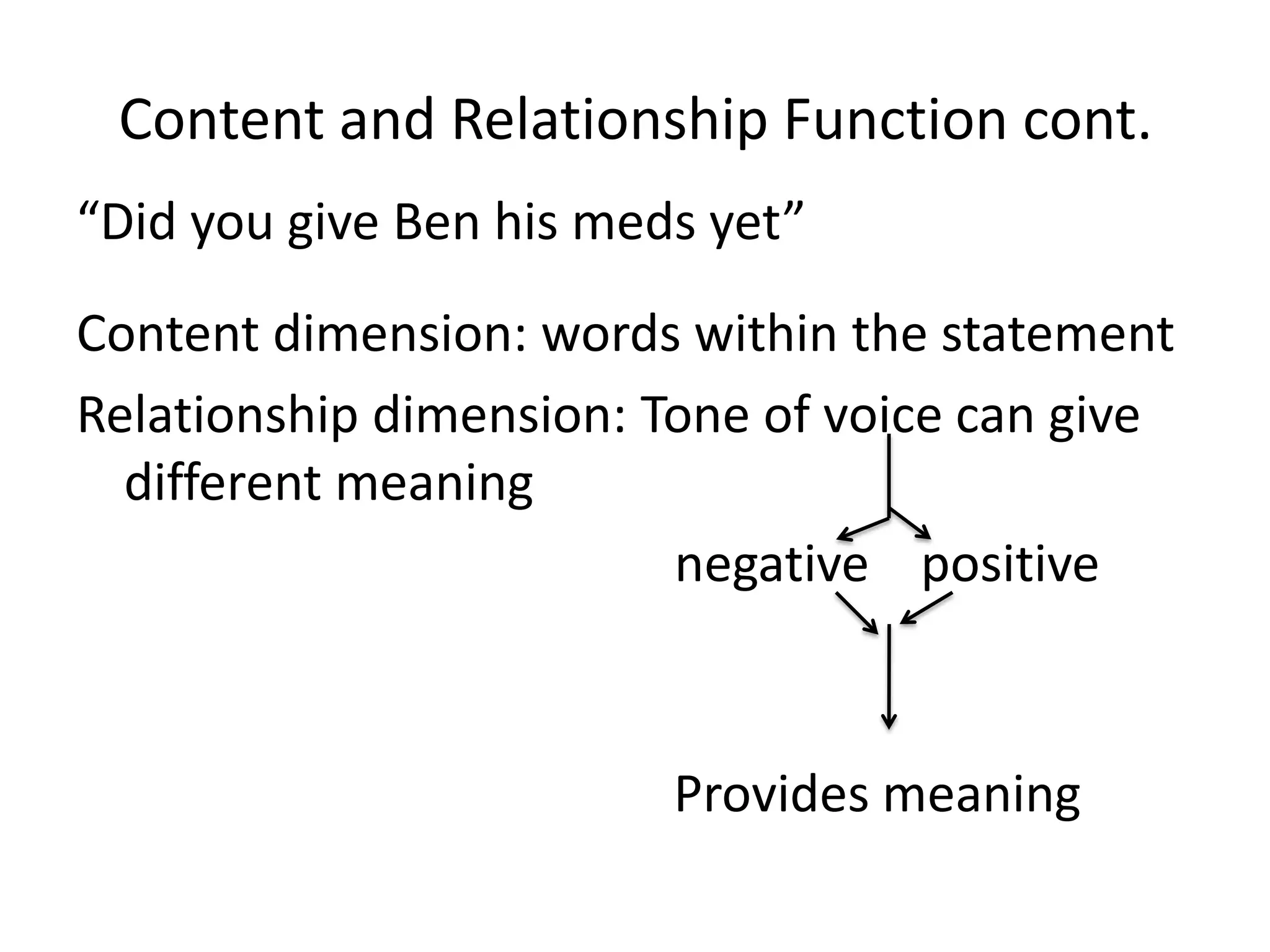
Content and Relationship Function cont.
“Did you give Ben his meds yet”
Content dimension: words within the statement
Relationship dimension: Tone of voice can give
  different meaning
                         negative positive


                         Provides meaning
Symmetrical vs. Complementary
Symmetrical ~ based on equality, mirroring, equal
     (Talking to your husband, wife or associate)


Complementary ~ based on maximizing difference,
                power imbalance, (“I am more
                important than you”)
             (Talking to a student, teacher or boss)
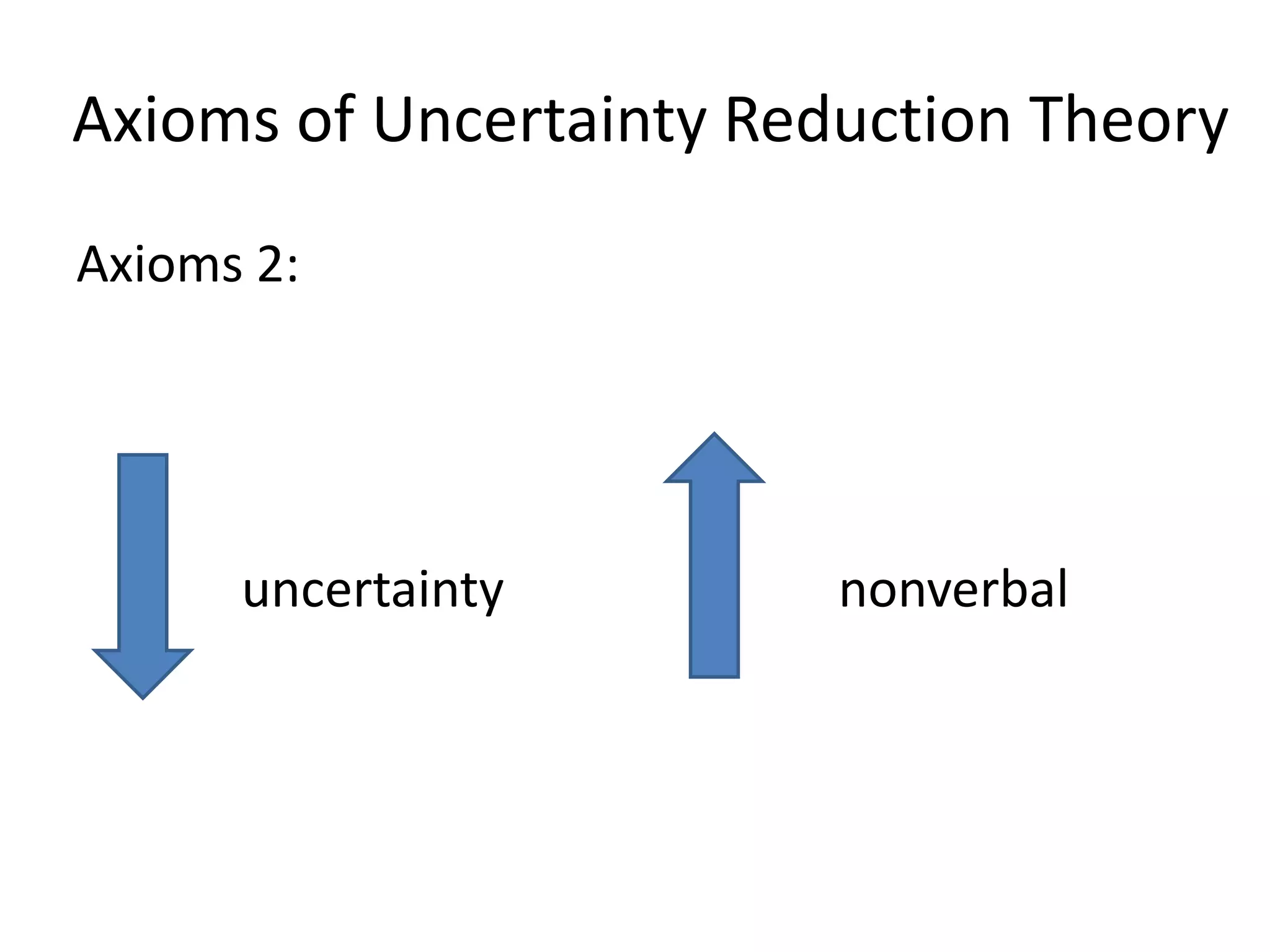
Axioms of Uncertainty Reduction Theory
Axioms 2:


      uncertainty        nonverbal
Axioms of Uncertainty Reduction Theory
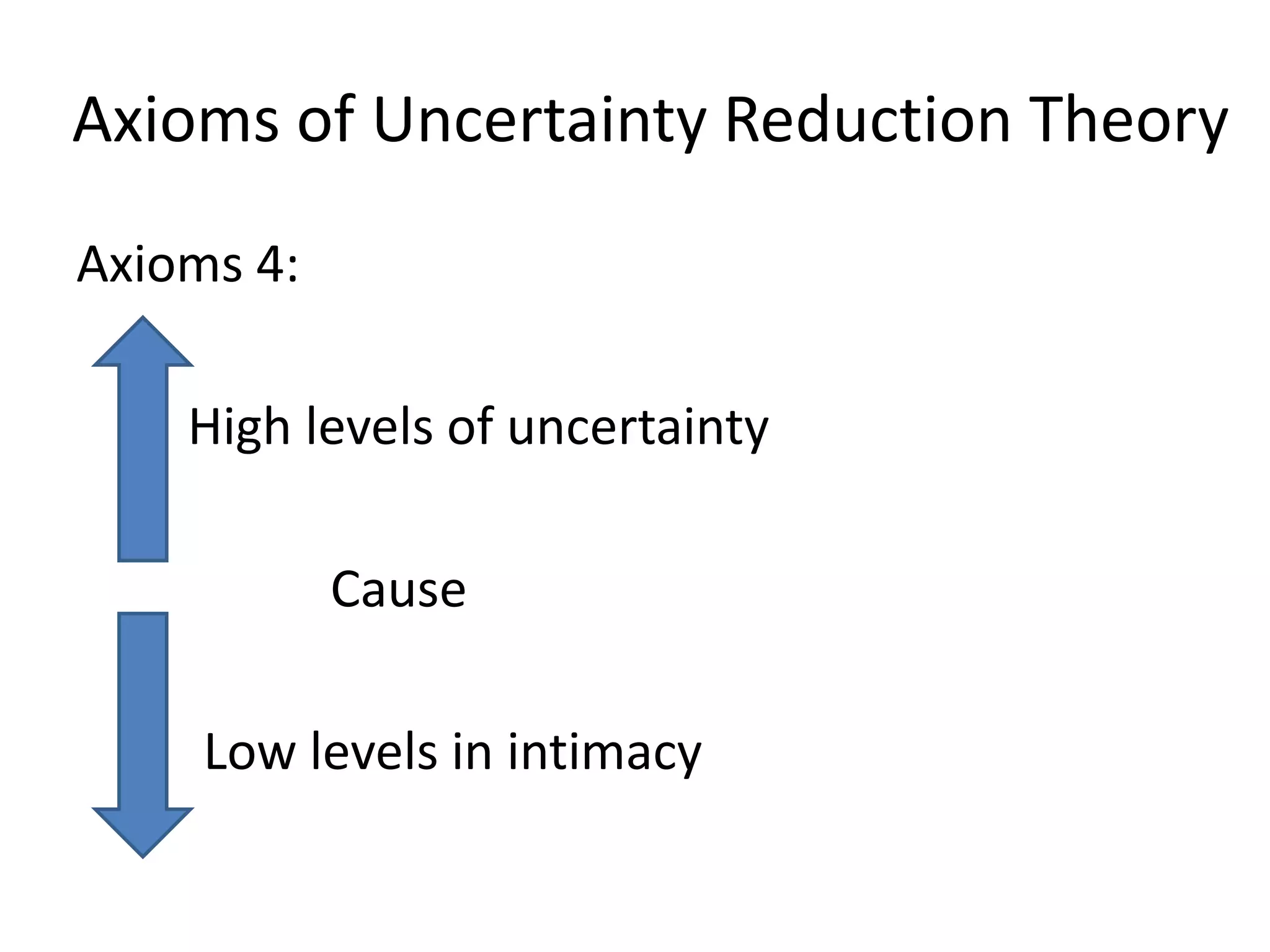
Axioms 4:

    High levels of uncertainty

            Cause

     Low levels in intimacy
Axioms of Uncertainty Reduction Theory
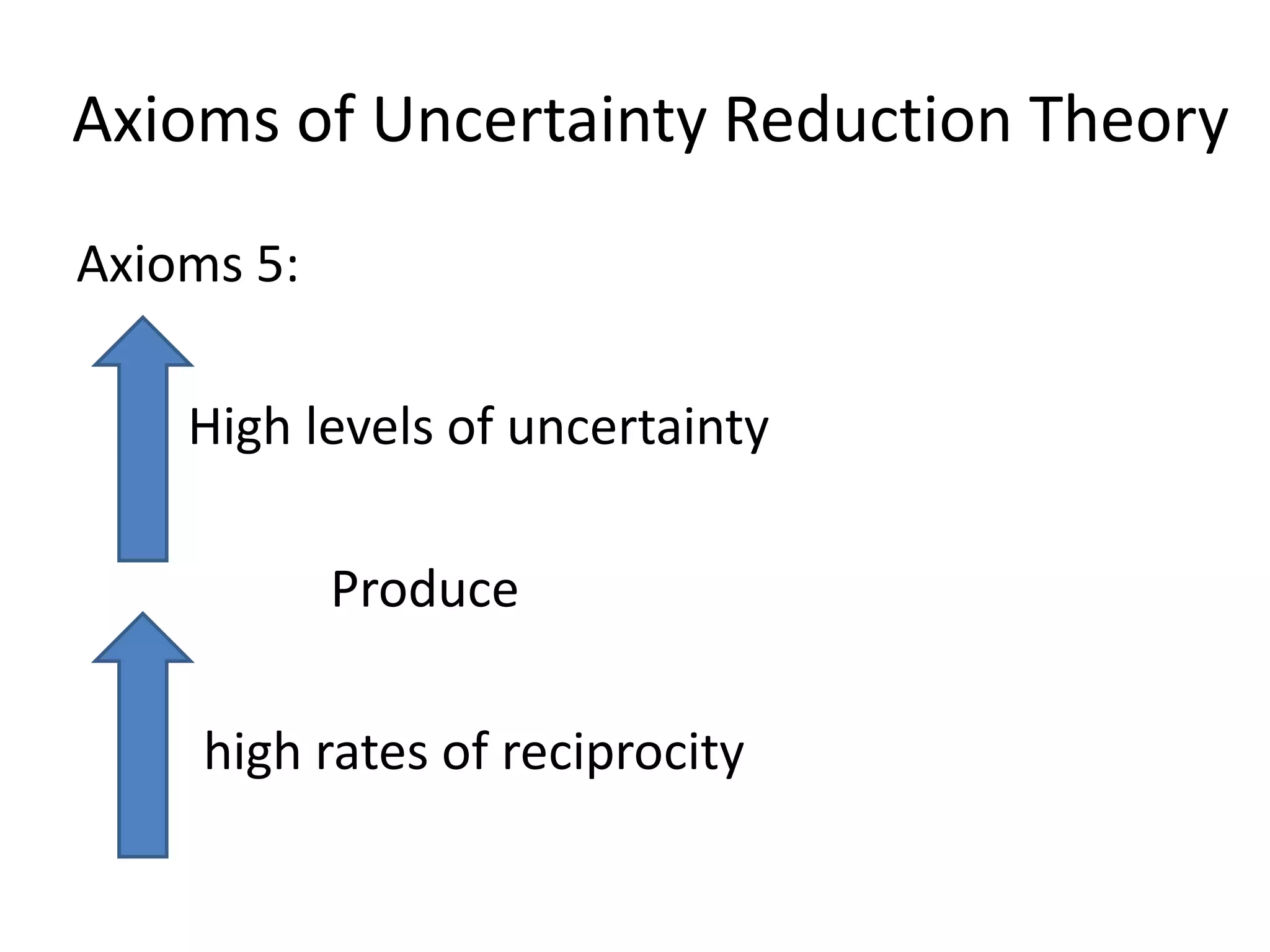
Axioms 5:

    High levels of uncertainty

            Produce

     high rates of reciprocity
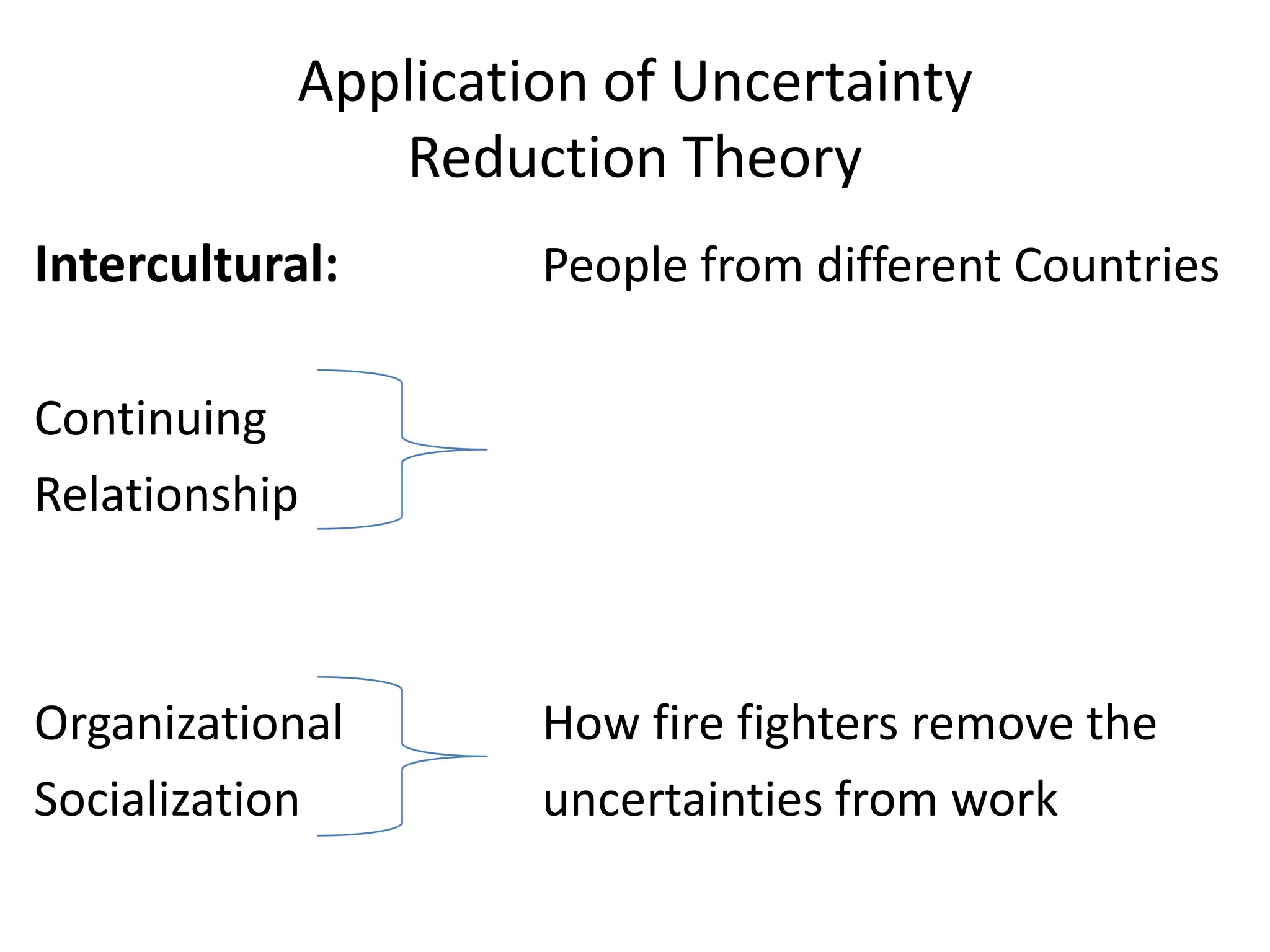
Application of Uncertainty
               Reduction Theory
Intercultural:       People from different Countries

Continuing
Relationship


Organizational       How fire fighters remove the
Socialization        uncertainties from work
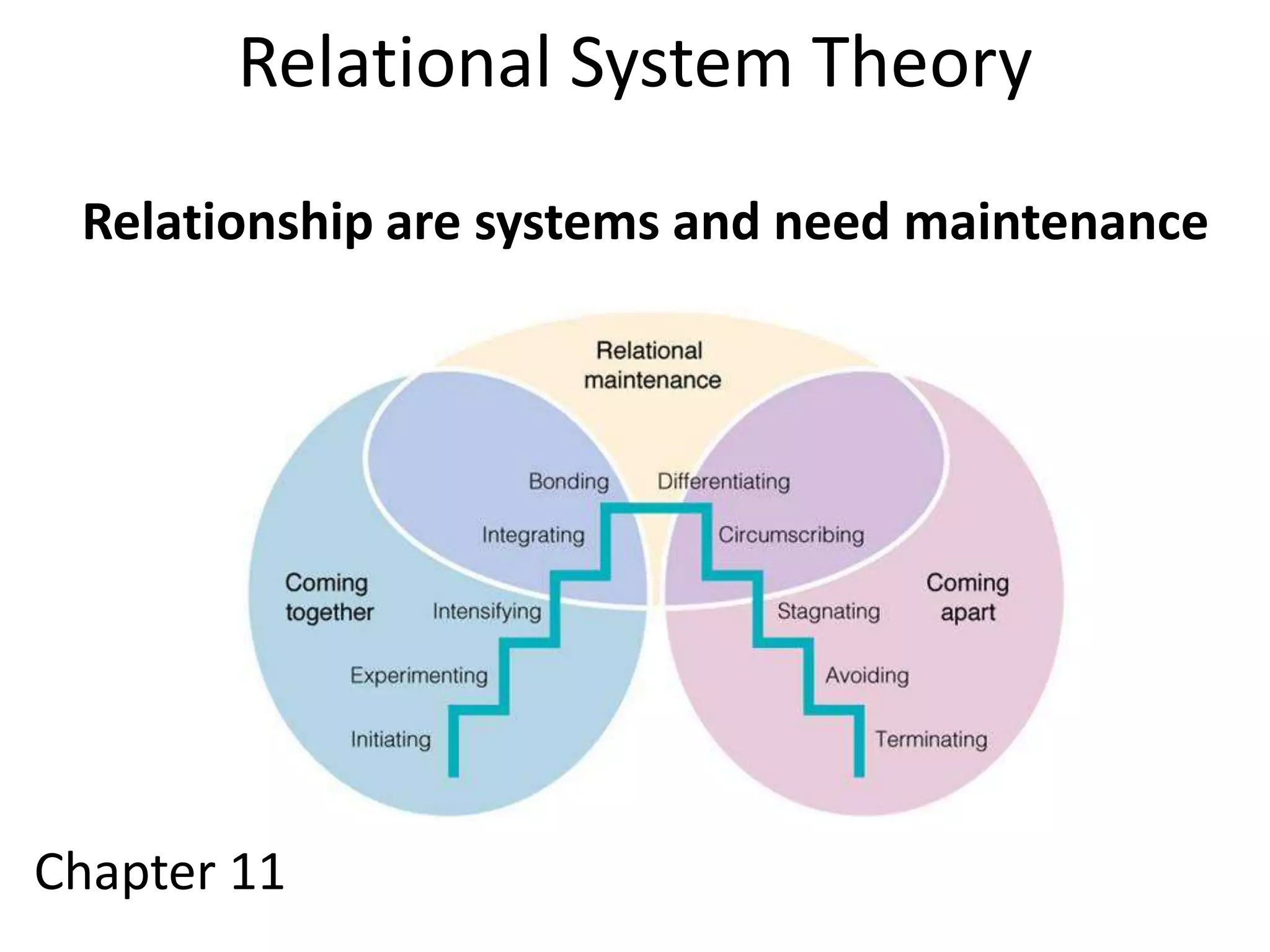
Relational System Theory
 Relationship are systems and need maintenance


Chapter 11
Maintaining the Relationship System

Regular communication        Spending quality time
Acts of service              Words of affirmation
Gifts


Positive Feedback: Leads to change or improvement
                     within the relationship
Negative Feedback: Preserves the status quo
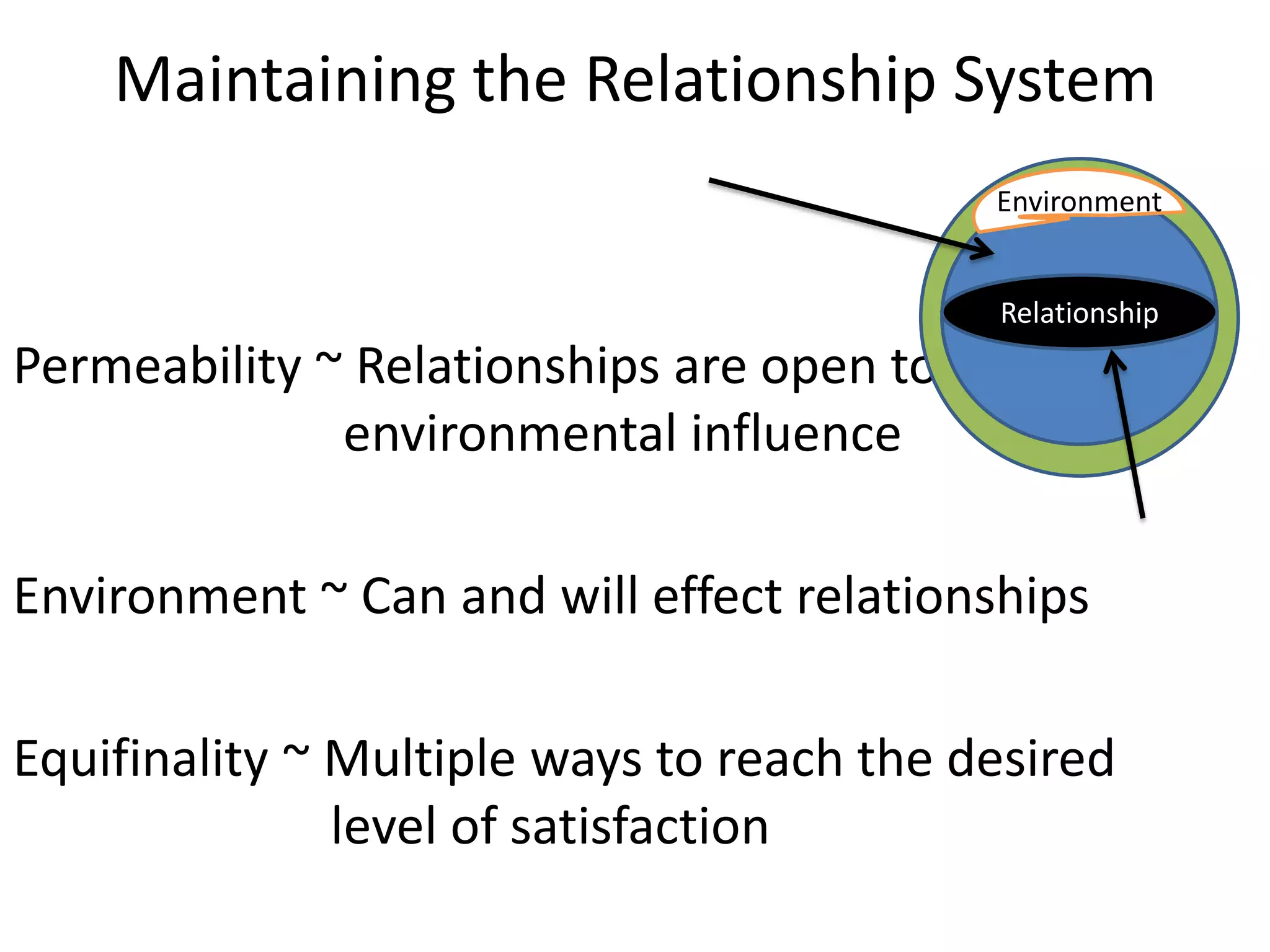
Maintaining the Relationship System
                                           Environment


                                           Relationship
Permeability ~ Relationships are open to
              environmental influence

Environment ~ Can and will effect relationships

Equifinality ~ Multiple ways to reach the desired
               level of satisfaction
Theories of Relational Dialectics
Contradiction~ Perhaps the most central and
  dining feature of a dialectical approach.

One in which both forces can – and do – exist
 simultaneously.

   (In a relationship you can simultaneously
          desire intimacy and distance )
Dialectics within a Relationship
1: Connectedness                 Separateness

Individual autonomy must be sacrificed

To much connection results in Identity lose
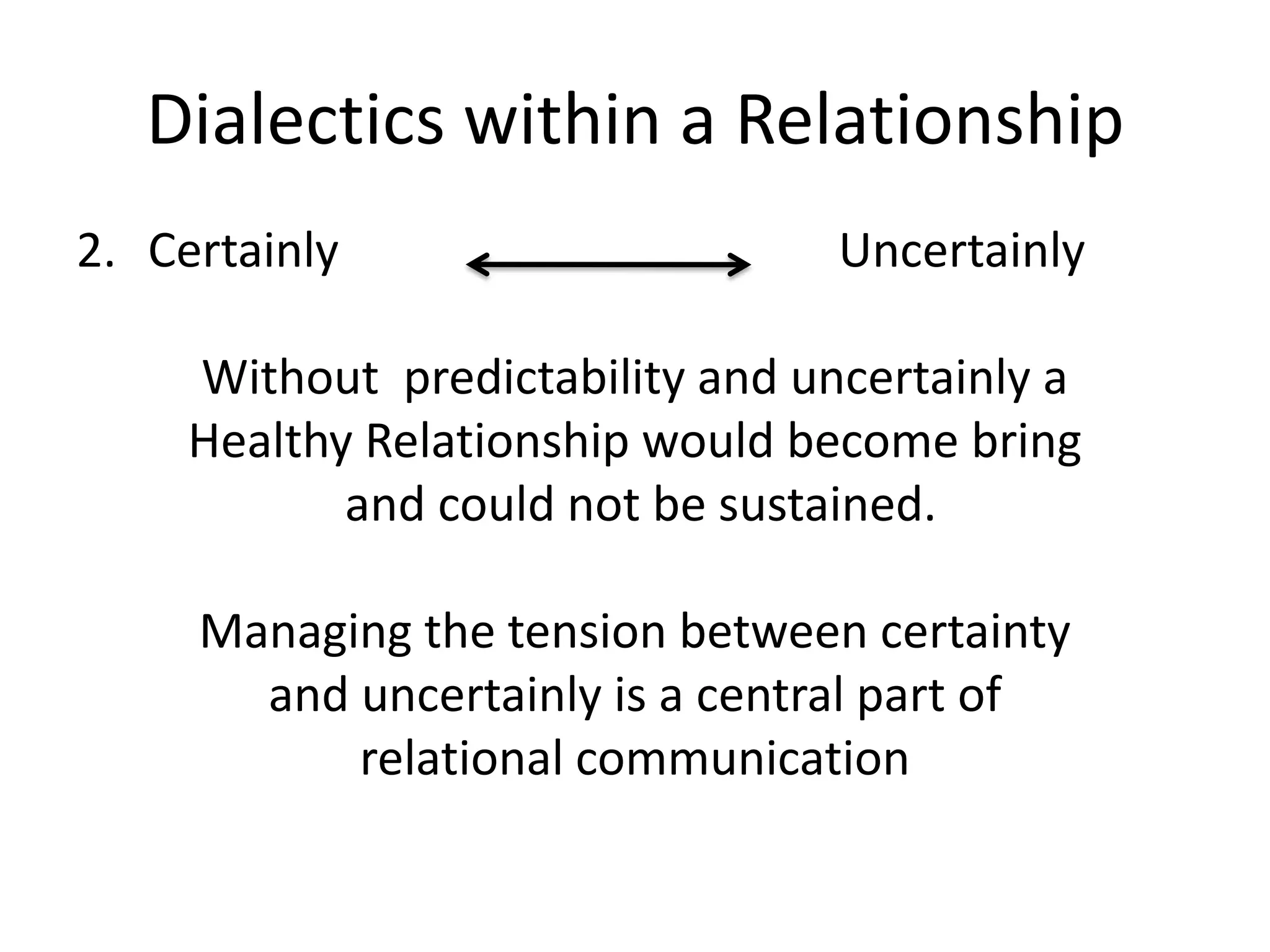
Dialectics within a Relationship
2. Certainly                      Uncertainly

     Without predictability and uncertainly a
     Healthy Relationship would become bring
            and could not be sustained.

     Managing the tension between certainty
       and uncertainly is a central part of
           relational communication
Dialectics within a Relationship
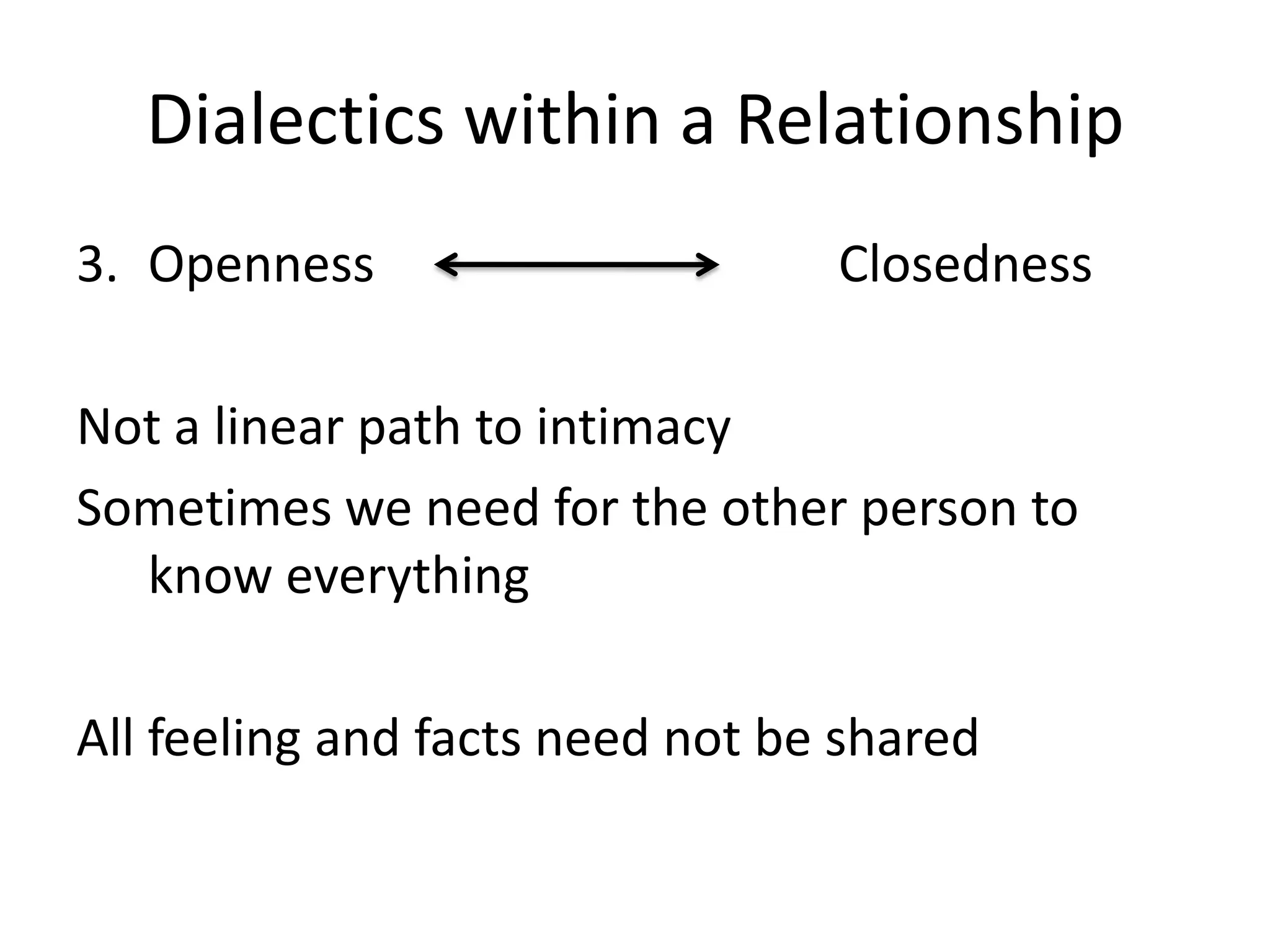
3. Openness                      Closedness

Not a linear path to intimacy
Sometimes we need for the other person to
  know everything

All feeling and facts need not be shared
Dialectics within a Relationship
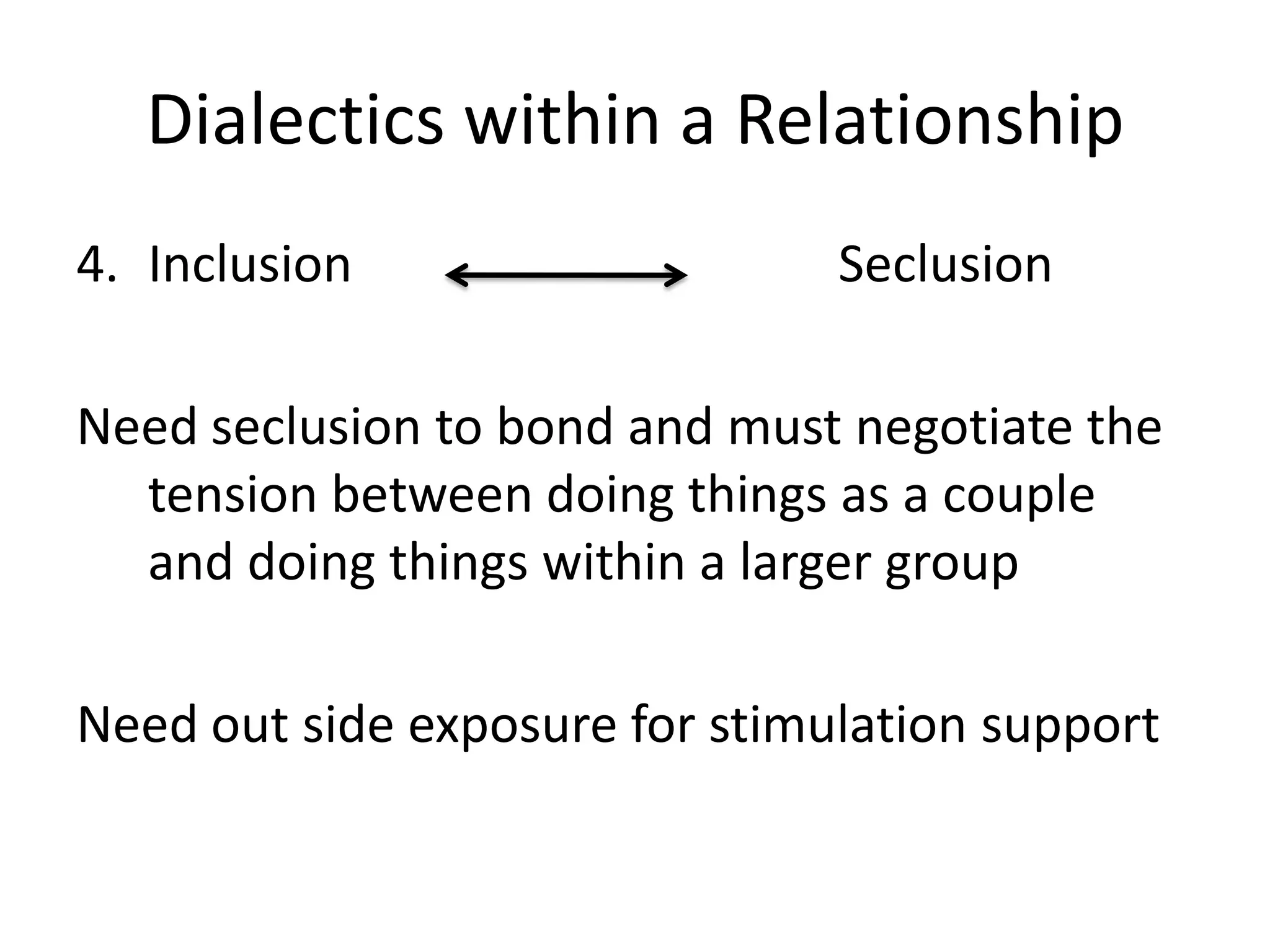
4. Inclusion                    Seclusion

Need seclusion to bond and must negotiate the
  tension between doing things as a couple
  and doing things within a larger group

Need out side exposure for stimulation support
Dialectics within a Relationship
5. Conventionality                             Uniqueness

Excessive uniqueness makes others uncomfortable
               (following social norms)
Intimacy requires that relational partners fell
  different from the rest of the world

Things that are only known inside the relationship
       (Pet names, eating cereal from a cool whip bowl)
Dialectics within a Relationship
6. Revelation                             Concealment

“Going Public” about one issue or another
  provides opportunities for support.

    There are times within the relationship you will want
    To keep things private (mis-carriage) and other times
            you will want to be public (wedding)
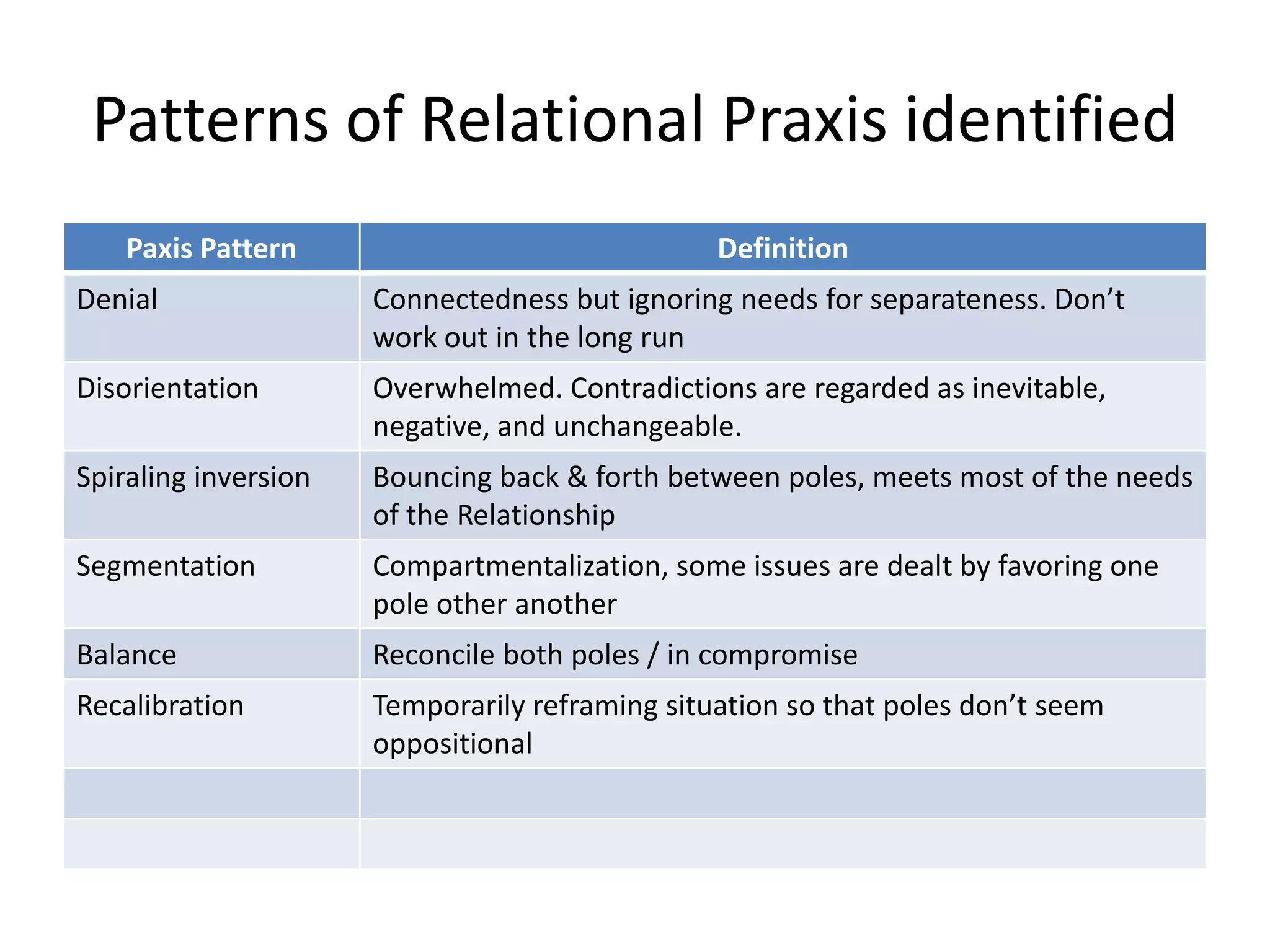
Patterns of Relational Praxis identified
    Paxis Pattern                               Definition
Denial                Connectedness but ignoring needs for separateness. Don’t
                      work out in the long run
Disorientation        Overwhelmed. Contradictions are regarded as inevitable,
                      negative, and unchangeable.
Spiraling inversion   Bouncing back & forth between poles, meets most of the needs
                      of the Relationship
Segmentation          Compartmentalization, some issues are dealt by favoring one
                      pole other another
Balance               Reconcile both poles / in compromise
Recalibration         Temporarily reframing situation so that poles don’t seem
                      oppositional
Theories of Communication Context
Weick’s theory of organizing:
  equivocality, enactment, selection, retention,
  recipes, causal maps


Unobtrusive and concertive control theory:
  simple, technological, bureaucratic,
  and concertive control; identification, discipline

Chapter 12
Dialogue(Littlejohn)
Dialectics,
Chronotopic similarity
Self-becoming
Amplitude
salience
Dialogue
         Used to maintain relationships !

A coming together of diverse voices in conversation

Conversation that defines & redefines Relationship
  as they emerge in actual situations over time

What we use to manage dialectical tensions
Dialogue
Can be used as a turning point in a relationship

Need not be verbal comm., could be an action

Self, other and relationship are constructed and
  maintained through talk.
Dialogue
Create moments (photos) or turning points to
  remember as important

Retelling old stories that highlights similarity and
  shared experience (chronotopic similarity)

Identify and reinforce difference between and
  others (self-becoming)

         (men are from mars women are from venus)
Dialogue
Unity with in difference:
Dialogue gives us a chance to achieve unity
  within diversity
We use conversations to manage competing
 needs for connection and autonomy

Express needs and perceptions and empathize
  with needs and perceptions of others
Dialogue
What changes our relationships:

Amplitude: Strength of feeling and behaviors

Salience: focus on past situations, present or
  future (babies, marriage, etc…)
Dialogue

Sequence – order of events in the relationship
    How you organize your time
    What you do around and with one another


Pace/Rhythms: Rapidity of events, length of
              intervals between events
Dialogue is Aesthetic

Aesthetic perceived pattern in the relationship that
  makes it seem identifiable, unique and whole
Dialogue produces an overall sense of what the
  relationship is like
When we talk about our relationship and tell
 stories about them out talk reflects that
 aesthetics
Momentary and evolving
Narrative Paradigm
Narrative: Express and understand thru story
 telling which is a natural part of being human

Our beliefs and behaviors are reflected in and
 shaped by narratives

More board than theory

Narrative = perspective or approach
Narrative Paradigm
In contrast to narrative , many theories of
  communication are grounded in rational
  paradigm

Narration “symbolic actions” – words and or deeds
 that have sequence and meaning for who create
 or interpret them”
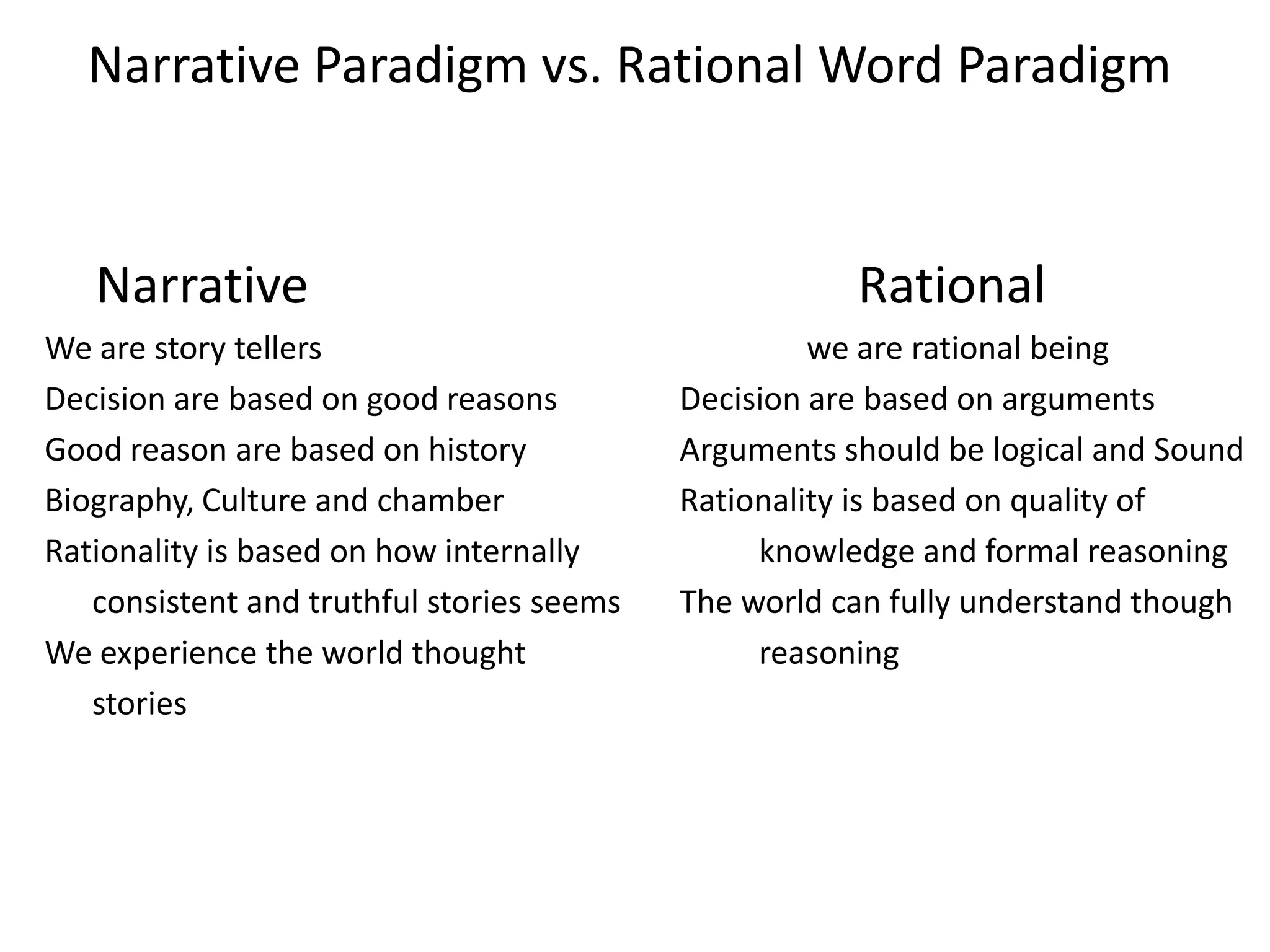
Narrative Paradigm vs. Rational Word Paradigm


   Narrative                                          Rational
We are story tellers                                we are rational being
Decision are based on good reasons         Decision are based on arguments
Good reason are based on history           Arguments should be logical and Sound
Biography, Culture and chamber             Rationality is based on quality of
Rationality is based on how internally          knowledge and formal reasoning
   consistent and truthful stories seems   The world can fully understand though
We experience the world thought                 reasoning
   stories
Narrative Rationality
Traditional, test of rationality include do claims
  correspond to actual facts?

Have all the facts been considered?

Are arguments internally consistent?

Does the reasoning that connects bacts and claims
  seem logical?
Narrative Rationality
Coherence:
Structural Coherence: Do the elements of the story
  flow smoothly
Material Coherence: Is t he character in the story
Characterological:
Fidelity: Does the story seem believable?
          Does it ring true?

Fidelity: A measure of simplistic
Evaluation the Narrative Paradigm
An interpretive theory

Criticized as overboard

Narrative rationality may be overrated

But does help to explain why we tell stories and
  why some are more believable
Narrative is in more of Political films
Real world emphasis on groups and teams
  design of typical organizations has changed
  (Growing decision task complexity)

Simple vs. complex problems

Half of all decisions fail (nutt)(if a decision sticks
 for a year, it is considered a good decision.
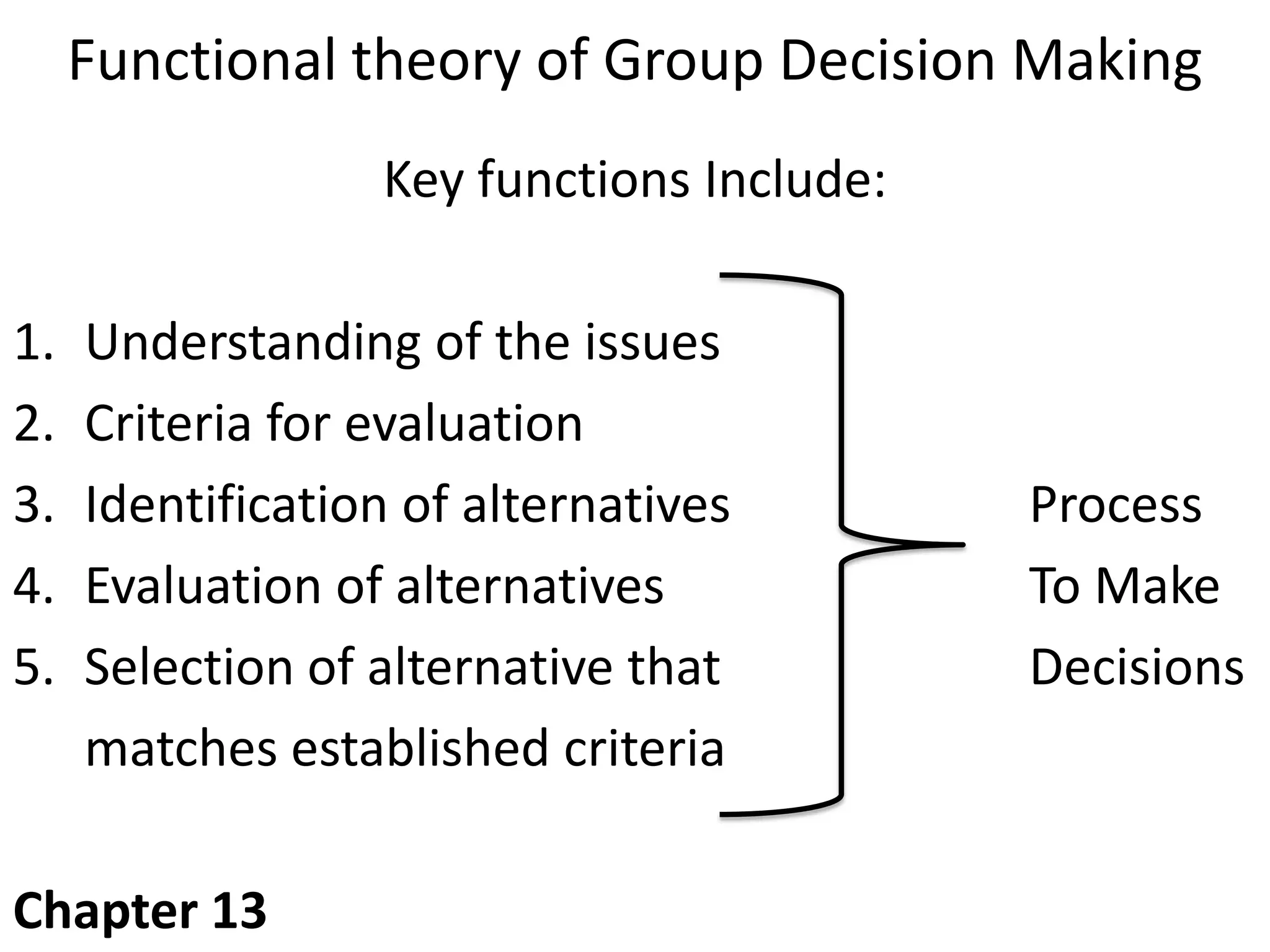
Functional theory of Group Decision Making
                  Key functions Include:

1.   Understanding of the issues
2.   Criteria for evaluation
3.   Identification of alternatives        Process
4.   Evaluation of alternatives            To Make
5.   Selection of alternative that         Decisions
     matches established criteria

Chapter 13
Functional Theory of Group Decision Making


1. Analysis of problem situation
2. Establish criteria for evaluation solutions
3. Consider positive & negative attributes of
   specific solutions
4. Must establish operating norms and procedures
   that guide groups communication

  Functional Theory argues that these functions
  associated with higher quality decisions
Functional Theory of Group Decision Making
Research generally supports the theory, but
  individual studies often differ with regards to
  which functions are most related to decision
  quality.

Overall, research shows that the most important
  factors are
1. Assessing negative consequences of potential
   solutions.
2. Problem analysis
Functional Theory of Group Decision Making

 • Criticisms:

 Applies only to groups with no history, (not real
   groups) aka ad hoc groups

 Applies only to task related groups
Multiple Sequence model
Unitary sequence path ~ Follows the traditional
                          sequence of orientation,
            “Rational, logical and standard”


Complex cyclic path ~ Multiple problem-solution
                       cycles

Solution-oriented path ~ Centers of solutions and
                           involves no activity to
                           problem definition or
                           analysis.
Symbolic convergence theory
Fantasy Theme ~ Ignites group interaction.
                 Refers to something outside

Fantasy Chain ~ “chaining out” Sharing of group
                 fantasies that groups develop a
                 sense of community and shared identity

Fantasy Type / Vision ~ emerges when same set of
                       themes cross several groups
                       Once ideas goes across groups
                       it becomes a vision
Impact of Symbolic Convergence Theory
Believes that the sharing of group fantasies

Indentifying who is “in” and “out” of the group

Clearly divides the sympathetic or good people
  (we) from the unsympathetic or the evil
  people (they)
Bona fide group (BFG) perspective
Groups are complex and contextual

Treats groups as a social system linked to its context

BFG are marked by shifting membership

BFG are clearly not zero-history or ad hoc groups
Com theroy exam 2
Com theroy exam 2
Com theroy exam 2
Com theroy exam 2
Com theroy exam 2
Com theroy exam 2

Com theroy exam 2

  • 1.
    Theories of Discourse and Interaction Chapter 9 Chapter 9
  • 2.
    Communication Is a transactionalprocess in which the ones actions have wide-ranging influences on the Actions of others. Mutual influence = Two way impact
  • 3.
    Key Terms Speech ActTheory Coordinated Management of Meaning Theory (CMM) Communication Accommodation Theory Expectancy Violation Theory
  • 4.
    Speech Act Theory Performingan Action 5 Types of Speech Acts 1. Assertives 2. Directives 3. Commissive 4. Expressives 5. Declaratives
  • 5.
    Assertives • You arethe weakest link! The advocate that truth value of a proposition. State TO: Claim Declare Hypothesize
  • 6.
    Directive That attempt toget the listener to do something Order Request Beg TO: Invite Advise Ask
  • 7.
    Declaratives I am goingto pass Comm. Theory By their very assertion, make something so Quit Nominate TO: appoint Define Name
  • 8.
    Illocutionary v/s Perlocutionary Illocutionary Act What is the message? When I say: “It’s cold in here” Am I saying that because of experience or am I asking for a jacket or asking to turn up the heat.
  • 9.
    Illocutionary v/s Perlocutionary Perlocutionay Deals with the effect on the receiver Deals with the impact on the impact of the receiver Causing the receiver to put another log on the fire or turn of the thermostat
  • 10.
    Coordinated Management ofMeaning Theory (CMM) Providing some understanding of how meanings are created, coordinated, and managed in the social world. Management – Meaning – Coordination The hierarchy of meaning will change depending on how well you know someone
  • 11.
    Coordinated Management ofMeaning Theory (CMM) Meaning are Managed by Rules 1. Constitutive Rule = Expression of Mild disbelief Knowing what the words count for! “O.M.G.” (oh my gosh) The Interpretation of the “Get out of hear” receiver gives meaning to the worlds
  • 12.
    Coordinated Management ofMeaning Theory (CMM) Meaning are Managed by Rules cont. 2. Regulative Rules = Patterns of regular behavior within certain situations If you say “O.M.G.” all the time when someone tells you a story, O.M.G switching from a constitutive word or phase to a Regulative word of phase because of the repetition of the use of that word or phase.
  • 13.
    Hierarchy of meaning •A kiss in church or “You can count on me” can take on different meaning as the relationship changes. At the introduction phase of a relationship words or phases could take different meaning that a relationship of many years. From Dictionary content to Relationship experience
  • 14.
    Meshing • How intentionsand interpretation mesh Meaning + Action = Coordinate Two people having an argument and both people thinking that they came out on top
  • 15.
    Communication Accommodation Theory Originatedin Communication Seeks to explain with monitors and adjustment Change your style of talk or word based on the person you are talking with. Talk slow to with old people, Speak with a southern drawl in the south, Baby talk
  • 16.
    Communication Accommodation Theory Speaker Attune: Matching someone else speech characteristics; Accent Length of utterances, Speech rate, Tone
  • 17.
    Communication Accommodation Theory Convergence: Tomake similar to someone else Individuals adapt to each other’s speech Changing you word to sound like your: professor, friend from England or your Cajun roommate
  • 18.
    Communication Accommodation Theory Divergence: When interactants try to highlight differences between themselves and others in the interactions. Full: individual matches the communication behavior of the other Partial: individual come close to the other but does not match the behavior of the other Hyper: the individual goes beyond the behavior of the other (know as mocking) aka … cross-over Unimodal: converging the vocabulary (Uni = one) Multimodal: several dimensions of behavior
  • 19.
    Symmetrical vs. Asymmetrical Symmetrical : Asymmetrical: Both parties in the Only one party Interaction attempt in the interaction attempts to to converge towards converge each other
  • 20.
    Antecedents to Accommodation Antecedents(aka) “Cause” to Accommodation Wanting to be like another Need for social approval, especially if future interaction is likely Status & Power
  • 21.
    Consequences of Accommodation Dependsof the interpretation we make of others accommodation Negative consequences for convergence if we perceive that the person is accommodating to curry favor. Doctor – patient interaction
  • 22.
    Expectancy Violation Theory Beganas a theory of nonverbal communication Arousal – causes us to pay more attention to the violation than other elements of the interaction
  • 23.
    Expectancy Violation Theory Violation of Expectation Depends on 2 Factors; 1. Your evaluation of the violation itself 2. Your evaluation of the person committing the violation
  • 24.
    Expectancy Violation Theory •Negative Valance ~ Does less than expected • Positive Valance ~ Does more than expected Threshold level is the behavior recognized as violating the expectation Arousal = causes an alertness that diverts attention
  • 25.
    Expectancy Violation Theory Communicatorreward valence Reward valence is based on a host of factors that influence assessment of the violation; 1. Personality, 2. Physical attractiveness 3. Likelihood of future interaction 4. Status or power
  • 26.
    Theories of RelationalDevelopment Relationships is how we explain the world Key Terms Orientation Outcomes Social penetration theory Exploratory affective exchange Uncertainty reduction theory Axioms Reciprocity Affective exchange Stable exchange Self-disclosure Chapter 10
  • 27.
    Social Penetration Theory Thedevelopment of relationships and self-disclosure 4 sequential stages of relationship 1. Orientation 2. Exploratory affective 3. Affective exchange 4. Stable exchange
  • 28.
    Social Penetration Theory Orientation: Theearliest stage were cautions and tentative in their interaction of sharing information. Surface and Small Talk
  • 29.
    Social Penetration Theory Exploratoryaffective exchange: The individuals begin to relax and share some information beyond small. Family and Back ground
  • 30.
    Social Penetration Theory Affectiveexchange: Many barriers have been crossed with a great deal of open exchange occurs. Close friends and Romantic
  • 31.
    Social Penetration Theory Stableexchange: Continued openness and interactions. Communication occurs often and can be nonverbal level Solid and stable Friendship. Rate of self- disclosure is slowing down.
  • 32.
    Social Penetration Theory •Breadth and Depth ~ As people move through these stages, both the breadth and depth of information exchange increase
  • 33.
    Social Penetration Theory SelfDisclosure: involves communication about self and can be both intimate and non-intimate. Self-Disclosure In Relationships I am from Michigan I want to be the Mayor I have very few close friends I have low back pain
  • 34.
    Social Penetration Theory Reciprocity~ When one person reveals something about themselves, the other person will tend to feel an obligation to reply with similar information. Is not automatic Not tit-for-tat Reply can accrue later in the relationship
  • 35.
    Social Penetration Theory Self Disclosure and Reciprocity The rate of exchange changes as individuals move through relational stages.
  • 36.
    Social Exchange Theory Cost – Rewards = Outcome We compare our outcomes in a current relationship to past relationships and to possible Future relationships Evaluating relationships in an economic fashion
  • 37.
    Social Exchange Situation Outcomes~ involves a consideration of both The outcome the rewards derived from the will lead to a decision relationship and the cost. Comparison level (CL) ~ Our assessment of part relationships Comparison level of alternatives (CLalt) ~ Assessment of possible future relationships Past, Present and what else is available
  • 38.
    Uncertainly Reduction Theory UncertainlyReduction: A process of increasing predictability outcomes of complete strangers Going through certain steps and checkpoints in order to reduce uncertainty about each other and form an idea of whether one likes or dislikes the other
  • 39.
    Uncertainly Reduction Theory Accordingto this theory uncertainty is NOT GOOD Reduce uncertainties by information seeking The stages of the relationship is determined by the value, one person places on the relationship and the cost verses the rewards. According to Social Penetration Theory: Things that cause unusual depth discovery lake emotion and social exchange theory lacks emotion.
  • 40.
    Information-Seeking Strategies Passive Stategies~(aka) Observation : Watching someone in a variety of social situations. Information gathering without interaction Example: You could watch how Glenda acts during parties especially those at which she is particularly comfortable.
  • 41.
    Information-Seeking Strategies Active Strategies~ Asking questions of 3rd parties to test the rules Individuals might ask other people questions about the target individual or might structure the environment in ways that information can be gathered. Example You could talk with Glenda’s friends about her behavior or invite her to a gathering
  • 42.
    Information-Seeking Strategies Interactive Strategies~ The target person is asked direct questions or in which self-disclosure is used with hope that reciprocation will lead to more information Example: You could ask Glenda yourself (interrogation) or Share your own views and hope for reciprocation
  • 43.
    Motivations for ReducingUncertainty Future interaction: If we think we are going to have future interaction with someone Incentive: values or possible potential rewards Deviation: Better understanding with someone is outside the norm.
  • 44.
    Axioms of UncertaintyReduction Theory (Axioms = Taking at face value) Axiom 1: Given the high level of uncertainty at the onset, Increasing verbal communication between Strangers will decrease the level of uncertainty Uncertainties verbal communication
  • 45.
    Theories of CommunicationProcess Positive Feedback Contradiction Negative Feedback Praxis Equifinality External Dialectics Content Function Internal Dialectics Content Function Praxis Patterns Relational Function Symmetrical Complementary Dialectics Chapter 11
  • 46.
    One Cannot “NOTCommunicate Communication is not always’ intentional People receive messages, regardless of whether they were sent intentional or not. Major importance in Interpersonal Communication
  • 47.
    Content and RelationshipFunction Each message attempts to express content, but it also says something about the relationship Relationship Function classifies the content of the function Context = words Relationship = Tone
  • 48.
    Content and RelationshipFunction cont. “Did you give Ben his meds yet” Content dimension: words within the statement Relationship dimension: Tone of voice can give different meaning negative positive Provides meaning
  • 49.
    Symmetrical vs. Complementary Symmetrical~ based on equality, mirroring, equal (Talking to your husband, wife or associate) Complementary ~ based on maximizing difference, power imbalance, (“I am more important than you”) (Talking to a student, teacher or boss)
  • 50.
    Axioms of UncertaintyReduction Theory Axioms 2: uncertainty nonverbal
  • 51.
    Axioms of UncertaintyReduction Theory Axioms 4: High levels of uncertainty Cause Low levels in intimacy
  • 52.
    Axioms of UncertaintyReduction Theory Axioms 5: High levels of uncertainty Produce high rates of reciprocity
  • 53.
    Application of Uncertainty Reduction Theory Intercultural: People from different Countries Continuing Relationship Organizational How fire fighters remove the Socialization uncertainties from work
  • 54.
    Relational System Theory Relationship are systems and need maintenance Chapter 11
  • 55.
    Maintaining the RelationshipSystem Regular communication Spending quality time Acts of service Words of affirmation Gifts Positive Feedback: Leads to change or improvement within the relationship Negative Feedback: Preserves the status quo
  • 56.
    Maintaining the RelationshipSystem Environment Relationship Permeability ~ Relationships are open to environmental influence Environment ~ Can and will effect relationships Equifinality ~ Multiple ways to reach the desired level of satisfaction
  • 57.
    Theories of RelationalDialectics Contradiction~ Perhaps the most central and dining feature of a dialectical approach. One in which both forces can – and do – exist simultaneously. (In a relationship you can simultaneously desire intimacy and distance )
  • 58.
    Dialectics within aRelationship 1: Connectedness Separateness Individual autonomy must be sacrificed To much connection results in Identity lose
  • 59.
    Dialectics within aRelationship 2. Certainly Uncertainly Without predictability and uncertainly a Healthy Relationship would become bring and could not be sustained. Managing the tension between certainty and uncertainly is a central part of relational communication
  • 60.
    Dialectics within aRelationship 3. Openness Closedness Not a linear path to intimacy Sometimes we need for the other person to know everything All feeling and facts need not be shared
  • 61.
    Dialectics within aRelationship 4. Inclusion Seclusion Need seclusion to bond and must negotiate the tension between doing things as a couple and doing things within a larger group Need out side exposure for stimulation support
  • 62.
    Dialectics within aRelationship 5. Conventionality Uniqueness Excessive uniqueness makes others uncomfortable (following social norms) Intimacy requires that relational partners fell different from the rest of the world Things that are only known inside the relationship (Pet names, eating cereal from a cool whip bowl)
  • 63.
    Dialectics within aRelationship 6. Revelation Concealment “Going Public” about one issue or another provides opportunities for support. There are times within the relationship you will want To keep things private (mis-carriage) and other times you will want to be public (wedding)
  • 64.
    Patterns of RelationalPraxis identified Paxis Pattern Definition Denial Connectedness but ignoring needs for separateness. Don’t work out in the long run Disorientation Overwhelmed. Contradictions are regarded as inevitable, negative, and unchangeable. Spiraling inversion Bouncing back & forth between poles, meets most of the needs of the Relationship Segmentation Compartmentalization, some issues are dealt by favoring one pole other another Balance Reconcile both poles / in compromise Recalibration Temporarily reframing situation so that poles don’t seem oppositional
  • 65.
    Theories of CommunicationContext Weick’s theory of organizing: equivocality, enactment, selection, retention, recipes, causal maps Unobtrusive and concertive control theory: simple, technological, bureaucratic, and concertive control; identification, discipline Chapter 12
  • 67.
  • 68.
    Dialogue Used to maintain relationships ! A coming together of diverse voices in conversation Conversation that defines & redefines Relationship as they emerge in actual situations over time What we use to manage dialectical tensions
  • 69.
    Dialogue Can be usedas a turning point in a relationship Need not be verbal comm., could be an action Self, other and relationship are constructed and maintained through talk.
  • 70.
    Dialogue Create moments (photos)or turning points to remember as important Retelling old stories that highlights similarity and shared experience (chronotopic similarity) Identify and reinforce difference between and others (self-becoming) (men are from mars women are from venus)
  • 71.
    Dialogue Unity with indifference: Dialogue gives us a chance to achieve unity within diversity We use conversations to manage competing needs for connection and autonomy Express needs and perceptions and empathize with needs and perceptions of others
  • 72.
    Dialogue What changes ourrelationships: Amplitude: Strength of feeling and behaviors Salience: focus on past situations, present or future (babies, marriage, etc…)
  • 73.
    Dialogue Sequence – orderof events in the relationship How you organize your time What you do around and with one another Pace/Rhythms: Rapidity of events, length of intervals between events
  • 74.
    Dialogue is Aesthetic Aestheticperceived pattern in the relationship that makes it seem identifiable, unique and whole Dialogue produces an overall sense of what the relationship is like When we talk about our relationship and tell stories about them out talk reflects that aesthetics Momentary and evolving
  • 75.
    Narrative Paradigm Narrative: Expressand understand thru story telling which is a natural part of being human Our beliefs and behaviors are reflected in and shaped by narratives More board than theory Narrative = perspective or approach
  • 76.
    Narrative Paradigm In contrastto narrative , many theories of communication are grounded in rational paradigm Narration “symbolic actions” – words and or deeds that have sequence and meaning for who create or interpret them”
  • 77.
    Narrative Paradigm vs.Rational Word Paradigm Narrative Rational We are story tellers we are rational being Decision are based on good reasons Decision are based on arguments Good reason are based on history Arguments should be logical and Sound Biography, Culture and chamber Rationality is based on quality of Rationality is based on how internally knowledge and formal reasoning consistent and truthful stories seems The world can fully understand though We experience the world thought reasoning stories
  • 78.
    Narrative Rationality Traditional, testof rationality include do claims correspond to actual facts? Have all the facts been considered? Are arguments internally consistent? Does the reasoning that connects bacts and claims seem logical?
  • 79.
    Narrative Rationality Coherence: Structural Coherence:Do the elements of the story flow smoothly Material Coherence: Is t he character in the story Characterological: Fidelity: Does the story seem believable? Does it ring true? Fidelity: A measure of simplistic
  • 80.
    Evaluation the NarrativeParadigm An interpretive theory Criticized as overboard Narrative rationality may be overrated But does help to explain why we tell stories and why some are more believable
  • 81.
    Narrative is inmore of Political films Real world emphasis on groups and teams design of typical organizations has changed (Growing decision task complexity) Simple vs. complex problems Half of all decisions fail (nutt)(if a decision sticks for a year, it is considered a good decision.
  • 82.
    Functional theory ofGroup Decision Making Key functions Include: 1. Understanding of the issues 2. Criteria for evaluation 3. Identification of alternatives Process 4. Evaluation of alternatives To Make 5. Selection of alternative that Decisions matches established criteria Chapter 13
  • 83.
    Functional Theory ofGroup Decision Making 1. Analysis of problem situation 2. Establish criteria for evaluation solutions 3. Consider positive & negative attributes of specific solutions 4. Must establish operating norms and procedures that guide groups communication Functional Theory argues that these functions associated with higher quality decisions
  • 84.
    Functional Theory ofGroup Decision Making Research generally supports the theory, but individual studies often differ with regards to which functions are most related to decision quality. Overall, research shows that the most important factors are 1. Assessing negative consequences of potential solutions. 2. Problem analysis

  • 85.
    Functional Theory ofGroup Decision Making • Criticisms: Applies only to groups with no history, (not real groups) aka ad hoc groups Applies only to task related groups
  • 86.
    Multiple Sequence model Unitarysequence path ~ Follows the traditional sequence of orientation, “Rational, logical and standard” Complex cyclic path ~ Multiple problem-solution cycles Solution-oriented path ~ Centers of solutions and involves no activity to problem definition or analysis.
  • 87.
    Symbolic convergence theory FantasyTheme ~ Ignites group interaction. Refers to something outside Fantasy Chain ~ “chaining out” Sharing of group fantasies that groups develop a sense of community and shared identity Fantasy Type / Vision ~ emerges when same set of themes cross several groups Once ideas goes across groups it becomes a vision
  • 88.
    Impact of SymbolicConvergence Theory Believes that the sharing of group fantasies Indentifying who is “in” and “out” of the group Clearly divides the sympathetic or good people (we) from the unsympathetic or the evil people (they)
  • 89.
    Bona fide group(BFG) perspective Groups are complex and contextual Treats groups as a social system linked to its context BFG are marked by shifting membership BFG are clearly not zero-history or ad hoc groups