INDIRECT OPHTHALMOSCOPY
Dr. Anupama Manoharan
Junior resident , Dept of ophthmology
UGMCH ooty (TN)
INTRODUCTION:
 IDO was introduced by Nagel in 1864
 Examination of the posterior segment
 Consists of headset with binocular
viewing system and adjustable lighting
system
 Portable – rechargeable power packs/
spectacle mounted
 Uses condensing lens(+14 to +30 D)
OPTICAL PRINCIPLE:
 To make the eye highly myopic by placing a strong
convex lens in front of patient’s eye
 Emergent rays from an area of fundus is brought to
focus as a Real, inverted image
OPTICAL SYSTEM
 Binocularity is achieved by reducing the observer’s
interpupillary distance from about 60 mm to approx
15 mm by prisms/ mirrors.
FIELD OF ILLUMINATION:
 More in Myopia
 Less in Hypermetropia
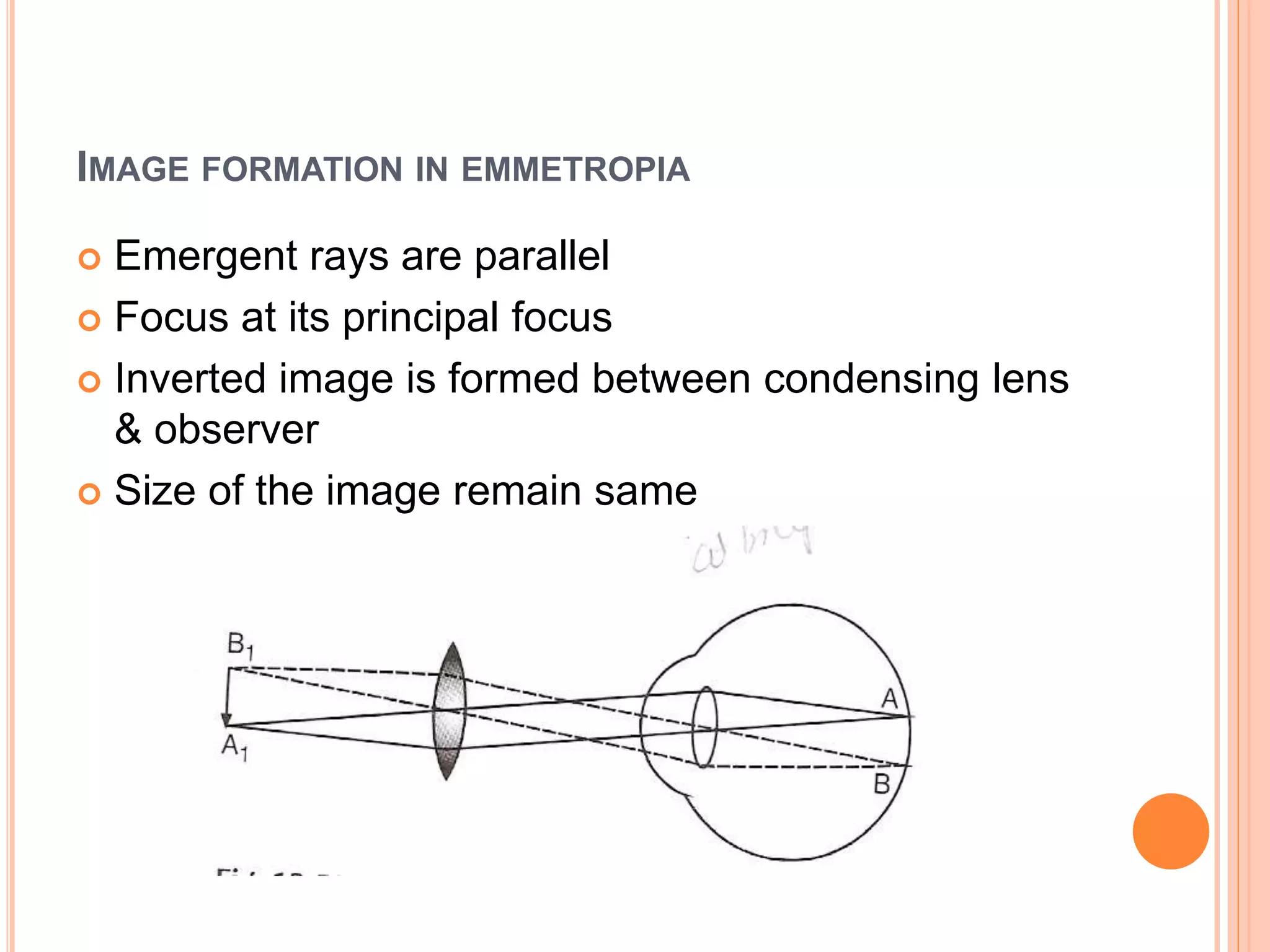
IMAGE FORMATION IN EMMETROPIA
 Emergent rays are parallel
 Focus at its principal focus
 Inverted image is formed between condensing lens
& observer
 Size of the image remain same
IMAGE FORMATION IN HYPERMETROPIA:
 Emergent rays are divergent
 Condensing lens uses imaginary enlarged upright
image behind the eye
 Final image is in front of principal focus
SIZE OF THE IMAGE:
 Equal to an emmetropic eye if lens is held that
principal focus correspond to ant focus of eye
 Larger than emmetropic eye if cond lens is held
at distance that principal focus is nearer than ant
focus of the eye
 Smaller than emmetropic eye when cond lens is
farther away than ant focus of the eye
IMAGE FORMATION IN MYOPIA:
 Emergent rays are convergent
 Inverted image in front of the eye
 Final image is within its own focal length
SIZE OF THE IMAGE:
 Equal to an emmetropic eye, if cond lens –
principal focus corresponds to ant focus of the eye
 Smaller than emmetropic eye, if cond lens -
principal focus is nearer than the ant focus of the
eye
 Larger than emmetropic eye, principal focus of
cond lens is farther away from ant focus of the eye
IMAGE CHARACTERISTICS:
 Image- Real, Inverted and magnified
IMAGE MAGNIFICATION:
 Function of power of condensing lens
 Power of patient’s eye ( 60 D)
 Mag= power of eye
power of cond lens
 Ex) 20 D lens- 60/20 = 3x lateral mag
30 D lens- 60/30= 2x lateral mag
 Magnification:
 - Diopteric power of the convex lens
 - Position of the lens in relation to eyeball
 - Refractive state of the eyeball
Condensing lens Magnification Field of view
15 D 4x 40°
20 D 3x 45°
25D 2.5x 50°
30D 2x 60°
40D 1.5x 65°
FIELD OF ILLUMINATION
 Field of observation is larger than the field of
illumination
 Field of observation is func of magnification and
condensing lens diameter
TECHNIQUE:
 Procedure explained to pt
 Light thrown into pt’s eye at arm’s distance
 Keeping eye on that reflex, interpose condensing
lens in path of beam of light – slowly move the lens
away from the eye until image clearly seen
 Examiner moves around the head of the patient
 Examiner has to stand opposite the clock hour
position to be examined
SCLERAL DEPRESSION:
 Depressor placed on pt’s lid
 Examiner move depressor in a direction opposite to
that he/she wishes the depression to appear
 Depressor rolled gently and tangentially over eye
surface
 Most sensitive- superonasal quadrant
FUNDUS DRAWING:
 Image – vertically inverted and laterally reversed
 Top of retina chart placed towards foot end of the pt.
 Made on special Amsler ‘s chart that has 12 clock hrs
marked and 3 concentric circles made on it.
Innermost circle- Equator
Middle circle-Ora serrata
Outermost circle-midpoint of pars plana
NORMAL ANATOMICAL LANDMARKS:
 Vortex veins ampulla- along the equator
 Long ciliary vein- 3 o’ clock and 9 o’ clock position
 Branching vessels marked to draw the pathology seen
COLOUR CODE FOR FUNDUS DRAWING
COLOUR REPRESENTATION
Red Retinal arterioles
Attached retina
Retinal hemorrhage
Microaneursyms
Neovascularisation
Retinal break or hole
Blue Retinal venules
Detached retina
Outline of retinal break or hole
Yellow Exudate
Edema
Green Vitreous opacity
Brown Pigmentation
Detached choroid
Black Hyperpigmentation
Ora serrata
ADVANTAGES:
 Larger field of retina is visible
 Lesser distortion of image
 Useful in hazy media because of bright light and
optical property
 Can be used during retinal surgery as it preserve
sterile operative field
 Laser energy can be directed thro IDO
DISADVANTAGE:
 Less magnification( 5 times)
 Impossible in very small pupil
 Patient uncomfortable because of intense light of
IDO & scleral intentation
FEATURE DIRECT
OPHTHALMOSCOPY
INDIRECT
OPHTHALMOSCOPY
Condensing lens Not recqired Recquired
Examination distance As close to patient’s eye
as possible
At an arm’s distance
Image Virtual, Erect Real, Inverted
Magnification 15 times 4-5 times
Illumination Not so bright Bright
FEATURE DIRECT
OPHTHALMOSCOPY
INDIRECT
OPHTHALMOSCOPY
Examination thro hazy
media
Not possible Possible
Area of field in focus About 2 disc diopter About 8 disc diopter
Stereopsis Absent present
Accessible fundus
view
Beyond equator Upto ora serrata
Teaching mirror None Can be attached
THANK YOU

Indirect ophthalmoscopy

  • 1.
    INDIRECT OPHTHALMOSCOPY Dr. AnupamaManoharan Junior resident , Dept of ophthmology UGMCH ooty (TN)
  • 2.
    INTRODUCTION:  IDO wasintroduced by Nagel in 1864  Examination of the posterior segment  Consists of headset with binocular viewing system and adjustable lighting system  Portable – rechargeable power packs/ spectacle mounted  Uses condensing lens(+14 to +30 D)
  • 3.
    OPTICAL PRINCIPLE:  Tomake the eye highly myopic by placing a strong convex lens in front of patient’s eye  Emergent rays from an area of fundus is brought to focus as a Real, inverted image
  • 4.
    OPTICAL SYSTEM  Binocularityis achieved by reducing the observer’s interpupillary distance from about 60 mm to approx 15 mm by prisms/ mirrors.
  • 5.
    FIELD OF ILLUMINATION: More in Myopia  Less in Hypermetropia
  • 6.
    IMAGE FORMATION INEMMETROPIA  Emergent rays are parallel  Focus at its principal focus  Inverted image is formed between condensing lens & observer  Size of the image remain same
  • 7.
    IMAGE FORMATION INHYPERMETROPIA:  Emergent rays are divergent  Condensing lens uses imaginary enlarged upright image behind the eye  Final image is in front of principal focus
  • 8.
    SIZE OF THEIMAGE:  Equal to an emmetropic eye if lens is held that principal focus correspond to ant focus of eye  Larger than emmetropic eye if cond lens is held at distance that principal focus is nearer than ant focus of the eye  Smaller than emmetropic eye when cond lens is farther away than ant focus of the eye
  • 9.
    IMAGE FORMATION INMYOPIA:  Emergent rays are convergent  Inverted image in front of the eye  Final image is within its own focal length
  • 10.
    SIZE OF THEIMAGE:  Equal to an emmetropic eye, if cond lens – principal focus corresponds to ant focus of the eye  Smaller than emmetropic eye, if cond lens - principal focus is nearer than the ant focus of the eye  Larger than emmetropic eye, principal focus of cond lens is farther away from ant focus of the eye
  • 11.
    IMAGE CHARACTERISTICS:  Image-Real, Inverted and magnified
  • 12.
    IMAGE MAGNIFICATION:  Functionof power of condensing lens  Power of patient’s eye ( 60 D)  Mag= power of eye power of cond lens  Ex) 20 D lens- 60/20 = 3x lateral mag 30 D lens- 60/30= 2x lateral mag
  • 13.
     Magnification:  -Diopteric power of the convex lens  - Position of the lens in relation to eyeball  - Refractive state of the eyeball
  • 14.
    Condensing lens MagnificationField of view 15 D 4x 40° 20 D 3x 45° 25D 2.5x 50° 30D 2x 60° 40D 1.5x 65°
  • 15.
    FIELD OF ILLUMINATION Field of observation is larger than the field of illumination  Field of observation is func of magnification and condensing lens diameter
  • 16.
    TECHNIQUE:  Procedure explainedto pt  Light thrown into pt’s eye at arm’s distance  Keeping eye on that reflex, interpose condensing lens in path of beam of light – slowly move the lens away from the eye until image clearly seen  Examiner moves around the head of the patient  Examiner has to stand opposite the clock hour position to be examined
  • 19.
    SCLERAL DEPRESSION:  Depressorplaced on pt’s lid  Examiner move depressor in a direction opposite to that he/she wishes the depression to appear  Depressor rolled gently and tangentially over eye surface  Most sensitive- superonasal quadrant
  • 22.
    FUNDUS DRAWING:  Image– vertically inverted and laterally reversed  Top of retina chart placed towards foot end of the pt.  Made on special Amsler ‘s chart that has 12 clock hrs marked and 3 concentric circles made on it. Innermost circle- Equator Middle circle-Ora serrata Outermost circle-midpoint of pars plana
  • 24.
    NORMAL ANATOMICAL LANDMARKS: Vortex veins ampulla- along the equator  Long ciliary vein- 3 o’ clock and 9 o’ clock position  Branching vessels marked to draw the pathology seen
  • 26.
    COLOUR CODE FORFUNDUS DRAWING COLOUR REPRESENTATION Red Retinal arterioles Attached retina Retinal hemorrhage Microaneursyms Neovascularisation Retinal break or hole Blue Retinal venules Detached retina Outline of retinal break or hole Yellow Exudate Edema Green Vitreous opacity Brown Pigmentation Detached choroid Black Hyperpigmentation Ora serrata
  • 27.
    ADVANTAGES:  Larger fieldof retina is visible  Lesser distortion of image  Useful in hazy media because of bright light and optical property  Can be used during retinal surgery as it preserve sterile operative field  Laser energy can be directed thro IDO
  • 28.
    DISADVANTAGE:  Less magnification(5 times)  Impossible in very small pupil  Patient uncomfortable because of intense light of IDO & scleral intentation
  • 29.
    FEATURE DIRECT OPHTHALMOSCOPY INDIRECT OPHTHALMOSCOPY Condensing lensNot recqired Recquired Examination distance As close to patient’s eye as possible At an arm’s distance Image Virtual, Erect Real, Inverted Magnification 15 times 4-5 times Illumination Not so bright Bright
  • 30.
    FEATURE DIRECT OPHTHALMOSCOPY INDIRECT OPHTHALMOSCOPY Examination throhazy media Not possible Possible Area of field in focus About 2 disc diopter About 8 disc diopter Stereopsis Absent present Accessible fundus view Beyond equator Upto ora serrata Teaching mirror None Can be attached
  • 31.