A.C GENERATOR
◦ NAME: SIMRAN GUPTA ROLL.NO:19/439
WHAT IS A GENERATOR
FARADAY LAW OF EMI
INTRODUCTION OF AC GENERATOR
COMPONENTS OF AC GENERATOR:
◦ FIELD
◦ ARMATURE
◦ PRIME MOVER
CONSTRUCTION OF 3 PHASE SYNCHRONOUS GENERATOR
◦ INDUCTION MOTOR
◦ STATOR AND ITS PARTS
◦ ROTOR AND ITS PARTS
◦ SLIP
◦ WORKING OF AN AC GENERATOR
◦ ADVANTAGES AND DISADVANTAGES OF AC GENERATOR
WHAT IS A GENERATOR ??
 The device which converts the mechanical energy into electrical
energy is called generator.
There are 2 types of generators:
1. D.C Generator: The generator which converts the mechanical
energy into D.C form of electrical energy is called D.C Generator.
2. A.C Generator: The generator which converts the mechanical
energy into A.C form of electrical energy is called A.C Generator.
Both of the generator works on the principle of FARADAY’S LAW OF
ELECTROMAGNETIC INDUCTION.
FARADAY’S LAW ELECTROMAGNETIC
INDUCTION:
Faraday’s law of electromagnetic induction:
It states that electromotive force -EMF or voltage – is generated in a current-
carrying conductor that cuts a uniform magnetic field. This can either be achieved by
rotating a conducting coil in a static magnetic field, or by rotating the magnetic field
that contains the stationary conductor. The preferred arrangement is to keep the coil
stationary because it is easier to draw induced alternating current from a stationary
armature coil than a rotating coil.
The generated EMF depends on the number of armature coil turns, magnetic field
strength, and the speed of the rotating field.
A.C GENERATOR
Ac generators are usually called alternators. They are also called
synchronous generators .
Rotating machines that rotate at a speed fixed by the supply frequency
and the number of poles are called synchronous machines .
A synchronous generator is a machine for converting mechanical power
from a prime mover to a.c. electric power at specific voltage and
frequency.
Synchronous machine are used primarily as generator of electrical
power.
PARTS OF AN AC GENERATOR:
The various components of an AC generator
are:
1) Field
2) Armature
3) Prime Mover
4) Rotor
5) Stator
6) Slip Rings
COMPONENTS OF AC GENERATOR:
Field :
The field consists of coils of conductors that receive a voltage from the source and produce
magnetic flux. The magnetic flux in the field cuts the armature to produce magnetic flux. This
voltage is the output voltage of the AC generator.
Armature:
The part of an AC generator in which the voltage is produced is known as an armature. This
component primarily consists of coils of wire that are large enough to carry the full-load current
of the generator.
Prime Mover:
The component used to drive the AC generator is known as a prime mover. The prime mover
could either be a diesel engine, a steam turbine, or a motor.
CONSTRUCTION OF THREE-PHASE
SYNCHRONUS GENERATOR
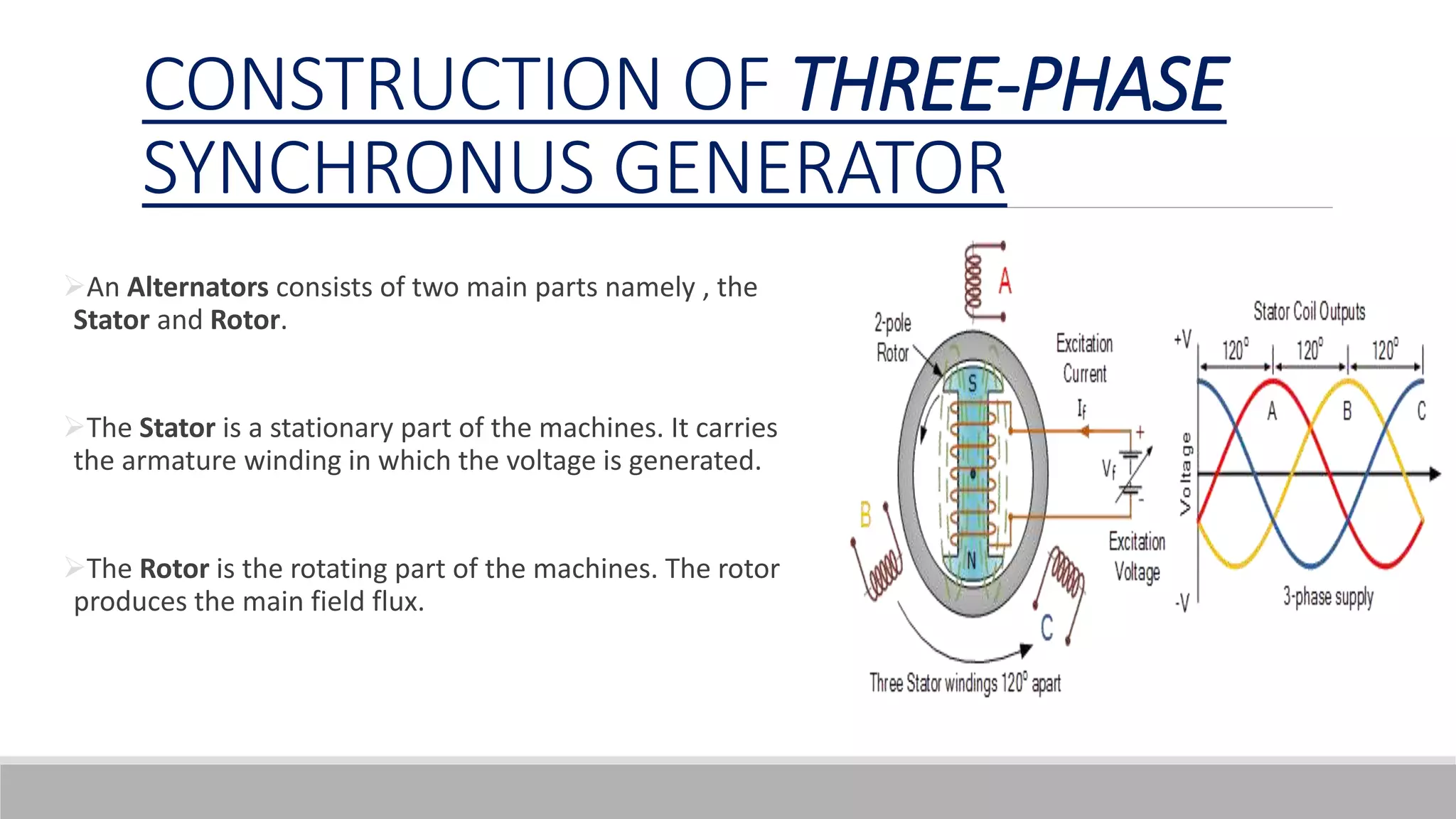
An Alternators consists of two main parts namely , the
Stator and Rotor.
The Stator is a stationary part of the machines. It carries
the armature winding in which the voltage is generated.
The Rotor is the rotating part of the machines. The rotor
produces the main field flux.
SPEED AND FREQUENCY:
Frequency:
P=total number of poles
N=speed of field poles in r.p.m.
n=speed of field poles in r.p.s.
f=frequency of the generated voltage in Hz.
N/60 = n
P/2=p
f=PN/120
SYNCHRONOUS SPEED:
Synchronous speed
Ns = 120f/p
Where Ns is the called synchronous machine
f = frequency the generated voltage in Hz
P = total no of field poles
WHAT IS INDUCTION MOTOR
“An induction motor is an AC electric motor in which the electric
current in the rotor needed to produce torque is obtained by
electromagnetic induction from the magnetic field of the stator
winding. An induction motor can therefore be made without electrical
connections to the rotor.”
“ It is also called Asynchronous motor.”
STATOR:
Stator- The Stator is the stationary part of a
rotary system, found in electric generators,
electric motors, sirens or biological rotors.
The main use of a stator is to keep the field aligned.
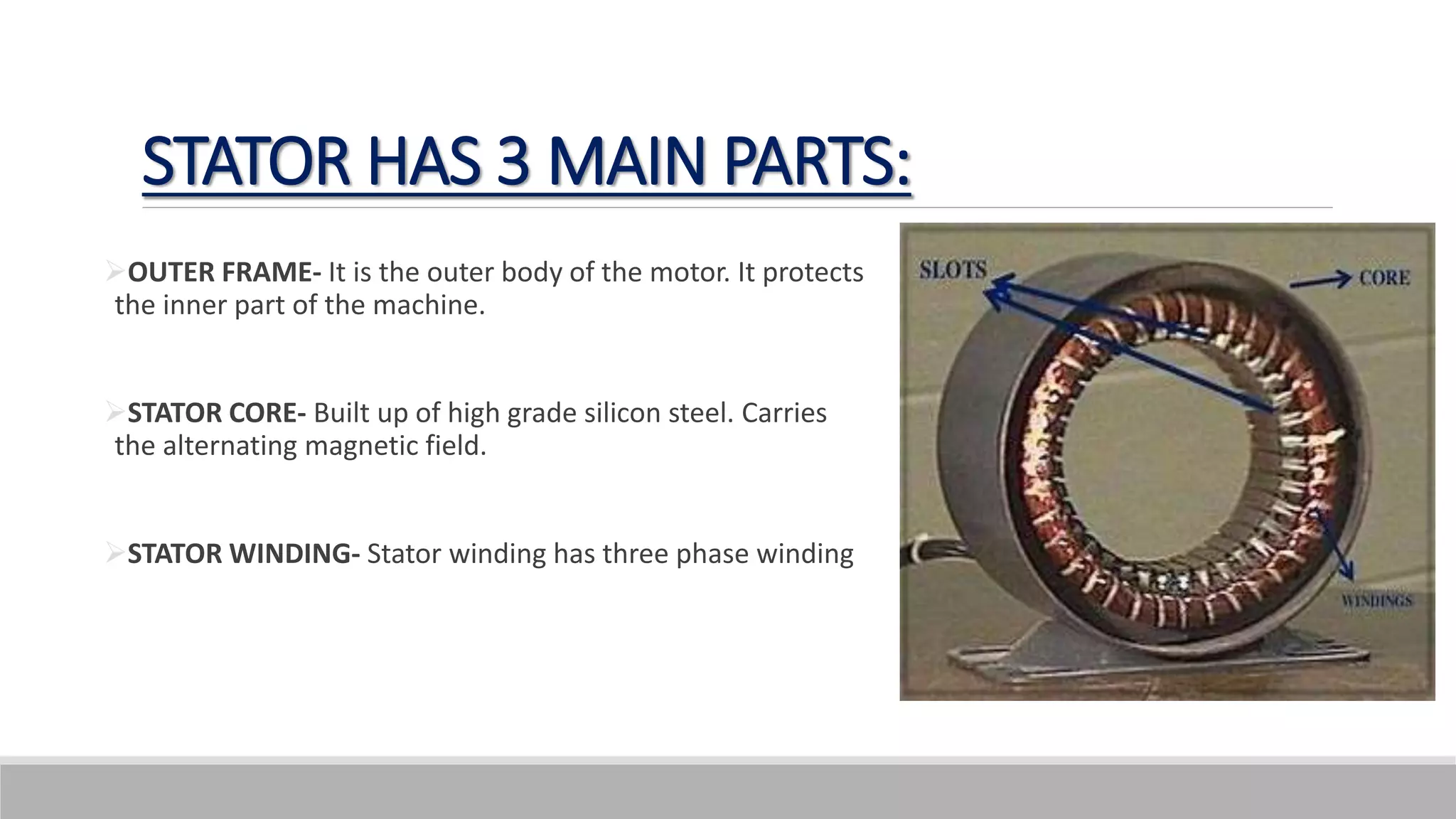
STATOR HAS 3 MAIN PARTS:
OUTER FRAME- It is the outer body of the motor. It protects
the inner part of the machine.
STATOR CORE- Built up of high grade silicon steel. Carries
the alternating magnetic field.
STATOR WINDING- Stator winding has three phase winding
ROTOR:
ROTOR - The Rotor is a moving component of an
electromagnetic system in the electric motor, electric
generator , alternator.
 Its rotation is due to the interaction between the
windings and magnetic fields which produces a torque
around the rotor’s axis.
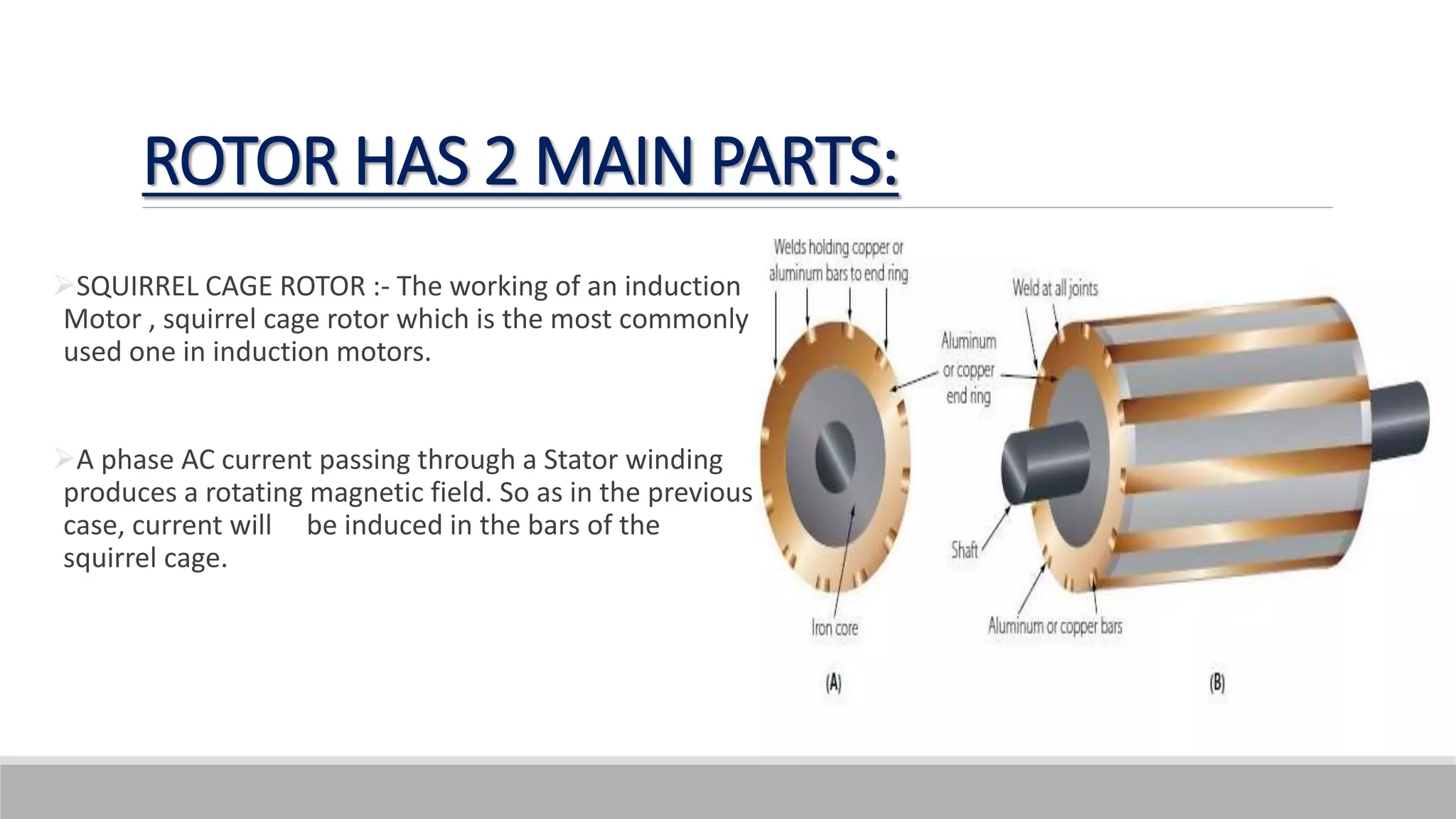
ROTOR HAS 2 MAIN PARTS:
SQUIRREL CAGE ROTOR :- The working of an induction
Motor , squirrel cage rotor which is the most commonly
used one in induction motors.
A phase AC current passing through a Stator winding
produces a rotating magnetic field. So as in the previous
case, current will be induced in the bars of the
squirrel cage.
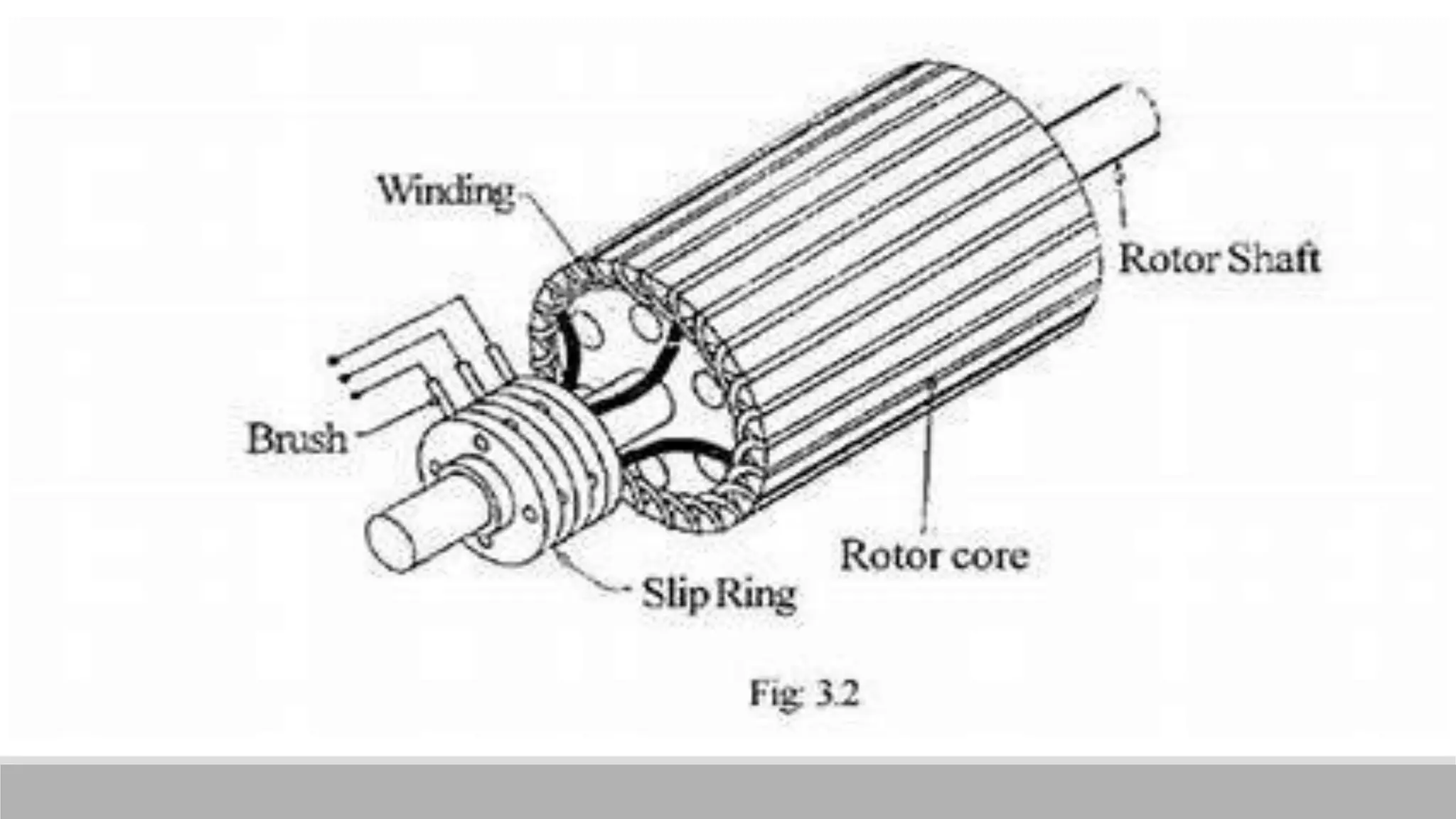
SLIP RING ROTOR:
Slip Rings :
Slip rings are electrical connections that are used to
transfer power to and fro from the rotor of an AC
generator.
 They are typically designed to conduct the flow of
current from a stationary device to a rotating one.
SLIP:
Induction motor rotor always rotate at a speed less than synchronous speed.
The difference between the flux (Ns) and the rotor speed (N) is called Slip.
%Slip= ((Ns-N) /N) X 100
Slip speed=Ns-N
WORKING OF AN AC GENERATOR:
When the armature rotates between the poles of the
magnet upon an axis perpendicular to the magnetic field,
the flux linkage of the armature changes continuously.
Due to this, an emf is induced in the armature. This
produces an electric current that flows through the
galvanometer and the slip rings and brushes.
The galvanometer swings between positive and negative
values. This indicates that there is an alternating current
flowing through the galvanometer.
The direction of the induced current can be identified
using Fleming’s Right Hand Rule.
ADVANTAGES OF AC GENERATORS
Following are a few advantages of AC generators over DC generators:
AC generators can be easily stepped up and stepped down through transformers.
Transmission link size might be thinner because of the step-up feature.
Losses are relatively lesser than DC machine
Size of the AC generators are relatively smaller than DC generators.
DISADVANTAGES OF AC GENERATOR
Following are some disadvantages of AC generators.
Generating large scale AC power using AC generators can be
extremely hazardous.
The flow of electricity through generator and transformer
coils produces resistive heat. This heat can damage the
insulation and cause a fire.
THANK YOU
SUBMITTED TO: KRISHAN SIR

AC generator

  • 1.
    A.C GENERATOR ◦ NAME:SIMRAN GUPTA ROLL.NO:19/439
  • 2.
    WHAT IS AGENERATOR FARADAY LAW OF EMI INTRODUCTION OF AC GENERATOR COMPONENTS OF AC GENERATOR: ◦ FIELD ◦ ARMATURE ◦ PRIME MOVER CONSTRUCTION OF 3 PHASE SYNCHRONOUS GENERATOR ◦ INDUCTION MOTOR ◦ STATOR AND ITS PARTS ◦ ROTOR AND ITS PARTS ◦ SLIP ◦ WORKING OF AN AC GENERATOR ◦ ADVANTAGES AND DISADVANTAGES OF AC GENERATOR
  • 3.
    WHAT IS AGENERATOR ??  The device which converts the mechanical energy into electrical energy is called generator. There are 2 types of generators: 1. D.C Generator: The generator which converts the mechanical energy into D.C form of electrical energy is called D.C Generator. 2. A.C Generator: The generator which converts the mechanical energy into A.C form of electrical energy is called A.C Generator. Both of the generator works on the principle of FARADAY’S LAW OF ELECTROMAGNETIC INDUCTION.
  • 4.
    FARADAY’S LAW ELECTROMAGNETIC INDUCTION: Faraday’slaw of electromagnetic induction: It states that electromotive force -EMF or voltage – is generated in a current- carrying conductor that cuts a uniform magnetic field. This can either be achieved by rotating a conducting coil in a static magnetic field, or by rotating the magnetic field that contains the stationary conductor. The preferred arrangement is to keep the coil stationary because it is easier to draw induced alternating current from a stationary armature coil than a rotating coil. The generated EMF depends on the number of armature coil turns, magnetic field strength, and the speed of the rotating field.
  • 5.
    A.C GENERATOR Ac generatorsare usually called alternators. They are also called synchronous generators . Rotating machines that rotate at a speed fixed by the supply frequency and the number of poles are called synchronous machines . A synchronous generator is a machine for converting mechanical power from a prime mover to a.c. electric power at specific voltage and frequency. Synchronous machine are used primarily as generator of electrical power.
  • 6.
    PARTS OF ANAC GENERATOR: The various components of an AC generator are: 1) Field 2) Armature 3) Prime Mover 4) Rotor 5) Stator 6) Slip Rings
  • 7.
    COMPONENTS OF ACGENERATOR: Field : The field consists of coils of conductors that receive a voltage from the source and produce magnetic flux. The magnetic flux in the field cuts the armature to produce magnetic flux. This voltage is the output voltage of the AC generator. Armature: The part of an AC generator in which the voltage is produced is known as an armature. This component primarily consists of coils of wire that are large enough to carry the full-load current of the generator. Prime Mover: The component used to drive the AC generator is known as a prime mover. The prime mover could either be a diesel engine, a steam turbine, or a motor.
  • 8.
    CONSTRUCTION OF THREE-PHASE SYNCHRONUSGENERATOR An Alternators consists of two main parts namely , the Stator and Rotor. The Stator is a stationary part of the machines. It carries the armature winding in which the voltage is generated. The Rotor is the rotating part of the machines. The rotor produces the main field flux.
  • 9.
    SPEED AND FREQUENCY: Frequency: P=totalnumber of poles N=speed of field poles in r.p.m. n=speed of field poles in r.p.s. f=frequency of the generated voltage in Hz. N/60 = n P/2=p f=PN/120
  • 10.
    SYNCHRONOUS SPEED: Synchronous speed Ns= 120f/p Where Ns is the called synchronous machine f = frequency the generated voltage in Hz P = total no of field poles
  • 11.
    WHAT IS INDUCTIONMOTOR “An induction motor is an AC electric motor in which the electric current in the rotor needed to produce torque is obtained by electromagnetic induction from the magnetic field of the stator winding. An induction motor can therefore be made without electrical connections to the rotor.” “ It is also called Asynchronous motor.”
  • 12.
    STATOR: Stator- The Statoris the stationary part of a rotary system, found in electric generators, electric motors, sirens or biological rotors. The main use of a stator is to keep the field aligned.
  • 13.
    STATOR HAS 3MAIN PARTS: OUTER FRAME- It is the outer body of the motor. It protects the inner part of the machine. STATOR CORE- Built up of high grade silicon steel. Carries the alternating magnetic field. STATOR WINDING- Stator winding has three phase winding
  • 14.
    ROTOR: ROTOR - TheRotor is a moving component of an electromagnetic system in the electric motor, electric generator , alternator.  Its rotation is due to the interaction between the windings and magnetic fields which produces a torque around the rotor’s axis.
  • 15.
    ROTOR HAS 2MAIN PARTS: SQUIRREL CAGE ROTOR :- The working of an induction Motor , squirrel cage rotor which is the most commonly used one in induction motors. A phase AC current passing through a Stator winding produces a rotating magnetic field. So as in the previous case, current will be induced in the bars of the squirrel cage.
  • 16.
    SLIP RING ROTOR: SlipRings : Slip rings are electrical connections that are used to transfer power to and fro from the rotor of an AC generator.  They are typically designed to conduct the flow of current from a stationary device to a rotating one.
  • 18.
    SLIP: Induction motor rotoralways rotate at a speed less than synchronous speed. The difference between the flux (Ns) and the rotor speed (N) is called Slip. %Slip= ((Ns-N) /N) X 100 Slip speed=Ns-N
  • 19.
    WORKING OF ANAC GENERATOR: When the armature rotates between the poles of the magnet upon an axis perpendicular to the magnetic field, the flux linkage of the armature changes continuously. Due to this, an emf is induced in the armature. This produces an electric current that flows through the galvanometer and the slip rings and brushes. The galvanometer swings between positive and negative values. This indicates that there is an alternating current flowing through the galvanometer. The direction of the induced current can be identified using Fleming’s Right Hand Rule.
  • 20.
    ADVANTAGES OF ACGENERATORS Following are a few advantages of AC generators over DC generators: AC generators can be easily stepped up and stepped down through transformers. Transmission link size might be thinner because of the step-up feature. Losses are relatively lesser than DC machine Size of the AC generators are relatively smaller than DC generators.
  • 21.
    DISADVANTAGES OF ACGENERATOR Following are some disadvantages of AC generators. Generating large scale AC power using AC generators can be extremely hazardous. The flow of electricity through generator and transformer coils produces resistive heat. This heat can damage the insulation and cause a fire.
  • 22.