Electrical Generator
Muhammad Mehtab Ali Syed
Outline
 Introduction
 History of Generator
 Material used in electrical generator
 Categories and construction
 DC generator
 AC generator
 Type of generator
 Common use cases
 Advantage and disadvantages
 Generator Market
Introduction
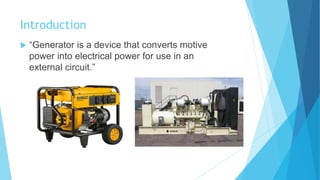
 “Generator is a device that converts motive
power into electrical power for use in an
external circuit.”
Source of mechanical energy
Steam
engine
Wind
turbine
Combustion
engine etc.
Smaller
Larger output
obsolete
Aim
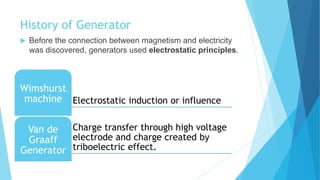
History of Generator
 Before the connection between magnetism and electricity
was discovered, generators used electrostatic principles.
Electrostatic induction or influence
Wimshurst
machine
Charge transfer through high voltage
electrode and charge created by
triboelectric effect.
Van de
Graaff
Generator
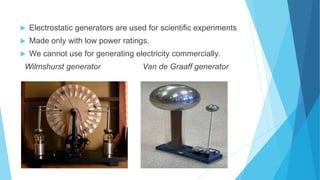
 Electrostatic generators are used for scientific experiments
 Made only with low power ratings.
 We cannot use for generating electricity commercially.
Wilmshurst generator Van de Graaff generator

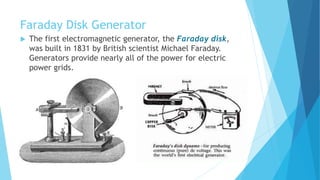
Faraday Disk Generator
 The first electromagnetic generator, the Faraday disk,
was built in 1831 by British scientist Michael Faraday.
Generators provide nearly all of the power for electric
power grids.
 Operating principle of electromagnetic generators was
discovered in the years of 1831–1832.
 The principle later called Faraday's law.
 Electromotive force is generated in an electrical conductor
which encircles a varying magnetic flux.
 A type of homopolar generator, using a copper disc rotating
between the poles of a horseshoe magnet.
 It produced a small DC voltage.
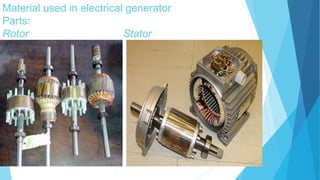
Material used in electrical generator
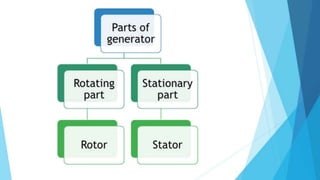
Parts:
Rotor Stator
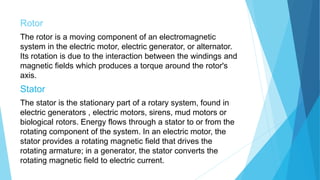
Rotor
The rotor is a moving component of an electromagnetic
system in the electric motor, electric generator, or alternator.
Its rotation is due to the interaction between the windings and
magnetic fields which produces a torque around the rotor's
axis.
Stator
The stator is the stationary part of a rotary system, found in
electric generators , electric motors, sirens, mud motors or
biological rotors. Energy flows through a stator to or from the
rotating component of the system. In an electric motor, the
stator provides a rotating magnetic field that drives the
rotating armature; in a generator, the stator converts the
rotating magnetic field to electric current.
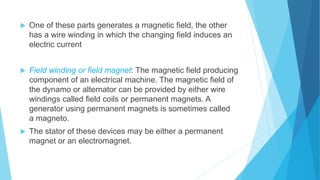
 One of these parts generates a magnetic field, the other
has a wire winding in which the changing field induces an
electric current
 Field winding or field magnet: The magnetic field producing
component of an electrical machine. The magnetic field of
the dynamo or alternator can be provided by either wire
windings called field coils or permanent magnets. A
generator using permanent magnets is sometimes called
a magneto.
 The stator of these devices may be either a permanent
magnet or an electromagnet.
.
Stator Coil: Comparison of different
material
 The coil can be either iron core or aluminum. To reduce
loading losses in motors, manufacturers invariably use
copper as the conducting material in windings.
Aluminum, because of its lower electrical conductivity, may
be an alternate material in fractional horsepower motors,
especially when the motors are used for very short
durations.
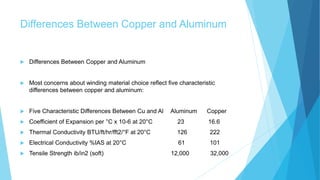
Differences Between Copper and Aluminum
 Differences Between Copper and Aluminum
 Most concerns about winding material choice reflect five characteristic
differences between copper and aluminum:
 Five Characteristic Differences Between Cu and Al Aluminum Copper
 Coefficient of Expansion per °C x 10-6 at 20°C 23 16.6
 Thermal Conductivity BTU/ft/hr/fft2/°F at 20°C 126 222
 Electrical Conductivity %IAS at 20°C 61 101
 Tensile Strength ib/in2 (soft) 12,000 32,000
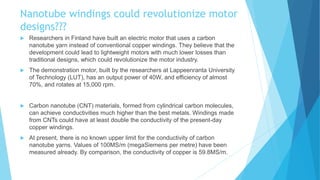
Nanotube windings could revolutionize motor
designs???
 Researchers in Finland have built an electric motor that uses a carbon
nanotube yarn instead of conventional copper windings. They believe that the
development could lead to lightweight motors with much lower losses than
traditional designs, which could revolutionize the motor industry.
 The demonstration motor, built by the researchers at Lappeenranta University
of Technology (LUT), has an output power of 40W, and efficiency of almost
70%, and rotates at 15,000 rpm.
 Carbon nanotube (CNT) materials, formed from cylindrical carbon molecules,
can achieve conductivities much higher than the best metals. Windings made
from CNTs could have at least double the conductivity of the present-day
copper windings.
 At present, there is no known upper limit for the conductivity of carbon
nanotube yarns. Values of 100MS/m (megaSiemens per metre) have been
measured already. By comparison, the conductivity of copper is 59.8MS/m.
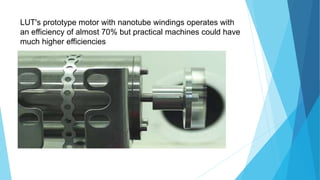
LUT's prototype motor with nanotube windings operates with
an efficiency of almost 70% but practical machines could have
much higher efficiencies
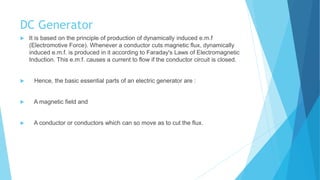
DC Generator
 It is based on the principle of production of dynamically induced e.m.f
(Electromotive Force). Whenever a conductor cuts magnetic flux, dynamically
induced e.m.f. is produced in it according to Faraday's Laws of Electromagnetic
Induction. This e.m.f. causes a current to flow if the conductor circuit is closed.
 Hence, the basic essential parts of an electric generator are :
 A magnetic field and
 A conductor or conductors which can so move as to cut the flux.
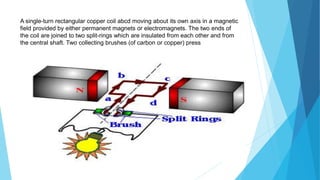
A single-turn rectangular copper coil abcd moving about its own axis in a magnetic
field provided by either permanent magnets or electromagnets. The two ends of
the coil are joined to two split-rings which are insulated from each other and from
the central shaft. Two collecting brushes (of carbon or copper) press
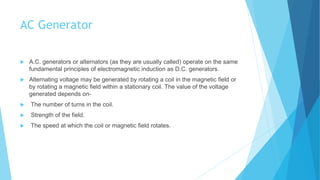
AC Generator
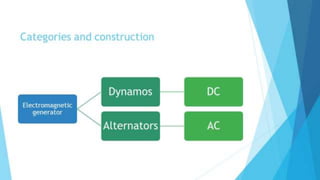
 A.C. generators or alternators (as they are usually called) operate on the same
fundamental principles of electromagnetic induction as D.C. generators.
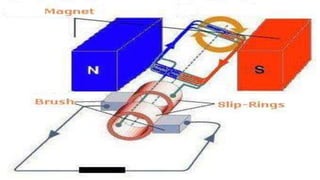
 Alternating voltage may be generated by rotating a coil in the magnetic field or
by rotating a magnetic field within a stationary coil. The value of the voltage
generated depends on-
 The number of turns in the coil.
 Strength of the field.
 The speed at which the coil or magnetic field rotates.
Concepts
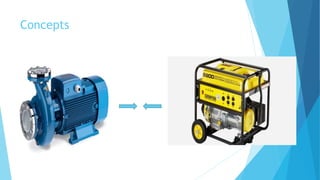
 ‘The generator moves an electric current, but it
does not create electric charge, which is already
present in the conductive wire of its windings. It
is somewhat analogous to a water pump, which
creates a flow of water but does not create the
water itself.’
Maximum power
 The maximum power theorem applies to generators as it does to any
source of electrical energy.
 This theorem states that the maximum power can be obtained from the
generator by making the resistance of the load equal to that of the
generator.
 However, under this condition the power transfer efficiency is only 50
percent, which means that half the power generated is wasted as heat
inside the generator.
 For this reason, practical generators are not usually designed to
operate at maximum power output, but at a lower power output where
efficiency is greater.
Low power
 Early motor vehicles tended to use DC generators with
electromechanical regulators.
 These were not particularly reliable or efficient and have now been
replaced by alternators with built-in rectifier circuits.
 These power the electrical systems on the vehicle and recharge the
battery after starting. Rated output will typically be in the range 50-100
A at 12 V, depending on the designed electrical load within the
vehicle—some cars now have electrically-powered steering assistance
and air conditioning, which places a high load on the electrical system.
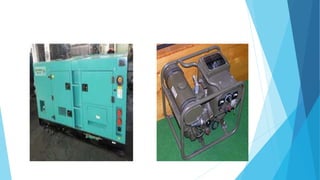
Engine Generator(Types)
Genset Generator
 An engine-generator is the combination of an electrical generator and
an engine mounted together to form a single piece of equipment. This
combination is also called an engine-generator set or a gen-set. In
many contexts, the engine is taken for granted and the combined unit is
simply called a generator.
 The primary advantage of engine-generators is the ability to
independently supply electricity, allowing the units to serve as backup
power solutions.
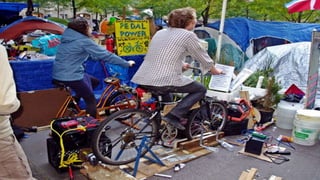
Human Powered Electrical Generators
 Typically operated by means of pedal power, a converted bicycle
trainer, or a foot pump, such generators can be practically used to
charge batteries, and in some cases are designed with an integral
inverter.
 An average "healthy human" can produce a steady 75 Watts (0.1
horsepower) for a full eight hour period, while a "first class athlete" can
produce approximately 298 Watts (0.4 horsepower) for a similar period.
MHD generator
 A magnetohydrodynamic generator directly extracts electric
power from moving hot gases through a magnetic field.
 Without the use of rotating electromagnetic machinery.
MHD generators were originally developed because the
output of a plasma MHD generator is a flame, well able to
heat the boilers of a steam power plant.
Mechanical measurement
 Designed to measure shaft speed, a tachogenerator is a
device which produces an output voltage proportional to
that speed. Tachogenerators are frequently used to
power tachometers to measure the speeds of electric
motors, engines, and the equipment they power and speed.
With precise construction and design, generators can be
built to produce very precise voltages for certain ranges of
shafts.
Common Use Cases
 Roadway vehicles:
Motor vehicles require electrical energy to power their
instrumentation, keep the engine itself operating, and
recharge their batteries.
Until about the 1960s motor vehicles tended to use DC
generators with electromechanical regulators.
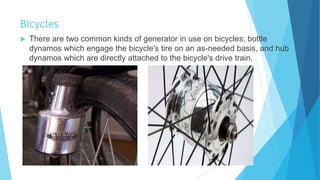
Bicycles
 There are two common kinds of generator in use on bicycles: bottle
dynamos which engage the bicycle's tire on an as-needed basis, and hub
dynamos which are directly attached to the bicycle's drive train.
Sailboats
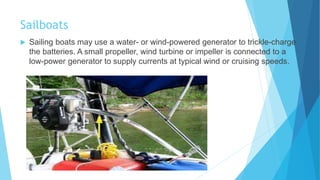
 Sailing boats may use a water- or wind-powered generator to trickle-charge
the batteries. A small propeller, wind turbine or impeller is connected to a
low-power generator to supply currents at typical wind or cruising speeds.
Advantages and disadvantages
 Advantages
 Power producing ability
 Durability
 Purpose of use
 Use of electricity
 Disadvantages
 Effect on environment
 Power storage capacity
 Manual Start
 Maintenance cost
Market Value
 Demand of electricity has been increased across the globe in the last
decay owing to increase population and industrialization.
 However electricity generation by utilities is not sufficient to meet the
global demand for power. This has created a favorable space for
generator sets to fill in the gap between power generation and
consumption.
 Commercial and industrialization end-user of generators sets
accounted for the major share of the generator market.
 The generator market has been segmented based on geography into
North-America, Europe, Asia, Pacific, Middle east and Africa and latin
America, demand for each type of generators sets in terms of revenue
for each of these region has been forecast for the period from 2016 to
2024.
THANKS FOR YOUR
ATTENTION!
References
 https://www.google.com.pk/search?q=electrical+generator&source=lnms&tbm=isch&sa=X&ved=0ahU
KEwibsLfvltPXAhUDWhoKHQy_DbAQ_AUICigB&biw=1242&bih=579#imgrc=b7VTQ9FK8RodpM:
 https://www.google.com.pk/search?q=electrical+generator&source=lnms&tbm=isch&sa=X&ved=0ahU
KEwibsLfvltPXAhUDWhoKHQy_DbAQ_AUICigB&biw=1242&bih=579#imgrc=Q0AY281ZAduWGM:
 http://www.newworldencyclopedia.org/entry/Electrical_generator
 https://www.google.com.pk/search?q=Wimshurst+machine&source=lnms&tbm=isch&sa=X&ved=0ahU
KEwiA0t3iptPXAhVKuhoKHdhcCBgQ_AUICigB&biw=1242&bih=579#imgrc=16KXGIZtHm_ZuM:
 https://www.google.com.pk/search?q=van+de+graaff+generator&source=lnms&tbm=isch&sa=X&ved=
0ahUKEwiclLeZqNPXAhUB1BoKHaKnDcYQ_AUICigB&biw=1242&bih=579#imgrc=MWSOnIKQ3rzi1
M:
 https://www.google.com.pk/search?q=faraday+disc+generator&source=lnms&tbm=isch&sa=X&ved=0a
hUKEwjXtNiTqtPXAhWLXBoKHXkBApQQ_AUICigB&biw=1242&bih=579#imgrc=mWB_NKni7QqjvM:
 https://www.google.com.pk/search?q=faraday+disc+generator&source=lnms&tbm=isch&sa=X&ved=0a
hUKEwjXtNiTqtPXAhWLXBoKHXkBApQQ_AUICigB&biw=1242&bih=579#imgrc=_kYF31STeQzXBM:
 https://www.google.com.pk/search?q=faraday+disc+generator&source=lnms&tbm=isch&sa=X&ved=0a
hUKEwjXtNiTqtPXAhWLXBoKHXkBApQQ_AUICigB&biw=1242&bih=579#imgrc=_kYF31STeQzXBM:
 https://en.wikipedia.org/wiki/Stator#/media/File:Stator_and_rotor_by_Zureks.JPG
https://www.google.com.pk/search?q=dc+generator&source=lnms&tbm=isch&sa=X&ved=0ahUKEwis44jqlt
3XAhXJQZoKHSjVD7oQ_AUICigB&biw=1242&bih=579#imgrc=eG7G3m7kT3-eKM:
https://es.wikipedia.org/wiki/Hippolyte_Pixii
https://www.google.com.pk/search?q=generator&source=lnms&tbm=isch&sa=X&ved=0ahUKEwiiq9TFnd3
XAhXCYpoKHbULA4IQ_AUICygC&biw=1242&bih=535#imgrc=NjFySL7jdkuN0M:
https://www.google.com.pk/search?q=Ferranti%E2%80%99s+AC+Generator&hl=en&source=lnms&tbm=is
ch&sa=X&ved=0ahUKEwjYs965o93XAhUkJpoKHevfACMQ_AUICigB&biw=1242&bih=535#imgrc=3wNtEv
oJ7OCl-M:
https://energy.gov/fe/how-gas-turbine-power-plants-work
https://www.gepower.com/resources/knowledge-base/what-is-a-gas-turbine
http://drivesncontrols.com/news/fullstory.php/aid/4584/Nanotube_windings_could_revolutionise_motor_des
igns.html

Electrical generator.pptx complete.pptx new

  • 1.
  • 2.
    Outline  Introduction  Historyof Generator  Material used in electrical generator  Categories and construction  DC generator  AC generator  Type of generator  Common use cases  Advantage and disadvantages  Generator Market
  • 3.
    Introduction  “Generator isa device that converts motive power into electrical power for use in an external circuit.”
  • 4.
    Source of mechanicalenergy Steam engine Wind turbine Combustion engine etc.
  • 5.
  • 6.
    History of Generator Before the connection between magnetism and electricity was discovered, generators used electrostatic principles. Electrostatic induction or influence Wimshurst machine Charge transfer through high voltage electrode and charge created by triboelectric effect. Van de Graaff Generator
  • 7.
     Electrostatic generatorsare used for scientific experiments  Made only with low power ratings.  We cannot use for generating electricity commercially. Wilmshurst generator Van de Graaff generator 
  • 8.
    Faraday Disk Generator The first electromagnetic generator, the Faraday disk, was built in 1831 by British scientist Michael Faraday. Generators provide nearly all of the power for electric power grids.
  • 9.
     Operating principleof electromagnetic generators was discovered in the years of 1831–1832.  The principle later called Faraday's law.  Electromotive force is generated in an electrical conductor which encircles a varying magnetic flux.  A type of homopolar generator, using a copper disc rotating between the poles of a horseshoe magnet.  It produced a small DC voltage.
  • 10.
    Material used inelectrical generator Parts: Rotor Stator
  • 12.
    Rotor The rotor isa moving component of an electromagnetic system in the electric motor, electric generator, or alternator. Its rotation is due to the interaction between the windings and magnetic fields which produces a torque around the rotor's axis. Stator The stator is the stationary part of a rotary system, found in electric generators , electric motors, sirens, mud motors or biological rotors. Energy flows through a stator to or from the rotating component of the system. In an electric motor, the stator provides a rotating magnetic field that drives the rotating armature; in a generator, the stator converts the rotating magnetic field to electric current.
  • 13.
     One ofthese parts generates a magnetic field, the other has a wire winding in which the changing field induces an electric current  Field winding or field magnet: The magnetic field producing component of an electrical machine. The magnetic field of the dynamo or alternator can be provided by either wire windings called field coils or permanent magnets. A generator using permanent magnets is sometimes called a magneto.  The stator of these devices may be either a permanent magnet or an electromagnet.
  • 14.
  • 15.
    Stator Coil: Comparisonof different material  The coil can be either iron core or aluminum. To reduce loading losses in motors, manufacturers invariably use copper as the conducting material in windings. Aluminum, because of its lower electrical conductivity, may be an alternate material in fractional horsepower motors, especially when the motors are used for very short durations.
  • 16.
    Differences Between Copperand Aluminum  Differences Between Copper and Aluminum  Most concerns about winding material choice reflect five characteristic differences between copper and aluminum:  Five Characteristic Differences Between Cu and Al Aluminum Copper  Coefficient of Expansion per °C x 10-6 at 20°C 23 16.6  Thermal Conductivity BTU/ft/hr/fft2/°F at 20°C 126 222  Electrical Conductivity %IAS at 20°C 61 101  Tensile Strength ib/in2 (soft) 12,000 32,000
  • 17.
    Nanotube windings couldrevolutionize motor designs???  Researchers in Finland have built an electric motor that uses a carbon nanotube yarn instead of conventional copper windings. They believe that the development could lead to lightweight motors with much lower losses than traditional designs, which could revolutionize the motor industry.  The demonstration motor, built by the researchers at Lappeenranta University of Technology (LUT), has an output power of 40W, and efficiency of almost 70%, and rotates at 15,000 rpm.  Carbon nanotube (CNT) materials, formed from cylindrical carbon molecules, can achieve conductivities much higher than the best metals. Windings made from CNTs could have at least double the conductivity of the present-day copper windings.  At present, there is no known upper limit for the conductivity of carbon nanotube yarns. Values of 100MS/m (megaSiemens per metre) have been measured already. By comparison, the conductivity of copper is 59.8MS/m.
  • 18.
    LUT's prototype motorwith nanotube windings operates with an efficiency of almost 70% but practical machines could have much higher efficiencies
  • 20.
    DC Generator  Itis based on the principle of production of dynamically induced e.m.f (Electromotive Force). Whenever a conductor cuts magnetic flux, dynamically induced e.m.f. is produced in it according to Faraday's Laws of Electromagnetic Induction. This e.m.f. causes a current to flow if the conductor circuit is closed.  Hence, the basic essential parts of an electric generator are :  A magnetic field and  A conductor or conductors which can so move as to cut the flux.
  • 21.
    A single-turn rectangularcopper coil abcd moving about its own axis in a magnetic field provided by either permanent magnets or electromagnets. The two ends of the coil are joined to two split-rings which are insulated from each other and from the central shaft. Two collecting brushes (of carbon or copper) press
  • 22.
    AC Generator  A.C.generators or alternators (as they are usually called) operate on the same fundamental principles of electromagnetic induction as D.C. generators.  Alternating voltage may be generated by rotating a coil in the magnetic field or by rotating a magnetic field within a stationary coil. The value of the voltage generated depends on-  The number of turns in the coil.  Strength of the field.  The speed at which the coil or magnetic field rotates.
  • 24.
  • 25.
     ‘The generatormoves an electric current, but it does not create electric charge, which is already present in the conductive wire of its windings. It is somewhat analogous to a water pump, which creates a flow of water but does not create the water itself.’
  • 26.
    Maximum power  Themaximum power theorem applies to generators as it does to any source of electrical energy.  This theorem states that the maximum power can be obtained from the generator by making the resistance of the load equal to that of the generator.  However, under this condition the power transfer efficiency is only 50 percent, which means that half the power generated is wasted as heat inside the generator.  For this reason, practical generators are not usually designed to operate at maximum power output, but at a lower power output where efficiency is greater.
  • 27.
    Low power  Earlymotor vehicles tended to use DC generators with electromechanical regulators.  These were not particularly reliable or efficient and have now been replaced by alternators with built-in rectifier circuits.  These power the electrical systems on the vehicle and recharge the battery after starting. Rated output will typically be in the range 50-100 A at 12 V, depending on the designed electrical load within the vehicle—some cars now have electrically-powered steering assistance and air conditioning, which places a high load on the electrical system.
  • 28.
    Engine Generator(Types) Genset Generator An engine-generator is the combination of an electrical generator and an engine mounted together to form a single piece of equipment. This combination is also called an engine-generator set or a gen-set. In many contexts, the engine is taken for granted and the combined unit is simply called a generator.  The primary advantage of engine-generators is the ability to independently supply electricity, allowing the units to serve as backup power solutions.
  • 30.
    Human Powered ElectricalGenerators  Typically operated by means of pedal power, a converted bicycle trainer, or a foot pump, such generators can be practically used to charge batteries, and in some cases are designed with an integral inverter.  An average "healthy human" can produce a steady 75 Watts (0.1 horsepower) for a full eight hour period, while a "first class athlete" can produce approximately 298 Watts (0.4 horsepower) for a similar period.
  • 32.
    MHD generator  Amagnetohydrodynamic generator directly extracts electric power from moving hot gases through a magnetic field.  Without the use of rotating electromagnetic machinery. MHD generators were originally developed because the output of a plasma MHD generator is a flame, well able to heat the boilers of a steam power plant.
  • 33.
    Mechanical measurement  Designedto measure shaft speed, a tachogenerator is a device which produces an output voltage proportional to that speed. Tachogenerators are frequently used to power tachometers to measure the speeds of electric motors, engines, and the equipment they power and speed. With precise construction and design, generators can be built to produce very precise voltages for certain ranges of shafts.
  • 34.
    Common Use Cases Roadway vehicles: Motor vehicles require electrical energy to power their instrumentation, keep the engine itself operating, and recharge their batteries. Until about the 1960s motor vehicles tended to use DC generators with electromechanical regulators.
  • 35.
    Bicycles  There aretwo common kinds of generator in use on bicycles: bottle dynamos which engage the bicycle's tire on an as-needed basis, and hub dynamos which are directly attached to the bicycle's drive train.
  • 36.
    Sailboats  Sailing boatsmay use a water- or wind-powered generator to trickle-charge the batteries. A small propeller, wind turbine or impeller is connected to a low-power generator to supply currents at typical wind or cruising speeds.
  • 37.
    Advantages and disadvantages Advantages  Power producing ability  Durability  Purpose of use  Use of electricity  Disadvantages  Effect on environment  Power storage capacity  Manual Start  Maintenance cost
  • 38.
    Market Value  Demandof electricity has been increased across the globe in the last decay owing to increase population and industrialization.  However electricity generation by utilities is not sufficient to meet the global demand for power. This has created a favorable space for generator sets to fill in the gap between power generation and consumption.  Commercial and industrialization end-user of generators sets accounted for the major share of the generator market.  The generator market has been segmented based on geography into North-America, Europe, Asia, Pacific, Middle east and Africa and latin America, demand for each type of generators sets in terms of revenue for each of these region has been forecast for the period from 2016 to 2024.
  • 39.
  • 40.
    References  https://www.google.com.pk/search?q=electrical+generator&source=lnms&tbm=isch&sa=X&ved=0ahU KEwibsLfvltPXAhUDWhoKHQy_DbAQ_AUICigB&biw=1242&bih=579#imgrc=b7VTQ9FK8RodpM:  https://www.google.com.pk/search?q=electrical+generator&source=lnms&tbm=isch&sa=X&ved=0ahU KEwibsLfvltPXAhUDWhoKHQy_DbAQ_AUICigB&biw=1242&bih=579#imgrc=Q0AY281ZAduWGM: http://www.newworldencyclopedia.org/entry/Electrical_generator  https://www.google.com.pk/search?q=Wimshurst+machine&source=lnms&tbm=isch&sa=X&ved=0ahU KEwiA0t3iptPXAhVKuhoKHdhcCBgQ_AUICigB&biw=1242&bih=579#imgrc=16KXGIZtHm_ZuM:  https://www.google.com.pk/search?q=van+de+graaff+generator&source=lnms&tbm=isch&sa=X&ved= 0ahUKEwiclLeZqNPXAhUB1BoKHaKnDcYQ_AUICigB&biw=1242&bih=579#imgrc=MWSOnIKQ3rzi1 M:  https://www.google.com.pk/search?q=faraday+disc+generator&source=lnms&tbm=isch&sa=X&ved=0a hUKEwjXtNiTqtPXAhWLXBoKHXkBApQQ_AUICigB&biw=1242&bih=579#imgrc=mWB_NKni7QqjvM:  https://www.google.com.pk/search?q=faraday+disc+generator&source=lnms&tbm=isch&sa=X&ved=0a hUKEwjXtNiTqtPXAhWLXBoKHXkBApQQ_AUICigB&biw=1242&bih=579#imgrc=_kYF31STeQzXBM:  https://www.google.com.pk/search?q=faraday+disc+generator&source=lnms&tbm=isch&sa=X&ved=0a hUKEwjXtNiTqtPXAhWLXBoKHXkBApQQ_AUICigB&biw=1242&bih=579#imgrc=_kYF31STeQzXBM:  https://en.wikipedia.org/wiki/Stator#/media/File:Stator_and_rotor_by_Zureks.JPG
  • 41.