1
DC machines
2
DC GENERATORS:
• Constructional details – emf equation – Methods of excitation
– Self and separately excited generators – Characteristics of
series, shunt and compound generators
3
4
Wednesday, January 27, 2016 Ch. 14 Alternators and Synchronous Motors 5
Electro-mechanical Energy-conversion
(EMEC) Machines
Next
Wednesday, January 27, 2016 Ch. 14 Alternators and Synchronous Motors 6
AC and DC
Generators and Motors
• When the electrical system is characterized by direct
current, the machines are called dc motors and dc
generators.
• Similarly, if the electrical system is characterized by
alternating current, the machines are called ac motors
and ac generators.
• Basically, the ac machines are not different from the dc
machines.
Next
Wednesday, January 27, 2016 Ch. 14 Alternators and Synchronous Motors 7
Electrical Rotary Machine
• It has two parts :
(1) the fixed part, called the stator, and
(2) the moving part, called the rotor.
Next
Wednesday, January 27, 2016 Ch. 14 Alternators and Synchronous Motors 8
Generator Action
• Whenever the conductors of a coil cut across the
magnetic flux (or are cut by it), an emf e is induced in
it.
• This emf can supply a current i to an electrical load.
• Thus, an electrical power ei is generated.
• This is the Generator Action.
Next
Wednesday, January 27, 2016 Ch. 14 Alternators and Synchronous Motors 9
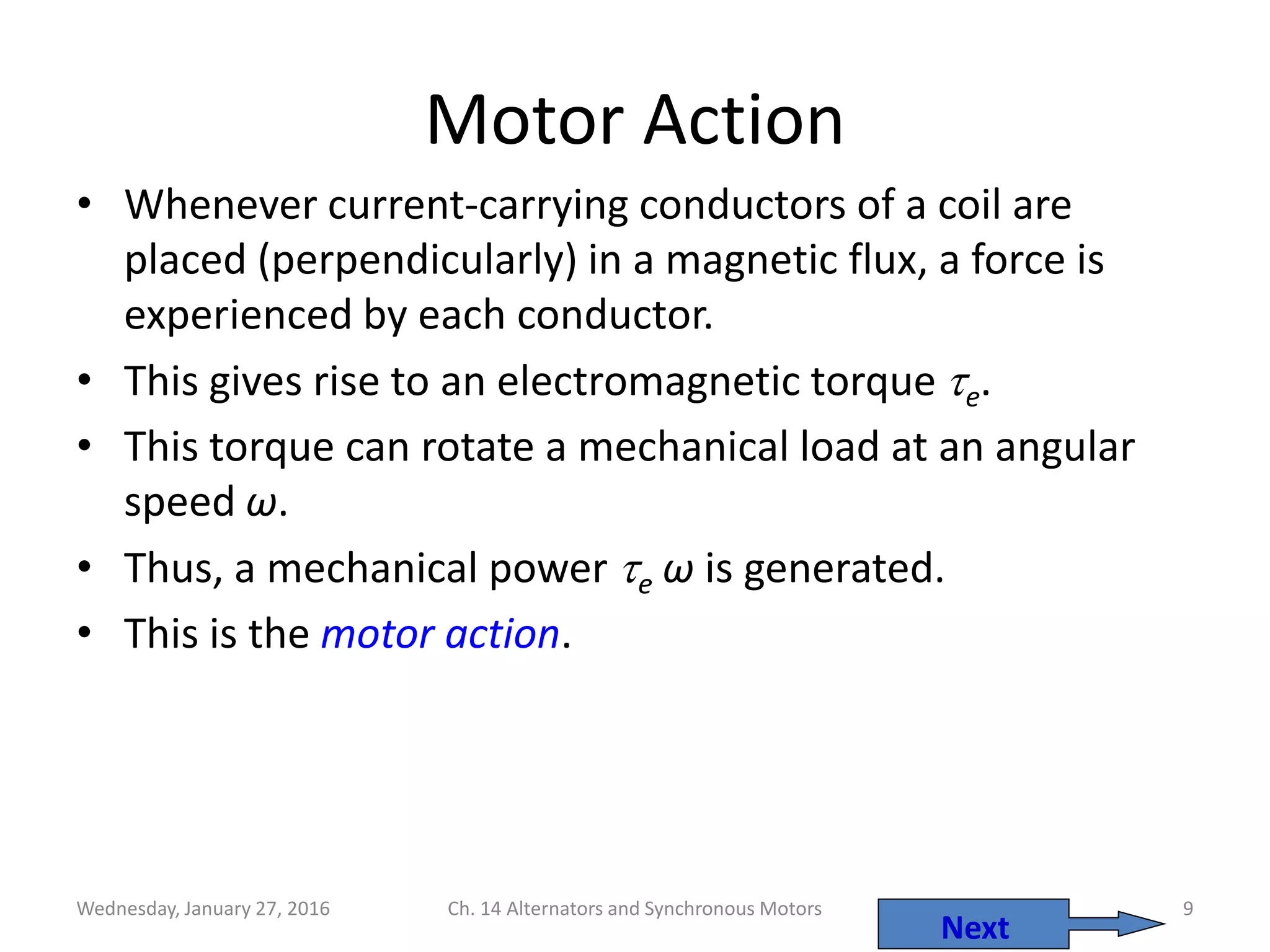
Motor Action
• Whenever current-carrying conductors of a coil are
placed (perpendicularly) in a magnetic flux, a force is
experienced by each conductor.
• This gives rise to an electromagnetic torque e.
• This torque can rotate a mechanical load at an angular
speed ω.
• Thus, a mechanical power e ω is generated.
• This is the motor action.
Next
Wednesday, January 27, 2016 Ch. 14 Alternators and Synchronous Motors 10
Power Considerations for a Generator
Large-size generators are usually called
alternators.
Next
Wednesday, January 27, 2016 Ch. 16 DC Machines 11
Importance
• DC machines were the first electrical machines invented.
• It is still the best motor to drive trains and cranes.
• Because semiconductor rectifiers can easily convert ac into dc, dc
generators are not needed.
• Even in the automobiles, the dc generator has been replaced by
the alternator plus diodes for rectification.
• Portable devices powered by batteries require dc motors, such as
portable tape players, walkman, window-lifters, etc.
• The dc motor is readily controlled in speed and torque and hence
is useful for control systems.
Next
Wednesday, January 27, 2016 Ch. 16 DC Machines 12
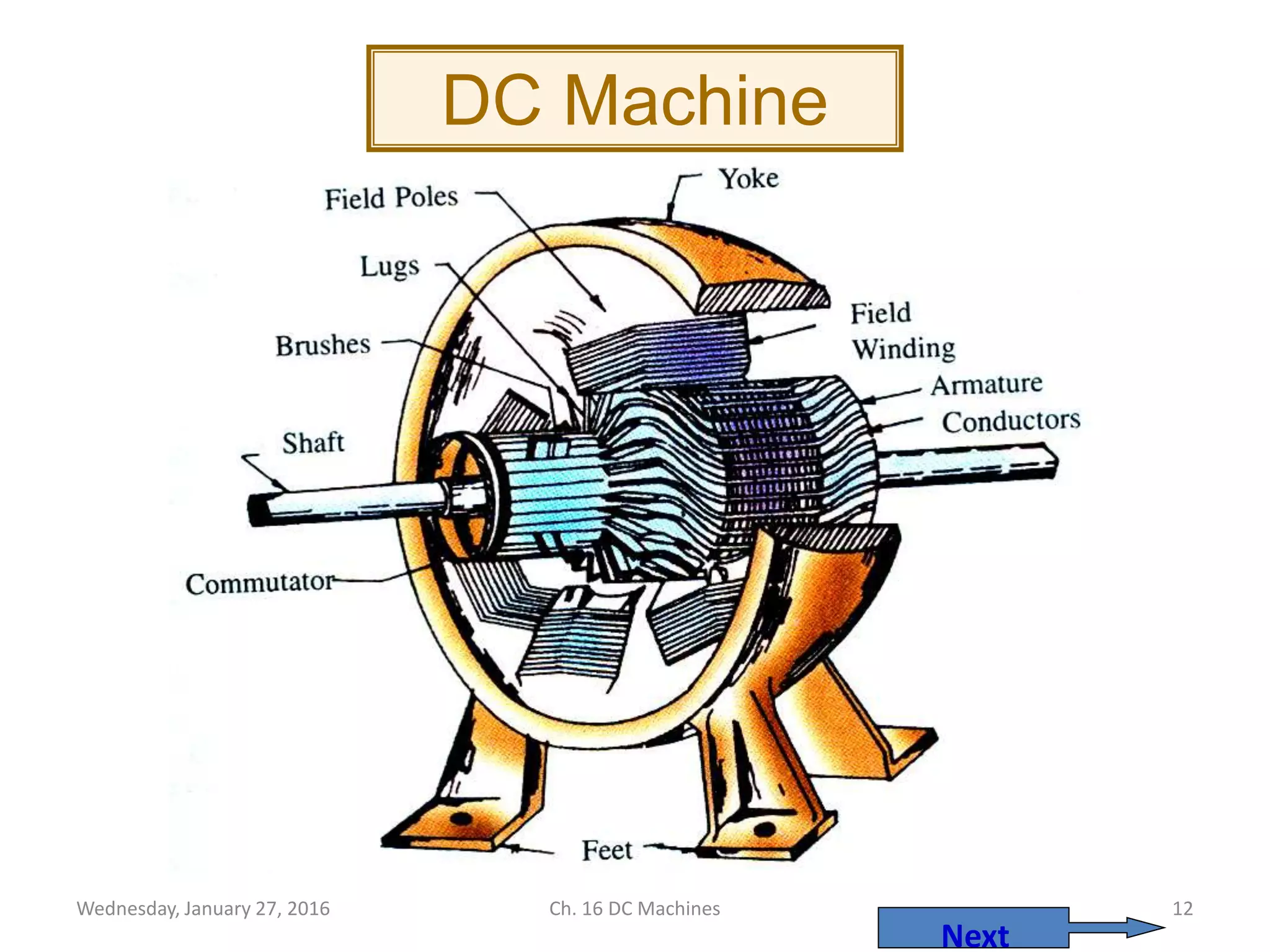
DC Machine
Next
Wednesday, January 27, 2016 Ch. 16 DC Machines 13
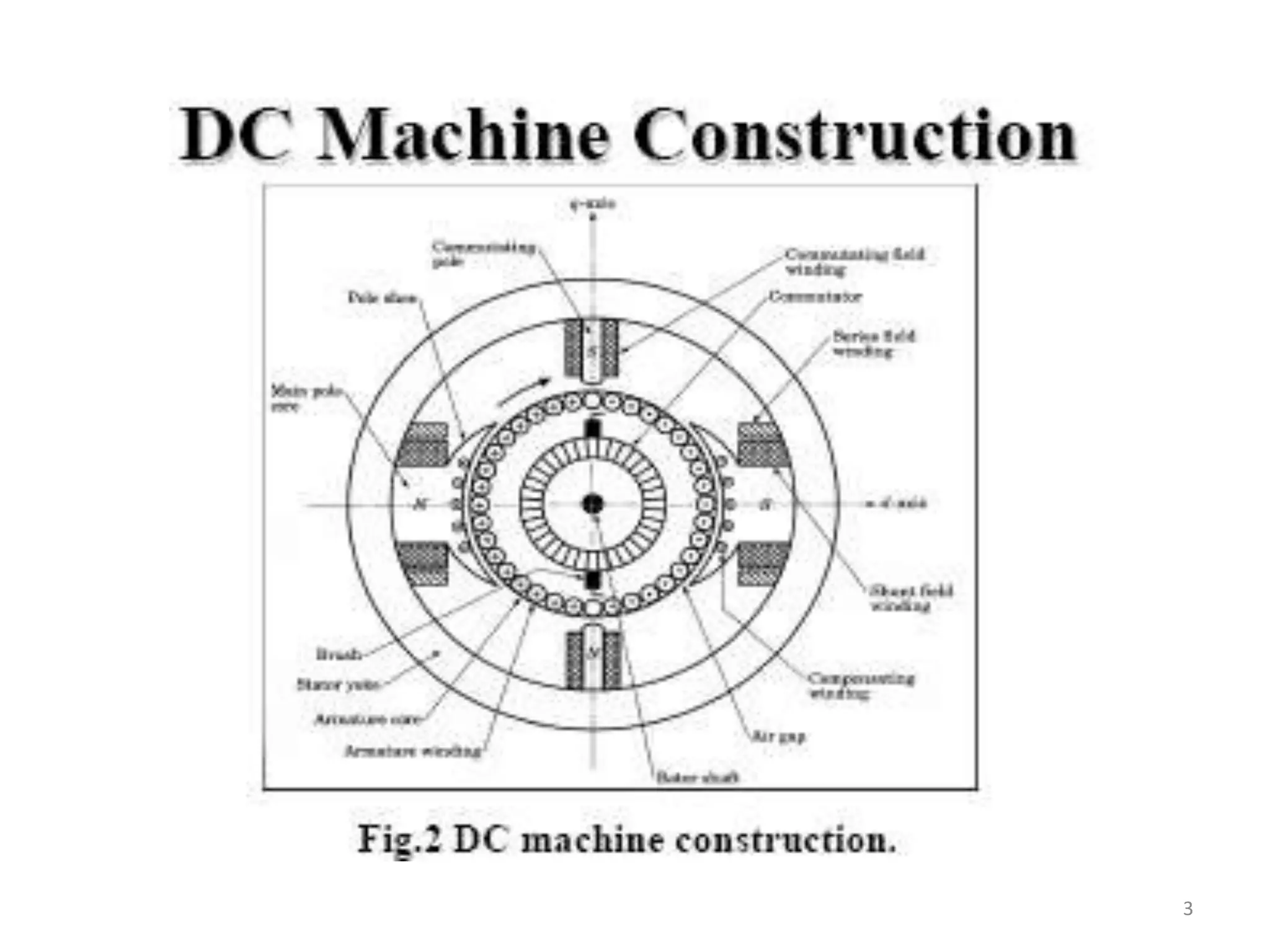
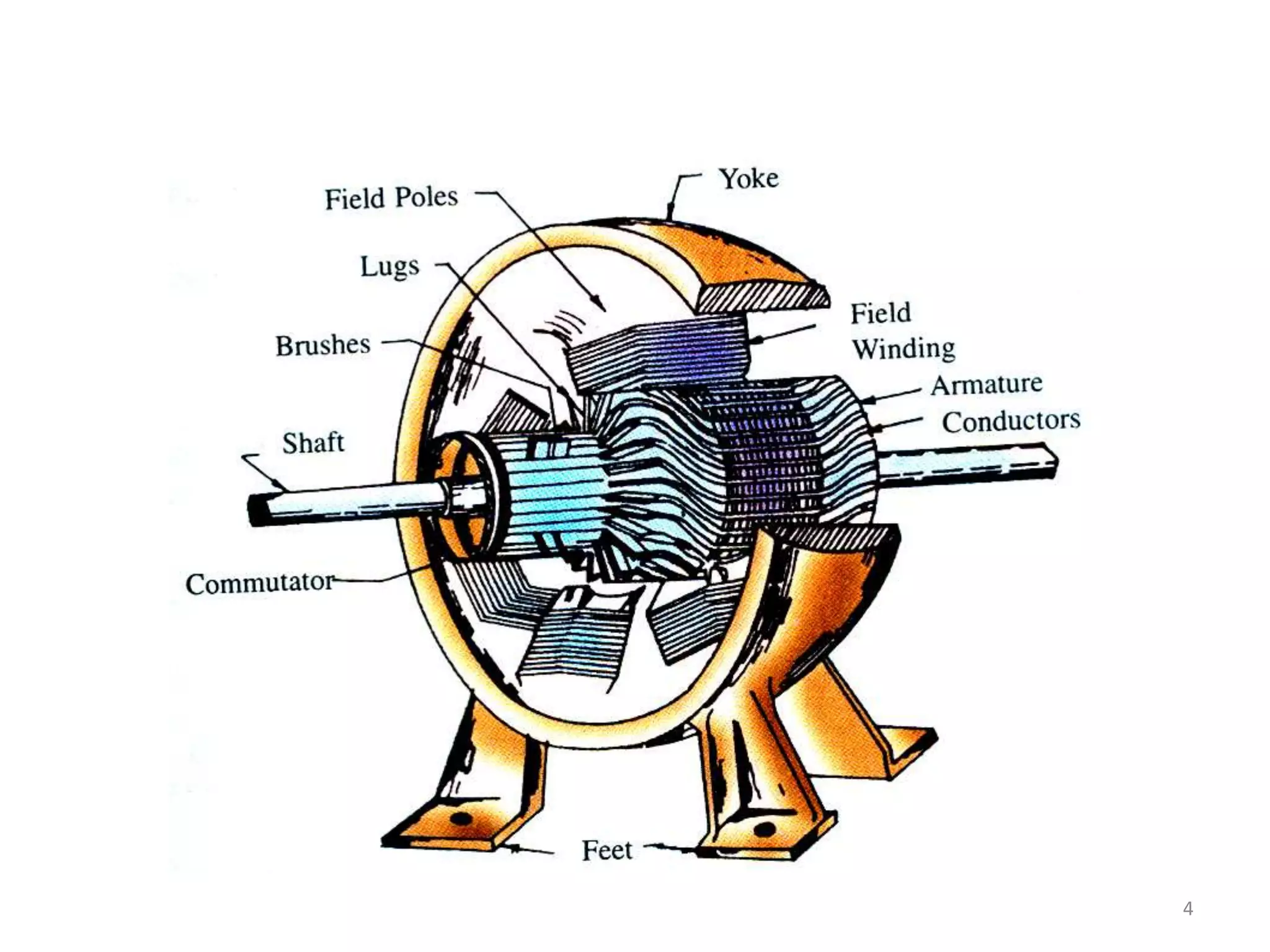
Construction
• The main parts of a DC machine are
– Yoke
– Poles, pole shoes.
– Field Coils.
– Armature.
– Commutator.
– Brushes.
Next
Wednesday, January 27, 2016 Ch. 16 DC Machines 14
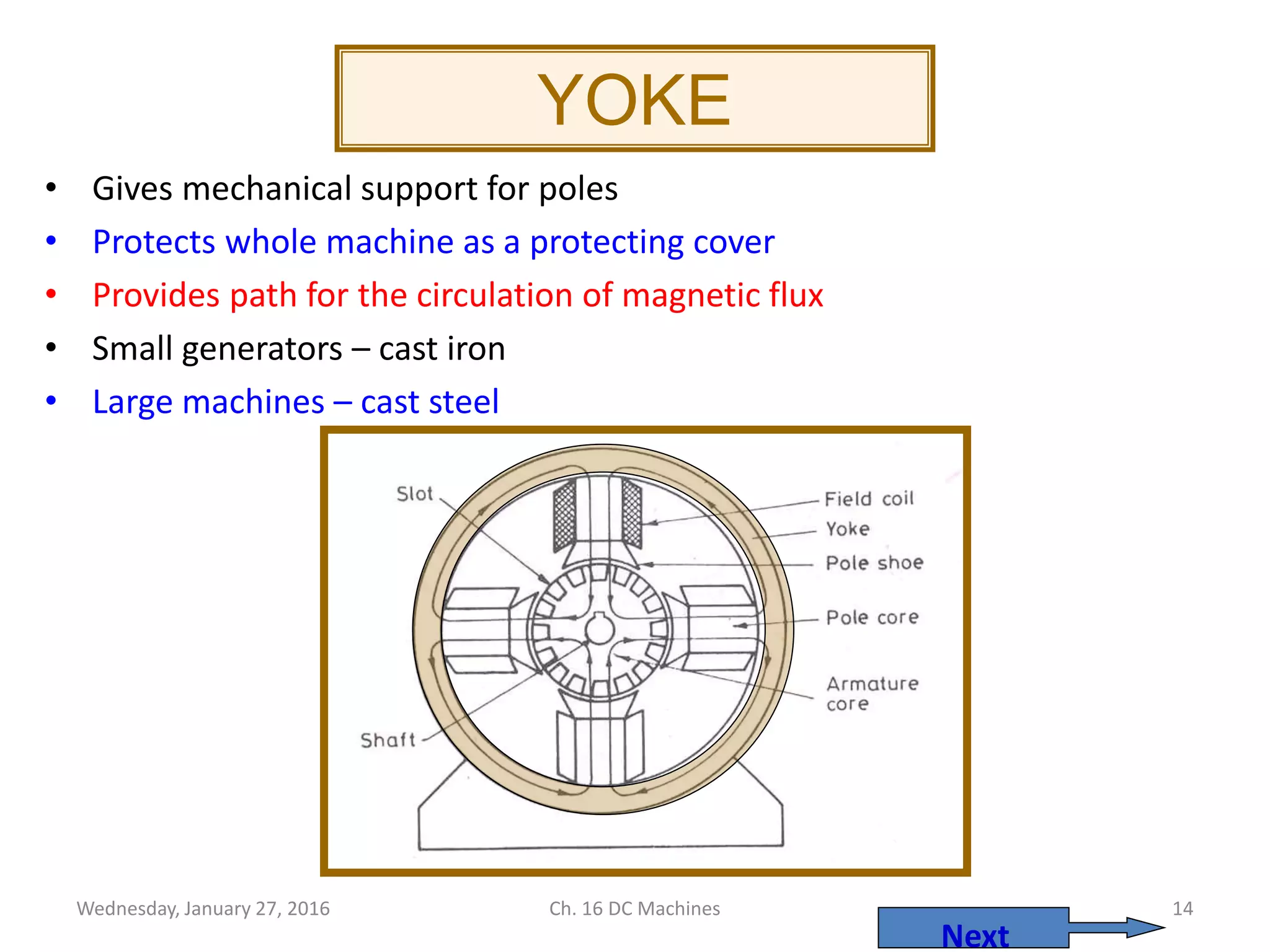
YOKE
• Gives mechanical support for poles
• Protects whole machine as a protecting cover
• Provides path for the circulation of magnetic flux
• Small generators – cast iron
• Large machines – cast steel
Next
Wednesday, January 27, 2016 Ch. 16 DC Machines 15
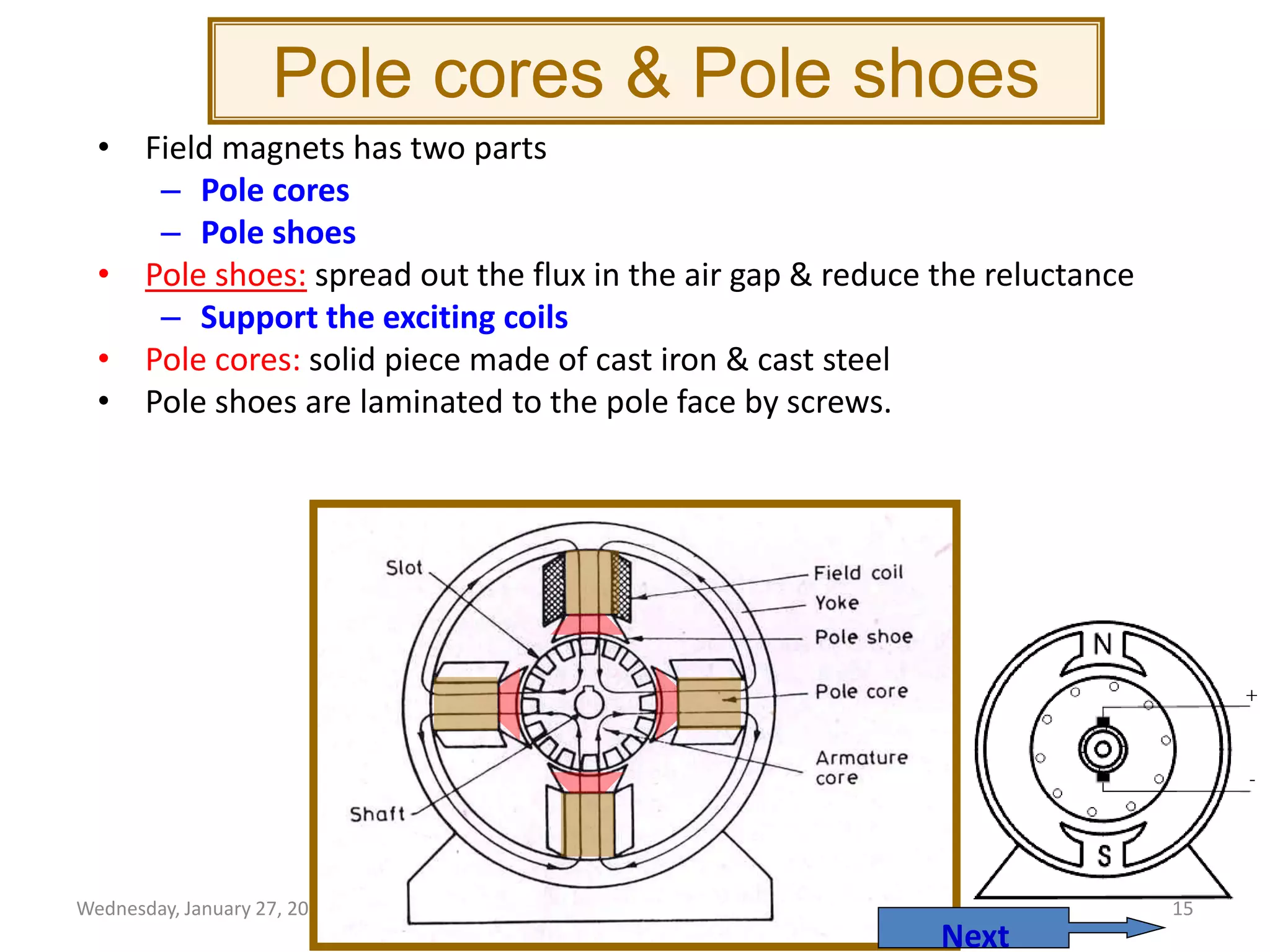
Pole cores & Pole shoes
• Field magnets has two parts
– Pole cores
– Pole shoes
• Pole shoes: spread out the flux in the air gap & reduce the reluctance
– Support the exciting coils
• Pole cores: solid piece made of cast iron & cast steel
• Pole shoes are laminated to the pole face by screws.
Next
Wednesday, January 27, 2016 Ch. 16 DC Machines 16
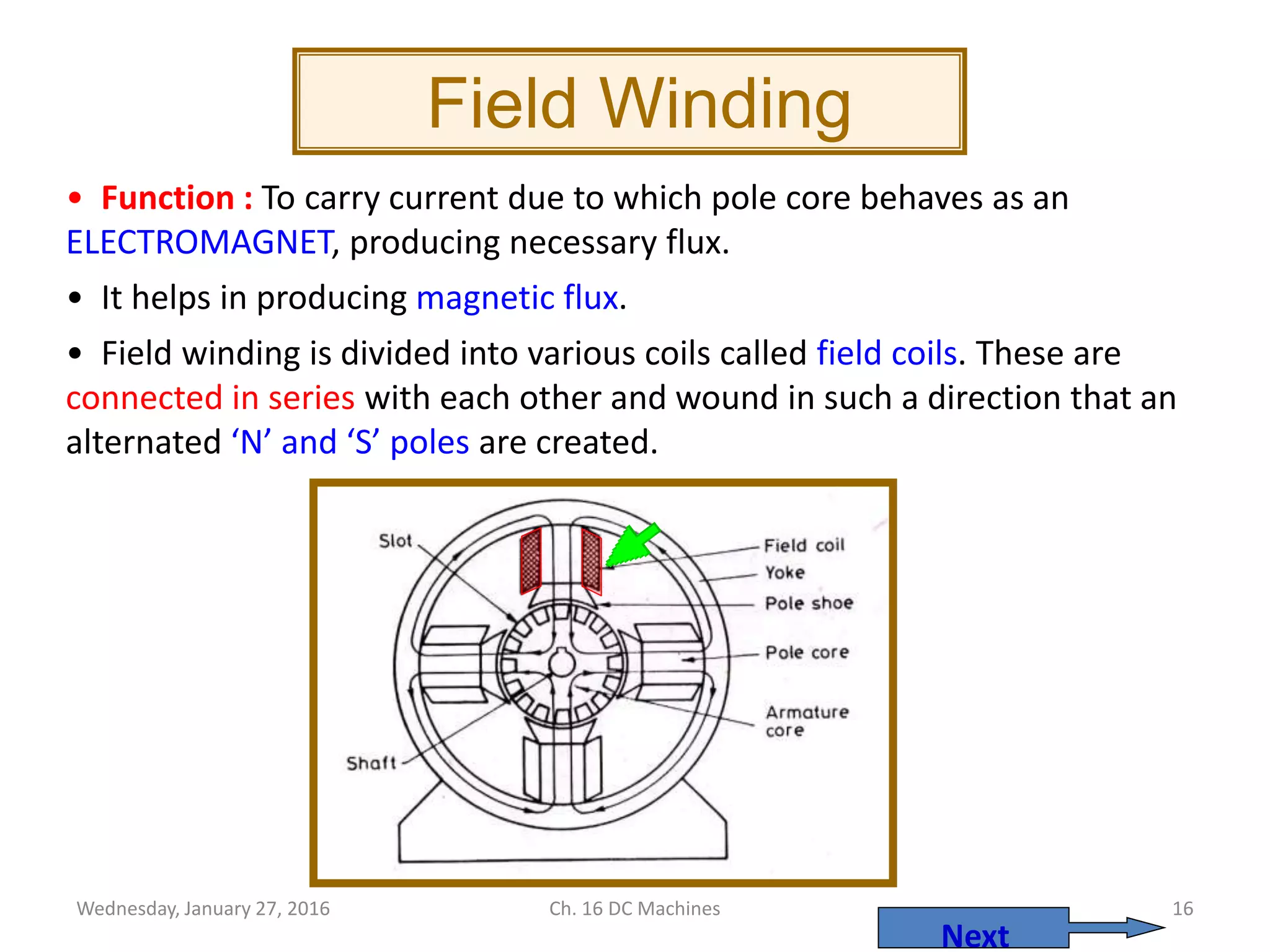
Field Winding
• Function : To carry current due to which pole core behaves as an
ELECTROMAGNET, producing necessary flux.
• It helps in producing magnetic flux.
• Field winding is divided into various coils called field coils. These are
connected in series with each other and wound in such a direction that an
alternated ‘N’ and ‘S’ poles are created.
Next
Wednesday, January 27, 2016 Ch. 16 DC Machines 17
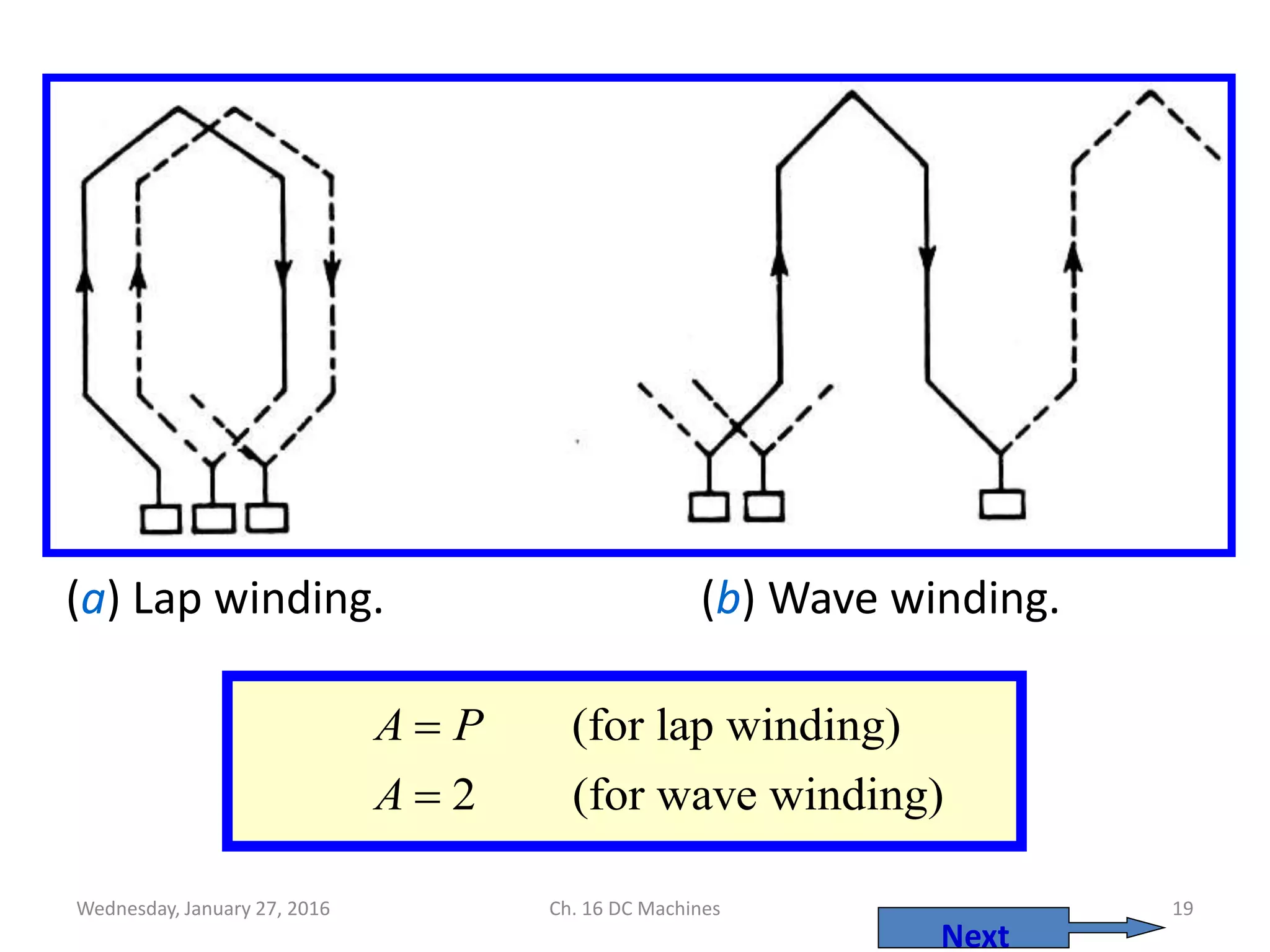
Two Types of Winding
(1) Lap Winding : The sides of the successive coils
overlap each other.
(2) Wave Winding : One side of a coil under one
pole is connected to the other side of a coil
which occupies approximately the same
position under the next pole.
Next
Wednesday, January 27, 2016 Ch. 16 DC Machines 18
Lap Winding:
Wave Winding:
Armature winding
1
3
2
4
5
Next
Wednesday, January 27, 2016 Ch. 16 DC Machines 19
(a) Lap winding. (b) Wave winding.
(for lap winding)
2 (for wave winding)
A P
A


Next
The simplest DC machine
segments
brushes
Example of a commutator…
• Function :Commutator
A commutator is a mechanical rectifier which converts the
alternating voltage generated in the armature winding
into direct voltage across the brushes. The commutator is
made of copper segments insulated from each other by
micasheets and mounted on the shaft of the machine .The
armature conductors are soldered to the commutator
segments in a suitable manner to give rise to the armature
winding. Depending upon the manner in which the
armature conductors are connected to the commutator
segments, there are two types of armature winding in a
d.c. machine viz., (a) lap winding (b) wave winding. Great
care is taken in building the commutator because any
eccentricity will cause the brushes to bounce, producing
unacceptable sparking. The sparks may bum the brushes
and overheat and carbonise the commutator.
Example of a commutator…
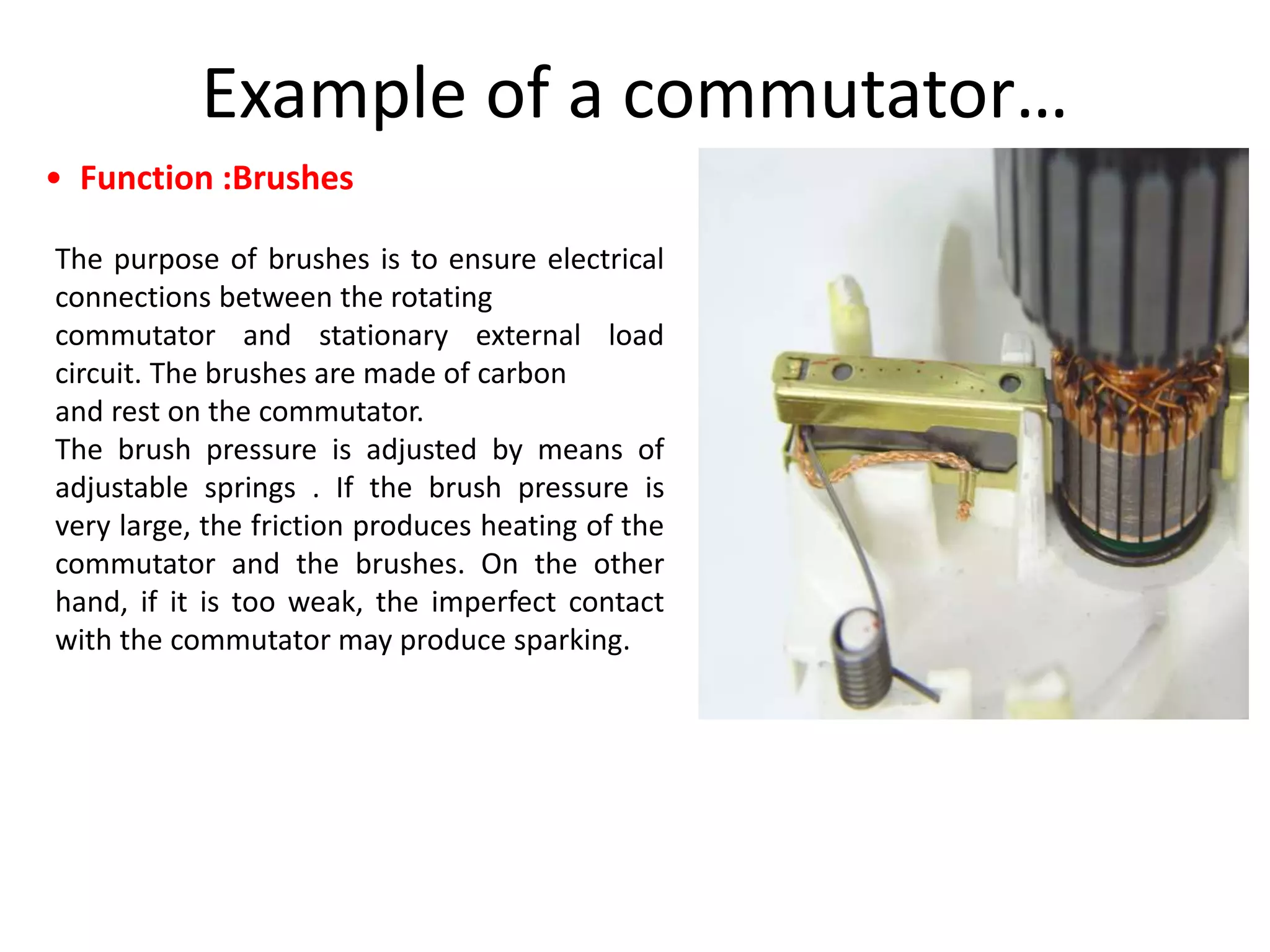
• Function :Brushes
The purpose of brushes is to ensure electrical
connections between the rotating
commutator and stationary external load
circuit. The brushes are made of carbon
and rest on the commutator.
The brush pressure is adjusted by means of
adjustable springs . If the brush pressure is
very large, the friction produces heating of the
commutator and the brushes. On the other
hand, if it is too weak, the imperfect contact
with the commutator may produce sparking.

Dc machines

  • 1.
  • 2.
    2 DC GENERATORS: • Constructionaldetails – emf equation – Methods of excitation – Self and separately excited generators – Characteristics of series, shunt and compound generators
  • 3.
  • 4.
  • 5.
    Wednesday, January 27,2016 Ch. 14 Alternators and Synchronous Motors 5 Electro-mechanical Energy-conversion (EMEC) Machines Next
  • 6.
    Wednesday, January 27,2016 Ch. 14 Alternators and Synchronous Motors 6 AC and DC Generators and Motors • When the electrical system is characterized by direct current, the machines are called dc motors and dc generators. • Similarly, if the electrical system is characterized by alternating current, the machines are called ac motors and ac generators. • Basically, the ac machines are not different from the dc machines. Next
  • 7.
    Wednesday, January 27,2016 Ch. 14 Alternators and Synchronous Motors 7 Electrical Rotary Machine • It has two parts : (1) the fixed part, called the stator, and (2) the moving part, called the rotor. Next
  • 8.
    Wednesday, January 27,2016 Ch. 14 Alternators and Synchronous Motors 8 Generator Action • Whenever the conductors of a coil cut across the magnetic flux (or are cut by it), an emf e is induced in it. • This emf can supply a current i to an electrical load. • Thus, an electrical power ei is generated. • This is the Generator Action. Next
  • 9.
    Wednesday, January 27,2016 Ch. 14 Alternators and Synchronous Motors 9 Motor Action • Whenever current-carrying conductors of a coil are placed (perpendicularly) in a magnetic flux, a force is experienced by each conductor. • This gives rise to an electromagnetic torque e. • This torque can rotate a mechanical load at an angular speed ω. • Thus, a mechanical power e ω is generated. • This is the motor action. Next
  • 10.
    Wednesday, January 27,2016 Ch. 14 Alternators and Synchronous Motors 10 Power Considerations for a Generator Large-size generators are usually called alternators. Next
  • 11.
    Wednesday, January 27,2016 Ch. 16 DC Machines 11 Importance • DC machines were the first electrical machines invented. • It is still the best motor to drive trains and cranes. • Because semiconductor rectifiers can easily convert ac into dc, dc generators are not needed. • Even in the automobiles, the dc generator has been replaced by the alternator plus diodes for rectification. • Portable devices powered by batteries require dc motors, such as portable tape players, walkman, window-lifters, etc. • The dc motor is readily controlled in speed and torque and hence is useful for control systems. Next
  • 12.
    Wednesday, January 27,2016 Ch. 16 DC Machines 12 DC Machine Next
  • 13.
    Wednesday, January 27,2016 Ch. 16 DC Machines 13 Construction • The main parts of a DC machine are – Yoke – Poles, pole shoes. – Field Coils. – Armature. – Commutator. – Brushes. Next
  • 14.
    Wednesday, January 27,2016 Ch. 16 DC Machines 14 YOKE • Gives mechanical support for poles • Protects whole machine as a protecting cover • Provides path for the circulation of magnetic flux • Small generators – cast iron • Large machines – cast steel Next
  • 15.
    Wednesday, January 27,2016 Ch. 16 DC Machines 15 Pole cores & Pole shoes • Field magnets has two parts – Pole cores – Pole shoes • Pole shoes: spread out the flux in the air gap & reduce the reluctance – Support the exciting coils • Pole cores: solid piece made of cast iron & cast steel • Pole shoes are laminated to the pole face by screws. Next
  • 16.
    Wednesday, January 27,2016 Ch. 16 DC Machines 16 Field Winding • Function : To carry current due to which pole core behaves as an ELECTROMAGNET, producing necessary flux. • It helps in producing magnetic flux. • Field winding is divided into various coils called field coils. These are connected in series with each other and wound in such a direction that an alternated ‘N’ and ‘S’ poles are created. Next
  • 17.
    Wednesday, January 27,2016 Ch. 16 DC Machines 17 Two Types of Winding (1) Lap Winding : The sides of the successive coils overlap each other. (2) Wave Winding : One side of a coil under one pole is connected to the other side of a coil which occupies approximately the same position under the next pole. Next
  • 18.
    Wednesday, January 27,2016 Ch. 16 DC Machines 18 Lap Winding: Wave Winding: Armature winding 1 3 2 4 5 Next
  • 19.
    Wednesday, January 27,2016 Ch. 16 DC Machines 19 (a) Lap winding. (b) Wave winding. (for lap winding) 2 (for wave winding) A P A   Next
  • 21.
    The simplest DCmachine segments brushes
  • 22.
    Example of acommutator… • Function :Commutator A commutator is a mechanical rectifier which converts the alternating voltage generated in the armature winding into direct voltage across the brushes. The commutator is made of copper segments insulated from each other by micasheets and mounted on the shaft of the machine .The armature conductors are soldered to the commutator segments in a suitable manner to give rise to the armature winding. Depending upon the manner in which the armature conductors are connected to the commutator segments, there are two types of armature winding in a d.c. machine viz., (a) lap winding (b) wave winding. Great care is taken in building the commutator because any eccentricity will cause the brushes to bounce, producing unacceptable sparking. The sparks may bum the brushes and overheat and carbonise the commutator.
  • 23.
    Example of acommutator… • Function :Brushes The purpose of brushes is to ensure electrical connections between the rotating commutator and stationary external load circuit. The brushes are made of carbon and rest on the commutator. The brush pressure is adjusted by means of adjustable springs . If the brush pressure is very large, the friction produces heating of the commutator and the brushes. On the other hand, if it is too weak, the imperfect contact with the commutator may produce sparking.