What is a psychological
disorder?
 Is a pattern of behavioral or psychological
symptoms that impact multiple life areas
and create distress for the person
experiencing these symptoms.
Indicators of Abnormality
 While psychologists look for the three classical
symptoms, not all disorders have such sever
symptoms. A few others are:
 Distress: Does the individual show unusual or prolonged
levels of anxiety?
 Maladaptiveness: Does the person act in ways that make
others fearful?
 Irrationality: Does the person act or talk in ways that are
irrational or incomprehensible to others?
 Unpredictability: Does the individual behave erratically and
inconsistently at different times?
 Unconventional/undesirable behavior: Does the person act in
ways that are statistically rare and violate social norms?
DSM
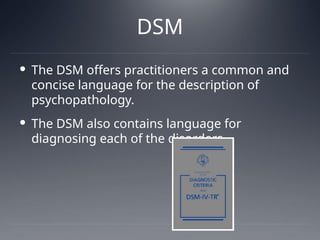
 The DSM offers practitioners a common and
concise language for the description of
psychopathology.
 The DSM also contains language for
diagnosing each of the disorders.
Mood Disorders
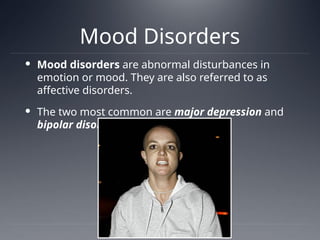
 Mood disorders are abnormal disturbances in
emotion or mood. They are also referred to as
affective disorders.
 The two most common are major depression and
bipolar disorder.
Major Depression
 It is normal to become depressed after a
sad or unfortunate even but if a person
remains depressed weeks or months after
that event, it may be classified as major
depression.
Bipolar Disorder
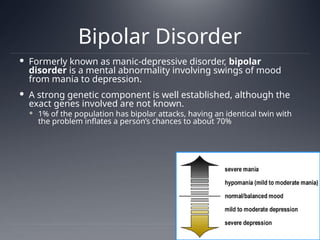
 Formerly known as manic-depressive disorder, bipolar
disorder is a mental abnormality involving swings of mood
from mania to depression.
 A strong genetic component is well established, although the
exact genes involved are not known.
 1% of the population has bipolar attacks, having an identical twin with
the problem inflates a person’s chances to about 70%
Anxiety Disorders
 Everyone has experienced
some level of anxiety in
their life. For some
people, a spider, or a tall
ladder are enough to
send chills down the
spine.
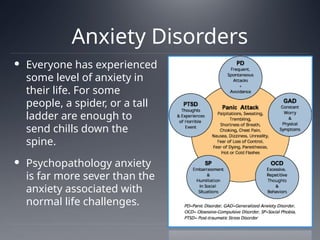
 Psychopathology anxiety
is far more sever than the
anxiety associated with
normal life challenges.
Generalized Anxiety
Disorder
 Generalized anxiety disorder is a psychological
problem characterized by persistent and pervasive
feelings of anxiety, without any external cause.
 May experience times when your worries don't completely
consume you, but you still feel rather anxious
 May feel on edge about many or all aspects of your life
 May have a general sense that something bad is about to
happen, even when there's no apparent danger.
 May not remember when you last felt relaxed or at ease.
 GAD often begins at an early age, and the signs and
symptoms may develop slowly.
Panic Disorder
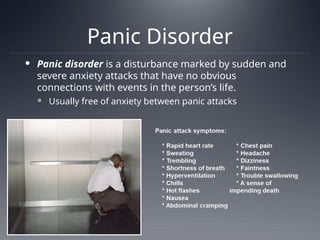
 Panic disorder is a disturbance marked by sudden and
severe anxiety attacks that have no obvious
connections with events in the person’s life.
 Usually free of anxiety between panic attacks
Phobic Disorders
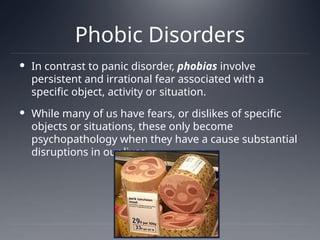
 In contrast to panic disorder, phobias involve
persistent and irrational fear associated with a
specific object, activity or situation.
 While many of us have fears, or dislikes of specific
objects or situations, these only become
psychopathology when they have a cause substantial
disruptions in our lives.
Obsessive-Compulsive
Disorder
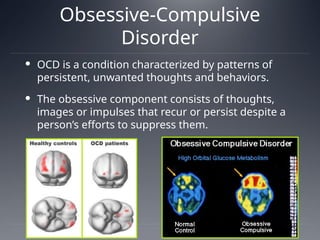
 OCD is a condition characterized by patterns of
persistent, unwanted thoughts and behaviors.
 The obsessive component consists of thoughts,
images or impulses that recur or persist despite a
person’s efforts to suppress them.
Obsessive-Compulsive
Disorder
 The compulsive component are repetitive,
purposeful acts performed according to certain
private “rules,” in response to an obsession.
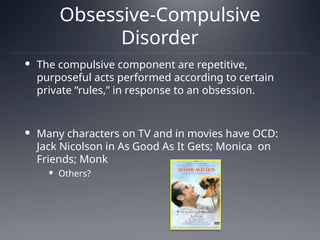
 Many characters on TV and in movies have OCD:
Jack Nicolson in As Good As It Gets; Monica on
Friends; Monk
 Others?
Somatoform Disorders
 Somatoform disorders are psychological
problems appearing in the form of bodily
symptoms or physical complaints such as
weakness or excessive worry about disease.
 Conversion Disorder: A disorder marked by
paralysis, weakness or loss of sensation but with no
discernable physical cause.
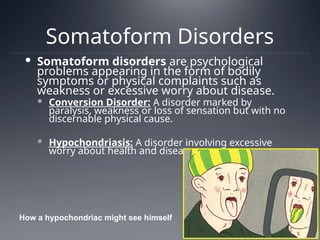
 Hypochondriasis: A disorder involving excessive
worry about health and disease.
How a hypochondriac might see himself
Dissociative Disorders
 Dissociative disorders are a group of pathologies
involving the “fragmentation” of the personality, in
which some parts of the personality have become
detached from other parts.
 Dissociative Amnesia: A psychologically induced
loss of memory for personal information, like one’s
identity.
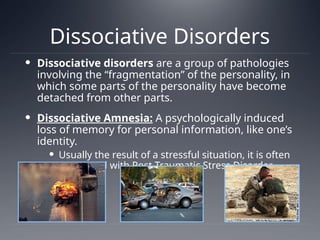
 Usually the result of a stressful situation, it is often
associated with Post Traumatic Stress Disorder
(PTSD).
PTSD
 Post Traumatic Stress Disorder dates back to 6 B.C.
where reports of battlefield stress had an adverse
affect on soldiers.
 In the past PTSD has been referred to as railway
spine, shell shock, battle fatigue, traumatic war
neurosis, or post-traumatic stress syndrome.
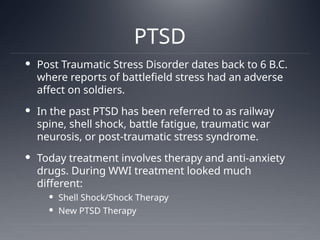
 Today treatment involves therapy and anti-anxiety
drugs. During WWI treatment looked much
different:
 Shell Shock/Shock Therapy
 New PTSD Therapy
Dissociative Fugue
 Dissociative fugue is a combination of fugue, or
“flight, and amnesia. Sufferers not only suffer from
a lost sense of identity, they also flee their homes,
jobs and families.
 While most episodes last only a few hours or days,
it can last longer.
 Heavy use of alcohol may predispose a person to
dissociative fugue. While this suggest that some
brain impairment may be involved, no specific
cause has been identified.
Depersonalization
Disorder
 Depersonalization disorder is an abnormality
involving the sensation that mind and body have
separated.
 Often times sufferers explain episodes as out of
body experiences.
 Like all of the other dissociative disorders,
depersonalization disorder occurs far more
frequently following a prolonged period of stress
or a traumatic event.
Dissociative Identity
Disorder
 Once called multiple personality
disorder, dissociative identity
disorder is a condition where an
individual displays multiple
identities or personalities.
 Experts say this disorder appears
first in childhood and may be a
defensive response to abusive
situations or terrifying events.
 Most of the emerging personalities
contrast in some significant way
with the original self. Hershel Walker was recently
diagnosed with DID.
Schizophrenia
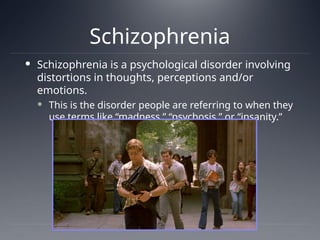
 Schizophrenia is a psychological disorder involving
distortions in thoughts, perceptions and/or
emotions.
 This is the disorder people are referring to when they
use terms like “madness,” “psychosis,” or “insanity.”
Sample Speech From Schizophrenic
Patient
 The lion will have to change from dogs into
cats until I can meet my father and mother and
we dispart some rats. I live on the front of
Whitton’s head. You have to work hard if you
don’t want to get into bed…It’s all over for a
squab true tray and there ain’t no squabs,
there ain’t no men, there ain’t no music, there
ain’t nothing besides my mother and my father
who stand along upon the Island of Capri
where is no ice. Well it’s my suitcase sir. (Roger,
1982)
Eating Disorders
 Of the eating disorders that exist,
two are most prevalent and most
studied:
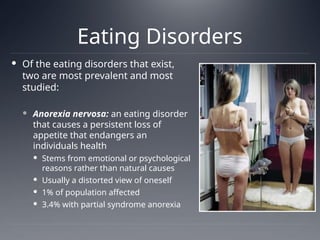
 Anorexia nervosa: an eating disorder
that causes a persistent loss of
appetite that endangers an
individuals health
 Stems from emotional or psychological
reasons rather than natural causes
 Usually a distorted view of oneself
 1% of population affected
 3.4% with partial syndrome anorexia
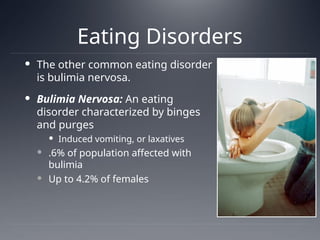
 The other common eating disorder
is bulimia nervosa.
 Bulimia Nervosa: An eating
disorder characterized by binges
and purges
 Induced vomiting, or laxatives
 .6% of population affected with
bulimia
 Up to 4.2% of females
Eating Disorders
Personality Disorders
 Personality disorders are conditions involving a
chronic, pervasive, inflexible and maladaptive pattern
of thinking, emotion, social relationships or impulse
control
 Narcissistic Personality Disorder: Grandiose sense of self
importance and preoccupation with fantasies of success
 Antisocial Personality Disorder: Longstanding pattern of
irresponsible behavior indicating lack of conscience and
responsibility towards others.
 Borderline Personality Disorder: Unstable and given to
extreme impulses without clear reasoning.
Development Disorders
 Developmental disorders are a group of disorders
that can appear at any age, but most commonly
show signs during childhood.
 Autism: Marked by disabilities in language, social
interaction and the inability to understand another
person’s state of mind
 1 in 500 children; recent increase in cases
 Dyslexia: A reading disorder where letters words and
numbers are perceived out of order, upside down or
completely incomprehensible
 True account of dyslexia
PSYCHOLOGICAL DISORDER WITH explanations

  • 2.
    What is apsychological disorder?  Is a pattern of behavioral or psychological symptoms that impact multiple life areas and create distress for the person experiencing these symptoms.
  • 3.
    Indicators of Abnormality While psychologists look for the three classical symptoms, not all disorders have such sever symptoms. A few others are:  Distress: Does the individual show unusual or prolonged levels of anxiety?  Maladaptiveness: Does the person act in ways that make others fearful?  Irrationality: Does the person act or talk in ways that are irrational or incomprehensible to others?  Unpredictability: Does the individual behave erratically and inconsistently at different times?  Unconventional/undesirable behavior: Does the person act in ways that are statistically rare and violate social norms?
  • 4.
    DSM  The DSMoffers practitioners a common and concise language for the description of psychopathology.  The DSM also contains language for diagnosing each of the disorders.
  • 5.
    Mood Disorders  Mooddisorders are abnormal disturbances in emotion or mood. They are also referred to as affective disorders.  The two most common are major depression and bipolar disorder.
  • 6.
    Major Depression  Itis normal to become depressed after a sad or unfortunate even but if a person remains depressed weeks or months after that event, it may be classified as major depression.
  • 7.
    Bipolar Disorder  Formerlyknown as manic-depressive disorder, bipolar disorder is a mental abnormality involving swings of mood from mania to depression.  A strong genetic component is well established, although the exact genes involved are not known.  1% of the population has bipolar attacks, having an identical twin with the problem inflates a person’s chances to about 70%
  • 8.
    Anxiety Disorders  Everyonehas experienced some level of anxiety in their life. For some people, a spider, or a tall ladder are enough to send chills down the spine.  Psychopathology anxiety is far more sever than the anxiety associated with normal life challenges.
  • 9.
    Generalized Anxiety Disorder  Generalizedanxiety disorder is a psychological problem characterized by persistent and pervasive feelings of anxiety, without any external cause.  May experience times when your worries don't completely consume you, but you still feel rather anxious  May feel on edge about many or all aspects of your life  May have a general sense that something bad is about to happen, even when there's no apparent danger.  May not remember when you last felt relaxed or at ease.  GAD often begins at an early age, and the signs and symptoms may develop slowly.
  • 10.
    Panic Disorder  Panicdisorder is a disturbance marked by sudden and severe anxiety attacks that have no obvious connections with events in the person’s life.  Usually free of anxiety between panic attacks
  • 11.
    Phobic Disorders  Incontrast to panic disorder, phobias involve persistent and irrational fear associated with a specific object, activity or situation.  While many of us have fears, or dislikes of specific objects or situations, these only become psychopathology when they have a cause substantial disruptions in our lives.
  • 12.
    Obsessive-Compulsive Disorder  OCD isa condition characterized by patterns of persistent, unwanted thoughts and behaviors.  The obsessive component consists of thoughts, images or impulses that recur or persist despite a person’s efforts to suppress them.
  • 13.
    Obsessive-Compulsive Disorder  The compulsivecomponent are repetitive, purposeful acts performed according to certain private “rules,” in response to an obsession.  Many characters on TV and in movies have OCD: Jack Nicolson in As Good As It Gets; Monica on Friends; Monk  Others?
  • 14.
    Somatoform Disorders  Somatoformdisorders are psychological problems appearing in the form of bodily symptoms or physical complaints such as weakness or excessive worry about disease.  Conversion Disorder: A disorder marked by paralysis, weakness or loss of sensation but with no discernable physical cause.  Hypochondriasis: A disorder involving excessive worry about health and disease. How a hypochondriac might see himself
  • 15.
    Dissociative Disorders  Dissociativedisorders are a group of pathologies involving the “fragmentation” of the personality, in which some parts of the personality have become detached from other parts.  Dissociative Amnesia: A psychologically induced loss of memory for personal information, like one’s identity.  Usually the result of a stressful situation, it is often associated with Post Traumatic Stress Disorder (PTSD).
  • 16.
    PTSD  Post TraumaticStress Disorder dates back to 6 B.C. where reports of battlefield stress had an adverse affect on soldiers.  In the past PTSD has been referred to as railway spine, shell shock, battle fatigue, traumatic war neurosis, or post-traumatic stress syndrome.  Today treatment involves therapy and anti-anxiety drugs. During WWI treatment looked much different:  Shell Shock/Shock Therapy  New PTSD Therapy
  • 17.
    Dissociative Fugue  Dissociativefugue is a combination of fugue, or “flight, and amnesia. Sufferers not only suffer from a lost sense of identity, they also flee their homes, jobs and families.  While most episodes last only a few hours or days, it can last longer.  Heavy use of alcohol may predispose a person to dissociative fugue. While this suggest that some brain impairment may be involved, no specific cause has been identified.
  • 18.
    Depersonalization Disorder  Depersonalization disorderis an abnormality involving the sensation that mind and body have separated.  Often times sufferers explain episodes as out of body experiences.  Like all of the other dissociative disorders, depersonalization disorder occurs far more frequently following a prolonged period of stress or a traumatic event.
  • 19.
    Dissociative Identity Disorder  Oncecalled multiple personality disorder, dissociative identity disorder is a condition where an individual displays multiple identities or personalities.  Experts say this disorder appears first in childhood and may be a defensive response to abusive situations or terrifying events.  Most of the emerging personalities contrast in some significant way with the original self. Hershel Walker was recently diagnosed with DID.
  • 20.
    Schizophrenia  Schizophrenia isa psychological disorder involving distortions in thoughts, perceptions and/or emotions.  This is the disorder people are referring to when they use terms like “madness,” “psychosis,” or “insanity.”
  • 21.
    Sample Speech FromSchizophrenic Patient  The lion will have to change from dogs into cats until I can meet my father and mother and we dispart some rats. I live on the front of Whitton’s head. You have to work hard if you don’t want to get into bed…It’s all over for a squab true tray and there ain’t no squabs, there ain’t no men, there ain’t no music, there ain’t nothing besides my mother and my father who stand along upon the Island of Capri where is no ice. Well it’s my suitcase sir. (Roger, 1982)
  • 22.
    Eating Disorders  Ofthe eating disorders that exist, two are most prevalent and most studied:  Anorexia nervosa: an eating disorder that causes a persistent loss of appetite that endangers an individuals health  Stems from emotional or psychological reasons rather than natural causes  Usually a distorted view of oneself  1% of population affected  3.4% with partial syndrome anorexia
  • 23.
     The othercommon eating disorder is bulimia nervosa.  Bulimia Nervosa: An eating disorder characterized by binges and purges  Induced vomiting, or laxatives  .6% of population affected with bulimia  Up to 4.2% of females Eating Disorders
  • 24.
    Personality Disorders  Personalitydisorders are conditions involving a chronic, pervasive, inflexible and maladaptive pattern of thinking, emotion, social relationships or impulse control  Narcissistic Personality Disorder: Grandiose sense of self importance and preoccupation with fantasies of success  Antisocial Personality Disorder: Longstanding pattern of irresponsible behavior indicating lack of conscience and responsibility towards others.  Borderline Personality Disorder: Unstable and given to extreme impulses without clear reasoning.
  • 25.
    Development Disorders  Developmentaldisorders are a group of disorders that can appear at any age, but most commonly show signs during childhood.  Autism: Marked by disabilities in language, social interaction and the inability to understand another person’s state of mind  1 in 500 children; recent increase in cases  Dyslexia: A reading disorder where letters words and numbers are perceived out of order, upside down or completely incomprehensible  True account of dyslexia