PSYCHOLOGICAL DISORDERSPrepared byProf. Vincent E. Lugtu, M. A.
ObjectivesDiscuss the characteristics and classifications of abnormal behaviorDistinguish among the various anxiety disordersDescribe the dissociative disordersCompare the mood disorders and specify risk factors for depression and suicideCharacterize schizophreniaIdentify the behavior patterns typical of personality disorders
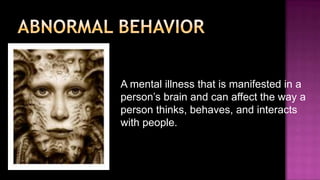
Abnormal behaviorA mental illness that is manifested in a person’s brain and can affect the way a person thinks, behaves, and interacts with people.
Abnormal behaviorAbnormal behavior is behavior that is deviant, maladaptive, or personally distressful.
Deviant: atypical behavior that deviates from culturally accepted norms.Maladaptive: behavior that interferes with a person’s ability to function effectively.Personal distress: behavior that causes personal distress.
TRUE or FALSEAbnormal behavior is always bizarre.Normal and abnormal behavior are different in kind.Once people have a mental disorder, they will always have it.FALSEFALSEFALSE
Theoretical approaches to mental disorders
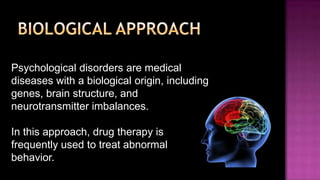
Biological approachPsychological disorders are medical diseases with a biological origin, including genes, brain structure, and neurotransmitter imbalances.In this approach, drug therapy is frequently used to treat abnormal behavior.
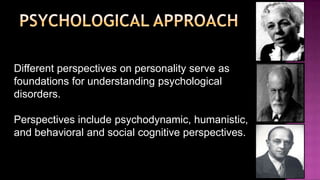
psychological approachDifferent perspectives on personality serve as foundations for understanding psychological disorders. Perspectives include psychodynamic, humanistic, and behavioral and social cognitive perspectives.
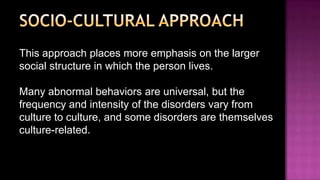
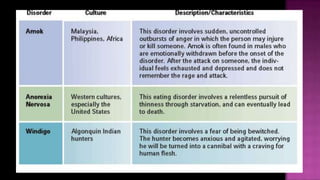
Socio-cultural approachThis approach places more emphasis on the larger social structure in which the person lives.Many abnormal behaviors are universal, but the frequency and intensity of the disorders vary from culture to culture, and some disorders are themselves culture-related.
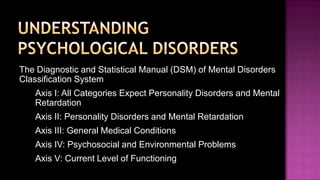
Understanding psychological disordersThe Diagnostic and Statistical Manual (DSM) of Mental Disorders Classification SystemAxis I: All Categories Expect Personality Disorders and Mental RetardationAxis II: Personality Disorders and Mental RetardationAxis III: General Medical ConditionsAxis IV: Psychosocial and Environmental ProblemsAxis V: Current Level of Functioning
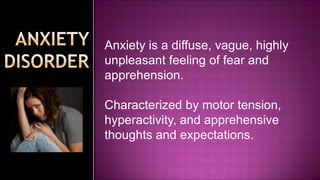
 Anxiety is a diffuse, vague, highly unpleasant feeling of fear and apprehension.Characterized by motor tension, hyperactivity, and apprehensive thoughts and expectations.ANXIETY DISORDER
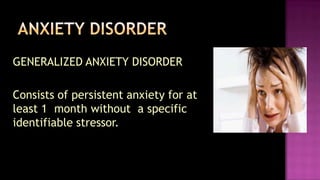
GENERALIZED ANXIETY DISORDER	Consists of persistent anxiety for at  least 1  month without  a specific identifiable stressor.ANXIETY DISORDER
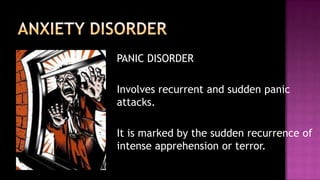
PANIC DISORDER	Involves recurrent and sudden panic attacks.	It is marked by the sudden recurrence of intense apprehension or terror.ANXIETY DISORDER
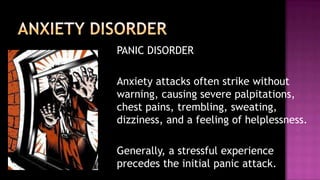
PANIC DISORDER	Anxiety attacks often strike without warning, causing severe palpitations, chest pains, trembling, sweating, dizziness, and a feeling of helplessness.Generally, a stressful experience precedes the initial panic attack.ANXIETY DISORDER
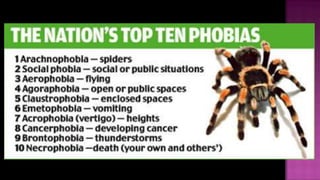
	PHOBIC DISORDERS	Involve irrational, overwhelming, persistent fears of specific objects or situations. ANXIETY DISORDER
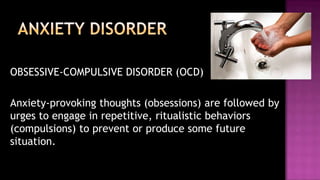
	OBSESSIVE-COMPULSIVE DISORDER (OCD)	Anxiety-provoking thoughts (obsessions) are followed by urges to engage in repetitive, ritualistic behaviors (compulsions) to prevent or produce some future situation.ANXIETY DISORDER
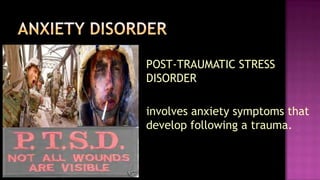
POST-TRAUMATIC STRESS DISORDER	involves anxiety symptoms that develop following a trauma.ANXIETY DISORDER
PTSD refers to anxiety symptoms that develop through exposure to a traumatic event and includes:a.flashbacksb.constricted ability to feel emotionsc.excessive arousald.difficulties with memory and concentratione.feelings of apprehension, including nervous tremorsf.impulsive outbursts of behavior, includingaggressiveness
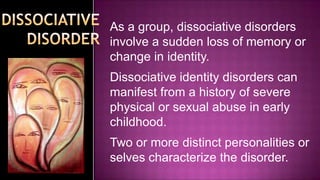
As a group, dissociative disorders involve a sudden loss of memory or change in identity.Dissociative identity disorders can manifest from a history of severe physical or sexual abuse in early childhood.Two or more distinct personalities or selves characterize the disorder.DISSOCIATIVE DISORDER
Dissociative amnesia involves memory loss caused by extensive psychological stress.In dissociative fugue, the individual not only develops amnesia but also unexpectedly travels away from home and assumes a new identity.
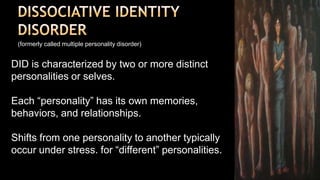
DISSOCIATIVE IDENTITYDISORDER(formerly called multiple personality disorder)DID is characterized by two or more distinct personalities or selves.Each “personality” has its own memories, behaviors, and relationships.Shifts from one personality to another typically occur under stress.for “different” personalities.
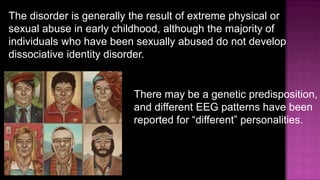
The disorder is generally the result of extreme physical or sexual abuse in early childhood, although the majority of individuals who have been sexually abused do not develop dissociative identity disorder.There may be a genetic predisposition, and different EEG patterns have been reported for “different” personalities.
A group of disorders characterized by a primary disturbance of mood, that usually includes cognitive, behavioral, and somatic symptoms as well as interpersonal difficulties.Disorders can represent one extreme of emotion (depression) or both extremes (bipolar disorders).MOOD DISORDERS
Depressive disorderAn individual suffers from depression without ever experiencing  mania for at  least 2 week’s duration and with at least five of the following symptoms present:
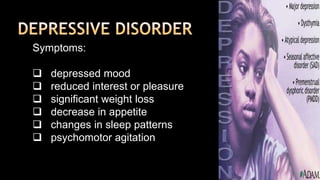
Depressive DISORDERSymptoms:   depressed mood
   reduced interest or pleasure
   significant weight loss
   decrease in appetite
   changes in sleep patterns
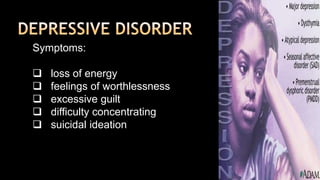
   psychomotor agitationDepressive DISORDERSymptoms:   loss of energy
   feelings of worthlessness
   excessive guilt
   difficulty concentrating
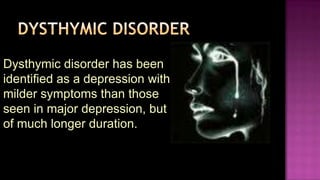
   suicidal ideationDysthymic DISORDERDysthymic disorder has been identified as a depression with milder symptoms than those seen in major depression, but of much longer duration.
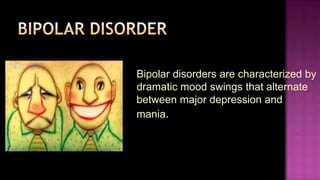
bipolar DISORDERBipolar disorders are characterized by dramatic mood swings that alternate between major depression and mania.
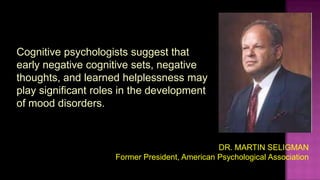
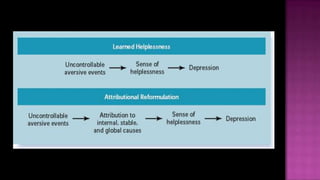
Cognitive psychologists suggest that early negative cognitive sets, negative thoughts, and learned helplessness may play significant roles in the developmentof mood disorders.DR. MARTIN SELIGMANFormer President, American Psychological Association
Socio-cultural factors that put people at higher risk for depression include:        POVERTY         NEGLECT AND ABUSE           FEMALE	         INTERPERSONAL                                           IN CHILDHOOD                    ROLES		PROBLEMS
suicideSuicide is the third leading cause of death among adolescents.Females are more likely to attempt suicide, but males are more likely to succeed.Psychological factors include mental illness, stress, a history of abuse, and substance use.Family instability, loss of a loved one, poverty, and cultural/religious norms influence suicidality.
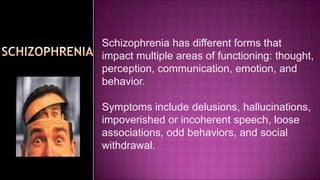
SCHIZOPHRENIASchizophrenia has different forms that impact multiple areas of functioning: thought, perception, communication, emotion, and behavior.Symptoms include delusions, hallucinations, impoverished or incoherent speech, loose associations, odd behaviors, and social withdrawal.
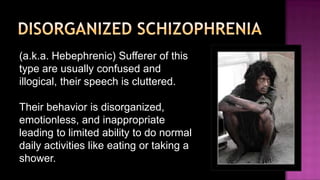
Disorganized schizophrenia(a.k.a. Hebephrenic) Sufferer of this type are usually confused and illogical, their speech is cluttered. Their behavior is disorganized, emotionless, and inappropriate leading to limited ability to do normal daily activities like eating or taking a shower.
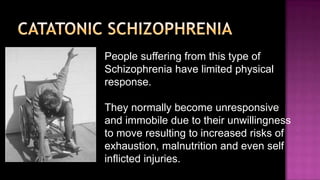
Catatonic schizophreniaPeople suffering from this type of Schizophrenia have limited physical response.They normally become unresponsive and immobile due to their unwillingness to move resulting to increased risks of exhaustion, malnutrition and even self inflicted injuries.
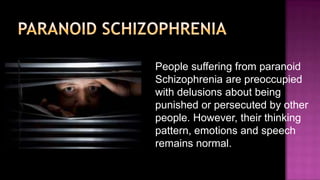
Paranoid schizophreniaPeople suffering from paranoid Schizophrenia are preoccupied with delusions about being punished or persecuted by other people. However, their thinking pattern, emotions and speech remains normal.
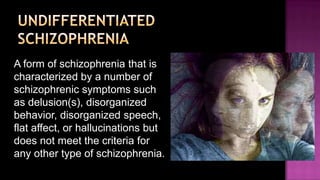
Undifferentiated schizophreniaA form of schizophrenia that is characterized by a number of schizophrenic symptoms such as delusion(s), disorganized behavior, disorganized speech, flat affect, or hallucinations but does not meet the criteria for any other type of schizophrenia.
Personality DISORDERPersonality disorders are chronic, maladaptive cognitive-behavioral patterns thoroughly integrated into the personality.

Psychological disorders

  • 1.
  • 2.
    ObjectivesDiscuss the characteristicsand classifications of abnormal behaviorDistinguish among the various anxiety disordersDescribe the dissociative disordersCompare the mood disorders and specify risk factors for depression and suicideCharacterize schizophreniaIdentify the behavior patterns typical of personality disorders
  • 3.
    Abnormal behaviorA mentalillness that is manifested in a person’s brain and can affect the way a person thinks, behaves, and interacts with people.
  • 4.
    Abnormal behaviorAbnormal behavioris behavior that is deviant, maladaptive, or personally distressful.
  • 5.
    Deviant: atypical behaviorthat deviates from culturally accepted norms.Maladaptive: behavior that interferes with a person’s ability to function effectively.Personal distress: behavior that causes personal distress.
  • 6.
    TRUE or FALSEAbnormalbehavior is always bizarre.Normal and abnormal behavior are different in kind.Once people have a mental disorder, they will always have it.FALSEFALSEFALSE
  • 7.
  • 8.
    Biological approachPsychological disordersare medical diseases with a biological origin, including genes, brain structure, and neurotransmitter imbalances.In this approach, drug therapy is frequently used to treat abnormal behavior.
  • 9.
    psychological approachDifferent perspectiveson personality serve as foundations for understanding psychological disorders. Perspectives include psychodynamic, humanistic, and behavioral and social cognitive perspectives.
  • 10.
    Socio-cultural approachThis approachplaces more emphasis on the larger social structure in which the person lives.Many abnormal behaviors are universal, but the frequency and intensity of the disorders vary from culture to culture, and some disorders are themselves culture-related.
  • 12.
    Understanding psychological disordersTheDiagnostic and Statistical Manual (DSM) of Mental Disorders Classification SystemAxis I: All Categories Expect Personality Disorders and Mental RetardationAxis II: Personality Disorders and Mental RetardationAxis III: General Medical ConditionsAxis IV: Psychosocial and Environmental ProblemsAxis V: Current Level of Functioning
  • 13.
     Anxiety is adiffuse, vague, highly unpleasant feeling of fear and apprehension.Characterized by motor tension, hyperactivity, and apprehensive thoughts and expectations.ANXIETY DISORDER
  • 14.
    GENERALIZED ANXIETY DISORDER Consistsof persistent anxiety for at least 1 month without a specific identifiable stressor.ANXIETY DISORDER
  • 15.
    PANIC DISORDER Involves recurrentand sudden panic attacks. It is marked by the sudden recurrence of intense apprehension or terror.ANXIETY DISORDER
  • 16.
    PANIC DISORDER Anxiety attacksoften strike without warning, causing severe palpitations, chest pains, trembling, sweating, dizziness, and a feeling of helplessness.Generally, a stressful experience precedes the initial panic attack.ANXIETY DISORDER
  • 17.
    PHOBIC DISORDERS Involve irrational,overwhelming, persistent fears of specific objects or situations. ANXIETY DISORDER
  • 19.
    OBSESSIVE-COMPULSIVE DISORDER (OCD) Anxiety-provokingthoughts (obsessions) are followed by urges to engage in repetitive, ritualistic behaviors (compulsions) to prevent or produce some future situation.ANXIETY DISORDER
  • 21.
    POST-TRAUMATIC STRESS DISORDER involvesanxiety symptoms that develop following a trauma.ANXIETY DISORDER
  • 22.
    PTSD refers toanxiety symptoms that develop through exposure to a traumatic event and includes:a.flashbacksb.constricted ability to feel emotionsc.excessive arousald.difficulties with memory and concentratione.feelings of apprehension, including nervous tremorsf.impulsive outbursts of behavior, includingaggressiveness
  • 23.
    As a group,dissociative disorders involve a sudden loss of memory or change in identity.Dissociative identity disorders can manifest from a history of severe physical or sexual abuse in early childhood.Two or more distinct personalities or selves characterize the disorder.DISSOCIATIVE DISORDER
  • 24.
    Dissociative amnesia involvesmemory loss caused by extensive psychological stress.In dissociative fugue, the individual not only develops amnesia but also unexpectedly travels away from home and assumes a new identity.
  • 25.
    DISSOCIATIVE IDENTITYDISORDER(formerly calledmultiple personality disorder)DID is characterized by two or more distinct personalities or selves.Each “personality” has its own memories, behaviors, and relationships.Shifts from one personality to another typically occur under stress.for “different” personalities.
  • 26.
    The disorder isgenerally the result of extreme physical or sexual abuse in early childhood, although the majority of individuals who have been sexually abused do not develop dissociative identity disorder.There may be a genetic predisposition, and different EEG patterns have been reported for “different” personalities.
  • 28.
    A group ofdisorders characterized by a primary disturbance of mood, that usually includes cognitive, behavioral, and somatic symptoms as well as interpersonal difficulties.Disorders can represent one extreme of emotion (depression) or both extremes (bipolar disorders).MOOD DISORDERS
  • 29.
    Depressive disorderAn individualsuffers from depression without ever experiencing mania for at least 2 week’s duration and with at least five of the following symptoms present:
  • 30.
  • 31.
    reduced interest or pleasure
  • 32.
    significant weight loss
  • 33.
    decrease in appetite
  • 34.
    changes in sleep patterns
  • 35.
    psychomotor agitationDepressive DISORDERSymptoms: loss of energy
  • 36.
    feelings of worthlessness
  • 37.
    excessive guilt
  • 38.
    difficulty concentrating
  • 39.
    suicidal ideationDysthymic DISORDERDysthymic disorder has been identified as a depression with milder symptoms than those seen in major depression, but of much longer duration.
  • 40.
    bipolar DISORDERBipolar disordersare characterized by dramatic mood swings that alternate between major depression and mania.
  • 41.
    Cognitive psychologists suggestthat early negative cognitive sets, negative thoughts, and learned helplessness may play significant roles in the developmentof mood disorders.DR. MARTIN SELIGMANFormer President, American Psychological Association
  • 43.
    Socio-cultural factors thatput people at higher risk for depression include: POVERTY NEGLECT AND ABUSE FEMALE INTERPERSONAL IN CHILDHOOD ROLES PROBLEMS
  • 44.
    suicideSuicide is thethird leading cause of death among adolescents.Females are more likely to attempt suicide, but males are more likely to succeed.Psychological factors include mental illness, stress, a history of abuse, and substance use.Family instability, loss of a loved one, poverty, and cultural/religious norms influence suicidality.
  • 45.
    SCHIZOPHRENIASchizophrenia has differentforms that impact multiple areas of functioning: thought, perception, communication, emotion, and behavior.Symptoms include delusions, hallucinations, impoverished or incoherent speech, loose associations, odd behaviors, and social withdrawal.
  • 47.
    Disorganized schizophrenia(a.k.a. Hebephrenic)Sufferer of this type are usually confused and illogical, their speech is cluttered. Their behavior is disorganized, emotionless, and inappropriate leading to limited ability to do normal daily activities like eating or taking a shower.
  • 48.
    Catatonic schizophreniaPeople sufferingfrom this type of Schizophrenia have limited physical response.They normally become unresponsive and immobile due to their unwillingness to move resulting to increased risks of exhaustion, malnutrition and even self inflicted injuries.
  • 50.
    Paranoid schizophreniaPeople sufferingfrom paranoid Schizophrenia are preoccupied with delusions about being punished or persecuted by other people. However, their thinking pattern, emotions and speech remains normal.
  • 51.
    Undifferentiated schizophreniaA formof schizophrenia that is characterized by a number of schizophrenic symptoms such as delusion(s), disorganized behavior, disorganized speech, flat affect, or hallucinations but does not meet the criteria for any other type of schizophrenia.
  • 52.
    Personality DISORDERPersonality disordersare chronic, maladaptive cognitive-behavioral patterns thoroughly integrated into the personality.