Chapter 2
The Constitution of the United
States: A New Vision of
Representative Government
James Madison Plans for a Republic
• Republic
– Governments ruled by representatives of the people
• James Madison
– Wanted a change in structure of the U.S.
government
– Annapolis Convention 1787
– Important role in the creation of the U.S. Constitution
Abernathy, American Government, 2e
SAGE Publishing, 2020
3
The Confederal System Made
Coordination Difficult (1 of 2)
• Articles of Confederation and Perpetual Union
– Union of 13 sovereign states in which the states
were centers of political power
– Adopted by Second Continental Congress in 1777
and ratified in 1781
• Mistrust of motives between states
• Desire for self-sufficiency
Abernathy, American Government, 2e
SAGE Publishing, 2020
4
Political Ideals of the Founders
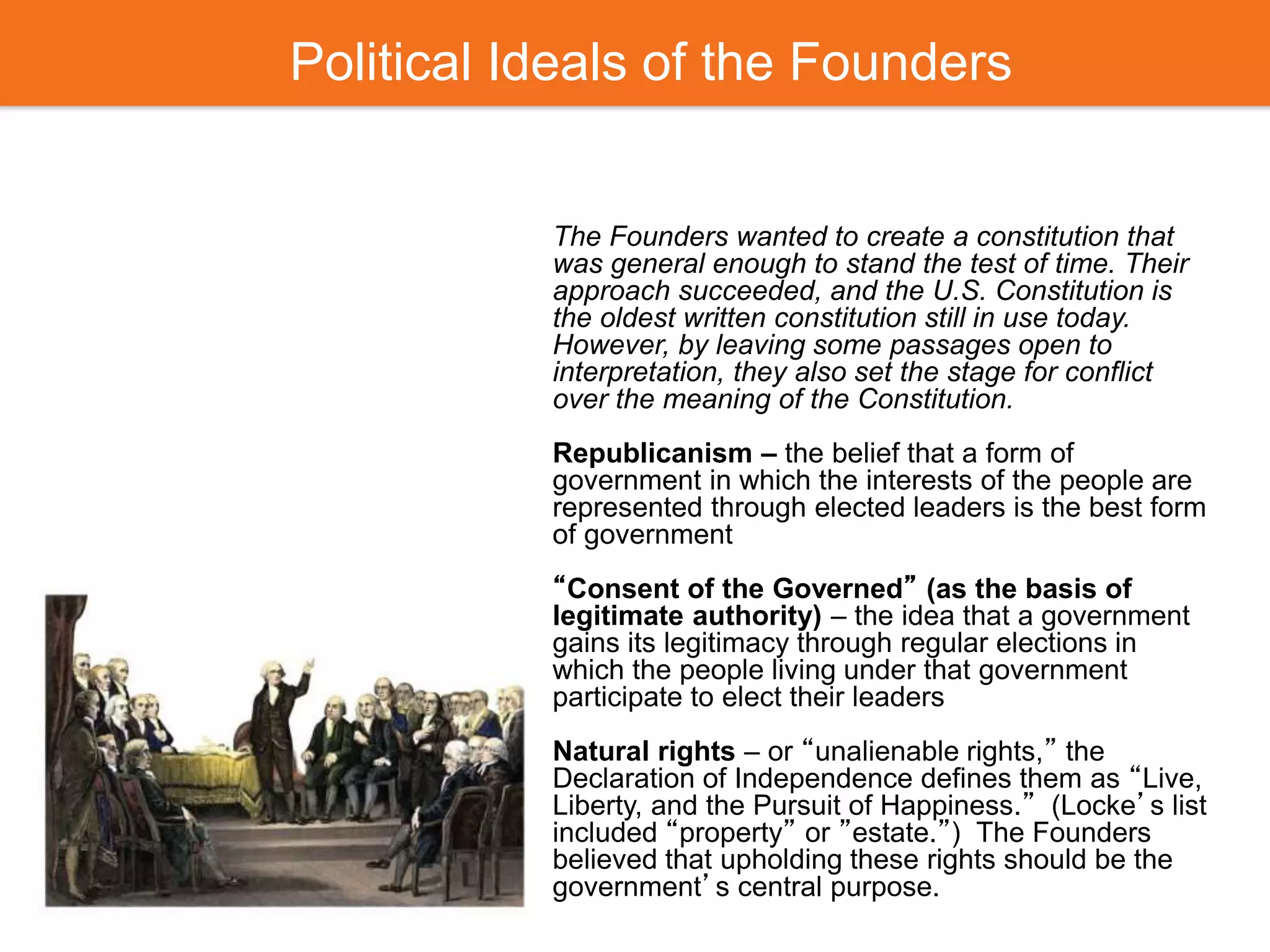
The Founders wanted to create a constitution that
was general enough to stand the test of time. Their
approach succeeded, and the U.S. Constitution is
the oldest written constitution still in use today.
However, by leaving some passages open to
interpretation, they also set the stage for conflict
over the meaning of the Constitution.
Republicanism – the belief that a form of
government in which the interests of the people are
represented through elected leaders is the best form
of government
“Consent of the Governed” (as the basis of
legitimate authority) – the idea that a government
gains its legitimacy through regular elections in
which the people living under that government
participate to elect their leaders
Natural rights – or “unalienable rights,” the
Declaration of Independence defines them as “Live,
Liberty, and the Pursuit of Happiness.” (Locke’s list
included “property” or ”estate.”) The Founders
believed that upholding these rights should be the
government’s central purpose.
Human Nature and Its Implications for
Democracy
• The framers viewed humans as naturally self-interested.
• Governments must productively channel this self-interest.
• Governments must also be able to handle majority factions.
• James Madison, writing in Federalist 10, speaks eloquently
about the problem of factions.
– “A number of citizens, whether amounting to a majority or a
minority of the whole, who are united and actuated by some
common . . . interest, adverse to the rights of other citizens, or
to the permanent and aggregate interests of the community.”
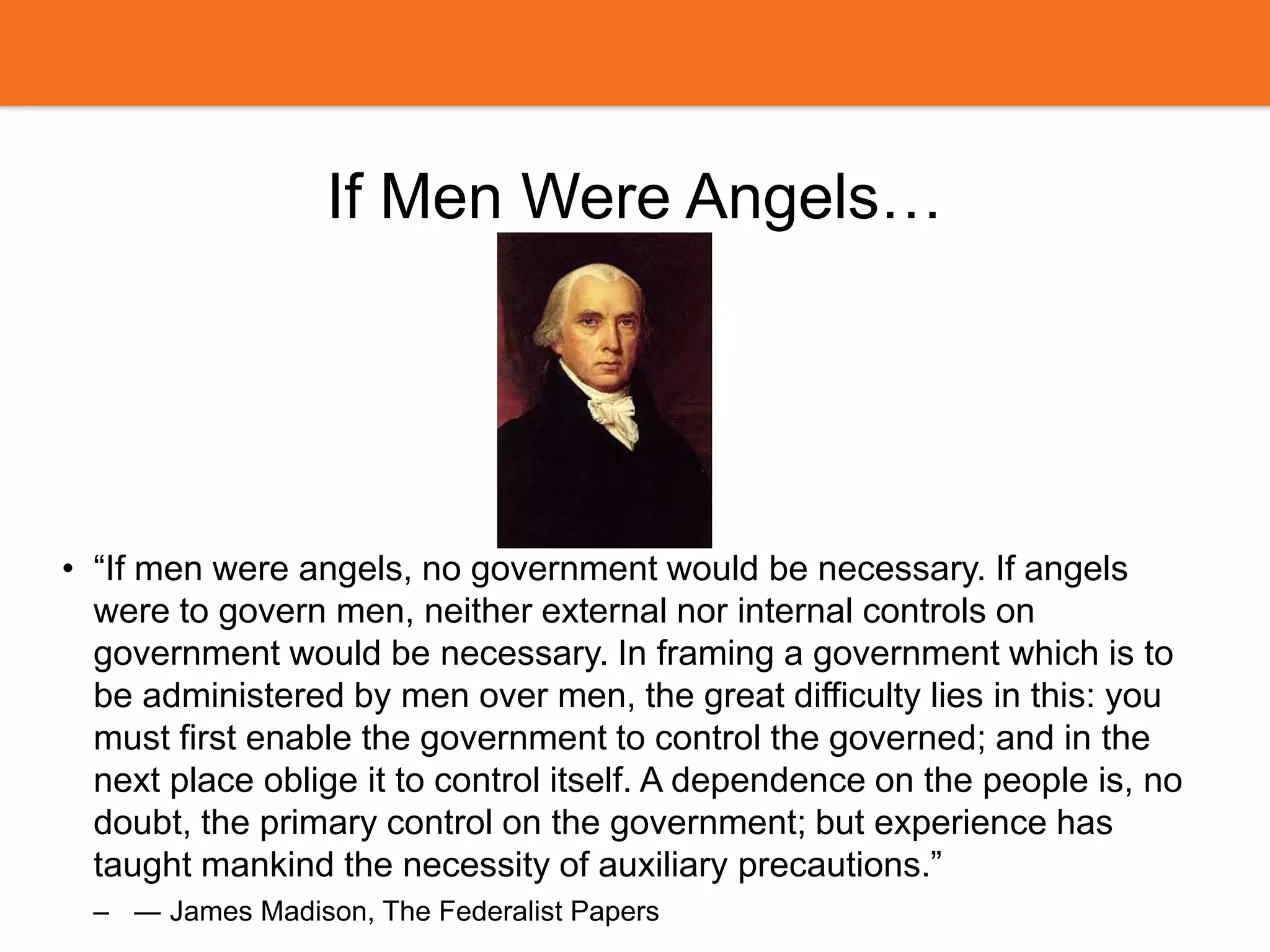
If Men Were Angels…
• “If men were angels, no government would be necessary. If angels
were to govern men, neither external nor internal controls on
government would be necessary. In framing a government which is to
be administered by men over men, the great difficulty lies in this: you
must first enable the government to control the governed; and in the
next place oblige it to control itself. A dependence on the people is, no
doubt, the primary control on the government; but experience has
taught mankind the necessity of auxiliary precautions.”
– ― James Madison, The Federalist Papers
Factions
• What are factions?
– Factions are groups of like-minded people who try to
influence the government. Often they try to dominate
the government. American government is set up to
avoid domination by any one of these groups.
• Why do factions exist?
– Many reasons: differences of opinion, errors in
reason, differences in wealth, property, native
abilities; attachment to different leaders.
What to do? …
• Madison saw two ways to eliminate the deleterious effects of factions,
but only one that would work: since “liberty is to faction as air is to fire,”
– one solution would be to eliminate liberty. This has obvious problems.
– A second way would be merely to control factions by making sure that there were
many of them and no one would grow too powerful—a powerful argument for creating
a strong national government.
• In Federalist 51, Madison eloquently states, “In framing a government
which is to be administered by men over men, the great difficulty lies in
this: you must first enable the government to control the governed; and
in the next place, oblige it to control itself.” The framers tried hard to
harness humanity’s proclivities toward self-interest in the name of
creating a more durable government.
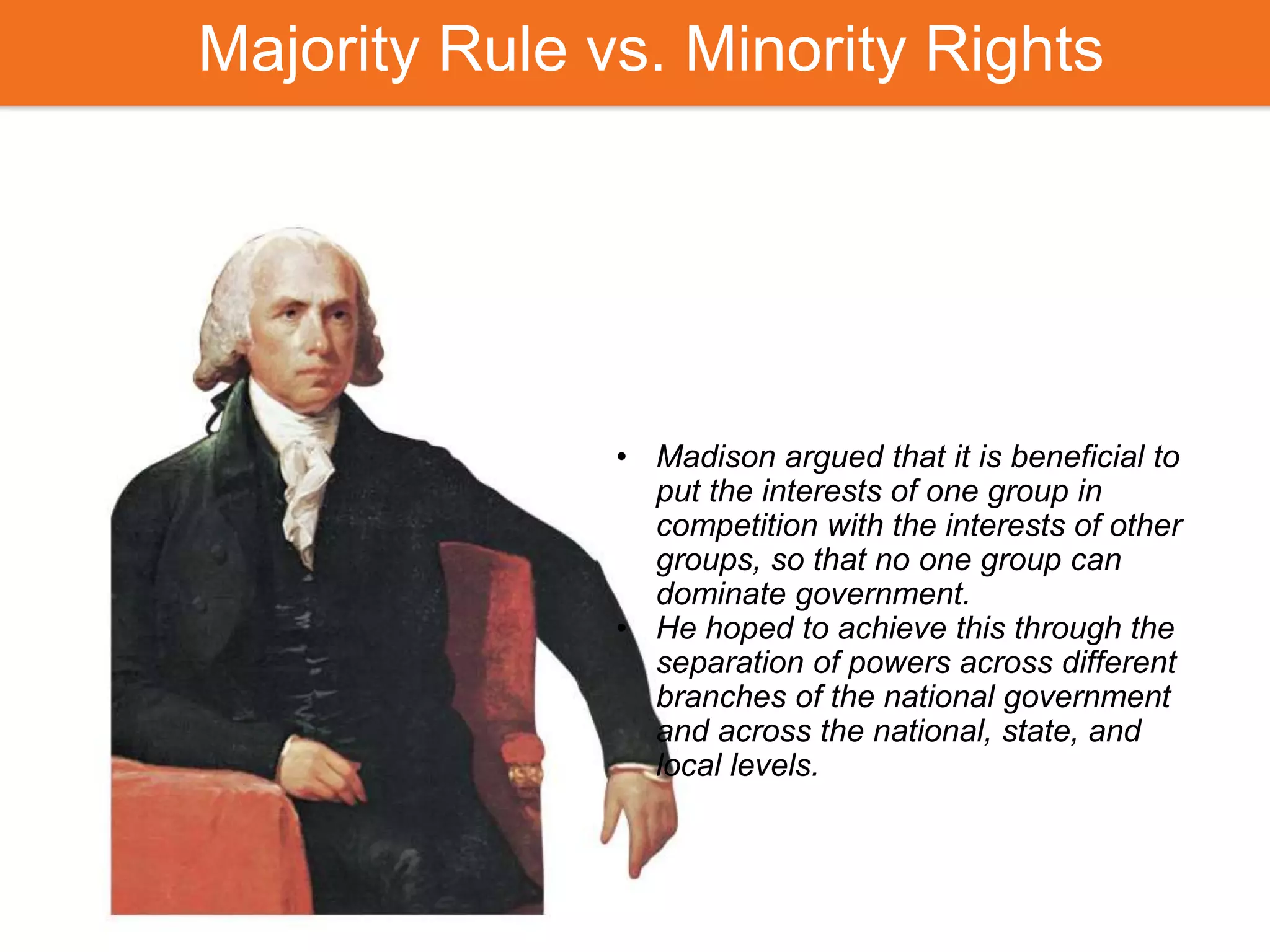
Majority Rule vs. Minority Rights
• Madison argued that it is beneficial to
put the interests of one group in
competition with the interests of other
groups, so that no one group can
dominate government.
• He hoped to achieve this through the
separation of powers across different
branches of the national government
and across the national, state, and
local levels.
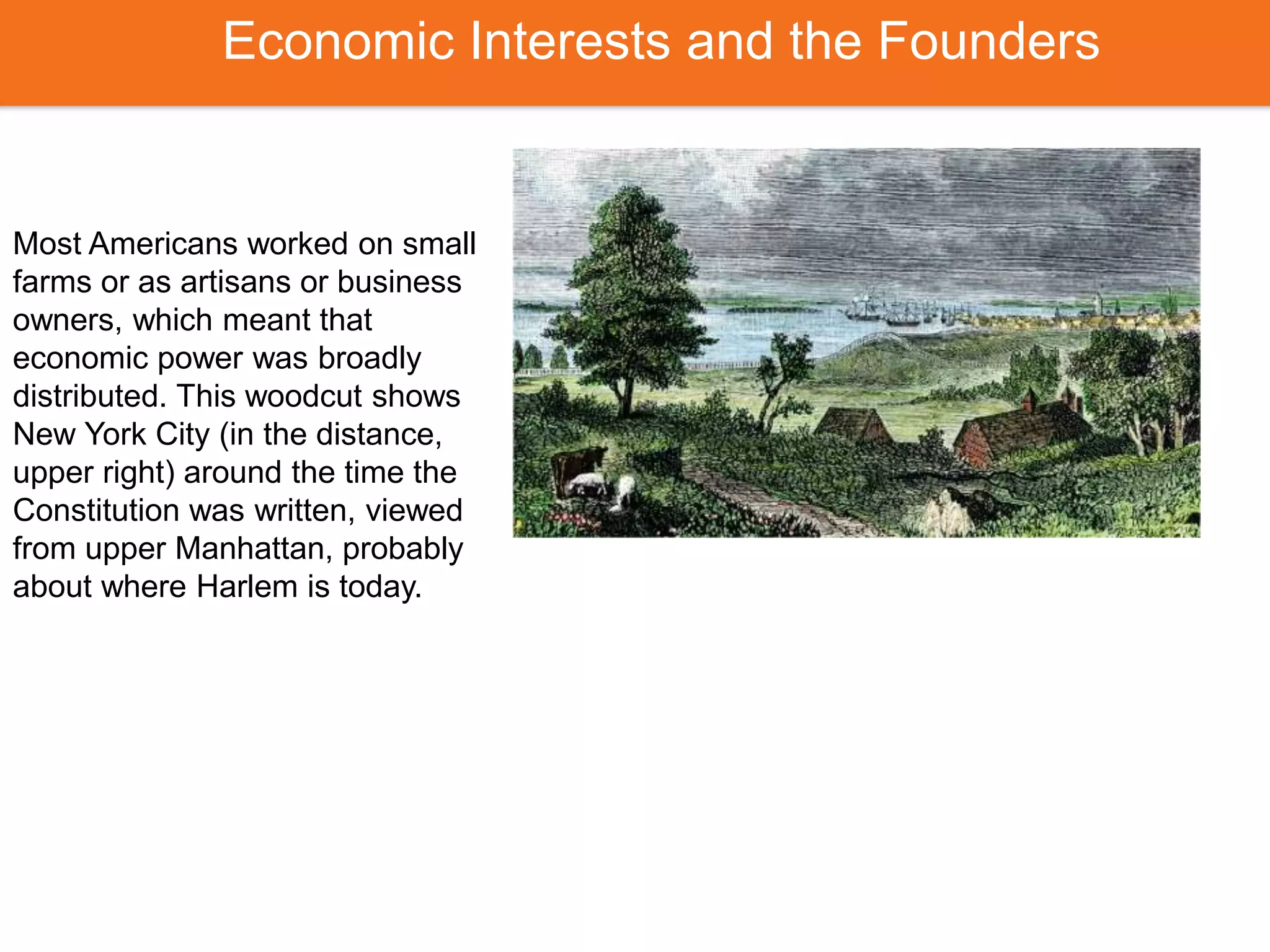
Economic Interests and the Founders
Most Americans worked on small
farms or as artisans or business
owners, which meant that
economic power was broadly
distributed. This woodcut shows
New York City (in the distance,
upper right) around the time the
Constitution was written, viewed
from upper Manhattan, probably
about where Harlem is today.
Founders Were Politicians,
Not Philosophers or Real Estate Investors
• Prominent early-twentieth century Progressive historian Charles Beard argued that the
framers established the Constitution to protect their property holdings and investments—
and the Founders’ supposed ideas were just post-hoc justifications. Problematic for this
interpretation is that both the advocates and the opponents of the Constitution
(Federalists and Antifederalists, respectively) came from the upper classes.
• The conclusion of David Robertson is that “The delegates who made the Constitution
were first and foremost politicians, not philosophers or real estate investors.”
– The rest of the economic context is equally enlightening:
– America had lots of land and landholders, no preexisting feudalism, and therefore
relative economic equality compared to Europe.
– The South was agricultural and therefore supported free trade (to get their goods to
market; whereas the North was a manufacturing base that wanted tariffs to protect its
“infant industries.”
The Confederal System Made
Coordination Difficult (2 of 2)
• Conflicts over land, representation, and sovereignty
• Equal representation of states
– Unicameral Confederation Congress
– Sovereign states
• Weak design of Confederal government
– Forbidden to tax citizens or force policies
– Certain powers
– Financial troubles
Abernathy, American Government, 2e
SAGE Publishing, 2020
13
Systems of Slavery and
Representation
• Difficult to amend the articles
• Systems of slavery
– Fears that slavery would be outlawed
• Concerns over representation
– Small states and underrepresentation
– Fears of population-based representation
• Change in political landscape
Abernathy, American Government, 2e
SAGE Publishing, 2020
14
Crisis and Fears of Tyranny
• Shay’s Rebellion
– Uprising against the government of Massachusetts
that led to calls for reform of the Articles of
Confederation
– Debt crisis
• Regulators
– Members of Shay’s Rebellion
• Led to the Philadelphia Conference
Abernathy, American Government, 2e
SAGE Publishing, 2020
15
Delegates Reach a Compromise (1 of
4)
• Constitutional Convention
– Meeting in Philadelphia in 1787 to fix the Articles of
Confederation
– Resulted in drafting U.S. Constitution
• Attendees included James Madison, George
Washington, and Alexander Hamilton
• Secrecy for delegate deliberations
Abernathy, American Government, 2e
SAGE Publishing, 2020
16
Delegates Reach a Compromise (2 of 4)
• Virginia Plan
– plan calling for a strong national government with
three branches and a bicameral legislature
– Laid out failures of American confederation
• New Jersey Plan
– Plan preserving provisions in the Articles of
Confederation, including equal votes for each state
– Objection from small states to Virginia Plan
Abernathy, American Government, 2e
SAGE Publishing, 2020
17
Delegates Reach a Compromise (3 of 4)
• Great Compromise
– Agreement that drew on both Virginia and New
Jersey plans
– House of Representatives
– Senate
– Constitution
Abernathy, American Government, 2e
SAGE Publishing, 2020
18
Delegates Reach a Compromise (4 of 4)
Abernathy, American Government, 2e
SAGE Publishing, 2020
19
The Importance of Political
Compromise vs. Polarization
20
https://youtu.be/dhE-gq9tq1A
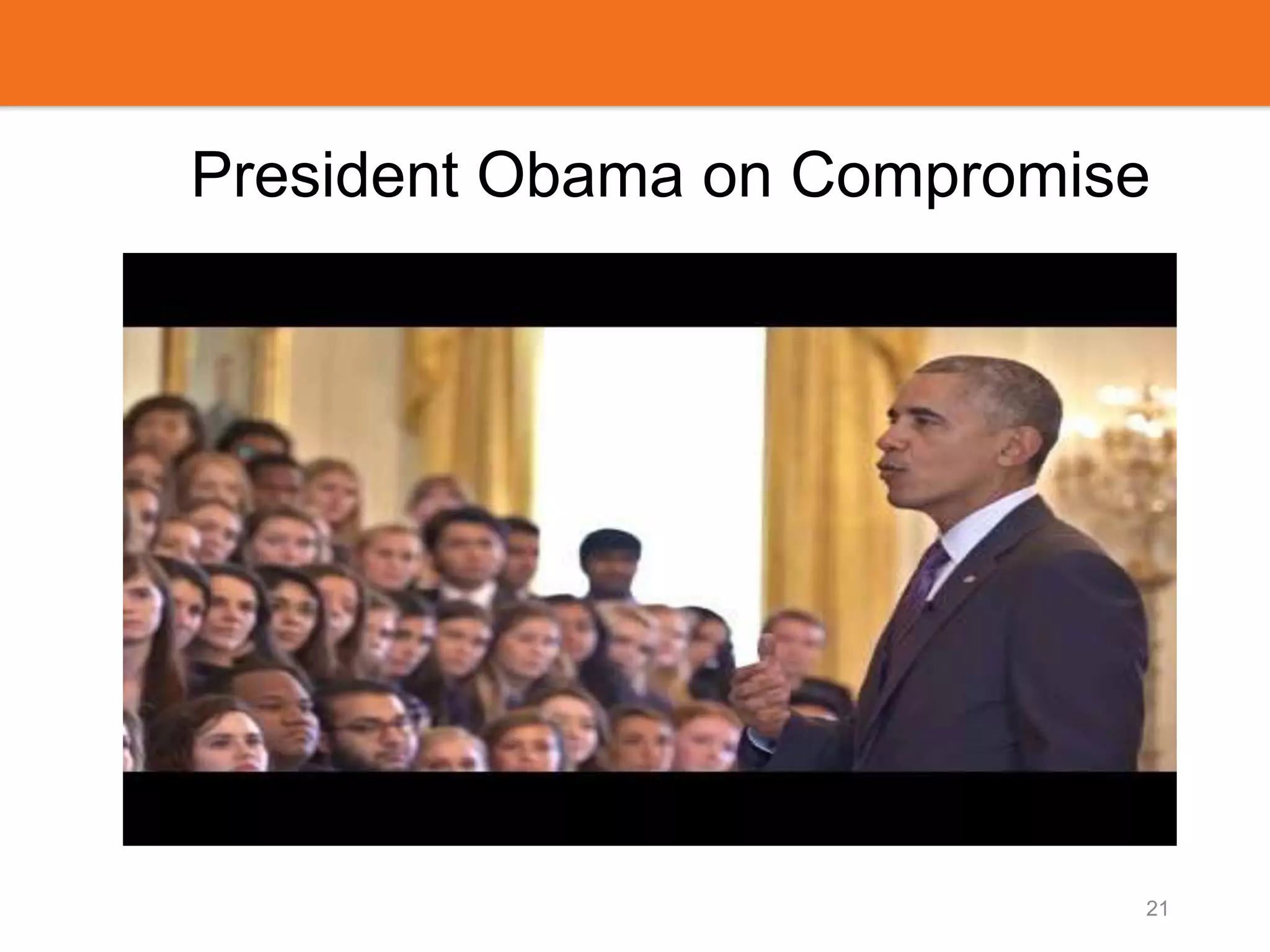
President Obama on Compromise
21
Delegates Worked Out Details of the
New Government (1 of 2)
• Committee of Detail
– Structure of government
– Relationships between branches
• Committee of Unfinished Parts
– Unresolved issues
Abernathy, American Government, 2e
SAGE Publishing, 2020
22
Legislative Branch
• Congress
– House of Representatives
o Elected by the people
– Senate
o Chosen by state legislatures
• Cooperation between Houses
• Responsible for making laws
Abernathy, American Government, 2e
SAGE Publishing, 2020
23
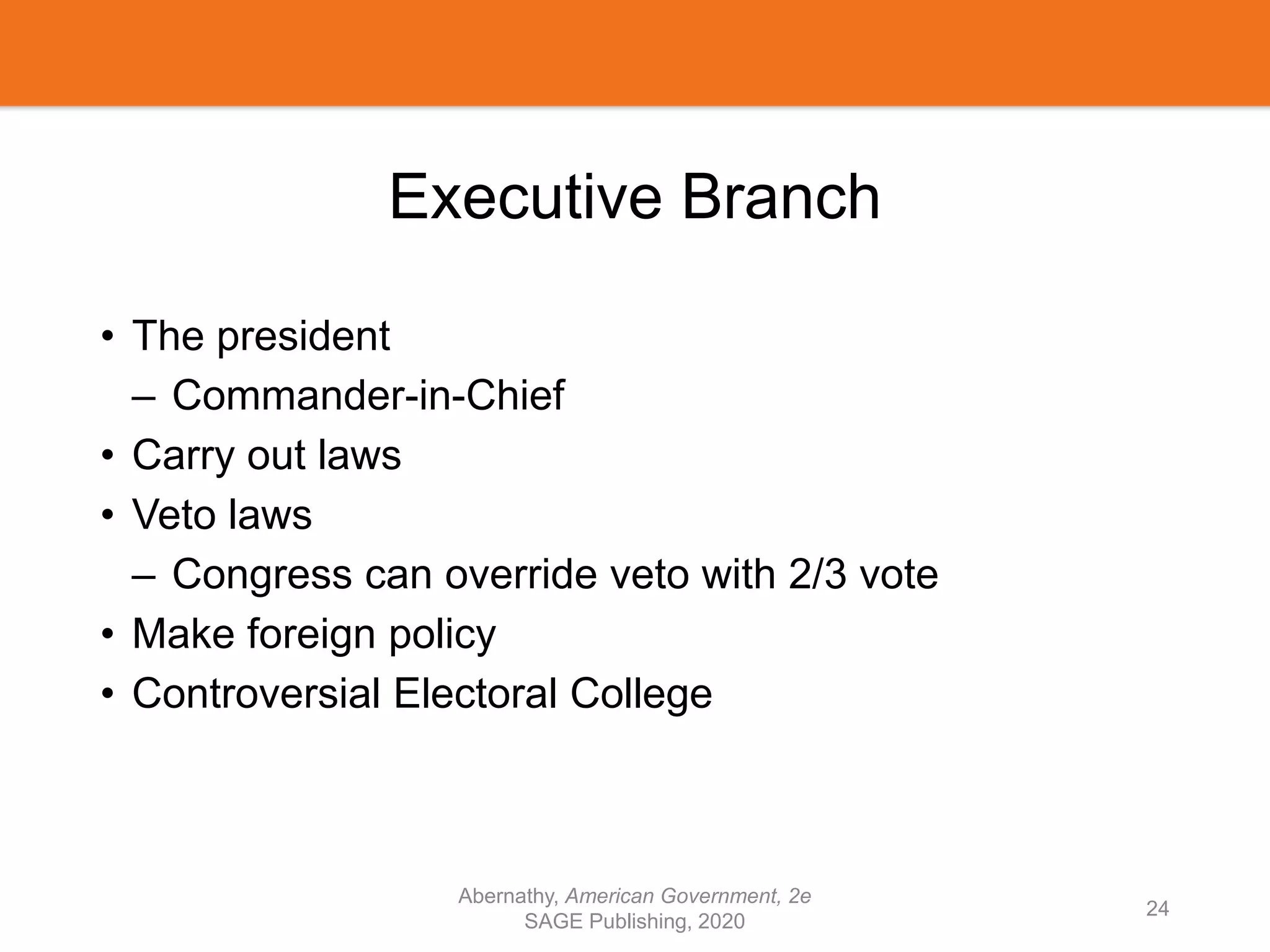
Executive Branch
• The president
– Commander-in-Chief
• Carry out laws
• Veto laws
– Congress can override veto with 2/3 vote
• Make foreign policy
• Controversial Electoral College
Abernathy, American Government, 2e
SAGE Publishing, 2020
24
Judicial Branch
• System of federal courts
• Supreme Court
– Most powerful
• Hearing and deciding cases
• Judicial review
• Constitution and people are above all branches
Abernathy, American Government, 2e
SAGE Publishing, 2020
25
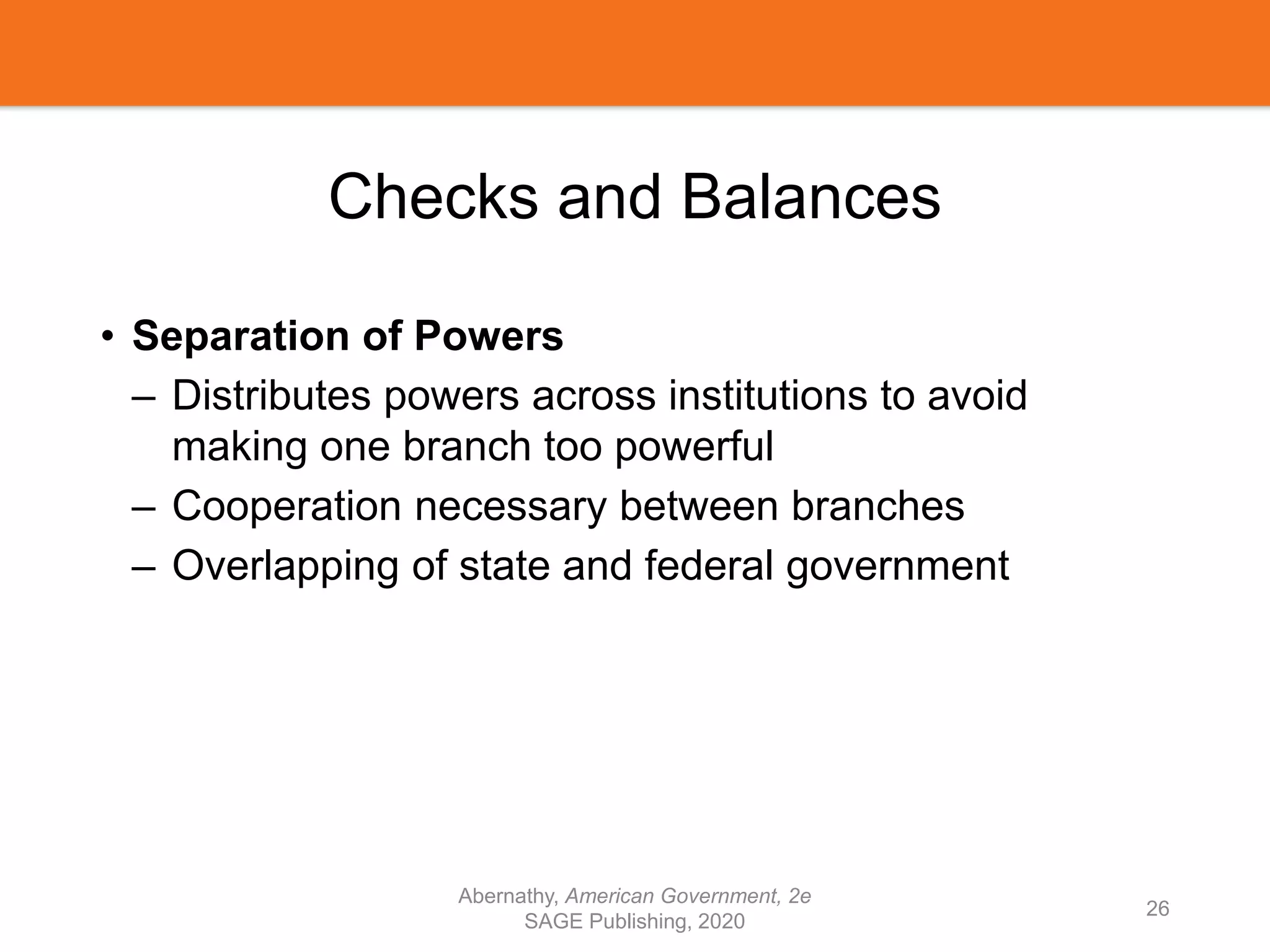
Checks and Balances
• Separation of Powers
– Distributes powers across institutions to avoid
making one branch too powerful
– Cooperation necessary between branches
– Overlapping of state and federal government
Abernathy, American Government, 2e
SAGE Publishing, 2020
26
Delegates Worked Out Details of the
New Government (2 of 2)
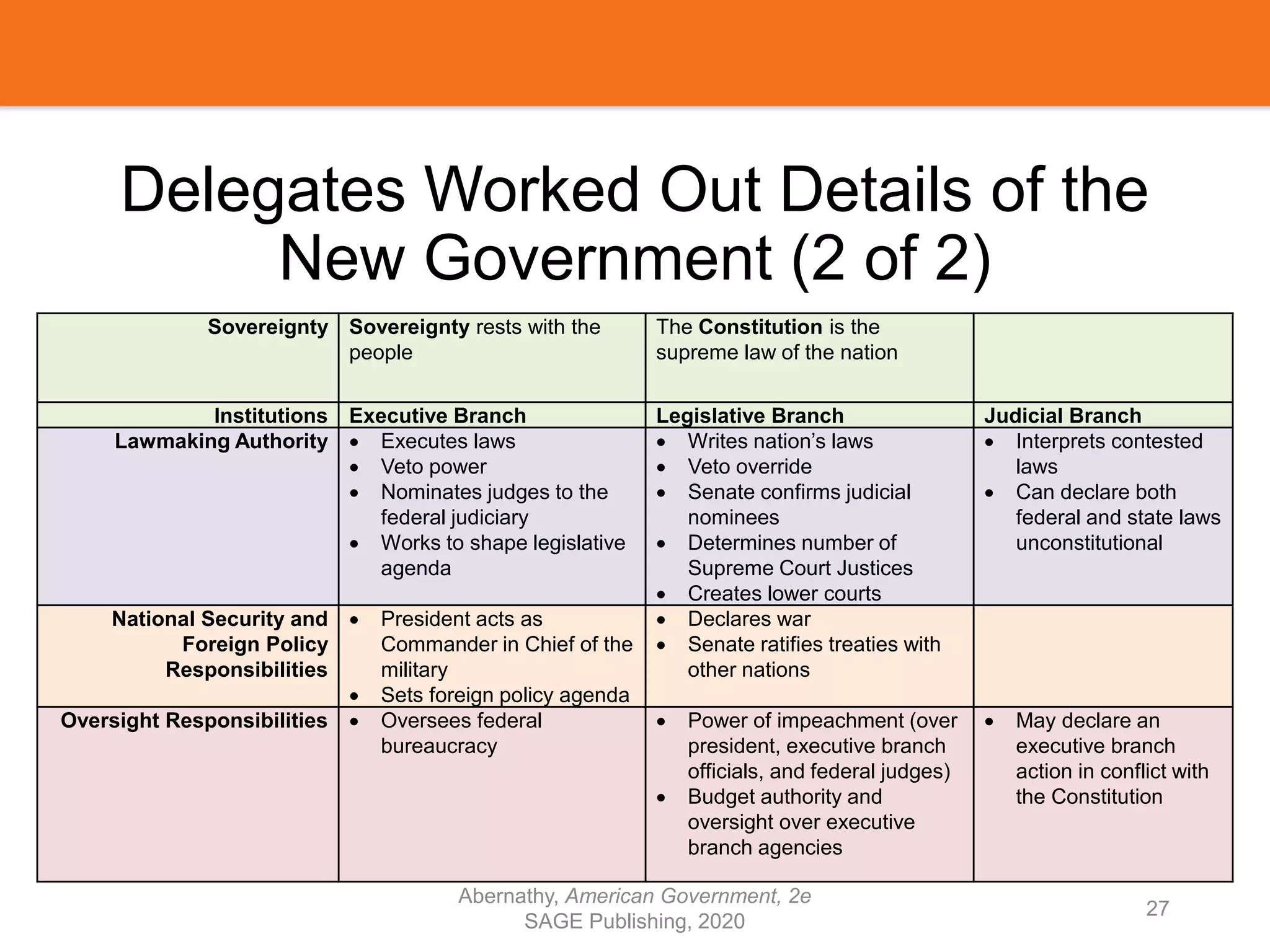
Sovereignty Sovereignty rests with the
people
The Constitution is the
supreme law of the nation
Institutions Executive Branch Legislative Branch Judicial Branch
Lawmaking Authority  Executes laws
 Veto power
 Nominates judges to the
federal judiciary
 Works to shape legislative
agenda
 Writes nation’s laws
 Veto override
 Senate confirms judicial
nominees
 Determines number of
Supreme Court Justices
 Creates lower courts
 Interprets contested
laws
 Can declare both
federal and state laws
unconstitutional
National Security and
Foreign Policy
Responsibilities
 President acts as
Commander in Chief of the
military
 Sets foreign policy agenda
 Declares war
 Senate ratifies treaties with
other nations
Oversight Responsibilities  Oversees federal
bureaucracy
 Power of impeachment (over
president, executive branch
officials, and federal judges)
 Budget authority and
oversight over executive
branch agencies
 May declare an
executive branch
action in conflict with
the Constitution
Abernathy, American Government, 2e
SAGE Publishing, 2020
27
The Problem of Slavery Left Behind
• Full faith and credit clause
• Amendment
– A constitutional provision by which changes may be
made to the original Constitution
– Required to officially propose and ratify
• Three-fifths Compromise
• Issue left unsettled
• James Madison and slavery
Abernathy, American Government, 2e
SAGE Publishing, 2020
28
Federalists and Anti-Federalists
Fought Over Ratification (1 of 2)
• Federalists
– Supporters of the proposed Constitution
– Called for a stronger national government
• Anti-Federalists
– Those who opposed the proposed Constitution
– Favored stronger state governments
• Split between classes
• Tyranny
Abernathy, American Government, 2e
SAGE Publishing, 2020
29
Federalists and Anti-Federalists
Fought Over Ratification (2 of 2)
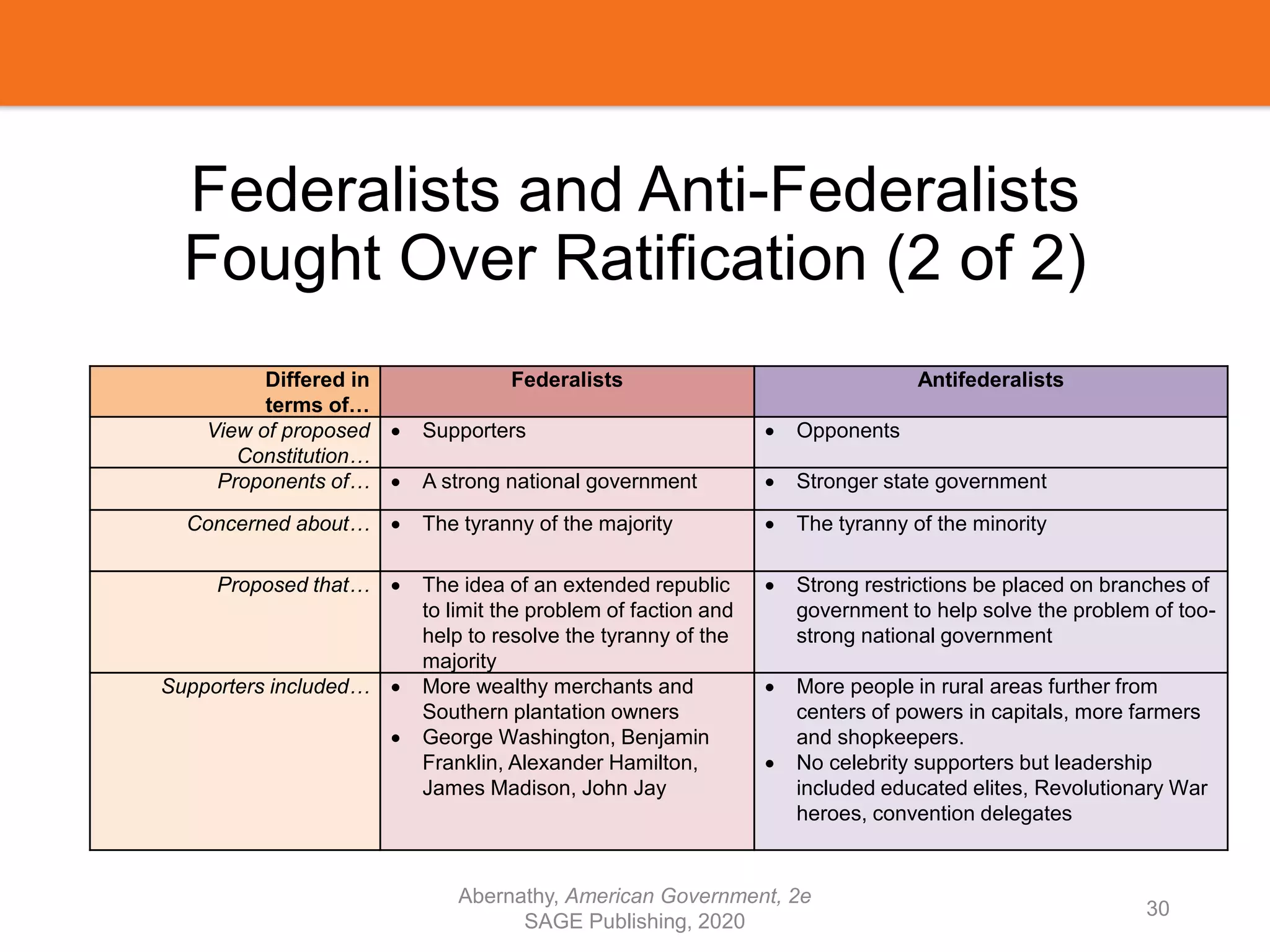
Differed in
terms of…
Federalists Antifederalists
View of proposed
Constitution…
 Supporters  Opponents
Proponents of…  A strong national government  Stronger state government
Concerned about…  The tyranny of the majority  The tyranny of the minority
Proposed that…  The idea of an extended republic
to limit the problem of faction and
help to resolve the tyranny of the
majority
 Strong restrictions be placed on branches of
government to help solve the problem of too-
strong national government
Supporters included…  More wealthy merchants and
Southern plantation owners
 George Washington, Benjamin
Franklin, Alexander Hamilton,
James Madison, John Jay
 More people in rural areas further from
centers of powers in capitals, more farmers
and shopkeepers.
 No celebrity supporters but leadership
included educated elites, Revolutionary War
heroes, convention delegates
Abernathy, American Government, 2e
SAGE Publishing, 2020
30
Dangers of Power in a Large
Republic
• Federalist Papers
– 85 essays written by Alexander Hamilton, James
Madison, and John Jay between 1787 and 1788
– Publius
– lay out the theory behind the constitution
– Federalist No. 10
o Factions
o Extended republic
Abernathy, American Government, 2e
SAGE Publishing, 2020
31
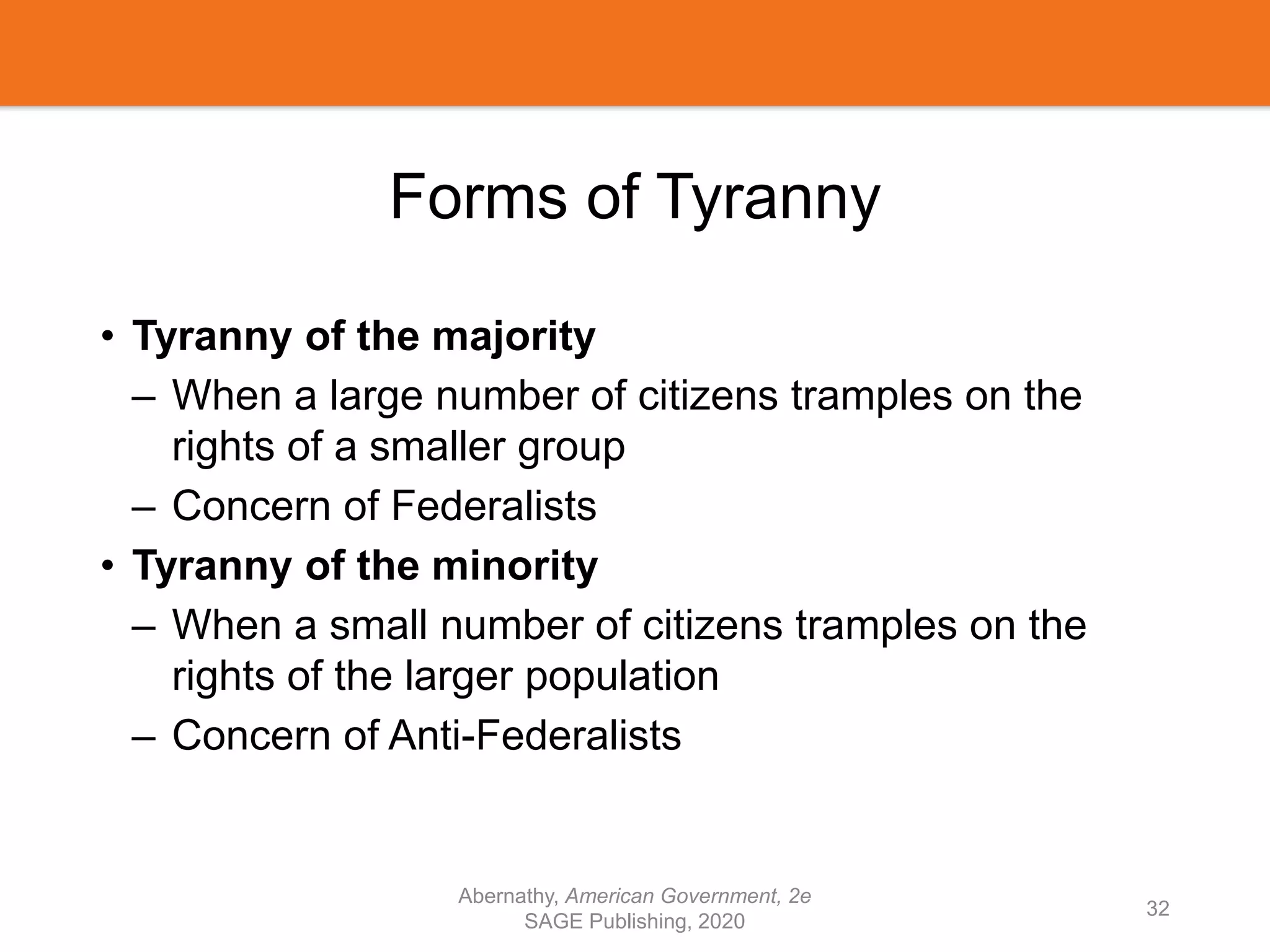
Forms of Tyranny
• Tyranny of the majority
– When a large number of citizens tramples on the
rights of a smaller group
– Concern of Federalists
• Tyranny of the minority
– When a small number of citizens tramples on the
rights of the larger population
– Concern of Anti-Federalists
Abernathy, American Government, 2e
SAGE Publishing, 2020
32
A Key Issue in Ratification Debates
• Bill of Rights
• Mercy Otis Warren
– Proponent for a bill of rights
– Showed support through plays, pamphlets and
poems
• In February 1788, the Federalists won
– New Hampshire was 9th to ratify
– Stipulation to add a bill of rights
– Constitution became supreme law in 1789
Abernathy, American Government, 2e
SAGE Publishing, 2020
33
Effects of the Constitution are Still
Being Debated
• Americans still debate over whether the constitution:
– Protects individual rights and liberties
– Preserves inequality
Abernathy, American Government, 2e
SAGE Publishing, 2020
34
Blueprint of the Constitution - Video
35
https://youtu.be/X7jRFbvPcGI
Preamble
• We the People of the United States, in order to form a
more perfect Union, establish Justice, insure domestic
Tranquility, provide for the common defense, promote
the general Welfare, and secure the blessings of
Liberty to ourselves and our Posterity, do ordain and
establish this constitution for the United States of
America.
– Answers Questions:
– Who? Why? For Whom?
36
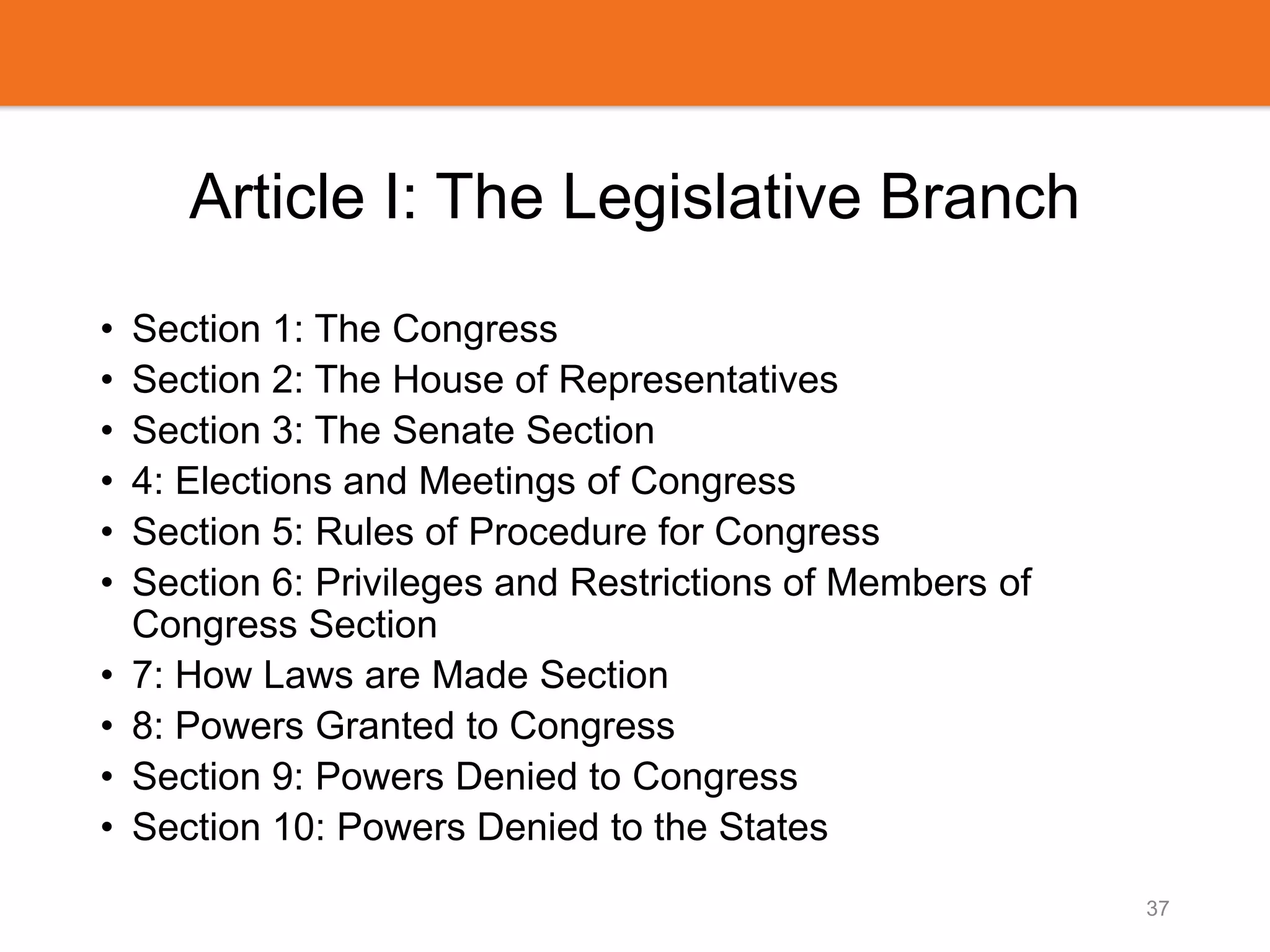
Article I: The Legislative Branch
• Section 1: The Congress
• Section 2: The House of Representatives
• Section 3: The Senate Section
• 4: Elections and Meetings of Congress
• Section 5: Rules of Procedure for Congress
• Section 6: Privileges and Restrictions of Members of
Congress Section
• 7: How Laws are Made Section
• 8: Powers Granted to Congress
• Section 9: Powers Denied to Congress
• Section 10: Powers Denied to the States
37
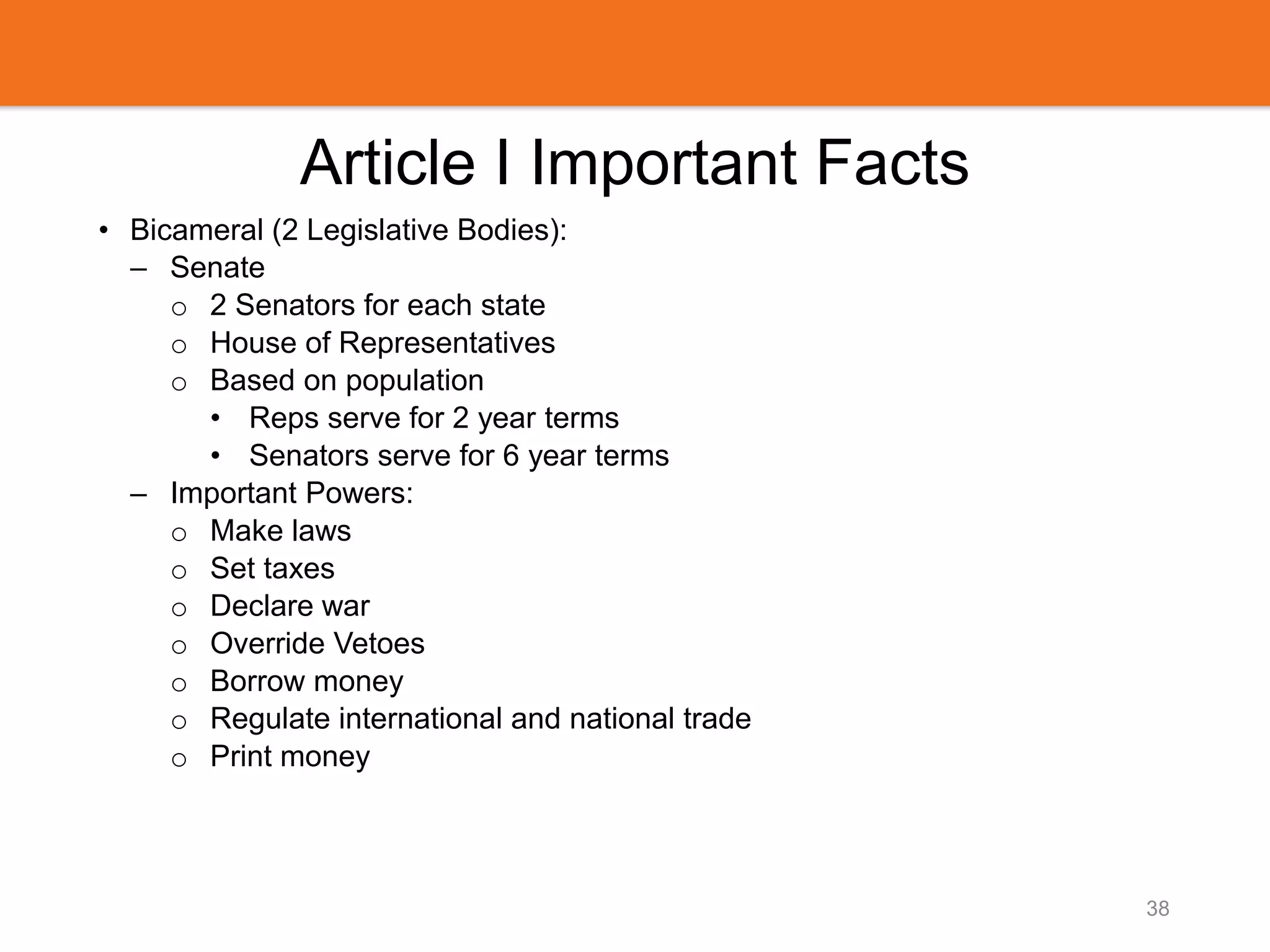
Article I Important Facts
• Bicameral (2 Legislative Bodies):
– Senate
o 2 Senators for each state
o House of Representatives
o Based on population
• Reps serve for 2 year terms
• Senators serve for 6 year terms
– Important Powers:
o Make laws
o Set taxes
o Declare war
o Override Vetoes
o Borrow money
o Regulate international and national trade
o Print money
38
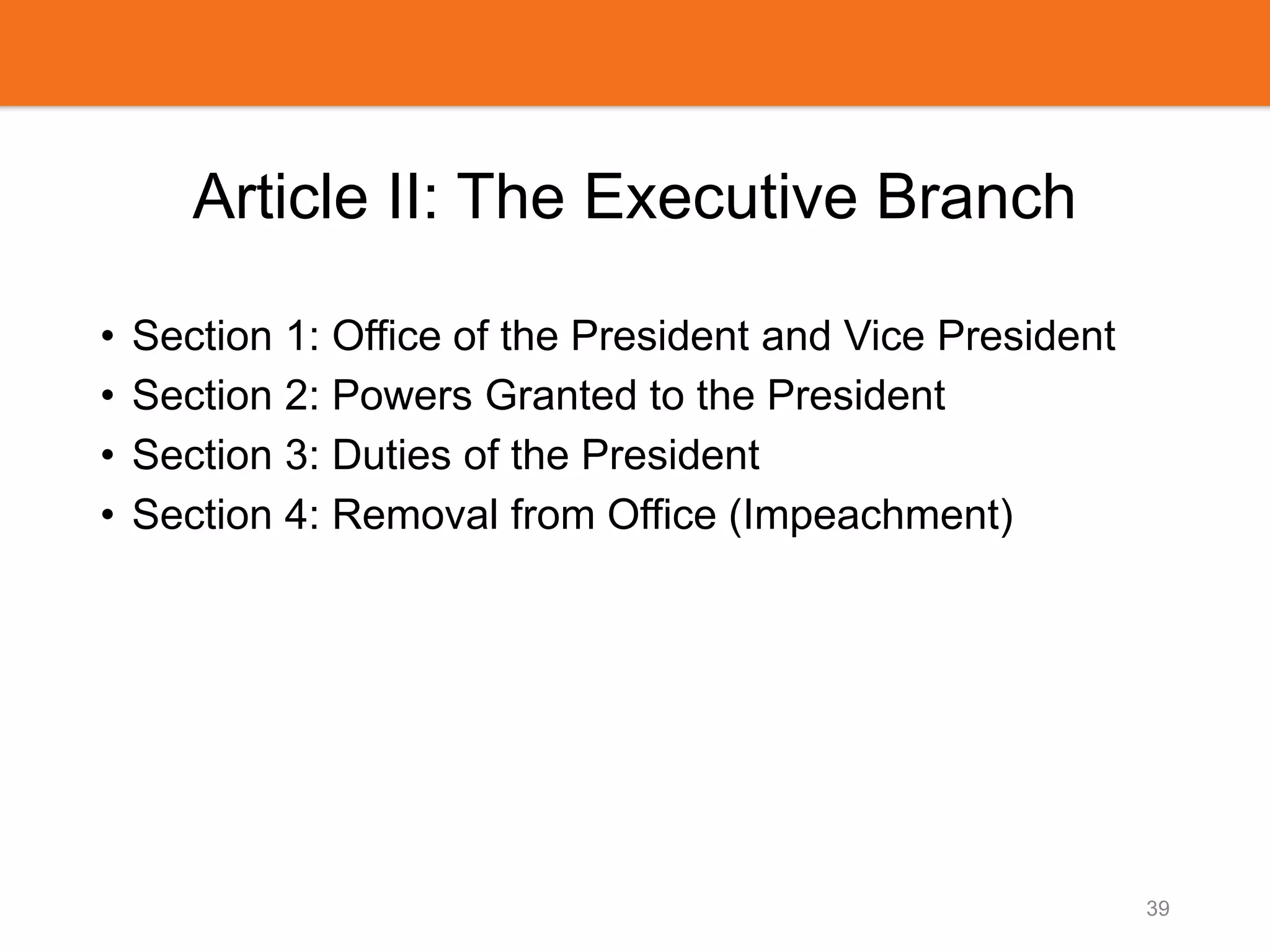
Article II: The Executive Branch
• Section 1: Office of the President and Vice President
• Section 2: Powers Granted to the President
• Section 3: Duties of the President
• Section 4: Removal from Office (Impeachment)
39
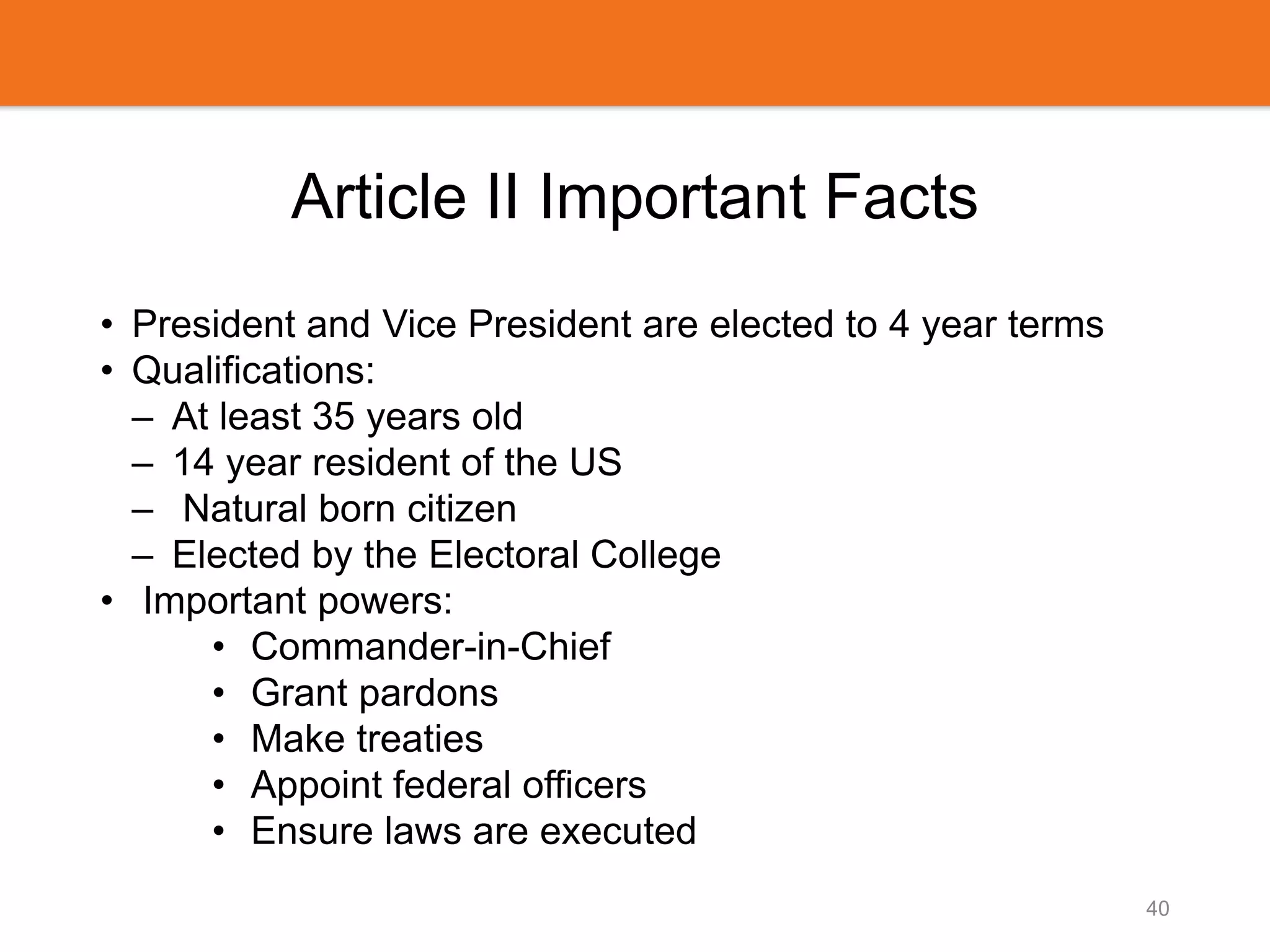
Article II Important Facts
• President and Vice President are elected to 4 year terms
• Qualifications:
– At least 35 years old
– 14 year resident of the US
– Natural born citizen
– Elected by the Electoral College
• Important powers:
• Commander-in-Chief
• Grant pardons
• Make treaties
• Appoint federal officers
• Ensure laws are executed
40
Article III: The Judicial Branch
• Section 1: Federal Courts
• Section 2: Powers of the Federal Courts
• Section 3: The Crime of Treason
41
Article III: Important Facts
• Supreme Court judges serve for life unless impeached.
• Judicial power rests with US Supreme Court and other
courts created by Congress
• Important Powers:
o Decides cases of Constitutional law and federal law
o Cases involving ambassadors go straight to Supreme
Court
o Judicial Review (ability to overturn laws based on
constitutionality) comes later
• 1803 – Case of Marbury v. Madison
42
Article IV: Relations among the States
• Section 1: Recognition by Each State of Acts of Other
States
• Section 2: Rights of Citizens in Other States
• Section 3: Treatment of New States and Territories
• Section 4: Guarantees of the States
43
Article IV Important Facts
• Section 1 – Each State to Honor the Others
• Section 2 – State Citizens and Extraditions
– Clause 1 – Full Faith and Credit
– Full Faith and Credit Clause
o Extend credit & full faith to public acts, court proceedings, and to status of other states.
o Congress has power to watch over intra-state relationships.
• Can step in if states are not abiding by full faith and credit clause.
– Clause 2- Extradition Clause
o Individuals charged with crimes who try to escape to another state can be forced to return to
the state where the crime was committed.
– Clause 3 – Fugitive Slaves
o Must be returned to the state in which they originated.
o Dread Scott vs. Sanford Case upholds this clause
• Section 3 – New States
– Clause 1 – Congress has power to admit new states
– Clause 2 – Territorial (Property) Clause – Gives U.S. Congress power over any territory of United
States (ex. Puerto Rico, Virgin Islands, Guam, etc.)
• Section 4 – Republican Government
– Clause 1 – Guarantee Clause – Guarantees each state is part of a republican form of
government.
– Clause 2 – Protects States against Domestic violence & Invasion
44
Article V: Amending the Constitution
• Outlines the process of changing the constitution
through several amendment ratification paths.
45
Article V: Important Facts
• Amendments are proposed when 2/3 of House and
Senate deem it necessary
• Amendments are proposed when 2/3 of states deem it
necessary
• Amendments must be ratified by ¾ of state
legislatures or by conventions in ¾ of states
46
Article VI: Debts, Federal Supremacy,
Oaths of Office
• Section 1: Prior Debts to the United States
• Section 2: The Supreme Law of the Land
• Section 3: Oaths of Office
47
Article VI: Important Facts
• Article VI: Federal Power –
– Constitution is the “Law of the Land
– Supremacy Clause: Federal law is supreme to state
law
• All government officials, federal and state, must swear
an oath to the Constitution which bonds them to uphold
it.
• No religious tests for public office
48
Article VII: Ratification of the Constitution
• Outlines the process of ratifying the constitution
• Only used ONCE (to adopt the document)
• Process lasted over one year
• Two Sides to the debate
– Federalists (Supported New Constitution)
– Antifederalists (Questioned Constitution & Fought
Perceptions of Federal Power over the States)
49
Article VII Important Facts
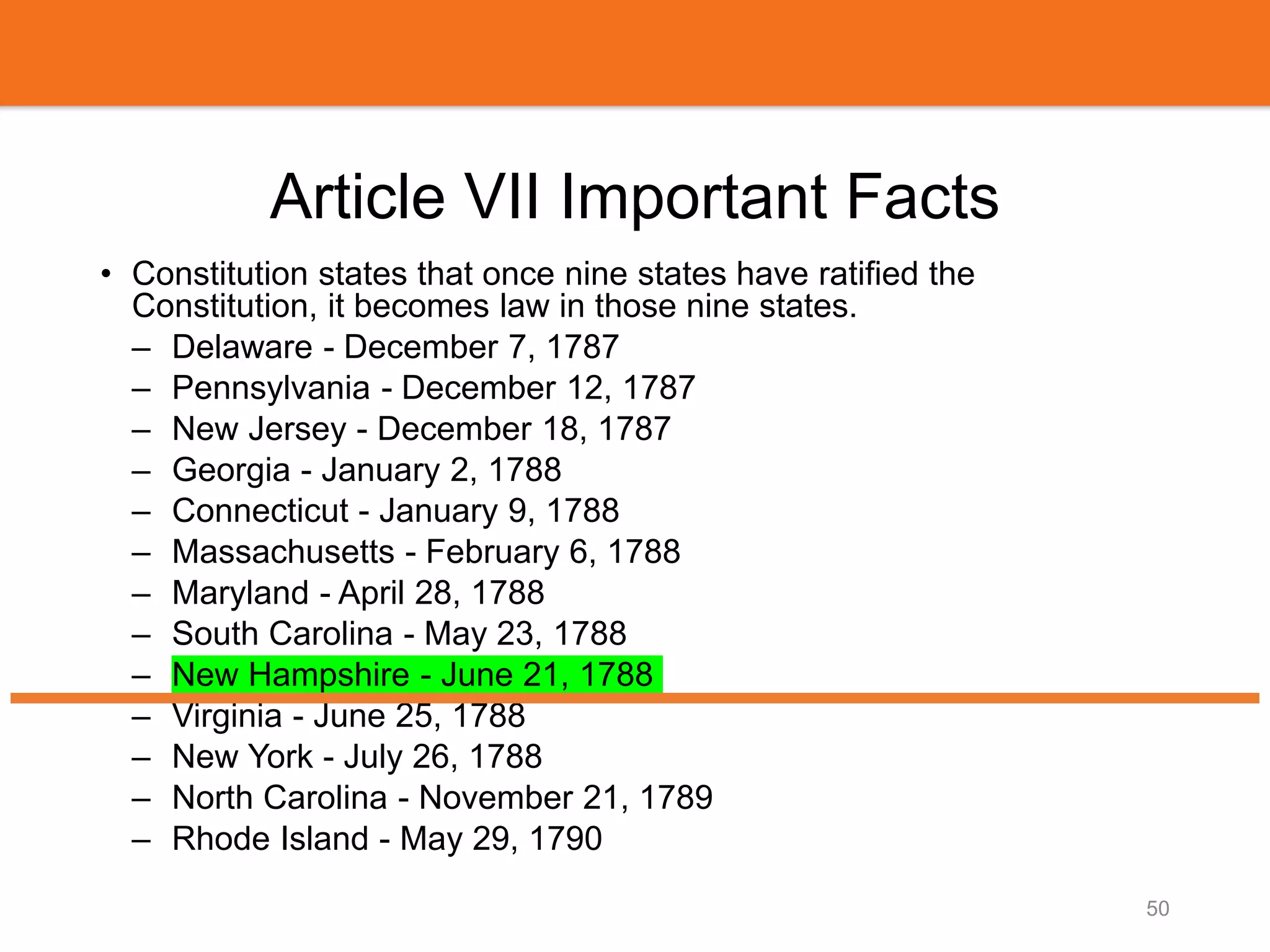
• Constitution states that once nine states have ratified the
Constitution, it becomes law in those nine states.
– Delaware - December 7, 1787
– Pennsylvania - December 12, 1787
– New Jersey - December 18, 1787
– Georgia - January 2, 1788
– Connecticut - January 9, 1788
– Massachusetts - February 6, 1788
– Maryland - April 28, 1788
– South Carolina - May 23, 1788
– New Hampshire - June 21, 1788
– Virginia - June 25, 1788
– New York - July 26, 1788
– North Carolina - November 21, 1789
– Rhode Island - May 29, 1790
50
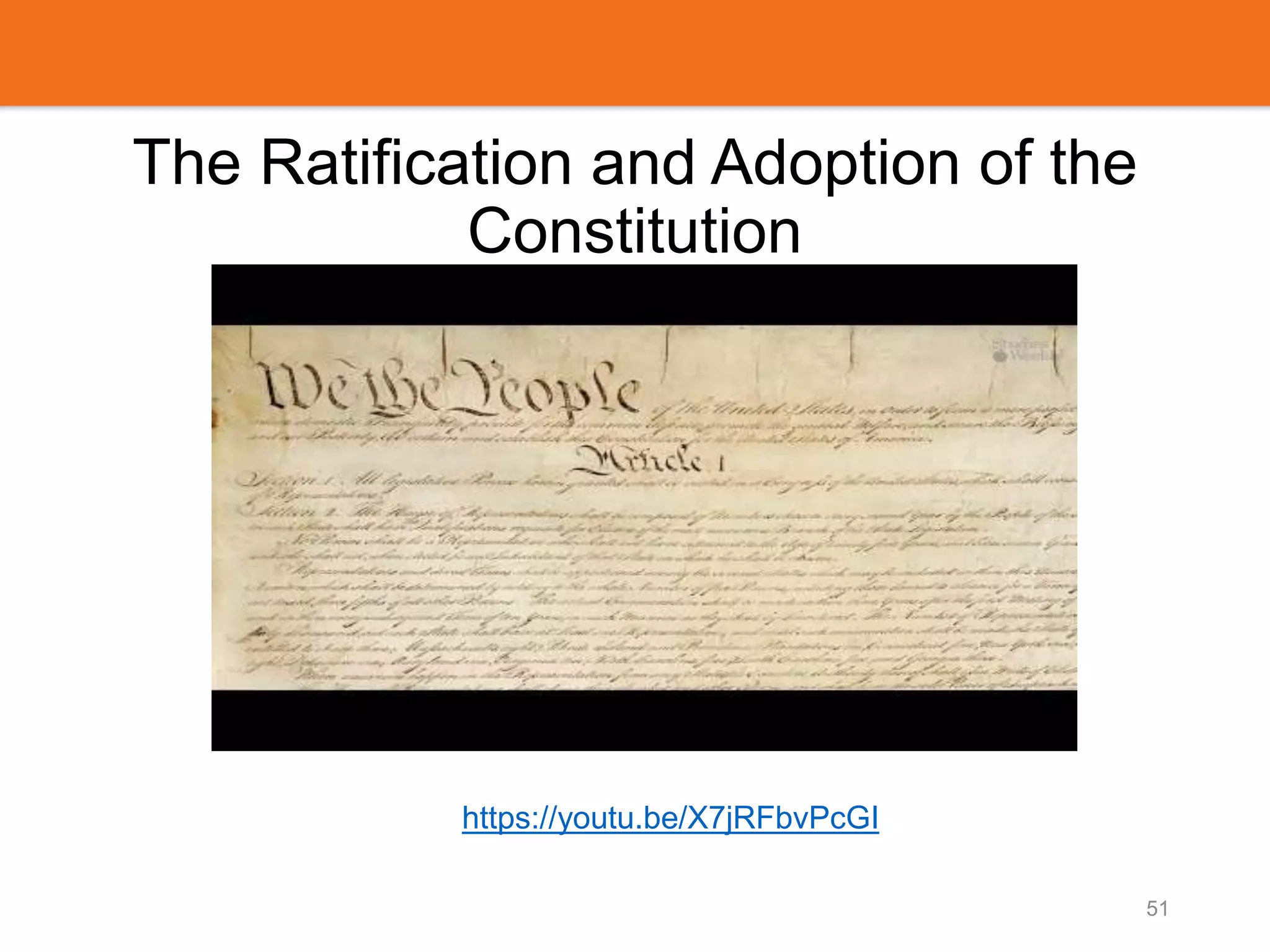
The Ratification and Adoption of the
Constitution
51
https://youtu.be/X7jRFbvPcGI

Abernathy2e full ppt02_edited

  • 2.
    Chapter 2 The Constitutionof the United States: A New Vision of Representative Government
  • 3.
    James Madison Plansfor a Republic • Republic – Governments ruled by representatives of the people • James Madison – Wanted a change in structure of the U.S. government – Annapolis Convention 1787 – Important role in the creation of the U.S. Constitution Abernathy, American Government, 2e SAGE Publishing, 2020 3
  • 4.
    The Confederal SystemMade Coordination Difficult (1 of 2) • Articles of Confederation and Perpetual Union – Union of 13 sovereign states in which the states were centers of political power – Adopted by Second Continental Congress in 1777 and ratified in 1781 • Mistrust of motives between states • Desire for self-sufficiency Abernathy, American Government, 2e SAGE Publishing, 2020 4
  • 5.
    Political Ideals ofthe Founders The Founders wanted to create a constitution that was general enough to stand the test of time. Their approach succeeded, and the U.S. Constitution is the oldest written constitution still in use today. However, by leaving some passages open to interpretation, they also set the stage for conflict over the meaning of the Constitution. Republicanism – the belief that a form of government in which the interests of the people are represented through elected leaders is the best form of government “Consent of the Governed” (as the basis of legitimate authority) – the idea that a government gains its legitimacy through regular elections in which the people living under that government participate to elect their leaders Natural rights – or “unalienable rights,” the Declaration of Independence defines them as “Live, Liberty, and the Pursuit of Happiness.” (Locke’s list included “property” or ”estate.”) The Founders believed that upholding these rights should be the government’s central purpose.
  • 6.
    Human Nature andIts Implications for Democracy • The framers viewed humans as naturally self-interested. • Governments must productively channel this self-interest. • Governments must also be able to handle majority factions. • James Madison, writing in Federalist 10, speaks eloquently about the problem of factions. – “A number of citizens, whether amounting to a majority or a minority of the whole, who are united and actuated by some common . . . interest, adverse to the rights of other citizens, or to the permanent and aggregate interests of the community.”
  • 7.
    If Men WereAngels… • “If men were angels, no government would be necessary. If angels were to govern men, neither external nor internal controls on government would be necessary. In framing a government which is to be administered by men over men, the great difficulty lies in this: you must first enable the government to control the governed; and in the next place oblige it to control itself. A dependence on the people is, no doubt, the primary control on the government; but experience has taught mankind the necessity of auxiliary precautions.” – ― James Madison, The Federalist Papers
  • 8.
    Factions • What arefactions? – Factions are groups of like-minded people who try to influence the government. Often they try to dominate the government. American government is set up to avoid domination by any one of these groups. • Why do factions exist? – Many reasons: differences of opinion, errors in reason, differences in wealth, property, native abilities; attachment to different leaders.
  • 9.
    What to do?… • Madison saw two ways to eliminate the deleterious effects of factions, but only one that would work: since “liberty is to faction as air is to fire,” – one solution would be to eliminate liberty. This has obvious problems. – A second way would be merely to control factions by making sure that there were many of them and no one would grow too powerful—a powerful argument for creating a strong national government. • In Federalist 51, Madison eloquently states, “In framing a government which is to be administered by men over men, the great difficulty lies in this: you must first enable the government to control the governed; and in the next place, oblige it to control itself.” The framers tried hard to harness humanity’s proclivities toward self-interest in the name of creating a more durable government.
  • 10.
    Majority Rule vs.Minority Rights • Madison argued that it is beneficial to put the interests of one group in competition with the interests of other groups, so that no one group can dominate government. • He hoped to achieve this through the separation of powers across different branches of the national government and across the national, state, and local levels.
  • 11.
    Economic Interests andthe Founders Most Americans worked on small farms or as artisans or business owners, which meant that economic power was broadly distributed. This woodcut shows New York City (in the distance, upper right) around the time the Constitution was written, viewed from upper Manhattan, probably about where Harlem is today.
  • 12.
    Founders Were Politicians, NotPhilosophers or Real Estate Investors • Prominent early-twentieth century Progressive historian Charles Beard argued that the framers established the Constitution to protect their property holdings and investments— and the Founders’ supposed ideas were just post-hoc justifications. Problematic for this interpretation is that both the advocates and the opponents of the Constitution (Federalists and Antifederalists, respectively) came from the upper classes. • The conclusion of David Robertson is that “The delegates who made the Constitution were first and foremost politicians, not philosophers or real estate investors.” – The rest of the economic context is equally enlightening: – America had lots of land and landholders, no preexisting feudalism, and therefore relative economic equality compared to Europe. – The South was agricultural and therefore supported free trade (to get their goods to market; whereas the North was a manufacturing base that wanted tariffs to protect its “infant industries.”
  • 13.
    The Confederal SystemMade Coordination Difficult (2 of 2) • Conflicts over land, representation, and sovereignty • Equal representation of states – Unicameral Confederation Congress – Sovereign states • Weak design of Confederal government – Forbidden to tax citizens or force policies – Certain powers – Financial troubles Abernathy, American Government, 2e SAGE Publishing, 2020 13
  • 14.
    Systems of Slaveryand Representation • Difficult to amend the articles • Systems of slavery – Fears that slavery would be outlawed • Concerns over representation – Small states and underrepresentation – Fears of population-based representation • Change in political landscape Abernathy, American Government, 2e SAGE Publishing, 2020 14
  • 15.
    Crisis and Fearsof Tyranny • Shay’s Rebellion – Uprising against the government of Massachusetts that led to calls for reform of the Articles of Confederation – Debt crisis • Regulators – Members of Shay’s Rebellion • Led to the Philadelphia Conference Abernathy, American Government, 2e SAGE Publishing, 2020 15
  • 16.
    Delegates Reach aCompromise (1 of 4) • Constitutional Convention – Meeting in Philadelphia in 1787 to fix the Articles of Confederation – Resulted in drafting U.S. Constitution • Attendees included James Madison, George Washington, and Alexander Hamilton • Secrecy for delegate deliberations Abernathy, American Government, 2e SAGE Publishing, 2020 16
  • 17.
    Delegates Reach aCompromise (2 of 4) • Virginia Plan – plan calling for a strong national government with three branches and a bicameral legislature – Laid out failures of American confederation • New Jersey Plan – Plan preserving provisions in the Articles of Confederation, including equal votes for each state – Objection from small states to Virginia Plan Abernathy, American Government, 2e SAGE Publishing, 2020 17
  • 18.
    Delegates Reach aCompromise (3 of 4) • Great Compromise – Agreement that drew on both Virginia and New Jersey plans – House of Representatives – Senate – Constitution Abernathy, American Government, 2e SAGE Publishing, 2020 18
  • 19.
    Delegates Reach aCompromise (4 of 4) Abernathy, American Government, 2e SAGE Publishing, 2020 19
  • 20.
    The Importance ofPolitical Compromise vs. Polarization 20 https://youtu.be/dhE-gq9tq1A
  • 21.
    President Obama onCompromise 21
  • 22.
    Delegates Worked OutDetails of the New Government (1 of 2) • Committee of Detail – Structure of government – Relationships between branches • Committee of Unfinished Parts – Unresolved issues Abernathy, American Government, 2e SAGE Publishing, 2020 22
  • 23.
    Legislative Branch • Congress –House of Representatives o Elected by the people – Senate o Chosen by state legislatures • Cooperation between Houses • Responsible for making laws Abernathy, American Government, 2e SAGE Publishing, 2020 23
  • 24.
    Executive Branch • Thepresident – Commander-in-Chief • Carry out laws • Veto laws – Congress can override veto with 2/3 vote • Make foreign policy • Controversial Electoral College Abernathy, American Government, 2e SAGE Publishing, 2020 24
  • 25.
    Judicial Branch • Systemof federal courts • Supreme Court – Most powerful • Hearing and deciding cases • Judicial review • Constitution and people are above all branches Abernathy, American Government, 2e SAGE Publishing, 2020 25
  • 26.
    Checks and Balances •Separation of Powers – Distributes powers across institutions to avoid making one branch too powerful – Cooperation necessary between branches – Overlapping of state and federal government Abernathy, American Government, 2e SAGE Publishing, 2020 26
  • 27.
    Delegates Worked OutDetails of the New Government (2 of 2) Sovereignty Sovereignty rests with the people The Constitution is the supreme law of the nation Institutions Executive Branch Legislative Branch Judicial Branch Lawmaking Authority  Executes laws  Veto power  Nominates judges to the federal judiciary  Works to shape legislative agenda  Writes nation’s laws  Veto override  Senate confirms judicial nominees  Determines number of Supreme Court Justices  Creates lower courts  Interprets contested laws  Can declare both federal and state laws unconstitutional National Security and Foreign Policy Responsibilities  President acts as Commander in Chief of the military  Sets foreign policy agenda  Declares war  Senate ratifies treaties with other nations Oversight Responsibilities  Oversees federal bureaucracy  Power of impeachment (over president, executive branch officials, and federal judges)  Budget authority and oversight over executive branch agencies  May declare an executive branch action in conflict with the Constitution Abernathy, American Government, 2e SAGE Publishing, 2020 27
  • 28.
    The Problem ofSlavery Left Behind • Full faith and credit clause • Amendment – A constitutional provision by which changes may be made to the original Constitution – Required to officially propose and ratify • Three-fifths Compromise • Issue left unsettled • James Madison and slavery Abernathy, American Government, 2e SAGE Publishing, 2020 28
  • 29.
    Federalists and Anti-Federalists FoughtOver Ratification (1 of 2) • Federalists – Supporters of the proposed Constitution – Called for a stronger national government • Anti-Federalists – Those who opposed the proposed Constitution – Favored stronger state governments • Split between classes • Tyranny Abernathy, American Government, 2e SAGE Publishing, 2020 29
  • 30.
    Federalists and Anti-Federalists FoughtOver Ratification (2 of 2) Differed in terms of… Federalists Antifederalists View of proposed Constitution…  Supporters  Opponents Proponents of…  A strong national government  Stronger state government Concerned about…  The tyranny of the majority  The tyranny of the minority Proposed that…  The idea of an extended republic to limit the problem of faction and help to resolve the tyranny of the majority  Strong restrictions be placed on branches of government to help solve the problem of too- strong national government Supporters included…  More wealthy merchants and Southern plantation owners  George Washington, Benjamin Franklin, Alexander Hamilton, James Madison, John Jay  More people in rural areas further from centers of powers in capitals, more farmers and shopkeepers.  No celebrity supporters but leadership included educated elites, Revolutionary War heroes, convention delegates Abernathy, American Government, 2e SAGE Publishing, 2020 30
  • 31.
    Dangers of Powerin a Large Republic • Federalist Papers – 85 essays written by Alexander Hamilton, James Madison, and John Jay between 1787 and 1788 – Publius – lay out the theory behind the constitution – Federalist No. 10 o Factions o Extended republic Abernathy, American Government, 2e SAGE Publishing, 2020 31
  • 32.
    Forms of Tyranny •Tyranny of the majority – When a large number of citizens tramples on the rights of a smaller group – Concern of Federalists • Tyranny of the minority – When a small number of citizens tramples on the rights of the larger population – Concern of Anti-Federalists Abernathy, American Government, 2e SAGE Publishing, 2020 32
  • 33.
    A Key Issuein Ratification Debates • Bill of Rights • Mercy Otis Warren – Proponent for a bill of rights – Showed support through plays, pamphlets and poems • In February 1788, the Federalists won – New Hampshire was 9th to ratify – Stipulation to add a bill of rights – Constitution became supreme law in 1789 Abernathy, American Government, 2e SAGE Publishing, 2020 33
  • 34.
    Effects of theConstitution are Still Being Debated • Americans still debate over whether the constitution: – Protects individual rights and liberties – Preserves inequality Abernathy, American Government, 2e SAGE Publishing, 2020 34
  • 35.
    Blueprint of theConstitution - Video 35 https://youtu.be/X7jRFbvPcGI
  • 36.
    Preamble • We thePeople of the United States, in order to form a more perfect Union, establish Justice, insure domestic Tranquility, provide for the common defense, promote the general Welfare, and secure the blessings of Liberty to ourselves and our Posterity, do ordain and establish this constitution for the United States of America. – Answers Questions: – Who? Why? For Whom? 36
  • 37.
    Article I: TheLegislative Branch • Section 1: The Congress • Section 2: The House of Representatives • Section 3: The Senate Section • 4: Elections and Meetings of Congress • Section 5: Rules of Procedure for Congress • Section 6: Privileges and Restrictions of Members of Congress Section • 7: How Laws are Made Section • 8: Powers Granted to Congress • Section 9: Powers Denied to Congress • Section 10: Powers Denied to the States 37
  • 38.
    Article I ImportantFacts • Bicameral (2 Legislative Bodies): – Senate o 2 Senators for each state o House of Representatives o Based on population • Reps serve for 2 year terms • Senators serve for 6 year terms – Important Powers: o Make laws o Set taxes o Declare war o Override Vetoes o Borrow money o Regulate international and national trade o Print money 38
  • 39.
    Article II: TheExecutive Branch • Section 1: Office of the President and Vice President • Section 2: Powers Granted to the President • Section 3: Duties of the President • Section 4: Removal from Office (Impeachment) 39
  • 40.
    Article II ImportantFacts • President and Vice President are elected to 4 year terms • Qualifications: – At least 35 years old – 14 year resident of the US – Natural born citizen – Elected by the Electoral College • Important powers: • Commander-in-Chief • Grant pardons • Make treaties • Appoint federal officers • Ensure laws are executed 40
  • 41.
    Article III: TheJudicial Branch • Section 1: Federal Courts • Section 2: Powers of the Federal Courts • Section 3: The Crime of Treason 41
  • 42.
    Article III: ImportantFacts • Supreme Court judges serve for life unless impeached. • Judicial power rests with US Supreme Court and other courts created by Congress • Important Powers: o Decides cases of Constitutional law and federal law o Cases involving ambassadors go straight to Supreme Court o Judicial Review (ability to overturn laws based on constitutionality) comes later • 1803 – Case of Marbury v. Madison 42
  • 43.
    Article IV: Relationsamong the States • Section 1: Recognition by Each State of Acts of Other States • Section 2: Rights of Citizens in Other States • Section 3: Treatment of New States and Territories • Section 4: Guarantees of the States 43
  • 44.
    Article IV ImportantFacts • Section 1 – Each State to Honor the Others • Section 2 – State Citizens and Extraditions – Clause 1 – Full Faith and Credit – Full Faith and Credit Clause o Extend credit & full faith to public acts, court proceedings, and to status of other states. o Congress has power to watch over intra-state relationships. • Can step in if states are not abiding by full faith and credit clause. – Clause 2- Extradition Clause o Individuals charged with crimes who try to escape to another state can be forced to return to the state where the crime was committed. – Clause 3 – Fugitive Slaves o Must be returned to the state in which they originated. o Dread Scott vs. Sanford Case upholds this clause • Section 3 – New States – Clause 1 – Congress has power to admit new states – Clause 2 – Territorial (Property) Clause – Gives U.S. Congress power over any territory of United States (ex. Puerto Rico, Virgin Islands, Guam, etc.) • Section 4 – Republican Government – Clause 1 – Guarantee Clause – Guarantees each state is part of a republican form of government. – Clause 2 – Protects States against Domestic violence & Invasion 44
  • 45.
    Article V: Amendingthe Constitution • Outlines the process of changing the constitution through several amendment ratification paths. 45
  • 46.
    Article V: ImportantFacts • Amendments are proposed when 2/3 of House and Senate deem it necessary • Amendments are proposed when 2/3 of states deem it necessary • Amendments must be ratified by ¾ of state legislatures or by conventions in ¾ of states 46
  • 47.
    Article VI: Debts,Federal Supremacy, Oaths of Office • Section 1: Prior Debts to the United States • Section 2: The Supreme Law of the Land • Section 3: Oaths of Office 47
  • 48.
    Article VI: ImportantFacts • Article VI: Federal Power – – Constitution is the “Law of the Land – Supremacy Clause: Federal law is supreme to state law • All government officials, federal and state, must swear an oath to the Constitution which bonds them to uphold it. • No religious tests for public office 48
  • 49.
    Article VII: Ratificationof the Constitution • Outlines the process of ratifying the constitution • Only used ONCE (to adopt the document) • Process lasted over one year • Two Sides to the debate – Federalists (Supported New Constitution) – Antifederalists (Questioned Constitution & Fought Perceptions of Federal Power over the States) 49
  • 50.
    Article VII ImportantFacts • Constitution states that once nine states have ratified the Constitution, it becomes law in those nine states. – Delaware - December 7, 1787 – Pennsylvania - December 12, 1787 – New Jersey - December 18, 1787 – Georgia - January 2, 1788 – Connecticut - January 9, 1788 – Massachusetts - February 6, 1788 – Maryland - April 28, 1788 – South Carolina - May 23, 1788 – New Hampshire - June 21, 1788 – Virginia - June 25, 1788 – New York - July 26, 1788 – North Carolina - November 21, 1789 – Rhode Island - May 29, 1790 50
  • 51.
    The Ratification andAdoption of the Constitution 51 https://youtu.be/X7jRFbvPcGI

Editor's Notes

  • #2 LEARNING OBJECTIVES 2.1 Describe the ideas and historical context that shaped James Madison’s thinking about republics. 2.2 Explain the challenges faced by the nation following the American Revolution in trying to form a government strong enough to rule effectively but not so strong as to oppress the rights of Americans. 2.3 Describe the role that compromise over states’ interests played in shaping the government during the Constitutional Convention. 2.4 Identify the institutions of government established by the Constitution and the distribution of political power among them. 2.5 Compare and contrast the arguments put forth by the Federalists and Anti-Federalists during the ratification debates.
  • #4 2.1 Describe the ideas and historical context that shaped James Madison’s thinking about republics
  • #5 2.2 Explain the challenges faced by the nation following the American Revolution in trying to form a government strong enough to rule effectively but not so strong as to oppress the rights of Americans.
  • #6 The Founders wanted to create a constitution that was general enough to stand the test of time. Their approach succeeded, and the U.S. Constitution is the oldest written constitution still in use today. However, by leaving some passages open to interpretation, they also set the stage for conflict over the meaning of the Constitution. Republicanism – the belief that a form of government in which the interests of the people are represented through elected leaders is the best form of government “Consent of the Governed” (as the basis of legitimate authority) – the idea that a government gains its legitimacy through regular elections in which the people living under that government participate to elect their leaders Natural rights – or “unalienable rights,” the Declaration of Independence defines them as “Live, Liberty, and the Pursuit of Happiness.” (Locke’s list included “property” or ”estate.”) The Founders believed that upholding these rights should be the government’s central purpose.
  • #7 James Madison, writing in Federalist 10, speaks eloquently about the problem of factions. “A number of citizens, whether amounting to a majority or a minority of the whole, who are united and actuated by some common . . . interest, adverse to the rights of other citizens, or to the permanent and aggregate interests of the community.” But what are factions? Factions are groups of like-minded people who try to influence the government. Often they try to dominate the government. American government is set up to avoid domination by any one of these groups. Why do factions exist? Many reasons: differences of opinion, errors in reason, differences in wealth, property, native abilities; attachment to different leaders. Madison saw two ways to eliminate the deleterious effects of factions, but only one that would work: since “liberty is to faction as air is to fire,” one solution would be to eliminate liberty. This has obvious problems. A second way would be merely to control factions by making sure that there were many of them and no one would grow too powerful—a powerful argument for creating a strong national government. In Federalist 51, Madison eloquently states, “In framing a government which is to be administered by men over men, the great difficulty lies in this: you must first enable the government to control the governed; and in the next place, oblige it to control itself.” The framers tried hard to harness humanity’s proclivities toward self-interest in the name of creating a more durable government.
  • #11 James Madison argued that it is beneficial to put the interests of one group in competition with the interests of other groups, so that no one group can dominate government. He hoped to achieve this through the separation of powers across different branches of the national government and across the national, state, and local levels.
  • #12 The economic context of the American Founding had an important impact on the Constitution. Most Americans worked on small farms or as artisans or business owners, which meant that economic power was broadly distributed. This woodcut shows New York City (in the distance, upper right) around the time the Constitution was written, viewed from upper Manhattan, probably about where Harlem is today. Prominent early-twentieth century Progressive historian Charles Beard argued that the framers established the Constitution to protect their property holdings and investments—and the Founders’ supposed ideas were just post-hoc justifications. Problematic for this interpretation is that both the advocates and the opponents of the Constitution (Federalists and Antifederalists, respectively) came from the upper classes. The conclusion of David Robertson is that “The delegates who made the Constitution were first and foremost politicians, not philosophers or real estate investors.” The rest of the economic context is equally enlightening: America had lots of land and landholders, no preexisting feudalism, and therefore relative economic equality compared to Europe. The South was agricultural and therefore supported free trade (to get their goods to market; whereas the North was a manufacturing base that wanted tariffs to protect its “infant industries.”
  • #14 2.2 Explain the challenges faced by the nation following the American Revolution in trying to form a government strong enough to rule effectively but not so strong as to oppress the rights of Americans.
  • #15 2.2 Explain the challenges faced by the nation following the American Revolution in trying to form a government strong enough to rule effectively but not so strong as to oppress the rights of Americans.
  • #16 2.2 Explain the challenges faced by the nation following the American Revolution in trying to form a government strong enough to rule effectively but not so strong as to oppress the rights of Americans.
  • #17 2.3 Describe the role that compromise over states’ interests played in shaping the government during the Constitutional Convention
  • #18 2.3 Describe the role that compromise over states’ interests played in shaping the government during the Constitutional Convention
  • #19 2.3 Describe the role that compromise over states’ interests played in shaping the government during the Constitutional Convention
  • #20 2.3 Describe the role that compromise over states’ interests played in shaping the government during the Constitutional Convention
  • #23 2.4 Identify the institutions of government established by the Constitution and the distribution of political power among them.
  • #24 2.4 Identify the institutions of government established by the Constitution and the distribution of political power among them.
  • #25 2.4 Identify the institutions of government established by the Constitution and the distribution of political power among them.
  • #26 2.4 Identify the institutions of government established by the Constitution and the distribution of political power among them.
  • #27 2.4 Identify the institutions of government established by the Constitution and the distribution of political power among them.
  • #28 2.4 Identify the institutions of government established by the Constitution and the distribution of political power among them.
  • #29 2.4 Identify the institutions of government established by the Constitution and the distribution of political power among them.
  • #30 2.5 Compare and contrast the arguments put forth by the Federalists and Anti-Federalists during the ratification debates.
  • #31 2.5 Compare and contrast the arguments put forth by the Federalists and Anti-Federalists during the ratification debates.
  • #32 2.5 Compare and contrast the arguments put forth by the Federalists and Anti-Federalists during the ratification debates.
  • #33 2.5 Compare and contrast the arguments put forth by the Federalists and Anti-Federalists during the ratification debates.
  • #34 2.5 Compare and contrast the arguments put forth by the Federalists and Anti-Federalists during the ratification debates.
  • #35 2.5 Compare and contrast the arguments put forth by the Federalists and Anti-Federalists during the ratification debates.