The First Continental Congress
(1774)
• Delegates (representatives) from 12
colonies met in Philadelphia to discuss
problems with Britain
• Sent a Declaration of Rights to complain to
King George III about his administration’s
policies
• Colonists wanted the taxes and
regulations repealed (taken back,
cancelled)
*Second Continental
Congress* (1775-1776)
• All 13 colonies sent delegates to
Philadelphia --> became our first
national government
• Britain would not repeal their policies or
compromise (made laws harsher) =
time for colonies to declare
independence!
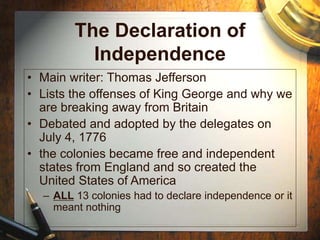
The Declaration of
Independence
• Main writer: Thomas Jefferson
• Lists the offenses of King George and why we
are breaking away from Britain
• Debated and adopted by the delegates on
July 4, 1776
• the colonies became free and independent
states from England and so created the
United States of America
– ALL 13 colonies had to declare independence or it
meant nothing
The Articles of
Confederation
• The Continental Congress wasn’t based
on any law; our gov’t needed a law to
run the country and manage the states
• The Articles of Confederation were our
first “rough draft” government
– Formed a “league of friendship” between
the states
Gov’t Setup Under the
Articles
• Each state kept its own power, but they
would join with other states for the good
of the country
• the national government = a unicameral
Congress with state delegates
– Congress made all the nation’s decisions,
even enforced laws and judged them
Powers of Congress
Under the Articles
• Could declare war and make peace
• Make treaties
• Borrow money
• Set up a money system
• Raise an army by asking for volunteers from
the states
• Settle fights between the states
Weaknesses of the Gov’t
Under the Articles
• Did not have the power to tax (had to ask
states for money or borrow it)
• Couldn’t control trade between the states
• Couldn’t make the states obey the Articles
• 9 out of 13 states had to agree on anything
the gov’t did
Problems with the States
• The states grew jealous of each other
and began fighting
• taxed each other’s goods and banned
trade with certain states
• made foreign alliances
• Each state acted like a little country
Shays’ Rebellion
• Because the economy was bad, farmers
lost their land because they couldn’t pay
taxes
• Rebellions in Massachusetts to shut
down courts and free debtors
• Daniel Shays leads a mob to attack an
arsenal and get guns
• Becomes clear that the government is
not prepared to put down rebellions
The Constitutional
Convention (1787)
• We needed a better system of gov’t --
the Articles of Confederation were too
weak
• They originally met to fix the Articles
• 55 delegates from 12 states attended
• These men were known as the Framers
(they “built” the Constitution)
Organization of the
Convention
• George Washington was elected
president of the Convention
• 1.) A majority vote was needed to
decide issues
• 2.) Each state got one vote
• 3.) The meetings were done in secrecy
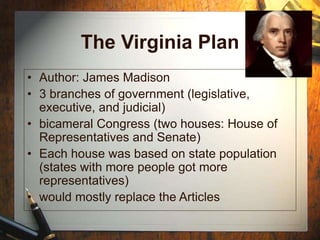
The Virginia Plan
• Author: James Madison
• 3 branches of government (legislative,
executive, and judicial)
• bicameral Congress (two houses: House of
Representatives and Senate)
• Each house was based on state population
(states with more people got more
representatives)
• would mostly replace the Articles
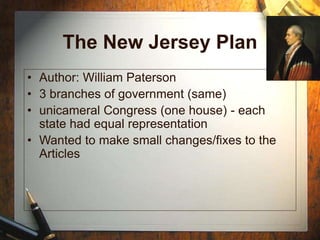
The New Jersey Plan
• Author: William Paterson
• 3 branches of government (same)
• unicameral Congress (one house) - each
state had equal representation
• Wanted to make small changes/fixes to the
Articles
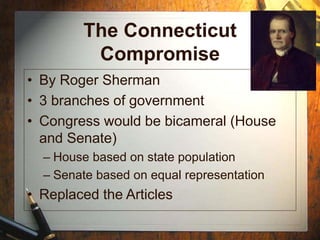
The Connecticut
Compromise
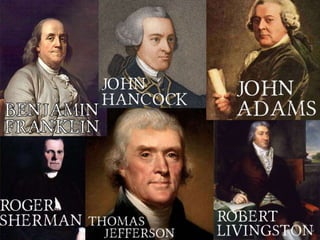
• By Roger Sherman
• 3 branches of government
• Congress would be bicameral (House
and Senate)
– House based on state population
– Senate based on equal representation
• Replaced the Articles
3/5 Compromise
• The South wanted to count their slaves
as their population, but slaves were
considered property
• Compromise: For every five slaves,
three counted as people
Commerce and Slave
Trade Compromise
• (The South is afraid the North will
interfere with their trade)
• Congress cannot tax state exports
(goods shipped out)
• Could not interfere with the slave trade
for 20 years
A Constitution is Born
• September 17, 1787: Constitution
signed in its final form
• Now it’s up to the states to approve it
Ratifying the
Constitution
• Ratification - to pass, approve
• The Constitution couldn’t go into effect
until the states ratified it
• Led to debate between two groups: the
Federalists and the Anti-Federalists
(became like our first political parties)
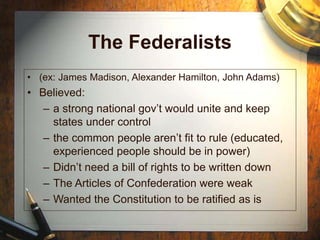
The Federalists
• (ex: James Madison, Alexander Hamilton, John Adams)
• Believed:
– a strong national gov’t would unite and keep
states under control
– the common people aren’t fit to rule (educated,
experienced people should be in power)
– Didn’t need a bill of rights to be written down
– The Articles of Confederation were weak
– Wanted the Constitution to be ratified as is
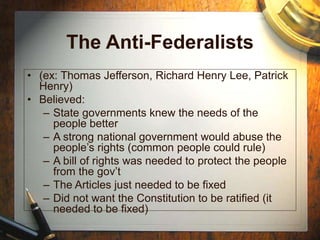
The Anti-Federalists
• (ex: Thomas Jefferson, Richard Henry Lee, Patrick
Henry)
• Believed:
– State governments knew the needs of the
people better
– A strong national government would abuse the
people’s rights (common people could rule)
– A bill of rights was needed to protect the people
from the gov’t
– The Articles just needed to be fixed
– Did not want the Constitution to be ratified (it
needed to be fixed)
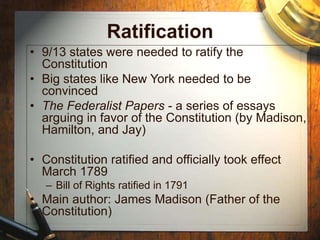
Ratification
• 9/13 states were needed to ratify the
Constitution
• Big states like New York needed to be
convinced
• The Federalist Papers - a series of essays
arguing in favor of the Constitution (by Madison,
Hamilton, and Jay)
• Constitution ratified and officially took effect
March 1789
– Bill of Rights ratified in 1791
• Main author: James Madison (Father of the
Constitution)
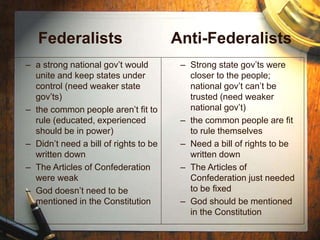
Federalists Anti-Federalists
– a strong national gov’t would
unite and keep states under
control (need weaker state
gov’ts)
– the common people aren’t fit to
rule (educated, experienced
should be in power)
– Didn’t need a bill of rights to be
written down
– The Articles of Confederation
were weak
– God doesn’t need to be
mentioned in the Constitution
– Strong state gov’ts were
closer to the people;
national gov’t can’t be
trusted (need weaker
national gov’t)
– the common people are fit
to rule themselves
– Need a bill of rights to be
written down
– The Articles of
Confederation just needed
to be fixed
– God should be mentioned
in the Constitution
Ch. 2 Quiz
• royal colony
• proprietary colony
• charter colony
• delegate
• Framers
• bicameral
• unicameral
• ratify
• boycott
• charter
Ch. 2 Political Cartoons
• Interpret the cartoon:
Write 3-5 sentences about what is going
on in the cartoon, why it is drawn the
way it is, and what message the artist is
trying to send.

Declaration to Constitution

  • 1.
    The First ContinentalCongress (1774) • Delegates (representatives) from 12 colonies met in Philadelphia to discuss problems with Britain • Sent a Declaration of Rights to complain to King George III about his administration’s policies • Colonists wanted the taxes and regulations repealed (taken back, cancelled)
  • 3.
    *Second Continental Congress* (1775-1776) •All 13 colonies sent delegates to Philadelphia --> became our first national government • Britain would not repeal their policies or compromise (made laws harsher) = time for colonies to declare independence!
  • 4.
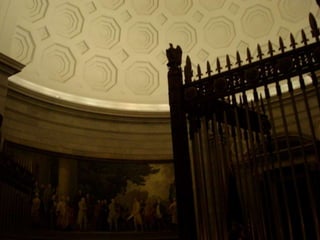
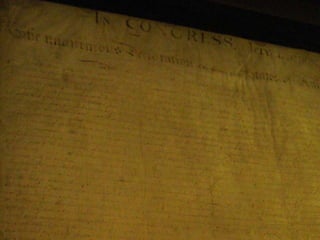
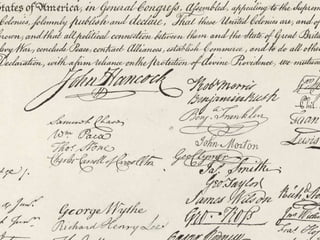
    The Declaration of Independence •Main writer: Thomas Jefferson • Lists the offenses of King George and why we are breaking away from Britain • Debated and adopted by the delegates on July 4, 1776 • the colonies became free and independent states from England and so created the United States of America – ALL 13 colonies had to declare independence or it meant nothing
  • 10.
    The Articles of Confederation •The Continental Congress wasn’t based on any law; our gov’t needed a law to run the country and manage the states • The Articles of Confederation were our first “rough draft” government – Formed a “league of friendship” between the states
  • 11.
    Gov’t Setup Underthe Articles • Each state kept its own power, but they would join with other states for the good of the country • the national government = a unicameral Congress with state delegates – Congress made all the nation’s decisions, even enforced laws and judged them
  • 12.
    Powers of Congress Underthe Articles • Could declare war and make peace • Make treaties • Borrow money • Set up a money system • Raise an army by asking for volunteers from the states • Settle fights between the states
  • 13.
    Weaknesses of theGov’t Under the Articles • Did not have the power to tax (had to ask states for money or borrow it) • Couldn’t control trade between the states • Couldn’t make the states obey the Articles • 9 out of 13 states had to agree on anything the gov’t did
  • 14.
    Problems with theStates • The states grew jealous of each other and began fighting • taxed each other’s goods and banned trade with certain states • made foreign alliances • Each state acted like a little country
  • 15.
    Shays’ Rebellion • Becausethe economy was bad, farmers lost their land because they couldn’t pay taxes • Rebellions in Massachusetts to shut down courts and free debtors • Daniel Shays leads a mob to attack an arsenal and get guns • Becomes clear that the government is not prepared to put down rebellions
  • 16.
    The Constitutional Convention (1787) •We needed a better system of gov’t -- the Articles of Confederation were too weak • They originally met to fix the Articles • 55 delegates from 12 states attended • These men were known as the Framers (they “built” the Constitution)
  • 17.
    Organization of the Convention •George Washington was elected president of the Convention • 1.) A majority vote was needed to decide issues • 2.) Each state got one vote • 3.) The meetings were done in secrecy
  • 18.
    The Virginia Plan •Author: James Madison • 3 branches of government (legislative, executive, and judicial) • bicameral Congress (two houses: House of Representatives and Senate) • Each house was based on state population (states with more people got more representatives) • would mostly replace the Articles
  • 19.
    The New JerseyPlan • Author: William Paterson • 3 branches of government (same) • unicameral Congress (one house) - each state had equal representation • Wanted to make small changes/fixes to the Articles
  • 20.
    The Connecticut Compromise • ByRoger Sherman • 3 branches of government • Congress would be bicameral (House and Senate) – House based on state population – Senate based on equal representation • Replaced the Articles
  • 21.
    3/5 Compromise • TheSouth wanted to count their slaves as their population, but slaves were considered property • Compromise: For every five slaves, three counted as people
  • 22.
    Commerce and Slave TradeCompromise • (The South is afraid the North will interfere with their trade) • Congress cannot tax state exports (goods shipped out) • Could not interfere with the slave trade for 20 years
  • 23.
    A Constitution isBorn • September 17, 1787: Constitution signed in its final form • Now it’s up to the states to approve it
  • 24.
    Ratifying the Constitution • Ratification- to pass, approve • The Constitution couldn’t go into effect until the states ratified it • Led to debate between two groups: the Federalists and the Anti-Federalists (became like our first political parties)
  • 25.
    The Federalists • (ex:James Madison, Alexander Hamilton, John Adams) • Believed: – a strong national gov’t would unite and keep states under control – the common people aren’t fit to rule (educated, experienced people should be in power) – Didn’t need a bill of rights to be written down – The Articles of Confederation were weak – Wanted the Constitution to be ratified as is
  • 26.
    The Anti-Federalists • (ex:Thomas Jefferson, Richard Henry Lee, Patrick Henry) • Believed: – State governments knew the needs of the people better – A strong national government would abuse the people’s rights (common people could rule) – A bill of rights was needed to protect the people from the gov’t – The Articles just needed to be fixed – Did not want the Constitution to be ratified (it needed to be fixed)
  • 27.
    Ratification • 9/13 stateswere needed to ratify the Constitution • Big states like New York needed to be convinced • The Federalist Papers - a series of essays arguing in favor of the Constitution (by Madison, Hamilton, and Jay) • Constitution ratified and officially took effect March 1789 – Bill of Rights ratified in 1791 • Main author: James Madison (Father of the Constitution)
  • 28.
    Federalists Anti-Federalists – astrong national gov’t would unite and keep states under control (need weaker state gov’ts) – the common people aren’t fit to rule (educated, experienced should be in power) – Didn’t need a bill of rights to be written down – The Articles of Confederation were weak – God doesn’t need to be mentioned in the Constitution – Strong state gov’ts were closer to the people; national gov’t can’t be trusted (need weaker national gov’t) – the common people are fit to rule themselves – Need a bill of rights to be written down – The Articles of Confederation just needed to be fixed – God should be mentioned in the Constitution
  • 29.
    Ch. 2 Quiz •royal colony • proprietary colony • charter colony • delegate • Framers • bicameral • unicameral • ratify • boycott • charter
  • 30.
    Ch. 2 PoliticalCartoons • Interpret the cartoon: Write 3-5 sentences about what is going on in the cartoon, why it is drawn the way it is, and what message the artist is trying to send.