The Constitution Ch. 2 Prof. Ivy A.M. Cargile Thursday 2/5/2009 7p-9:50p
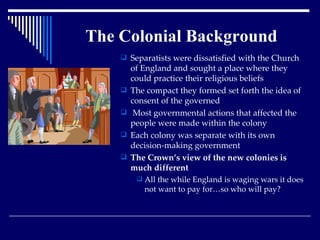
The Colonial Background Separatists were dissatisfied with the Church of England and sought a place where they could practice their religious beliefs The compact they formed set forth the idea of consent of the governed  Most governmental actions that affected the people were made within the colony Each colony was separate with its own decision-making government The Crown’s view of the new colonies is much different All the while England is waging wars it does not want to pay for…so who will pay?
Continental Congresses…Reactions to The Crown taking Rights Away   First Continental Congress The focus was to restore the political structure that was in existence before the passage of  legislation affecting the internal operations of each colony by Parliament If the Crown & Parliament gave in to some or all of their demands it is possible the Declaration of Independence would not have been issued Olive Branch Petition  – goal was to avert fighting but this goal failed! Second Continental Congress (1775) Established an army Made Washington the general in chief and pursued the Revolutionary War
The Declaration of Independence (1776) Natural  Rights Natural rights: life, liberty, and the pursuit of happiness Social Contract – John Locke, Montesquieu, etc… Based on the idea of consent of the governed, and that governments had the responsibility to protect the natural rights of its citizens. If the government failed to do so, the people had the right to revolt.
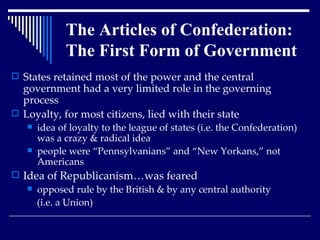
States retained most of the power and the central government had a very limited role in the governing process Loyalty, for most citizens, lied with their state idea of loyalty to the league of states (i.e. the Confederation) was a crazy & radical idea people were “Pennsylvanians” and “New Yorkans,” not Americans Idea of Republicanism…was feared opposed rule by the British & by any central authority  (i.e. a Union) The Articles of Confederation:  The First Form of Government
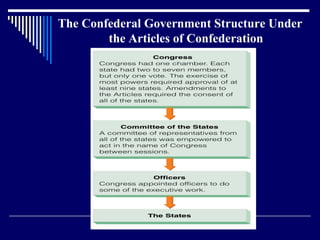
The Confederal Government Structure Under the Articles of Confederation
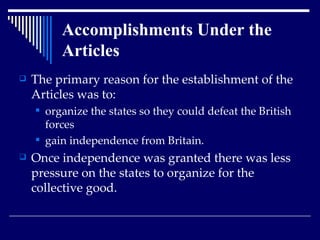
The primary reason for the establishment of the Articles was to: organize the states so they could defeat the British forces  gain independence from Britain.  Once independence was granted there was less pressure on the states to organize for the collective good. Accomplishments Under the Articles
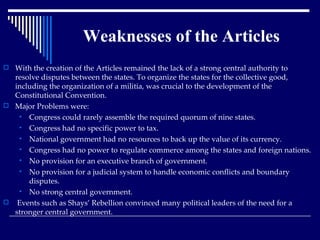
With the creation of the Articles remained the lack of a strong central authority to resolve disputes between the states. To organize the states for the collective good, including the organization of a militia, was crucial to the development of the Constitutional Convention. Major Problems were: Congress could rarely assemble the required quorum of nine states.  Congress had no specific power to tax.  National government had no resources to back up the value of its currency.  Congress had no power to regulate commerce among the states and foreign nations.  No provision for an executive branch of government. No provision for a judicial system to handle economic conflicts and boundary disputes.  No strong central government. Events such as Shays’ Rebellion convinced many political leaders of the need for a stronger central government. Weaknesses of the Articles
Republicans opposed any centralization of power Also known as  The Anti-Federalists Federalists favored a stronger government; but there was no agreement among them about which structure and division of power for this new government would work best The beliefs of the delegates ranged from the near-monarchism of Hamilton to definite decentralized republicanism. Some of these last people left when they saw the federalist tenor of the proceedings Framers of the Constitution
Politicking and Compromises: The Virginia & New Jersey Plans Two Plans Emerge: The Virginia Plan Concentrated power in a lower house that was to choose the executive Major weakness: representation was strictly by population, to the disadvantage of the small states The New Jersey Plan A one-state, one-vote plan that would have created a relatively weak central government.  Again, the executive was to be elected by Congress
Politicking and Compromises:  The Great Compromise Compromise between more populous states, which advocated representation based on population and the small states, which advocated representation equal for each state  Also known as the Connecticut Plan, this provided for:  a bicameral legislature with one house based on population and the other house based on equal representation for each state In this plan, Congress did  not  choose the president.
Politicking and Compromises:  The 3/5ths Compromise   (Politics makes for Strange Bed-Buddies) Northern states wanted to ban the importation of slaves, while Southern states did not.  Southern states wanted slaves counted in the population for the purposes of determining the number of members each state sent to the House of Representatives.  The  Three-Fifths Compromise  provided that 3/5 of the slaves would be counted (or each slave would count as 3/5 of a person.)
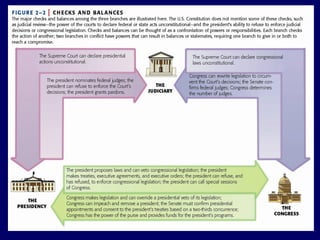
Working Toward the Final    Agreement The Madisonian Model Separation of Powers  - t he legislative, executive, and judicial powers to be independent of each other Checks and Balances  -  government had considerably more power than under the Articles of Confederation  Electoral College  - meant that the president was not to be chosen by Congress, but not by a popular vote either
 
The Final Document A summary of the results:  popular sovereignty  a republican government a limited government - separation of powers, and checks and balances a federal system where both the national and the state governments each had their own sphere of influence
Ratification Defense necessary because there’s fear that: It’s too much like a monarchy Judges have too much power Who votes? Protection of personal liberties The Federalist Papers   An attempt to persuade the public to support the new form of government.  Federalist #10  and  Federalist #51  provide an excellent view of James Madison’s political theory concerning human nature
Support for the New Constitution Beard’s Thesis  - Historian Charles Beard argued that the  Constitution was put through by an undemocratic elite  intent on the protection of property. State Ratifying Conventions -  These conventions were  elected by a strikingly small part of the total population. Support Was Probably Widespread -  Still, the defense of  property was a value that was by no means limited to the  elite. The belief that the government under the Articles  was dangerously weak was widespread.
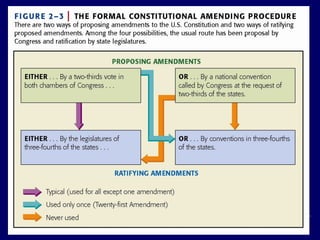
The Bill of Rights (Bill of Limits?) No explicit limits on state government powers So, it did not apply to state governments Although 11,000 amendments have been considered by Congress, only 33 have been submitted to the states after being approved, and only 27 have been ratified since 1789 Methods to amend the Constitution: By two-thirds vote in both houses of Congress (and then three-fourths of the state legislatures) By national constitutional convention called by Congress at the request of the state legislatures Method to ratify: By legislatures in three-fourths of the states By conventions in three-fourths of the states
 
Informal Methods of Constitutional Change Congressional Legislation Presidential Action  Judicial Review Interpretation, Custom, and Usage
Federalist # 1 Why the Constitution should be ratified Strong national government will curb despotism Demagogues vs. Tyrants Citizenry should want to defend their liberty, dignity and happiness Purpose behind writing a defense for the new Constitution Federalist papers will defend the positions of : The importance of a Union under the new Constitution to ensure political prosperity The connection between the new Constitution and the principles of a republican democracy How the new Constitution will work to preserve the government, liberty and property

Ch. 2 The Constitution

  • 1.
    The Constitution Ch.2 Prof. Ivy A.M. Cargile Thursday 2/5/2009 7p-9:50p
  • 2.
    The Colonial BackgroundSeparatists were dissatisfied with the Church of England and sought a place where they could practice their religious beliefs The compact they formed set forth the idea of consent of the governed Most governmental actions that affected the people were made within the colony Each colony was separate with its own decision-making government The Crown’s view of the new colonies is much different All the while England is waging wars it does not want to pay for…so who will pay?
  • 3.
    Continental Congresses…Reactions toThe Crown taking Rights Away First Continental Congress The focus was to restore the political structure that was in existence before the passage of legislation affecting the internal operations of each colony by Parliament If the Crown & Parliament gave in to some or all of their demands it is possible the Declaration of Independence would not have been issued Olive Branch Petition – goal was to avert fighting but this goal failed! Second Continental Congress (1775) Established an army Made Washington the general in chief and pursued the Revolutionary War
  • 4.
    The Declaration ofIndependence (1776) Natural Rights Natural rights: life, liberty, and the pursuit of happiness Social Contract – John Locke, Montesquieu, etc… Based on the idea of consent of the governed, and that governments had the responsibility to protect the natural rights of its citizens. If the government failed to do so, the people had the right to revolt.
  • 5.
    States retained mostof the power and the central government had a very limited role in the governing process Loyalty, for most citizens, lied with their state idea of loyalty to the league of states (i.e. the Confederation) was a crazy & radical idea people were “Pennsylvanians” and “New Yorkans,” not Americans Idea of Republicanism…was feared opposed rule by the British & by any central authority (i.e. a Union) The Articles of Confederation: The First Form of Government
  • 6.
    The Confederal GovernmentStructure Under the Articles of Confederation
  • 7.
    The primary reasonfor the establishment of the Articles was to: organize the states so they could defeat the British forces gain independence from Britain. Once independence was granted there was less pressure on the states to organize for the collective good. Accomplishments Under the Articles
  • 8.
    With the creationof the Articles remained the lack of a strong central authority to resolve disputes between the states. To organize the states for the collective good, including the organization of a militia, was crucial to the development of the Constitutional Convention. Major Problems were: Congress could rarely assemble the required quorum of nine states. Congress had no specific power to tax. National government had no resources to back up the value of its currency. Congress had no power to regulate commerce among the states and foreign nations. No provision for an executive branch of government. No provision for a judicial system to handle economic conflicts and boundary disputes. No strong central government. Events such as Shays’ Rebellion convinced many political leaders of the need for a stronger central government. Weaknesses of the Articles
  • 9.
    Republicans opposed anycentralization of power Also known as The Anti-Federalists Federalists favored a stronger government; but there was no agreement among them about which structure and division of power for this new government would work best The beliefs of the delegates ranged from the near-monarchism of Hamilton to definite decentralized republicanism. Some of these last people left when they saw the federalist tenor of the proceedings Framers of the Constitution
  • 10.
    Politicking and Compromises:The Virginia & New Jersey Plans Two Plans Emerge: The Virginia Plan Concentrated power in a lower house that was to choose the executive Major weakness: representation was strictly by population, to the disadvantage of the small states The New Jersey Plan A one-state, one-vote plan that would have created a relatively weak central government. Again, the executive was to be elected by Congress
  • 11.
    Politicking and Compromises: The Great Compromise Compromise between more populous states, which advocated representation based on population and the small states, which advocated representation equal for each state Also known as the Connecticut Plan, this provided for: a bicameral legislature with one house based on population and the other house based on equal representation for each state In this plan, Congress did not choose the president.
  • 12.
    Politicking and Compromises: The 3/5ths Compromise (Politics makes for Strange Bed-Buddies) Northern states wanted to ban the importation of slaves, while Southern states did not. Southern states wanted slaves counted in the population for the purposes of determining the number of members each state sent to the House of Representatives. The Three-Fifths Compromise provided that 3/5 of the slaves would be counted (or each slave would count as 3/5 of a person.)
  • 13.
    Working Toward theFinal Agreement The Madisonian Model Separation of Powers - t he legislative, executive, and judicial powers to be independent of each other Checks and Balances - government had considerably more power than under the Articles of Confederation Electoral College - meant that the president was not to be chosen by Congress, but not by a popular vote either
  • 14.
  • 15.
    The Final DocumentA summary of the results: popular sovereignty a republican government a limited government - separation of powers, and checks and balances a federal system where both the national and the state governments each had their own sphere of influence
  • 16.
    Ratification Defense necessarybecause there’s fear that: It’s too much like a monarchy Judges have too much power Who votes? Protection of personal liberties The Federalist Papers An attempt to persuade the public to support the new form of government. Federalist #10 and Federalist #51 provide an excellent view of James Madison’s political theory concerning human nature
  • 17.
    Support for theNew Constitution Beard’s Thesis - Historian Charles Beard argued that the Constitution was put through by an undemocratic elite intent on the protection of property. State Ratifying Conventions - These conventions were elected by a strikingly small part of the total population. Support Was Probably Widespread - Still, the defense of property was a value that was by no means limited to the elite. The belief that the government under the Articles was dangerously weak was widespread.
  • 18.
    The Bill ofRights (Bill of Limits?) No explicit limits on state government powers So, it did not apply to state governments Although 11,000 amendments have been considered by Congress, only 33 have been submitted to the states after being approved, and only 27 have been ratified since 1789 Methods to amend the Constitution: By two-thirds vote in both houses of Congress (and then three-fourths of the state legislatures) By national constitutional convention called by Congress at the request of the state legislatures Method to ratify: By legislatures in three-fourths of the states By conventions in three-fourths of the states
  • 19.
  • 20.
    Informal Methods ofConstitutional Change Congressional Legislation Presidential Action Judicial Review Interpretation, Custom, and Usage
  • 21.
    Federalist # 1Why the Constitution should be ratified Strong national government will curb despotism Demagogues vs. Tyrants Citizenry should want to defend their liberty, dignity and happiness Purpose behind writing a defense for the new Constitution Federalist papers will defend the positions of : The importance of a Union under the new Constitution to ensure political prosperity The connection between the new Constitution and the principles of a republican democracy How the new Constitution will work to preserve the government, liberty and property