Chapter 1 – The Struggle for Texas:
Demographics, Culture, and Political Power
1
Chapter 1: The Struggle for Texas
Learning Objectives
1.1 Describe the settlement history of Texas.
1.2 Assess the impact industries have made to the Texas
economy from 1860 to today.
1.3 Analyze how the changing demographics of the state
affect government.
1.4 Examine the source and impact of political culture in
Texas.
2
The Origins of Texas
Native Americans
• Native Americans occupied the lands of Texas more
than 10,000 years before the arrival of Europeans.
• Tribes in North America competed for land, pushing
each other into new territory and eventually settling
in lands throughout Texas.
The Origins of Texas
Native Americans
• Native Americans occupied the lands of Texas more
than 10,000 years before the arrival of Europeans.
• Tribes in North America competed for land, pushing
each other into new territory and eventually settling
in lands throughout Texas.
The Origins of Texas
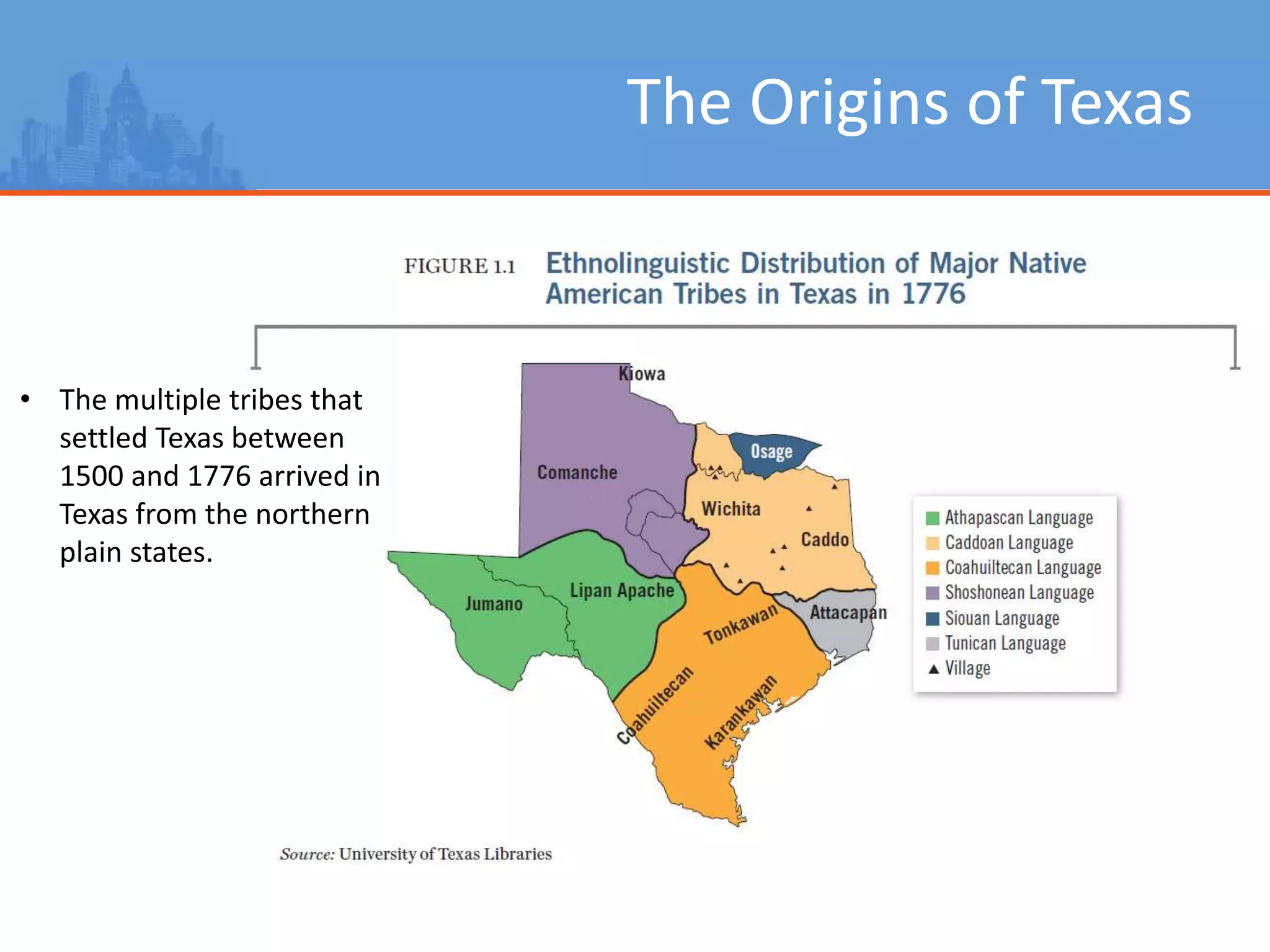
• The multiple tribes that
settled Texas between
1500 and 1776 arrived in
Texas from the northern
plain states.
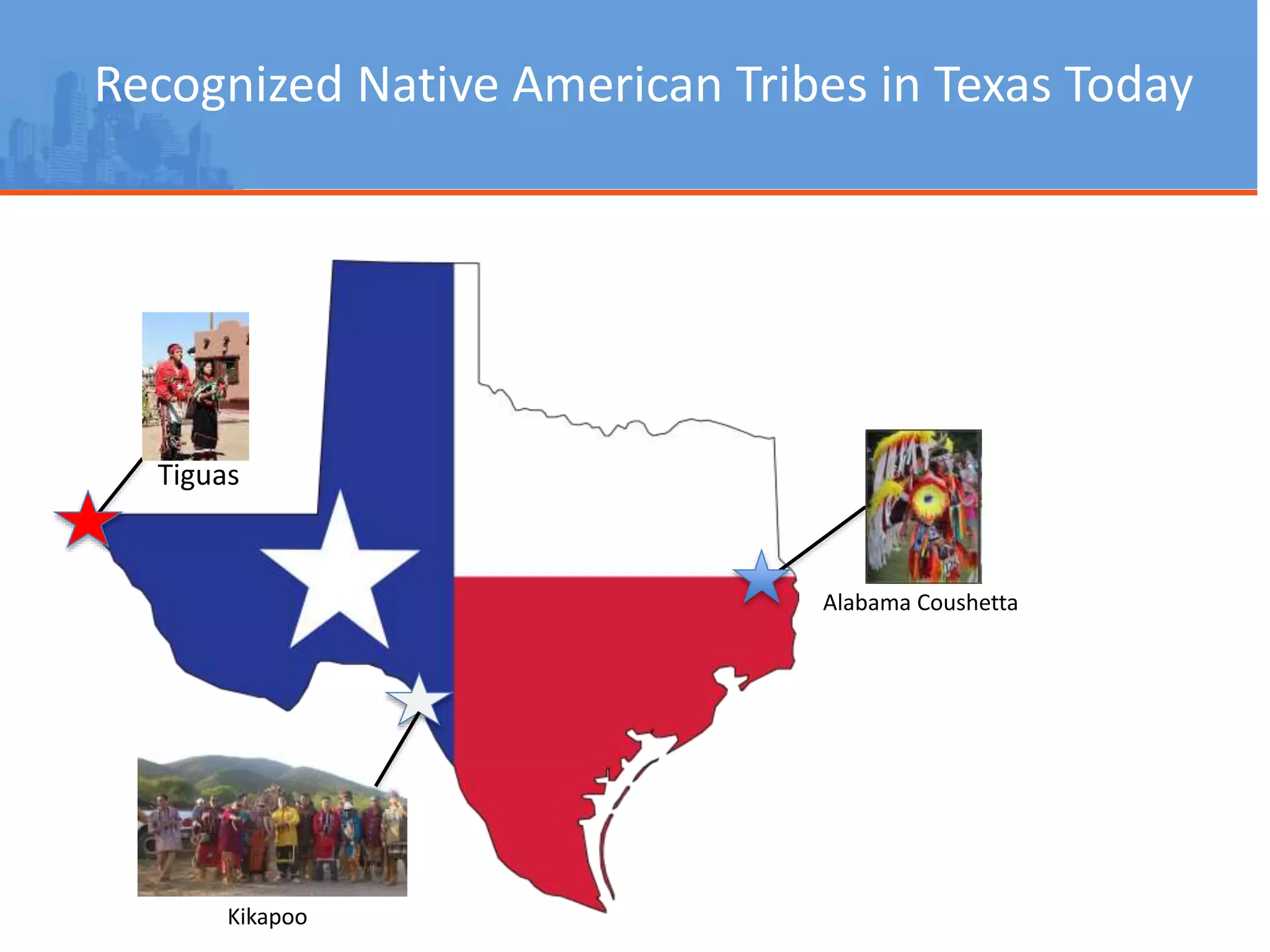
Recognized Native American Tribes in Texas Today
Tiguas
Alabama Coushetta
Kikapoo
The Origins of Texas
Spanish Settlers
• The name Texas derives from a Cado Indian word that
means “friendly” or “ally,” the term attributed to native
populations by Spanish explorers.
• In the 1530s and 1540s, Spanish explorers first
penetrated coastal, northern, and eastern Texas.
• Over the next two centuries, the Spanish established
missions and military outposts.
The Origins of Texas
Spanish Settlers
• Expansion into Texas protected the interior of New
Spain
• “Glory, God and Gold” summarized the Spanish
colonists’ approach to settlement
• Spain increased taxes on the colonies to pay debts
which prompted a revolutionary movement
• New Spain, United Mexican States, won independence
in 1821
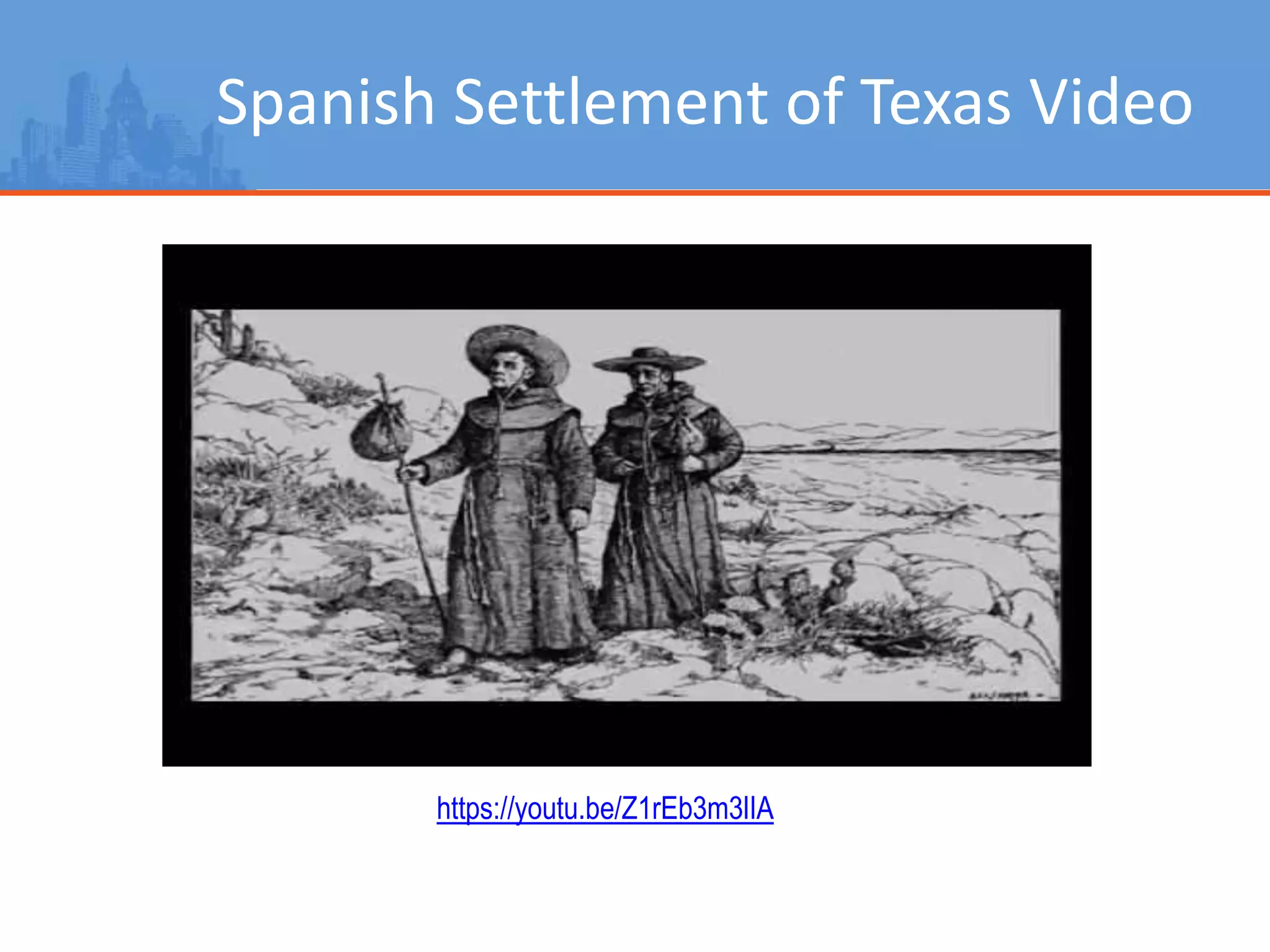
Spanish Settlement of Texas Video
https://youtu.be/Z1rEb3m3lIA
The Origins of Texas
Tejanos
• Tejanos primarily worked in and around the ranching
communities of the region that had sprung up near military
outposts along the northern frontier of Mexico.
• Transformed settler life from agrarian to ranching
• Like the Anglos who were immigrating to Texas during this
time, Tejanos resisted centralized authority and embraced
the idea of local self governance.
• Shaped local laws before the revolution, planed the seeds of
Texas independence
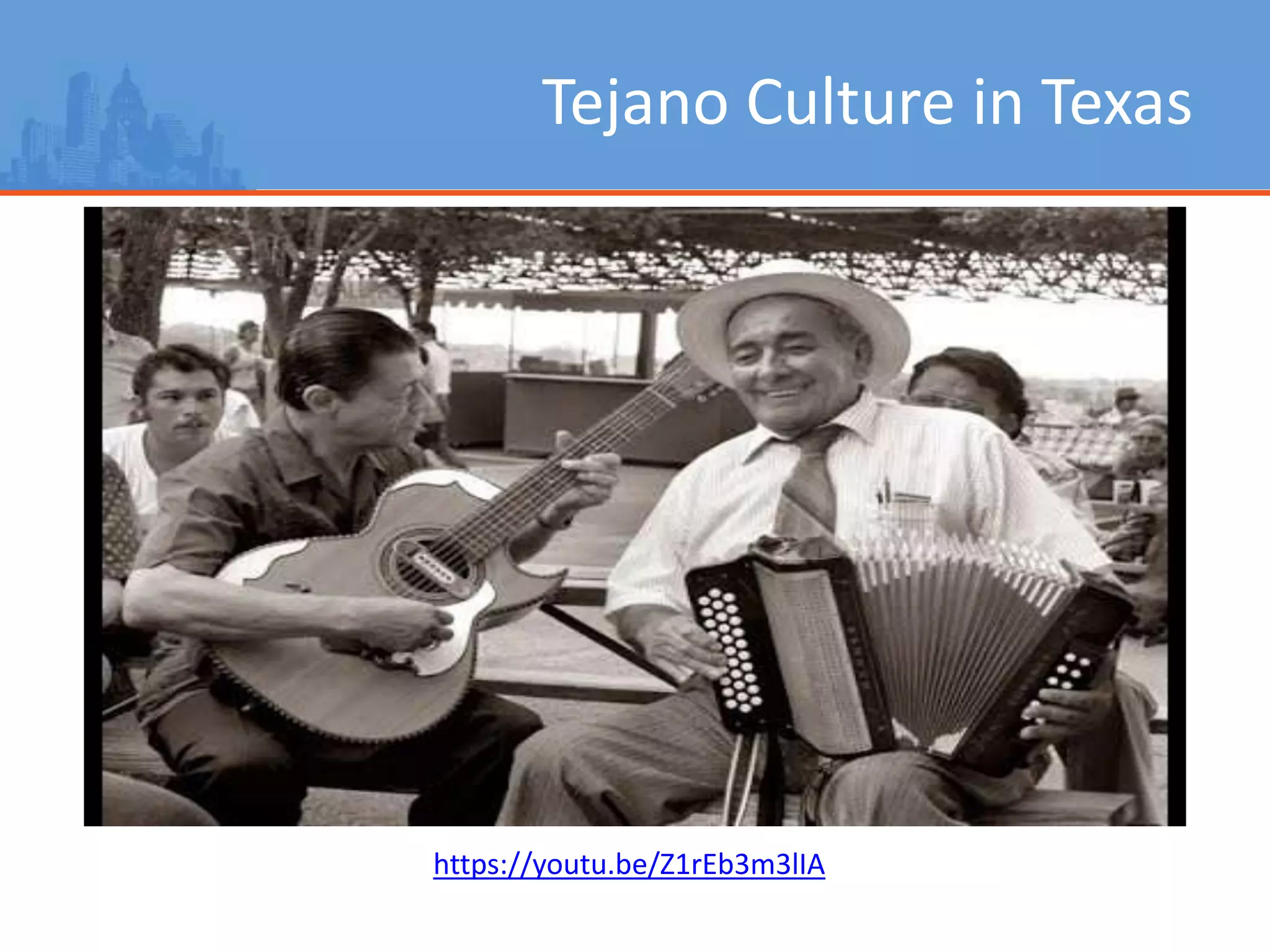
Tejano Culture in Texas
https://youtu.be/Z1rEb3m3lIA
The Origins of Texas
Anglos
• Mexico used Texas as a source of economic revenue
• Land-hungry United States threatened Spanish control
• 1820s Mexico aggressively promoted Anglo settlement in
Texas
• Empresarios: individuals granted the right to help settle a
new land and recruit new settlers
• Laws in 1830 stopped further immigration into Texas
spurred Anglo illegal immigration
Moses Austin and the Texas Venture
https://youtu.be/BY7g3Eim0ww
The Origins of Texas
African Americans
• By 1823, Mexico had banned slavery, but beginning in
1829, Anglo settlers brought African American slaves
with them under the guise of “contract labor.”
• By 1847, after Texas gained her independence and
subsequently joined the U.S., the number of slaves
was around 38,753.
The Origins of Texas
African Americans
• Before the Civil War, African Americans faced harsh
slave codes
• Civil War and Reconstruction brought the promise of
freedom, but “Black Codes” restricted access and
relegated African Americans to work as agricultural
laborers
• 1890s most African Americans worked as tenant
farmers on former plantations
• African Americans established “freedmantowns” on
the outskirts of major cities
The Origins of Texas
African Americans
• Before the Civil War, African Americans faced harsh
slave codes
• Civil War and Reconstruction brought the promise of
freedom, but “Black Codes” restricted access and
relegated African Americans to work as agricultural
laborers
• 1890s most African Americans worked as tenant
farmers on former plantations
• African Americans established “freedmantowns” on
the outskirts of major cities
African American History - Video
https://youtu.be/zQiJ95GhFhk
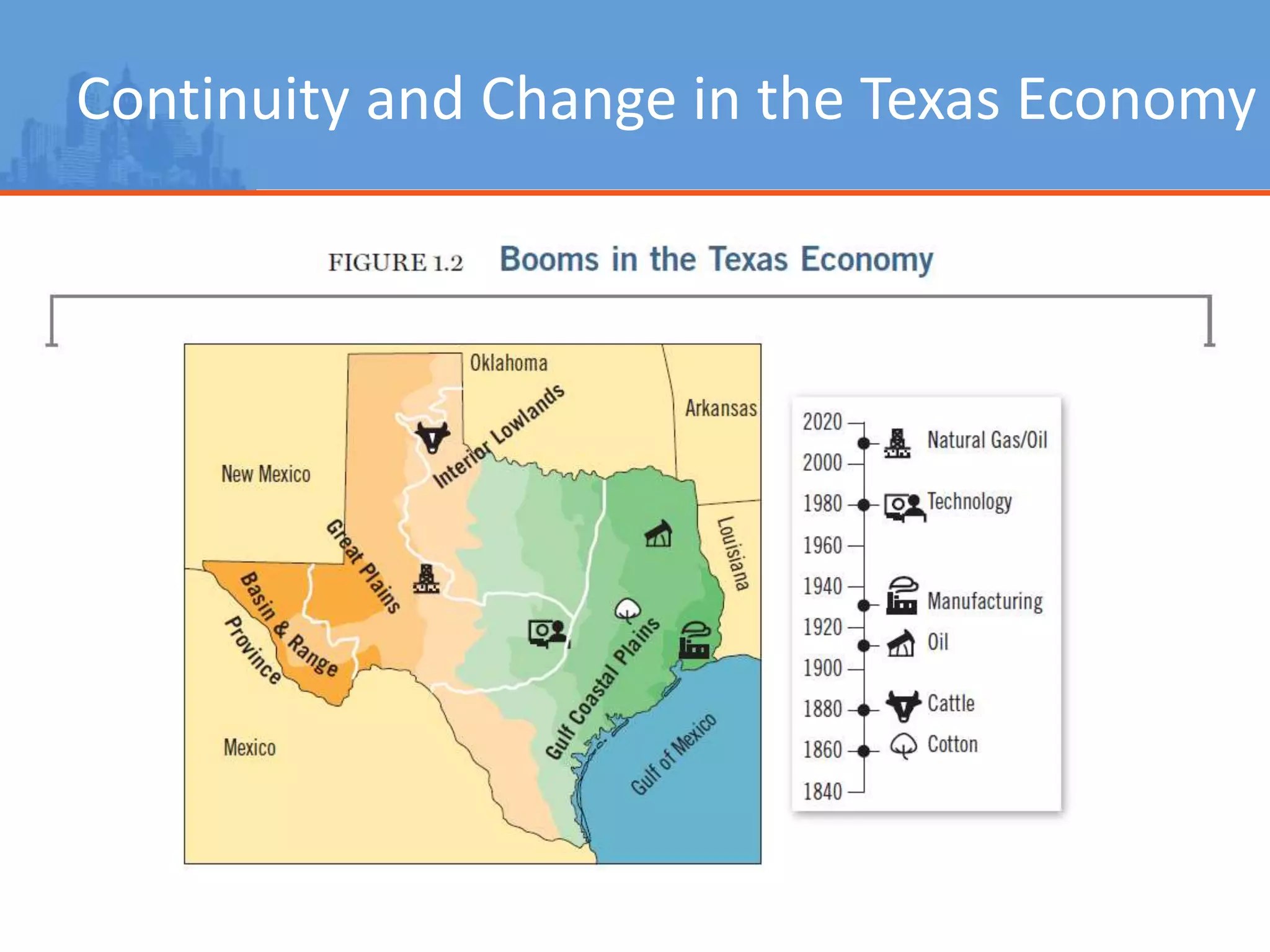
Continuity and Change in the Texas Economy
• Texas as an independent nation would rank tenth in the
world
• Home to six of the top fifty companies on the Fortune
500 list
• Gross state product is second highest in the United
States
• Economy relies on a mix of agriculture and ranching, oil
and natural gas, military and defense, information
technology, electric power and manufacturing
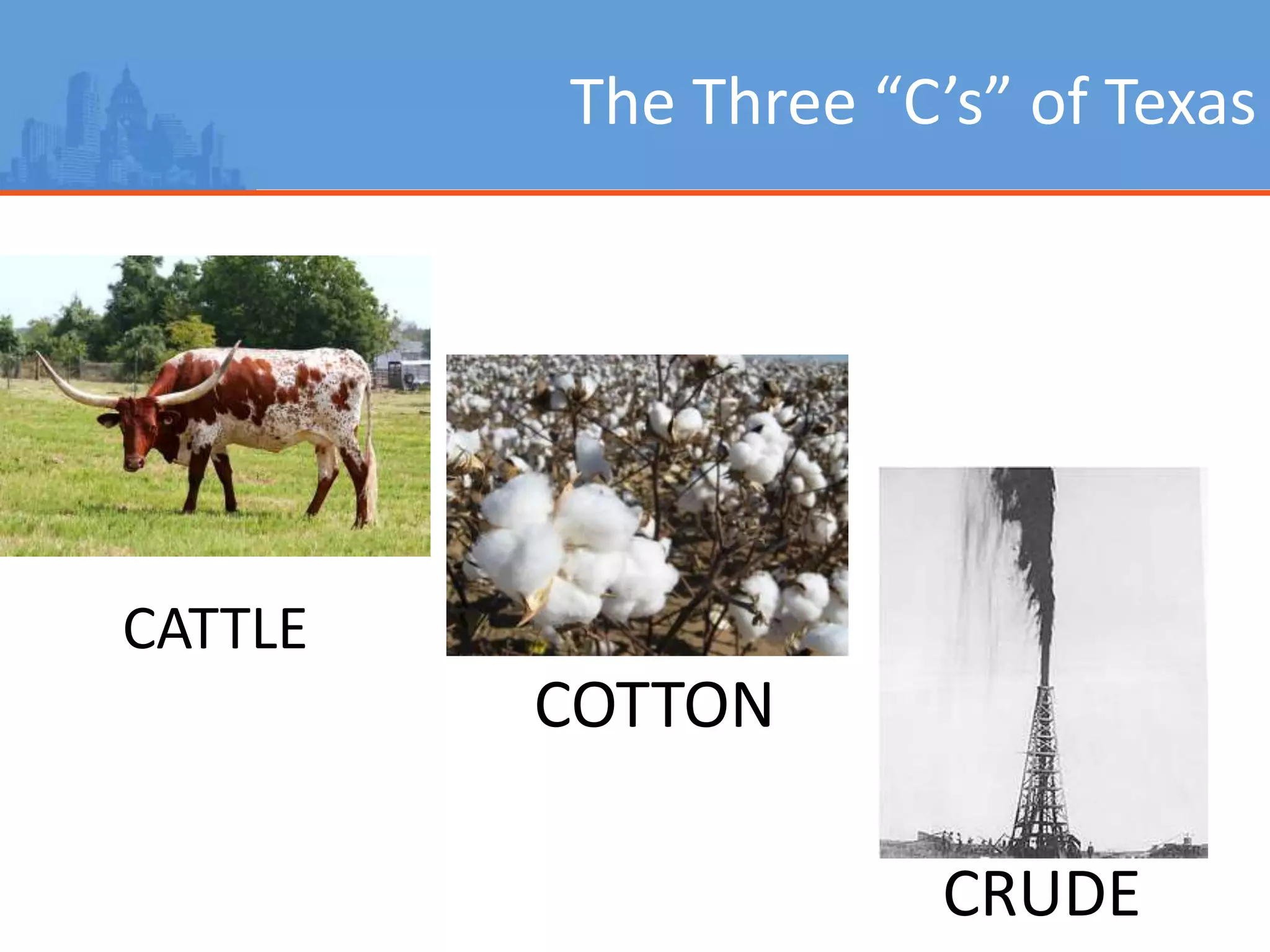
The Three “C’s” of Texas
CATTLE
COTTON
CRUDE
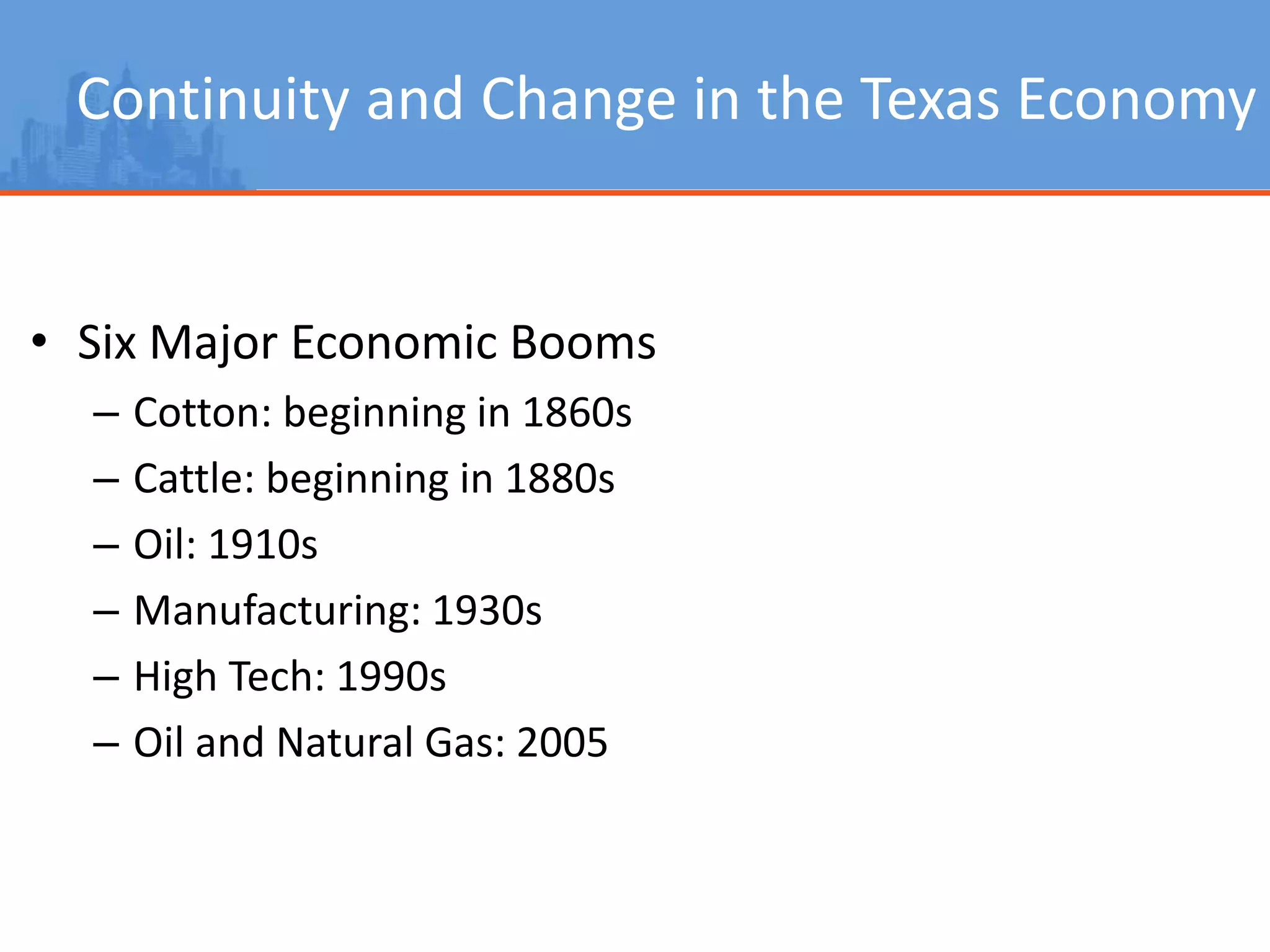
Continuity and Change in the Texas Economy
• Six Major Economic Booms
– Cotton: beginning in 1860s
– Cattle: beginning in 1880s
– Oil: 1910s
– Manufacturing: 1930s
– High Tech: 1990s
– Oil and Natural Gas: 2005
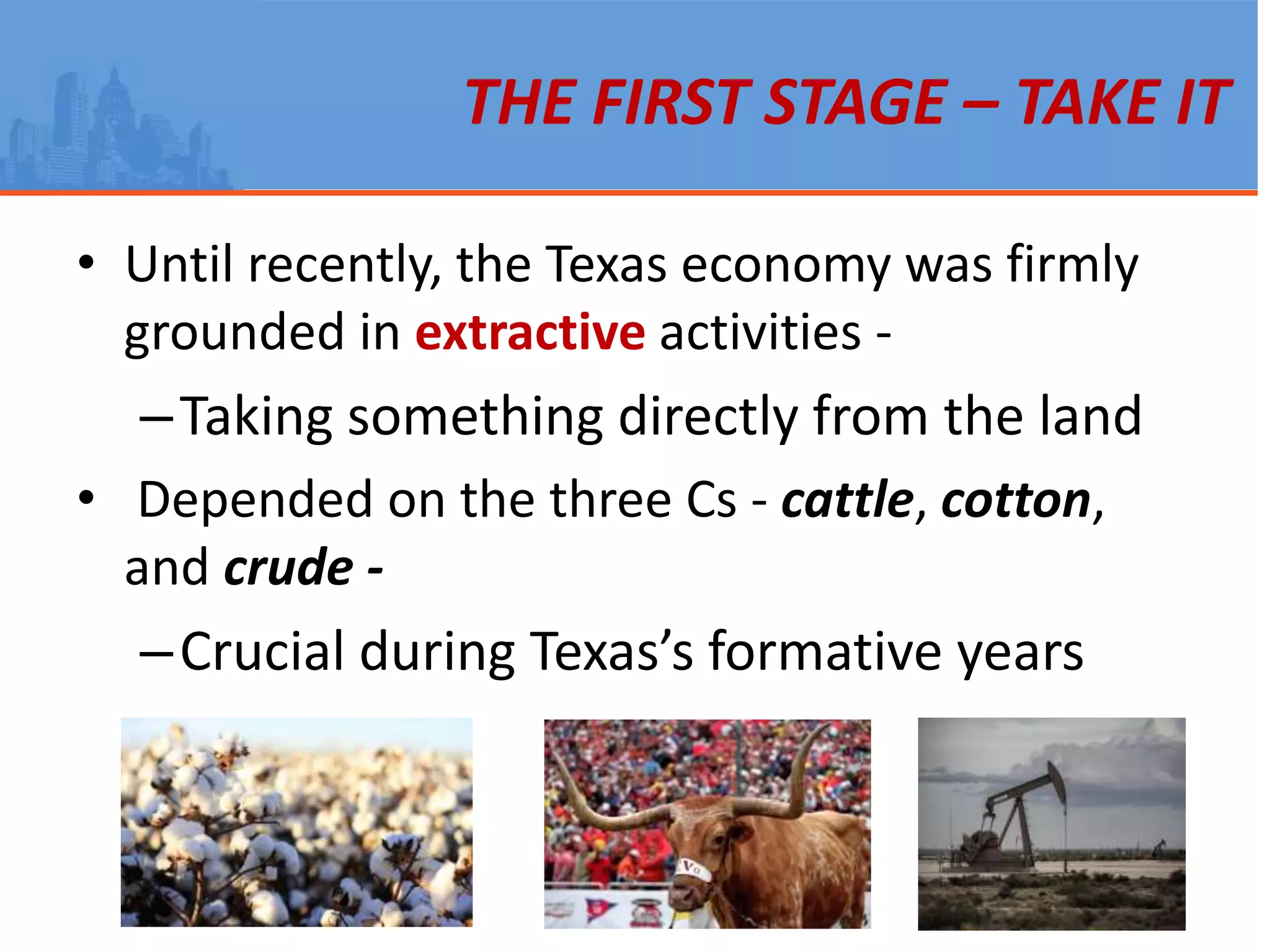
THE FIRST STAGE – TAKE IT
• Until recently, the Texas economy was firmly
grounded in extractive activities -
–Taking something directly from the land
• Depended on the three Cs - cattle, cotton,
and crude -
–Crucial during Texas’s formative years
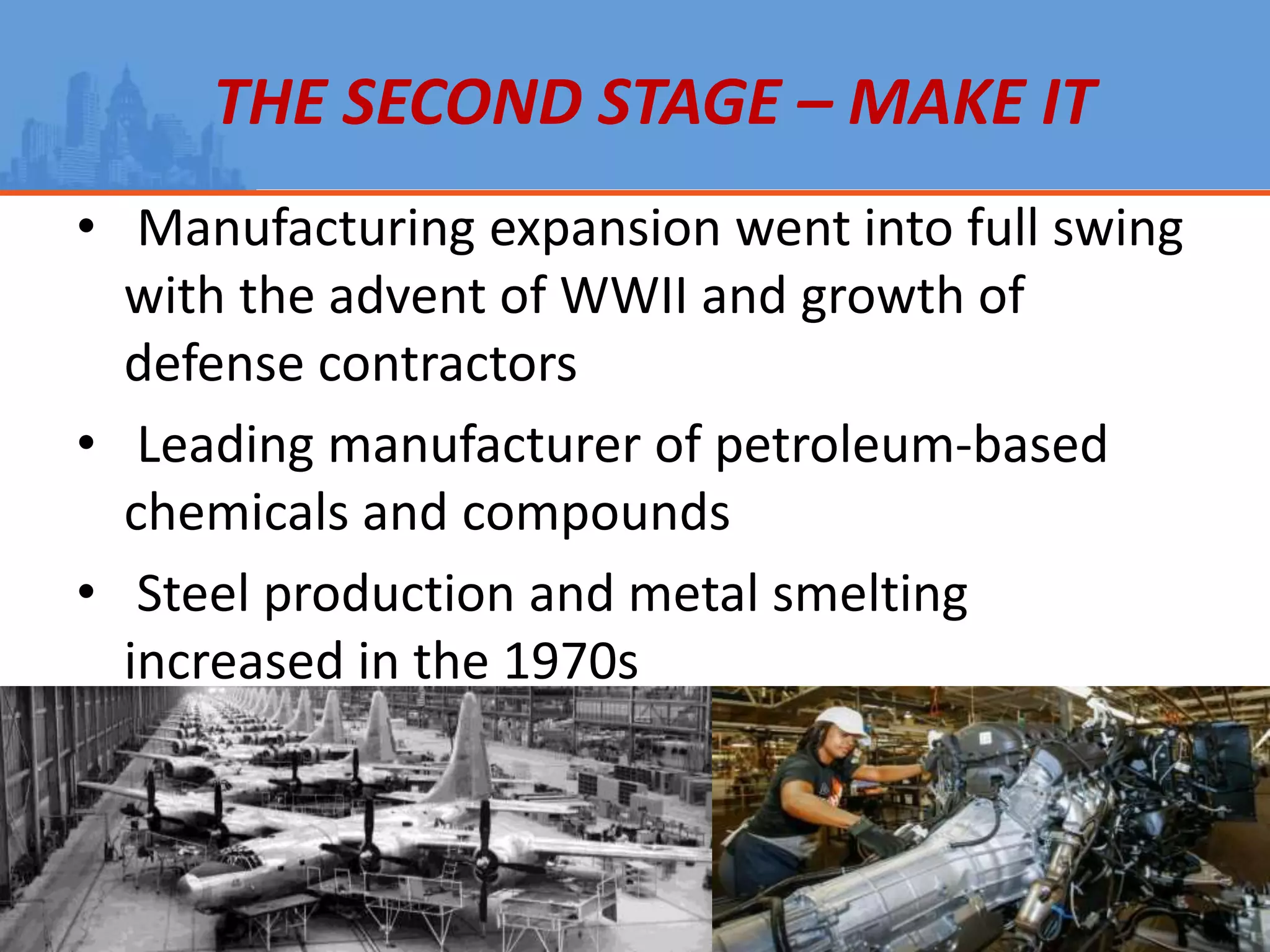
THE SECOND STAGE – MAKE IT
• Manufacturing expansion went into full swing
with the advent of WWII and growth of
defense contractors
• Leading manufacturer of petroleum-based
chemicals and compounds
• Steel production and metal smelting
increased in the 1970s
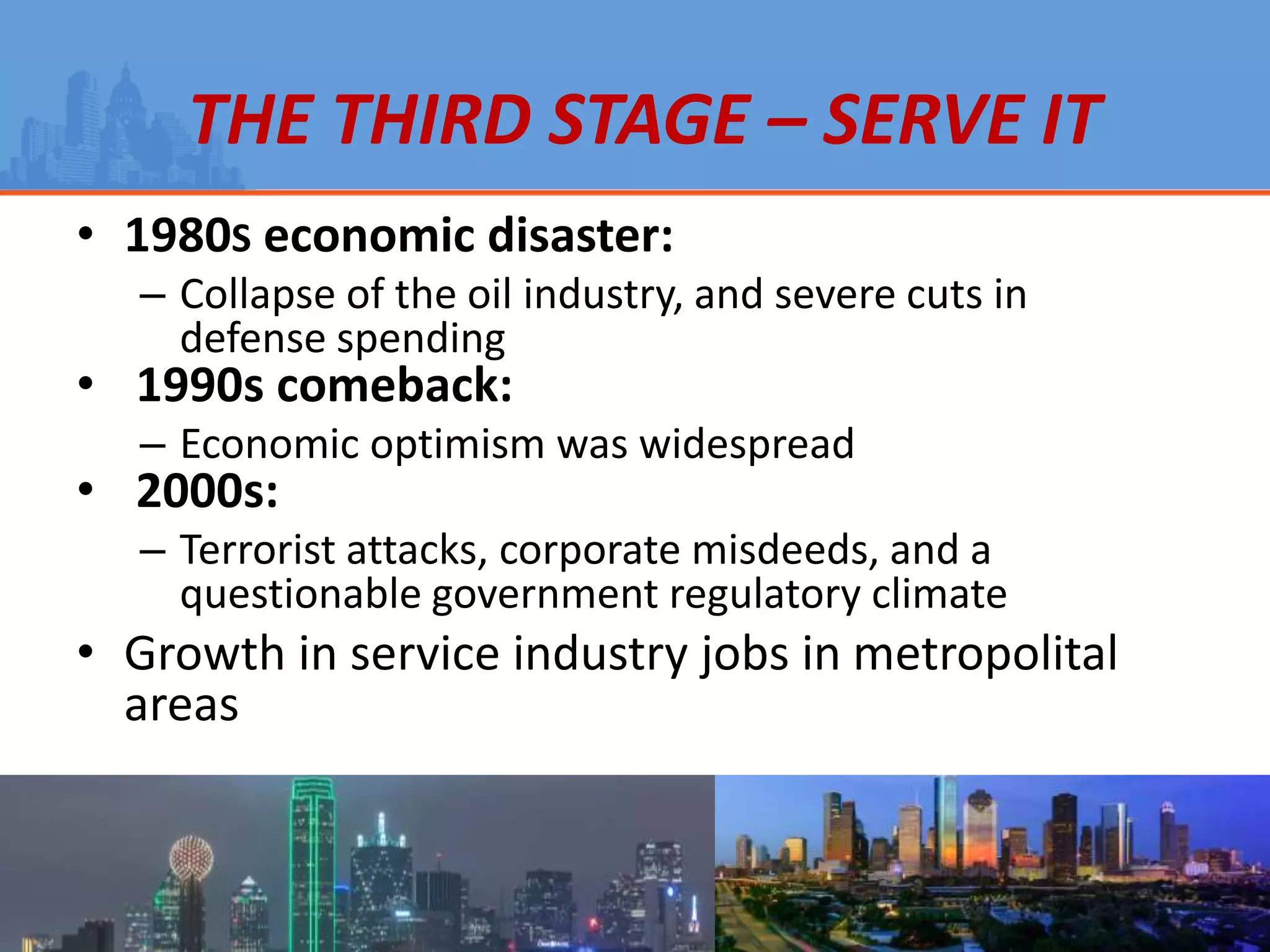
THE THIRD STAGE – SERVE IT
• 1980S economic disaster:
– Collapse of the oil industry, and severe cuts in
defense spending
• 1990s comeback:
– Economic optimism was widespread
• 2000s:
– Terrorist attacks, corporate misdeeds, and a
questionable government regulatory climate
• Growth in service industry jobs in metropolital
areas
Continuity and Change in the Texas Economy
Food and Fiber
• In Antebellum Texas, three-quarters of all families
drew their living from the state’s plentiful farmland.
• Corn in the east, sorghum in the west, wheat in the
northern plains, citrus in the south and rice in the
coastal prairies
Continuity and Change in the Texas Economy
Food and Fiber
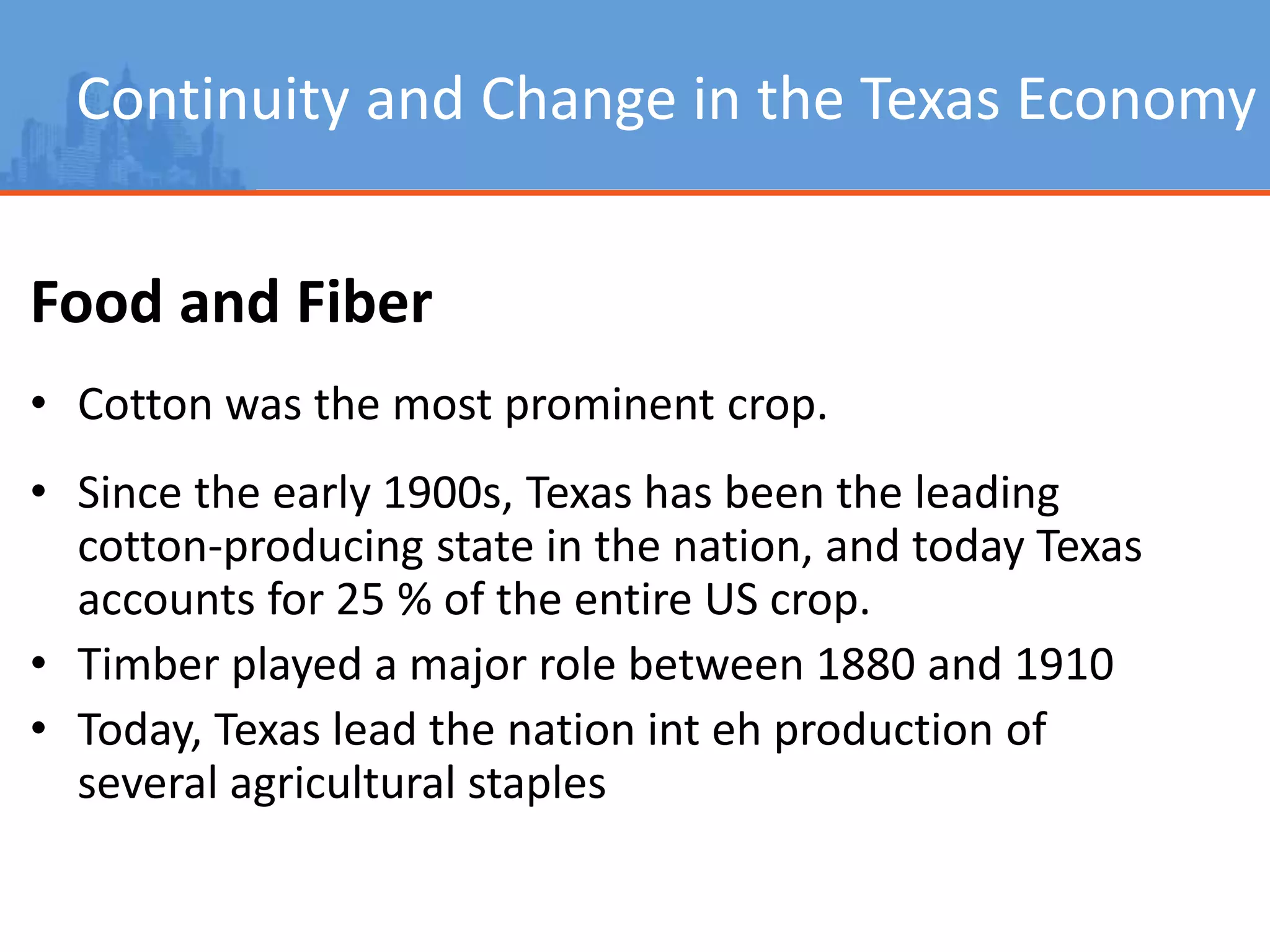
• Cotton was the most prominent crop.
• Since the early 1900s, Texas has been the leading
cotton-producing state in the nation, and today Texas
accounts for 25 % of the entire US crop.
• Timber played a major role between 1880 and 1910
• Today, Texas lead the nation int eh production of
several agricultural staples
Continuity and Change in the Texas Economy
Fuel
• The discovery of a major oil deposit beneath the marshy
soil at Spindletop Hill in Beaumont, TX, in 1901 ushered in a
new economic era and one that continues to drive the
state’s financial booms and busts.
• By 1940, Texas was the leading oil-producing state in the
United States and central to the war effort.
• Pumping and production regulated by the Texas Railroad
Commission
• Today, Texas is a world leader in the energy industry.
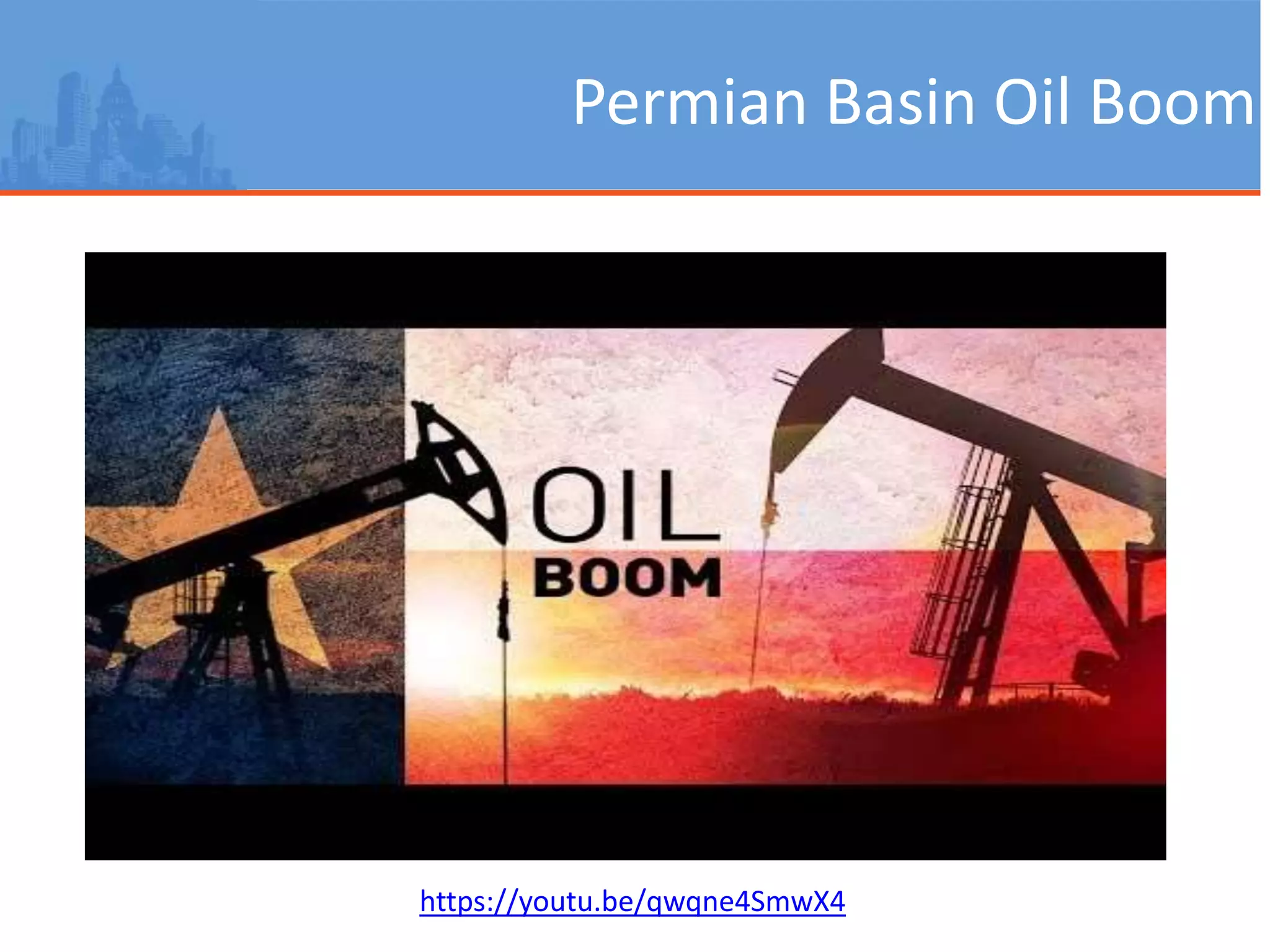
Permian Basin Oil Boom
https://youtu.be/qwqne4SmwX4
Continuity and Change in the Texas Economy
More Economic Drivers
• Cattle
• Manufacturing
• Military and Defense Industries
• High Tech
• Health Care
• Recreation and Retirement
Continuity and Change in the Texas
Demographics
State Population Growth
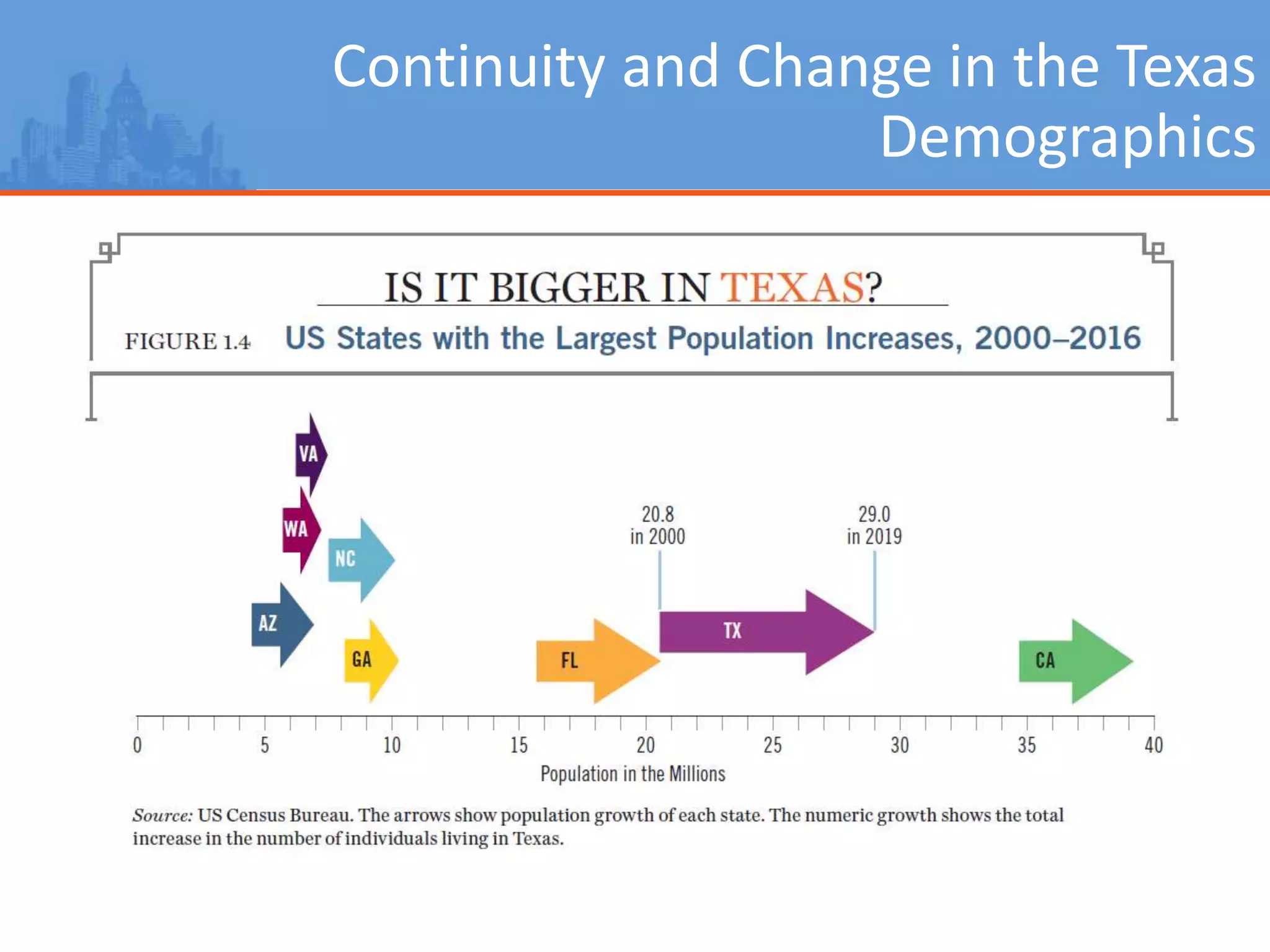
• Texas today is the fastest growing of the large states in
the United States.
• “Sunbelt” states, such as Texas, are growing rapidly as
baby boomers retire and as jobs move from the industrial
northeast and Midwest to the South.
• With population growth comes greater sway in
presidential elections, more seats in Congress, and thus
more power on the national level.
Continuity and Change in the Texas
Demographics
Continuity and Change in the Texas
Demographics
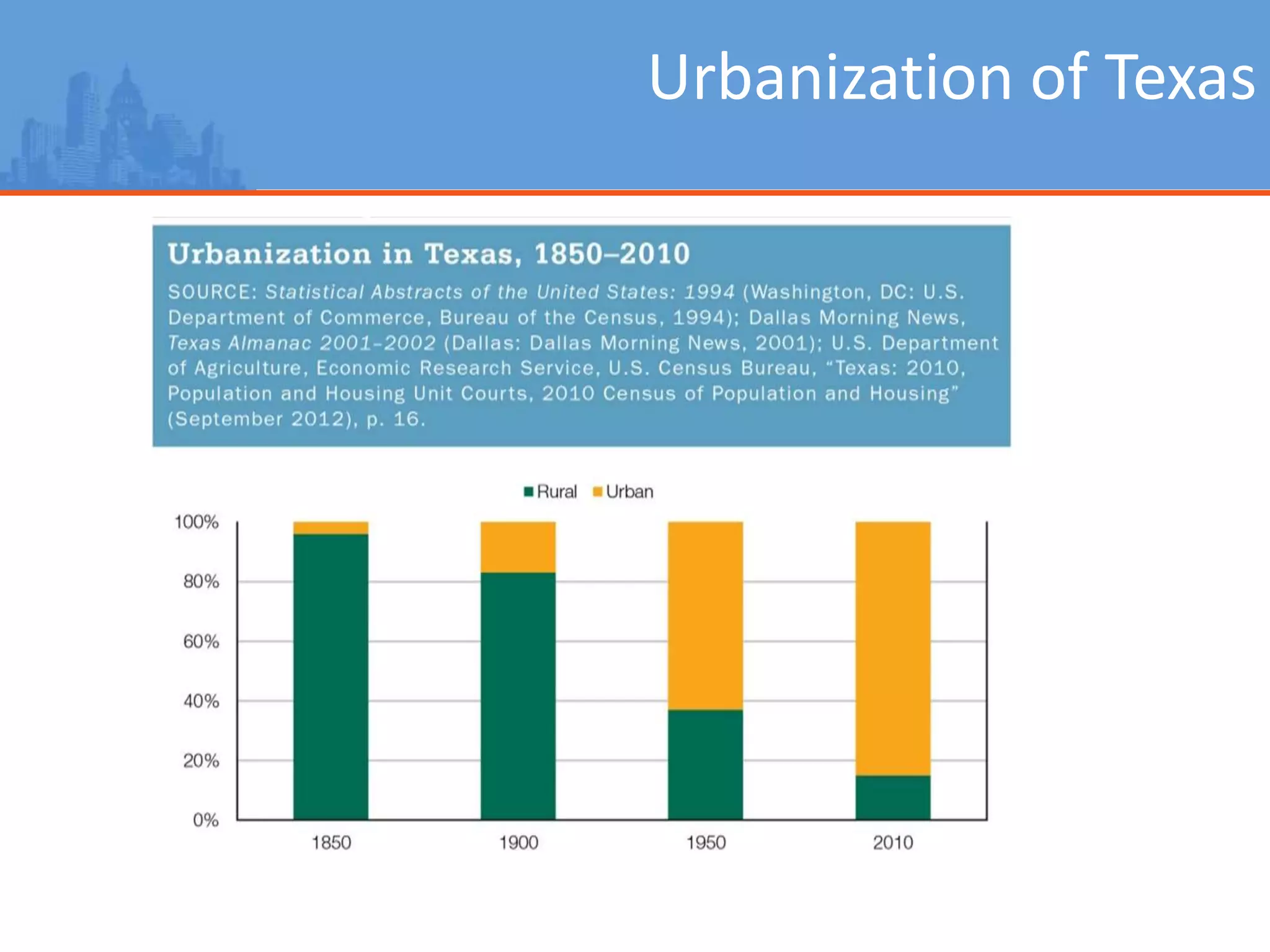
Urbanization
• The population has not increased uniformly across the state.
Much of the growth has occurred in urban areas
• In 1890, Texas had no urban areas with a population larger than
40,000.
• By 1920, four cities Dallas, Fort Worth, Houston, and San Antonio
boasted more than 100,000 each.
• Today, the “big six” counties (Harris, Dallas, Tarrant, Bexar, Travis,
and El Paso) account for 47% of the total population in Texas.
• Today, approximately 90% of Texans live in Urban Areas
Urbanization of Texas
Continuity and Change in the Texas
Demographics
Suburbanization
• Most significant demographic change has
been a suburbanization
• Population shifts from urban and rural
areas to suburban areas adjacent to major
cities
• Texas suburbs made up half of the country’s
10 fastest growing cities in 2016
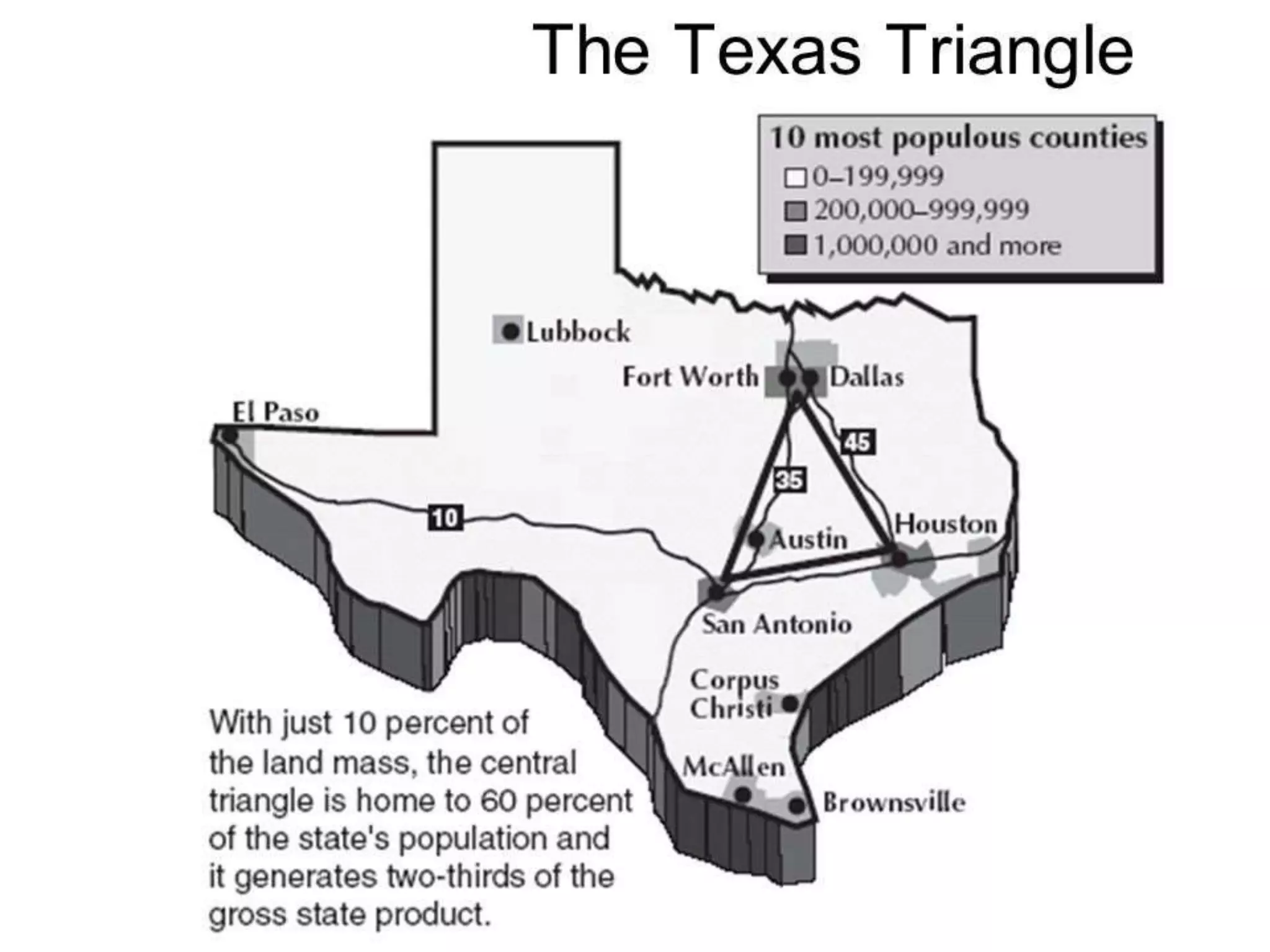
The “Texas Triangle”
Continuity and Change in the Texas
Demographics
Implications of Population Shifts
• Population shifted from rural to urban and suburban
centers changing center of political power
• Policy priorities follow growing population
• Texas government addresses urban and suburban
problems and focus less on rural issues
• Number of representatives for urban and suburban
areas rise
• Political divisions develop between conservative
suburbs and liberal urban areas
Continuity and Change in the Texas
Demographics
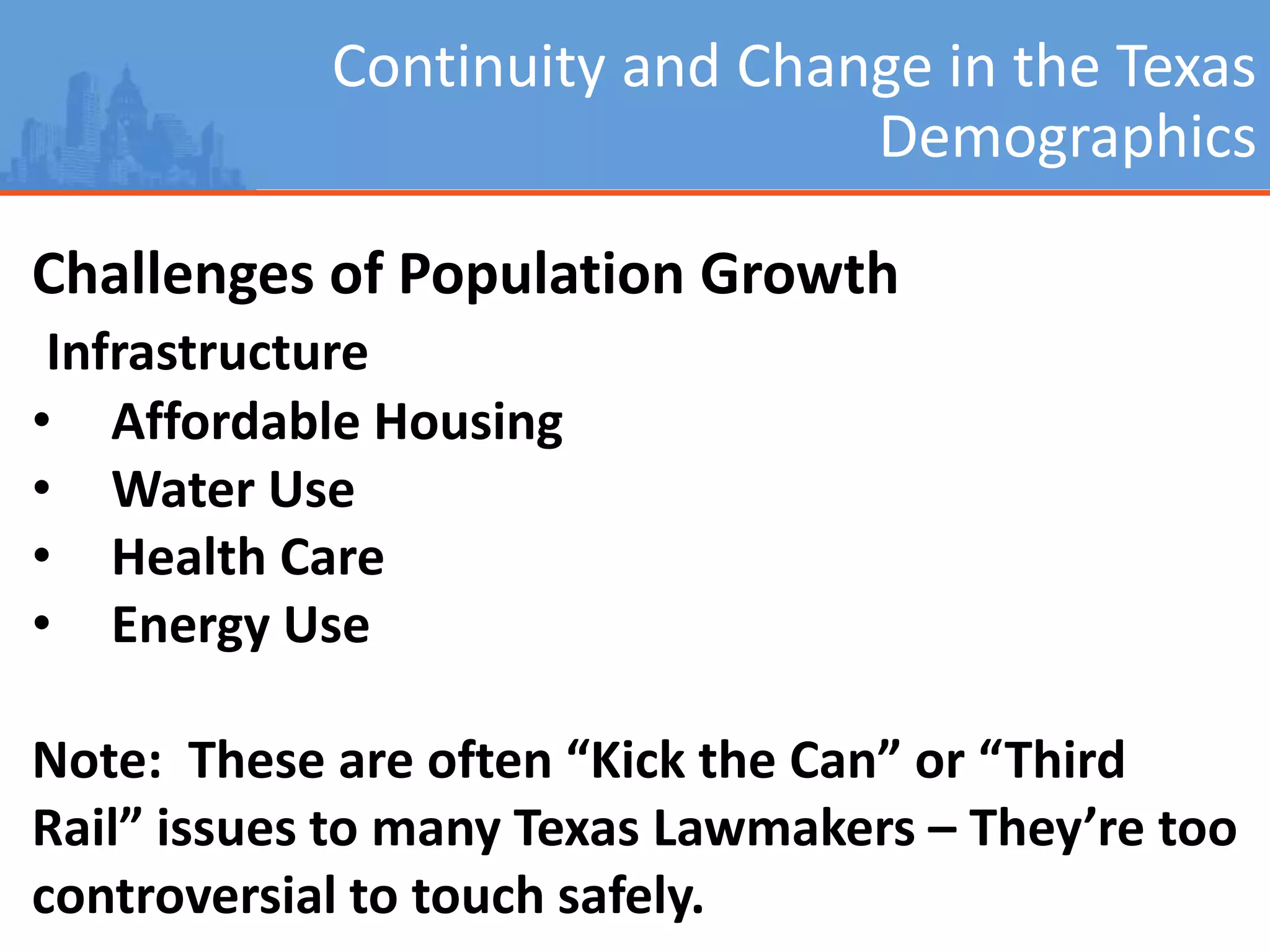
Challenges of Population Growth
Infrastructure
• Affordable Housing
• Water Use
• Health Care
• Energy Use
Note: These are often “Kick the Can” or “Third
Rail” issues to many Texas Lawmakers – They’re too
controversial to touch safely.
Continuity and Change in the Texas
Demographics
Continuity and Change in the Texas
Demographics
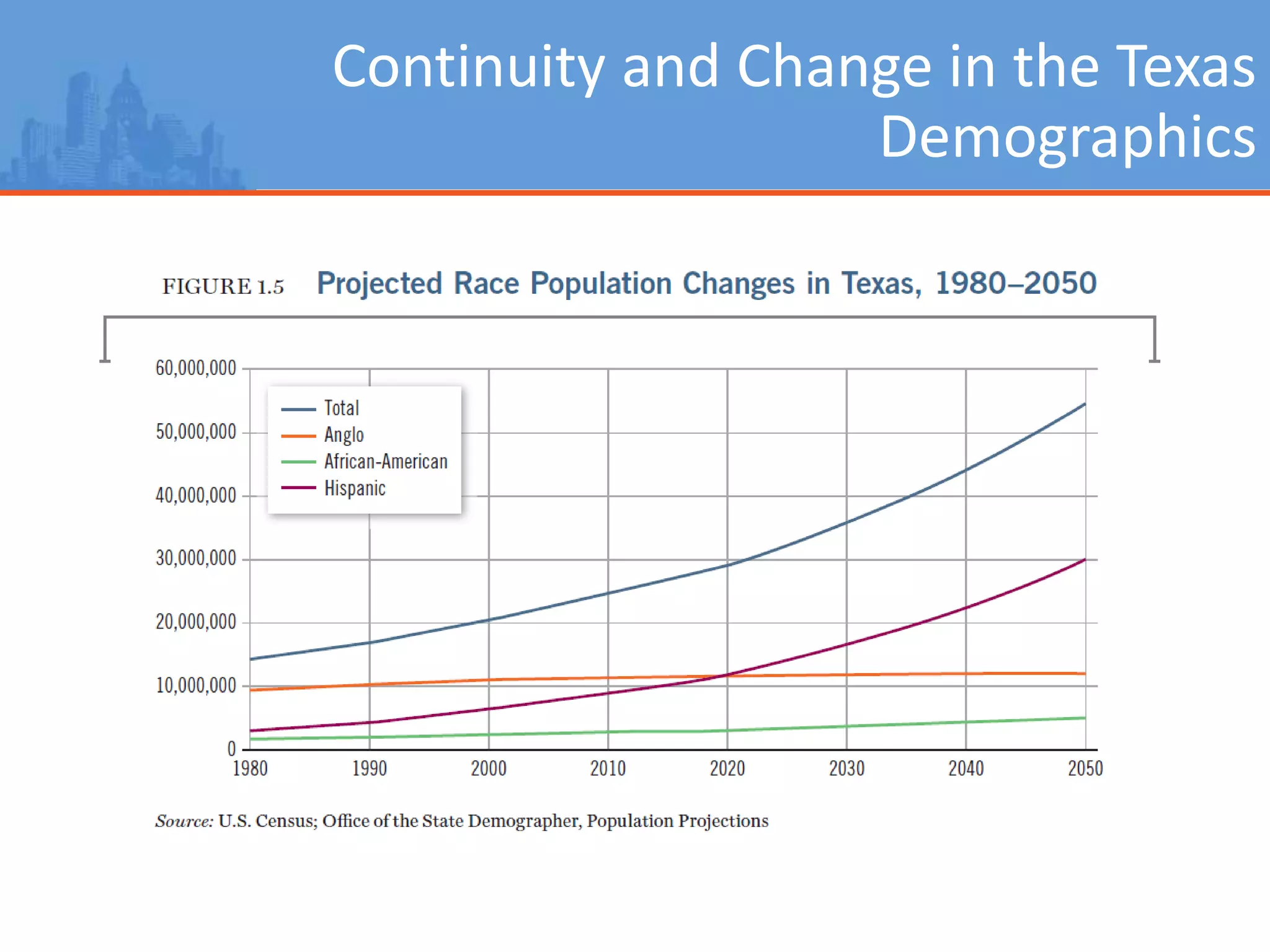
Racial and Ethnic Trends in Texas
• Demographic groups have different needs that
government must respond to
• Segregation: enforced or de facto separation of different
racial groups
• Anglos were a clear supermajority in 1980s
• Rapid rise of Hispanic population has and will continue to
alter the social and political shape of the state
Continuity and Change in the Texas
Demographics
Racial and Ethnic Trends in Texas
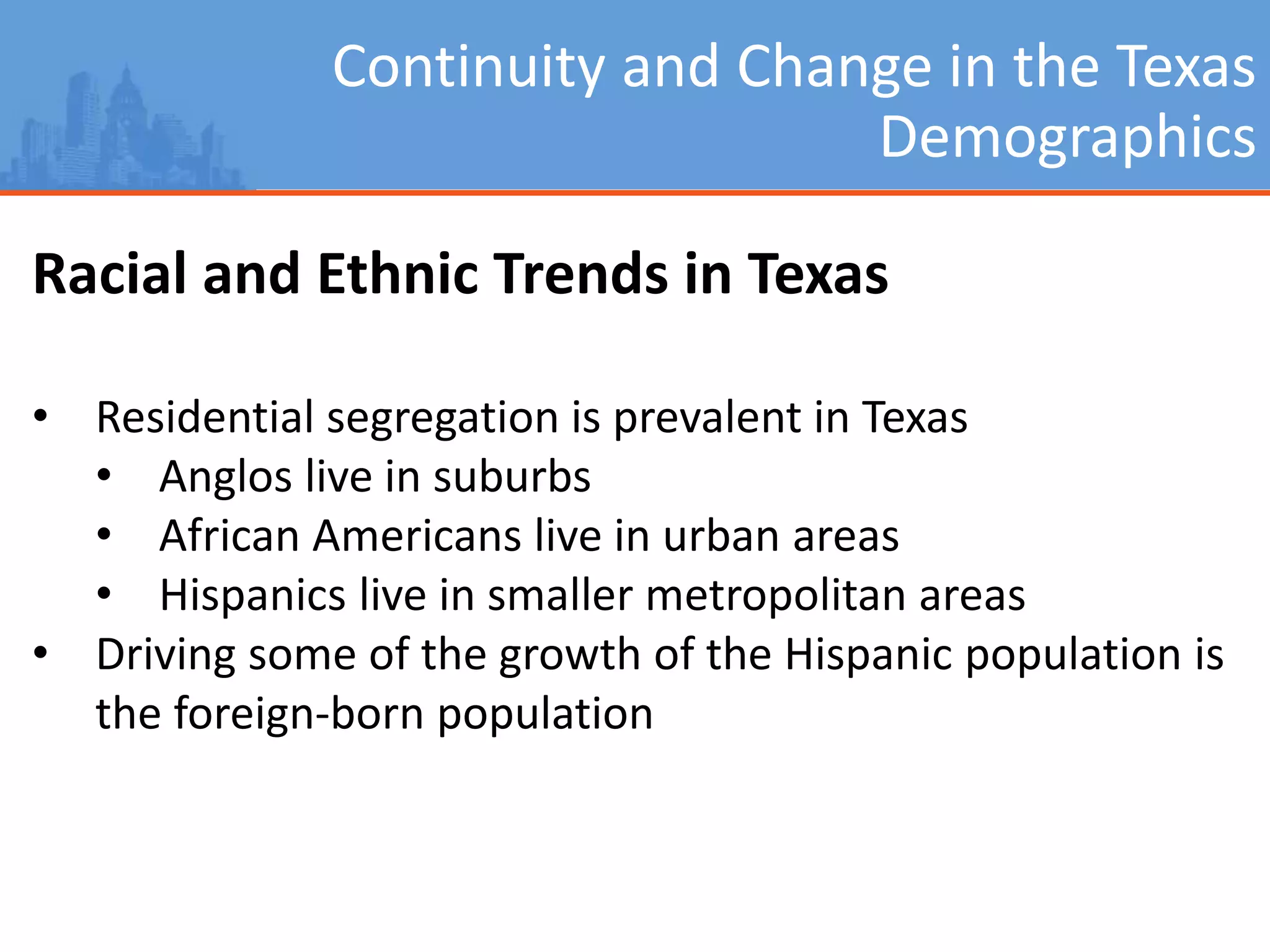
• Residential segregation is prevalent in Texas
• Anglos live in suburbs
• African Americans live in urban areas
• Hispanics live in smaller metropolitan areas
• Driving some of the growth of the Hispanic population is
the foreign-born population
Continuity and Change in the Texas
Demographics
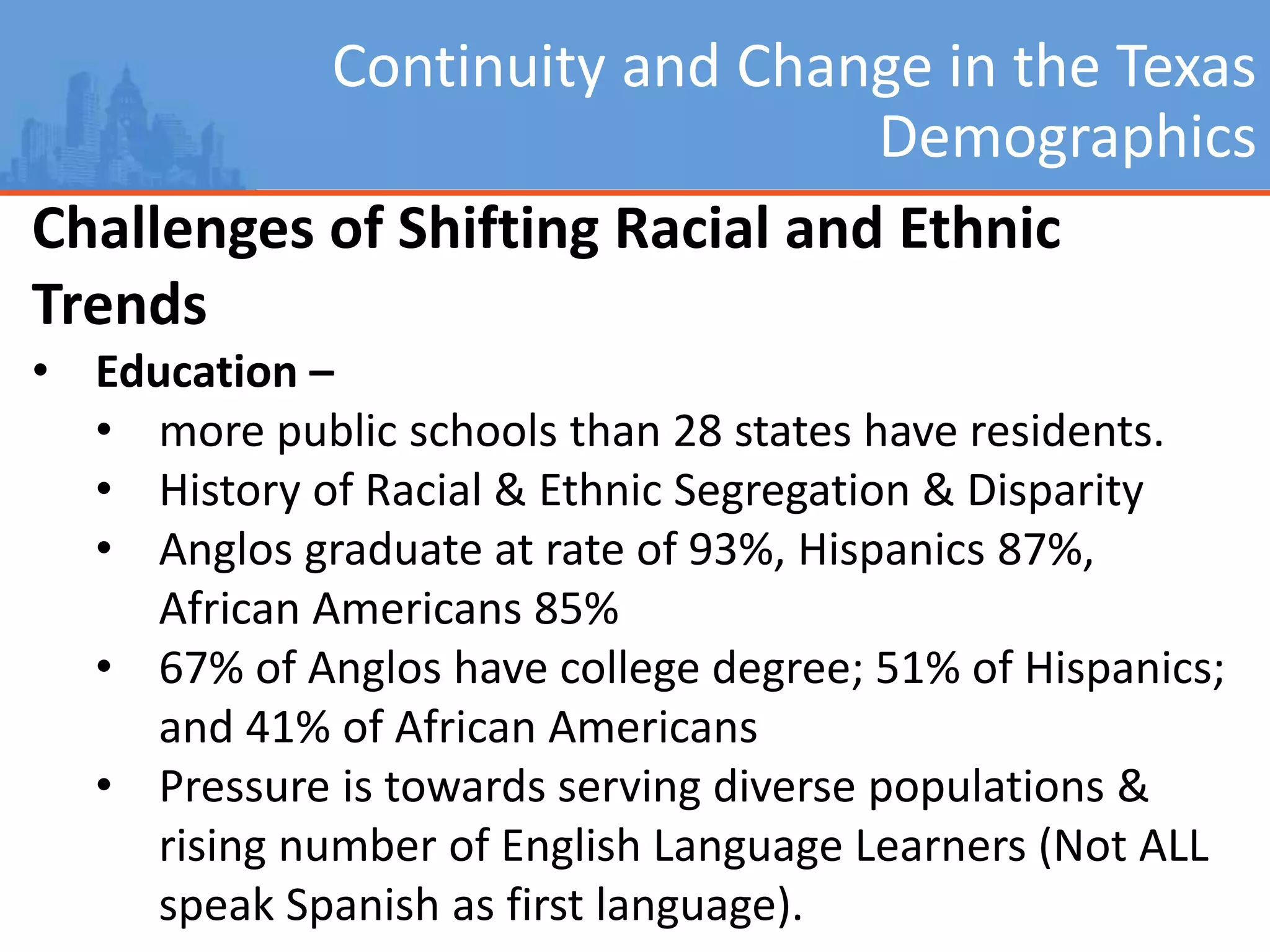
Challenges of Shifting Racial and Ethnic
Trends
• Education –
• more public schools than 28 states have residents.
• History of Racial & Ethnic Segregation & Disparity
• Anglos graduate at rate of 93%, Hispanics 87%,
African Americans 85%
• 67% of Anglos have college degree; 51% of Hispanics;
and 41% of African Americans
• Pressure is towards serving diverse populations &
rising number of English Language Learners (Not ALL
speak Spanish as first language).
Continuity and Change in the Texas
Demographics
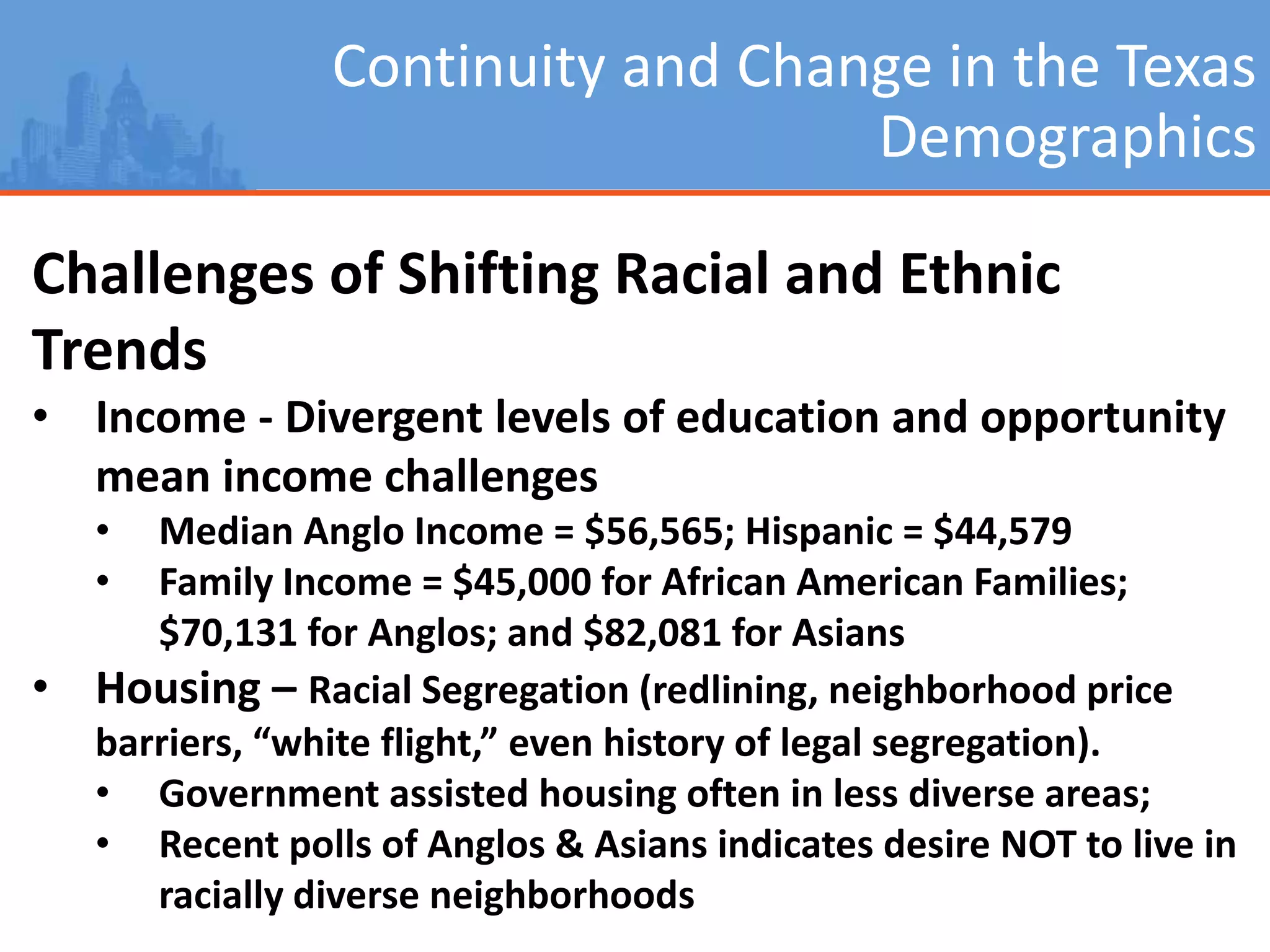
Challenges of Shifting Racial and Ethnic
Trends
• Income - Divergent levels of education and opportunity
mean income challenges
• Median Anglo Income = $56,565; Hispanic = $44,579
• Family Income = $45,000 for African American Families;
$70,131 for Anglos; and $82,081 for Asians
• Housing – Racial Segregation (redlining, neighborhood price
barriers, “white flight,” even history of legal segregation).
• Government assisted housing often in less diverse areas;
• Recent polls of Anglos & Asians indicates desire NOT to live in
racially diverse neighborhoods
Continuity and Change in the Texas
Demographics
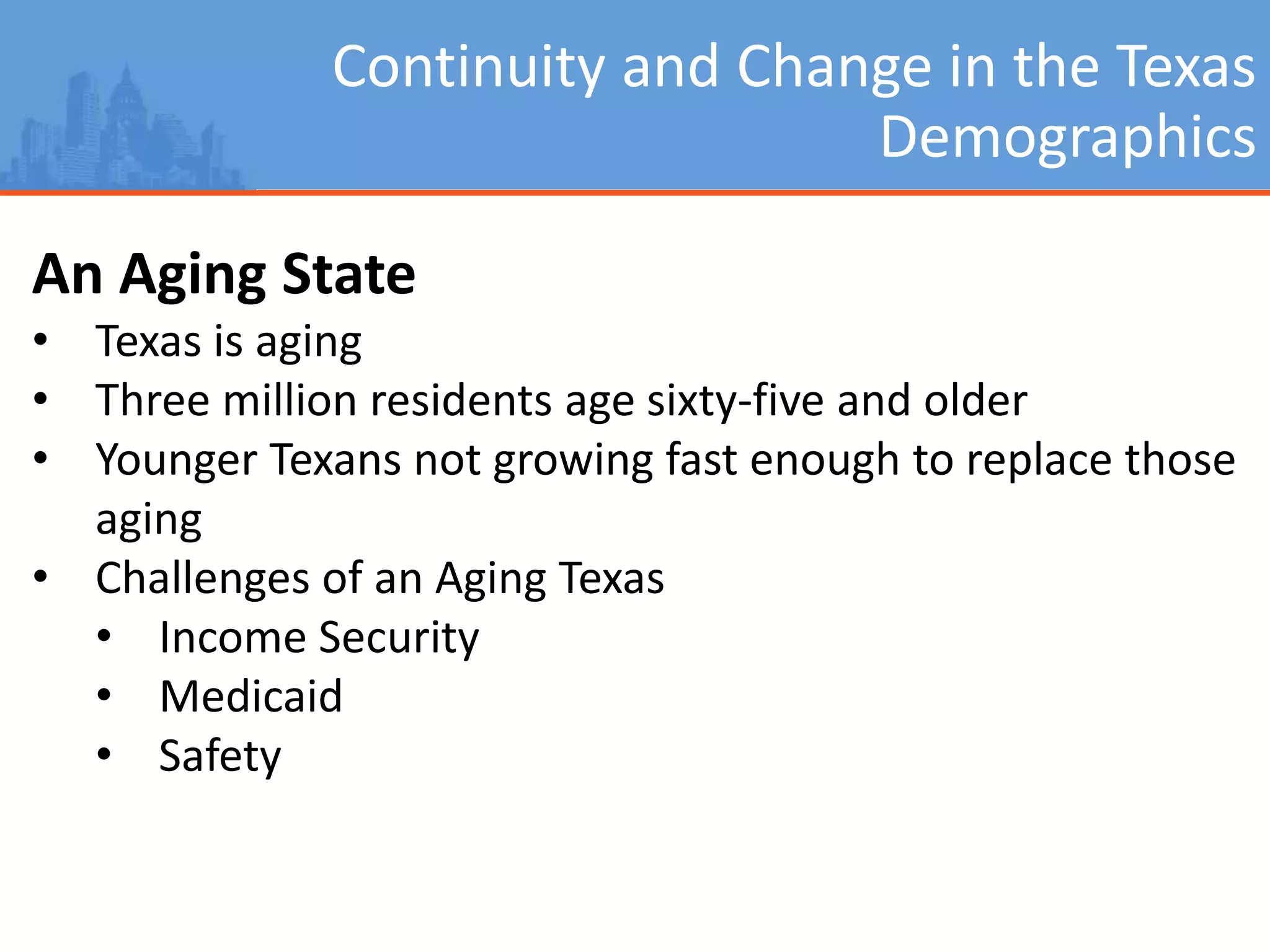
An Aging State
• Texas is aging
• Three million residents age sixty-five and older
• Younger Texans not growing fast enough to replace those
aging
• Challenges of an Aging Texas
• Income Security
• Medicaid
• Safety
Continuity and Change in the Texas
Demographics
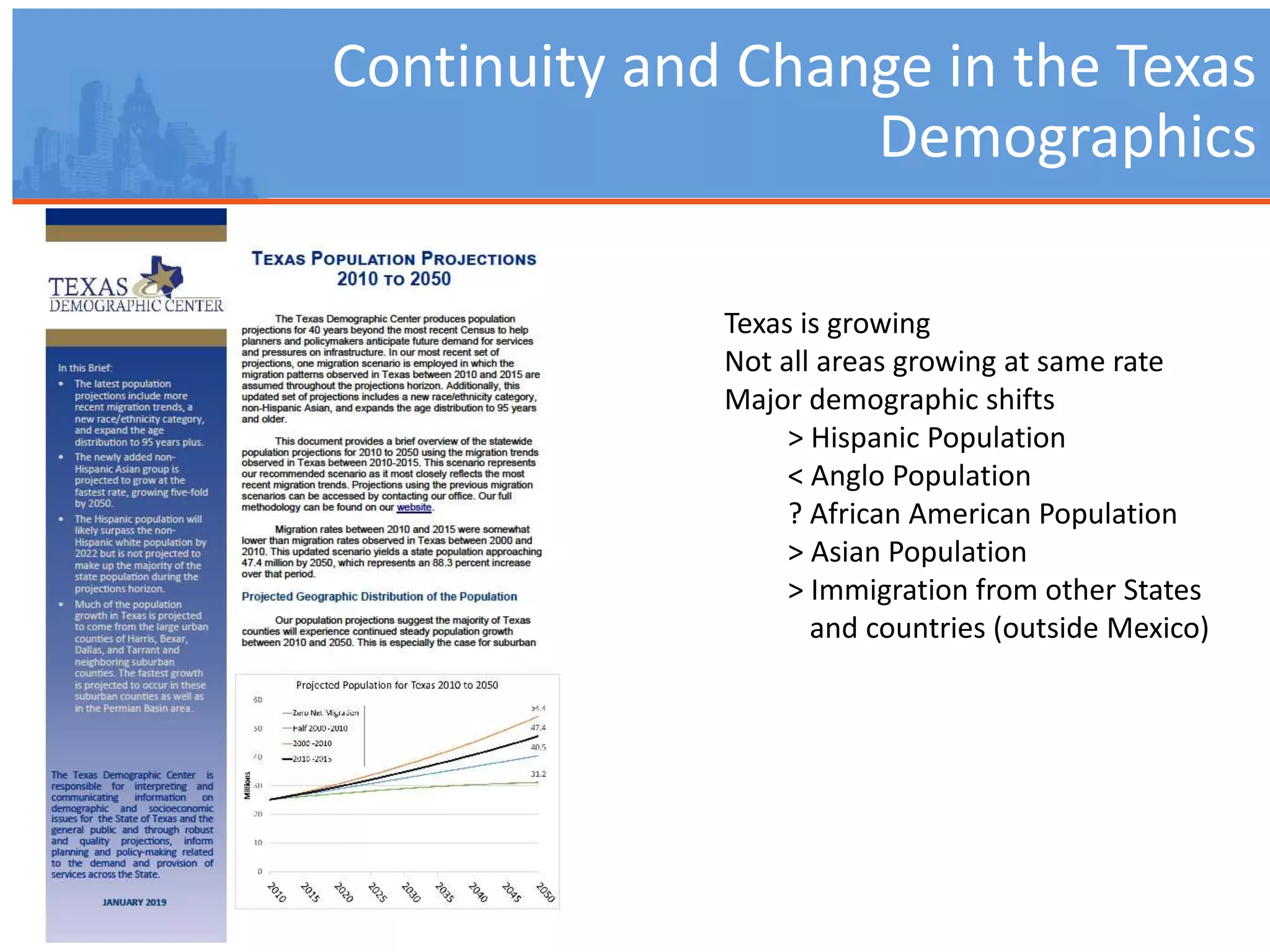
Texas is growing
Not all areas growing at same rate
Major demographic shifts
> Hispanic Population
< Anglo Population
? African American Population
> Asian Population
> Immigration from other States
and countries (outside Mexico)
Continuity and Change in the Texas
Political Culture
• Texas is a “state of mind and a nation in
every sense of the word” John Steinbeck
• Texas infused with a spirit of rugged
individualism and strong sense of fair play
• Texans have expansive and grandiose vision
of the state
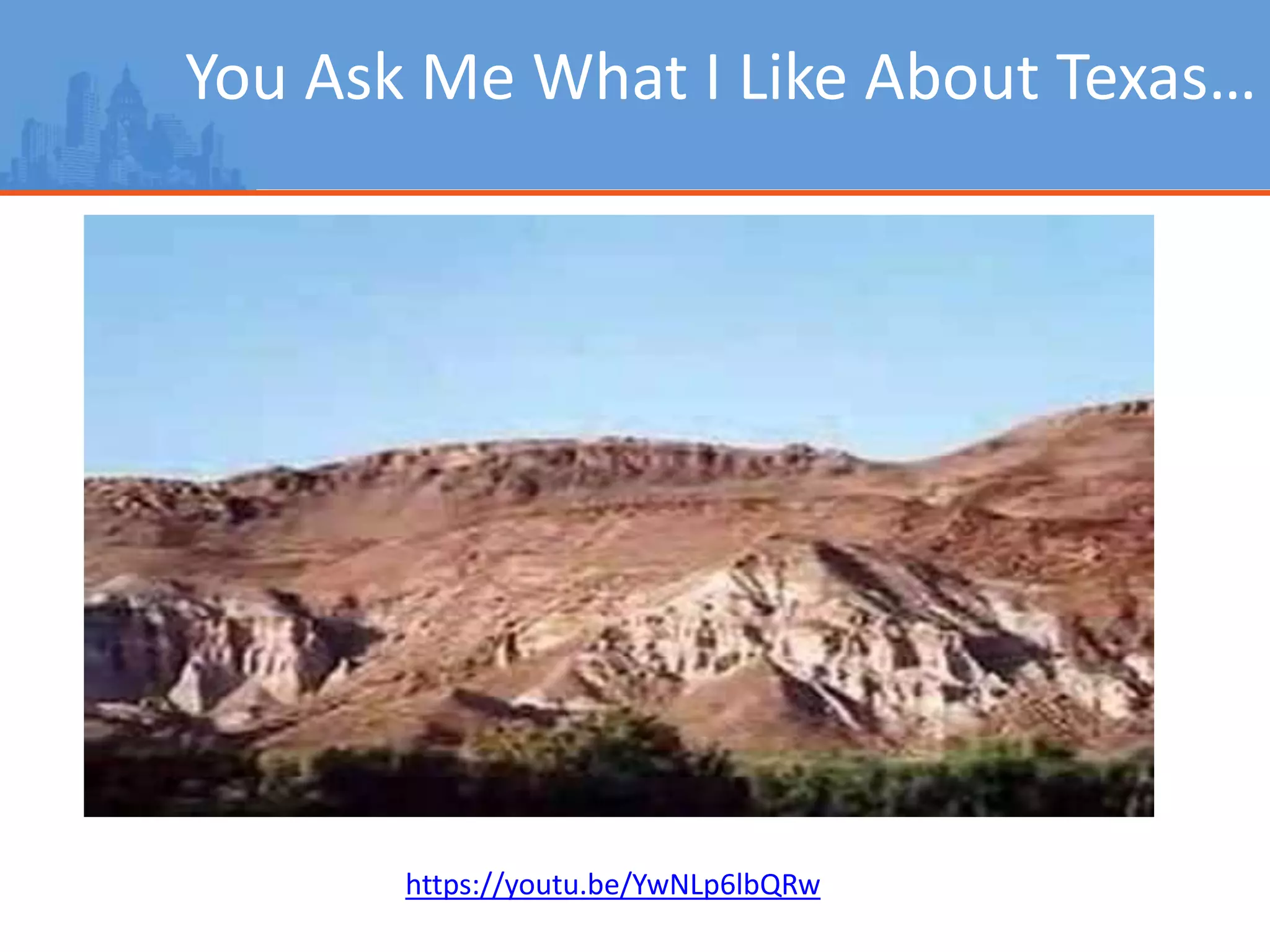
You Ask Me What I Like About Texas…
https://youtu.be/YwNLp6lbQRw
El Paso
https://vimeo.com/287920014/00b26c36ac
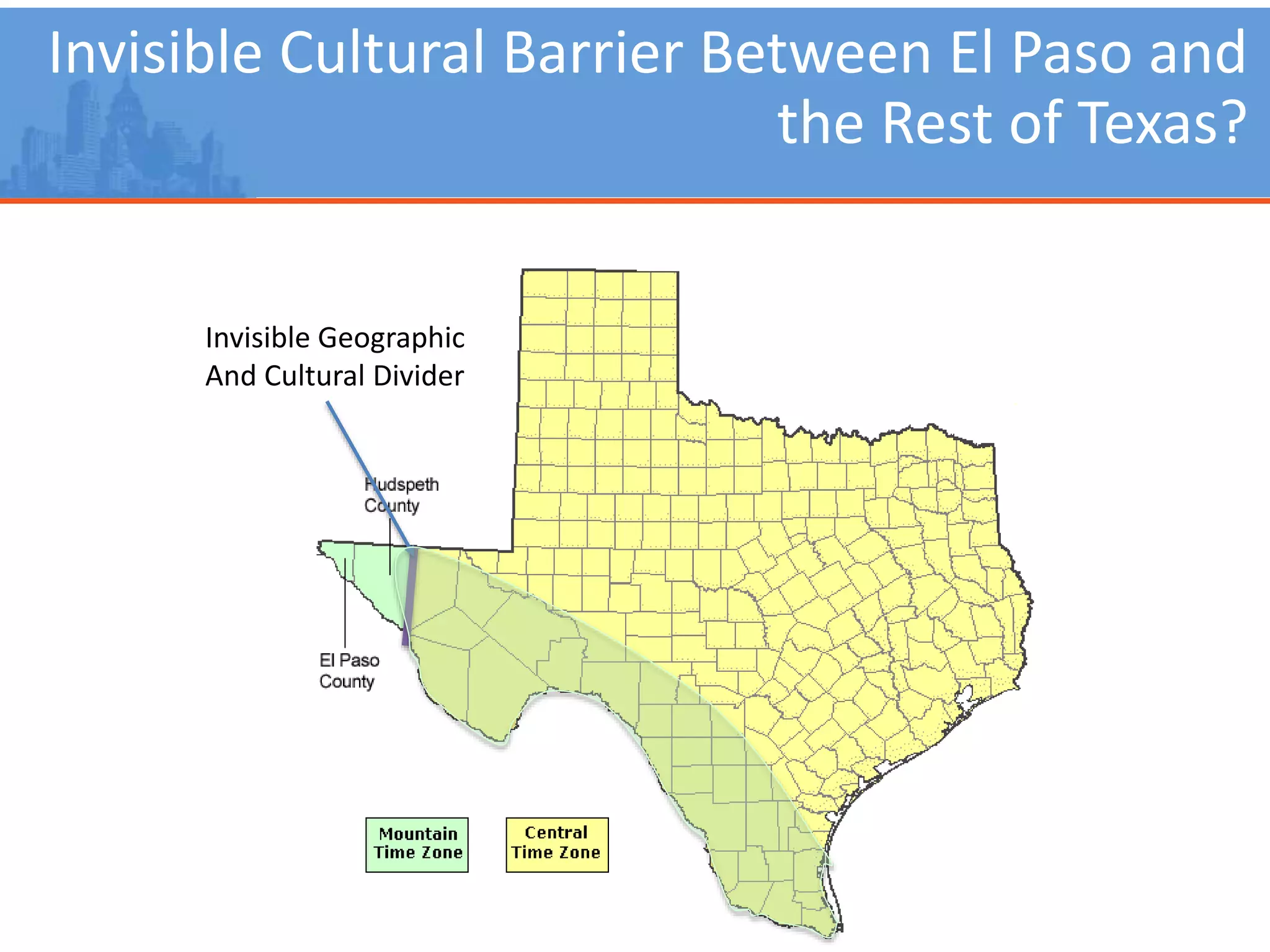
Invisible Cultural Barrier Between El Paso and
the Rest of Texas?
Invisible Geographic
And Cultural Divider
Continuity and Change in the Texas
Political Culture
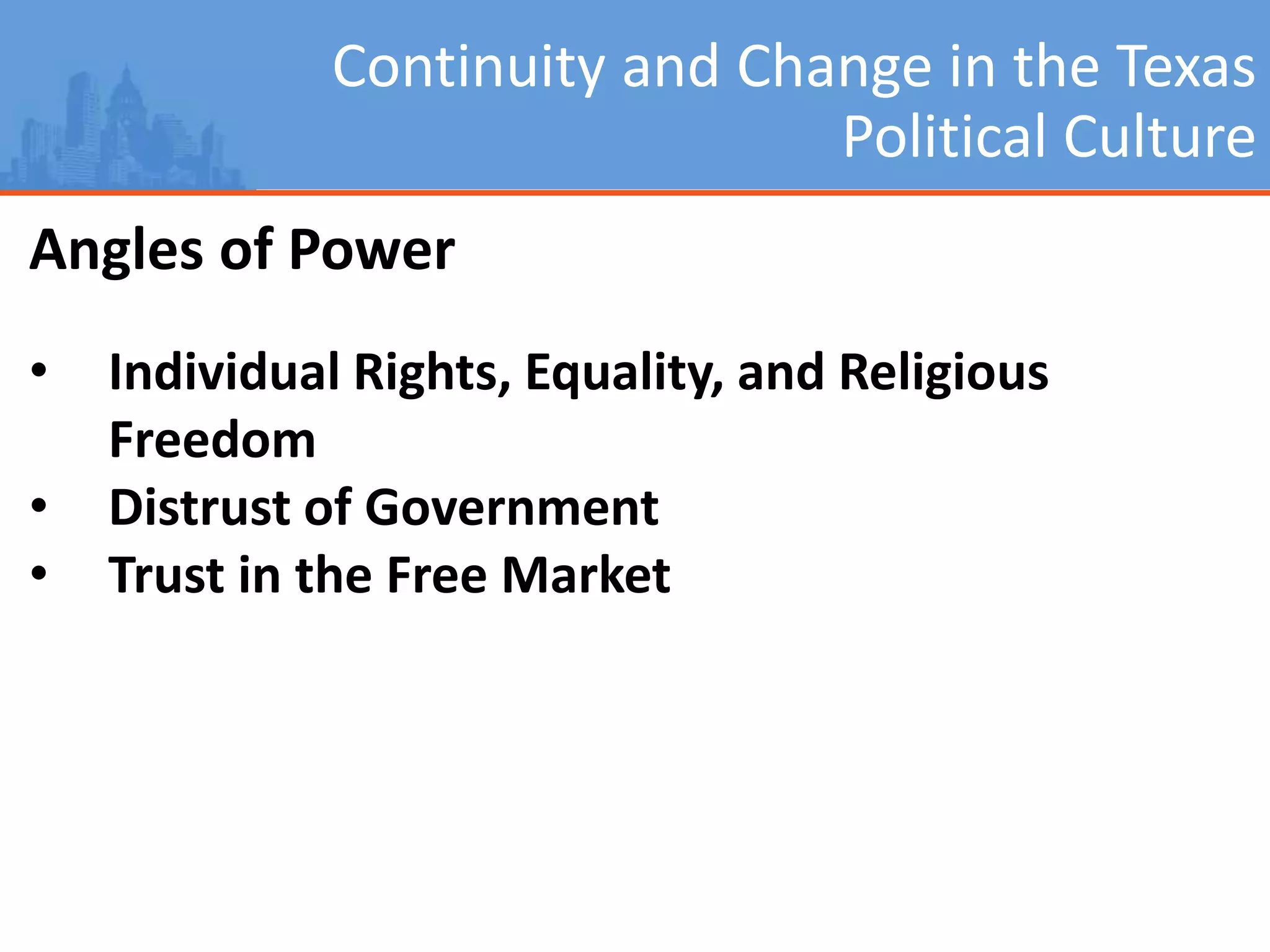
Angles of Power
• Individual Rights, Equality, and Religious
Freedom
• Distrust of Government
• Trust in the Free Market
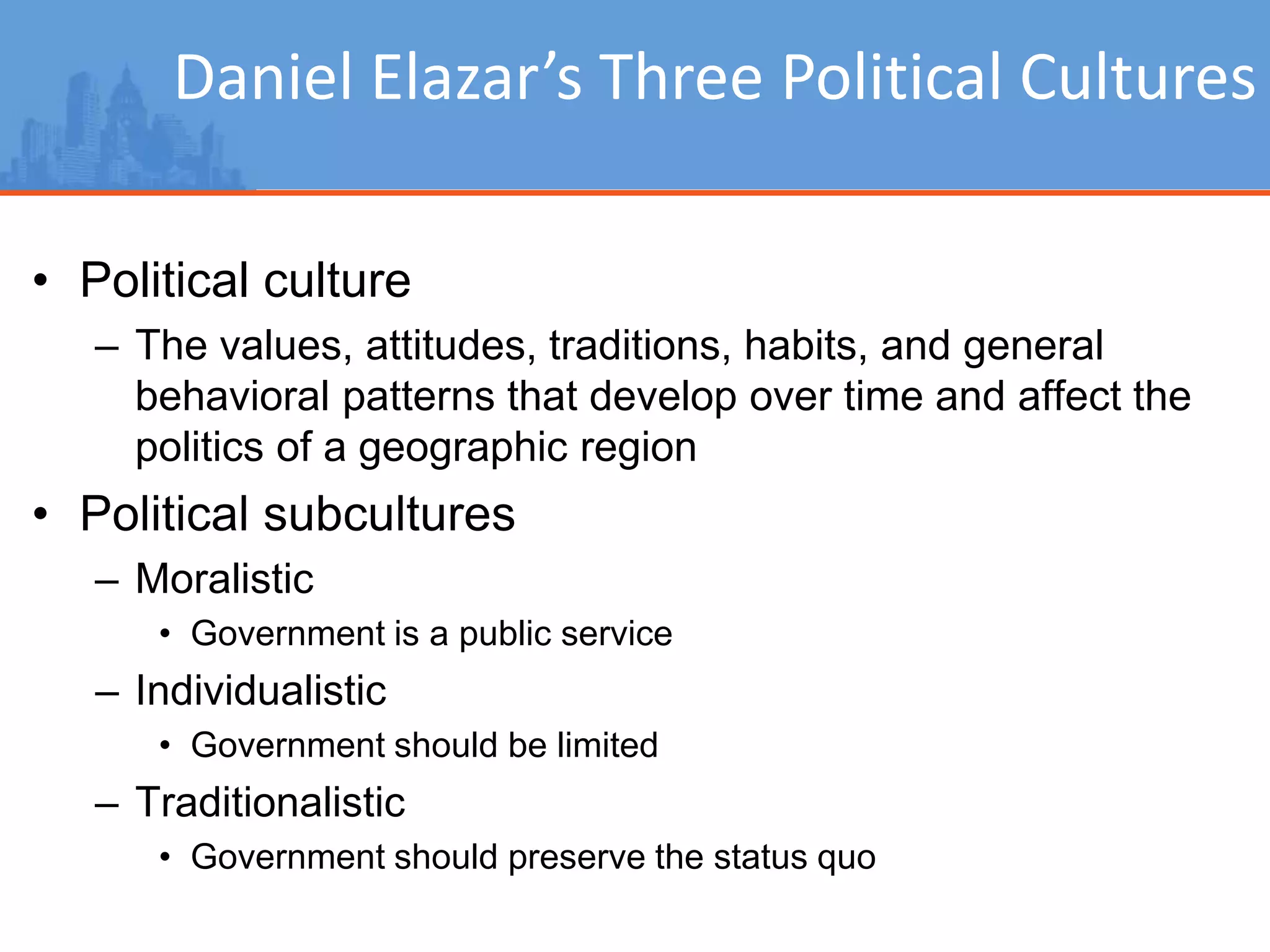
Daniel Elazar’s Three Political Cultures
• Political culture
– The values, attitudes, traditions, habits, and general
behavioral patterns that develop over time and affect the
politics of a geographic region
• Political subcultures
– Moralistic
• Government is a public service
– Individualistic
• Government should be limited
– Traditionalistic
• Government should preserve the status quo
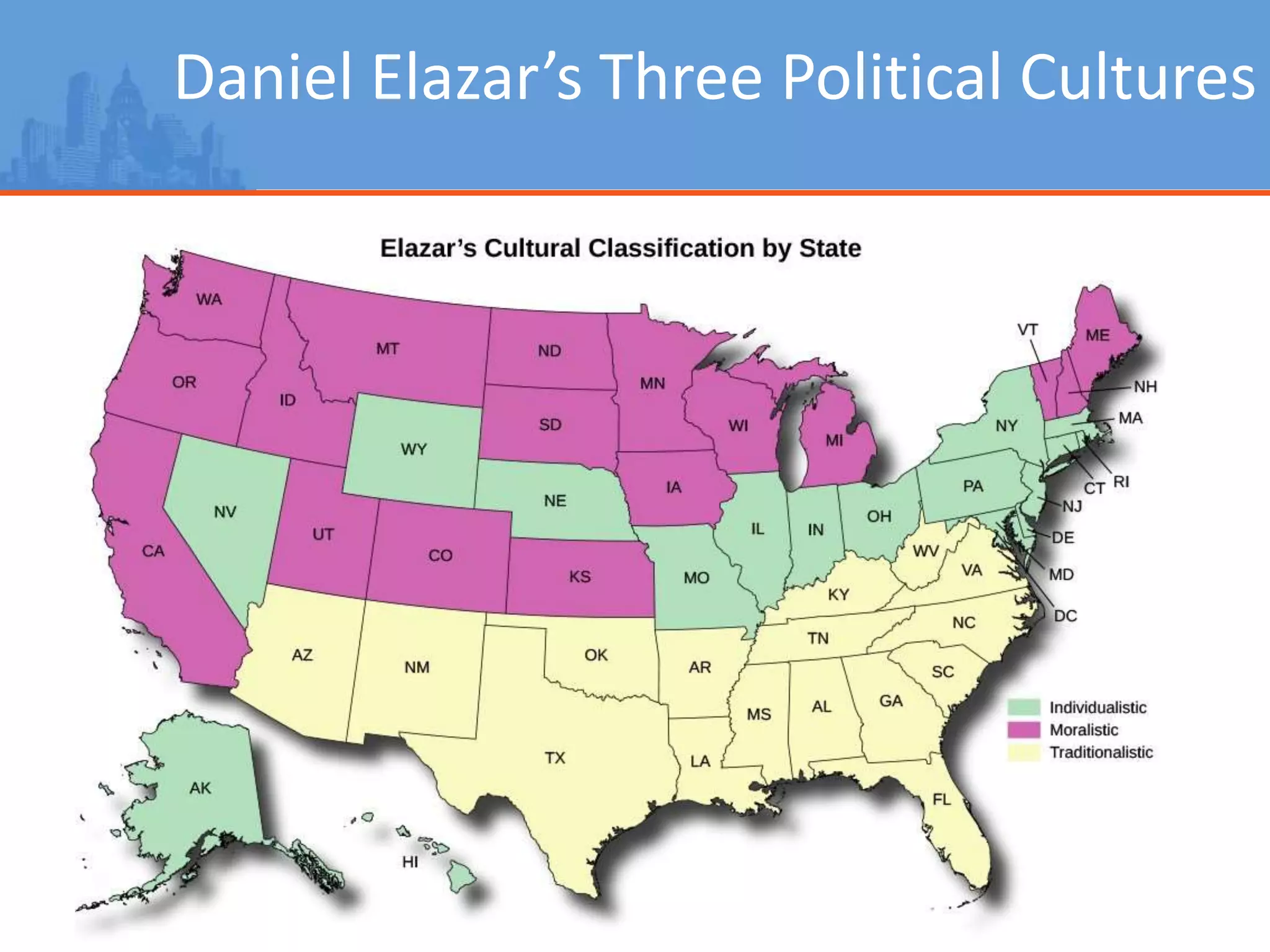
Daniel Elazar’s Three Political Cultures
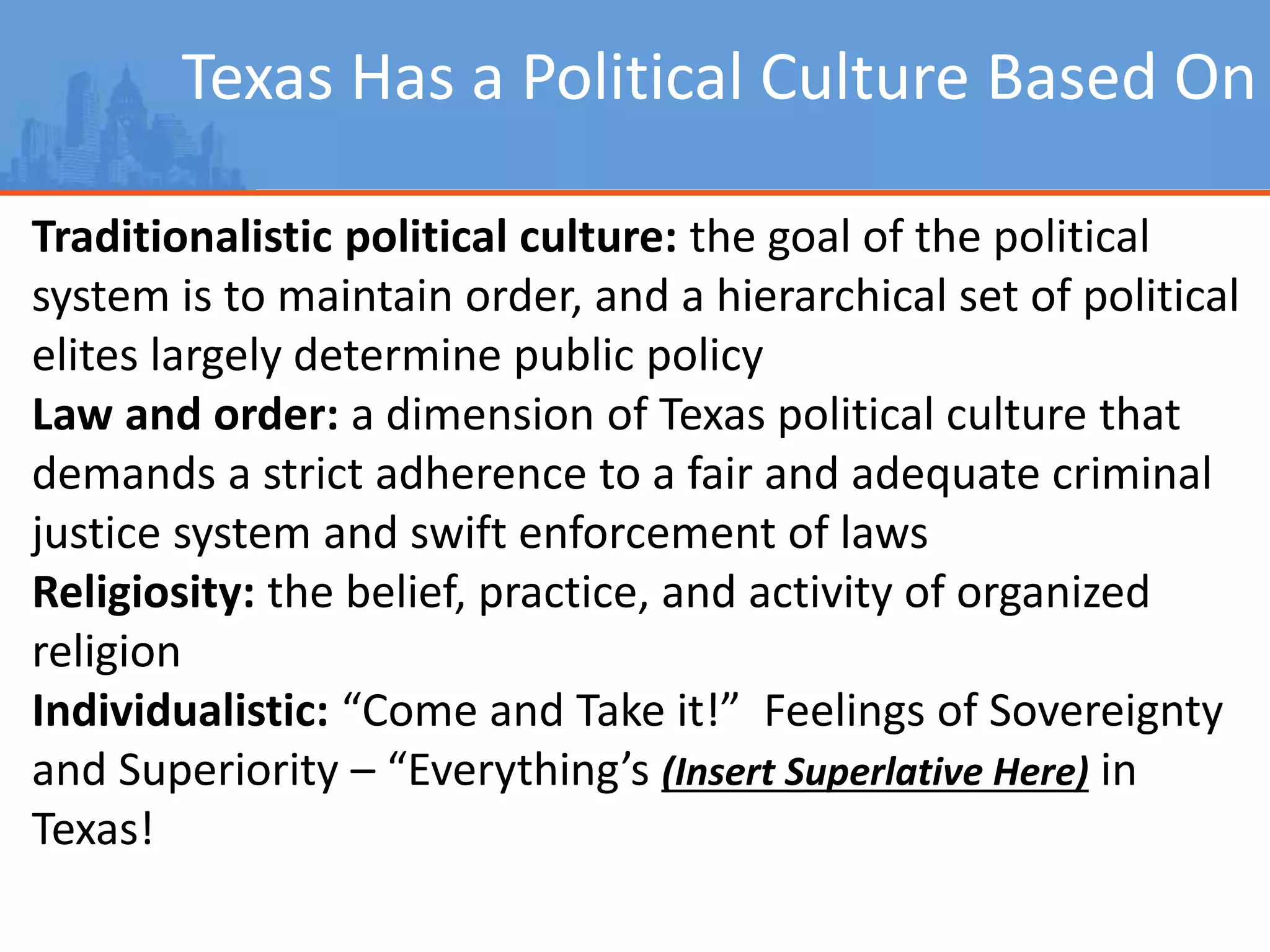
Texas Has a Political Culture Based On
Traditionalistic political culture: the goal of the political
system is to maintain order, and a hierarchical set of political
elites largely determine public policy
Law and order: a dimension of Texas political culture that
demands a strict adherence to a fair and adequate criminal
justice system and swift enforcement of laws
Religiosity: the belief, practice, and activity of organized
religion
Individualistic: “Come and Take it!” Feelings of Sovereignty
and Superiority – “Everything’s (Insert Superlative Here) in
Texas!
Continuity and Change in the Texas
Political Culture
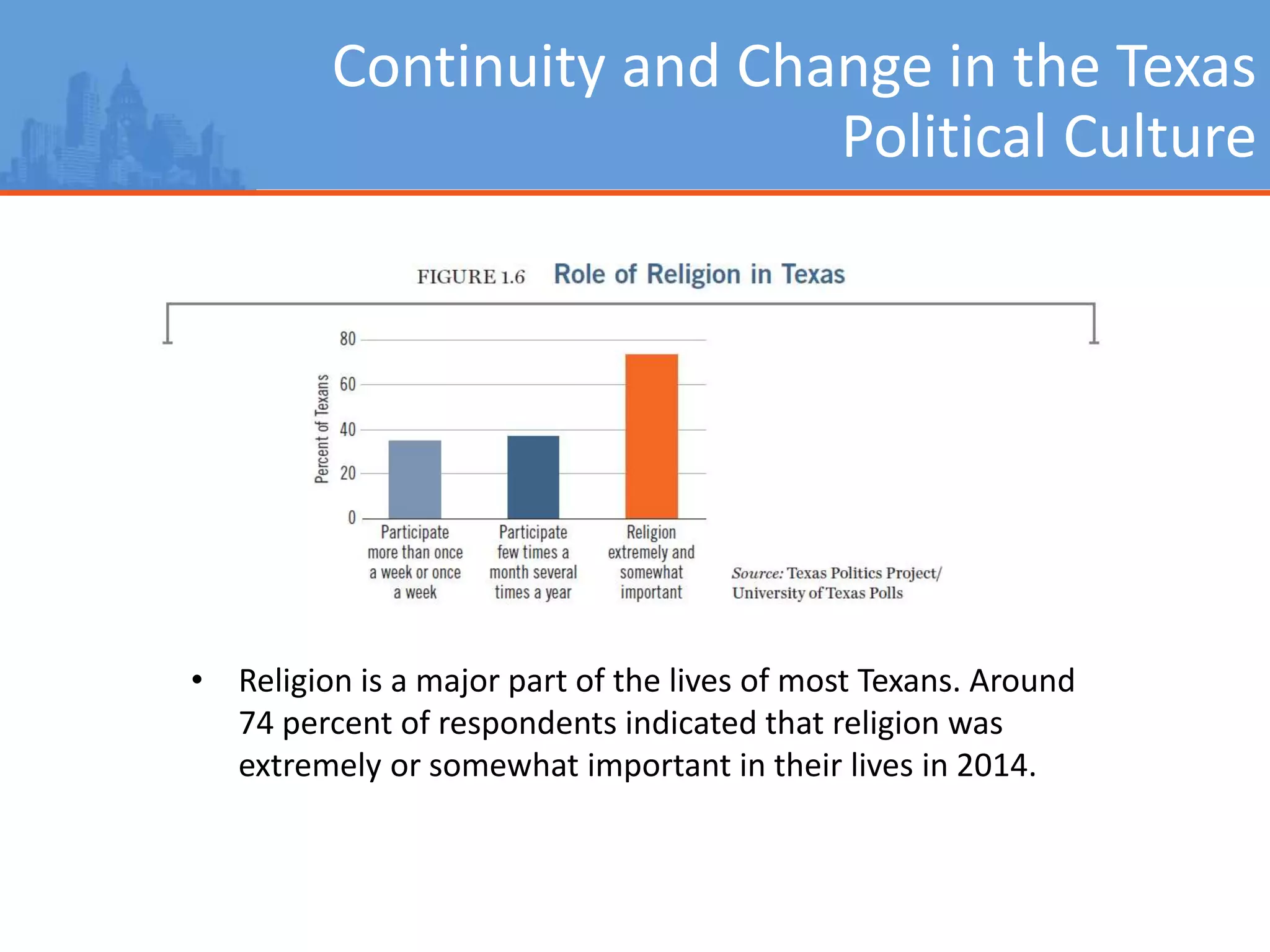
• Religion is a major part of the lives of most Texans. Around
74 percent of respondents indicated that religion was
extremely or somewhat important in their lives in 2014.
Continuity and Change in the Texas
Political Culture
Culture Conflicts
• College Funding
• Morals and Money
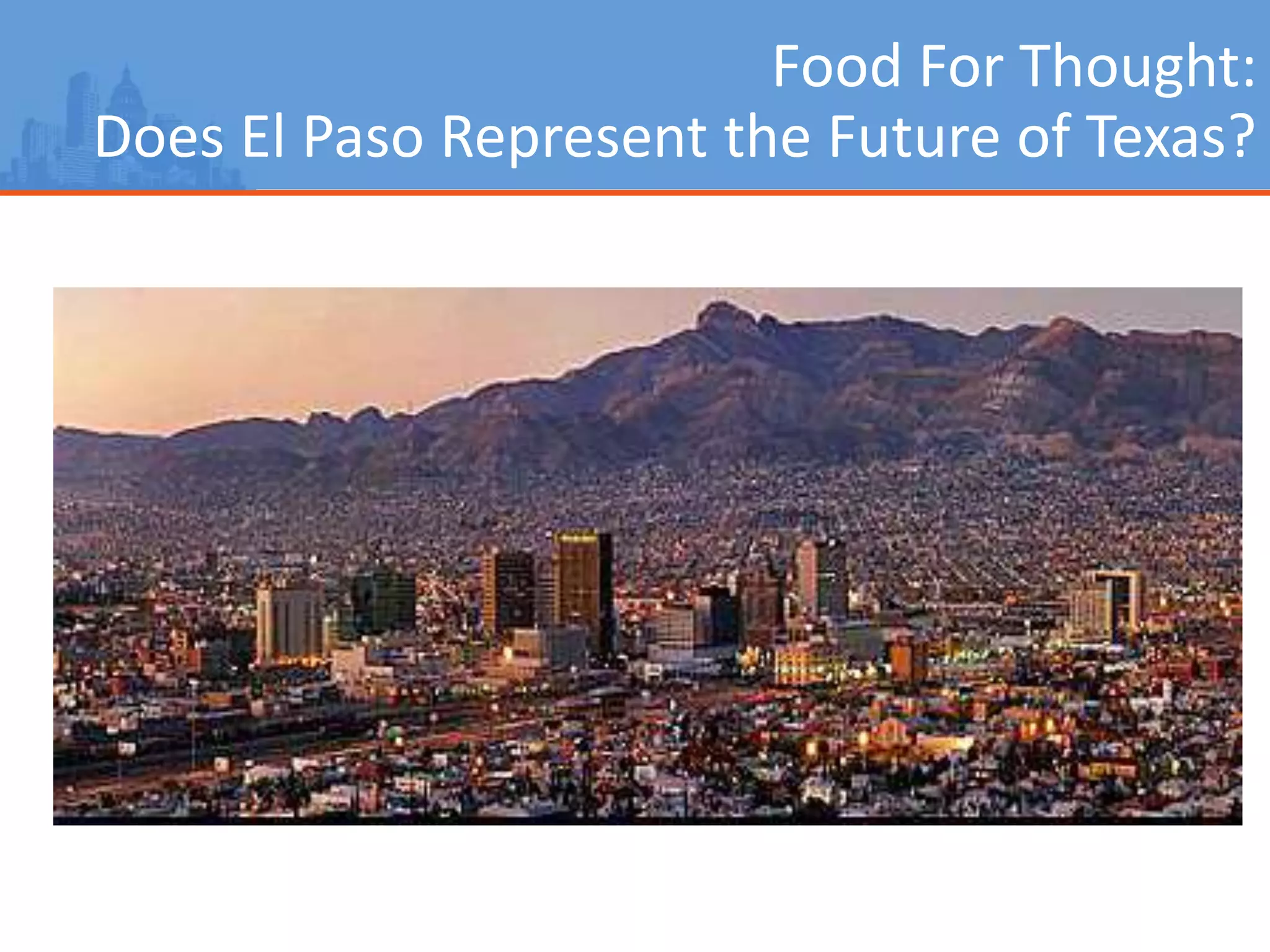
Food For Thought:
Does El Paso Represent the Future of Texas?

Govt 2306 rottinghause_ch01_lecture

  • 1.
    Chapter 1 –The Struggle for Texas: Demographics, Culture, and Political Power 1
  • 2.
    Chapter 1: TheStruggle for Texas Learning Objectives 1.1 Describe the settlement history of Texas. 1.2 Assess the impact industries have made to the Texas economy from 1860 to today. 1.3 Analyze how the changing demographics of the state affect government. 1.4 Examine the source and impact of political culture in Texas. 2
  • 3.
    The Origins ofTexas Native Americans • Native Americans occupied the lands of Texas more than 10,000 years before the arrival of Europeans. • Tribes in North America competed for land, pushing each other into new territory and eventually settling in lands throughout Texas.
  • 4.
    The Origins ofTexas Native Americans • Native Americans occupied the lands of Texas more than 10,000 years before the arrival of Europeans. • Tribes in North America competed for land, pushing each other into new territory and eventually settling in lands throughout Texas.
  • 5.
    The Origins ofTexas • The multiple tribes that settled Texas between 1500 and 1776 arrived in Texas from the northern plain states.
  • 6.
    Recognized Native AmericanTribes in Texas Today Tiguas Alabama Coushetta Kikapoo
  • 7.
    The Origins ofTexas Spanish Settlers • The name Texas derives from a Cado Indian word that means “friendly” or “ally,” the term attributed to native populations by Spanish explorers. • In the 1530s and 1540s, Spanish explorers first penetrated coastal, northern, and eastern Texas. • Over the next two centuries, the Spanish established missions and military outposts.
  • 8.
    The Origins ofTexas Spanish Settlers • Expansion into Texas protected the interior of New Spain • “Glory, God and Gold” summarized the Spanish colonists’ approach to settlement • Spain increased taxes on the colonies to pay debts which prompted a revolutionary movement • New Spain, United Mexican States, won independence in 1821
  • 9.
    Spanish Settlement ofTexas Video https://youtu.be/Z1rEb3m3lIA
  • 10.
    The Origins ofTexas Tejanos • Tejanos primarily worked in and around the ranching communities of the region that had sprung up near military outposts along the northern frontier of Mexico. • Transformed settler life from agrarian to ranching • Like the Anglos who were immigrating to Texas during this time, Tejanos resisted centralized authority and embraced the idea of local self governance. • Shaped local laws before the revolution, planed the seeds of Texas independence
  • 11.
    Tejano Culture inTexas https://youtu.be/Z1rEb3m3lIA
  • 12.
    The Origins ofTexas Anglos • Mexico used Texas as a source of economic revenue • Land-hungry United States threatened Spanish control • 1820s Mexico aggressively promoted Anglo settlement in Texas • Empresarios: individuals granted the right to help settle a new land and recruit new settlers • Laws in 1830 stopped further immigration into Texas spurred Anglo illegal immigration
  • 13.
    Moses Austin andthe Texas Venture https://youtu.be/BY7g3Eim0ww
  • 14.
    The Origins ofTexas African Americans • By 1823, Mexico had banned slavery, but beginning in 1829, Anglo settlers brought African American slaves with them under the guise of “contract labor.” • By 1847, after Texas gained her independence and subsequently joined the U.S., the number of slaves was around 38,753.
  • 15.
    The Origins ofTexas African Americans • Before the Civil War, African Americans faced harsh slave codes • Civil War and Reconstruction brought the promise of freedom, but “Black Codes” restricted access and relegated African Americans to work as agricultural laborers • 1890s most African Americans worked as tenant farmers on former plantations • African Americans established “freedmantowns” on the outskirts of major cities
  • 16.
    The Origins ofTexas African Americans • Before the Civil War, African Americans faced harsh slave codes • Civil War and Reconstruction brought the promise of freedom, but “Black Codes” restricted access and relegated African Americans to work as agricultural laborers • 1890s most African Americans worked as tenant farmers on former plantations • African Americans established “freedmantowns” on the outskirts of major cities
  • 17.
    African American History- Video https://youtu.be/zQiJ95GhFhk
  • 18.
    Continuity and Changein the Texas Economy • Texas as an independent nation would rank tenth in the world • Home to six of the top fifty companies on the Fortune 500 list • Gross state product is second highest in the United States • Economy relies on a mix of agriculture and ranching, oil and natural gas, military and defense, information technology, electric power and manufacturing
  • 19.
    The Three “C’s”of Texas CATTLE COTTON CRUDE
  • 20.
    Continuity and Changein the Texas Economy • Six Major Economic Booms – Cotton: beginning in 1860s – Cattle: beginning in 1880s – Oil: 1910s – Manufacturing: 1930s – High Tech: 1990s – Oil and Natural Gas: 2005
  • 21.
    THE FIRST STAGE– TAKE IT • Until recently, the Texas economy was firmly grounded in extractive activities - –Taking something directly from the land • Depended on the three Cs - cattle, cotton, and crude - –Crucial during Texas’s formative years
  • 22.
    THE SECOND STAGE– MAKE IT • Manufacturing expansion went into full swing with the advent of WWII and growth of defense contractors • Leading manufacturer of petroleum-based chemicals and compounds • Steel production and metal smelting increased in the 1970s
  • 23.
    THE THIRD STAGE– SERVE IT • 1980S economic disaster: – Collapse of the oil industry, and severe cuts in defense spending • 1990s comeback: – Economic optimism was widespread • 2000s: – Terrorist attacks, corporate misdeeds, and a questionable government regulatory climate • Growth in service industry jobs in metropolital areas
  • 24.
    Continuity and Changein the Texas Economy
  • 25.
    Continuity and Changein the Texas Economy Food and Fiber • In Antebellum Texas, three-quarters of all families drew their living from the state’s plentiful farmland. • Corn in the east, sorghum in the west, wheat in the northern plains, citrus in the south and rice in the coastal prairies
  • 26.
    Continuity and Changein the Texas Economy Food and Fiber • Cotton was the most prominent crop. • Since the early 1900s, Texas has been the leading cotton-producing state in the nation, and today Texas accounts for 25 % of the entire US crop. • Timber played a major role between 1880 and 1910 • Today, Texas lead the nation int eh production of several agricultural staples
  • 27.
    Continuity and Changein the Texas Economy Fuel • The discovery of a major oil deposit beneath the marshy soil at Spindletop Hill in Beaumont, TX, in 1901 ushered in a new economic era and one that continues to drive the state’s financial booms and busts. • By 1940, Texas was the leading oil-producing state in the United States and central to the war effort. • Pumping and production regulated by the Texas Railroad Commission • Today, Texas is a world leader in the energy industry.
  • 28.
    Permian Basin OilBoom https://youtu.be/qwqne4SmwX4
  • 29.
    Continuity and Changein the Texas Economy More Economic Drivers • Cattle • Manufacturing • Military and Defense Industries • High Tech • Health Care • Recreation and Retirement
  • 30.
    Continuity and Changein the Texas Demographics State Population Growth • Texas today is the fastest growing of the large states in the United States. • “Sunbelt” states, such as Texas, are growing rapidly as baby boomers retire and as jobs move from the industrial northeast and Midwest to the South. • With population growth comes greater sway in presidential elections, more seats in Congress, and thus more power on the national level.
  • 31.
    Continuity and Changein the Texas Demographics
  • 32.
    Continuity and Changein the Texas Demographics Urbanization • The population has not increased uniformly across the state. Much of the growth has occurred in urban areas • In 1890, Texas had no urban areas with a population larger than 40,000. • By 1920, four cities Dallas, Fort Worth, Houston, and San Antonio boasted more than 100,000 each. • Today, the “big six” counties (Harris, Dallas, Tarrant, Bexar, Travis, and El Paso) account for 47% of the total population in Texas. • Today, approximately 90% of Texans live in Urban Areas
  • 33.
  • 34.
    Continuity and Changein the Texas Demographics Suburbanization • Most significant demographic change has been a suburbanization • Population shifts from urban and rural areas to suburban areas adjacent to major cities • Texas suburbs made up half of the country’s 10 fastest growing cities in 2016
  • 35.
  • 36.
    Continuity and Changein the Texas Demographics Implications of Population Shifts • Population shifted from rural to urban and suburban centers changing center of political power • Policy priorities follow growing population • Texas government addresses urban and suburban problems and focus less on rural issues • Number of representatives for urban and suburban areas rise • Political divisions develop between conservative suburbs and liberal urban areas
  • 37.
    Continuity and Changein the Texas Demographics Challenges of Population Growth Infrastructure • Affordable Housing • Water Use • Health Care • Energy Use Note: These are often “Kick the Can” or “Third Rail” issues to many Texas Lawmakers – They’re too controversial to touch safely.
  • 38.
    Continuity and Changein the Texas Demographics
  • 39.
    Continuity and Changein the Texas Demographics Racial and Ethnic Trends in Texas • Demographic groups have different needs that government must respond to • Segregation: enforced or de facto separation of different racial groups • Anglos were a clear supermajority in 1980s • Rapid rise of Hispanic population has and will continue to alter the social and political shape of the state
  • 40.
    Continuity and Changein the Texas Demographics Racial and Ethnic Trends in Texas • Residential segregation is prevalent in Texas • Anglos live in suburbs • African Americans live in urban areas • Hispanics live in smaller metropolitan areas • Driving some of the growth of the Hispanic population is the foreign-born population
  • 41.
    Continuity and Changein the Texas Demographics Challenges of Shifting Racial and Ethnic Trends • Education – • more public schools than 28 states have residents. • History of Racial & Ethnic Segregation & Disparity • Anglos graduate at rate of 93%, Hispanics 87%, African Americans 85% • 67% of Anglos have college degree; 51% of Hispanics; and 41% of African Americans • Pressure is towards serving diverse populations & rising number of English Language Learners (Not ALL speak Spanish as first language).
  • 42.
    Continuity and Changein the Texas Demographics Challenges of Shifting Racial and Ethnic Trends • Income - Divergent levels of education and opportunity mean income challenges • Median Anglo Income = $56,565; Hispanic = $44,579 • Family Income = $45,000 for African American Families; $70,131 for Anglos; and $82,081 for Asians • Housing – Racial Segregation (redlining, neighborhood price barriers, “white flight,” even history of legal segregation). • Government assisted housing often in less diverse areas; • Recent polls of Anglos & Asians indicates desire NOT to live in racially diverse neighborhoods
  • 43.
    Continuity and Changein the Texas Demographics An Aging State • Texas is aging • Three million residents age sixty-five and older • Younger Texans not growing fast enough to replace those aging • Challenges of an Aging Texas • Income Security • Medicaid • Safety
  • 44.
    Continuity and Changein the Texas Demographics Texas is growing Not all areas growing at same rate Major demographic shifts > Hispanic Population < Anglo Population ? African American Population > Asian Population > Immigration from other States and countries (outside Mexico)
  • 45.
    Continuity and Changein the Texas Political Culture • Texas is a “state of mind and a nation in every sense of the word” John Steinbeck • Texas infused with a spirit of rugged individualism and strong sense of fair play • Texans have expansive and grandiose vision of the state
  • 46.
    You Ask MeWhat I Like About Texas… https://youtu.be/YwNLp6lbQRw
  • 47.
  • 48.
    Invisible Cultural BarrierBetween El Paso and the Rest of Texas? Invisible Geographic And Cultural Divider
  • 49.
    Continuity and Changein the Texas Political Culture Angles of Power • Individual Rights, Equality, and Religious Freedom • Distrust of Government • Trust in the Free Market
  • 50.
    Daniel Elazar’s ThreePolitical Cultures • Political culture – The values, attitudes, traditions, habits, and general behavioral patterns that develop over time and affect the politics of a geographic region • Political subcultures – Moralistic • Government is a public service – Individualistic • Government should be limited – Traditionalistic • Government should preserve the status quo
  • 51.
    Daniel Elazar’s ThreePolitical Cultures
  • 52.
    Texas Has aPolitical Culture Based On Traditionalistic political culture: the goal of the political system is to maintain order, and a hierarchical set of political elites largely determine public policy Law and order: a dimension of Texas political culture that demands a strict adherence to a fair and adequate criminal justice system and swift enforcement of laws Religiosity: the belief, practice, and activity of organized religion Individualistic: “Come and Take it!” Feelings of Sovereignty and Superiority – “Everything’s (Insert Superlative Here) in Texas!
  • 53.
    Continuity and Changein the Texas Political Culture • Religion is a major part of the lives of most Texans. Around 74 percent of respondents indicated that religion was extremely or somewhat important in their lives in 2014.
  • 54.
    Continuity and Changein the Texas Political Culture Culture Conflicts • College Funding • Morals and Money
  • 55.
    Food For Thought: DoesEl Paso Represent the Future of Texas?