The Basics
AP Government
Here’s what we’ll cover…
•What is the purpose of government?
•What are the various forms of government?
•What are the basic values of democracy?
•What are the various political ideologies?
•What are the roots of the American political
system?
What is the purpose of government?
Part one (in groups of five)
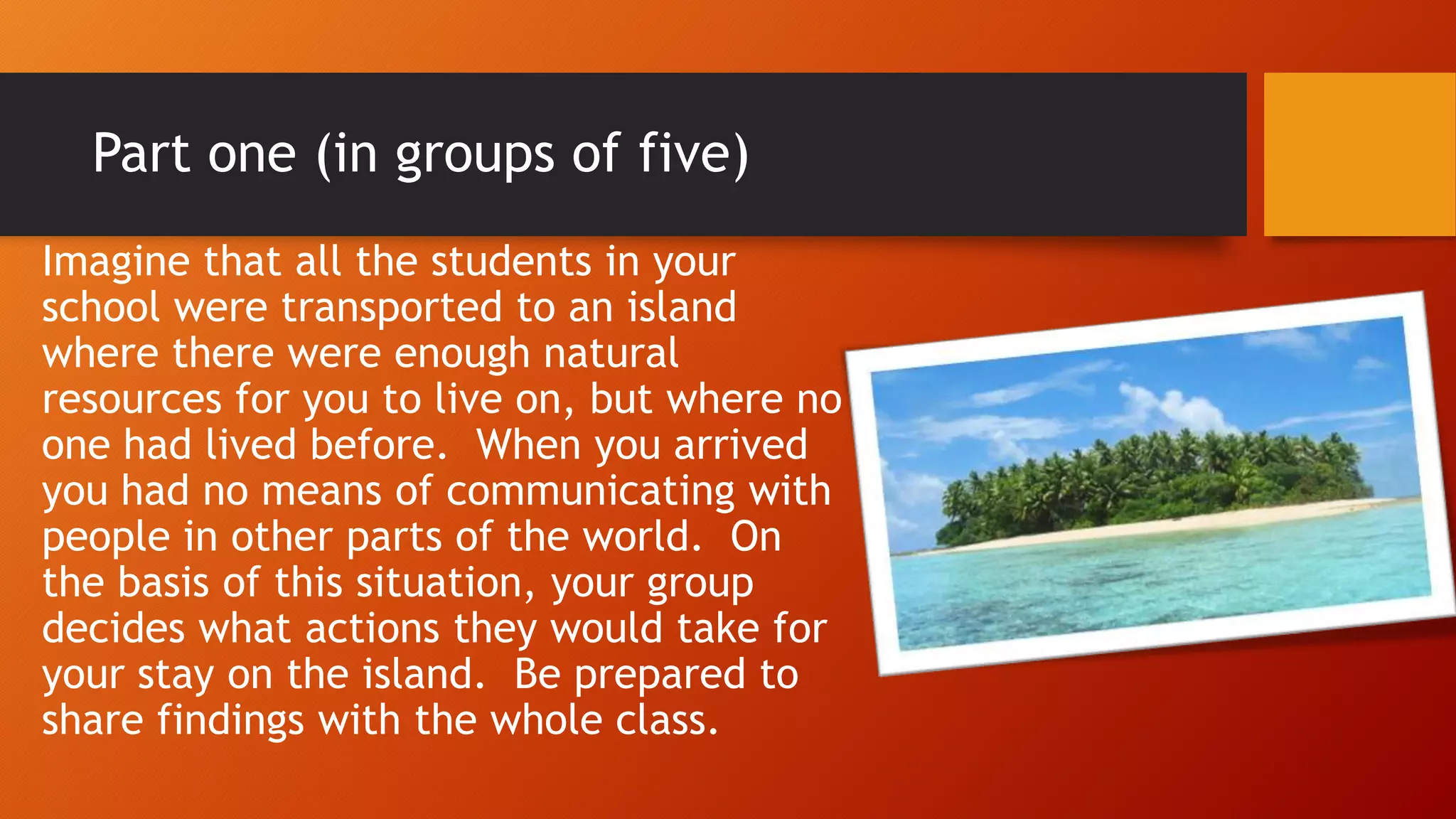
Imagine that all the students in your
school were transported to an island
where there were enough natural
resources for you to live on, but where no
one had lived before. When you arrived
you had no means of communicating with
people in other parts of the world. On
the basis of this situation, your group
decides what actions they would take for
your stay on the island. Be prepared to
share findings with the whole class.
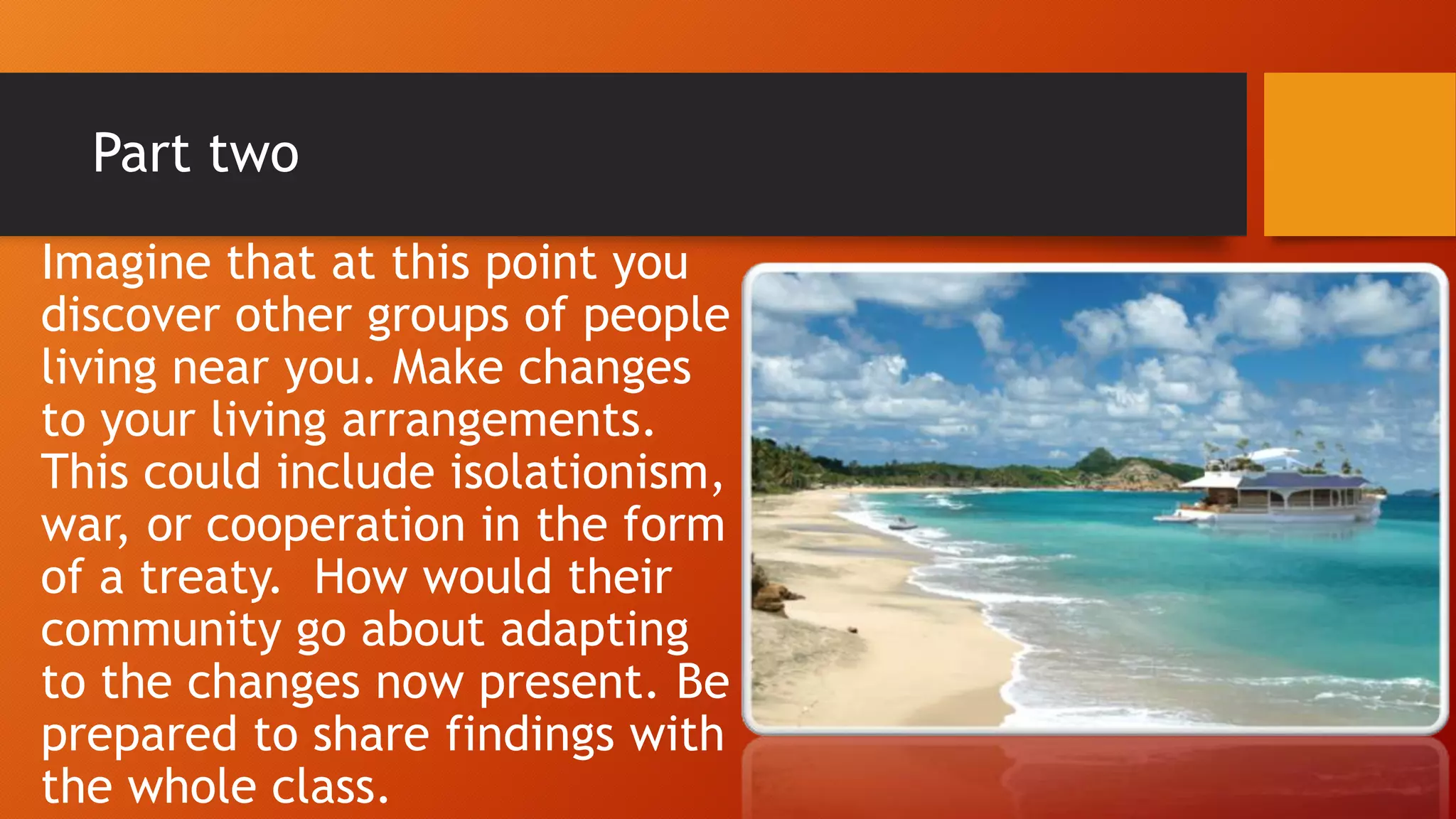
Part two
Imagine that at this point you
discover other groups of people
living near you. Make changes
to your living arrangements.
This could include isolationism,
war, or cooperation in the form
of a treaty. How would their
community go about adapting
to the changes now present. Be
prepared to share findings with
the whole class.
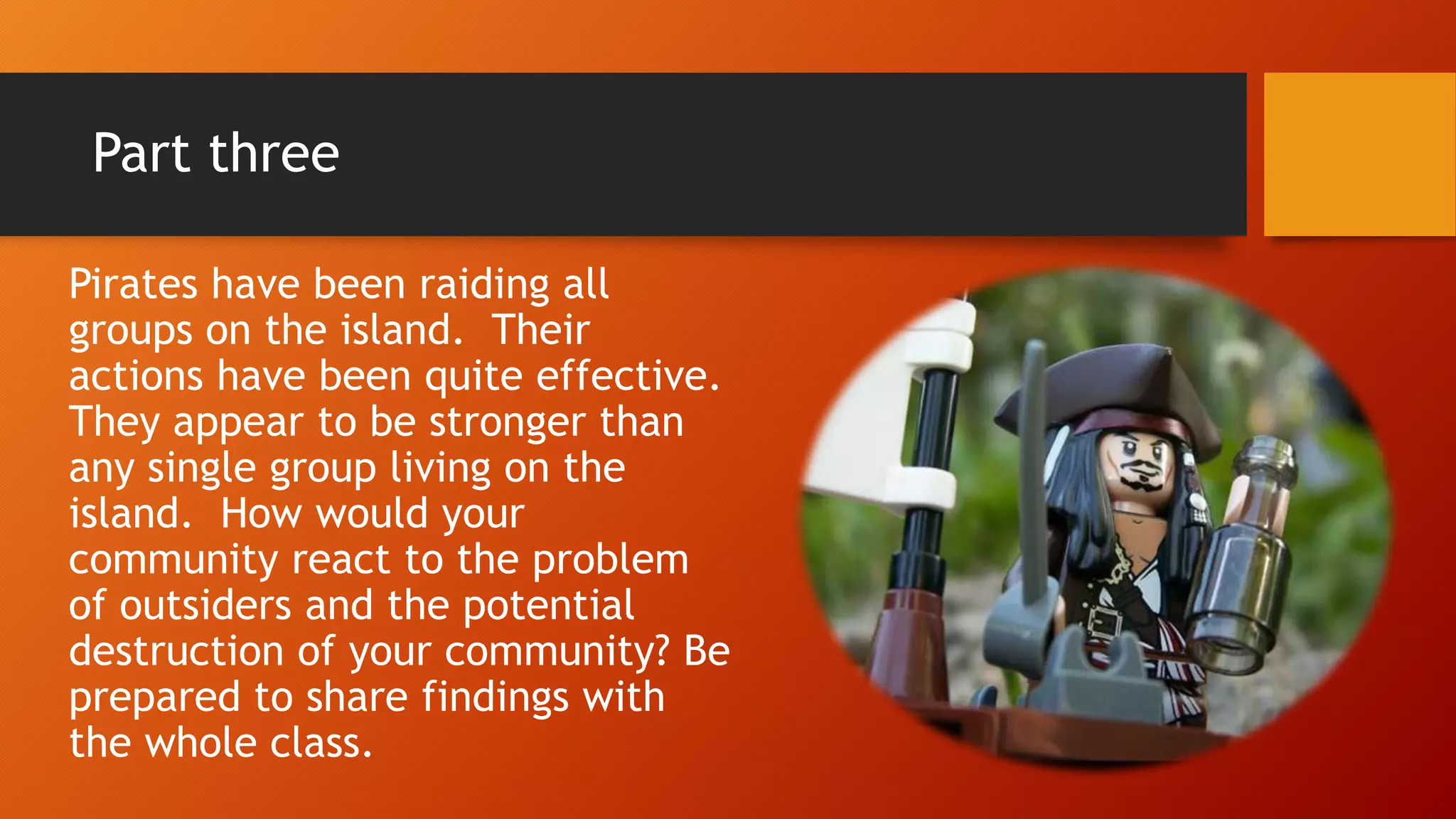
Part three
Pirates have been raiding all
groups on the island. Their
actions have been quite effective.
They appear to be stronger than
any single group living on the
island. How would your
community react to the problem
of outsiders and the potential
destruction of your community? Be
prepared to share findings with
the whole class.
Discuss: What is the purpose of government?
What are the various forms of government?
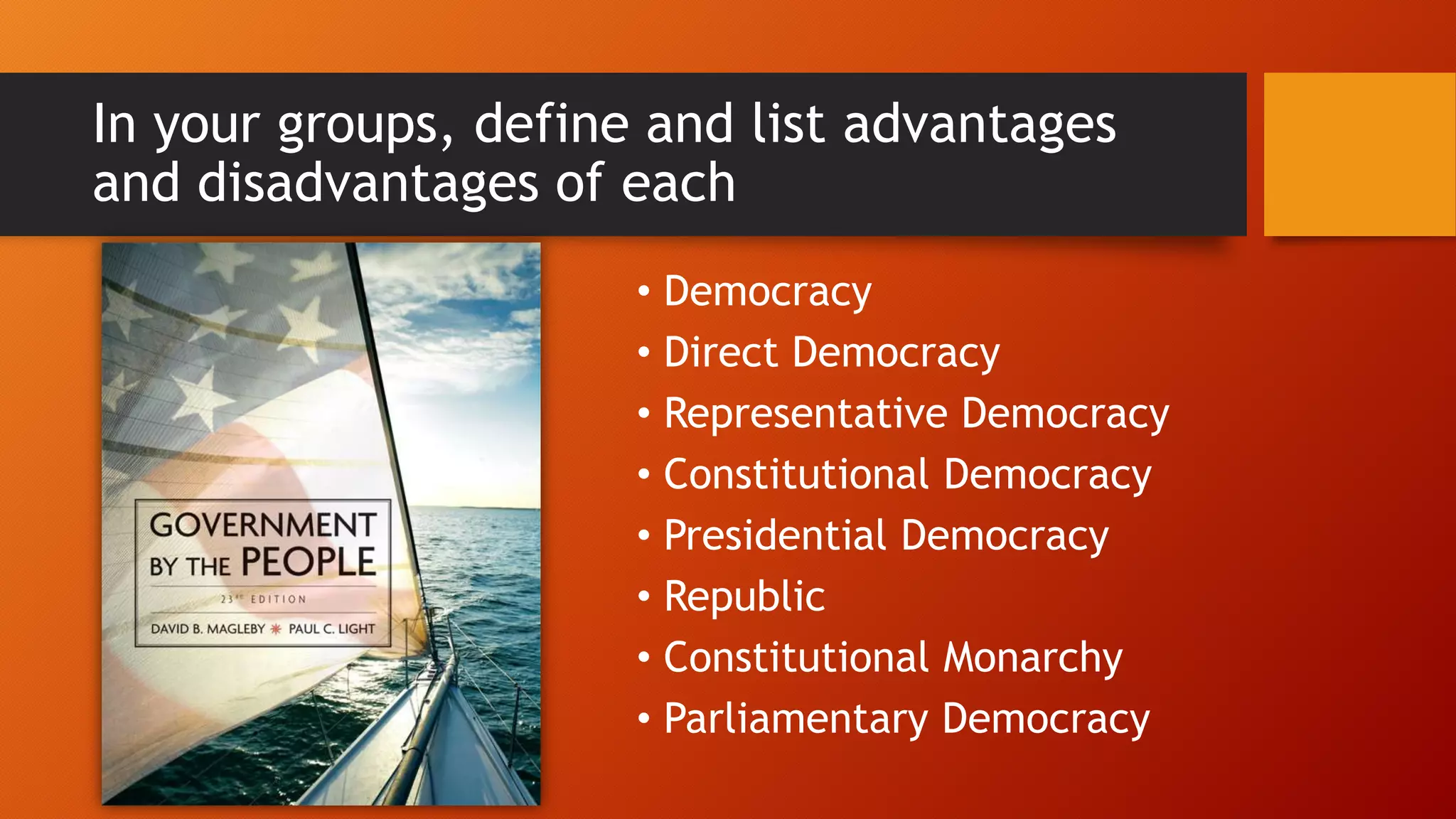
In your groups, define and list advantages
and disadvantages of each
• Democracy
• Direct Democracy
• Representative Democracy
• Constitutional Democracy
• Presidential Democracy
• Republic
• Constitutional Monarchy
• Parliamentary Democracy
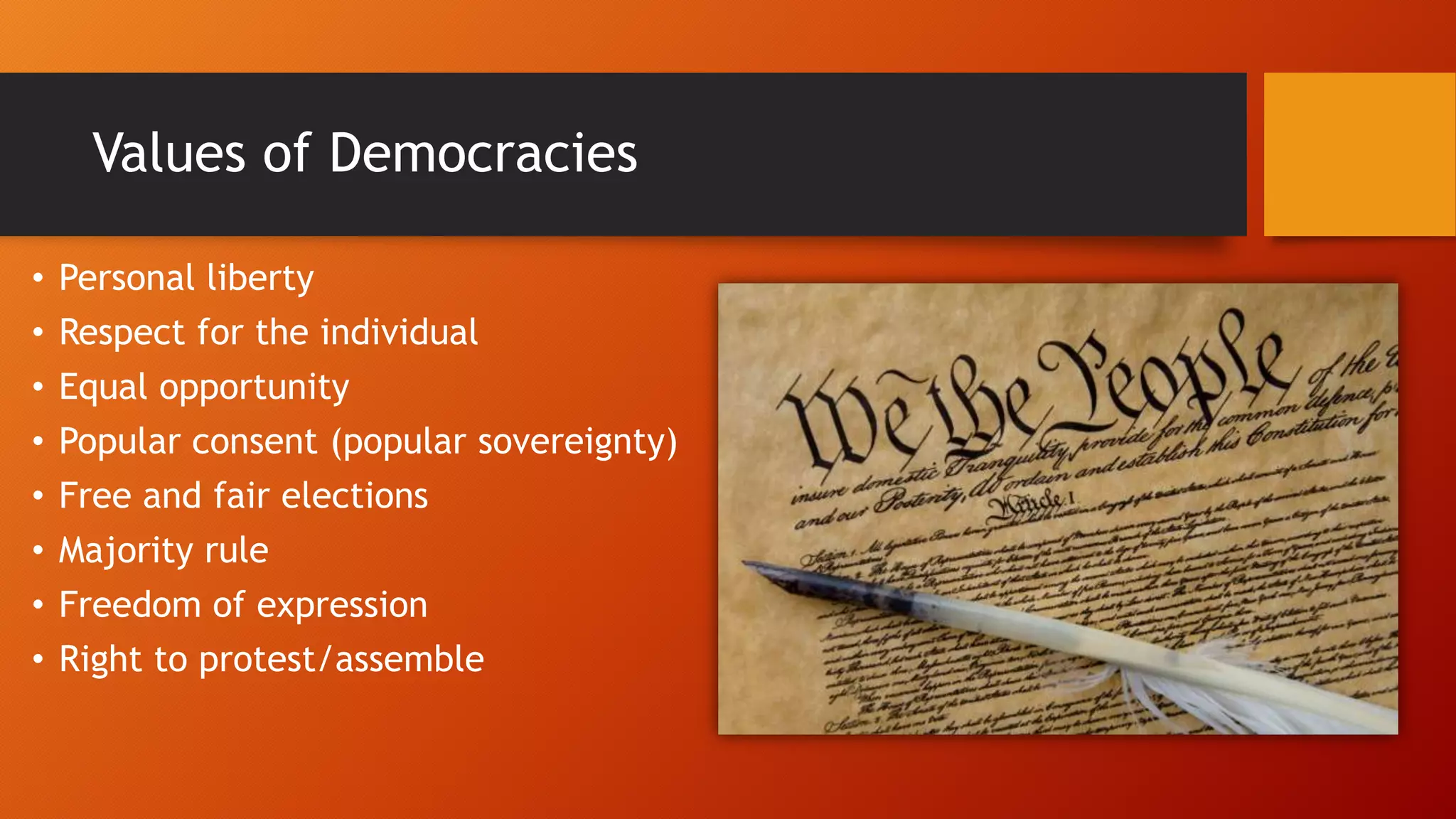
Values of Democracies
• Personal liberty
• Respect for the individual
• Equal opportunity
• Popular consent (popular sovereignty)
• Free and fair elections
• Majority rule
• Freedom of expression
• Right to protest/assemble
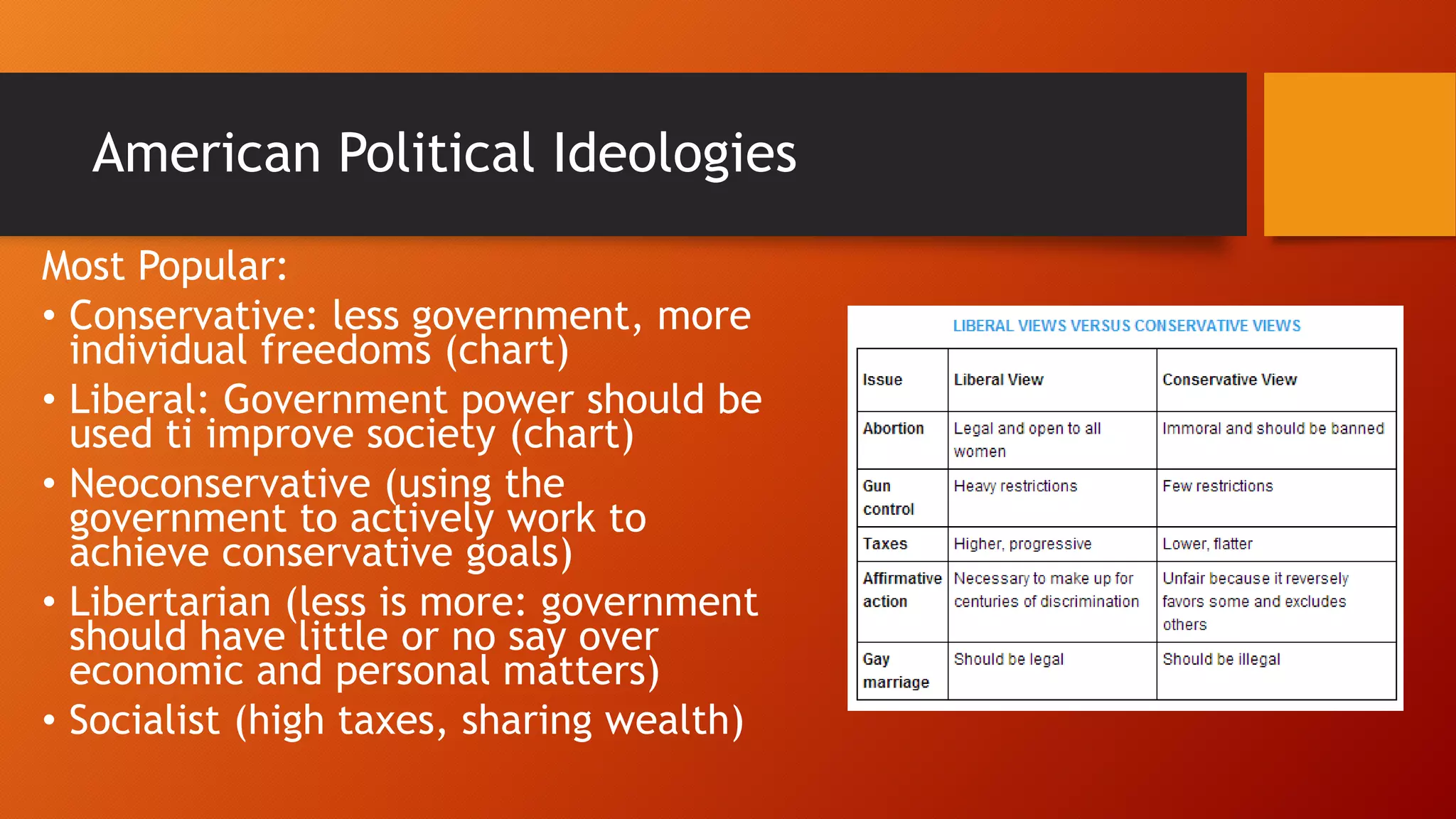
American Political Ideologies
Most Popular:
• Conservative: less government, more
individual freedoms (chart)
• Liberal: Government power should be
used ti improve society (chart)
• Neoconservative (using the
government to actively work to
achieve conservative goals)
• Libertarian (less is more: government
should have little or no say over
economic and personal matters)
• Socialist (high taxes, sharing wealth)
What are the roots of the American political
system?
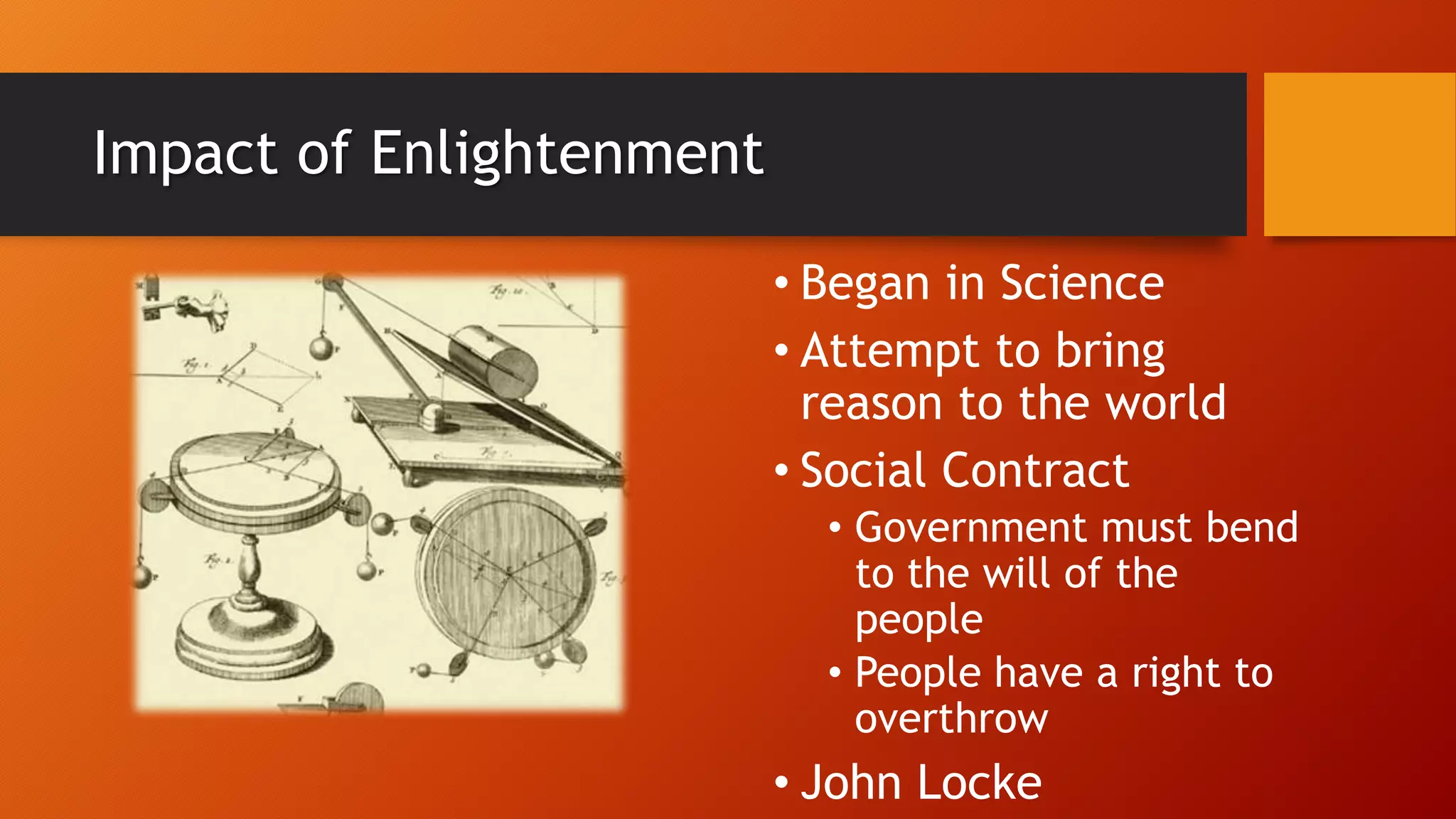
Impact of Enlightenment
• Began in Science
• Attempt to bring
reason to the world
• Social Contract
• Government must bend
to the will of the
people
• People have a right to
overthrow
• John Locke
The Articles of Confederation
• First Government: colonists wanted a constitution-
-a written document that defines rights and
obligations and puts limits on government.
• The colonists created a loose league of friendship
under "The Articles of Confederation.“
• The Articles were a reaction to the unitary system
used in Britain in which all of the power and
sovereignty is vested in the central government
(States were stronger than National Government)
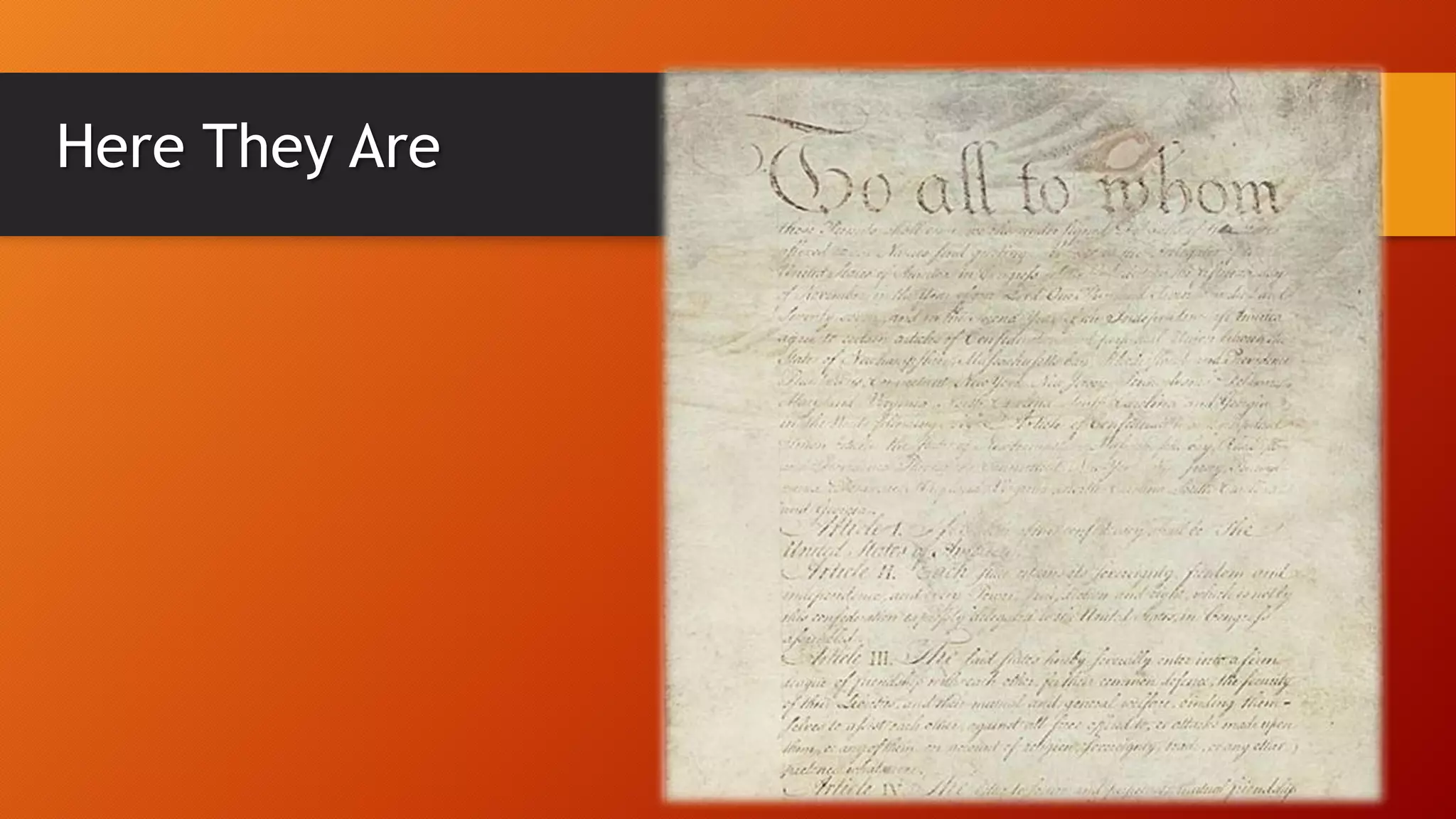
Here They Are
Some of The Articles
• "Each state retains its sovereignty, freedom, and independence, and every
power, jurisdiction, and right, which is not by this Confederation expressly delegated."
• Members of Congress were appointed by state legislatures; individuals could not serve
more than three out of any six years.
• Only the central government is allowed to conduct foreign policy and to war. No states
may have navies or standing armies, or engage in war, without permission of Congress
(although the state militias are encouraged).
• Expenditures by the United States will be paid by funds raised by state legislatures, and
apportioned to the states based on the real property values of each.
• Defines the rights of the central government: to declare war, to set weights and measures
(including coins), and for Congress to serve as a final court for disputes between states.
• Declares that the articles are perpetual, and can only be altered by approval of Congress
with ratification by all the state legislatures.
Problems Under the Articles of
Confederation
• Congress had trouble getting a quorum of nine states to
conduct business
• The Congress had no power to tax. States coined their own
money and trade wars erupted.
• Congress had no power to regulate commerce among the
states or ensure a unified monetary system.
• States conducted foreign relations without regard to
neighboring states' needs or wants.
• Duties, tariffs, and taxes on trade proliferated with different
ones in each state.
America Under the Articles
• The economy began to deteriorate. Several years of bad harvests
ensued. Farmers went into ever-deeper debt.
• Many leaders worried about questions of defense, trade, and
frontier expansion.
• Under the Articles, the central government was not strong enough
to cope with these problems.
• By 1786, several states had called for a convention to discuss ways
of strengthening the national government.
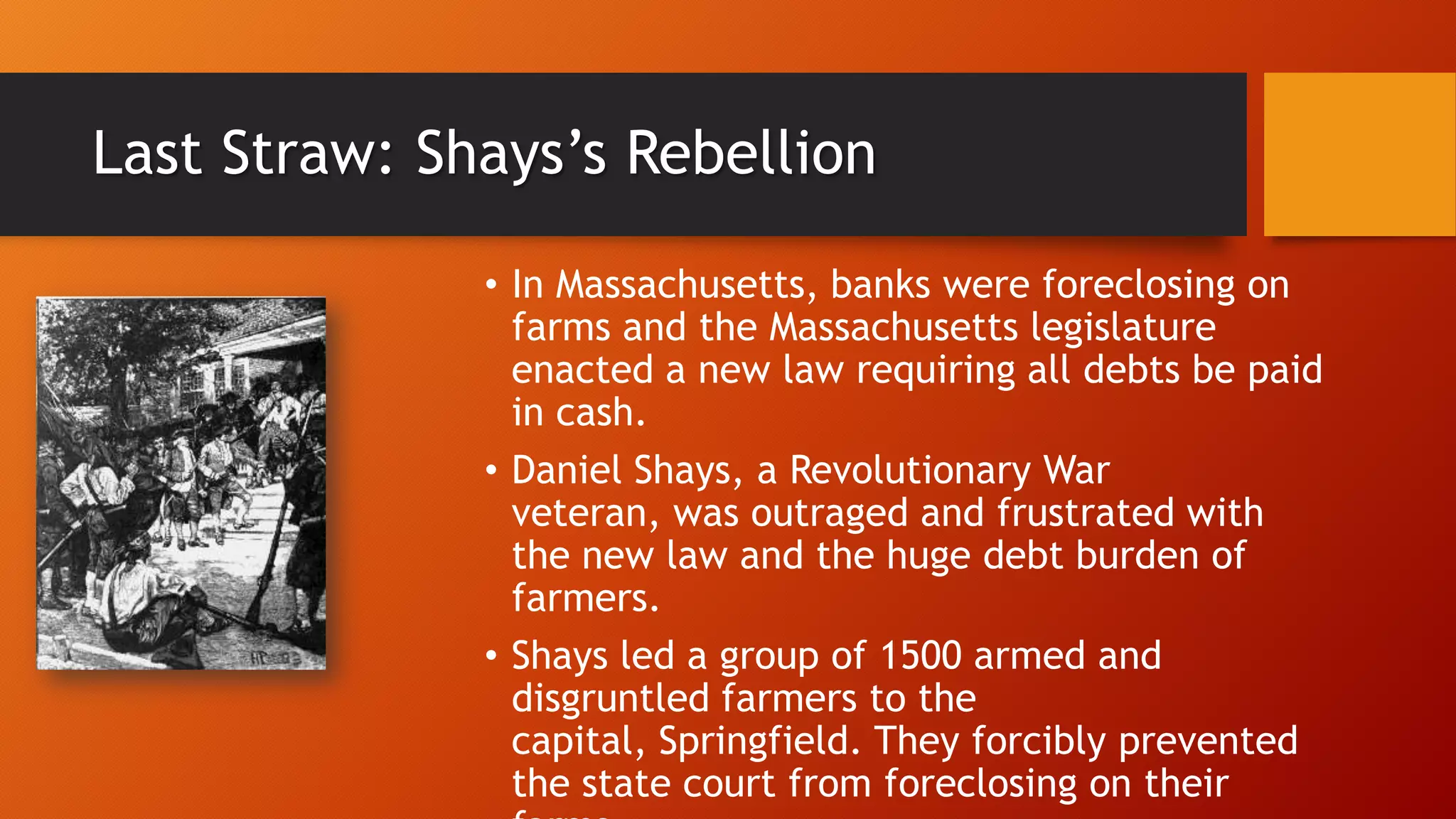
Last Straw: Shays’s Rebellion
• In Massachusetts, banks were foreclosing on
farms and the Massachusetts legislature
enacted a new law requiring all debts be paid
in cash.
• Daniel Shays, a Revolutionary War
veteran, was outraged and frustrated with
the new law and the huge debt burden of
farmers.
• Shays led a group of 1500 armed and
disgruntled farmers to the
capital, Springfield. They forcibly prevented
the state court from foreclosing on their
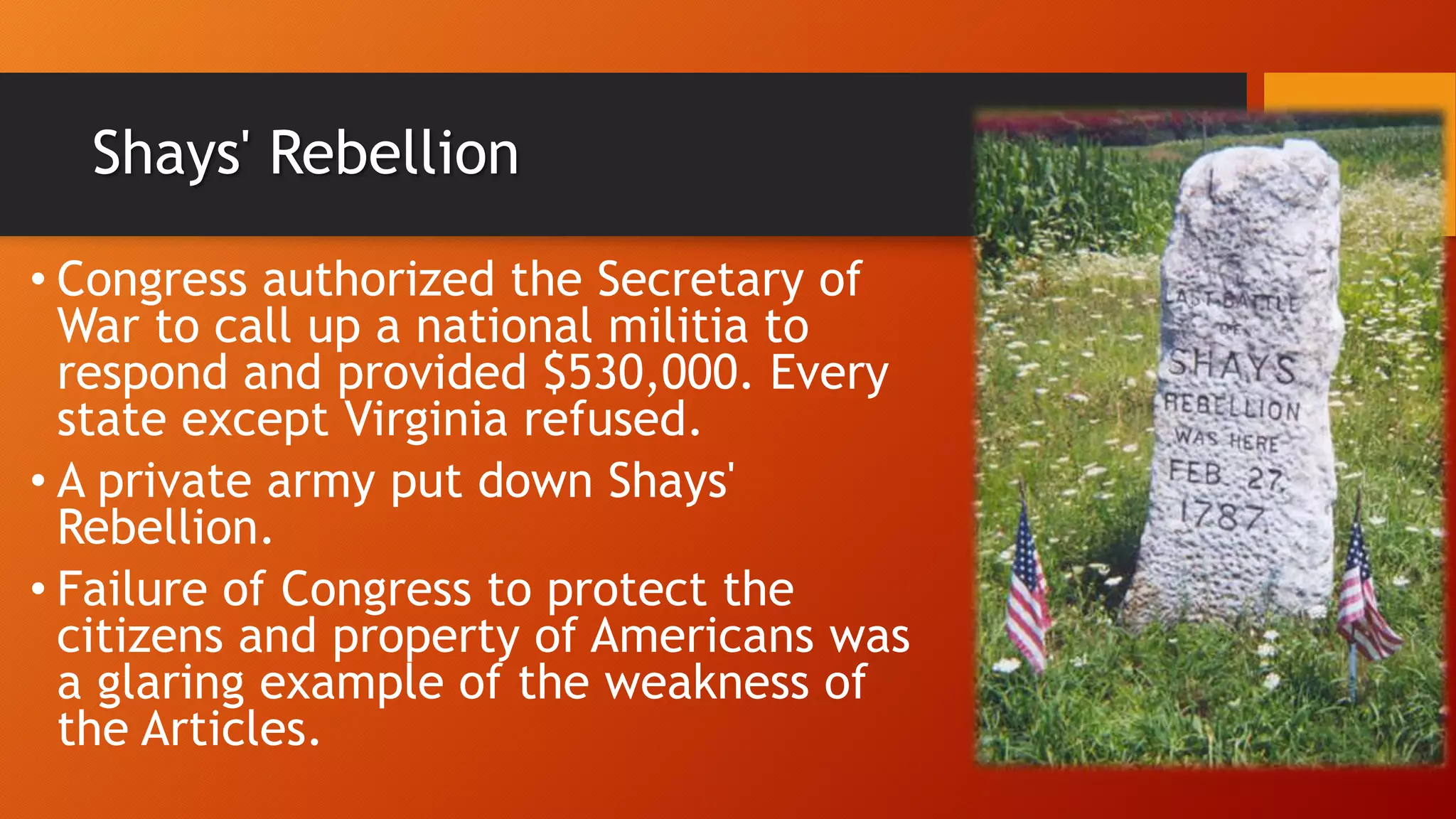
Shays' Rebellion
• Congress authorized the Secretary of
War to call up a national militia to
respond and provided $530,000. Every
state except Virginia refused.
• A private army put down Shays'
Rebellion.
• Failure of Congress to protect the
citizens and property of Americans was
a glaring example of the weakness of
the Articles.
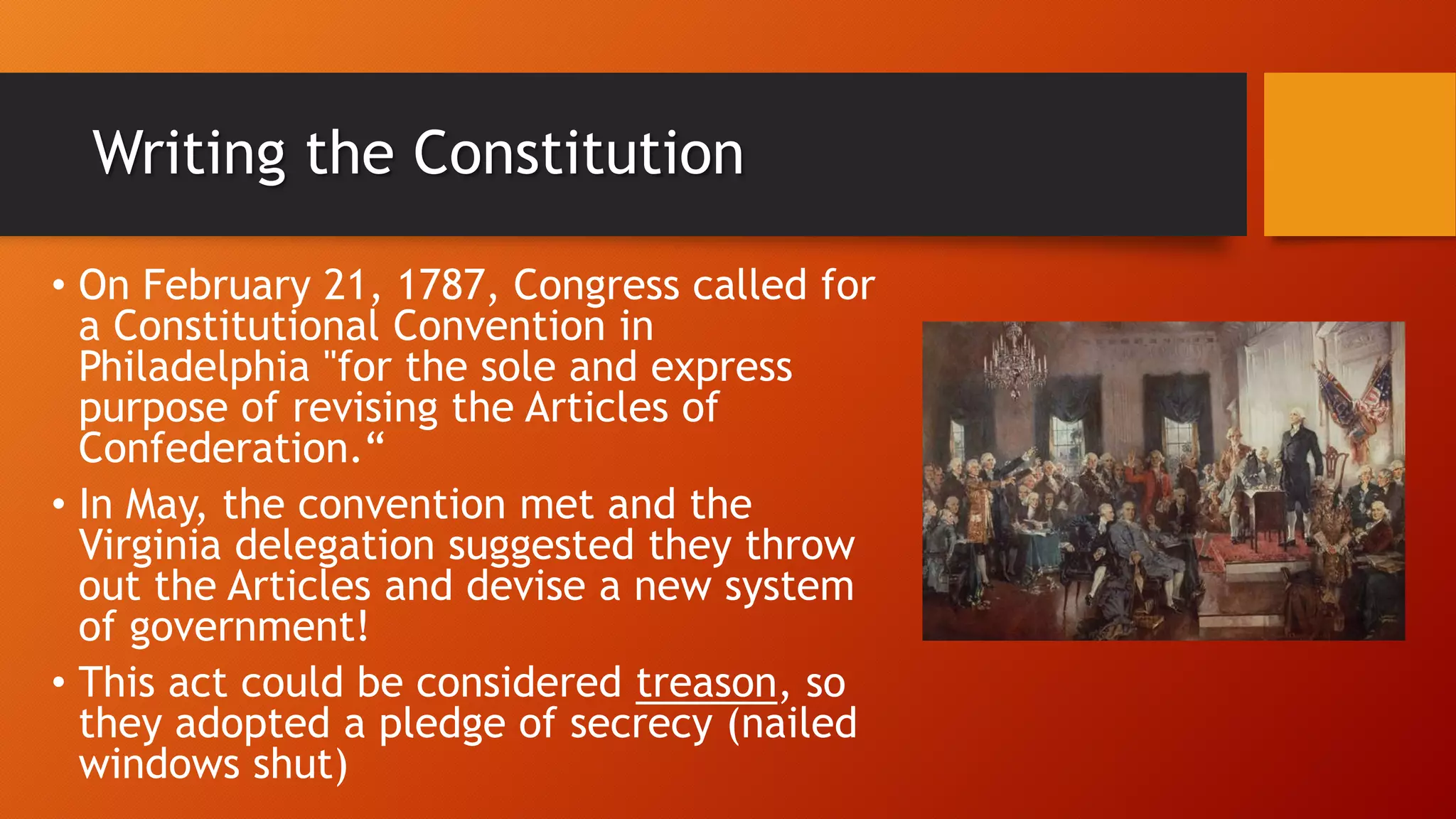
Writing the Constitution
• On February 21, 1787, Congress called for
a Constitutional Convention in
Philadelphia "for the sole and express
purpose of revising the Articles of
Confederation.“
• In May, the convention met and the
Virginia delegation suggested they throw
out the Articles and devise a new system
of government!
• This act could be considered treason, so
they adopted a pledge of secrecy (nailed
windows shut)
The Virginia and New Jersey Plans
• The delegates submitted plans for a new government.
• The Virginia Plan proposed that sovereignty be vested in the
people and not the states.
• The New Jersey Plan would have primarily strengthened the
Articles by giving Congress the ability to raise revenues and would
have kept a unicameral legislature chosen by state legislatures.
The Great Compromise
• Connecticut offered a compromise taking
elements of each plan.
• The legislature would be bicameral with the
lower house (House of Representatives)based on
population and the upper house (Senate)
premised on equal representation for the states.
• Both houses had to pass all legislation so both
small and large states were satisfied.
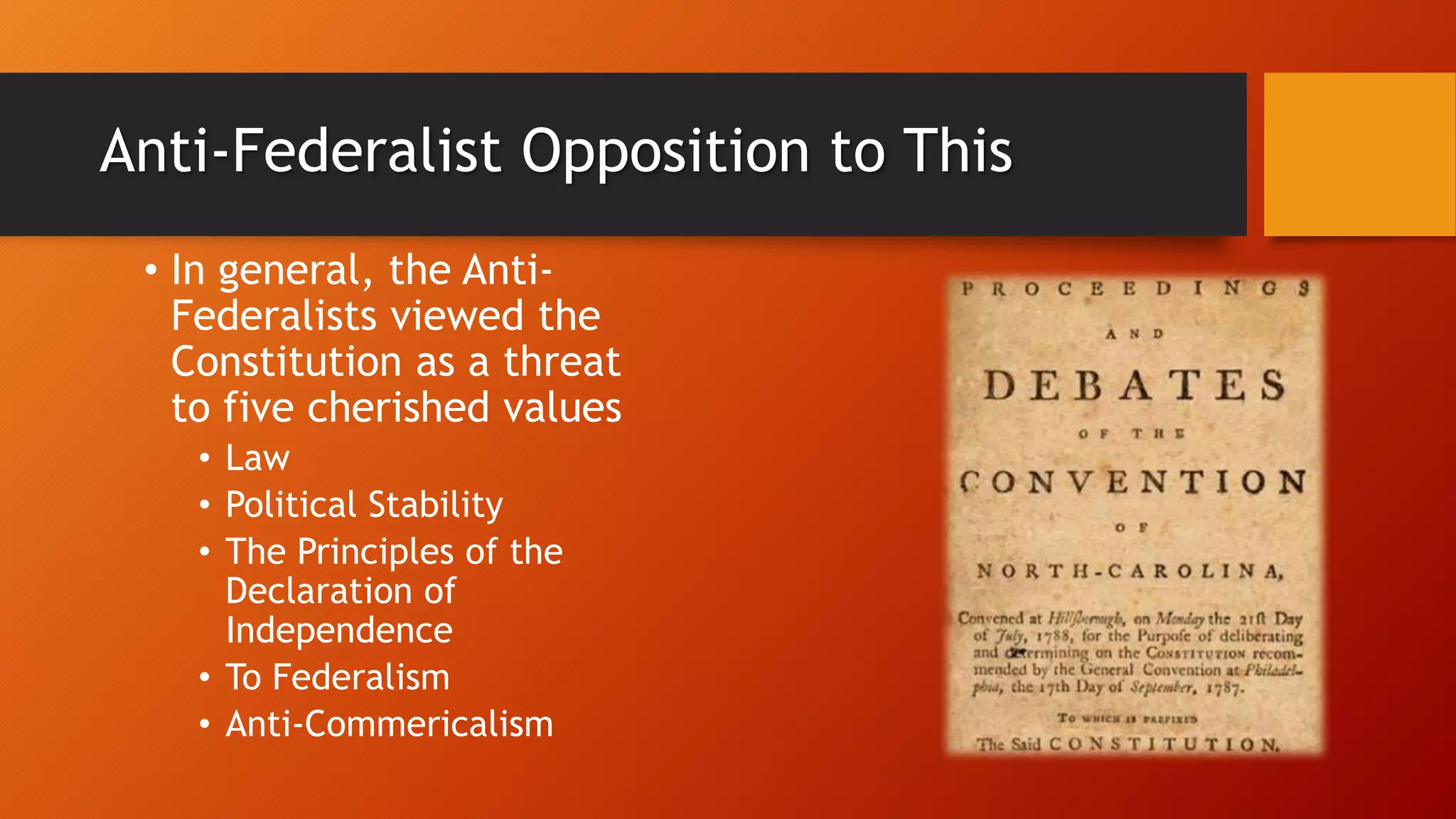
Anti-Federalist Opposition to This
• In general, the Anti-
Federalists viewed the
Constitution as a threat
to five cherished values
• Law
• Political Stability
• The Principles of the
Declaration of
Independence
• To Federalism
• Anti-Commericalism
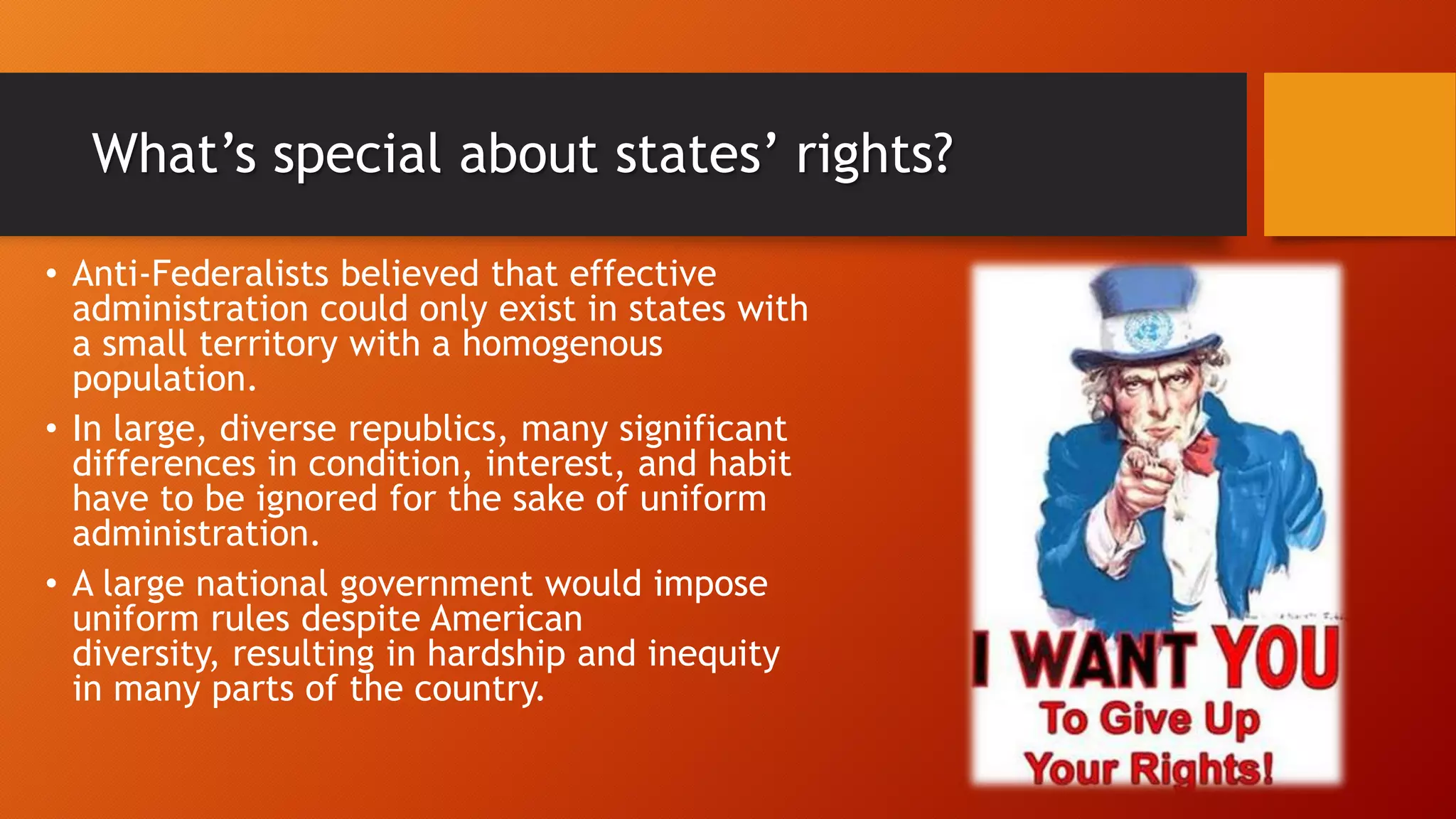
What’s special about states’ rights?
• Anti-Federalists believed that effective
administration could only exist in states with
a small territory with a homogenous
population.
• In large, diverse republics, many significant
differences in condition, interest, and habit
have to be ignored for the sake of uniform
administration.
• A large national government would impose
uniform rules despite American
diversity, resulting in hardship and inequity
in many parts of the country.
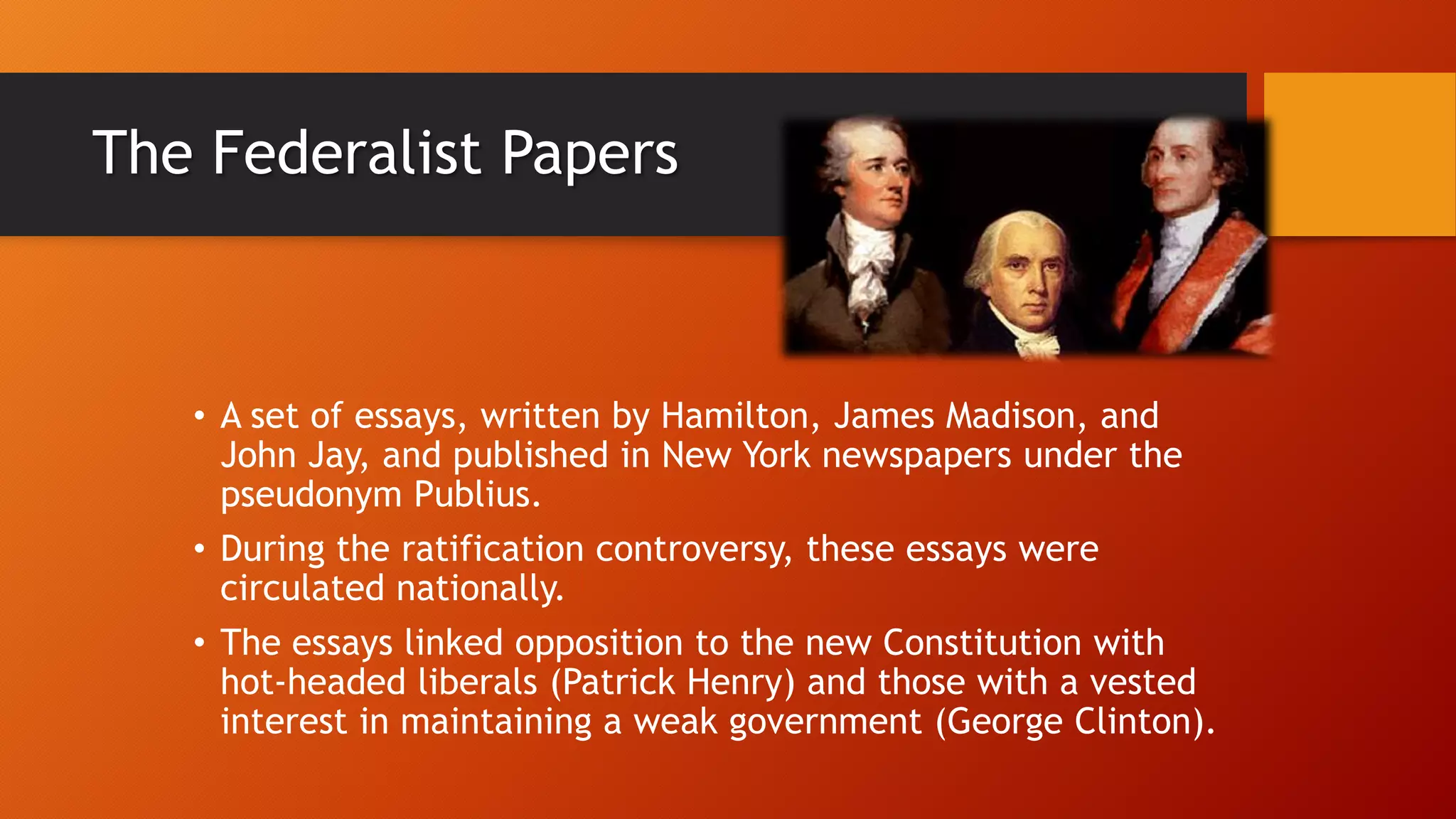
The Federalist Papers
• A set of essays, written by Hamilton, James Madison, and
John Jay, and published in New York newspapers under the
pseudonym Publius.
• During the ratification controversy, these essays were
circulated nationally.
• The essays linked opposition to the new Constitution with
hot-headed liberals (Patrick Henry) and those with a vested
interest in maintaining a weak government (George Clinton).
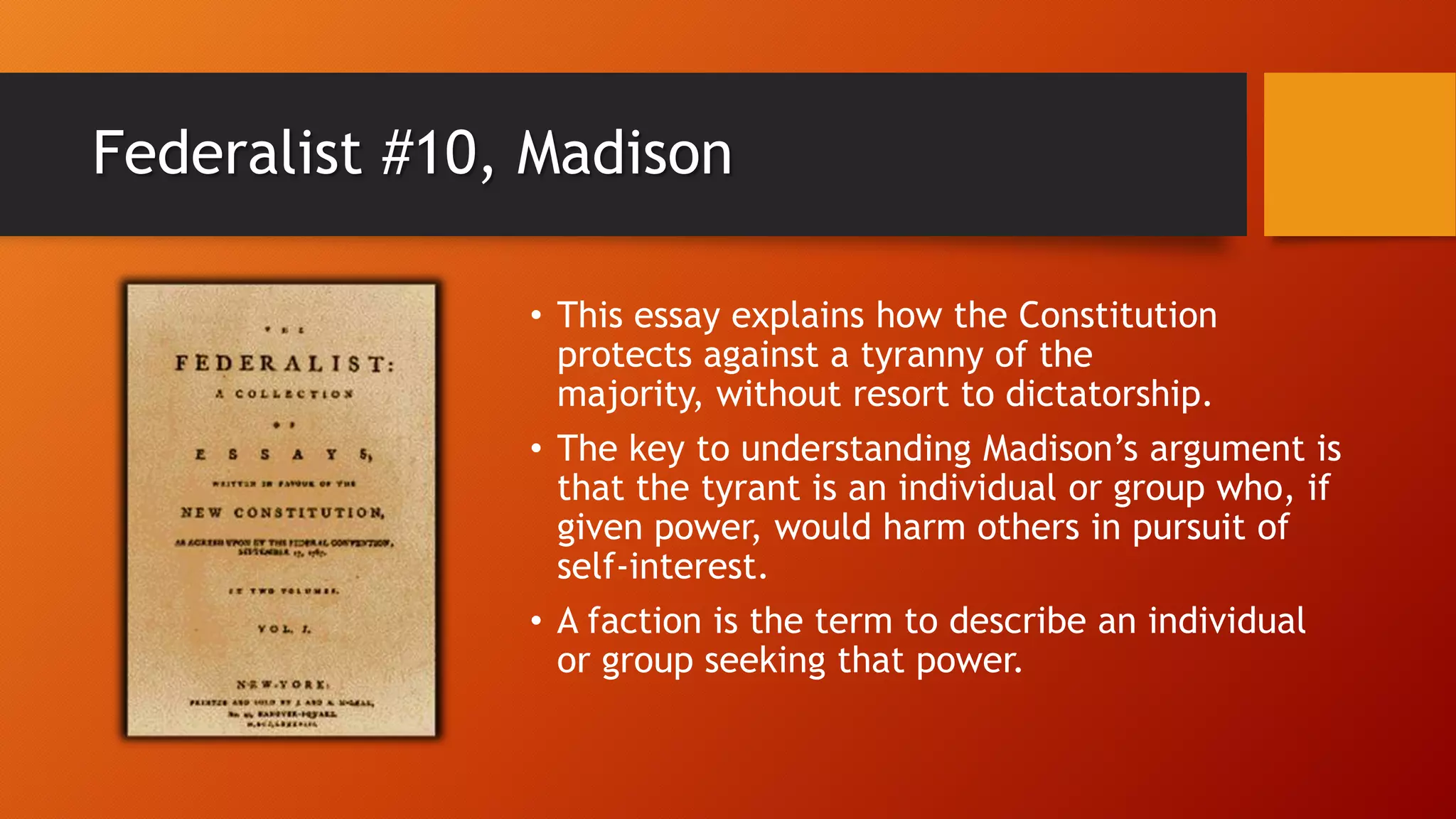
Federalist #10, Madison
• This essay explains how the Constitution
protects against a tyranny of the
majority, without resort to dictatorship.
• The key to understanding Madison’s argument is
that the tyrant is an individual or group who, if
given power, would harm others in pursuit of
self-interest.
• A faction is the term to describe an individual
or group seeking that power.
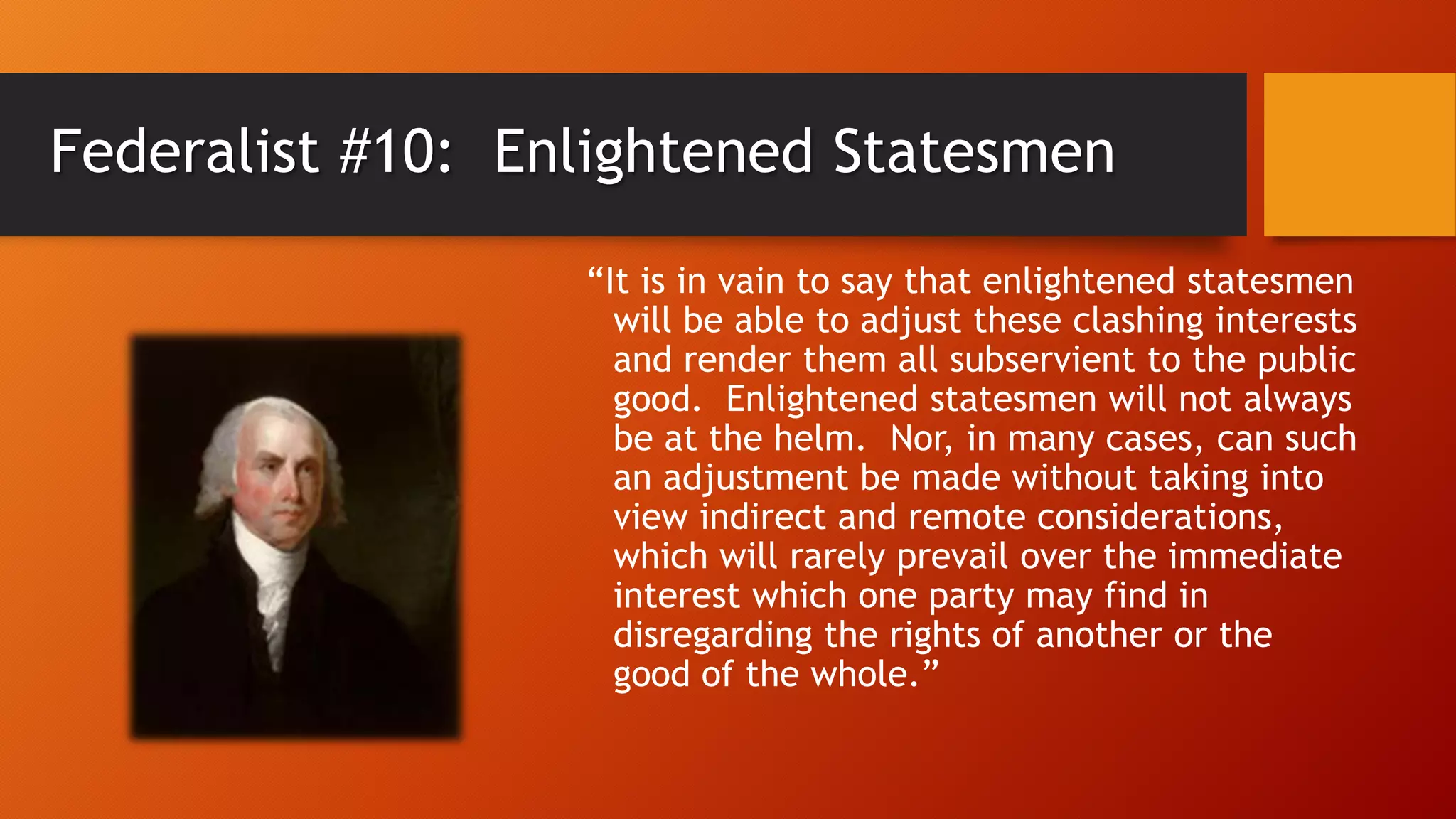
Federalist #10: Enlightened Statesmen
“It is in vain to say that enlightened statesmen
will be able to adjust these clashing interests
and render them all subservient to the public
good. Enlightened statesmen will not always
be at the helm. Nor, in many cases, can such
an adjustment be made without taking into
view indirect and remote considerations,
which will rarely prevail over the immediate
interest which one party may find in
disregarding the rights of another or the
good of the whole.”
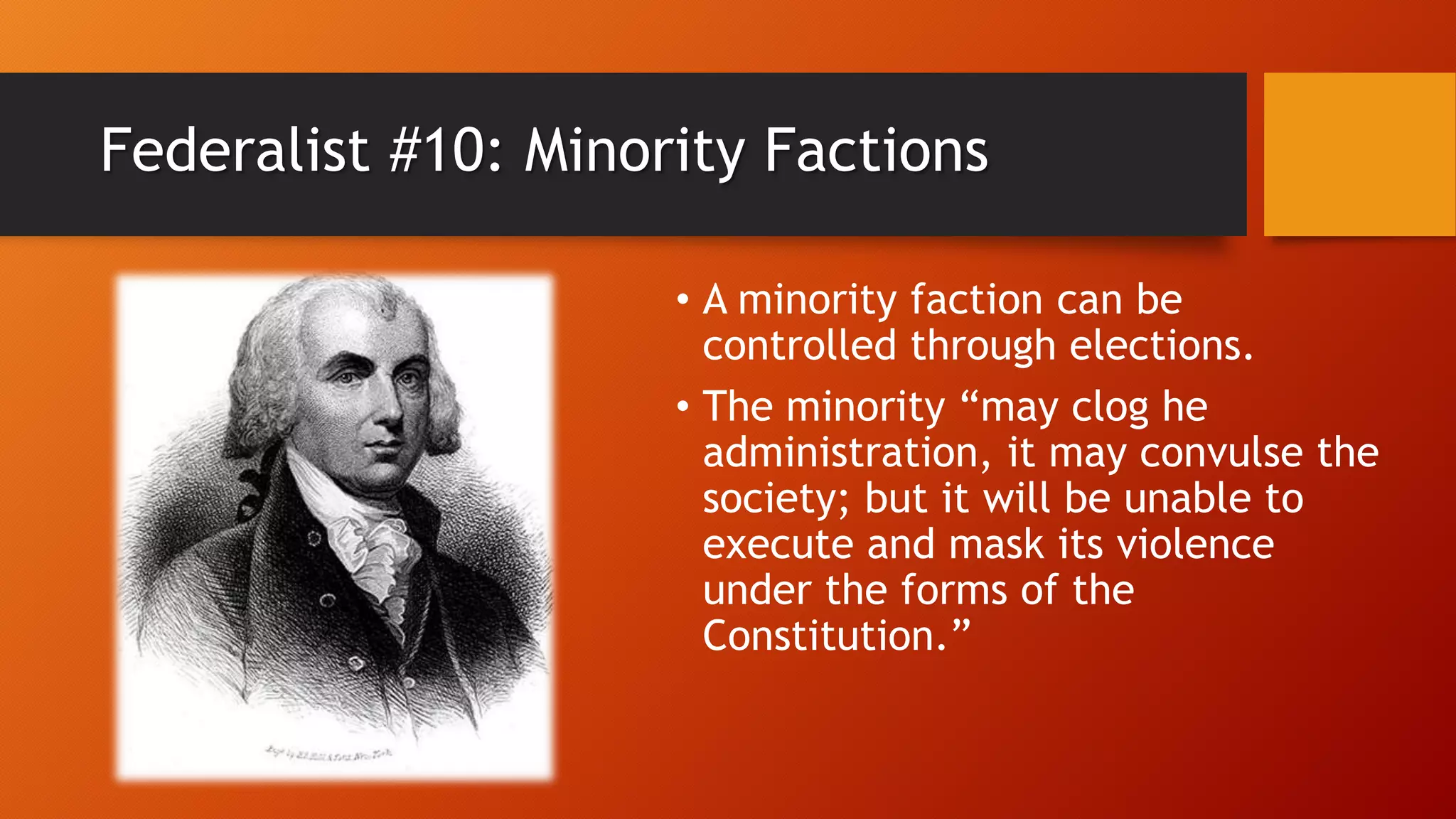
Federalist #10: Minority Factions
• A minority faction can be
controlled through elections.
• The minority “may clog he
administration, it may convulse the
society; but it will be unable to
execute and mask its violence
under the forms of the
Constitution.”
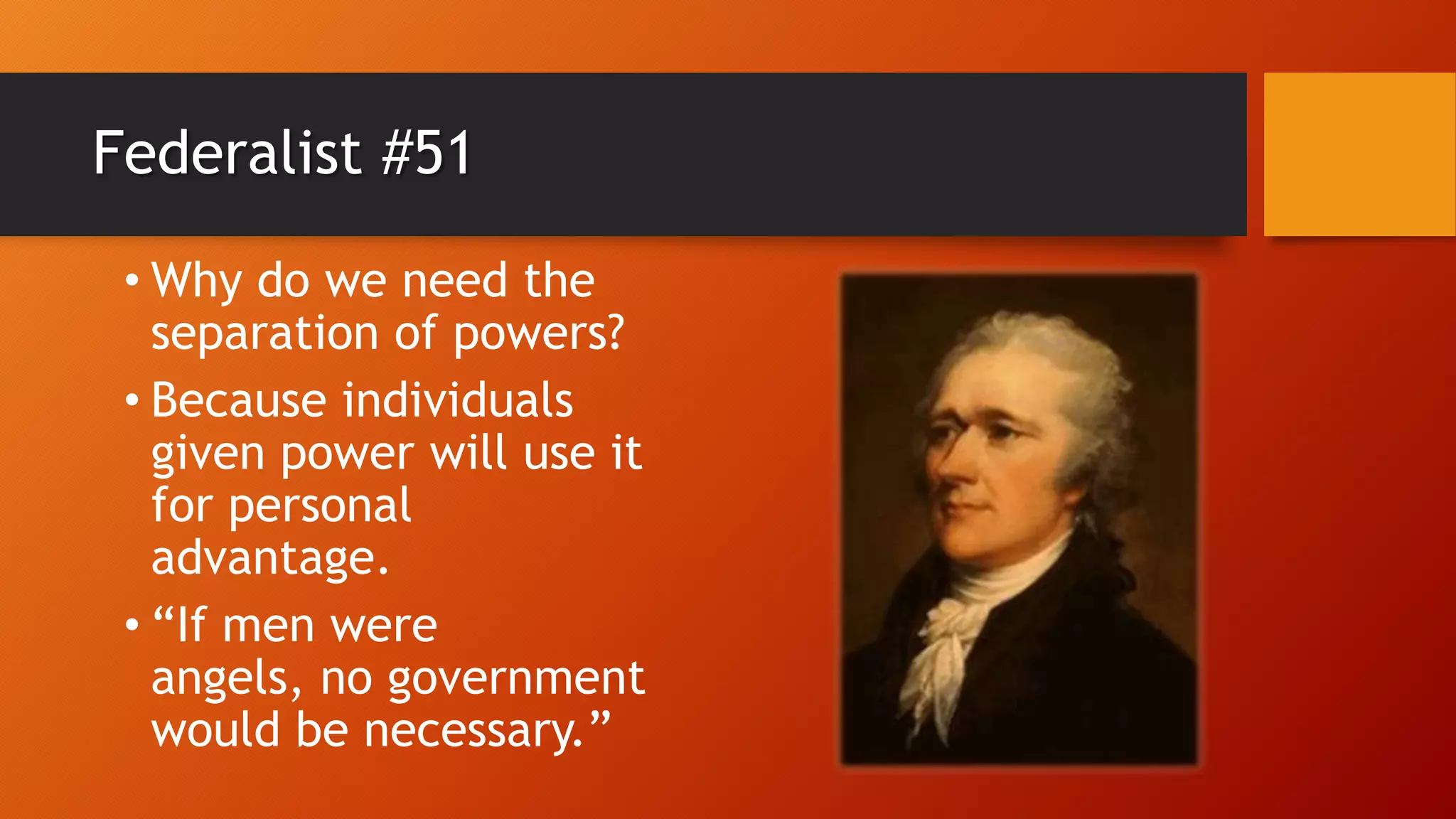
Federalist #51
• Why do we need the
separation of powers?
• Because individuals
given power will use it
for personal
advantage.
• “If men were
angels, no government
would be necessary.”
Federalist #51: Checks and Balances
• A constitution must balance two aims: sufficient capacity
for governance and effective control over the leadership.
• A system of checks and balances was what Montesquieu
meant, rather than a strict separation of powers.
• To function effectively, the system of checks and balances
requires multiple branches of government.
• Each branch must be independent from the others.
• Each branch must sufficient power to hold the others in
check.
An Aside: Could the Founding Fathers be
Elected Today?
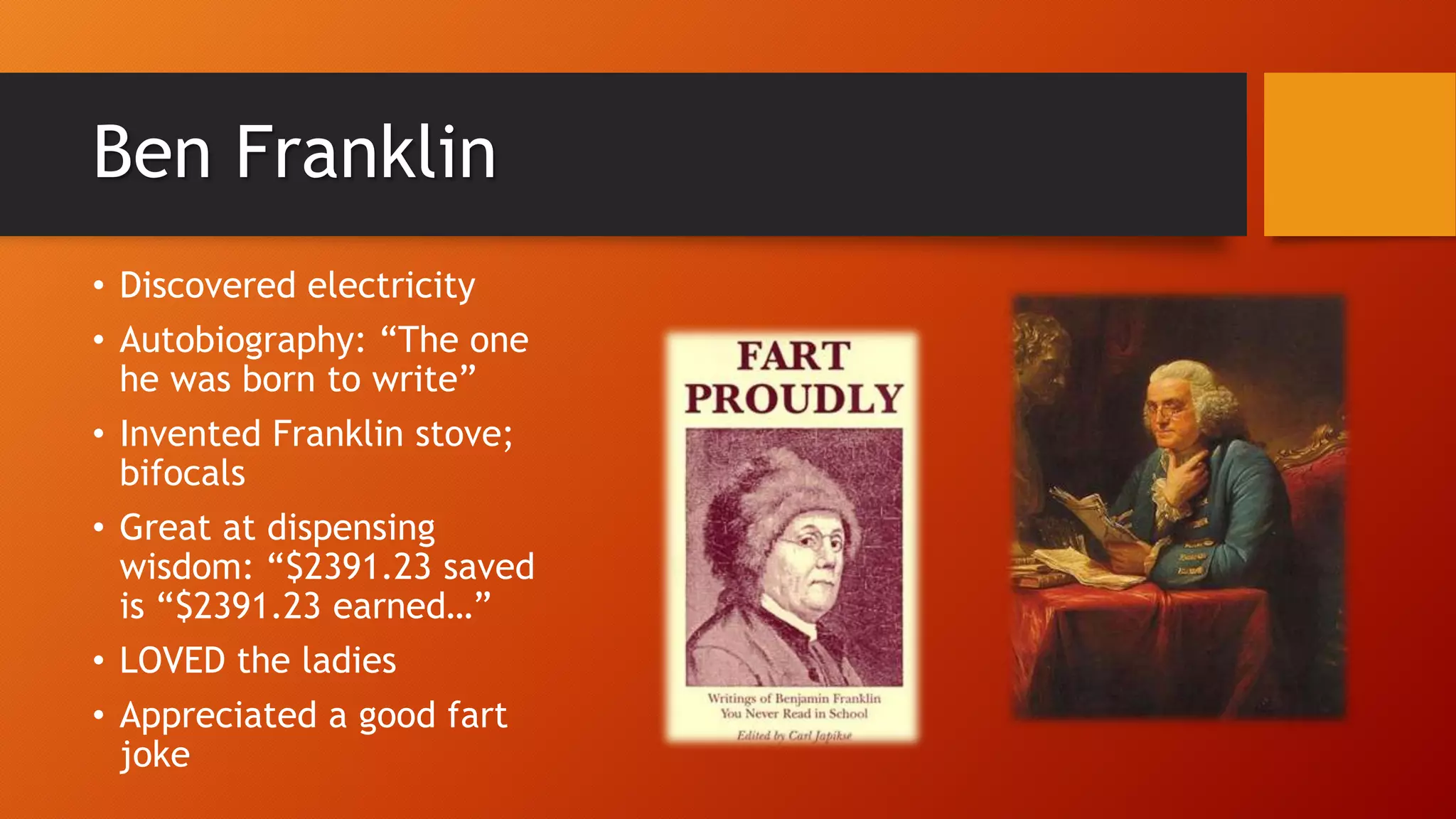
Ben Franklin
• Discovered electricity
• Autobiography: “The one
he was born to write”
• Invented Franklin stove;
bifocals
• Great at dispensing
wisdom: “$2391.23 saved
is “$2391.23 earned…”
• LOVED the ladies
• Appreciated a good fart
joke
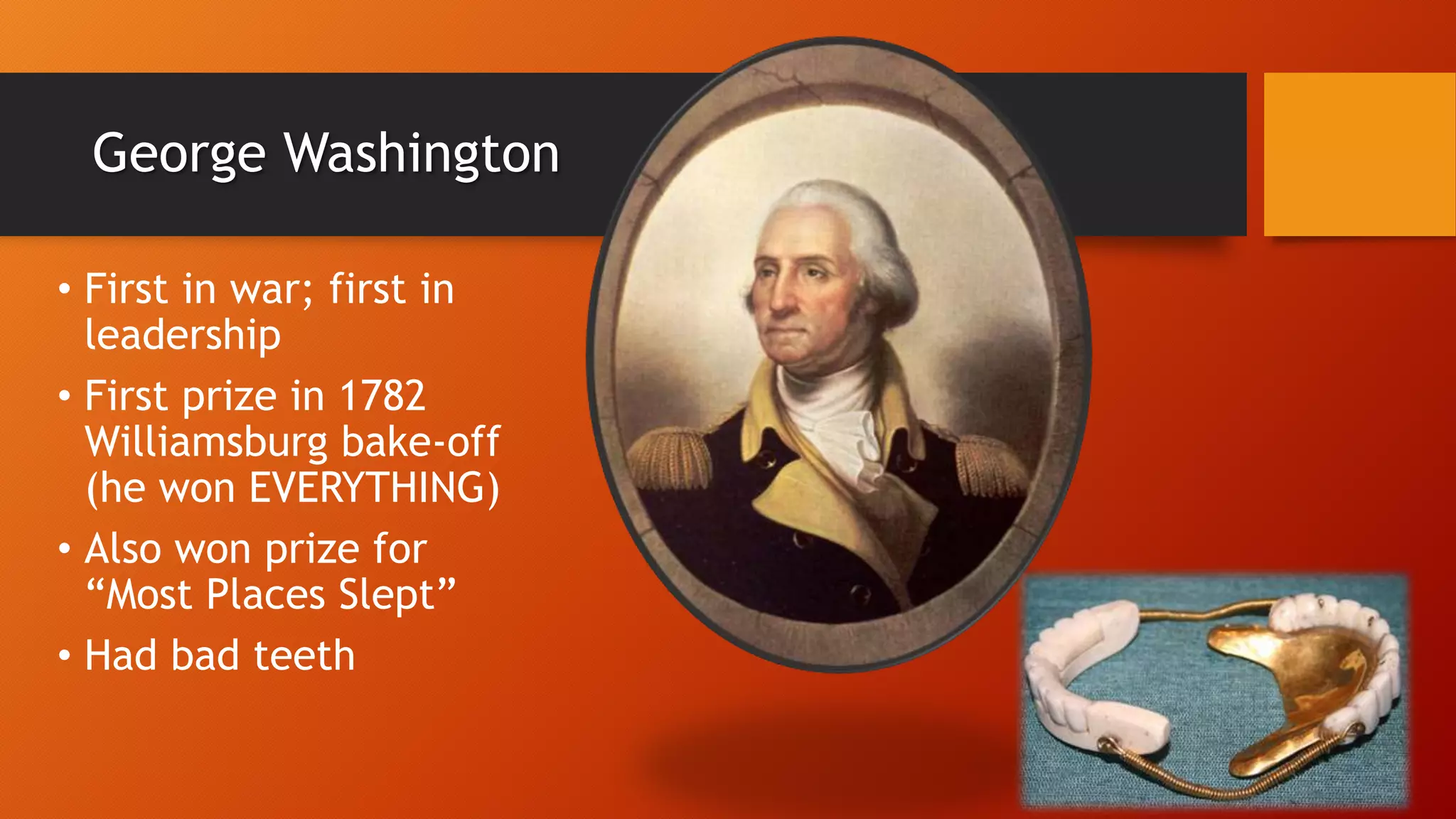
George Washington
• First in war; first in
leadership
• First prize in 1782
Williamsburg bake-off
(he won EVERYTHING)
• Also won prize for
“Most Places Slept”
• Had bad teeth
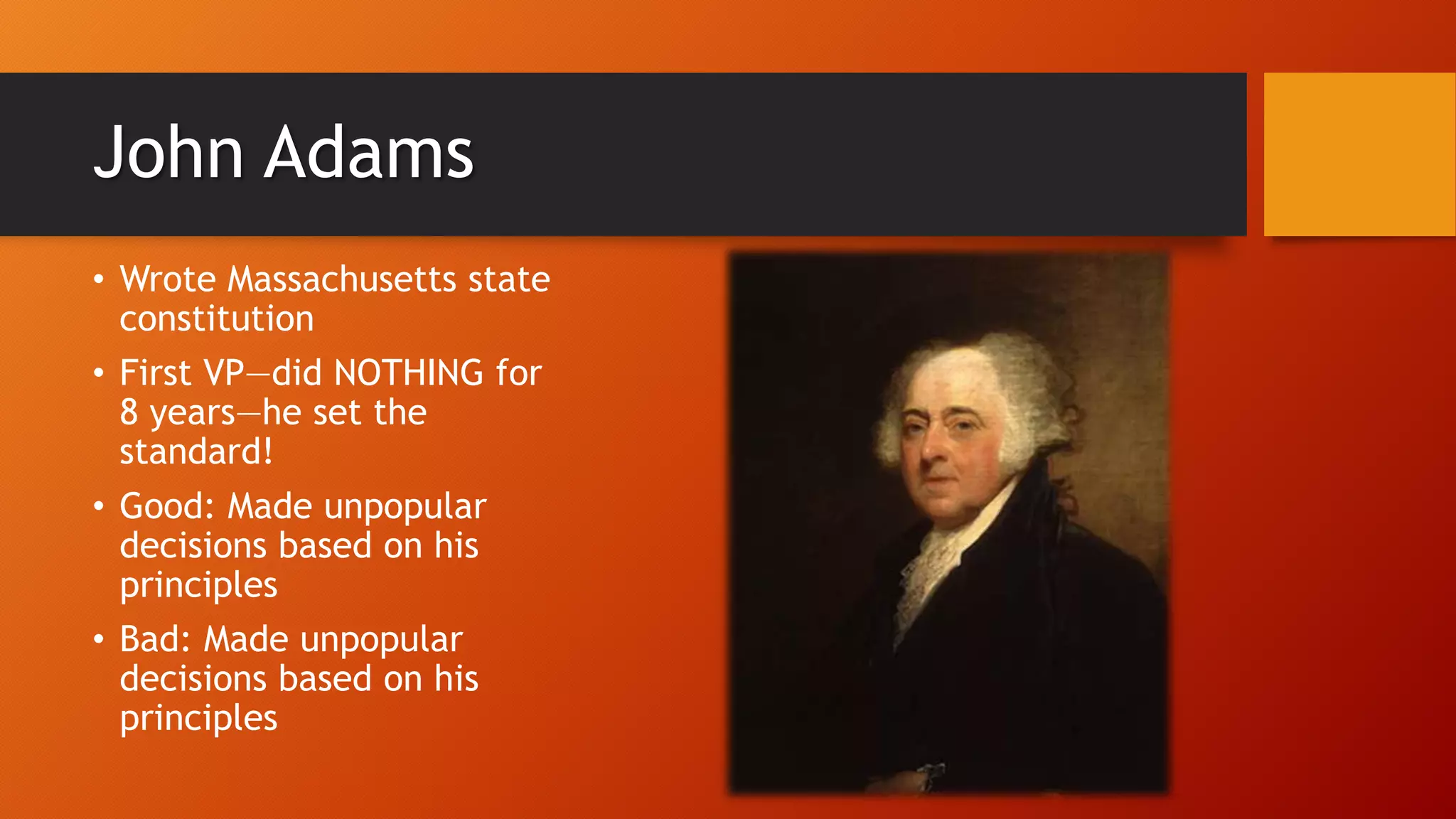
John Adams
• Wrote Massachusetts state
constitution
• First VP—did NOTHING for
8 years—he set the
standard!
• Good: Made unpopular
decisions based on his
principles
• Bad: Made unpopular
decisions based on his
principles
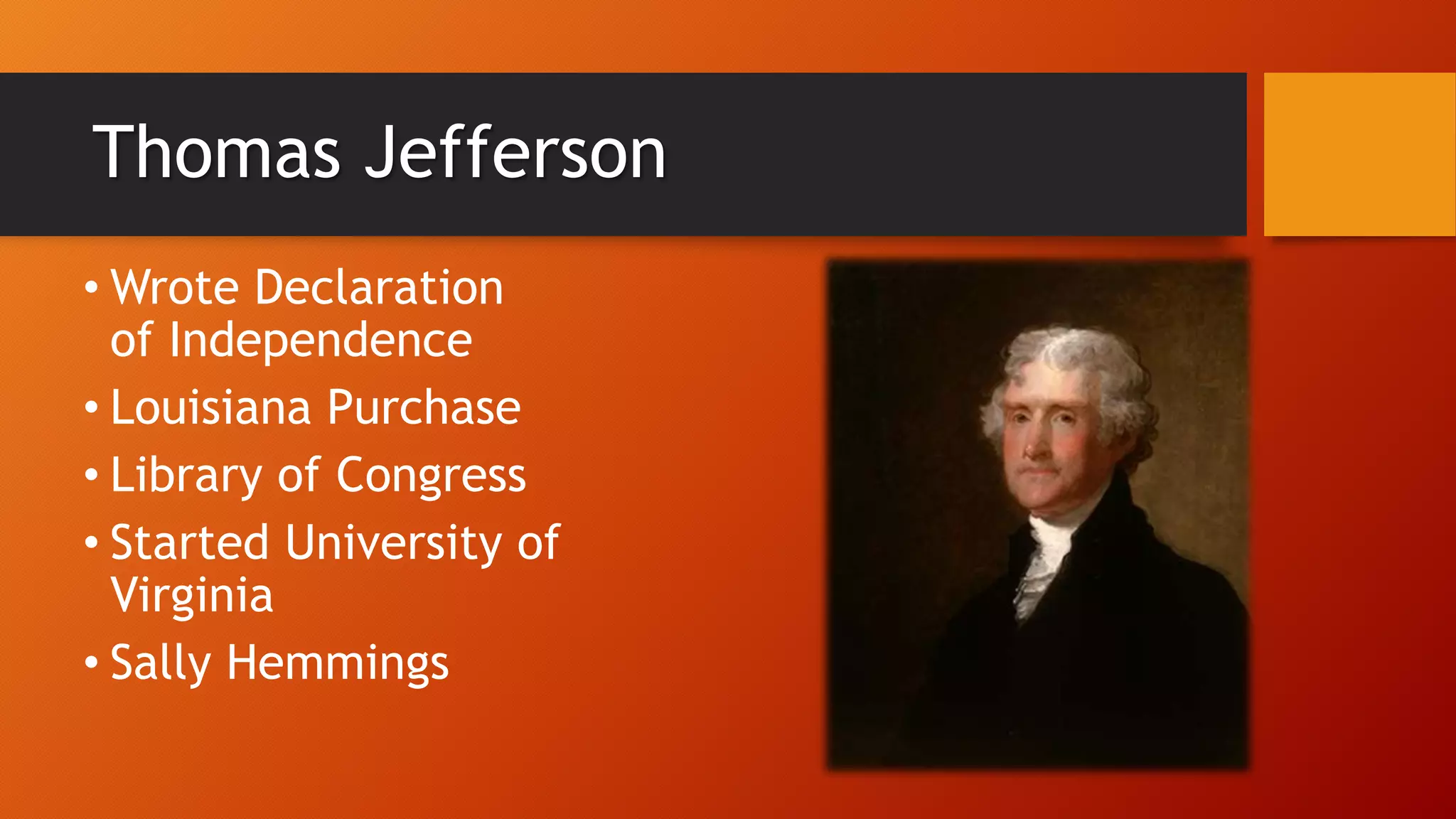
Thomas Jefferson
• Wrote Declaration
of Independence
• Louisiana Purchase
• Library of Congress
• Started University of
Virginia
• Sally Hemmings
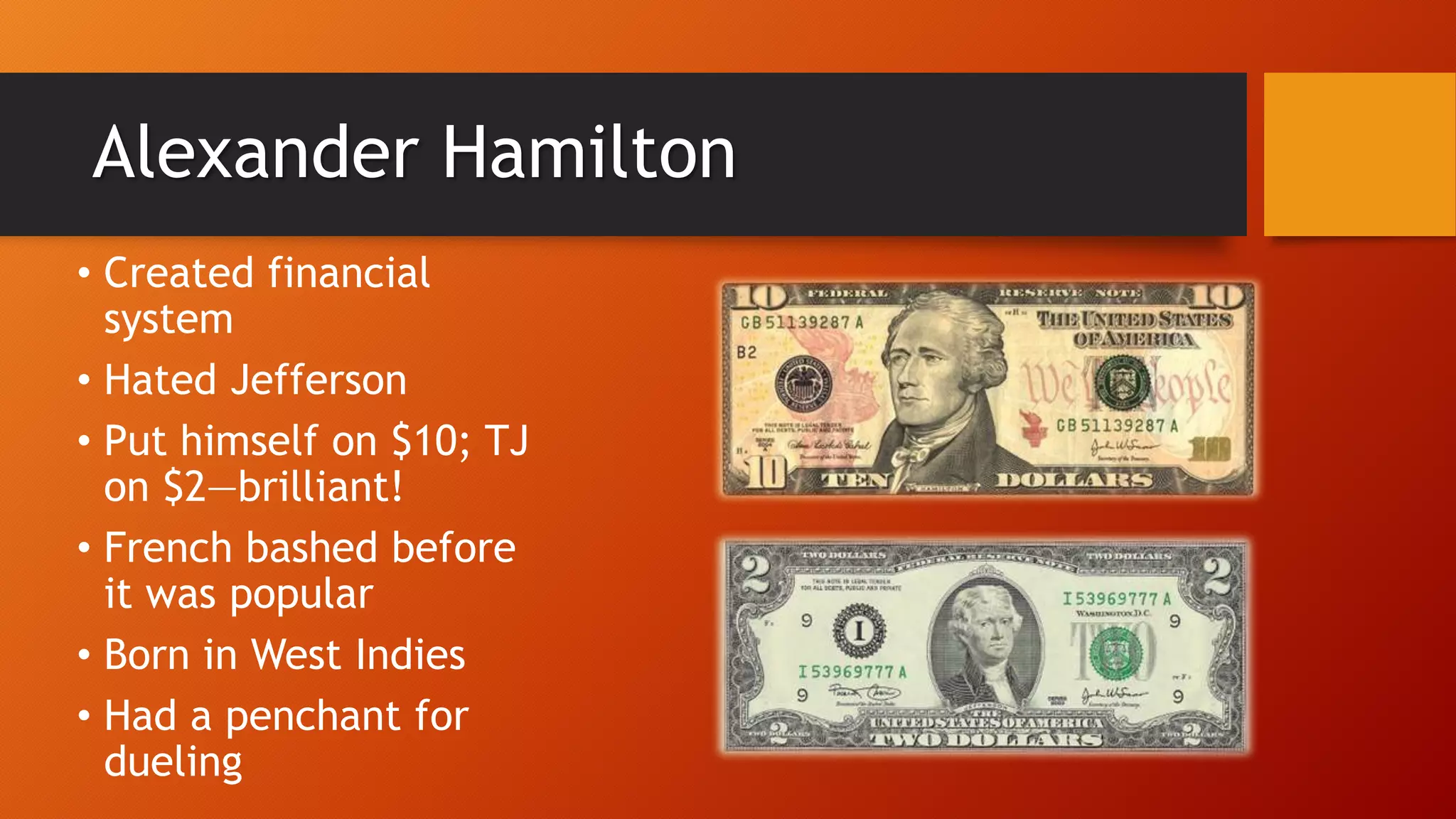
Alexander Hamilton
• Created financial
system
• Hated Jefferson
• Put himself on $10; TJ
on $2—brilliant!
• French bashed before
it was popular
• Born in West Indies
• Had a penchant for
dueling
Thanks Jon Stewart!

Government Basics

  • 1.
  • 2.
    Here’s what we’llcover… •What is the purpose of government? •What are the various forms of government? •What are the basic values of democracy? •What are the various political ideologies? •What are the roots of the American political system?
  • 3.
    What is thepurpose of government?
  • 4.
    Part one (ingroups of five) Imagine that all the students in your school were transported to an island where there were enough natural resources for you to live on, but where no one had lived before. When you arrived you had no means of communicating with people in other parts of the world. On the basis of this situation, your group decides what actions they would take for your stay on the island. Be prepared to share findings with the whole class.
  • 5.
    Part two Imagine thatat this point you discover other groups of people living near you. Make changes to your living arrangements. This could include isolationism, war, or cooperation in the form of a treaty. How would their community go about adapting to the changes now present. Be prepared to share findings with the whole class.
  • 6.
    Part three Pirates havebeen raiding all groups on the island. Their actions have been quite effective. They appear to be stronger than any single group living on the island. How would your community react to the problem of outsiders and the potential destruction of your community? Be prepared to share findings with the whole class.
  • 7.
    Discuss: What isthe purpose of government?
  • 8.
    What are thevarious forms of government?
  • 9.
    In your groups,define and list advantages and disadvantages of each • Democracy • Direct Democracy • Representative Democracy • Constitutional Democracy • Presidential Democracy • Republic • Constitutional Monarchy • Parliamentary Democracy
  • 10.
    Values of Democracies •Personal liberty • Respect for the individual • Equal opportunity • Popular consent (popular sovereignty) • Free and fair elections • Majority rule • Freedom of expression • Right to protest/assemble
  • 11.
    American Political Ideologies MostPopular: • Conservative: less government, more individual freedoms (chart) • Liberal: Government power should be used ti improve society (chart) • Neoconservative (using the government to actively work to achieve conservative goals) • Libertarian (less is more: government should have little or no say over economic and personal matters) • Socialist (high taxes, sharing wealth)
  • 12.
    What are theroots of the American political system?
  • 13.
    Impact of Enlightenment •Began in Science • Attempt to bring reason to the world • Social Contract • Government must bend to the will of the people • People have a right to overthrow • John Locke
  • 14.
    The Articles ofConfederation • First Government: colonists wanted a constitution- -a written document that defines rights and obligations and puts limits on government. • The colonists created a loose league of friendship under "The Articles of Confederation.“ • The Articles were a reaction to the unitary system used in Britain in which all of the power and sovereignty is vested in the central government (States were stronger than National Government)
  • 15.
  • 16.
    Some of TheArticles • "Each state retains its sovereignty, freedom, and independence, and every power, jurisdiction, and right, which is not by this Confederation expressly delegated." • Members of Congress were appointed by state legislatures; individuals could not serve more than three out of any six years. • Only the central government is allowed to conduct foreign policy and to war. No states may have navies or standing armies, or engage in war, without permission of Congress (although the state militias are encouraged). • Expenditures by the United States will be paid by funds raised by state legislatures, and apportioned to the states based on the real property values of each. • Defines the rights of the central government: to declare war, to set weights and measures (including coins), and for Congress to serve as a final court for disputes between states. • Declares that the articles are perpetual, and can only be altered by approval of Congress with ratification by all the state legislatures.
  • 17.
    Problems Under theArticles of Confederation • Congress had trouble getting a quorum of nine states to conduct business • The Congress had no power to tax. States coined their own money and trade wars erupted. • Congress had no power to regulate commerce among the states or ensure a unified monetary system. • States conducted foreign relations without regard to neighboring states' needs or wants. • Duties, tariffs, and taxes on trade proliferated with different ones in each state.
  • 18.
    America Under theArticles • The economy began to deteriorate. Several years of bad harvests ensued. Farmers went into ever-deeper debt. • Many leaders worried about questions of defense, trade, and frontier expansion. • Under the Articles, the central government was not strong enough to cope with these problems. • By 1786, several states had called for a convention to discuss ways of strengthening the national government.
  • 19.
    Last Straw: Shays’sRebellion • In Massachusetts, banks were foreclosing on farms and the Massachusetts legislature enacted a new law requiring all debts be paid in cash. • Daniel Shays, a Revolutionary War veteran, was outraged and frustrated with the new law and the huge debt burden of farmers. • Shays led a group of 1500 armed and disgruntled farmers to the capital, Springfield. They forcibly prevented the state court from foreclosing on their
  • 20.
    Shays' Rebellion • Congressauthorized the Secretary of War to call up a national militia to respond and provided $530,000. Every state except Virginia refused. • A private army put down Shays' Rebellion. • Failure of Congress to protect the citizens and property of Americans was a glaring example of the weakness of the Articles.
  • 21.
    Writing the Constitution •On February 21, 1787, Congress called for a Constitutional Convention in Philadelphia "for the sole and express purpose of revising the Articles of Confederation.“ • In May, the convention met and the Virginia delegation suggested they throw out the Articles and devise a new system of government! • This act could be considered treason, so they adopted a pledge of secrecy (nailed windows shut)
  • 22.
    The Virginia andNew Jersey Plans • The delegates submitted plans for a new government. • The Virginia Plan proposed that sovereignty be vested in the people and not the states. • The New Jersey Plan would have primarily strengthened the Articles by giving Congress the ability to raise revenues and would have kept a unicameral legislature chosen by state legislatures.
  • 23.
    The Great Compromise •Connecticut offered a compromise taking elements of each plan. • The legislature would be bicameral with the lower house (House of Representatives)based on population and the upper house (Senate) premised on equal representation for the states. • Both houses had to pass all legislation so both small and large states were satisfied.
  • 24.
    Anti-Federalist Opposition toThis • In general, the Anti- Federalists viewed the Constitution as a threat to five cherished values • Law • Political Stability • The Principles of the Declaration of Independence • To Federalism • Anti-Commericalism
  • 25.
    What’s special aboutstates’ rights? • Anti-Federalists believed that effective administration could only exist in states with a small territory with a homogenous population. • In large, diverse republics, many significant differences in condition, interest, and habit have to be ignored for the sake of uniform administration. • A large national government would impose uniform rules despite American diversity, resulting in hardship and inequity in many parts of the country.
  • 26.
    The Federalist Papers •A set of essays, written by Hamilton, James Madison, and John Jay, and published in New York newspapers under the pseudonym Publius. • During the ratification controversy, these essays were circulated nationally. • The essays linked opposition to the new Constitution with hot-headed liberals (Patrick Henry) and those with a vested interest in maintaining a weak government (George Clinton).
  • 27.
    Federalist #10, Madison •This essay explains how the Constitution protects against a tyranny of the majority, without resort to dictatorship. • The key to understanding Madison’s argument is that the tyrant is an individual or group who, if given power, would harm others in pursuit of self-interest. • A faction is the term to describe an individual or group seeking that power.
  • 28.
    Federalist #10: EnlightenedStatesmen “It is in vain to say that enlightened statesmen will be able to adjust these clashing interests and render them all subservient to the public good. Enlightened statesmen will not always be at the helm. Nor, in many cases, can such an adjustment be made without taking into view indirect and remote considerations, which will rarely prevail over the immediate interest which one party may find in disregarding the rights of another or the good of the whole.”
  • 29.
    Federalist #10: MinorityFactions • A minority faction can be controlled through elections. • The minority “may clog he administration, it may convulse the society; but it will be unable to execute and mask its violence under the forms of the Constitution.”
  • 30.
    Federalist #51 • Whydo we need the separation of powers? • Because individuals given power will use it for personal advantage. • “If men were angels, no government would be necessary.”
  • 31.
    Federalist #51: Checksand Balances • A constitution must balance two aims: sufficient capacity for governance and effective control over the leadership. • A system of checks and balances was what Montesquieu meant, rather than a strict separation of powers. • To function effectively, the system of checks and balances requires multiple branches of government. • Each branch must be independent from the others. • Each branch must sufficient power to hold the others in check.
  • 32.
    An Aside: Couldthe Founding Fathers be Elected Today?
  • 33.
    Ben Franklin • Discoveredelectricity • Autobiography: “The one he was born to write” • Invented Franklin stove; bifocals • Great at dispensing wisdom: “$2391.23 saved is “$2391.23 earned…” • LOVED the ladies • Appreciated a good fart joke
  • 34.
    George Washington • Firstin war; first in leadership • First prize in 1782 Williamsburg bake-off (he won EVERYTHING) • Also won prize for “Most Places Slept” • Had bad teeth
  • 35.
    John Adams • WroteMassachusetts state constitution • First VP—did NOTHING for 8 years—he set the standard! • Good: Made unpopular decisions based on his principles • Bad: Made unpopular decisions based on his principles
  • 36.
    Thomas Jefferson • WroteDeclaration of Independence • Louisiana Purchase • Library of Congress • Started University of Virginia • Sally Hemmings
  • 37.
    Alexander Hamilton • Createdfinancial system • Hated Jefferson • Put himself on $10; TJ on $2—brilliant! • French bashed before it was popular • Born in West Indies • Had a penchant for dueling
  • 38.