Using Blogs for Academic
Communication
Dr Helen Webster
aka Rattus Scholasticus
Anglia Learning and Teaching
What is a blog?
Definitions and characteristics please!
static, broadcast web 1.0 webpage vs
dynamic, interactive, conversational web
2.0 blog post
And variations on a theme…
Who here reads blogs?
• Those who do:
▫ What sort? (hobbies, professional, etc)
▫ How do you find them?
▫ How do you know what’s the latest on them?
▫ How do you read them (how long, how much etc)
▫ What makes a good blog?
• Those who don’t:
• Why not?
• Everyone: what sort of academic blog would you
like to read?
Reading blogs
• It’s important to read blogs
because:
▫ You become familiar with the medium.
▫ You get to know what works (and doesn’t)
▫ You get to know typical reader behaviour
▫ You get to know other bloggers – at its best,
blogging is a reciprocal conversation
▫ They’re interesting! And might provoke thoughts
for you to write about and link to in your own
blog…
Does anyone here blog
already?
So why do you want to blog?
What do you want to get out of it?
Blogging as an Academic
Pros and cons
• Relationship to traditional publishing
• Networking and collegiality
• Professional profile and employability
• Impact and outreach, knowledge
exchange
• Your own development
Blogging as an Early Career
Researcher
What do you want to blog about?
• Who is your intended audience?
• Who exactly is your intended audience?
• How large an audience are they?
• What would they find valuable?
• What have you got to offer them?
• What else have you got to offer them?
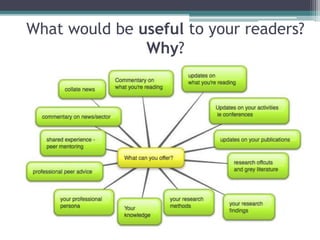
Other than research, what could you
share?
Core
research
Profess-
ional
activities
Teaching
And
Learning
Adminis
-trationImpact
Publish
-ing
What would be useful to your readers?
Why?
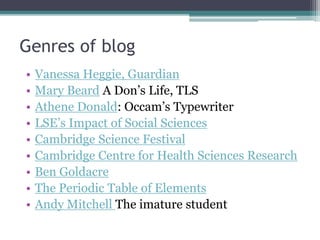
Genres of blog
• Vanessa Heggie, Guardian
• Mary Beard A Don’s Life, TLS
• Athene Donald: Occam’s Typewriter
• LSE’s Impact of Social Sciences
• Cambridge Science Festival
• Cambridge Centre for Health Sciences Research
• Ben Goldacre
• The Periodic Table of Elements
• Andy Mitchell The imature student
What to post about?
Three minutes:
• For your intended blog, jot down at least TEN
ideas for posts
▫ Titles?
▫ a brief note of what each one might include?
▫ Category and Tags?
• Review these: are they too large? can you break
each one down into more posts or suggest other
takes on them?
Types of post
• You could vary between:
▫ Instructional tips and how-to
▫ Explanation and information
▫ Reflection
▫ Advice and problem-solving
▫ Editorial commentary on a news story
▫ Account of an event e.g. conference
▫ Some ideas in draft for discussion
▫ A review of an article or book
▫ Top ten list (listicle)
▫ Curation of other people’s material
▫ A series of posts on a topic
Blogging style
• A blog is NOT an online journal article; it is a
different genre with different writing conventions:
▫ Snappy title (will also be URL)
▫ Conversational, personal tone (‘your voice’)
▫ ‘Shorth’ – 300 min - 600 words (1000 MAX and
RARELY depending on audience)
▫ Hypertext links instead of footnotes and references
▫ Multimedia – embed images, video, sound, slides,
documents….
▫ Scannable – no large blocks of dense text –
subheadings, bullet points, short paragraphs
Practising your style
• Take one of your ten ideas for a blog post
• Write ca. 300 words in a suitable style and tone
• See what others think – is it engaging and
accessible? (try reading it aloud as if you were
chatting to someone – if it sounds odd, the tone
may be too academic!)
Choosing a blog platform
• Wordpress.com (lots of functionality and
possibility to customise it)
• Blogger (from Google – integrates with your
other Google tools. Easy to use)
• Livejournal (often associated with fandom)
• Tumblr (in between a blog and a microblog –
good for getting used to posting short things or
commenting on media you’ve found)
• Twitter (microblog)
• Paid options
Finding readers
• Searching: Metadata – use tags and categories.
Linking to social media and authority sites. Post
regularly.
• Sharing: embed ‘share’ buttons for social media,
attention grabbing titles, memes, build relationships
with other bloggers
• Stumbling: Link from your other web presence, let
others use your content, use others’ content,
comment on their content
• Suggesting: that your readers share, follow,
comment, invite and include you, reuse
Start small
• “projects that will only work if they grow large enough
generally won’t grow large; a veritable natural law in
social media is that to get to a system that is large and
good, it is far better to start with a system that is small
and good and work on making it bigger than to start
with a system that is large and mediocre and working
on making it better”
Clay Shirky (2010), Cognitive Surplus: Creativity and
Generosity in a Connected Age
Too much effort?
• Consider:
▫ Writing guest posts on other people’s blogs
▫ Starting a group blog (good editing experience!)
▫ Vlogging
▫ Writing shorter posts!
▫ Posting over a set time period
Or if you’re really keen, set up additional
blogs!
Some of my favourite blogs for early
career academics:
• The Thesis Whisperer
• The Research Whisperer
• Pat Thompson
• LSE’s Impact of Social Sciences
• Steve Wheeler Learning with ‘e’s

Abeginnersguidetoblogging

  • 1.
    Using Blogs forAcademic Communication Dr Helen Webster aka Rattus Scholasticus Anglia Learning and Teaching
  • 2.
    What is ablog? Definitions and characteristics please! static, broadcast web 1.0 webpage vs dynamic, interactive, conversational web 2.0 blog post And variations on a theme…
  • 3.
    Who here readsblogs? • Those who do: ▫ What sort? (hobbies, professional, etc) ▫ How do you find them? ▫ How do you know what’s the latest on them? ▫ How do you read them (how long, how much etc) ▫ What makes a good blog? • Those who don’t: • Why not? • Everyone: what sort of academic blog would you like to read?
  • 4.
    Reading blogs • It’simportant to read blogs because: ▫ You become familiar with the medium. ▫ You get to know what works (and doesn’t) ▫ You get to know typical reader behaviour ▫ You get to know other bloggers – at its best, blogging is a reciprocal conversation ▫ They’re interesting! And might provoke thoughts for you to write about and link to in your own blog…
  • 5.
    Does anyone hereblog already?
  • 6.
    So why doyou want to blog? What do you want to get out of it?
  • 7.
    Blogging as anAcademic Pros and cons • Relationship to traditional publishing • Networking and collegiality • Professional profile and employability • Impact and outreach, knowledge exchange • Your own development
  • 8.
    Blogging as anEarly Career Researcher
  • 9.
    What do youwant to blog about? • Who is your intended audience? • Who exactly is your intended audience? • How large an audience are they? • What would they find valuable? • What have you got to offer them? • What else have you got to offer them?
  • 10.
    Other than research,what could you share? Core research Profess- ional activities Teaching And Learning Adminis -trationImpact Publish -ing
  • 11.
    What would beuseful to your readers? Why?
  • 12.
    Genres of blog •Vanessa Heggie, Guardian • Mary Beard A Don’s Life, TLS • Athene Donald: Occam’s Typewriter • LSE’s Impact of Social Sciences • Cambridge Science Festival • Cambridge Centre for Health Sciences Research • Ben Goldacre • The Periodic Table of Elements • Andy Mitchell The imature student
  • 13.
    What to postabout? Three minutes: • For your intended blog, jot down at least TEN ideas for posts ▫ Titles? ▫ a brief note of what each one might include? ▫ Category and Tags? • Review these: are they too large? can you break each one down into more posts or suggest other takes on them?
  • 14.
    Types of post •You could vary between: ▫ Instructional tips and how-to ▫ Explanation and information ▫ Reflection ▫ Advice and problem-solving ▫ Editorial commentary on a news story ▫ Account of an event e.g. conference ▫ Some ideas in draft for discussion ▫ A review of an article or book ▫ Top ten list (listicle) ▫ Curation of other people’s material ▫ A series of posts on a topic
  • 15.
    Blogging style • Ablog is NOT an online journal article; it is a different genre with different writing conventions: ▫ Snappy title (will also be URL) ▫ Conversational, personal tone (‘your voice’) ▫ ‘Shorth’ – 300 min - 600 words (1000 MAX and RARELY depending on audience) ▫ Hypertext links instead of footnotes and references ▫ Multimedia – embed images, video, sound, slides, documents…. ▫ Scannable – no large blocks of dense text – subheadings, bullet points, short paragraphs
  • 16.
    Practising your style •Take one of your ten ideas for a blog post • Write ca. 300 words in a suitable style and tone • See what others think – is it engaging and accessible? (try reading it aloud as if you were chatting to someone – if it sounds odd, the tone may be too academic!)
  • 17.
    Choosing a blogplatform • Wordpress.com (lots of functionality and possibility to customise it) • Blogger (from Google – integrates with your other Google tools. Easy to use) • Livejournal (often associated with fandom) • Tumblr (in between a blog and a microblog – good for getting used to posting short things or commenting on media you’ve found) • Twitter (microblog) • Paid options
  • 18.
    Finding readers • Searching:Metadata – use tags and categories. Linking to social media and authority sites. Post regularly. • Sharing: embed ‘share’ buttons for social media, attention grabbing titles, memes, build relationships with other bloggers • Stumbling: Link from your other web presence, let others use your content, use others’ content, comment on their content • Suggesting: that your readers share, follow, comment, invite and include you, reuse
  • 19.
    Start small • “projectsthat will only work if they grow large enough generally won’t grow large; a veritable natural law in social media is that to get to a system that is large and good, it is far better to start with a system that is small and good and work on making it bigger than to start with a system that is large and mediocre and working on making it better” Clay Shirky (2010), Cognitive Surplus: Creativity and Generosity in a Connected Age
  • 20.
    Too much effort? •Consider: ▫ Writing guest posts on other people’s blogs ▫ Starting a group blog (good editing experience!) ▫ Vlogging ▫ Writing shorter posts! ▫ Posting over a set time period Or if you’re really keen, set up additional blogs!
  • 21.
    Some of myfavourite blogs for early career academics: • The Thesis Whisperer • The Research Whisperer • Pat Thompson • LSE’s Impact of Social Sciences • Steve Wheeler Learning with ‘e’s

Editor's Notes

  • #13 Vanessa – journalism crossover Athene – campaigning LSE – case studies and how to Cambridge science festival – public engagement CCHSR - research and activties Ben Goldacre –public awareness Mary Beard – media don Steve Wheeler – reflections on profession Period table – vlog for interested public Andy Mitchell - learning