How to Be A Learning
Developer
ALDINHE REGIONAL EVENT: NEWCASTLE AND SUNDERLAND
Schedule
10:15 Welcome
10:30 What are We?
◦ Facets of the LD role
◦ ‘Doing’ values
11:30 Coffee
11:45 One to One work
◦ Structuring a One to One
◦ Overcoming barriers to learning
13:15 Lunch
14:00 Workshop Approaches
◦ Sue Meyer: ‘how to resource an evolving
workshop programme with limited staff’
◦ Jiani Liu: ‘teaching critical thinking to
new first years’
◦ Caroline Crow: ‘how to stop reinventing
the wheel every time’
15:00 Coffee
15:15 Workshop Toolkit
15:45 Plenary
16:00 Departure
Who are we?
•What’s your name?
• Where do you work?
• What’s your role and set-up?
•What are you hoping for from
today?
Part One: What Are We?
The Roots of Learning Development
Learning
Development
EAP
SpLD
Counselling
Staff
Development
Researcher
Development
IL Librarians
Faculty
teaching
Student
advice work
FE
Learning
Technology Professional:
• Ethics and Values
• Theory
• Expertise and
knowledge
• Practices and skills
• Standards
What roles do we play?
On each table are a number of ‘hats’ which we might wear
during our work.
•What is the distinction between each role?
•How (far) might each apply to LD work?
•Can you add any? Would you reject any?
A hierarchy?
Which do you identify
most closely with? Which
do you identify least with?
Organise the roles in a
hierarchy
A Continuum?
Place each role along a continuum:
What is the ‘axis’ of the continuum – a spectrum between what and what?
? ?
The Values of Learning Development
How do you react to these views?
“Study skills support is really helpful for the weaker students, to stop them falling
behind”
“For one reason or another, students lack these skills when they come to uni, and
training is needed to give them the skills they need.”
“I never had any study skills support when I was a student – I was expected to pick this
stuff up by osmosis!”
“Academic writing and study has particular conventions and norms which just need to
be learned”.
“Study skills are important transferable skills. Every student should have a course of
class of study skills as well as their subject.”
Professional Values – what can we borrow?
•From teaching – student-centred, constructivist
•From counselling – empathy, unconditional positive regard,
congruence, confidentiality
•From guidance work – neutrality, impartiality
•From EAP/Careers - authenticity
•From Disability/SpLD - inclusivity, social justice
•General professional - physical boundaries and spaces, punctuality
and preparedness
Learning Development Values
Brainstorm:
What values would you say we
‘profess’ as learning
developers?
Diamond ranking exercise:
Which are the core values?
‘Doing’ Values
Choose one of the values.
How is this manifested in a practical way in an aspect of your LD
work?
• One to one
• Workshops
• Resource development
•Publicity
Coffee
Part Two: One to One
work
How to do a one to one tutorial
So what happens in a one to one tutorial?
Tell the story of the average one to one appointment, from start to
finish. What are the stages? What are the key elements?
Use the materials on the table to sketch it out as a timeline, cartoon, mindmap etc
Librarians: the Reference Interview
1.Welcome - approachability and interest
2.Listen - Gather information from user, gain overview of need
3.Clarify and confirm understanding of need
4.Intervention - search, give information, advice, instructions
5.Finish - follow-up, feedback and summary
(RUSA 2004)
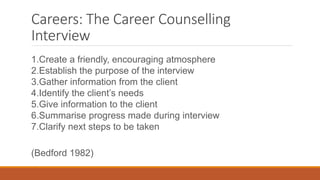
Careers: The Career Counselling
Interview
1.Create a friendly, encouraging atmosphere
2.Establish the purpose of the interview
3.Gather information from the client
4.Identify the client’s needs
5.Give information to the client
6.Summarise progress made during interview
7.Clarify next steps to be taken
(Bedford 1982)
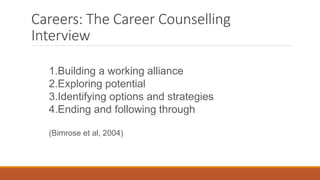
Careers: The Career Counselling
Interview
1.Building a working alliance
2.Exploring potential
3.Identifying options and strategies
4.Ending and following through
(Bimrose et al, 2004)
Counselling
1. ‘What’s going on?’ Encourage exploration - create rapport,
invite communication, identify presenting problem, agree agenda
2. ‘What solutions make sense for me?’ exploring in more depth,
challenging understanding, analysing themes, focussing and
prioritising, considering options and barriers
3. ‘How do I get what I need?’ Facilitating action – identify goals
and actions, support problem solving, summarise and feed back,
ending
(Egan, 2007)
The Learning Development One to One
• What needs to be done at the start of a one to one?
• Is there any standard structure to the middle?
• What needs to be done at the end?
Look both at what needs doing, and how it might best be done
Overcoming Barriers to Learning in the
One to One
You each have an example of a challenging behaviour which you
might encounter in a one to one: the issue and an example of what it
might sound like.
For each case, consider:
• What might the causes of this behaviour be?
• What might happen if you don’t try to address it?
• What strategies might you use to address it?
• How might you phrase this?
Lunch
Part Three: Workshops
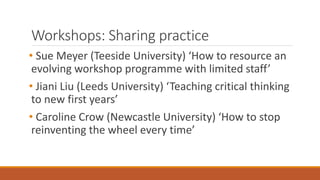
Workshops: Sharing practice
• Sue Meyer (Teeside University) ‘How to resource an
evolving workshop programme with limited staff’
• Jiani Liu (Leeds University) ‘Teaching critical thinking
to new first years’
• Caroline Crow (Newcastle University) ‘How to stop
reinventing the wheel every time’
Implementing practice
What could you take away from these
presentations to use in your own practice?
Coffee
“Tools” and techniques for workshops
Share your top workshop “tool” or technique
Suggest an activity, exercise, resource, prop, app, tool or approach which you’ve
used to good effect in workshops.
• 2 mins: jot down one idea
• 2mins share with the group – what do you do and why?
Plenary
•What insights about your practice have you gained today?
•What practical strategies might you try in your own practice?
•What else might be included in a day called ‘How to Be A Learning
Developer’?
Evaluation

How to be a learning developer

  • 1.
    How to BeA Learning Developer ALDINHE REGIONAL EVENT: NEWCASTLE AND SUNDERLAND
  • 2.
    Schedule 10:15 Welcome 10:30 Whatare We? ◦ Facets of the LD role ◦ ‘Doing’ values 11:30 Coffee 11:45 One to One work ◦ Structuring a One to One ◦ Overcoming barriers to learning 13:15 Lunch 14:00 Workshop Approaches ◦ Sue Meyer: ‘how to resource an evolving workshop programme with limited staff’ ◦ Jiani Liu: ‘teaching critical thinking to new first years’ ◦ Caroline Crow: ‘how to stop reinventing the wheel every time’ 15:00 Coffee 15:15 Workshop Toolkit 15:45 Plenary 16:00 Departure
  • 3.
    Who are we? •What’syour name? • Where do you work? • What’s your role and set-up? •What are you hoping for from today?
  • 4.
  • 5.
    The Roots ofLearning Development Learning Development EAP SpLD Counselling Staff Development Researcher Development IL Librarians Faculty teaching Student advice work FE Learning Technology Professional: • Ethics and Values • Theory • Expertise and knowledge • Practices and skills • Standards
  • 6.
    What roles dowe play? On each table are a number of ‘hats’ which we might wear during our work. •What is the distinction between each role? •How (far) might each apply to LD work? •Can you add any? Would you reject any?
  • 7.
    A hierarchy? Which doyou identify most closely with? Which do you identify least with? Organise the roles in a hierarchy
  • 8.
    A Continuum? Place eachrole along a continuum: What is the ‘axis’ of the continuum – a spectrum between what and what? ? ?
  • 9.
    The Values ofLearning Development How do you react to these views? “Study skills support is really helpful for the weaker students, to stop them falling behind” “For one reason or another, students lack these skills when they come to uni, and training is needed to give them the skills they need.” “I never had any study skills support when I was a student – I was expected to pick this stuff up by osmosis!” “Academic writing and study has particular conventions and norms which just need to be learned”. “Study skills are important transferable skills. Every student should have a course of class of study skills as well as their subject.”
  • 10.
    Professional Values –what can we borrow? •From teaching – student-centred, constructivist •From counselling – empathy, unconditional positive regard, congruence, confidentiality •From guidance work – neutrality, impartiality •From EAP/Careers - authenticity •From Disability/SpLD - inclusivity, social justice •General professional - physical boundaries and spaces, punctuality and preparedness
  • 11.
    Learning Development Values Brainstorm: Whatvalues would you say we ‘profess’ as learning developers? Diamond ranking exercise: Which are the core values?
  • 12.
    ‘Doing’ Values Choose oneof the values. How is this manifested in a practical way in an aspect of your LD work? • One to one • Workshops • Resource development •Publicity
  • 13.
  • 14.
    Part Two: Oneto One work
  • 15.
    How to doa one to one tutorial So what happens in a one to one tutorial? Tell the story of the average one to one appointment, from start to finish. What are the stages? What are the key elements? Use the materials on the table to sketch it out as a timeline, cartoon, mindmap etc
  • 16.
    Librarians: the ReferenceInterview 1.Welcome - approachability and interest 2.Listen - Gather information from user, gain overview of need 3.Clarify and confirm understanding of need 4.Intervention - search, give information, advice, instructions 5.Finish - follow-up, feedback and summary (RUSA 2004)
  • 17.
    Careers: The CareerCounselling Interview 1.Create a friendly, encouraging atmosphere 2.Establish the purpose of the interview 3.Gather information from the client 4.Identify the client’s needs 5.Give information to the client 6.Summarise progress made during interview 7.Clarify next steps to be taken (Bedford 1982)
  • 18.
    Careers: The CareerCounselling Interview 1.Building a working alliance 2.Exploring potential 3.Identifying options and strategies 4.Ending and following through (Bimrose et al, 2004)
  • 19.
    Counselling 1. ‘What’s goingon?’ Encourage exploration - create rapport, invite communication, identify presenting problem, agree agenda 2. ‘What solutions make sense for me?’ exploring in more depth, challenging understanding, analysing themes, focussing and prioritising, considering options and barriers 3. ‘How do I get what I need?’ Facilitating action – identify goals and actions, support problem solving, summarise and feed back, ending (Egan, 2007)
  • 20.
    The Learning DevelopmentOne to One • What needs to be done at the start of a one to one? • Is there any standard structure to the middle? • What needs to be done at the end? Look both at what needs doing, and how it might best be done
  • 21.
    Overcoming Barriers toLearning in the One to One You each have an example of a challenging behaviour which you might encounter in a one to one: the issue and an example of what it might sound like. For each case, consider: • What might the causes of this behaviour be? • What might happen if you don’t try to address it? • What strategies might you use to address it? • How might you phrase this?
  • 22.
  • 23.
  • 24.
    Workshops: Sharing practice •Sue Meyer (Teeside University) ‘How to resource an evolving workshop programme with limited staff’ • Jiani Liu (Leeds University) ‘Teaching critical thinking to new first years’ • Caroline Crow (Newcastle University) ‘How to stop reinventing the wheel every time’
  • 25.
    Implementing practice What couldyou take away from these presentations to use in your own practice?
  • 26.
  • 27.
    “Tools” and techniquesfor workshops Share your top workshop “tool” or technique Suggest an activity, exercise, resource, prop, app, tool or approach which you’ve used to good effect in workshops. • 2 mins: jot down one idea • 2mins share with the group – what do you do and why?
  • 28.
    Plenary •What insights aboutyour practice have you gained today? •What practical strategies might you try in your own practice? •What else might be included in a day called ‘How to Be A Learning Developer’?
  • 29.

Editor's Notes

  • #6 Show of hands - Who’s come from where. What does it mean to be a professional?
  • #7  Further prompts for discussion: are we teachers if we have no content to teach (or do we?) Are we advisers and what do we offer – guidance, information, advice? Are we experts? In what and where does that expertise come from?
  • #9 Think about: the locus of control The flow of information Expertise needed Independence Familiarity needed (draw on this again in the challenging behaviour section – maybe switching role might help – as in transactional analysis)
  • #10 These views are drawn from the three levels outlined in Lea and Street – they’re all slightly ‘off’ somehow. From counselling – rogers - empathy, unconditional positive regard, congruence, and also client-centred, client-led aims and outcomes, confidentiality From teaching – student-centred, constructivist, From guidance work – neutrality, impartiality From EAP/Careers - authenticity From Disability/SpLD  - inclusivity, social justice General professional  - physical boundaries and spaces, punctuality and preparedness From LD?
  • #11 What would they add, remove or adapt? Diamond ranking activity
  • #21 Give start and end to different groups, ask both to discuss the middle
  • #22 Facilitator notes: What does the student bring into the space? What about the approach to the space? How does the student feel in that space? How does the space shape this? Map their movement through it. How does one to one work intersect with other aspects of your LD role in that space? How much of the environment has been designed and how much of it is just happenstance/working round what’s there? How does it shape your practice? Extension – collate all the maps on the table and construct your ideal one to one space. Draw yourself in the environment and body language, how you move within it
  • #23 See facilitator notes
  • #29 Reiterate some of the techniques we’ve used today Helen: the non-linear ppt Victoria: Jellybean tree
  • #30 Flipchart paper Bring copies of similar books for other professions as inspiration