Rethinking Study
Skills
Dr Helen Webster
Rethinking study skills?
•What are “study skills”?
•How are “study skills” taught?
•Why rethink – what are the
implications?
What Are Study Skills?
Terms and Questions
• Assessment literacy, digital literacy, information literacy…
• Academic skills, study skills, writing skills, research skills
• English for Academic Purposes, Graduate attributes, ‘Soft’ skills, Wellbeing, Employability
• What might we include under this umbrella?
• Are we mistaking a conceptual or affective issue for a procedural one…?
• What does it mean to *have* a skill, to *be* literate?
• Pedagogical implications
Study Skills as Contingent: A
Definition
“learning to learn, and to know, to practise and to
communicate according to the expectations and
conventions of the institution, discipline and level of
study, and in the student’s own context.”
• Metacognition
• Epistemology
• Community of Practice
• Discourse
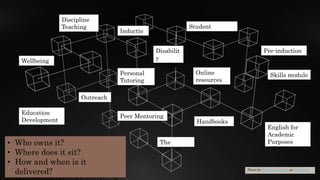
Who owns study skills?
“Wasn't expecting to get much out of the Essay
lecture given that it was delivered by someone who
didn't really know the field (especially given how
lecturer suggestions in how to write essays are kind
of patchy and inconsistent at the best of times), but
it was actually really helpful. […] it clarified a lot of
stuff that lecturers haven't really been that good at
explaining”.
(Student feedback on an embedded central services Study Skills
workshop)
Photo by Shubham Dhage on Unsplash
Student
Services
The
Library
Inductio
n
Pre-induction
Skills module
Personal
Tutoring
Peer Mentoring
Online
resources
Discipline
Teaching
Handbooks
Wellbeing
English for
Academic
Purposes
Outreach
• Who owns it?
• Where does it sit?
• How and when is it
delivered?
Education
Development
Disabilit
y
support
Teaching Study
Skills:
Academic Literacies
as ‘how’, not ‘what’
Examples
Avoid abbreviations and contractions. Write words out in
full:
- ‘dept.’ as ‘department’
- ‘e.g’. as ‘for example’
- ‘didn’t’ as ‘did not’
- ‘they’re’ as ‘they are’
- ‘isn’t’ as ‘is not’
Avoid personal pronouns such as ‘I’/’we’ and ‘you’. Instead,
sentences begin in impersonal ways such as ‘it can be seen
that…’
Linking ideas together:
Introducing an alternative viewpoint: conversely; in comparison; on the contrary;
in fact; though; although.
(Cottrell, Study Skills Handbook)
Examples
Academic writing is clear, concise, focussed, structured and backed up by
evidence. Its purpose is to aid the reader’s understanding.
Characteristics of academic writing. Academic writing is:
Planned and focused: answers the question and demonstrates an
understanding of the subject.
Structured: is coherent, written in a logical order, and brings together related
points and material.
Evidenced: demonstrates knowledge of the subject area, supports opinions and
arguments with evidence, and is referenced accurately.
Formal in tone and style: uses appropriate language and tenses, and is clear,
concise and balanced
Leeds University
https://library.leeds.ac.uk/info/14011/writing/106/academic_writing
Examples
Note-making from your reading is an incredibly
important process. ‘Process’ is the right word, because
it is when you make notes that your brain processes
the information. It goes in as new information (data,
explanation or argument) and down on your page as
something you now know, understand, want to
remember, and plan to use as you get to grips with
your topic. You start off not knowing or understanding
something, and end up knowing and understanding.
That’s great!’
Williams, 2022: Getting Critical (3rd end)
Examples
Use a diary to keep track of your day-to-day schedule (for example, lectures, sports
activities,) and to note submission deadlines for university work.
- work your way back from key dates, creating milestones such as ‘finish library
work for essay’ or ‘prepare first draft of essay’.
- refer to the diary frequently to keep yourself on track and to plan out each day
and week. Try to get into the habit of looking at the next day’s activities the night
before and the next week’s work at the end of the week.
- number the weeks, so you can sense how time is progressing over longer periods,
such as a term or semester.
Create a detailed timetable of work when you have a big task looming (e.g. before
exams, or when there is a large report or literature survey to write up). You could:
- break the task down into smaller parts
- space these out appropriately
- schedule important work for when you generally feel most intellectually active
McMillan and Weyers, the Smarter Student
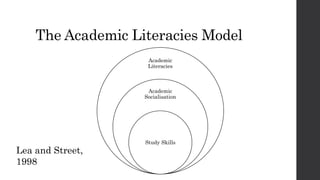
The Academic Literacies Model
Academic
Literacies
Academic
Socialisation
Study Skills
Lea and Street,
1998
The ‘Study Skills’ model
‘The study skills model sees writing and literacy as
primarily an individual and cognitive skill. This approach
focusses on the surface features of language form and
presumes that students can transfer their knowledge of
writing and literacy unproblematically from one context to
another’. (Lea and Street, 2006).
• Study Skills: [Remediation of] Student Deficit.
 ‘Fix it’, atomised [transferable] skills; surface language, grammar, spelling.
 Sources: behavioural and experimental psychology; programmed learning
 Student writing as technical and instrumental skill
(Robinson-Pant and Street, 2012).
Study Skills model: Approaches and
Issues
 Approaches
 Bolt-on remediation
 Normative and prescriptive
 Generic, simplistic and decontextualised (and ineffective?)
 Diagnostic / pathologizing
• Issues:
 These are just surface features – what’s ‘academic’ about them? Is this even the real issue?
 These ‘rules’ aren’t always true or applicable.
 This is a deficit, remedial approach, supposedly applying only to some who ‘lack’ (EAP, WP,
SpLD)
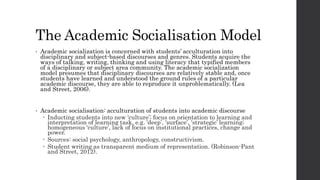
The Academic Socialisation Model
• Academic socialization is concerned with students’ acculturation into
disciplinary and subject-based discourses and genres. Students acquire the
ways of talking, writing, thinking and using literacy that typified members
of a disciplinary or subject area community. The academic socialization
model presumes that disciplinary discourses are relatively stable and, once
students have learned and understood the ground rules of a particular
academic discourse, they are able to reproduce it unproblematically. (Lea
and Street, 2006).
• Academic socialisation: acculturation of students into academic discourse
 Inducting students into new ‘culture’; focus on orientation to learning and
interpretation of learning task, e.g. ‘deep’, ‘surface’, ‘strategic’ learning;
homogeneous ‘culture’, lack of focus on institutional practices, change and
power.
 Sources: social psychology, anthropology, constructivism.
 Student writing as transparent medium of representation. (Robinson-Pant
and Street, 2012).
The Academic Socialisation model:
approaches and issuses
• Approaches:
 Demystifying the ‘institutional practice of mystery’ (Lillis, 2001)
 ‘Academic language is no one’s mother tongue’ (Bourdieu and Passeron,
1994)
 Embedded
• Issues:
 These aren’t ‘transferable skills’.
 Focus on product, not process
 These concepts aren’t transparent or straightforward.
 Gatekeeping - perpetuates social and cultural capital without
challenging it.
 Demands more identity-work of students who do not share the
dominant culture.
The Academic Literacies model
• Academic literacies is concerned with meaning-making, identity, power and
authority, and foregrounds the institutional nature of what counts as
knowledge in any particular academic context. It […] views the processes
involved in acquiring appropriate and effective uses of literacy as more
complex, dynamic, nuanced, situated and involving both epistemological
issues and social processes, including power relations among people,
institutions and social identities. (Lea and Street, 2006).
• Academic Literacies: Students’ negotiation of conflicting literary practices
 Literacies as social practices; at level of epistemologies and identities;
institutions as sites of/constituted in discourses and power; variety of
communicative repertoire, switching with regard to linguistic practices,
social meanings and identities,
 Sources: New Literacy studies; critical discourse analysis, systemic
functional linguistics, cultural anthropology.
 Student Writing as constitutive and contested. (Robinson-Pant and Street,
2012).
The Academic Literacies model:
approaches and issues
• Approaches:
 Switching between repertoire– subject, genre, level, language, institution,
individual lecturer…
 Person-centred, Negotiation (both senses)
 Focussed on communicative acts (writing, sometimes reading, speaking,
listening) but rooted in discourses, practices, identities and relationships
 Not skills possessed but social practices enacted
 Emancipatory - questioning the Hidden Curriculum
• Issues:
 How do we deal with power and authority? Who needs to change?
 How could you – should you - ever establish an academic literacy ‘curriculum’?!
 How do you implement at scale?
 Too focussed on writing - What about revision, criticality, time management,
groupwork?
A summary
An alternative Academic Literacies
model 4. Socio-
cultural and
political context
3. Event
2. Cognitive
Process
1. Text
Ivanic,
2004
Academic Literacies:
The Implications
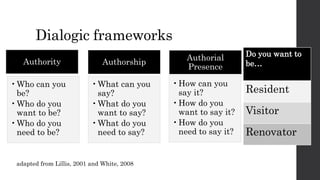
Dialogic frameworks
Authority
•Who can you
be?
•Who do you
want to be?
•Who do you
need to be?
Authorial
Presence
•How can you
say it?
•How do you
want to say it?
•How do you
need to say it?
Authorship
•What can you
say?
•What do you
want to say?
•What do you
need to say?
Do you want to
be…
Resident
Visitor
Renovator
adapted from Lillis, 2001 and White, 2008
Dialogic frameworks
The Five Ps of LD
Presenting
“Problem”
Pertinent
factors
Perception
of task
Process
Product
Recent exampleshttps://wonkhe.com/blogs/we-should-be-more-interested-in-curiosity-than-compe
Implications: inclusive, emancipatory
practice
• “Academic practices are usually presented as
neutral, decontextualised sets of technical skills
and literacy that students from socially
disadvantaged backgrounds are seen to lack”
(Lillis, 2001).
• “The principal function of student writing is
increasingly that of gatekeeping.” (Lillis, 2001)
Implications: inclusive, emancipatory
practice
Implications: inclusive, emancipatory
practice
“Through taken- for-granted academic practices,
constructions of difference are formed, often in problematic
ways. The tendency is to project a pathologising gaze on
racialised bodies that have historically been constructed as
a problem, and as suffering from a range of deficit
disorders (e.g. lack of aspiration, lack of motivation, lack of
confidence and so on’)” (Burke, 2015).
‘Inclusion tends to be more about fitting into the dominant
culture than about interrogating that culture for the ways
that it is complicit in the social and cultural reproduction
of exclusion, misrecognition and inequality.’ (Burke, 2015)
References
• Bhopal, K. (2018) White Privilege: The Myth of a Postracial Society. Bristol: Policy Press.
• Burke, P. (2015) ‘Widening Participation in Higher Education: Racialised Inequalities and Misrecognitions’. In C.
Alexander and J Arday (eds), Aiming Higher: Race, Inequality and Diversity in Higher Education. London:
Runnymeade, pp. 21-4.
• Ivanic, R. (1998) Writing and Identity: The discoursal construction of identity in academic writing. Amsterdam: John
Benjamins Press.
• •Lea, M. and Street, B. (1998). ‘Student Writing in Higher Education: An Academic Literacies Approach’ Studies in
Higher Education 23 (2) 157-172.
• •Lea, M. and Street, B. (2006). ‘The Academic Literacies Model: Theory and Applications’ Theory into Practice, 45(4)
368-377.
• •Lillis, T. (2001) Student Writing: Access, Regulation and Desire. London: Routledge.
• •Lillis, T. and Tuck, J. (2016). ‘Academic Literacies’ in: Ken Hyland and Phillip Shaw (eds). The Routledge
Handbook of English for Academic Purposes. London: Routledge. 30-43.
• •Robinson-Pant, A. And Street, B. (2012) ‘Students’ and Tutors’ Understanding of ‘New’ Academic Literacy Practices’
in: M. Castello and C. Donahue (eds). University Writing: Selves and Texts in Academic Societies. (London:
Routledge. 71-92.
• •Wingate, U. (2015). Academic Literacy and Student Diversity: The case for Inclusive Practice.

Rethinking Study Skills Webster.pptx

  • 1.
  • 2.
    Rethinking study skills? •Whatare “study skills”? •How are “study skills” taught? •Why rethink – what are the implications?
  • 3.
  • 4.
    Terms and Questions •Assessment literacy, digital literacy, information literacy… • Academic skills, study skills, writing skills, research skills • English for Academic Purposes, Graduate attributes, ‘Soft’ skills, Wellbeing, Employability • What might we include under this umbrella? • Are we mistaking a conceptual or affective issue for a procedural one…? • What does it mean to *have* a skill, to *be* literate? • Pedagogical implications
  • 5.
    Study Skills asContingent: A Definition “learning to learn, and to know, to practise and to communicate according to the expectations and conventions of the institution, discipline and level of study, and in the student’s own context.” • Metacognition • Epistemology • Community of Practice • Discourse
  • 6.
    Who owns studyskills? “Wasn't expecting to get much out of the Essay lecture given that it was delivered by someone who didn't really know the field (especially given how lecturer suggestions in how to write essays are kind of patchy and inconsistent at the best of times), but it was actually really helpful. […] it clarified a lot of stuff that lecturers haven't really been that good at explaining”. (Student feedback on an embedded central services Study Skills workshop)
  • 7.
    Photo by ShubhamDhage on Unsplash Student Services The Library Inductio n Pre-induction Skills module Personal Tutoring Peer Mentoring Online resources Discipline Teaching Handbooks Wellbeing English for Academic Purposes Outreach • Who owns it? • Where does it sit? • How and when is it delivered? Education Development Disabilit y support
  • 8.
  • 9.
    Examples Avoid abbreviations andcontractions. Write words out in full: - ‘dept.’ as ‘department’ - ‘e.g’. as ‘for example’ - ‘didn’t’ as ‘did not’ - ‘they’re’ as ‘they are’ - ‘isn’t’ as ‘is not’ Avoid personal pronouns such as ‘I’/’we’ and ‘you’. Instead, sentences begin in impersonal ways such as ‘it can be seen that…’ Linking ideas together: Introducing an alternative viewpoint: conversely; in comparison; on the contrary; in fact; though; although. (Cottrell, Study Skills Handbook)
  • 10.
    Examples Academic writing isclear, concise, focussed, structured and backed up by evidence. Its purpose is to aid the reader’s understanding. Characteristics of academic writing. Academic writing is: Planned and focused: answers the question and demonstrates an understanding of the subject. Structured: is coherent, written in a logical order, and brings together related points and material. Evidenced: demonstrates knowledge of the subject area, supports opinions and arguments with evidence, and is referenced accurately. Formal in tone and style: uses appropriate language and tenses, and is clear, concise and balanced Leeds University https://library.leeds.ac.uk/info/14011/writing/106/academic_writing
  • 11.
    Examples Note-making from yourreading is an incredibly important process. ‘Process’ is the right word, because it is when you make notes that your brain processes the information. It goes in as new information (data, explanation or argument) and down on your page as something you now know, understand, want to remember, and plan to use as you get to grips with your topic. You start off not knowing or understanding something, and end up knowing and understanding. That’s great!’ Williams, 2022: Getting Critical (3rd end)
  • 12.
    Examples Use a diaryto keep track of your day-to-day schedule (for example, lectures, sports activities,) and to note submission deadlines for university work. - work your way back from key dates, creating milestones such as ‘finish library work for essay’ or ‘prepare first draft of essay’. - refer to the diary frequently to keep yourself on track and to plan out each day and week. Try to get into the habit of looking at the next day’s activities the night before and the next week’s work at the end of the week. - number the weeks, so you can sense how time is progressing over longer periods, such as a term or semester. Create a detailed timetable of work when you have a big task looming (e.g. before exams, or when there is a large report or literature survey to write up). You could: - break the task down into smaller parts - space these out appropriately - schedule important work for when you generally feel most intellectually active McMillan and Weyers, the Smarter Student
  • 13.
    The Academic LiteraciesModel Academic Literacies Academic Socialisation Study Skills Lea and Street, 1998
  • 14.
    The ‘Study Skills’model ‘The study skills model sees writing and literacy as primarily an individual and cognitive skill. This approach focusses on the surface features of language form and presumes that students can transfer their knowledge of writing and literacy unproblematically from one context to another’. (Lea and Street, 2006). • Study Skills: [Remediation of] Student Deficit.  ‘Fix it’, atomised [transferable] skills; surface language, grammar, spelling.  Sources: behavioural and experimental psychology; programmed learning  Student writing as technical and instrumental skill (Robinson-Pant and Street, 2012).
  • 15.
    Study Skills model:Approaches and Issues  Approaches  Bolt-on remediation  Normative and prescriptive  Generic, simplistic and decontextualised (and ineffective?)  Diagnostic / pathologizing • Issues:  These are just surface features – what’s ‘academic’ about them? Is this even the real issue?  These ‘rules’ aren’t always true or applicable.  This is a deficit, remedial approach, supposedly applying only to some who ‘lack’ (EAP, WP, SpLD)
  • 16.
    The Academic SocialisationModel • Academic socialization is concerned with students’ acculturation into disciplinary and subject-based discourses and genres. Students acquire the ways of talking, writing, thinking and using literacy that typified members of a disciplinary or subject area community. The academic socialization model presumes that disciplinary discourses are relatively stable and, once students have learned and understood the ground rules of a particular academic discourse, they are able to reproduce it unproblematically. (Lea and Street, 2006). • Academic socialisation: acculturation of students into academic discourse  Inducting students into new ‘culture’; focus on orientation to learning and interpretation of learning task, e.g. ‘deep’, ‘surface’, ‘strategic’ learning; homogeneous ‘culture’, lack of focus on institutional practices, change and power.  Sources: social psychology, anthropology, constructivism.  Student writing as transparent medium of representation. (Robinson-Pant and Street, 2012).
  • 17.
    The Academic Socialisationmodel: approaches and issuses • Approaches:  Demystifying the ‘institutional practice of mystery’ (Lillis, 2001)  ‘Academic language is no one’s mother tongue’ (Bourdieu and Passeron, 1994)  Embedded • Issues:  These aren’t ‘transferable skills’.  Focus on product, not process  These concepts aren’t transparent or straightforward.  Gatekeeping - perpetuates social and cultural capital without challenging it.  Demands more identity-work of students who do not share the dominant culture.
  • 18.
    The Academic Literaciesmodel • Academic literacies is concerned with meaning-making, identity, power and authority, and foregrounds the institutional nature of what counts as knowledge in any particular academic context. It […] views the processes involved in acquiring appropriate and effective uses of literacy as more complex, dynamic, nuanced, situated and involving both epistemological issues and social processes, including power relations among people, institutions and social identities. (Lea and Street, 2006). • Academic Literacies: Students’ negotiation of conflicting literary practices  Literacies as social practices; at level of epistemologies and identities; institutions as sites of/constituted in discourses and power; variety of communicative repertoire, switching with regard to linguistic practices, social meanings and identities,  Sources: New Literacy studies; critical discourse analysis, systemic functional linguistics, cultural anthropology.  Student Writing as constitutive and contested. (Robinson-Pant and Street, 2012).
  • 19.
    The Academic Literaciesmodel: approaches and issues • Approaches:  Switching between repertoire– subject, genre, level, language, institution, individual lecturer…  Person-centred, Negotiation (both senses)  Focussed on communicative acts (writing, sometimes reading, speaking, listening) but rooted in discourses, practices, identities and relationships  Not skills possessed but social practices enacted  Emancipatory - questioning the Hidden Curriculum • Issues:  How do we deal with power and authority? Who needs to change?  How could you – should you - ever establish an academic literacy ‘curriculum’?!  How do you implement at scale?  Too focussed on writing - What about revision, criticality, time management, groupwork?
  • 20.
  • 21.
    An alternative AcademicLiteracies model 4. Socio- cultural and political context 3. Event 2. Cognitive Process 1. Text Ivanic, 2004
  • 22.
  • 23.
    Dialogic frameworks Authority •Who canyou be? •Who do you want to be? •Who do you need to be? Authorial Presence •How can you say it? •How do you want to say it? •How do you need to say it? Authorship •What can you say? •What do you want to say? •What do you need to say? Do you want to be… Resident Visitor Renovator adapted from Lillis, 2001 and White, 2008
  • 24.
    Dialogic frameworks The FivePs of LD Presenting “Problem” Pertinent factors Perception of task Process Product
  • 25.
  • 26.
    Implications: inclusive, emancipatory practice •“Academic practices are usually presented as neutral, decontextualised sets of technical skills and literacy that students from socially disadvantaged backgrounds are seen to lack” (Lillis, 2001). • “The principal function of student writing is increasingly that of gatekeeping.” (Lillis, 2001)
  • 27.
  • 28.
    Implications: inclusive, emancipatory practice “Throughtaken- for-granted academic practices, constructions of difference are formed, often in problematic ways. The tendency is to project a pathologising gaze on racialised bodies that have historically been constructed as a problem, and as suffering from a range of deficit disorders (e.g. lack of aspiration, lack of motivation, lack of confidence and so on’)” (Burke, 2015). ‘Inclusion tends to be more about fitting into the dominant culture than about interrogating that culture for the ways that it is complicit in the social and cultural reproduction of exclusion, misrecognition and inequality.’ (Burke, 2015)
  • 29.
    References • Bhopal, K.(2018) White Privilege: The Myth of a Postracial Society. Bristol: Policy Press. • Burke, P. (2015) ‘Widening Participation in Higher Education: Racialised Inequalities and Misrecognitions’. In C. Alexander and J Arday (eds), Aiming Higher: Race, Inequality and Diversity in Higher Education. London: Runnymeade, pp. 21-4. • Ivanic, R. (1998) Writing and Identity: The discoursal construction of identity in academic writing. Amsterdam: John Benjamins Press. • •Lea, M. and Street, B. (1998). ‘Student Writing in Higher Education: An Academic Literacies Approach’ Studies in Higher Education 23 (2) 157-172. • •Lea, M. and Street, B. (2006). ‘The Academic Literacies Model: Theory and Applications’ Theory into Practice, 45(4) 368-377. • •Lillis, T. (2001) Student Writing: Access, Regulation and Desire. London: Routledge. • •Lillis, T. and Tuck, J. (2016). ‘Academic Literacies’ in: Ken Hyland and Phillip Shaw (eds). The Routledge Handbook of English for Academic Purposes. London: Routledge. 30-43. • •Robinson-Pant, A. And Street, B. (2012) ‘Students’ and Tutors’ Understanding of ‘New’ Academic Literacy Practices’ in: M. Castello and C. Donahue (eds). University Writing: Selves and Texts in Academic Societies. (London: Routledge. 71-92. • •Wingate, U. (2015). Academic Literacy and Student Diversity: The case for Inclusive Practice.