Academic Literacy:
A Contested Concept
Dr Helen Webster
Head of the Writing Development Centre
Newcastle University
(aka @scholastic_rat)
@ncl_wdc
Writing Development Centre
Explore the possibilities
@ncl_wdc
Writing Development Centre
Explore the possibilities
What is ‘Academic Literacy’?
•How might it be defined?
•What might be included under this concept?
•Who teaches it and how?
•Why isn’t it straightforward?
@ncl_wdc
Writing Development Centre
Explore the possibilities
Who owns Academic Literacy?
EAP teachers
Linguistics
s
/Education
n
researchers
ers
Learning Developers
Developers
Subject
Academics
s
Wasn't expecting to get much out of
the essay lecture given that it was
delivered by someone who didn't
really know the field (especially given
how lecturer suggestions in how to
write essays are kind of patchy and
inconsistent at the best of times), but
it was actually really helpful. […] it
clarified a lot of stuff that lecturers
haven't really been that good at
explaining. (Student feedback)
@ncl_wdc
Writing Development Centre
Explore the possibilities
Text One
•What academic literacy issues do you identify with this
text?
•What feedback or advice would you give this student?
@ncl_wdc
Writing Development Centre
Explore the possibilities
Study Skills Advice
• Avoid abbreviations and contractions. Write words out in full:
• ‘dept.’ as ‘department’
• ‘e.g’. as ‘for example’
• ‘didn’t’ as ‘did not’
• ‘they’re’ as ‘they are’
• ‘isn’t’ as ‘is not’
• Avoid personal pronouns such as ‘I’/’we’ and ‘you’. Instead, sentences begin in
impersonal ways such as ‘it can be seen that…’
• Linking ideas together:
• Introducing an alternative viewpoint: conversely; in comparison; on the contrary; in fact; though; although.
(Cottrell, Study Skills Handbook)
@ncl_wdc
Writing Development Centre
Explore the possibilities
The ‘Study Skills’ Model
‘The study skills model sees writing and literacy as primarily an individual and
cognitive skill. This approach focusses on the surface features of language form and
presumes that students can transfer their knowledge of writing and literacy
unproblematically from one context to another’. (Lea and Street, 2006).
• Study Skills: [Remediation of] Student Deficit.
• ‘Fix it’, atomised [transferable] skills; surface language, grammar, spelling.
• Sources: behavioural and experimental psychology; programmed learning
• Student writing as technical and instrumental skill (Robinson-Pant and Street, 2012).
@ncl_wdc
Writing Development Centre
Explore the possibilities
Approaches and issues
• Approaches
• Bolt-on
• Generic
• Diagnostic
• Issues:
• These are just surface features – what’s ‘academic’ about them?
• These ‘rules’ aren’t always true or applicable.
• This is a deficit, remedial approach applying only to some (EAP, WP,
SpLD)
@ncl_wdc
Writing Development Centre
Explore the possibilities
Text Two
•What makes this text sound academic?
•Are there any instances where it sounds less
academic?
•Can we derive the features of ‘academic’ writing?
@ncl_wdc
Writing Development Centre
Explore the possibilities
Academic Socialisation Advice
Academic writing is clear, concise, focussed, structured and backed up by
evidence. Its purpose is to aid the reader’s understanding.
Characteristics of academic writing. Academic writing is:
• Planned and focused: answers the question and demonstrates an understanding of the subject.
• Structured: is coherent, written in a logical order, and brings together related points and material.
• Evidenced: demonstrates knowledge of the subject area, supports opinions and arguments with evidence,
and is referenced accurately.
• Formal in tone and style: uses appropriate language and tenses, and is clear, concise and balanced
Leeds University https://library.leeds.ac.uk/info/14011/writing/106/academic_writing
@ncl_wdc
Writing Development Centre
Explore the possibilities
The Academic Socialisation Model
• Academic socialization is concerned with students’ acculturation into disciplinary and
subject-based discourses and genres. Students acquire the ways of talking, writing,
thinking and using literacy that typified members of a disciplinary or subject area
community. The academic socialization model presumes that disciplinary discourses are
relatively stable and, once students have learned and understood the ground rules of a
particular academic discourse, they are able to reproduce it unproblematically. (Lea and
Street, 2006).
• Academic socialisation: acculturation of students into academic discourse
• Inducting students into new ‘culture’; focus on orientation to learning and interpretation of learning task,
e.g. ‘deep’, ‘surface’, ‘strategic’ learning; homogeneous ‘culture’, lack of focus on institutional practices,
change and power.
• Sources: social psychology, anthropology, constructivism.
• Student writing as transparent medium of representation. (Robinson-Pant and Street, 2012).
@ncl_wdc
Writing Development Centre
Explore the possibilities
Approaches and Issues
• Approaches:
• Demystifying the ‘institutional practice of mystery’ (Lillis, 2001)
• ‘Academic language is no one’s mother tongue’ (Bourdieu and Passeron, 1994)
• Embedded
• Issues:
• These aren’t ‘transferable skills’.
• Focus on product, not process
• These concepts aren’t transparent or straightforward.
• Gatekeeping - this perpetuates social and cultural capital without challenging it.
@ncl_wdc
Writing Development Centre
Explore the possibilities
Texts Two and Three
•Which of these two texts is more academic?
•Why?
@ncl_wdc
Writing Development Centre
Explore the possibilities
The Academic Literacies Model
• Academic literacies is concerned with meaning-making, identity, power and
authority, and foregrounds the institutional nature of what counts as knowledge in
any particular academic context. It […] views the processes involved in acquiring
appropriate and effective uses of literacy as more complex, dynamic, nuanced,
situated and involving both epistemological issues and social processes, including
power relations among people, institutions and social identities. (Lea and Street,
2006).
• Academic Literacies: Students’ negotiation of conflicting literary practices
• Literacies as social practices; at level of epistemologies and identities; institutions as sites
of/constituted in discourses and power; variety of communicative repertoire, switching with
regard to linguistic practices, social meanings and identities,
• Sources: New Literacy studies; critical discourse analysis, systemic functional linguistics,
cultural anthropology.
• Student Writing as constitutive and contested. (Robinson-Pant and Street, 2012).
@ncl_wdc
Writing Development Centre
Explore the possibilities
Academic Literacies Advice?
In this situation,
Authority
• Who can you
you be?
• Who do you
you want to
be?
• Who do you
need to be?
Authorial
Presence
• How can you
you say it?
• How do you
you want to
say it?
• How do you
need to say
it?
Authorship
• What can you
you say?
• What do you
you want to
say?
• What do you
need to say?
‘Heuristic’ adapted from Lillis, 2001
@ncl_wdc
Writing Development Centre
Explore the possibilities
Approaches and Issues
• Approaches:
• Switching between repertoire– subject, genre, level, language, institution, individual lecturer…
• Negotiation (both senses)
• Focussed on communicative acts (writing, sometimes reading, speaking, listening) but rooted
in discourses, practices, identities and relationships
• Not skills possessed but social practices enacted
• Emancipatory - decolonising the Hidden Curriculum
• Issues:
• Who is best placed to teach this, and where?
• How do we deal with power and authority?
• How could you – should you - ever establish an academic literacy ‘curriculum’?!
• Too focussed on writing - What about revision, criticality, time management,
groupwork?
@ncl_wdc
Writing Development Centre
Explore the possibilities
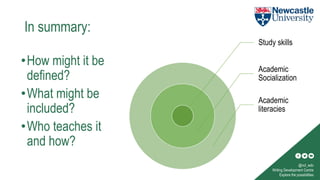
In summary:
Study skills
Academic
Socialization
Academic
literacies
•How might it be
defined?
•What might be
included?
•Who teaches it
and how?
@ncl_wdc
Writing Development Centre
Explore the possibilities
References
• Lea, M. and Street, B. (1998). ‘Student Writing in Higher Education: An Academic Literacies
Approach’ Studies in Higher Education 23 (2) 157-172.
• Lea, M. and Street, B. (2006). ‘The Academic Literacies Model: Theory and Applications’
Theory into Practice, 45(4) 368-377.
• Lillis, T. (2001) Student Writing: Access, Regulation and Desire. London: Routledge.
• Lillis, T. and Tuck, J. (2016). ‘Academic Literacies’ in: Ken Hyland and Phillip Shaw (eds). The
Routledge Handbook of English for Academic Purposes. London: Routledge. 30-43.
• Robinson-Pant, A. And Street, B. (2012) ‘Students’ and Tutors’ Understanding of ‘New’
Academic Literacy Practices’ in: M. Castello and C. Donahue (eds). University Writing: Selves
and Texts in Academic Societies. (London: Routledge. 71-92.
• Wingate, U. (2015). Academic Literacy and Student Diversity: The case for Inclusive Practice.
@ncl_wdc
Writing Development Centre
Explore the possibilities
With apologies to
• Dorothy Newbury-Birch (2000). Drinking, illicit drug use, stress and other
lifestyle variables in medical students and doctors. Unpublished PhD thesis.
Newcastle University.
• Dorothy Newbury-Birch, David Walshaw and Farhad Kamali (2001). ‘Drink
and drugs: from medical students to doctors’ Drug and Alcohol Dependence
64 3, 265–270
@ncl_wdc
Writing Development Centre
Explore the possibilities
Contact:
Dr Helen Webster
• Head of the Writing Development Centre, Newcastle University
• Email: helen.webster@ncl.ac.uk
• Twitter: @scholastic_rat
• Blog: https://rattusscholasticus.wordpress.com/

Academic literacy uhmlg

  • 1.
    Academic Literacy: A ContestedConcept Dr Helen Webster Head of the Writing Development Centre Newcastle University (aka @scholastic_rat) @ncl_wdc Writing Development Centre Explore the possibilities
  • 2.
    @ncl_wdc Writing Development Centre Explorethe possibilities What is ‘Academic Literacy’? •How might it be defined? •What might be included under this concept? •Who teaches it and how? •Why isn’t it straightforward?
  • 3.
    @ncl_wdc Writing Development Centre Explorethe possibilities Who owns Academic Literacy? EAP teachers Linguistics s /Education n researchers ers Learning Developers Developers Subject Academics s Wasn't expecting to get much out of the essay lecture given that it was delivered by someone who didn't really know the field (especially given how lecturer suggestions in how to write essays are kind of patchy and inconsistent at the best of times), but it was actually really helpful. […] it clarified a lot of stuff that lecturers haven't really been that good at explaining. (Student feedback)
  • 4.
    @ncl_wdc Writing Development Centre Explorethe possibilities Text One •What academic literacy issues do you identify with this text? •What feedback or advice would you give this student?
  • 5.
    @ncl_wdc Writing Development Centre Explorethe possibilities Study Skills Advice • Avoid abbreviations and contractions. Write words out in full: • ‘dept.’ as ‘department’ • ‘e.g’. as ‘for example’ • ‘didn’t’ as ‘did not’ • ‘they’re’ as ‘they are’ • ‘isn’t’ as ‘is not’ • Avoid personal pronouns such as ‘I’/’we’ and ‘you’. Instead, sentences begin in impersonal ways such as ‘it can be seen that…’ • Linking ideas together: • Introducing an alternative viewpoint: conversely; in comparison; on the contrary; in fact; though; although. (Cottrell, Study Skills Handbook)
  • 6.
    @ncl_wdc Writing Development Centre Explorethe possibilities The ‘Study Skills’ Model ‘The study skills model sees writing and literacy as primarily an individual and cognitive skill. This approach focusses on the surface features of language form and presumes that students can transfer their knowledge of writing and literacy unproblematically from one context to another’. (Lea and Street, 2006). • Study Skills: [Remediation of] Student Deficit. • ‘Fix it’, atomised [transferable] skills; surface language, grammar, spelling. • Sources: behavioural and experimental psychology; programmed learning • Student writing as technical and instrumental skill (Robinson-Pant and Street, 2012).
  • 7.
    @ncl_wdc Writing Development Centre Explorethe possibilities Approaches and issues • Approaches • Bolt-on • Generic • Diagnostic • Issues: • These are just surface features – what’s ‘academic’ about them? • These ‘rules’ aren’t always true or applicable. • This is a deficit, remedial approach applying only to some (EAP, WP, SpLD)
  • 8.
    @ncl_wdc Writing Development Centre Explorethe possibilities Text Two •What makes this text sound academic? •Are there any instances where it sounds less academic? •Can we derive the features of ‘academic’ writing?
  • 9.
    @ncl_wdc Writing Development Centre Explorethe possibilities Academic Socialisation Advice Academic writing is clear, concise, focussed, structured and backed up by evidence. Its purpose is to aid the reader’s understanding. Characteristics of academic writing. Academic writing is: • Planned and focused: answers the question and demonstrates an understanding of the subject. • Structured: is coherent, written in a logical order, and brings together related points and material. • Evidenced: demonstrates knowledge of the subject area, supports opinions and arguments with evidence, and is referenced accurately. • Formal in tone and style: uses appropriate language and tenses, and is clear, concise and balanced Leeds University https://library.leeds.ac.uk/info/14011/writing/106/academic_writing
  • 10.
    @ncl_wdc Writing Development Centre Explorethe possibilities The Academic Socialisation Model • Academic socialization is concerned with students’ acculturation into disciplinary and subject-based discourses and genres. Students acquire the ways of talking, writing, thinking and using literacy that typified members of a disciplinary or subject area community. The academic socialization model presumes that disciplinary discourses are relatively stable and, once students have learned and understood the ground rules of a particular academic discourse, they are able to reproduce it unproblematically. (Lea and Street, 2006). • Academic socialisation: acculturation of students into academic discourse • Inducting students into new ‘culture’; focus on orientation to learning and interpretation of learning task, e.g. ‘deep’, ‘surface’, ‘strategic’ learning; homogeneous ‘culture’, lack of focus on institutional practices, change and power. • Sources: social psychology, anthropology, constructivism. • Student writing as transparent medium of representation. (Robinson-Pant and Street, 2012).
  • 11.
    @ncl_wdc Writing Development Centre Explorethe possibilities Approaches and Issues • Approaches: • Demystifying the ‘institutional practice of mystery’ (Lillis, 2001) • ‘Academic language is no one’s mother tongue’ (Bourdieu and Passeron, 1994) • Embedded • Issues: • These aren’t ‘transferable skills’. • Focus on product, not process • These concepts aren’t transparent or straightforward. • Gatekeeping - this perpetuates social and cultural capital without challenging it.
  • 12.
    @ncl_wdc Writing Development Centre Explorethe possibilities Texts Two and Three •Which of these two texts is more academic? •Why?
  • 13.
    @ncl_wdc Writing Development Centre Explorethe possibilities The Academic Literacies Model • Academic literacies is concerned with meaning-making, identity, power and authority, and foregrounds the institutional nature of what counts as knowledge in any particular academic context. It […] views the processes involved in acquiring appropriate and effective uses of literacy as more complex, dynamic, nuanced, situated and involving both epistemological issues and social processes, including power relations among people, institutions and social identities. (Lea and Street, 2006). • Academic Literacies: Students’ negotiation of conflicting literary practices • Literacies as social practices; at level of epistemologies and identities; institutions as sites of/constituted in discourses and power; variety of communicative repertoire, switching with regard to linguistic practices, social meanings and identities, • Sources: New Literacy studies; critical discourse analysis, systemic functional linguistics, cultural anthropology. • Student Writing as constitutive and contested. (Robinson-Pant and Street, 2012).
  • 14.
    @ncl_wdc Writing Development Centre Explorethe possibilities Academic Literacies Advice? In this situation, Authority • Who can you you be? • Who do you you want to be? • Who do you need to be? Authorial Presence • How can you you say it? • How do you you want to say it? • How do you need to say it? Authorship • What can you you say? • What do you you want to say? • What do you need to say? ‘Heuristic’ adapted from Lillis, 2001
  • 15.
    @ncl_wdc Writing Development Centre Explorethe possibilities Approaches and Issues • Approaches: • Switching between repertoire– subject, genre, level, language, institution, individual lecturer… • Negotiation (both senses) • Focussed on communicative acts (writing, sometimes reading, speaking, listening) but rooted in discourses, practices, identities and relationships • Not skills possessed but social practices enacted • Emancipatory - decolonising the Hidden Curriculum • Issues: • Who is best placed to teach this, and where? • How do we deal with power and authority? • How could you – should you - ever establish an academic literacy ‘curriculum’?! • Too focussed on writing - What about revision, criticality, time management, groupwork?
  • 16.
    @ncl_wdc Writing Development Centre Explorethe possibilities In summary: Study skills Academic Socialization Academic literacies •How might it be defined? •What might be included? •Who teaches it and how?
  • 17.
    @ncl_wdc Writing Development Centre Explorethe possibilities References • Lea, M. and Street, B. (1998). ‘Student Writing in Higher Education: An Academic Literacies Approach’ Studies in Higher Education 23 (2) 157-172. • Lea, M. and Street, B. (2006). ‘The Academic Literacies Model: Theory and Applications’ Theory into Practice, 45(4) 368-377. • Lillis, T. (2001) Student Writing: Access, Regulation and Desire. London: Routledge. • Lillis, T. and Tuck, J. (2016). ‘Academic Literacies’ in: Ken Hyland and Phillip Shaw (eds). The Routledge Handbook of English for Academic Purposes. London: Routledge. 30-43. • Robinson-Pant, A. And Street, B. (2012) ‘Students’ and Tutors’ Understanding of ‘New’ Academic Literacy Practices’ in: M. Castello and C. Donahue (eds). University Writing: Selves and Texts in Academic Societies. (London: Routledge. 71-92. • Wingate, U. (2015). Academic Literacy and Student Diversity: The case for Inclusive Practice.
  • 18.
    @ncl_wdc Writing Development Centre Explorethe possibilities With apologies to • Dorothy Newbury-Birch (2000). Drinking, illicit drug use, stress and other lifestyle variables in medical students and doctors. Unpublished PhD thesis. Newcastle University. • Dorothy Newbury-Birch, David Walshaw and Farhad Kamali (2001). ‘Drink and drugs: from medical students to doctors’ Drug and Alcohol Dependence 64 3, 265–270
  • 19.
    @ncl_wdc Writing Development Centre Explorethe possibilities Contact: Dr Helen Webster • Head of the Writing Development Centre, Newcastle University • Email: helen.webster@ncl.ac.uk • Twitter: @scholastic_rat • Blog: https://rattusscholasticus.wordpress.com/

Editor's Notes

  • #3 Who owns academic literacy? Academics, Linguistics or Education researchers, EAP practitioners, Learning Developers. Also – why are we so obsessed with writing?
  • #7 Widening Participation, Internationalisation, Accessibility (SpLD)
  • #11  Lave and Wenger – communities of practice, novice/expert Not really looking at processes or practices of learning other than communication, and even then too skewed towards writing as product
  • #15 I’ve added the last layer as a place to bring together the writer and the reader and negotiate a way forward. wAS developed as a research heuristic, but could be a nice model for a developmental conversation. The resisting writer- negotiation and identities, constraints and potential. Polyphony – your ‘own’ words and ideas? Also helps to validate invisible or unintended learning – what we capture is a sampling, a snapshot only Can – both constraint and possibilities – open up multiples. Need – this brings in the lecturer’s dimension and is where negotiation happens Could be a workshop discussion, and also a pro forma for them to work through an assignment with