Entomology
353 Bio
T. Amani Alsharidah
1441 – 2019
lecture 4
The Insect Head
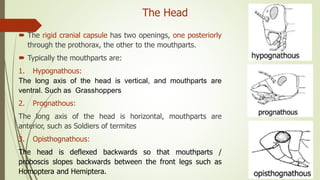
The Head
 The rigid cranial capsule has two openings, one posteriorly
through the prothorax, the other to the mouthparts.
 Typically the mouthparts are:
1. Hypognathous:
The long axis of the head is vertical, and mouthparts are
ventral. Such as Grasshoppers
2. Prognathous:
The long axis of the head is horizontal, mouthparts are
anterior, such as Soldiers of termites
3. Opisthognathous:
The head is deflexed backwards so that mouthparts /
proboscis slopes backwards between the front legs such as
Homoptera and Hemiptera.
The Head
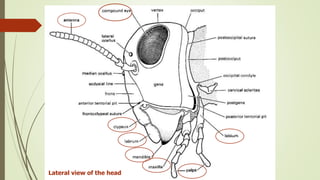
 In adult and nymphal insects, paired compound eyes between the vertex
and genae, with a pair of sensory antennae placed more medially.
 In many insect three light-sensitive “simple” eyes, or ocelli, are situated
on the anterior vertex, typically arranged in a triangle.
 The segmental origin of the head is most clearly demonstrated by the
mouthparts. From anterior to posterior, there are six fused head
segments: preantennal (or ocular); antennal; labral; mandibular;
maxillary; labial.
 The neck is mainly derived from the first part of the thorax and is not a
segment.
Lateral view of the head
The Mouth parts
 The mouthparts are formed from appendages of head segments.
 In omnivorous insects, such as cockroaches, crickets, and earwigs, the
mouthparts are of a biting and chewing type (mandibulate) and resemble
the probable basic design of ancestral pterygote insects more closely than
the mouthparts of the majority of modern insects.
 Extreme modifications of basic mouth part structure, correlated with
feeding specializations, occur in most Lepidoptera, Diptera, Hymenoptera,
Hemiptera.
Type of mouth parts
1- Basic mandibulate (Chewing)
mouthparts
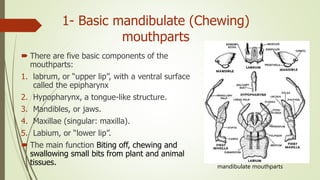
 There are five basic components of the
mouthparts:
1. labrum, or “upper lip”, with a ventral surface
called the epipharynx
2. Hypopharynx, a tongue-like structure.
3. Mandibles, or jaws.
4. Maxillae (singular: maxilla).
5. Labium, or “lower lip”.
 The main function Biting off, chewing and
swallowing small bits from plant and animal
tissues. mandibulate mouthparts
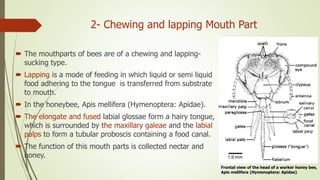
2- Chewing and lapping Mouth Part
 The mouthparts of bees are of a chewing and lapping-
sucking type.
 Lapping is a mode of feeding in which liquid or semi liquid
food adhering to the tongue is transferred from substrate
to mouth.
 In the honeybee, Apis mellifera (Hymenoptera: Apidae).
 The elongate and fused labial glossae form a hairy tongue,
which is surrounded by the maxillary galeae and the labial
palps to form a tubular proboscis containing a food canal.
 The function of this mouth parts is collected nectar and
honey.
Frontal view of the head of a worker honey bee,
Apis mellifera (Hymenoptera: Apidae)
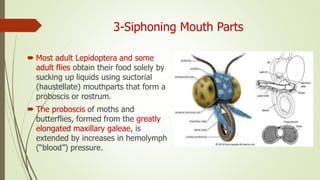
3-Siphoning Mouth Parts
 Most adult Lepidoptera and some
adult flies obtain their food solely by
sucking up liquids using suctorial
(haustellate) mouthparts that form a
proboscis or rostrum.
 The proboscis of moths and
butterflies, formed from the greatly
elongated maxillary galeae, is
extended by increases in hemolymph
(“blood”) pressure.
4- Sponging/lapping Mouth parts
 A few moths and many flies combine
sucking with piercing or biting.
 For example, moths that pierce fruit and
exceptionally suck blood (species of
Noctuidae) have spines and hooks at the
tip of their proboscis which are rasped
against the skins of either ungulate
mammals or fruit.
5-Pierecing-Sucking Mouth Parts
 All dipterans typically have a tubular sucking organ.
 The proboscis, comprising elongate mouthparts
(usually including the labrum).
 A biting-and-sucking type of proboscis appears to be
a primitive dipteran feature.
 Although biting functions have been lost and
regained with modifications more than once, blood
feeding is frequent, and leads to the importance of
the Diptera as vectors of disease.
 Blood-feeding flies have a variety of skin-penetration
and feeding mechanisms.
Antennae
 Antennae are mobile, segmented, paired appendages.
 They appear to be eight-segmented in nymphs and adults, but often
there are numerous sub- divisions, sometimes called antennomeres.
 The entire antenna typically has three main divisions:
1. Scape: generally is larger than the other segments and is the basal
stalk.
2. Pedicel: nearly always contains a sensory organ known as Johnston’s
organ, which responds to movement of the distal part of the antenna
relative to the pedicel.
3. The flagellum: is often filamentous and multisegmented (with many
flagellomeres),but may be reduced or variously modified.
 The antennae are reduced or almost absent in some larval insects.
Typical structure of Antenna
Antenna
 Numerous sensory organs, or sensilla), in the form of hairs, pegs, pits, or cones,
occur on antennae and function as chemoreceptors, mechanoreceptors,
thermoreceptors, and hygroreceptors.
Antenna Function:
 To serve as secondary sexual characters in male Lepidoptera and male mosquito.
 To find it’s way.
 To detect the danger.
 To find the food.
 To find the opposite sex.
 To communicate with each other e.g. Ants.
 It bear olfactory organs ( smell) e.g. Housefly
 It bears chordotonal organs (sound hearing) e.g. Male Mosquito.
 To detect humidity
 To hold the opposite sex at the time of mating.
 To catch the prey e.g. Mantids.
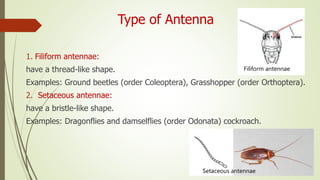
Type of Antenna
1. Filiform antennae:
have a thread-like shape.
Examples: Ground beetles (order Coleoptera), Grasshopper (order Orthoptera).
2. Setaceous antennae:
have a bristle-like shape.
Examples: Dragonflies and damselflies (order Odonata) cockroach.
Filiform antennae
Setaceous antennae
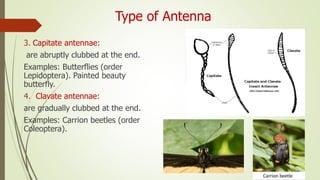
Type of Antenna
3. Capitate antennae:
are abruptly clubbed at the end.
Examples: Butterflies (order
Lepidoptera). Painted beauty
butterfly.
4. Clavate antennae:
are gradually clubbed at the end.
Examples: Carrion beetles (order
Coleoptera).
Type of Antenna
5. Lamellate or clubbed antennae:
End in nested plates.
Examples: Scarab beetles (order
Coleoptera). Rose chafer,
Macrodactylus subspinosus
6. Serrate antennae:
Have a saw-toothed shape.
Examples: Click beetles (order
Coleoptera).
Type of Antenna
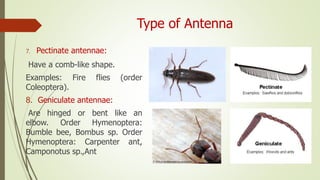
7. Pectinate antennae:
Have a comb-like shape.
Examples: Fire flies (order
Coleoptera).
8. Geniculate antennae:
Are hinged or bent like an
elbow. Order Hymenoptera:
Bumble bee, Bombus sp. Order
Hymenoptera: Carpenter ant,
Camponotus sp.,Ant
Type of Antenna
9. Bipectinate antennae:
Have a feather-like shape. Examples:
Moths (order Lepidoptera).
10.Plumose antennae:
Have a feather-like shape. Example Order
Diptera Mosquito male Culex sp. Male
mosquito, Female Mosquito.
Bipectinate antennae
Type of Antenna
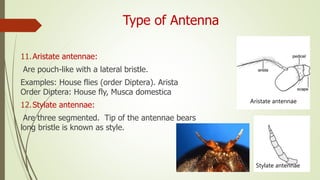
11.Aristate antennae:
Are pouch-like with a lateral bristle.
Examples: House flies (order Diptera). Arista
Order Diptera: House fly, Musca domestica
12.Stylate antennae:
Are three segmented. Tip of the antennae bears
long bristle is known as style.
Aristate antennae
Stylate antennae

Insect head

  • 1.
    Entomology 353 Bio T. AmaniAlsharidah 1441 – 2019
  • 2.
  • 3.
    The Head  Therigid cranial capsule has two openings, one posteriorly through the prothorax, the other to the mouthparts.  Typically the mouthparts are: 1. Hypognathous: The long axis of the head is vertical, and mouthparts are ventral. Such as Grasshoppers 2. Prognathous: The long axis of the head is horizontal, mouthparts are anterior, such as Soldiers of termites 3. Opisthognathous: The head is deflexed backwards so that mouthparts / proboscis slopes backwards between the front legs such as Homoptera and Hemiptera.
  • 4.
    The Head  Inadult and nymphal insects, paired compound eyes between the vertex and genae, with a pair of sensory antennae placed more medially.  In many insect three light-sensitive “simple” eyes, or ocelli, are situated on the anterior vertex, typically arranged in a triangle.  The segmental origin of the head is most clearly demonstrated by the mouthparts. From anterior to posterior, there are six fused head segments: preantennal (or ocular); antennal; labral; mandibular; maxillary; labial.  The neck is mainly derived from the first part of the thorax and is not a segment.
  • 5.
  • 7.
    The Mouth parts The mouthparts are formed from appendages of head segments.  In omnivorous insects, such as cockroaches, crickets, and earwigs, the mouthparts are of a biting and chewing type (mandibulate) and resemble the probable basic design of ancestral pterygote insects more closely than the mouthparts of the majority of modern insects.  Extreme modifications of basic mouth part structure, correlated with feeding specializations, occur in most Lepidoptera, Diptera, Hymenoptera, Hemiptera.
  • 8.
  • 9.
    1- Basic mandibulate(Chewing) mouthparts  There are five basic components of the mouthparts: 1. labrum, or “upper lip”, with a ventral surface called the epipharynx 2. Hypopharynx, a tongue-like structure. 3. Mandibles, or jaws. 4. Maxillae (singular: maxilla). 5. Labium, or “lower lip”.  The main function Biting off, chewing and swallowing small bits from plant and animal tissues. mandibulate mouthparts
  • 10.
    2- Chewing andlapping Mouth Part  The mouthparts of bees are of a chewing and lapping- sucking type.  Lapping is a mode of feeding in which liquid or semi liquid food adhering to the tongue is transferred from substrate to mouth.  In the honeybee, Apis mellifera (Hymenoptera: Apidae).  The elongate and fused labial glossae form a hairy tongue, which is surrounded by the maxillary galeae and the labial palps to form a tubular proboscis containing a food canal.  The function of this mouth parts is collected nectar and honey. Frontal view of the head of a worker honey bee, Apis mellifera (Hymenoptera: Apidae)
  • 11.
    3-Siphoning Mouth Parts Most adult Lepidoptera and some adult flies obtain their food solely by sucking up liquids using suctorial (haustellate) mouthparts that form a proboscis or rostrum.  The proboscis of moths and butterflies, formed from the greatly elongated maxillary galeae, is extended by increases in hemolymph (“blood”) pressure.
  • 12.
    4- Sponging/lapping Mouthparts  A few moths and many flies combine sucking with piercing or biting.  For example, moths that pierce fruit and exceptionally suck blood (species of Noctuidae) have spines and hooks at the tip of their proboscis which are rasped against the skins of either ungulate mammals or fruit.
  • 13.
    5-Pierecing-Sucking Mouth Parts All dipterans typically have a tubular sucking organ.  The proboscis, comprising elongate mouthparts (usually including the labrum).  A biting-and-sucking type of proboscis appears to be a primitive dipteran feature.  Although biting functions have been lost and regained with modifications more than once, blood feeding is frequent, and leads to the importance of the Diptera as vectors of disease.  Blood-feeding flies have a variety of skin-penetration and feeding mechanisms.
  • 14.
    Antennae  Antennae aremobile, segmented, paired appendages.  They appear to be eight-segmented in nymphs and adults, but often there are numerous sub- divisions, sometimes called antennomeres.  The entire antenna typically has three main divisions: 1. Scape: generally is larger than the other segments and is the basal stalk. 2. Pedicel: nearly always contains a sensory organ known as Johnston’s organ, which responds to movement of the distal part of the antenna relative to the pedicel. 3. The flagellum: is often filamentous and multisegmented (with many flagellomeres),but may be reduced or variously modified.  The antennae are reduced or almost absent in some larval insects.
  • 15.
  • 16.
    Antenna  Numerous sensoryorgans, or sensilla), in the form of hairs, pegs, pits, or cones, occur on antennae and function as chemoreceptors, mechanoreceptors, thermoreceptors, and hygroreceptors. Antenna Function:  To serve as secondary sexual characters in male Lepidoptera and male mosquito.  To find it’s way.  To detect the danger.  To find the food.  To find the opposite sex.  To communicate with each other e.g. Ants.  It bear olfactory organs ( smell) e.g. Housefly  It bears chordotonal organs (sound hearing) e.g. Male Mosquito.  To detect humidity  To hold the opposite sex at the time of mating.  To catch the prey e.g. Mantids.
  • 17.
    Type of Antenna 1.Filiform antennae: have a thread-like shape. Examples: Ground beetles (order Coleoptera), Grasshopper (order Orthoptera). 2. Setaceous antennae: have a bristle-like shape. Examples: Dragonflies and damselflies (order Odonata) cockroach. Filiform antennae Setaceous antennae
  • 18.
    Type of Antenna 3.Capitate antennae: are abruptly clubbed at the end. Examples: Butterflies (order Lepidoptera). Painted beauty butterfly. 4. Clavate antennae: are gradually clubbed at the end. Examples: Carrion beetles (order Coleoptera).
  • 19.
    Type of Antenna 5.Lamellate or clubbed antennae: End in nested plates. Examples: Scarab beetles (order Coleoptera). Rose chafer, Macrodactylus subspinosus 6. Serrate antennae: Have a saw-toothed shape. Examples: Click beetles (order Coleoptera).
  • 20.
    Type of Antenna 7.Pectinate antennae: Have a comb-like shape. Examples: Fire flies (order Coleoptera). 8. Geniculate antennae: Are hinged or bent like an elbow. Order Hymenoptera: Bumble bee, Bombus sp. Order Hymenoptera: Carpenter ant, Camponotus sp.,Ant
  • 21.
    Type of Antenna 9.Bipectinate antennae: Have a feather-like shape. Examples: Moths (order Lepidoptera). 10.Plumose antennae: Have a feather-like shape. Example Order Diptera Mosquito male Culex sp. Male mosquito, Female Mosquito. Bipectinate antennae
  • 22.
    Type of Antenna 11.Aristateantennae: Are pouch-like with a lateral bristle. Examples: House flies (order Diptera). Arista Order Diptera: House fly, Musca domestica 12.Stylate antennae: Are three segmented. Tip of the antennae bears long bristle is known as style. Aristate antennae Stylate antennae

Editor's Notes

  • #6 للفهم
  • #7 للفهم
  • #10 بدون الرسمة
  • #11 بدون الرسمة
  • #12 الرسمة + الكلام ليس بالفاينل
  • #14 الرسمة ليس بالفاينل
  • #18 مو بالفاينل
  • #19 ليس بالفاينل
  • #22 ليس من ضمن الفاينل