IOSR Journal of Computer Engineering (IOSR-JCE)
e-ISSN: 2278-0661,p-ISSN: 2278-8727, Volume 17, Issue 4, Ver. IV (July – Aug. 2015), PP 01-09
www.iosrjournals.org
DOI: 10.9790/0661-17440109 www.iosrjournals.org 1 | Page
An Energy Efficient Traffic Routing On Wake-Up Process in
Wireless Sensor Network
K V Umashankar, Dr.C.Chanadrasekar
Research Scholar, Bharathiyar University, Coimbatore-641 046, Tamilnadu, India.
Professor, Department of Computer Science, Periyar University, Salem-636011
Tamilnadu, India
Abstract: Wireless network consists of distributed sensor nodes to monitor the physical conditions and
establish the traffic system. Every node in WSN sends and receives the packet, resulting in wastage of
bandwidth.However, bandwidth effective sensor node is not effective in improving the energy-saving protocol in
wireless sensor network. The wake-up process with high energy consumption leads to maximal overhead count
on packet transmission channel. To reduce the energy consumption in wireless sensor network, Energy Efficient
Traffic Routing based on the Point Synchronization Fitness Functioning (EETR-PSFF)mechanism is proposed
in this paper.At first, Energy Efficient Traffic Routing enables the sensor nodes to sleep for specified durations
in an inactive condition in the sensor network to increase the bandwidth utility rate. Next, Active Allocation of
the traffic swap slots offers lesser energy consumption on the medium access control channels with heavy loads
to increase the overall packet transmission precision accuracy.The final part of our proposed work uses traffic
swap slots employedwith Point (i.e.,) node Synchronization Fitness Function which obtain significant energy
savings on the wake-up process. PSF function sums up all the coverage values in sensor network and divides it
by the product rule. The product rule takes place on the number of sources nodes in the heterogeneous WSN to
reduce the energy rate on wake-up process. At the same time the sleep mode in EETR-PSFF mechanism
improves the bandwidth efficiently. Experiment is conducted on the factors such as average energy consumption
rate on wake up process, bandwidth utility rate, and overall packet transmission precision accuracy.
Keywords: Fitness Functioning, Traffic Routing, Synchronization, Energy, Wake-up Process, Active
Allocation, Product Rule, Sleep Node, Packet Transmission.
I. Introduction
The wireless sensor network has been applied in several applications ranging from Surveillance,
Radiology to applications specific to. With the limited capacity of sensor node in the sensor network, several
design challenges remain unaddressed. Wireless Sensor Network (WSN) becomes highly challenging while
monitoring the physical conditions as well improvement on working with energy saving protocol.
Energy Saving in WSN (ES-WSN) [1] evaluated the distance between the transmitter and the receiver
and also ensured sleep mode in order to save energy during normal operational conditions. In addition, the
energy consumption for the entire network was evaluated using periodic sleep and wake up scheme. However,
the developed energy-saving protocol failed in generalizing the energy resources on wake-up processes. A
quorum based energy efficient protocol presented in [2] called as Queen-MAC with the objective of keeping the
transmission latency low with the aid of grid and e-torus. With this an adaptive energy efficient routing protocol
was designed based on light weight channel assignment and dygrid quorum system, but with low overhead. But,
the wake-up process with high energy consumption results in maximal overhead count on packet transmission
channel.
Wireless sensor networks with battery powered sensor devices are highly prone to susceptible attack
due to ineffective routing pose a great problem in sensor network. In [3], a Redundant Radix-based Approach
(RRA) was designed to ensure high energy efficient technique for data transmission. A distributed and energy
efficient sleep scheduling mechanism was designed in [4] to improve the network lifetime by maintaining
connectivity and coverage with the aid of probabilistic method. Another energy efficient method designed in [5]
for target tracking not only provided high accuracy but also ensured fault tolerance with the increase in the
scalability of the network. Exponential Weighted Moving Average (EWMA) [6] was designed to minimize the
overhead and increase the packet delivery ratio.
Energy detection in cognitive radio networks with the aid of cooperative spectrum was studied by
many researchers. In [7], two fusion strategies were used called as data fusion and decision fusion to improve
the detection performance. Hierarchical hashing based protocols introduced in [8] provided an insight into
improving the query success rate of the nodes using location updates. Friendship based routing in [9] was
designed with the objective of providing connectivity between nodes in Delay Tolerant Networks (DTN).
An Energy Efficient Traffic Routing On Wake-Up Process in Wireless Sensor Network
DOI: 10.9790/0661-17440109 www.iosrjournals.org 2 | Page
Another algorithm based on multi period spraying was designed in [10] to improve the message delivery.
However, with the raising changes in topology, message delivery significantly gets affected.
In this paper, we design an Energy Efficient Traffic Routing based on the Point Synchronization
Fitness Functioning (EETR-PSFF) mechanism. The contributions of EETR-PSFF mechanism include the
following:
 To reduce the energy consumption in wireless sensor network using an Energy Efficient Traffic Routing
based on the Point Synchronization Fitness Functioning (EETR-PSFF) mechanism.
 To improve the energy efficiency of sensor nodes and bandwidth utility rate in the network by enabling
sensor nodes to sleep for specified durations in an inactive condition for Energy Efficient Traffic Routing in
the sensor network.
 To increase the overall packet transmission precision accuracy on the medium access control channels with
heavy loads by performing Active Allocation of traffic swap slots.
 To reduce the average energy consumption rate on wake-up process with the help of Point (i.e.,) node
Synchronization Fitness Function that sums up all the coverage values in sensor network and divides it by
the product rule.
The rest of the paper organized as follows. In Section 2, a summary of different energy efficient routing
protocols are explained. In Section 3, the proposed mechanism with the help of neat architecture diagram is
described. In Section 4, simulation environment is provided with detailed analysis of results explained in
Section 5. In Section 6, conclusion is included.
II. Related Works
Packet size has a greater influence in determining the energy consumption of a communication link.
Long packet size increases the possibility of packet error whereas short packet size results in minimizing the
efficiency of the system drastically. As a result, an optimum packet size should be selected to reduce the
consumption of energy. Differential Phase Shift Keying (DPSK) and Differential Pulse Position Modulation
introduced in [11] to address the issues related to packet size. Energy Efficient Level Based Clustering Protocol
[12] not only minimized the energy consumption but also improved the network lifetime by introducing inter
cluster and energy model. Low Energy Adaptive Reliable Routing (LEARR) [13] provided energy efficient
routing mechanism to improve the system network lifetime. Multipath routing on the basis of on demand and
information obtained through multi hop was designed in [14] to improve the data forwarding.
Under Water Wireless Sensor Network is yet another topic receiving greater attention with the increase
in the number of sensor nodes. Energy efficient depth based routing protocol [15] was designed with the
objective of improving the packet forwarding process. Another cluster based routing protocol was presented in
[16] with the purview of improving the network lifetime in a significant manner. A new cluster routing
algorithm to reduce the energy consumption in [17] was addressed to increase the network lifetime and reduce
the energy consumption with the aid of center gravity and threshold. Quadrature Leach (Q-LEACH) [18] was
designed for homogeneous network for enhancing the stability period and increasing the network lifetime based
on cluster functionality. With the objective of improving the throughput, in [19] and with the aid of online and
offline algorithm stochastic optimization technique was applied to achieve the same. Though throughput was
increased but at the cost of energy consumption.
This paper presents an Energy Efficient Traffic Routing based on the Point Synchronization Fitness
Functioning (EETR-PSFF) mechanism that not only provides an energy efficient traffic routing protocol but
Point (i.e.,) node Synchronization Fitness Function, which reduces the average energy consumption rate and
increase the overall packet transmission precision accuracy. EETR-PSFF utilizes traffic swap slots for effective
switch over between active state and idle mode that provide an efficient traffic while providing concurrent
packet transmissions in sensor network.
III. Energy Efficient Traffic Routing Based On The Point Synchronization Fitness Functioning
Mechanism
Energy-saving on the wake-up process in heterogeneous wireless sensor network is the main objective
to be achieved in this work.Energy efficiency is the most significant consideration while designing
heterogeneouswireless sensor network nodes with minimal overhead count.Initially traffic routing is established
to transfer packet from source to destination. Wireless Sensor Networks (WSN) with EETR-PSFF mechanism
provides a significant capability to autonomously monitor the energy consumption and bandwidth utilization
activities on traffic network.
An Energy Efficient Traffic Routing On Wake-Up Process in Wireless Sensor Network
DOI: 10.9790/0661-17440109 www.iosrjournals.org 3 | Page
Figure 1 shows the energy scheduling based on wake-up process. The energy saving on Wake-up
process is the main proposal work to be achieved in this paper. The source node sends the packet to the
destination end through intermediate nodes. At the start process (i.e., source to intermediate node transfer) the
wake-up process is carried out. In this process, wireless sensor network multipath routing performs the active
listening operation to measure the energy rate in EETR-PSFF mechanism. Energy rate is effectively measured in
the traffic routing using the Point (i.e.,) node Synchronization Fitness Function.The architecture diagram of
EETR-PSFF mechanism is shown in Figure 2.
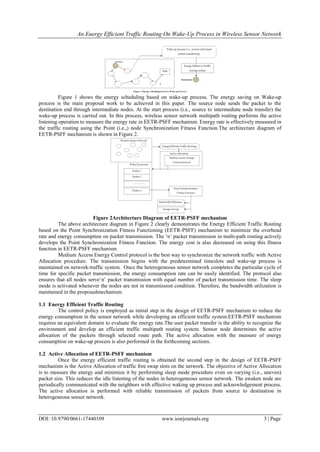
Figure 2Architecture Diagram of EETR-PSFF mechanism
The above architecture diagram in Figure 2 clearly demonstrates the Energy Efficient Traffic Routing
based on the Point Synchronization Fitness Functioning (EETR-PSFF) mechanism to minimize the overhead
rate and energy consumption on packet transmission. The „n‟ packet transmission in multi-path routing actively
develops the Point Synchronization Fitness Function. The energy cost is also decreased on using this fitness
function in EETR-PSFF mechanism.
Medium Access Energy Control protocol is the best way to synchronize the network traffic with Active
Allocation procedure. The transmission begins with the predetermined timeslots and wake-up process is
maintained on network-traffic system. Once the heterogeneous sensor network completes the particular cycle of
time for specific packet transmission, the energy consumption rate can be easily identified. The protocol also
ensures that all nodes serve„n‟ packet transmission with equal number of packet transmission time. The sleep
mode is activated whenever the nodes are not in transmission condition. Therefore, the bandwidth utilization is
maintained in the proposedmechanism.
1.1 Energy Efficient Traffic Routing
The control policy is employed as initial step in the design of EETR-PSFF mechanism to reduce the
energy consumption in the sensor network while developing an efficient traffic system.EETR-PSFF mechanism
requires an equivalent domain to evaluate the energy rate.The user packet transfer is the ability to recognize the
environment and develop an efficient traffic multipath routing system. Sensor node determines the active
allocation of the packets through selected route path. The active allocation with the measure of energy
consumption on wake-up process is also performed in the forthcoming sections.
1.2 Active Allocation of EETR-PSFF mechanism
Once the energy efficient traffic routing is obtained the second step in the design of EETR-PSFF
mechanism is the Active Allocation of traffic free swap slots on the network. The objective of Active Allocation
is to measure the energy and minimize it by performing sleep mode procedure even on varying (i.e., uneven)
packet size. This reduces the idle listening of the nodes in heterogeneous sensor network. The awaken node are
periodically communicated with the neighbors with effective waking up process and acknowledgement process.
The active allocation is performed with reliable transmission of packets from source to destination in
heterogeneous sensor network.
An Energy Efficient Traffic Routing On Wake-Up Process in Wireless Sensor Network
DOI: 10.9790/0661-17440109 www.iosrjournals.org 4 | Page
1.2.1 Medium Access Energy Control Channel
The medium access energy control channel in EETR-PSFF mechanism is constructed whenever there
occurs‟ burst of uneven length of packet size. During this packet transfer, the packet is stored in the temporary
buffer and until then the time frame is turned to idle state. The time frame helps to make the packet transmission
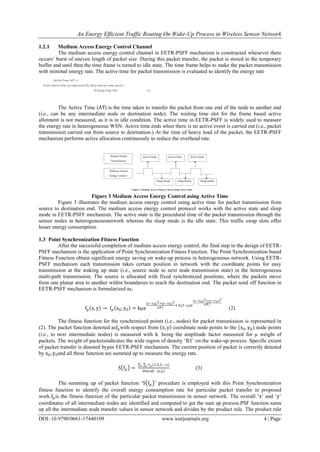
with minimal energy rate. The active time for packet transmission is evaluated to identify the energy rate
The Active Time (AT) is the time taken to transfer the packet from one end of the node to another end
(i.e., can be any intermediate node or destination node). The waiting time slot for the frame based active
allotment is not measured, as it is in idle condition. The active time in EETR-PSFF is widely used to measure
the energy rate in heterogeneous WSN. Active time ends when there is no active event is carried out (i.e., packet
transmission carried out from source to destination.) At the time of heavy load of the packet, the EETR-PSFF
mechanism performs active allocation continuously to reduce the overhead rate.
Figure 3 Medium Access Energy Control using Active Time
Figure 3 illustrates the medium access energy control using active time for packet transmission from
source to destination end. The medium access energy control protocol works with the active state and sleep
mode in EETR-PSFF mechanism. The active state is the procedural time of the packet transmission through the
sensor nodes in heterogeneousnetwork whereas the sleep mode is the idle state. This traffic swap slots offer
lesser energy consumption.
1.3 Point Synchronization Fitness Function
After the successful completion of medium access energy control, the final step in the design of EETR-
PSFF mechanism is the application of Point Synchronization Fitness Function. The Point Synchronization based
Fitness Function obtain significant energy saving on wake-up process in heterogeneous network. Using EETR-
PSFF mechanism each transmission takes certain position in network with the coordinate points for easy
transmission at the waking up state (i.e., source node to next node transmission state) in the heterogeneous
multi-path transmission. The source is allocated with fixed synchronized positions, where the packets move
from one planar area to another within boundaries to reach the destination end. The packet send off function in
EETR-PSFF mechanism is formularized as,
fp x, y → fp x0, y0 = kµe
(x−x0)2+(y−y0)2
ρR1
+ k(1−µ)e
(x−x0)2+(y−y0)2
ρR1
(2)
The fitness function for the synchronized points (i.e., nodes) for packet transmission is represented in
(2). The packet function denoted asfpwith respect from x, y coordinate node points to the (x0, y0) node points
(i.e., to next intermediate nodes) is measured with k being the amplitude factor measured for µ weight of
packets. The weight of packetsindicates the wide region of density „R1‟ on the wake-up process. Specific extent
of packet transfer is denoted byρin EETR-PSFF mechanism. The current position of packet is correctly denoted
by x0, y0and all these function are summed up to measure the energy rate.
S fp =
fp (1,2,3….n)yx
Overall (x,y)
(3)
The summing up of packet function „S fp ‟ procedure is employed with this Point Synchronization
fitness function to identify the overall energy consumption rate for particular packet transfer in proposed
work.fpis the fitness function of the particular packet transmission in sensor network. The overall „x‟ and „y‟
coordinates of all intermediate nodes are identified and computed to get the sum up process.PSF function sums
up all the intermediate node transfer values in sensor network and divides by the product rule. The product rule
An Energy Efficient Traffic Routing On Wake-Up Process in Wireless Sensor Network
DOI: 10.9790/0661-17440109 www.iosrjournals.org 5 | Page
is applicable to identify the energy taken on the wake-up process for different size of packets in heterogeneous
WSN. The algorithmic step description of Point Synchronization based Fitness Function is described as,
Algorithm PSFF ()
Input:Heterogeneous Network with sensor nodes SNi = SN1, SN2, … , SNn , i, n, m, Packets Pj = P1, P2, . . , Pm ,
coordinate node points{xa, ya}, intermediate points{x0, y0}, Packet Size {PSk = PS1, PS2, . . , PSo}
Output: Energy saving on wake-up process of nodes for packet transmission on multipath route
Step 1:For each sensor nodes SNi
Step 2: For each packet Pjand packet size PSk
Step 3: Construct traffic route path
Step 4: Construct route node for packet transfer „Pj‟ from xa, ya to destination with different count of x0, y0
Step 5: Perform active allocation with varying packet size
Step 6: Identify the active and sleep state condition using (2)
Step7: Fitness function are summed up with S fp using (3)
Step 8:Product Rule is employed to identify the energy rate on different size of packet load
Step 9: end for
Step 10: end for
Return PSFF ()
Step wise description provides the clear view of the proposed work which reduces energy consumption
and overhead rate on node waking up process. The point synchronized factor is widely used to minimize the
energy rate on heterogeneous sensor network. Product rule is clearly employed to measure the energy rate count
factor.
fp 1,2,3 … . n = fp 1 ∗ fp 2 ∗ fp (3) … . .∗ fp (n) (4)
Product rule in (4) is the constant multiple rule for the particular packet from the source todestination
end to accurately measure the energy rate.The product takes place on the number of node points in the
heterogeneous WSN which is in the active state while transmitting a specific packet.
IV. Experimental Evaluation
Energy Efficient Traffic Routing based on the Point Synchronization Fitness Functioning (EETR-
PSFF) mechanism performs the experimental evaluation on NS2 simulator. In the simulations, 60 sensor nodes
are constructed in sensor network environment. The sensor nodes use the DSDV routing protocol to perform the
experiment on the randomly moving objects. The RWM uses typical number of sensor nodes for scheduling the
nodes. The chosen location with an arbitrarily selected speed contains a predefined quantity and rate count. In
the Random Way Point (RWM) model, each sensor node moves to an irregularly chosen location and random
distributional energy effective node traffic occurrence rate is also measured.
The movement of all nodes generated over a 1000m x 1000m sensor field. The nodes moves at the
random speed of 4 m/s and an average pause of 0.01s. Energy Efficient TrafficRouting based on the Point
Synchronization Fitness Functioning (EETR-PSFF) mechanism are compared againstthe existing Energy Saving
in WSN (ES-WSN) [1] and Quorum-based energy-efficient medium access control protocol (Queen-MAC)
[2].Experiment is conducted on the factors such as average energy consumption rate on wake up process,
bandwidth utility rate, and overall packet transmission precision accuracy.
In table 1 we evaluate the performance of average energy consumption rate on wake-up process using
the EETR-PSFF mechanism. The number of sensor nodes used in this experiment ranges from 10 to 60 nodes
taken into consideration for experimental purpose. The average energy consumption rate on wake-up process
using EETR-PSFF mechanism is the amount of energy consumed to perform the wake-up process by the sensor
nodes in the sensor network.
ECavg = xa, ya + x0, y0 ∗ SNi
n
a,o,i =1 (5)
In (5) xa, ya is the coordinate node point, SNi is the number of sensor nodes in the network that varies
according to the network size and x0, y0 is the intermediate node points in the network. In order to maximize
the bandwidth utility rate, an Energy Efficient Traffic Routing is presented that efficiently allocates the user
frames based on the status of the sensor nodes, whether they are active or inactive. In the experimental setup, the
frames considered ranges from 5 to 30. The results of 6 different frames for experimental setup are listed in
table 2.
As listed in table 2, EETR-PSFF mechanism measures the amount of bandwidth utility rate while
providing user frames in sensor network which is measured in terms of kilo bits per second (Kb/s). The
An Energy Efficient Traffic Routing On Wake-Up Process in Wireless Sensor Network
DOI: 10.9790/0661-17440109 www.iosrjournals.org 6 | Page
bandwidth utility rate using our approach EETR-PSFF mechanism offer comparable bandwidth values than the
state-of-the-art methods.
The bandwidth utility rate of EETR-PSFF mechanisms is the amount of frames sent by sensor node in
the network during the simulation time or time frame. This metric bandwidth utility rate varies along the length
of network calculated according to the network density. It is measured in terms of bits per second or bps. This
bandwidth utility rate is calculated by formula
BUR =
(Frames t − Frames e )
Time Frame
(6)
In (6),Framest refers to the amount of frames being transmitted whereas Framese is the frames error
over time frame. In table 3 we show the analysis of overall packet transmission precision accuracy with respect
to number of number of packets transmitted being ranging between 10 and 60 that measures the amount of
precision accuracy in sensor network measured in terms of percentage (%).The overall packet transmission
precision accuracy is the percentage of ratio between the packets received to the packet transmitted. It is
measured in terms of percentage (%).
PAP =
PRj
PTj
∗ 100 (7)
In (7), PRjrefers to the amount of packets received and PTjthe amount of packets transmitted.
V. Simulation Results
To validate the efficiency and theoretical advantages of the proposed Energy Efficient Traffic Routing
based on the Point Synchronization Fitness Functioning (EETR-PSFF) mechanism with Energy Saving in WSN
(ES-WSN) [1] and Quorum-based energy-efficient medium access control protocol (Queen-MAC) [2],
simulation results under NS2 are presented. The parameters of the EETR-PSFF mechanism are chosen as
provided in the experiment section.
To better understand the effectiveness of the proposed EETR-PSFF mechanism, extensive experimental
results are reported in table 1.
Table 1 Tabulation for Average energy consumption rate on wake-up
No. of Sensor Nodes Average energy consumption rate on wake-up (J)
EETR-PSFF ES-WSN Queen-MAC
10 28 33 41
20 31 36 44
30 35 41 49
40 32 37 45
50 40 45 53
60 38 43 51
NS2 simulator is used to measure and experiment the factors by analyzing the percentage of result with
the help of table and graph values. Results are presented for different number of sensor nodes considering the
average energy consumption rate on wake-up. The results reported here confirm that with the increase in the
number of sensor nodes, the average energy consumption rate also gets increased. Finally, the value of user
acceptance ratio gets saturated when the number of sensor nodes ranges from 40 – 50.
Figure 4 Effects of average energy consumption rate with respect to varied sensor nodes
Figure 4 shows the average energy consumption rate based on the number of sensor nodes in sensor
network considered for experimental purpose. Our proposed PSFF algorithm performs relatively well when
compared to two other methods ES-WSN [1] and Queen-MAC [2]. This is because using Point (i.e.,) node
An Energy Efficient Traffic Routing On Wake-Up Process in Wireless Sensor Network
DOI: 10.9790/0661-17440109 www.iosrjournals.org 7 | Page
Synchronization Fitness Function, that sums up all the coverage values in sensor network and divides it by the
product rule helps in reducing the average energy consumption rate of EETR-PSFF mechanism by 12 – 17 %
compared to ES-WSN. Besides, the summing up of packet function using PSFF add up the entire values of
intermediate node transfer in sensor network and dividing it by the product rule minimizes the average energy
consumption rate using EETR-PSFF mechanism by 32 – 46 % compared to Queen-MAC.
Table 2 Tabulation for Bandwidth utility rate
No. of
Frames
Bandwidth utility rate (Kb/s)
EETR-PSFF ES-WSN Queen-MAC
5 45 39 31
10 59 53 45
15 65 59 51
20 71 65 57
25 78 72 64
30 84 78 71
The targeting results of bandwidth utility rate using EETR-PSFF mechanism with two state-of-the-art
methods [1], [2] in figure 5 is presented for visual comparison based on the number of frames sent by the sensor
node to the destination node in the sensor network.
From figure 5, it is evident that the bandwidth utility rate is improved using the proposed EETR-PSFF
mechanism.
Figure 5 Effects of bandwidth utility rate with respect to varied frames
Our method differs from the ES-WSN [1] and Queen-MAC [2] in that we have incorporated the for
Energy Efficient Traffic Routing in sensor network that develops an efficient multipath tracking system and
therefore increase the bandwidth utility rate by 7 – 13 % compared to ES-WSN. In addition, the active
allocation with the measure of energy consumption on wake-up process helps in increasing the bandwidth utility
rate by 15 – 31 % compared to Queen-MAC whereas in the existing system though bandwidth efficiency is
improved but compromising the energy-saving protocol in wireless sensor network.
Table 3 Tabulation for Overall packet transmission precision accuracy
No. of Packets transmitted Overall packet transmission precision accuracy (%)
EETR-PSFF ES-WSN Queen-MAC
10 68.35 61.32 53.29
20 71.45 64.42 59.39
30 75.82 68.79 62.76
40 69.35 62.32 54.29
50 77.89 71.86 65.83
60 82.35 74.32 68.29
Figure 6 presents the variation of overall packet transmission precision accuracy of EETR-PSFF
mechanism over different number of packets transmitted in sensor network.
0
20
40
60
80
100
5 1015202530
Bandwidthutilityrate
(Kb/s)
No. of Frames
EETR-PSFF
ES-WSN
Queen-MAC
An Energy Efficient Traffic Routing On Wake-Up Process in Wireless Sensor Network
DOI: 10.9790/0661-17440109 www.iosrjournals.org 8 | Page
Figure 6 Effects of overall packet transmission precision accuracy with respect to varied packets
All the results provided in figure 6 confirm that the proposed EETR-PSFF mechanism significantly
outperforms the other two methods, ES-WSN [1] and Queen-MAC [2]. The better performance of EETR-PSFF
mechanism is achieved due to the fact that with the application of Active Allocation of traffic swap slots in
EETR-PSFF, it converges to more than one intermediate node or directly to the destination node, resulting in
effective packet transmission accuracy for operational purpose on sensor network with an improvement of 7 –
10 % compared to ES-WSN [1]. Also in EETR-PSFF mechanism, the active time for packet transmission helps
in reducing the overhead rate, thereby increasing the packet transmission accuracy that represents the average
rate of successful packets being transmitted in sensor network by 15 – 22 % compared to Queen-MAC.
VI. Conclusion
In this paper, Energy Efficient Traffic Routing based on the Point Synchronization Fitness Functioning
(EETR-PSFF) mechanism is provided for sensor network. This mechanism avoids the computationally
expensive energy consumption problem in sensor network. As the mechanism uses Energy Efficient Traffic
Routing approach in sensor network, it increases the bandwidth utility rate in the network by enabling sensor
nodes to sleep for specified durations in an inactive condition. As a result, the proposed PSFF algorithm
achieves high rate of packet transmission reducing the energy consumption by providing an active time for
efficient packet transfer between source nodes to the destination nodes. By applying the medium access energy
control channel in EETR-PSFF mechanism in the sensor network, overcomes the maximal overhead count on
packet transmission channel to improve the bandwidth utility rate. Different sensor nodes with varied packet and
frame sizes on sensor network using EETR-PSFF mechanism carefully analyzes the idle and wake-up state on
sensor network to improve the overall packet transmission precision accuracy. A series of simulation results are
performed to test the average energy consumption rate on wake-up process, bandwidth utility rate and overall
packet transmission precision accuracy to measure the effectiveness of EETR-PSFF mechanism.
Experimentsconducted on varied simulation runs shows improvement over the state-of-the-art methods.
References
[1]. Ruqiang Yan, Hanghang Sun and YuningQian, “Energy-Aware Sensor Node Design With Its Application in Wireless Sensor
Networks,” IEEE TRANSACTIONS ON INSTRUMENTATION AND MEASUREMENT, VOL. 62, NO. 5, MAY 2013
[2]. GholamHosseinEkbatanifard, Reza Monsefi, Mohammad H. Yaghmaee M., Seyed Amin Hosseini S, “Queen-MAC: A quorum-
based energy-efficient medium access control protocol for wireless sensor networks,” Computer Networks., Elsevier journal
[3]. KoushikSinha, Bhabani P. Sinha, and DebasishDatta,” An Energy-Efficient Communication Scheme forWireless Networks:A
Redundant Radix-Based Approach”, IEEE TRANSACTIONS ON WIRELESS COMMUNICATIONS, VOL. 10, NO. 2,
FEBRUARY 2011
[4]. EyuphanBulut, Ibrahim Korpeoglu,” Sleep scheduling with expected common coverage in wirelesssensor networks”, Wireless
Networks, Springer, July 2010
[5]. ZIJIAN WANG, EYUPHAN BULUT, and BOLESLAW K. SZYMANSKI,” Distributed Energy-Efficient Target Trackingwith
Binary Sensor Networks”, ACM Transactions on Sensor Networks, Vol. 6, No. 4, Article 32, Publication date: July 2010.
[6]. Ha Dang and Hongyi Wu,” Clustering and Cluster-Based Routing Protocol forDelay-Tolerant Mobile Networks”,IEEE
TRANSACTIONS ON WIRELESS COMMUNICATIONS, VOL. 9, NO. 6, JUNE 2010
[7]. SamanAtapattu, ChinthaTellambura, and Hai Jiang,” Energy Detection Based Cooperative SpectrumSensing in Cognitive Radio
Networks”,IEEE TRANSACTIONS ON WIRELESS COMMUNICATIONS, VOL. 10, NO. 4, APRIL 2011
[8]. Zijian Wang, EyuphanBulut, Boleslaw K. Szymanski,” Energy-efficient location services for mobile ad hoc networks”, Ad Hoc
Networks, Elsevier, May 2012
An Energy Efficient Traffic Routing On Wake-Up Process in Wireless Sensor Network
DOI: 10.9790/0661-17440109 www.iosrjournals.org 9 | Page
[9]. EyuphanBulut, and Boleslaw K. Szymanski,” Exploiting Friendship Relations for EfficientRouting in Mobile Social
Networks”,IEEE TRANSACTIONS ON PARALLEL AND DISTRIBUTED SYSTEMS, VOL. 23, NO. 12, DECEMBER 2012
[10]. EyuphanBulut, Zijian Wang, and Boleslaw Karol Szymanski,” Cost-Effective Multiperiod Spraying for Routing inDelay-Tolerant
Networks”,IEEE/ACM TRANSACTIONS ON NETWORKING, VOL. 18, NO. 5, OCTOBER 2010
[11]. Tianqi Wang, Wendi Heinzelman, and AlirezaSeyedi,” Link Energy Minimization inIR-UWB Based Wireless Networks”, IEEE
TRANSACTIONS ON WIRELESS COMMUNICATIONS, May 2010
[12]. MeenakshiDiwakarandSushil Kumar,” AN ENERGY EFFICIENT LEVEL BASEDCLUSTERING ROUTING PROTOCOL FOR
WIRELESSSENSOR NETWORKS”, International Journal Of Advanced Smart Sensor Network Systems ( IJASSN ), Vol 2, No.2,
April 2012
[13]. SebastinChristhu Raj A, Helensupriya M, ShanmugaPriya S,” Reliable Energy Efficient Routing Algorithms In Wireless Ad Hoc
Networks”, INTERNATIONAL JOURNAL OF SCIENTIFIC & TECHNOLOGY RESEARCH VOLUME 3, ISSUE 4, APRIL
2014
[14]. K. NattarKannan and B. Paramasivan,” Development of Energy-Efficient Routing Protocol inWireless Sensor Networks Using
Optimal Gradient Routing withOn Demand Neighborhood Information”, Hindawi Publishing CorporationInternational Journal of
Distributed Sensor NetworksVolume 2014
[15]. F. Najeeb, Z. A. Khan, U. Qasim, Z. Najam, J. Ikram, S. H. Ahmed, M. J. Ashraf1, N. Javaid,” A New Advanced Energy Efficient
Routing Protocol for UWSNs”, Journal of Basic and AppliedScientific Research, Jan 2014
[16]. Jiguo Yu, Yingying Qi, Guanghui Wang, XinGu,” A cluster-based routing protocol for wireless sensor networks with nonuniform
node distribution”, International Journal of Electronics and Communications (AEÜ), Elsevier, Sep 2010
[17]. ArashGhorbanniaDelavar, SomayehShamsi, NafisehMirkazemi, JavadArtin,” SLGC: A NEW CLUSTER ROUTING
ALGORITHM IN WIRELESS SENSOR NETWORK FOR DECREASE ENERGY CONSUMPTION”, International Journal of
Computer Science, Engineering and Applications (IJCSEA) Vol.2, No.3, June 2012
[18]. B. Manzoor, N. Javaid, O. Rehman, M. Akbar, Q. Nadeem, A. Iqbal, M. Ishfaq,” Q-LEACH: A New Routing Protocol for WSNs”,
Procedia Computer Science, Elsevier, Mar 20103
[19]. Tao Cui, Feng Lu, VigneshSethuraman, Anil Goteti, Subramanya P. N. Rao, and Parvathanathanubrahmanya,” Throughput
Optimization in High Speed Downlink Packet Access (HSDPA)”, IEEE TRANSACTIONS ON WIRELESS
COMMUNICATIONS, VOL. 10, NO. 2, FEBRUARY 2011

A017440109

  • 1.
    IOSR Journal ofComputer Engineering (IOSR-JCE) e-ISSN: 2278-0661,p-ISSN: 2278-8727, Volume 17, Issue 4, Ver. IV (July – Aug. 2015), PP 01-09 www.iosrjournals.org DOI: 10.9790/0661-17440109 www.iosrjournals.org 1 | Page An Energy Efficient Traffic Routing On Wake-Up Process in Wireless Sensor Network K V Umashankar, Dr.C.Chanadrasekar Research Scholar, Bharathiyar University, Coimbatore-641 046, Tamilnadu, India. Professor, Department of Computer Science, Periyar University, Salem-636011 Tamilnadu, India Abstract: Wireless network consists of distributed sensor nodes to monitor the physical conditions and establish the traffic system. Every node in WSN sends and receives the packet, resulting in wastage of bandwidth.However, bandwidth effective sensor node is not effective in improving the energy-saving protocol in wireless sensor network. The wake-up process with high energy consumption leads to maximal overhead count on packet transmission channel. To reduce the energy consumption in wireless sensor network, Energy Efficient Traffic Routing based on the Point Synchronization Fitness Functioning (EETR-PSFF)mechanism is proposed in this paper.At first, Energy Efficient Traffic Routing enables the sensor nodes to sleep for specified durations in an inactive condition in the sensor network to increase the bandwidth utility rate. Next, Active Allocation of the traffic swap slots offers lesser energy consumption on the medium access control channels with heavy loads to increase the overall packet transmission precision accuracy.The final part of our proposed work uses traffic swap slots employedwith Point (i.e.,) node Synchronization Fitness Function which obtain significant energy savings on the wake-up process. PSF function sums up all the coverage values in sensor network and divides it by the product rule. The product rule takes place on the number of sources nodes in the heterogeneous WSN to reduce the energy rate on wake-up process. At the same time the sleep mode in EETR-PSFF mechanism improves the bandwidth efficiently. Experiment is conducted on the factors such as average energy consumption rate on wake up process, bandwidth utility rate, and overall packet transmission precision accuracy. Keywords: Fitness Functioning, Traffic Routing, Synchronization, Energy, Wake-up Process, Active Allocation, Product Rule, Sleep Node, Packet Transmission. I. Introduction The wireless sensor network has been applied in several applications ranging from Surveillance, Radiology to applications specific to. With the limited capacity of sensor node in the sensor network, several design challenges remain unaddressed. Wireless Sensor Network (WSN) becomes highly challenging while monitoring the physical conditions as well improvement on working with energy saving protocol. Energy Saving in WSN (ES-WSN) [1] evaluated the distance between the transmitter and the receiver and also ensured sleep mode in order to save energy during normal operational conditions. In addition, the energy consumption for the entire network was evaluated using periodic sleep and wake up scheme. However, the developed energy-saving protocol failed in generalizing the energy resources on wake-up processes. A quorum based energy efficient protocol presented in [2] called as Queen-MAC with the objective of keeping the transmission latency low with the aid of grid and e-torus. With this an adaptive energy efficient routing protocol was designed based on light weight channel assignment and dygrid quorum system, but with low overhead. But, the wake-up process with high energy consumption results in maximal overhead count on packet transmission channel. Wireless sensor networks with battery powered sensor devices are highly prone to susceptible attack due to ineffective routing pose a great problem in sensor network. In [3], a Redundant Radix-based Approach (RRA) was designed to ensure high energy efficient technique for data transmission. A distributed and energy efficient sleep scheduling mechanism was designed in [4] to improve the network lifetime by maintaining connectivity and coverage with the aid of probabilistic method. Another energy efficient method designed in [5] for target tracking not only provided high accuracy but also ensured fault tolerance with the increase in the scalability of the network. Exponential Weighted Moving Average (EWMA) [6] was designed to minimize the overhead and increase the packet delivery ratio. Energy detection in cognitive radio networks with the aid of cooperative spectrum was studied by many researchers. In [7], two fusion strategies were used called as data fusion and decision fusion to improve the detection performance. Hierarchical hashing based protocols introduced in [8] provided an insight into improving the query success rate of the nodes using location updates. Friendship based routing in [9] was designed with the objective of providing connectivity between nodes in Delay Tolerant Networks (DTN).
  • 2.
    An Energy EfficientTraffic Routing On Wake-Up Process in Wireless Sensor Network DOI: 10.9790/0661-17440109 www.iosrjournals.org 2 | Page Another algorithm based on multi period spraying was designed in [10] to improve the message delivery. However, with the raising changes in topology, message delivery significantly gets affected. In this paper, we design an Energy Efficient Traffic Routing based on the Point Synchronization Fitness Functioning (EETR-PSFF) mechanism. The contributions of EETR-PSFF mechanism include the following:  To reduce the energy consumption in wireless sensor network using an Energy Efficient Traffic Routing based on the Point Synchronization Fitness Functioning (EETR-PSFF) mechanism.  To improve the energy efficiency of sensor nodes and bandwidth utility rate in the network by enabling sensor nodes to sleep for specified durations in an inactive condition for Energy Efficient Traffic Routing in the sensor network.  To increase the overall packet transmission precision accuracy on the medium access control channels with heavy loads by performing Active Allocation of traffic swap slots.  To reduce the average energy consumption rate on wake-up process with the help of Point (i.e.,) node Synchronization Fitness Function that sums up all the coverage values in sensor network and divides it by the product rule. The rest of the paper organized as follows. In Section 2, a summary of different energy efficient routing protocols are explained. In Section 3, the proposed mechanism with the help of neat architecture diagram is described. In Section 4, simulation environment is provided with detailed analysis of results explained in Section 5. In Section 6, conclusion is included. II. Related Works Packet size has a greater influence in determining the energy consumption of a communication link. Long packet size increases the possibility of packet error whereas short packet size results in minimizing the efficiency of the system drastically. As a result, an optimum packet size should be selected to reduce the consumption of energy. Differential Phase Shift Keying (DPSK) and Differential Pulse Position Modulation introduced in [11] to address the issues related to packet size. Energy Efficient Level Based Clustering Protocol [12] not only minimized the energy consumption but also improved the network lifetime by introducing inter cluster and energy model. Low Energy Adaptive Reliable Routing (LEARR) [13] provided energy efficient routing mechanism to improve the system network lifetime. Multipath routing on the basis of on demand and information obtained through multi hop was designed in [14] to improve the data forwarding. Under Water Wireless Sensor Network is yet another topic receiving greater attention with the increase in the number of sensor nodes. Energy efficient depth based routing protocol [15] was designed with the objective of improving the packet forwarding process. Another cluster based routing protocol was presented in [16] with the purview of improving the network lifetime in a significant manner. A new cluster routing algorithm to reduce the energy consumption in [17] was addressed to increase the network lifetime and reduce the energy consumption with the aid of center gravity and threshold. Quadrature Leach (Q-LEACH) [18] was designed for homogeneous network for enhancing the stability period and increasing the network lifetime based on cluster functionality. With the objective of improving the throughput, in [19] and with the aid of online and offline algorithm stochastic optimization technique was applied to achieve the same. Though throughput was increased but at the cost of energy consumption. This paper presents an Energy Efficient Traffic Routing based on the Point Synchronization Fitness Functioning (EETR-PSFF) mechanism that not only provides an energy efficient traffic routing protocol but Point (i.e.,) node Synchronization Fitness Function, which reduces the average energy consumption rate and increase the overall packet transmission precision accuracy. EETR-PSFF utilizes traffic swap slots for effective switch over between active state and idle mode that provide an efficient traffic while providing concurrent packet transmissions in sensor network. III. Energy Efficient Traffic Routing Based On The Point Synchronization Fitness Functioning Mechanism Energy-saving on the wake-up process in heterogeneous wireless sensor network is the main objective to be achieved in this work.Energy efficiency is the most significant consideration while designing heterogeneouswireless sensor network nodes with minimal overhead count.Initially traffic routing is established to transfer packet from source to destination. Wireless Sensor Networks (WSN) with EETR-PSFF mechanism provides a significant capability to autonomously monitor the energy consumption and bandwidth utilization activities on traffic network.
  • 3.
    An Energy EfficientTraffic Routing On Wake-Up Process in Wireless Sensor Network DOI: 10.9790/0661-17440109 www.iosrjournals.org 3 | Page Figure 1 shows the energy scheduling based on wake-up process. The energy saving on Wake-up process is the main proposal work to be achieved in this paper. The source node sends the packet to the destination end through intermediate nodes. At the start process (i.e., source to intermediate node transfer) the wake-up process is carried out. In this process, wireless sensor network multipath routing performs the active listening operation to measure the energy rate in EETR-PSFF mechanism. Energy rate is effectively measured in the traffic routing using the Point (i.e.,) node Synchronization Fitness Function.The architecture diagram of EETR-PSFF mechanism is shown in Figure 2. Figure 2Architecture Diagram of EETR-PSFF mechanism The above architecture diagram in Figure 2 clearly demonstrates the Energy Efficient Traffic Routing based on the Point Synchronization Fitness Functioning (EETR-PSFF) mechanism to minimize the overhead rate and energy consumption on packet transmission. The „n‟ packet transmission in multi-path routing actively develops the Point Synchronization Fitness Function. The energy cost is also decreased on using this fitness function in EETR-PSFF mechanism. Medium Access Energy Control protocol is the best way to synchronize the network traffic with Active Allocation procedure. The transmission begins with the predetermined timeslots and wake-up process is maintained on network-traffic system. Once the heterogeneous sensor network completes the particular cycle of time for specific packet transmission, the energy consumption rate can be easily identified. The protocol also ensures that all nodes serve„n‟ packet transmission with equal number of packet transmission time. The sleep mode is activated whenever the nodes are not in transmission condition. Therefore, the bandwidth utilization is maintained in the proposedmechanism. 1.1 Energy Efficient Traffic Routing The control policy is employed as initial step in the design of EETR-PSFF mechanism to reduce the energy consumption in the sensor network while developing an efficient traffic system.EETR-PSFF mechanism requires an equivalent domain to evaluate the energy rate.The user packet transfer is the ability to recognize the environment and develop an efficient traffic multipath routing system. Sensor node determines the active allocation of the packets through selected route path. The active allocation with the measure of energy consumption on wake-up process is also performed in the forthcoming sections. 1.2 Active Allocation of EETR-PSFF mechanism Once the energy efficient traffic routing is obtained the second step in the design of EETR-PSFF mechanism is the Active Allocation of traffic free swap slots on the network. The objective of Active Allocation is to measure the energy and minimize it by performing sleep mode procedure even on varying (i.e., uneven) packet size. This reduces the idle listening of the nodes in heterogeneous sensor network. The awaken node are periodically communicated with the neighbors with effective waking up process and acknowledgement process. The active allocation is performed with reliable transmission of packets from source to destination in heterogeneous sensor network.
  • 4.
    An Energy EfficientTraffic Routing On Wake-Up Process in Wireless Sensor Network DOI: 10.9790/0661-17440109 www.iosrjournals.org 4 | Page 1.2.1 Medium Access Energy Control Channel The medium access energy control channel in EETR-PSFF mechanism is constructed whenever there occurs‟ burst of uneven length of packet size. During this packet transfer, the packet is stored in the temporary buffer and until then the time frame is turned to idle state. The time frame helps to make the packet transmission with minimal energy rate. The active time for packet transmission is evaluated to identify the energy rate The Active Time (AT) is the time taken to transfer the packet from one end of the node to another end (i.e., can be any intermediate node or destination node). The waiting time slot for the frame based active allotment is not measured, as it is in idle condition. The active time in EETR-PSFF is widely used to measure the energy rate in heterogeneous WSN. Active time ends when there is no active event is carried out (i.e., packet transmission carried out from source to destination.) At the time of heavy load of the packet, the EETR-PSFF mechanism performs active allocation continuously to reduce the overhead rate. Figure 3 Medium Access Energy Control using Active Time Figure 3 illustrates the medium access energy control using active time for packet transmission from source to destination end. The medium access energy control protocol works with the active state and sleep mode in EETR-PSFF mechanism. The active state is the procedural time of the packet transmission through the sensor nodes in heterogeneousnetwork whereas the sleep mode is the idle state. This traffic swap slots offer lesser energy consumption. 1.3 Point Synchronization Fitness Function After the successful completion of medium access energy control, the final step in the design of EETR- PSFF mechanism is the application of Point Synchronization Fitness Function. The Point Synchronization based Fitness Function obtain significant energy saving on wake-up process in heterogeneous network. Using EETR- PSFF mechanism each transmission takes certain position in network with the coordinate points for easy transmission at the waking up state (i.e., source node to next node transmission state) in the heterogeneous multi-path transmission. The source is allocated with fixed synchronized positions, where the packets move from one planar area to another within boundaries to reach the destination end. The packet send off function in EETR-PSFF mechanism is formularized as, fp x, y → fp x0, y0 = kµe (x−x0)2+(y−y0)2 ρR1 + k(1−µ)e (x−x0)2+(y−y0)2 ρR1 (2) The fitness function for the synchronized points (i.e., nodes) for packet transmission is represented in (2). The packet function denoted asfpwith respect from x, y coordinate node points to the (x0, y0) node points (i.e., to next intermediate nodes) is measured with k being the amplitude factor measured for µ weight of packets. The weight of packetsindicates the wide region of density „R1‟ on the wake-up process. Specific extent of packet transfer is denoted byρin EETR-PSFF mechanism. The current position of packet is correctly denoted by x0, y0and all these function are summed up to measure the energy rate. S fp = fp (1,2,3….n)yx Overall (x,y) (3) The summing up of packet function „S fp ‟ procedure is employed with this Point Synchronization fitness function to identify the overall energy consumption rate for particular packet transfer in proposed work.fpis the fitness function of the particular packet transmission in sensor network. The overall „x‟ and „y‟ coordinates of all intermediate nodes are identified and computed to get the sum up process.PSF function sums up all the intermediate node transfer values in sensor network and divides by the product rule. The product rule
  • 5.
    An Energy EfficientTraffic Routing On Wake-Up Process in Wireless Sensor Network DOI: 10.9790/0661-17440109 www.iosrjournals.org 5 | Page is applicable to identify the energy taken on the wake-up process for different size of packets in heterogeneous WSN. The algorithmic step description of Point Synchronization based Fitness Function is described as, Algorithm PSFF () Input:Heterogeneous Network with sensor nodes SNi = SN1, SN2, … , SNn , i, n, m, Packets Pj = P1, P2, . . , Pm , coordinate node points{xa, ya}, intermediate points{x0, y0}, Packet Size {PSk = PS1, PS2, . . , PSo} Output: Energy saving on wake-up process of nodes for packet transmission on multipath route Step 1:For each sensor nodes SNi Step 2: For each packet Pjand packet size PSk Step 3: Construct traffic route path Step 4: Construct route node for packet transfer „Pj‟ from xa, ya to destination with different count of x0, y0 Step 5: Perform active allocation with varying packet size Step 6: Identify the active and sleep state condition using (2) Step7: Fitness function are summed up with S fp using (3) Step 8:Product Rule is employed to identify the energy rate on different size of packet load Step 9: end for Step 10: end for Return PSFF () Step wise description provides the clear view of the proposed work which reduces energy consumption and overhead rate on node waking up process. The point synchronized factor is widely used to minimize the energy rate on heterogeneous sensor network. Product rule is clearly employed to measure the energy rate count factor. fp 1,2,3 … . n = fp 1 ∗ fp 2 ∗ fp (3) … . .∗ fp (n) (4) Product rule in (4) is the constant multiple rule for the particular packet from the source todestination end to accurately measure the energy rate.The product takes place on the number of node points in the heterogeneous WSN which is in the active state while transmitting a specific packet. IV. Experimental Evaluation Energy Efficient Traffic Routing based on the Point Synchronization Fitness Functioning (EETR- PSFF) mechanism performs the experimental evaluation on NS2 simulator. In the simulations, 60 sensor nodes are constructed in sensor network environment. The sensor nodes use the DSDV routing protocol to perform the experiment on the randomly moving objects. The RWM uses typical number of sensor nodes for scheduling the nodes. The chosen location with an arbitrarily selected speed contains a predefined quantity and rate count. In the Random Way Point (RWM) model, each sensor node moves to an irregularly chosen location and random distributional energy effective node traffic occurrence rate is also measured. The movement of all nodes generated over a 1000m x 1000m sensor field. The nodes moves at the random speed of 4 m/s and an average pause of 0.01s. Energy Efficient TrafficRouting based on the Point Synchronization Fitness Functioning (EETR-PSFF) mechanism are compared againstthe existing Energy Saving in WSN (ES-WSN) [1] and Quorum-based energy-efficient medium access control protocol (Queen-MAC) [2].Experiment is conducted on the factors such as average energy consumption rate on wake up process, bandwidth utility rate, and overall packet transmission precision accuracy. In table 1 we evaluate the performance of average energy consumption rate on wake-up process using the EETR-PSFF mechanism. The number of sensor nodes used in this experiment ranges from 10 to 60 nodes taken into consideration for experimental purpose. The average energy consumption rate on wake-up process using EETR-PSFF mechanism is the amount of energy consumed to perform the wake-up process by the sensor nodes in the sensor network. ECavg = xa, ya + x0, y0 ∗ SNi n a,o,i =1 (5) In (5) xa, ya is the coordinate node point, SNi is the number of sensor nodes in the network that varies according to the network size and x0, y0 is the intermediate node points in the network. In order to maximize the bandwidth utility rate, an Energy Efficient Traffic Routing is presented that efficiently allocates the user frames based on the status of the sensor nodes, whether they are active or inactive. In the experimental setup, the frames considered ranges from 5 to 30. The results of 6 different frames for experimental setup are listed in table 2. As listed in table 2, EETR-PSFF mechanism measures the amount of bandwidth utility rate while providing user frames in sensor network which is measured in terms of kilo bits per second (Kb/s). The
  • 6.
    An Energy EfficientTraffic Routing On Wake-Up Process in Wireless Sensor Network DOI: 10.9790/0661-17440109 www.iosrjournals.org 6 | Page bandwidth utility rate using our approach EETR-PSFF mechanism offer comparable bandwidth values than the state-of-the-art methods. The bandwidth utility rate of EETR-PSFF mechanisms is the amount of frames sent by sensor node in the network during the simulation time or time frame. This metric bandwidth utility rate varies along the length of network calculated according to the network density. It is measured in terms of bits per second or bps. This bandwidth utility rate is calculated by formula BUR = (Frames t − Frames e ) Time Frame (6) In (6),Framest refers to the amount of frames being transmitted whereas Framese is the frames error over time frame. In table 3 we show the analysis of overall packet transmission precision accuracy with respect to number of number of packets transmitted being ranging between 10 and 60 that measures the amount of precision accuracy in sensor network measured in terms of percentage (%).The overall packet transmission precision accuracy is the percentage of ratio between the packets received to the packet transmitted. It is measured in terms of percentage (%). PAP = PRj PTj ∗ 100 (7) In (7), PRjrefers to the amount of packets received and PTjthe amount of packets transmitted. V. Simulation Results To validate the efficiency and theoretical advantages of the proposed Energy Efficient Traffic Routing based on the Point Synchronization Fitness Functioning (EETR-PSFF) mechanism with Energy Saving in WSN (ES-WSN) [1] and Quorum-based energy-efficient medium access control protocol (Queen-MAC) [2], simulation results under NS2 are presented. The parameters of the EETR-PSFF mechanism are chosen as provided in the experiment section. To better understand the effectiveness of the proposed EETR-PSFF mechanism, extensive experimental results are reported in table 1. Table 1 Tabulation for Average energy consumption rate on wake-up No. of Sensor Nodes Average energy consumption rate on wake-up (J) EETR-PSFF ES-WSN Queen-MAC 10 28 33 41 20 31 36 44 30 35 41 49 40 32 37 45 50 40 45 53 60 38 43 51 NS2 simulator is used to measure and experiment the factors by analyzing the percentage of result with the help of table and graph values. Results are presented for different number of sensor nodes considering the average energy consumption rate on wake-up. The results reported here confirm that with the increase in the number of sensor nodes, the average energy consumption rate also gets increased. Finally, the value of user acceptance ratio gets saturated when the number of sensor nodes ranges from 40 – 50. Figure 4 Effects of average energy consumption rate with respect to varied sensor nodes Figure 4 shows the average energy consumption rate based on the number of sensor nodes in sensor network considered for experimental purpose. Our proposed PSFF algorithm performs relatively well when compared to two other methods ES-WSN [1] and Queen-MAC [2]. This is because using Point (i.e.,) node
  • 7.
    An Energy EfficientTraffic Routing On Wake-Up Process in Wireless Sensor Network DOI: 10.9790/0661-17440109 www.iosrjournals.org 7 | Page Synchronization Fitness Function, that sums up all the coverage values in sensor network and divides it by the product rule helps in reducing the average energy consumption rate of EETR-PSFF mechanism by 12 – 17 % compared to ES-WSN. Besides, the summing up of packet function using PSFF add up the entire values of intermediate node transfer in sensor network and dividing it by the product rule minimizes the average energy consumption rate using EETR-PSFF mechanism by 32 – 46 % compared to Queen-MAC. Table 2 Tabulation for Bandwidth utility rate No. of Frames Bandwidth utility rate (Kb/s) EETR-PSFF ES-WSN Queen-MAC 5 45 39 31 10 59 53 45 15 65 59 51 20 71 65 57 25 78 72 64 30 84 78 71 The targeting results of bandwidth utility rate using EETR-PSFF mechanism with two state-of-the-art methods [1], [2] in figure 5 is presented for visual comparison based on the number of frames sent by the sensor node to the destination node in the sensor network. From figure 5, it is evident that the bandwidth utility rate is improved using the proposed EETR-PSFF mechanism. Figure 5 Effects of bandwidth utility rate with respect to varied frames Our method differs from the ES-WSN [1] and Queen-MAC [2] in that we have incorporated the for Energy Efficient Traffic Routing in sensor network that develops an efficient multipath tracking system and therefore increase the bandwidth utility rate by 7 – 13 % compared to ES-WSN. In addition, the active allocation with the measure of energy consumption on wake-up process helps in increasing the bandwidth utility rate by 15 – 31 % compared to Queen-MAC whereas in the existing system though bandwidth efficiency is improved but compromising the energy-saving protocol in wireless sensor network. Table 3 Tabulation for Overall packet transmission precision accuracy No. of Packets transmitted Overall packet transmission precision accuracy (%) EETR-PSFF ES-WSN Queen-MAC 10 68.35 61.32 53.29 20 71.45 64.42 59.39 30 75.82 68.79 62.76 40 69.35 62.32 54.29 50 77.89 71.86 65.83 60 82.35 74.32 68.29 Figure 6 presents the variation of overall packet transmission precision accuracy of EETR-PSFF mechanism over different number of packets transmitted in sensor network. 0 20 40 60 80 100 5 1015202530 Bandwidthutilityrate (Kb/s) No. of Frames EETR-PSFF ES-WSN Queen-MAC
  • 8.
    An Energy EfficientTraffic Routing On Wake-Up Process in Wireless Sensor Network DOI: 10.9790/0661-17440109 www.iosrjournals.org 8 | Page Figure 6 Effects of overall packet transmission precision accuracy with respect to varied packets All the results provided in figure 6 confirm that the proposed EETR-PSFF mechanism significantly outperforms the other two methods, ES-WSN [1] and Queen-MAC [2]. The better performance of EETR-PSFF mechanism is achieved due to the fact that with the application of Active Allocation of traffic swap slots in EETR-PSFF, it converges to more than one intermediate node or directly to the destination node, resulting in effective packet transmission accuracy for operational purpose on sensor network with an improvement of 7 – 10 % compared to ES-WSN [1]. Also in EETR-PSFF mechanism, the active time for packet transmission helps in reducing the overhead rate, thereby increasing the packet transmission accuracy that represents the average rate of successful packets being transmitted in sensor network by 15 – 22 % compared to Queen-MAC. VI. Conclusion In this paper, Energy Efficient Traffic Routing based on the Point Synchronization Fitness Functioning (EETR-PSFF) mechanism is provided for sensor network. This mechanism avoids the computationally expensive energy consumption problem in sensor network. As the mechanism uses Energy Efficient Traffic Routing approach in sensor network, it increases the bandwidth utility rate in the network by enabling sensor nodes to sleep for specified durations in an inactive condition. As a result, the proposed PSFF algorithm achieves high rate of packet transmission reducing the energy consumption by providing an active time for efficient packet transfer between source nodes to the destination nodes. By applying the medium access energy control channel in EETR-PSFF mechanism in the sensor network, overcomes the maximal overhead count on packet transmission channel to improve the bandwidth utility rate. Different sensor nodes with varied packet and frame sizes on sensor network using EETR-PSFF mechanism carefully analyzes the idle and wake-up state on sensor network to improve the overall packet transmission precision accuracy. A series of simulation results are performed to test the average energy consumption rate on wake-up process, bandwidth utility rate and overall packet transmission precision accuracy to measure the effectiveness of EETR-PSFF mechanism. Experimentsconducted on varied simulation runs shows improvement over the state-of-the-art methods. References [1]. Ruqiang Yan, Hanghang Sun and YuningQian, “Energy-Aware Sensor Node Design With Its Application in Wireless Sensor Networks,” IEEE TRANSACTIONS ON INSTRUMENTATION AND MEASUREMENT, VOL. 62, NO. 5, MAY 2013 [2]. GholamHosseinEkbatanifard, Reza Monsefi, Mohammad H. Yaghmaee M., Seyed Amin Hosseini S, “Queen-MAC: A quorum- based energy-efficient medium access control protocol for wireless sensor networks,” Computer Networks., Elsevier journal [3]. KoushikSinha, Bhabani P. Sinha, and DebasishDatta,” An Energy-Efficient Communication Scheme forWireless Networks:A Redundant Radix-Based Approach”, IEEE TRANSACTIONS ON WIRELESS COMMUNICATIONS, VOL. 10, NO. 2, FEBRUARY 2011 [4]. EyuphanBulut, Ibrahim Korpeoglu,” Sleep scheduling with expected common coverage in wirelesssensor networks”, Wireless Networks, Springer, July 2010 [5]. ZIJIAN WANG, EYUPHAN BULUT, and BOLESLAW K. SZYMANSKI,” Distributed Energy-Efficient Target Trackingwith Binary Sensor Networks”, ACM Transactions on Sensor Networks, Vol. 6, No. 4, Article 32, Publication date: July 2010. [6]. Ha Dang and Hongyi Wu,” Clustering and Cluster-Based Routing Protocol forDelay-Tolerant Mobile Networks”,IEEE TRANSACTIONS ON WIRELESS COMMUNICATIONS, VOL. 9, NO. 6, JUNE 2010 [7]. SamanAtapattu, ChinthaTellambura, and Hai Jiang,” Energy Detection Based Cooperative SpectrumSensing in Cognitive Radio Networks”,IEEE TRANSACTIONS ON WIRELESS COMMUNICATIONS, VOL. 10, NO. 4, APRIL 2011 [8]. Zijian Wang, EyuphanBulut, Boleslaw K. Szymanski,” Energy-efficient location services for mobile ad hoc networks”, Ad Hoc Networks, Elsevier, May 2012
  • 9.
    An Energy EfficientTraffic Routing On Wake-Up Process in Wireless Sensor Network DOI: 10.9790/0661-17440109 www.iosrjournals.org 9 | Page [9]. EyuphanBulut, and Boleslaw K. Szymanski,” Exploiting Friendship Relations for EfficientRouting in Mobile Social Networks”,IEEE TRANSACTIONS ON PARALLEL AND DISTRIBUTED SYSTEMS, VOL. 23, NO. 12, DECEMBER 2012 [10]. EyuphanBulut, Zijian Wang, and Boleslaw Karol Szymanski,” Cost-Effective Multiperiod Spraying for Routing inDelay-Tolerant Networks”,IEEE/ACM TRANSACTIONS ON NETWORKING, VOL. 18, NO. 5, OCTOBER 2010 [11]. Tianqi Wang, Wendi Heinzelman, and AlirezaSeyedi,” Link Energy Minimization inIR-UWB Based Wireless Networks”, IEEE TRANSACTIONS ON WIRELESS COMMUNICATIONS, May 2010 [12]. MeenakshiDiwakarandSushil Kumar,” AN ENERGY EFFICIENT LEVEL BASEDCLUSTERING ROUTING PROTOCOL FOR WIRELESSSENSOR NETWORKS”, International Journal Of Advanced Smart Sensor Network Systems ( IJASSN ), Vol 2, No.2, April 2012 [13]. SebastinChristhu Raj A, Helensupriya M, ShanmugaPriya S,” Reliable Energy Efficient Routing Algorithms In Wireless Ad Hoc Networks”, INTERNATIONAL JOURNAL OF SCIENTIFIC & TECHNOLOGY RESEARCH VOLUME 3, ISSUE 4, APRIL 2014 [14]. K. NattarKannan and B. Paramasivan,” Development of Energy-Efficient Routing Protocol inWireless Sensor Networks Using Optimal Gradient Routing withOn Demand Neighborhood Information”, Hindawi Publishing CorporationInternational Journal of Distributed Sensor NetworksVolume 2014 [15]. F. Najeeb, Z. A. Khan, U. Qasim, Z. Najam, J. Ikram, S. H. Ahmed, M. J. Ashraf1, N. Javaid,” A New Advanced Energy Efficient Routing Protocol for UWSNs”, Journal of Basic and AppliedScientific Research, Jan 2014 [16]. Jiguo Yu, Yingying Qi, Guanghui Wang, XinGu,” A cluster-based routing protocol for wireless sensor networks with nonuniform node distribution”, International Journal of Electronics and Communications (AEÜ), Elsevier, Sep 2010 [17]. ArashGhorbanniaDelavar, SomayehShamsi, NafisehMirkazemi, JavadArtin,” SLGC: A NEW CLUSTER ROUTING ALGORITHM IN WIRELESS SENSOR NETWORK FOR DECREASE ENERGY CONSUMPTION”, International Journal of Computer Science, Engineering and Applications (IJCSEA) Vol.2, No.3, June 2012 [18]. B. Manzoor, N. Javaid, O. Rehman, M. Akbar, Q. Nadeem, A. Iqbal, M. Ishfaq,” Q-LEACH: A New Routing Protocol for WSNs”, Procedia Computer Science, Elsevier, Mar 20103 [19]. Tao Cui, Feng Lu, VigneshSethuraman, Anil Goteti, Subramanya P. N. Rao, and Parvathanathanubrahmanya,” Throughput Optimization in High Speed Downlink Packet Access (HSDPA)”, IEEE TRANSACTIONS ON WIRELESS COMMUNICATIONS, VOL. 10, NO. 2, FEBRUARY 2011