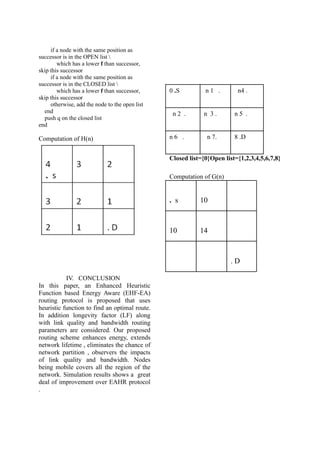
The document proposes an Enhanced Heuristic Function based Energy Aware (EHF-EA) routing protocol for wireless sensor networks. EHF-EA aims to extend network lifetime and improve link quality by using a heuristic function to find optimal routes while considering longevity factor, link quality, and bandwidth. It constructs a network of 50 mobile homogeneous sensor nodes in clusters. EHF-EA computes heuristic and cost values to determine the best next hop to the destination, aiming to efficiently transfer data and conserve energy. Simulation results show EHF-EA achieves a 93.85% packet delivery ratio while reducing bandwidth and number of hops compared to other protocols.
![Enhanced Heuristic Function Based Energy
Aware Routing Protocol In Wireless Sensor
Networks
B. Anand
Jerusalem college of engineering, Chennai-100.
Abstract— In Wireless Sensor Networks,
energy is an essential parameter because
initially while creating a network each
node is assigned to a unique id and a
certain joule of energy so while
transferring data from source to destination
,Energy is influenced heavily , thus energy
can be conserved by proposing a novel
energy aware routing protocol called
“Enhanced Heuristic Function based
Energy Aware (EHF-EA) routing protocol
in wireless sensor networks”. This
improves the system performance metrics
like link quality which in turn conserve
energy and extend lifetime at a delivery
rate ratio of 93.85% and also reduces
bandwidth and number of hops.
Keywords — Wireless Sensor Networks,
Energy, EHF-EA
I. INTRODUCTION
The high-tech advancement of digital
electronics and micro-electro-mechanical
systems (MEMS) have made possible the
development of low-power,
multifunctional, low-cost wireless sensor
nodes.[1] These wireless sensor nodes
communicate with each other in a multi
hop manner to form a system called a
wireless sensor network (WSN) The
architecture of WSN systems depends on
the IEEE802.15.4 standard, which
specifies a physical (PHY) and medium
access control (MAC) layer dedicated to a
low-rate wireless personal area network
(LR-WPAN). A WSN may include an
enormous number of wireless sensor nodes
placed in close proximity to an event to
collect the required facts about the
physical world and send these to the sink
node. A WSN allows a user to productively
sense and monitor from a distance.
Miniaturized wireless sensor nodes have
cost and size restrictions. In addition the
computational speed, memory, energy and
bandwidth are constraints that increase the
WSN complexity.
Generally, the failures in a WSN are
caused by the battery power exhaustion,
inactivity periods, and vulnerability to
destruction due to the small-sized sensor
nodes. Most low-power wireless networks
usually have unreliable links with limited
bandwidth, and their link quality can be
heavily influenced by environmental
factors. Basically, the research challenges
in WSNs are vast. The limited network
lifetime is the most common problem in
WSNs. The routing protocols must exploit
the nature of the WSN and are related to
various issues, including the fact that most
data is only valid for a short time ,it must
follow a short route to reach the
destination in a quick manner. The optimal
solution for finding the shortest path is by
A* heuristic algorithm which is the
successor of Greedy algorithm.](https://image.slidesharecdn.com/10aa805d-88fb-4a93-943e-b4375f9afcf6-161221213057/85/Abstract-1-320.jpg)
![Enhanced Heuristic Function Based Energy
Aware Routing Protocol In Wireless Sensor
Networks
B. Anand
Jerusalem college of engineering, Chennai-100.
Abstract— In Wireless Sensor Networks,
energy is an essential parameter because
initially while creating a network each
node is assigned to a unique id and a
certain joule of energy so while
transferring data from source to destination
,Energy is influenced heavily , thus energy
can be conserved by proposing a novel
energy aware routing protocol called
“Enhanced Heuristic Function based
Energy Aware (EHF-EA) routing protocol
in wireless sensor networks”. This
improves the system performance metrics
like link quality which in turn conserve
energy and extend lifetime at a delivery
rate ratio of 93.85% and also reduces
bandwidth and number of hops.
Keywords — Wireless Sensor Networks,
Energy, EHF-EA
I. INTRODUCTION
The high-tech advancement of digital
electronics and micro-electro-mechanical
systems (MEMS) have made possible the
development of low-power,
multifunctional, low-cost wireless sensor
nodes.[1] These wireless sensor nodes
communicate with each other in a multi
hop manner to form a system called a
wireless sensor network (WSN) The
architecture of WSN systems depends on
the IEEE802.15.4 standard, which
specifies a physical (PHY) and medium
access control (MAC) layer dedicated to a
low-rate wireless personal area network
(LR-WPAN). A WSN may include an
enormous number of wireless sensor nodes
placed in close proximity to an event to
collect the required facts about the
physical world and send these to the sink
node. A WSN allows a user to productively
sense and monitor from a distance.
Miniaturized wireless sensor nodes have
cost and size restrictions. In addition the
computational speed, memory, energy and
bandwidth are constraints that increase the
WSN complexity.
Generally, the failures in a WSN are
caused by the battery power exhaustion,
inactivity periods, and vulnerability to
destruction due to the small-sized sensor
nodes. Most low-power wireless networks
usually have unreliable links with limited
bandwidth, and their link quality can be
heavily influenced by environmental
factors. Basically, the research challenges
in WSNs are vast. The limited network
lifetime is the most common problem in
WSNs. The routing protocols must exploit
the nature of the WSN and are related to
various issues, including the fact that most
data is only valid for a short time ,it must
follow a short route to reach the
destination in a quick manner. The optimal
solution for finding the shortest path is by
A* heuristic algorithm which is the
successor of Greedy algorithm.](https://image.slidesharecdn.com/10aa805d-88fb-4a93-943e-b4375f9afcf6-161221213057/75/Abstract-1-2048.jpg)
![II. RELATED WORKS
The major application of wireless sensor network is
military surveillance . In Wireless Sensor
Networks, Surveillance wireless sensor networks
are deployed at border locations to detect
unauthorized intrusions [1].The Qos in military
surveillance can be improved by SOA strategies. In
SOA, services are loosely coupled. This means that
there is a separation of the clients from services.
The client is independent of the service such that if
a change to the service is made, it does not always
require a change to the client. The client also does
not have to know much about the service to use it.
The client needs to know how to communicate with
the service, which is usually through an interface
and does not need to know the details of the service
implementation. The service communicates with
the client through a well-defined interface. Though
the SOA services improve Qos and link quality ,it
is an energy constraint factor .Energy gets
consumed at a higher rate which in turn reduces
network lifetime.
Cluster head (CH) selection procedure allows even
distribution of energy consumption among the
sensors [2], and therefore prolonging the lifespan of
a sensor network. Energy depletion of a node as a
CH node and a non-CH node are inestigated and a
new distributed CH selection algorithm LEACH-
DT is proposed for sensor networks based on the
node distance to the BS, in order to balance the
energy consumption among the nodes. LEACH-
DT outperforms the original LEACH with
improved network lifespan over 10%. Network
lifespan can be further improved if nodes transmit
the packets to the base station through shortest path
.
An energy efficient routing protocol to find the
forwarding path between source and destination
node using heuristic function and A* search
algorithm. Longevity is an important factor which
must be considered while implementing A* search
algorithm. The longevity factor is used to maximize
the value of heuristic
function when the energy of a forwarding node is
below the threshold level. To implement the
longevity factor an “Energy Aware Heuristic –
Based Routing “ protocol is proposed. It considers
all 3 major factors like heuristic value, actual cost
value and longevity factor. But once the optimal
route is found ,some un necessary packets may be
forwarded thus priority must be set to each packet
,thus energy can be conserved efficiently.
Constantly moving nodes consume a considerable
amount of energy, thus we retain the mobility
features only when necessary to ensure that critical
events do not go unreported. Thus a priority-based
application specific congestion control clustering
(PASCCC) protocol is proposed, which integrates
the mobility and heterogeneity of the nodes to
detect congestion in a network. PASCCC achieves
better performance in terms of the network lifetime,
energy consumption, data transmission, and other
QoS metrics, but cluster head is choosen in a
random manner by considering only the threshold
factor so that some nodes in a region can be
headless (i.e) without cluster heads and throughput
factor is also ignored.Throughput should be
maximized to achieve a better packet delivery ratio.
Cluster Heads (CH) are presented with Adaptive
Clustering habit (ACH)2 schemes in wsn. It
increases the stability period, network lifetime, and
throughput of the WSN. (ACH)2 scheme is
implemented by varying node density and initial
energy of nodes in homogeneous, heterogeneous,
reactive, and proactive simulation environments.
Throughput is achieved by balancing the load on
cluster heads (CH). Thus, balanced load on CHs
and length of communication path reduction result
in efficient energy utilization. More importantly,
linear programming based solution for throughput
maximization with mixed bias bandwidth
allocation scheme further facilitate the desired
objectives. Thus simulation results shows that
throughput is achieved at a maximum rate through
(ACH)2](https://image.slidesharecdn.com/10aa805d-88fb-4a93-943e-b4375f9afcf6-161221213057/85/Abstract-2-320.jpg)
![III. Enhanced Heuristic Function based
Energy Aware (EHF-EA)
The failures in a WSN are caused by the
battery power exhaustion .Therefore
energy conservation becomes an essential
criteria to be handled in the network,
through energy conservation techniques
transfer of data can be done
efficiently.Thus the objective is to
implement an Enhanced Heuristic
Function based Energy Aware (EHF-EA)
routing protocol in Wireless sensor
network, which extends network lifetime
and improves link quality. Network
partition is avoided thus all nodes becomes
efficient and the shortest path to reach
destination is found.
A.Network Model
Nodes are created in cluster and assume
that WSN comprises of 50 nodes, Each
nodes are assigned a unique id, So that
nodes can request data from other nodes in
the network, here nodes are placed in a
random topology and type of the nodes is
mobile homogeneous nodes.
B. EHF-EA
The algorithm used is Enhanced Heuristic
Function based Energy Aware (EHF-EA)
routing protocol. The first step is to
construct a network with ‘n’ number of
nodes, node ID and the energy value for
each node is assigned. Then heuristic value
h(n) is computed by using Manhatten
Method .The next step is to determine the
cost parameter g(n) by right angle triangle
method .The visited nodes are added to the
closed list and the unvisited nodes are
added to the open list
f(n) = h(n) + g(n) + 100=LF
LF = (T _ Eres)=Einit
• g(n)=actual cost
• h(n)=estimated cost.
• F(n)=Heuristic function
• LF= longevity factor
• Nodes with lesser value of F(n) is
the best next hop for the current node.
Pseudocode :
procedure create path list(path list, current
node)
if current node in path list
p = create path list(path list, path
list[current node])
return (p + current node)
else
return current node
end if else
C.Link Quality
The link quality factor is considered along
with the heuristic function in order to
determine whether the data sent from one
node to another node is reliable and there
is no link breakage during data transfer.
D. Bandwidth
The bitrate of available or consumed
information capacity which is expressed in
multiple of bits per second,thus the
maximum data rate of the packet
transfered between source to destination is
measured in terms of bandwidth,this
bandwidth factor helps us to analyse the
info rate the bit rate and transfering speed.
initialize cluster nodes
initialize cluster head
initialize source node
initialize the open list
initialize the closed list
put the starting node on the open list (you can
leave its f at zero)
while the open list is not empty
find the node with the least f on the open
list, call it "q"
pop q off the open list
generate q's 8 successors and set their
parents to q
for each successor
if successor is the goal, stop the
search
successor.g = q.g + distance between
successor and q
successor.h = distance from goal to
successor
successor.f = successor.g + successor.h](https://image.slidesharecdn.com/10aa805d-88fb-4a93-943e-b4375f9afcf6-161221213057/85/Abstract-3-320.jpg)