International Research Journal of Engineering and Technology (IRJET) e-ISSN: 2395-0056
Volume: 05 Issue: 06 | June-2018 www.irjet.net p-ISSN: 2395-0072
© 2018, IRJET | Impact Factor value: 7.211 | ISO 9001:2008 Certified Journal | Page 1533
Spectrum Allocation Policies for Flex Grid Network with Data Rate
Limited Transmission
Kruthika Lohith1, Triveni C L 2, Dr. P.C Srikanth3
1Malnad College of Engineering, Hassan, Karnataka
2 Asst Professor, Dept of E&C Engineering MCE,Hassan
3 Professor and Former Head, Dept of E&C Engineering, MCE, Hassan,
---------------------------------------------------------------------***---------------------------------------------------------------------
Abstract - The bit rate and the noise occurring while on
transmission limit the maximum transmission length of the
optical path. The crosstalk is the important noise that limits
this maximum distance coverage in the multicore fiber. The
tradeoff between the data rate on the media and theallocated
frequency slots are made in order to make the choice of the
offered bandwidth and the multi bit rate capable
transponders.
The modulation format also has to be considered. On
consideration of the mediaprovisioningtheconstantdatarate
all through the channel makes the chances of maximum
utilization of the frequency slot as the 40Gbpsdemand willnot
be using the 400Gbps bandwidth. But when there is a higher
demand for the larger data rate the guard bands have to be
inserted between the channel as the penalty. If the bandwidth
is available but the transmission is not reachable also the
same penalty occurs. Thustheimportantissueinthefrequency
slot allocation is the routing and the spectrum allocation
methods. BPSK transponder with multicore capability yields
the better results.
Key Words: Flex grid network, Optical Network, Optical
Path, Spectrum Allocation.
1. INTRODUCTION
The future trend of the fiber optics domain has been the
Spatial Division Multiplexing (SDM) and is the topic of
research in today’s world. The two types of SDM are Mode-
Division Multiplexing (MDM) and Multi-Core Fibers (MCF).
These two techniques are challenging the today’s technique.
The mutual orthogonalitybetweenthepropagationmodesof
a waveguide are used in the MDM which can be used as a
independent medium. The MDM makes use of this
advantage.
Flex-Grid networks are in high demand in current
scenario as it provides very large bandwidth and efficiently
incorporates together low bit rate optical paths and high
data rate super channels. When considering the single core
of MCF the optical paths are allotted continuously between
the source and the destination.
There is no anticipation of the super channels in the work.
In the Flex-grid network any of the incoming spectral
allocated optical path can be switched any other path on the
outgoing spectral path in the single core i.e itcanbesaidthat
spatial multiplexing and demultiplexing happens at every
intermediate nodes. consider that the main intention of this
work is to equate multiple standard Single CoreFibers(SCF)
and Multi Core Fibers(MCF) on the network link to a Flex-
Grid Network. When this is done there will be much
impairments due to coupling of the cores which will result
under performance of transmission reach of the optical
signals
1.1 Related Work
For the various traffic demands the sub-wavelength
accommodation can be achieved by Orthogonal Frequency
Division Multiplexing (OFDM) basedElasticOptical Network
(EON). The EON is considered because of its advantages of
bandwidth allocation, adaptive channel ratedemandscan be
met and high spectrum efficiency [1].
To solve the problem of service connection and the
holding time of the optical path in slice network traffic is
time scheduled and heuristic algorithm which is time-aware
spectrum efficient is used [2].
With the use of distance adaptive modulation format the
utilization of bandwidth in SLICE is improved significantly
compared to that which does not use the distance adaptive
modulation format [3].
For the high traffic service the WDM networks with the
data rate of 10Gbps, 40Gbps and up-to 100Gbps is used
but these grid networks may not be able to give data rate of
400Gbps or more. To realize that the EON was proposed
which can be used to service the high traffic service rate.
When EON is combined with OFDM the results improve
significantly [4].
To solve the complexity introducedinSLICEnetwork due
to sub wavelength level of allocationcanbesolvedbythe use
of shortest path and balanced lode spectrumallocation [6,2].
For the problems of RSA numerous optimization
techniques like interger Linear programming, Simulated
Annealing , Genetic Algorithms are used. In SLICE networks
to avoid the chromatic dispersion impairments and
polarized mode dispersion(PMD) the OFDM is used [7].
Thus there are many modulation formats used for
this purpose, but when the demand is high the performance
may not be to the expected.
International Research Journal of Engineering and Technology (IRJET) e-ISSN: 2395-0056
Volume: 05 Issue: 06 | June-2018 www.irjet.net p-ISSN: 2395-0072
© 2018, IRJET | Impact Factor value: 7.211 | ISO 9001:2008 Certified Journal | Page 1534
2. OBJECTIVES
The objective of the proposed work is to :
 Identify optical path with end to end connectivity.
 Discover the path length of thesignal fromsourceto
destination.
 Choose the best suited modulation scheme for the
RSA.
 Make a comparative study to find out the optimal
route with effective modulation scheme providing
maximum utilization of bandwidth.
3. METHODOLOGY
To approximate theallocationofthespectrumofthe
Optically Amplified Single- core fiber optic channel one has
to consider number of factors. The special purpose
processors used compensate for both CD and PMD. It also
corrects the faults that are intra channel nonlinear effects
but fails to compensate for the interchannel nonlinear
effects. This is the biggest limiting factor. To overcome this
the power transmitted is made constant considering
constant baud rate and spacing between the channel. The
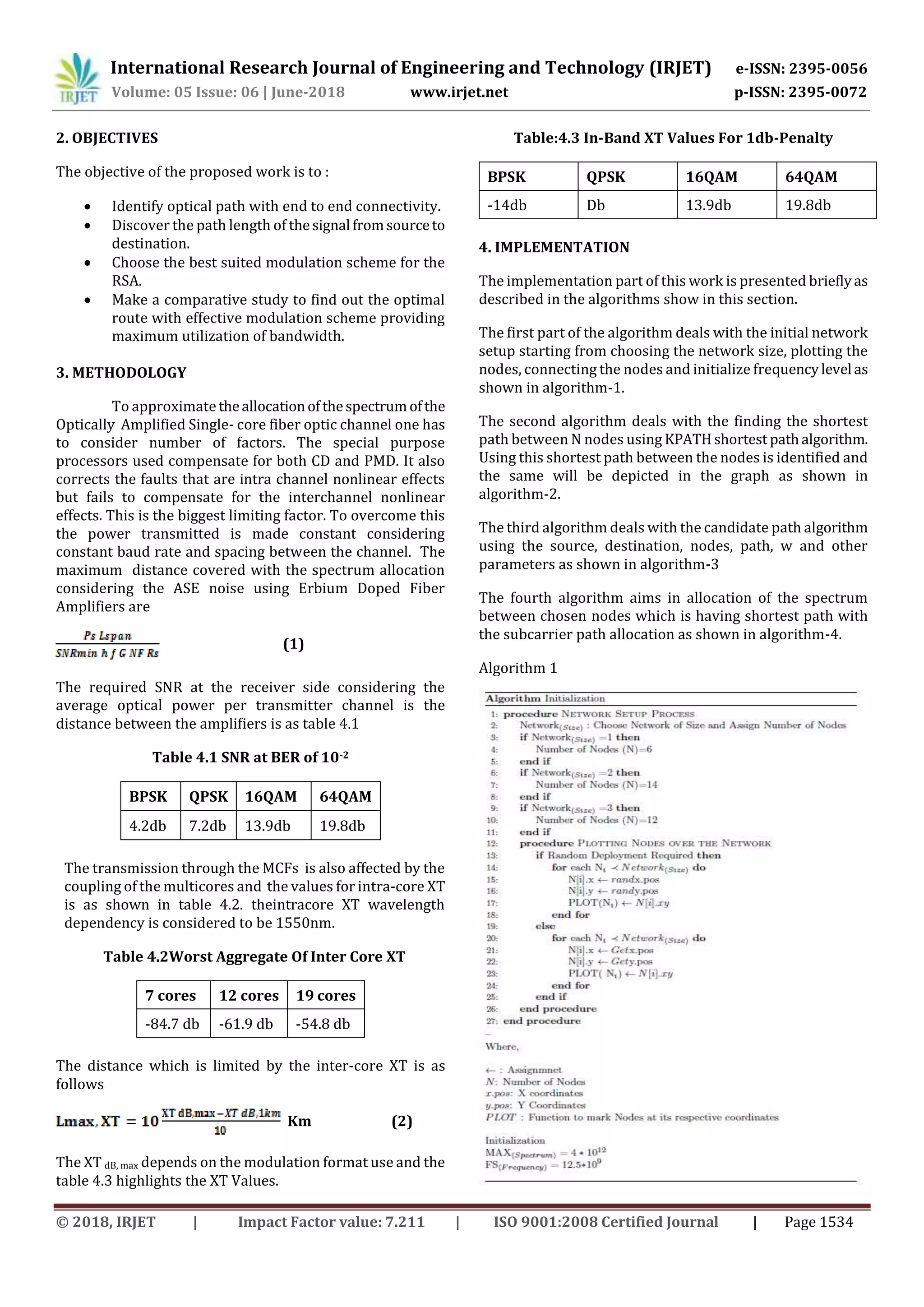
maximum distance covered with the spectrum allocation
considering the ASE noise using Erbium Doped Fiber
Amplifiers are
(1)
The required SNR at the receiver side considering the
average optical power per transmitter channel is the
distance between the amplifiers is as table 4.1
Table 4.1 SNR at BER of 10-2
BPSK QPSK 16QAM 64QAM
4.2db 7.2db 13.9db 19.8db
The transmission through the MCFs is also affected by the
coupling of the multicores and the values for intra-core XT
is as shown in table 4.2. theintracore XT wavelength
dependency is considered to be 1550nm.
Table 4.2Worst Aggregate Of Inter Core XT
7 cores 12 cores 19 cores
-84.7 db -61.9 db -54.8 db
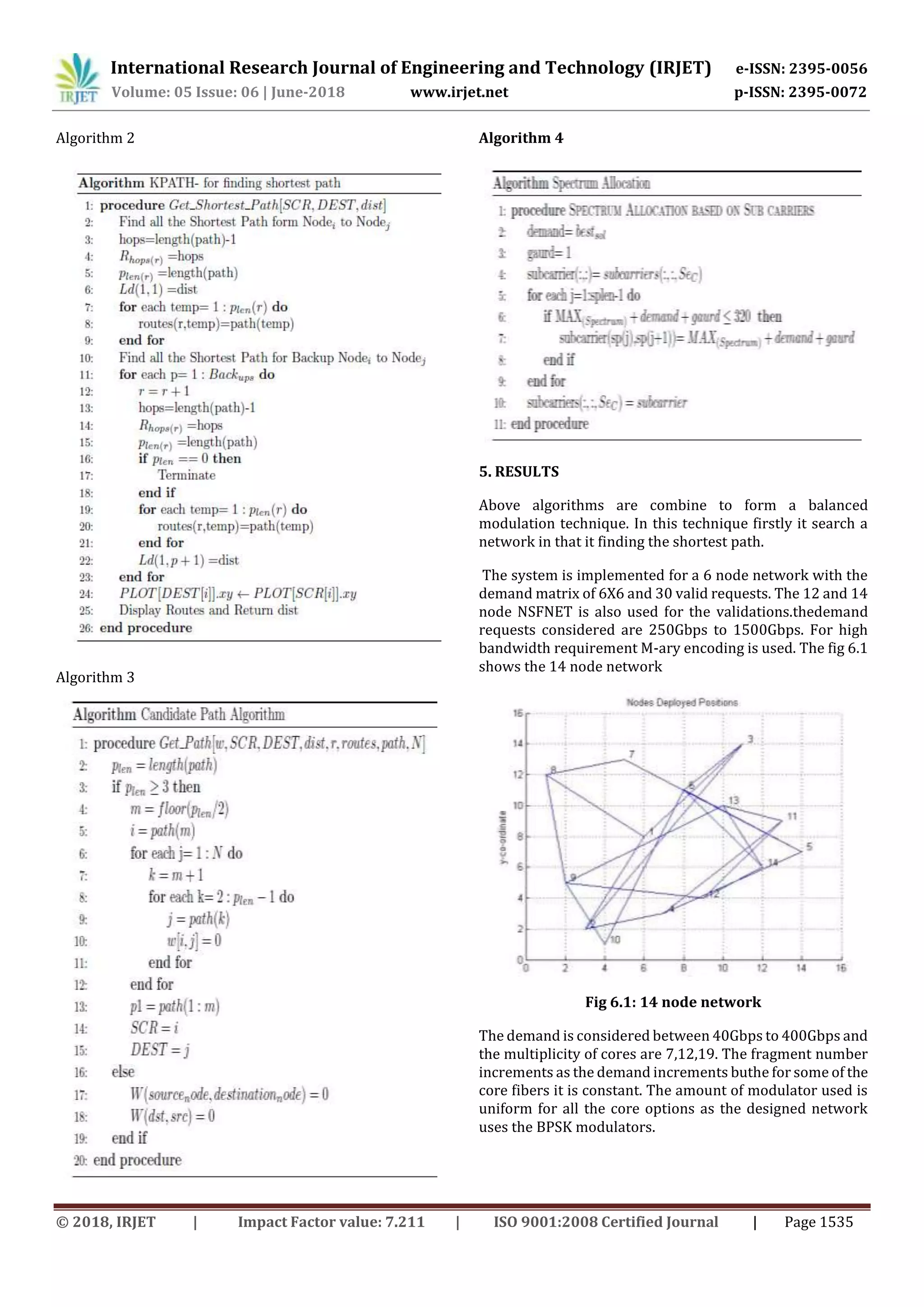
The distance which is limited by the inter-core XT is as
follows
Km (2)
The XT dB, max depends on the modulation format use and the
table 4.3 highlights the XT Values.
Table:4.3 In-Band XT Values For 1db-Penalty
BPSK QPSK 16QAM 64QAM
-14db Db 13.9db 19.8db
4. IMPLEMENTATION
The implementation part of this work is presented brieflyas
described in the algorithms show in this section.
The first part of the algorithm deals with the initial network
setup starting from choosing the network size, plotting the
nodes, connecting the nodes and initialize frequencylevel as
shown in algorithm-1.
The second algorithm deals with the finding the shortest
path between N nodes using KPATHshortest pathalgorithm.
Using this shortest path between the nodes is identified and
the same will be depicted in the graph as shown in
algorithm-2.
The third algorithm deals with the candidate path algorithm
using the source, destination, nodes, path, w and other
parameters as shown in algorithm-3
The fourth algorithm aims in allocation of the spectrum
between chosen nodes which is having shortest path with
the subcarrier path allocation as shown in algorithm-4.
Algorithm 1
International Research Journal of Engineering and Technology (IRJET) e-ISSN: 2395-0056
Volume: 05 Issue: 06 | June-2018 www.irjet.net p-ISSN: 2395-0072
© 2018, IRJET | Impact Factor value: 7.211 | ISO 9001:2008 Certified Journal | Page 1535
Algorithm 2
Algorithm 3
Algorithm 4
5. RESULTS
Above algorithms are combine to form a balanced
modulation technique. In this technique firstly it search a
network in that it finding the shortest path.
The system is implemented for a 6 node network with the
demand matrix of 6X6 and 30 valid requests. The 12 and 14
node NSFNET is also used for the validations.thedemand
requests considered are 250Gbps to 1500Gbps. For high
bandwidth requirement M-ary encoding is used. The fig 6.1
shows the 14 node network
Fig 6.1: 14 node network
The demand is considered between 40Gbps to 400Gbps and
the multiplicity of cores are 7,12,19. The fragment number
increments as the demand increments buthe for some of the
core fibers it is constant. The amount of modulator used is
uniform for all the core options as the designed network
uses the BPSK modulators.
International Research Journal of Engineering and Technology (IRJET) e-ISSN: 2395-0056
Volume: 05 Issue: 06 | June-2018 www.irjet.net p-ISSN: 2395-0072
© 2018, IRJET | Impact Factor value: 7.211 | ISO 9001:2008 Certified Journal | Page 1536
Fig 6.2. A 14 node N/w fragments usage per 7, 12, 19
core
The fig 6.2 shows that there is less fragments usage at the
low demands and very high usage as the demands increase
along with requests.
Fig.6.3 A 14 node N/W fragments usage for
7core
The number of transponders used is dependent on the
demand requirements and the slot availability. The fig 6.3
shows the A 14 node N/W fragments usage for 7core. It
shows that as the number of requests increase higher rate
transponder are used more.
Fig 6.4:A drop probability for 7, 12, 19core fiber
Network
As the core number increases the number of transponder
required also increases. The same study is done for the 12
core and 19 core. It is seen from the experiments that if the
number of request are dropped the fragmentsvariesandthe
changes is uniform across different cores under study. The
fig 6.4 shows the 14 node 1820 requests probability of
requests drops at every core level. It betters with the
increasing cores.
6. CONCLUSIONS
The multiple core multi demand requests for various small
as well as large networks implemented and results are
analyzed.
Hence it is also called as Balanced Core Modulation
Technique(BCMT). Forverylowdemandsincethefragments
are more than sufficient no effects of higher core usage as
well as higher rate transponders observed. But asthereisan
increase the demand as well as number of requests higher
rate transponders are used judiciously.
Also it is observed that higher number of cores provide
cushion to use BPSK transponders more needing less power
in case of SNR requirements. And therequestsdroprates are
less for higher core fibers. The reach length is mostlylimited
by the noise more than cross talk in case of multi core fibers.
International Research Journal of Engineering and Technology (IRJET) e-ISSN: 2395-0056
Volume: 05 Issue: 06 | June-2018 www.irjet.net p-ISSN: 2395-0072
© 2018, IRJET | Impact Factor value: 7.211 | ISO 9001:2008 Certified Journal | Page 1537
REFERENCES
[1]. Bingbing Li and Young-Chon Kim “Efficient Routing and
Spectrum Allocation considering QoT in Elastic Optical
Network” International Journal of Advances in
Telecommunications, Electrotechnics, Signals and Systems.
2016
[2] Yang Qiua, Zheyu Fan b, Chun-Kit Chan b “Efficient
routing and spectrum assignment in elastic
opticalnetworkswith time scheduled
traffic”OpticalFiberTechnology 30 (2016) 116-124.
[3] T.Takagi1, H. Hasegawa1, K. Sato1, Y. Sone2, B. Kozicki2,
A. Hirano2, and M. Jinno2
“Dynamic Routing and FrequencySlotAssignmentforElastic
Optical Path Networks that Adopt Distance Adaptive
Modulation”.Optical Fiber Communication Conference and
Expositionand the National Fiber Optic Engineers
Conference.2011
[4]R.-J. Essiambre et al., “Capacity Limits of Optical Fiber
Networks”, IEEE/OSA J. LightwaveTechnol.,vol.28,no.4, pp.
662-701, Feb. 2010.
[5]P. J. Winzer, “Spatial Multiplexing in FiberOptics:The10x
Scaling of Metro/Core Capacities”, Bell Labs Tech. Journal,
vol.19, pp. 22-30, Sept. 2014.
[6]Howard R. Stuart, “Dispersive Multiplexing in Multimode
Optical Fiber”, Science 289 (5477), 281, July 2000.
[7]N.K. Fontaine, et al, "30×30 MIMO transmission over 15
spatial modes," in Proc. OFC 2015 , March 2015.
[8]J. Sakaguchi et al., “Space Division Multiplexed
Transmission of 109-Tb/s Data Signals Using Homogeneous
Seven-Core Fiber”, IEEE/OSA J. Lightwave Technol., Vol. 30,
no. 4, p. 658665, Jan. 2012.
[9]Sano et al., “409-Tb/s + 409-Tb/s crosstalk suppressed
bidirectional MCF transmission over 450 km using
propagation-directioninterleaving”,Opt.Express,vol.21,pp.
16777-16683, Jul. 2013.

IRJET-Spectrum Allocation Policies for Flex Grid Network with Data Rate Limited Transmission.

  • 1.
    International Research Journalof Engineering and Technology (IRJET) e-ISSN: 2395-0056 Volume: 05 Issue: 06 | June-2018 www.irjet.net p-ISSN: 2395-0072 © 2018, IRJET | Impact Factor value: 7.211 | ISO 9001:2008 Certified Journal | Page 1533 Spectrum Allocation Policies for Flex Grid Network with Data Rate Limited Transmission Kruthika Lohith1, Triveni C L 2, Dr. P.C Srikanth3 1Malnad College of Engineering, Hassan, Karnataka 2 Asst Professor, Dept of E&C Engineering MCE,Hassan 3 Professor and Former Head, Dept of E&C Engineering, MCE, Hassan, ---------------------------------------------------------------------***--------------------------------------------------------------------- Abstract - The bit rate and the noise occurring while on transmission limit the maximum transmission length of the optical path. The crosstalk is the important noise that limits this maximum distance coverage in the multicore fiber. The tradeoff between the data rate on the media and theallocated frequency slots are made in order to make the choice of the offered bandwidth and the multi bit rate capable transponders. The modulation format also has to be considered. On consideration of the mediaprovisioningtheconstantdatarate all through the channel makes the chances of maximum utilization of the frequency slot as the 40Gbpsdemand willnot be using the 400Gbps bandwidth. But when there is a higher demand for the larger data rate the guard bands have to be inserted between the channel as the penalty. If the bandwidth is available but the transmission is not reachable also the same penalty occurs. Thustheimportantissueinthefrequency slot allocation is the routing and the spectrum allocation methods. BPSK transponder with multicore capability yields the better results. Key Words: Flex grid network, Optical Network, Optical Path, Spectrum Allocation. 1. INTRODUCTION The future trend of the fiber optics domain has been the Spatial Division Multiplexing (SDM) and is the topic of research in today’s world. The two types of SDM are Mode- Division Multiplexing (MDM) and Multi-Core Fibers (MCF). These two techniques are challenging the today’s technique. The mutual orthogonalitybetweenthepropagationmodesof a waveguide are used in the MDM which can be used as a independent medium. The MDM makes use of this advantage. Flex-Grid networks are in high demand in current scenario as it provides very large bandwidth and efficiently incorporates together low bit rate optical paths and high data rate super channels. When considering the single core of MCF the optical paths are allotted continuously between the source and the destination. There is no anticipation of the super channels in the work. In the Flex-grid network any of the incoming spectral allocated optical path can be switched any other path on the outgoing spectral path in the single core i.e itcanbesaidthat spatial multiplexing and demultiplexing happens at every intermediate nodes. consider that the main intention of this work is to equate multiple standard Single CoreFibers(SCF) and Multi Core Fibers(MCF) on the network link to a Flex- Grid Network. When this is done there will be much impairments due to coupling of the cores which will result under performance of transmission reach of the optical signals 1.1 Related Work For the various traffic demands the sub-wavelength accommodation can be achieved by Orthogonal Frequency Division Multiplexing (OFDM) basedElasticOptical Network (EON). The EON is considered because of its advantages of bandwidth allocation, adaptive channel ratedemandscan be met and high spectrum efficiency [1]. To solve the problem of service connection and the holding time of the optical path in slice network traffic is time scheduled and heuristic algorithm which is time-aware spectrum efficient is used [2]. With the use of distance adaptive modulation format the utilization of bandwidth in SLICE is improved significantly compared to that which does not use the distance adaptive modulation format [3]. For the high traffic service the WDM networks with the data rate of 10Gbps, 40Gbps and up-to 100Gbps is used but these grid networks may not be able to give data rate of 400Gbps or more. To realize that the EON was proposed which can be used to service the high traffic service rate. When EON is combined with OFDM the results improve significantly [4]. To solve the complexity introducedinSLICEnetwork due to sub wavelength level of allocationcanbesolvedbythe use of shortest path and balanced lode spectrumallocation [6,2]. For the problems of RSA numerous optimization techniques like interger Linear programming, Simulated Annealing , Genetic Algorithms are used. In SLICE networks to avoid the chromatic dispersion impairments and polarized mode dispersion(PMD) the OFDM is used [7]. Thus there are many modulation formats used for this purpose, but when the demand is high the performance may not be to the expected.
  • 2.
    International Research Journalof Engineering and Technology (IRJET) e-ISSN: 2395-0056 Volume: 05 Issue: 06 | June-2018 www.irjet.net p-ISSN: 2395-0072 © 2018, IRJET | Impact Factor value: 7.211 | ISO 9001:2008 Certified Journal | Page 1534 2. OBJECTIVES The objective of the proposed work is to :  Identify optical path with end to end connectivity.  Discover the path length of thesignal fromsourceto destination.  Choose the best suited modulation scheme for the RSA.  Make a comparative study to find out the optimal route with effective modulation scheme providing maximum utilization of bandwidth. 3. METHODOLOGY To approximate theallocationofthespectrumofthe Optically Amplified Single- core fiber optic channel one has to consider number of factors. The special purpose processors used compensate for both CD and PMD. It also corrects the faults that are intra channel nonlinear effects but fails to compensate for the interchannel nonlinear effects. This is the biggest limiting factor. To overcome this the power transmitted is made constant considering constant baud rate and spacing between the channel. The maximum distance covered with the spectrum allocation considering the ASE noise using Erbium Doped Fiber Amplifiers are (1) The required SNR at the receiver side considering the average optical power per transmitter channel is the distance between the amplifiers is as table 4.1 Table 4.1 SNR at BER of 10-2 BPSK QPSK 16QAM 64QAM 4.2db 7.2db 13.9db 19.8db The transmission through the MCFs is also affected by the coupling of the multicores and the values for intra-core XT is as shown in table 4.2. theintracore XT wavelength dependency is considered to be 1550nm. Table 4.2Worst Aggregate Of Inter Core XT 7 cores 12 cores 19 cores -84.7 db -61.9 db -54.8 db The distance which is limited by the inter-core XT is as follows Km (2) The XT dB, max depends on the modulation format use and the table 4.3 highlights the XT Values. Table:4.3 In-Band XT Values For 1db-Penalty BPSK QPSK 16QAM 64QAM -14db Db 13.9db 19.8db 4. IMPLEMENTATION The implementation part of this work is presented brieflyas described in the algorithms show in this section. The first part of the algorithm deals with the initial network setup starting from choosing the network size, plotting the nodes, connecting the nodes and initialize frequencylevel as shown in algorithm-1. The second algorithm deals with the finding the shortest path between N nodes using KPATHshortest pathalgorithm. Using this shortest path between the nodes is identified and the same will be depicted in the graph as shown in algorithm-2. The third algorithm deals with the candidate path algorithm using the source, destination, nodes, path, w and other parameters as shown in algorithm-3 The fourth algorithm aims in allocation of the spectrum between chosen nodes which is having shortest path with the subcarrier path allocation as shown in algorithm-4. Algorithm 1
  • 3.
    International Research Journalof Engineering and Technology (IRJET) e-ISSN: 2395-0056 Volume: 05 Issue: 06 | June-2018 www.irjet.net p-ISSN: 2395-0072 © 2018, IRJET | Impact Factor value: 7.211 | ISO 9001:2008 Certified Journal | Page 1535 Algorithm 2 Algorithm 3 Algorithm 4 5. RESULTS Above algorithms are combine to form a balanced modulation technique. In this technique firstly it search a network in that it finding the shortest path. The system is implemented for a 6 node network with the demand matrix of 6X6 and 30 valid requests. The 12 and 14 node NSFNET is also used for the validations.thedemand requests considered are 250Gbps to 1500Gbps. For high bandwidth requirement M-ary encoding is used. The fig 6.1 shows the 14 node network Fig 6.1: 14 node network The demand is considered between 40Gbps to 400Gbps and the multiplicity of cores are 7,12,19. The fragment number increments as the demand increments buthe for some of the core fibers it is constant. The amount of modulator used is uniform for all the core options as the designed network uses the BPSK modulators.
  • 4.
    International Research Journalof Engineering and Technology (IRJET) e-ISSN: 2395-0056 Volume: 05 Issue: 06 | June-2018 www.irjet.net p-ISSN: 2395-0072 © 2018, IRJET | Impact Factor value: 7.211 | ISO 9001:2008 Certified Journal | Page 1536 Fig 6.2. A 14 node N/w fragments usage per 7, 12, 19 core The fig 6.2 shows that there is less fragments usage at the low demands and very high usage as the demands increase along with requests. Fig.6.3 A 14 node N/W fragments usage for 7core The number of transponders used is dependent on the demand requirements and the slot availability. The fig 6.3 shows the A 14 node N/W fragments usage for 7core. It shows that as the number of requests increase higher rate transponder are used more. Fig 6.4:A drop probability for 7, 12, 19core fiber Network As the core number increases the number of transponder required also increases. The same study is done for the 12 core and 19 core. It is seen from the experiments that if the number of request are dropped the fragmentsvariesandthe changes is uniform across different cores under study. The fig 6.4 shows the 14 node 1820 requests probability of requests drops at every core level. It betters with the increasing cores. 6. CONCLUSIONS The multiple core multi demand requests for various small as well as large networks implemented and results are analyzed. Hence it is also called as Balanced Core Modulation Technique(BCMT). Forverylowdemandsincethefragments are more than sufficient no effects of higher core usage as well as higher rate transponders observed. But asthereisan increase the demand as well as number of requests higher rate transponders are used judiciously. Also it is observed that higher number of cores provide cushion to use BPSK transponders more needing less power in case of SNR requirements. And therequestsdroprates are less for higher core fibers. The reach length is mostlylimited by the noise more than cross talk in case of multi core fibers.
  • 5.
    International Research Journalof Engineering and Technology (IRJET) e-ISSN: 2395-0056 Volume: 05 Issue: 06 | June-2018 www.irjet.net p-ISSN: 2395-0072 © 2018, IRJET | Impact Factor value: 7.211 | ISO 9001:2008 Certified Journal | Page 1537 REFERENCES [1]. Bingbing Li and Young-Chon Kim “Efficient Routing and Spectrum Allocation considering QoT in Elastic Optical Network” International Journal of Advances in Telecommunications, Electrotechnics, Signals and Systems. 2016 [2] Yang Qiua, Zheyu Fan b, Chun-Kit Chan b “Efficient routing and spectrum assignment in elastic opticalnetworkswith time scheduled traffic”OpticalFiberTechnology 30 (2016) 116-124. [3] T.Takagi1, H. Hasegawa1, K. Sato1, Y. Sone2, B. Kozicki2, A. Hirano2, and M. Jinno2 “Dynamic Routing and FrequencySlotAssignmentforElastic Optical Path Networks that Adopt Distance Adaptive Modulation”.Optical Fiber Communication Conference and Expositionand the National Fiber Optic Engineers Conference.2011 [4]R.-J. Essiambre et al., “Capacity Limits of Optical Fiber Networks”, IEEE/OSA J. LightwaveTechnol.,vol.28,no.4, pp. 662-701, Feb. 2010. [5]P. J. Winzer, “Spatial Multiplexing in FiberOptics:The10x Scaling of Metro/Core Capacities”, Bell Labs Tech. Journal, vol.19, pp. 22-30, Sept. 2014. [6]Howard R. Stuart, “Dispersive Multiplexing in Multimode Optical Fiber”, Science 289 (5477), 281, July 2000. [7]N.K. Fontaine, et al, "30×30 MIMO transmission over 15 spatial modes," in Proc. OFC 2015 , March 2015. [8]J. Sakaguchi et al., “Space Division Multiplexed Transmission of 109-Tb/s Data Signals Using Homogeneous Seven-Core Fiber”, IEEE/OSA J. Lightwave Technol., Vol. 30, no. 4, p. 658665, Jan. 2012. [9]Sano et al., “409-Tb/s + 409-Tb/s crosstalk suppressed bidirectional MCF transmission over 450 km using propagation-directioninterleaving”,Opt.Express,vol.21,pp. 16777-16683, Jul. 2013.