Quantum Computers
Prepared by
Mitul Mohapatra
Quantum Computers
 Quantum computers are computational systems which makes direct
use of quantum states of subatomic particles to manipulate data
 Are different from binary digital electronic computers based on
transistors while this uses “Qu-bits”
 It takes advantage of the strange ability of subatomic particles to
exist in more than one state at any time
Why Quantum Computers?
 Humans heavily rely on computers to share
information and store data
 Classical computers use lot of power
 Classical computers makes use of transistors which
are approaching towards atomic measures
 Storing data requires lots of memory and space
Terms related to quantum computers
 Qubits
 Quantum superposition
 Quantum entanglement
Qubits
 The term “Qubit” was coined by Benjamin Schumacher
 Qubit is a unit of quantum information
 A qubit is a two-state quantum-mechanical system, here the two
states are vertical polarization and horizontal polarization
 The qubit is in a superposition of both states at the same time, a
property that is fundamental to quantum computing
Superposition
 Quantum superposition is a fundamental principle of quantum
mechanics
 It states that, any two or more quantum states can be added together
(superposed) and the result will be another valid quantum state; and
conversely, that every quantum state can be represented as a sum of
two or more other distinct states
 Qubits work on the same superposition principle
Entanglement
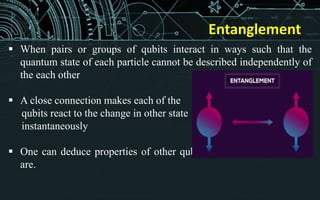
 When pairs or groups of qubits interact in ways such that the
quantum state of each particle cannot be described independently of
the each other
 A close connection makes each of the
qubits react to the change in other state
instantaneously
 One can deduce properties of other qubits no matter how far they
are.
Achievements
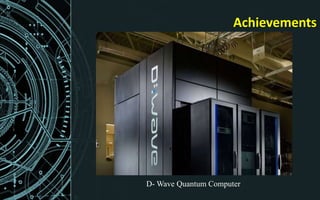
 Last year, a team of Google and NASA scientists
developed a “D-wave quantum computer” which is
100 million times faster than a conventional
computer
 The IBM Quantum Experience (QX) enables
anyone to easily connect to IBM’s quantum
processor via the IBM Cloud
Achievements
D- Wave Quantum Computer
Advantages
 Efficient use of power
 Greater computational speeds
 Higher accuracy rates
 Less requirement of space
 Compact design and structure
Disadvantages
 Quantum processors are quite unstable
 Moving quantum computing to an industrial scale
is difficult
 Can easily decode classical public/private
algorithms
 Very complex operations
Quantum computers

Quantum computers

  • 1.
  • 2.
    Quantum Computers  Quantumcomputers are computational systems which makes direct use of quantum states of subatomic particles to manipulate data  Are different from binary digital electronic computers based on transistors while this uses “Qu-bits”  It takes advantage of the strange ability of subatomic particles to exist in more than one state at any time
  • 3.
    Why Quantum Computers? Humans heavily rely on computers to share information and store data  Classical computers use lot of power  Classical computers makes use of transistors which are approaching towards atomic measures  Storing data requires lots of memory and space
  • 4.
    Terms related toquantum computers  Qubits  Quantum superposition  Quantum entanglement
  • 5.
    Qubits  The term“Qubit” was coined by Benjamin Schumacher  Qubit is a unit of quantum information  A qubit is a two-state quantum-mechanical system, here the two states are vertical polarization and horizontal polarization  The qubit is in a superposition of both states at the same time, a property that is fundamental to quantum computing
  • 6.
    Superposition  Quantum superpositionis a fundamental principle of quantum mechanics  It states that, any two or more quantum states can be added together (superposed) and the result will be another valid quantum state; and conversely, that every quantum state can be represented as a sum of two or more other distinct states  Qubits work on the same superposition principle
  • 7.
    Entanglement  When pairsor groups of qubits interact in ways such that the quantum state of each particle cannot be described independently of the each other  A close connection makes each of the qubits react to the change in other state instantaneously  One can deduce properties of other qubits no matter how far they are.
  • 8.
    Achievements  Last year,a team of Google and NASA scientists developed a “D-wave quantum computer” which is 100 million times faster than a conventional computer  The IBM Quantum Experience (QX) enables anyone to easily connect to IBM’s quantum processor via the IBM Cloud
  • 9.
  • 10.
    Advantages  Efficient useof power  Greater computational speeds  Higher accuracy rates  Less requirement of space  Compact design and structure
  • 11.
    Disadvantages  Quantum processorsare quite unstable  Moving quantum computing to an industrial scale is difficult  Can easily decode classical public/private algorithms  Very complex operations