Quantum
Computers
TAUKI TAHMID
BRAC UNIVERSITY
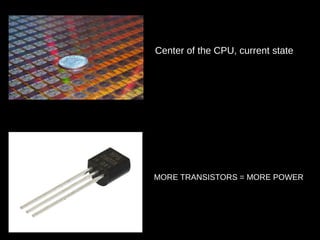
MORE TRANSISTORS = MORE POWER
Center of the CPU, current state
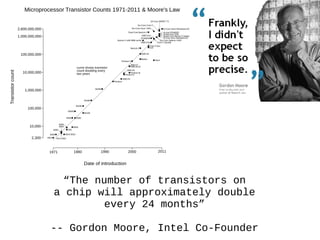
“The number of transistors on
a chip will approximately double
every 24 months”
-- Gordon Moore, Intel Co-Founder
Quantum Computing
QBITS
QUANTUM SUPER POSITION
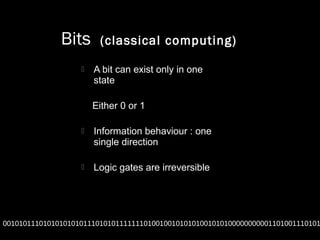
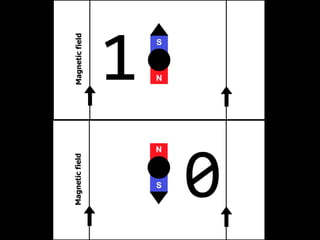
Bits (classical computing)
 A bit can exist only in one
state
Either 0 or 1
 Information behaviour : one
single direction
 Logic gates are irreversible
0010101110101010101011101010111111101001001010101001010100000000001101001110101
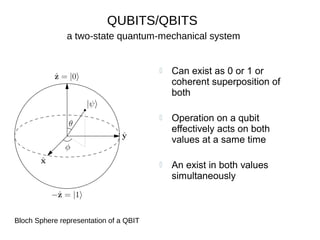
Bloch Sphere representation of a QBIT
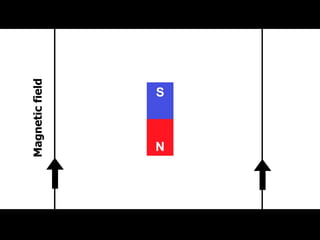
a two-state quantum-mechanical system
 Can exist as 0 or 1 or
coherent superposition of
both
 Operation on a qubit
effectively acts on both
values at a same time
 An exist in both values
simultaneously
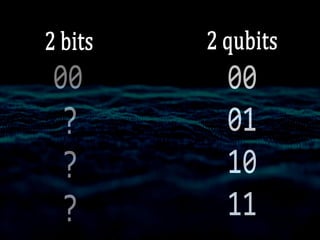
QUBITS/QBITS
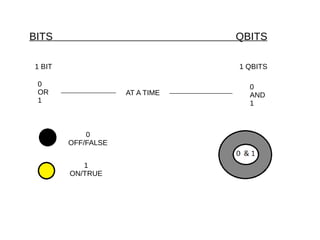
BITS QBITS
1 BIT 1 QBITS
0
OR
1
0
AND
1
AT A TIME
1
ON/TRUE
0
OFF/FALSE
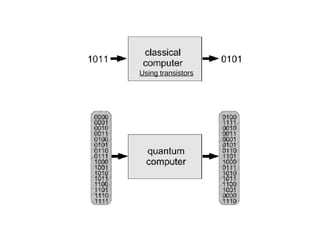
Using transistors
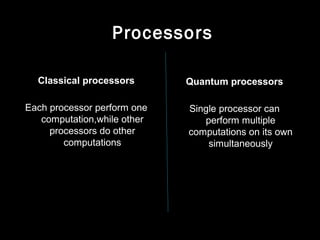
Processors
Classical processors
Each processor perform one
computation,while other
processors do other
computations
Quantum processors
Single processor can
perform multiple
computations on its own
simultaneously
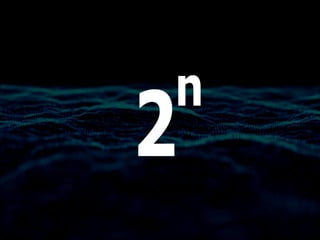
One day, a 2^500 qubit computer will be able to
calculate more data than there's atom in our
observable universe
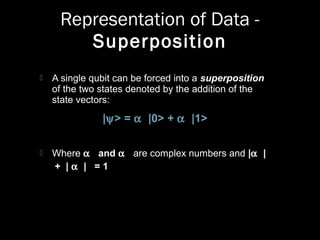
Representation of Data -
Superposition
 A single qubit can be forced into a superposition
of the two states denoted by the addition of the
state vectors:
|ψ> = α |0> + α |1>
 Where α and α are complex numbers and |α |
+ | α | = 1
Quantum computer
 Use direct use of quantum mechanical
phenomena
 Utilizes quantum properties to represent data
 Could solve certain problems much faster
.
.
.
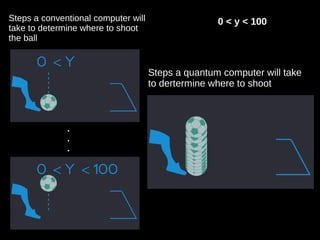
Steps a conventional computer will
take to determine where to shoot
the ball
0 < y < 100
Steps a quantum computer will take
to dertermine where to shoot
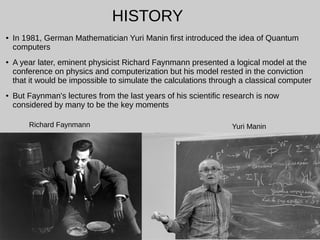
● In 1981, German Mathematician Yuri Manin first introduced the idea of Quantum
computers
● A year later, eminent physicist Richard Faynmann presented a logical model at the
conference on physics and computerization but his model rested in the conviction
that it would be impossible to simulate the calculations through a classical computer
● But Faynman's lectures from the last years of his scientific research is now
considered by many to be the key moments
HISTORY
Richard Faynmann Yuri Manin
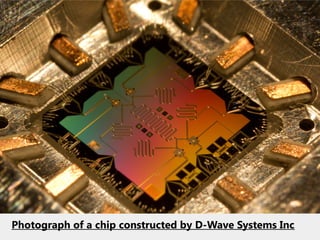
Photograph of a chip constructed by D-Wave Systems Inc
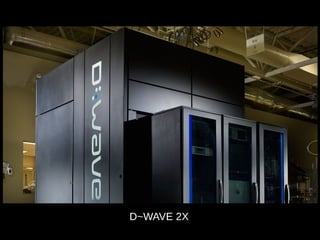
D~WAVE 2X
FIN

Quantum computers

  • 2.
  • 3.
    MORE TRANSISTORS =MORE POWER Center of the CPU, current state
  • 4.
    “The number oftransistors on a chip will approximately double every 24 months” -- Gordon Moore, Intel Co-Founder
  • 5.
  • 6.
    Bits (classical computing) A bit can exist only in one state Either 0 or 1  Information behaviour : one single direction  Logic gates are irreversible 0010101110101010101011101010111111101001001010101001010100000000001101001110101
  • 7.
    Bloch Sphere representationof a QBIT a two-state quantum-mechanical system  Can exist as 0 or 1 or coherent superposition of both  Operation on a qubit effectively acts on both values at a same time  An exist in both values simultaneously QUBITS/QBITS
  • 8.
    BITS QBITS 1 BIT1 QBITS 0 OR 1 0 AND 1 AT A TIME 1 ON/TRUE 0 OFF/FALSE
  • 9.
  • 10.
    Processors Classical processors Each processorperform one computation,while other processors do other computations Quantum processors Single processor can perform multiple computations on its own simultaneously
  • 12.
    One day, a2^500 qubit computer will be able to calculate more data than there's atom in our observable universe
  • 13.
    Representation of Data- Superposition  A single qubit can be forced into a superposition of the two states denoted by the addition of the state vectors: |ψ> = α |0> + α |1>  Where α and α are complex numbers and |α | + | α | = 1
  • 17.
    Quantum computer  Usedirect use of quantum mechanical phenomena  Utilizes quantum properties to represent data  Could solve certain problems much faster
  • 18.
    . . . Steps a conventionalcomputer will take to determine where to shoot the ball 0 < y < 100 Steps a quantum computer will take to dertermine where to shoot
  • 19.
    ● In 1981,German Mathematician Yuri Manin first introduced the idea of Quantum computers ● A year later, eminent physicist Richard Faynmann presented a logical model at the conference on physics and computerization but his model rested in the conviction that it would be impossible to simulate the calculations through a classical computer ● But Faynman's lectures from the last years of his scientific research is now considered by many to be the key moments HISTORY Richard Faynmann Yuri Manin
  • 20.
    Photograph of achip constructed by D-Wave Systems Inc
  • 21.
  • 22.