A Quantitative DTI Fiber Tract Analysis Suite Presenter: Casey Goodlett Isabelle Corouge Matthieu Jomier Guido Gerig
Outline Motivation (introduction to DTI) Open source technology Tractography Clustering and manual editing Analysis of fiber tracts Contributions to open source
Acknowledgements NeuroLib developers Pierre Fillard Sylvain Gouttard Matthieu Jomier Isabelle Corouge Clément Vachet Rémi Jean Casey Goodlett Supervisor Guido Gerig
Open Software Libraries ITK NA-MIC/ITK Sandbox VTK SOViewer (J. Jomier) QT ®   SNAP (Yushkevich) Qt and the Qt logo are trademarks of Trolltech in Norway, the United States and other countries.
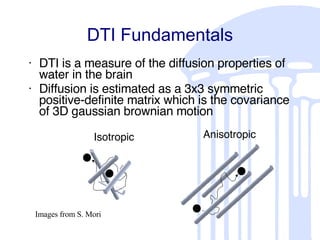
DTI Fundamentals DTI is a measure of the diffusion properties of water in the brain Diffusion is estimated as a 3x3 symmetric positive-definite matrix which is the covariance of 3D gaussian brownian motion Isotropic Anisotropic Images from S. Mori
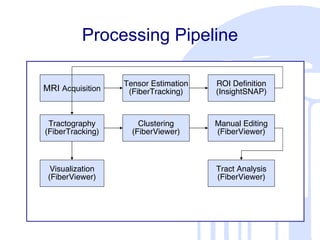
Processing Pipeline MRI  Acquisition Tensor Estimation (FiberTracking) ROI Definition (InsightSNAP) Tractography (FiberTracking) Clustering (FiberViewer) Manual Editing (FiberViewer) Tract Analysis (FiberViewer) Visualization (FiberViewer)
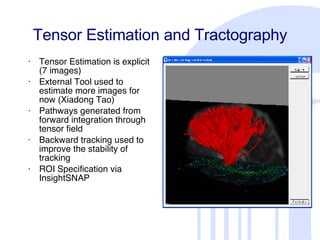
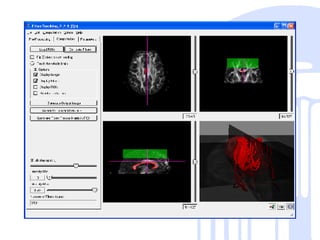
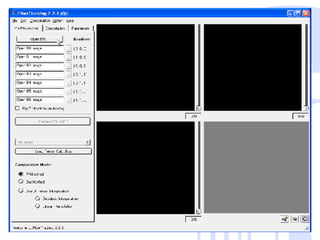
Tensor Estimation and Tractography Tensor Estimation is explicit (7 images) External Tool used to estimate more images for now (Xiadong Tao) Pathways generated from forward integration through tensor field Backward tracking used to improve the stability of tracking ROI Specification via InsightSNAP
 
 
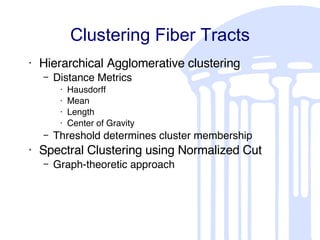
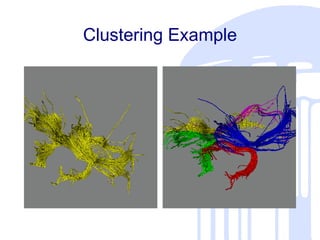
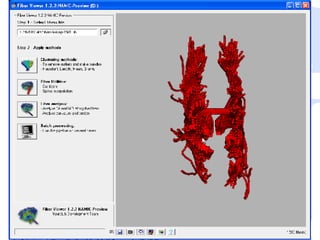
Clustering Fiber Tracts Hierarchical Agglomerative clustering Distance Metrics Hausdorff Mean Length Center of Gravity Threshold determines cluster membership Spectral Clustering using Normalized Cut Graph-theoretic approach
Clustering Example
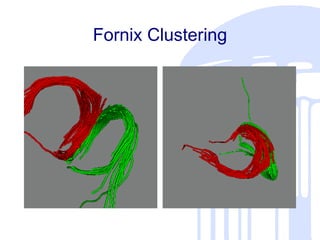
Fornix Clustering
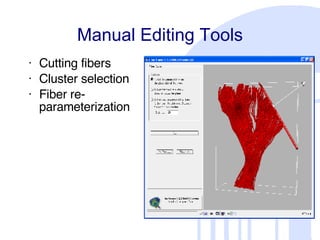
Manual Editing Tools Cutting fibers Cluster selection Fiber re-parameterization
Visualization Image visualization DWI images Derived properties (FA, MD, eigenvalues) Tensor ellipsoids Fiber Visualization Geometry Derived properties Full tensor information Mean fiber
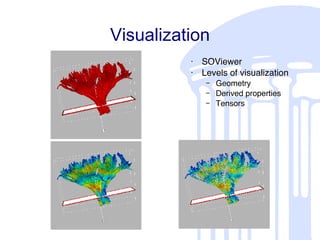
Visualization SOViewer Levels of visualization Geometry Derived properties Tensors
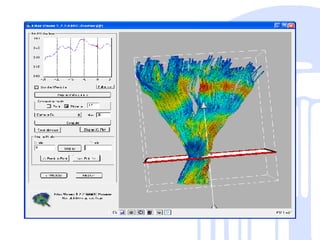
Analysis of Fiber Tracts Fibers are used as a coordinate system for computing the statistics of DTI data Process Establish an origin Reparameterize fibers Interpolation via Riemannian metric (Fletcher et al) Average tensor data at corresponding arc length Properties to analyze Full tensor Derived properties
 
 
Applications Currently being assessed in neurodevelopmental study of children (normal, at-risk for autism, at-risk for schizophrenia) Evaluations being performed by other labs into possible studies using tract-oriented statistics
Benefits from Open Source Large body of readily available image and geometry processing algorithms Common data format for processing intensity and diffusion images as well as tube spatial objects High quality flexible visualization methods
Contributions to Open Source Executables freely available FiberTracking is available in NeuroLib CVS FiberViewer source available shortly Clustering algorithm in sandbox Inter-operability with other tools Fiber analysis modules will be contributed through NAMIC
Questions/Comments For more information and the software http://www.ia.unc.edu/dev

A Quantitative DTI Fiber Tract Analysis Suite-898

  • 1.
    A Quantitative DTIFiber Tract Analysis Suite Presenter: Casey Goodlett Isabelle Corouge Matthieu Jomier Guido Gerig
  • 2.
    Outline Motivation (introductionto DTI) Open source technology Tractography Clustering and manual editing Analysis of fiber tracts Contributions to open source
  • 3.
    Acknowledgements NeuroLib developersPierre Fillard Sylvain Gouttard Matthieu Jomier Isabelle Corouge Clément Vachet Rémi Jean Casey Goodlett Supervisor Guido Gerig
  • 4.
    Open Software LibrariesITK NA-MIC/ITK Sandbox VTK SOViewer (J. Jomier) QT ® SNAP (Yushkevich) Qt and the Qt logo are trademarks of Trolltech in Norway, the United States and other countries.
  • 5.
    DTI Fundamentals DTIis a measure of the diffusion properties of water in the brain Diffusion is estimated as a 3x3 symmetric positive-definite matrix which is the covariance of 3D gaussian brownian motion Isotropic Anisotropic Images from S. Mori
  • 6.
    Processing Pipeline MRI Acquisition Tensor Estimation (FiberTracking) ROI Definition (InsightSNAP) Tractography (FiberTracking) Clustering (FiberViewer) Manual Editing (FiberViewer) Tract Analysis (FiberViewer) Visualization (FiberViewer)
  • 7.
    Tensor Estimation andTractography Tensor Estimation is explicit (7 images) External Tool used to estimate more images for now (Xiadong Tao) Pathways generated from forward integration through tensor field Backward tracking used to improve the stability of tracking ROI Specification via InsightSNAP
  • 8.
  • 9.
  • 10.
    Clustering Fiber TractsHierarchical Agglomerative clustering Distance Metrics Hausdorff Mean Length Center of Gravity Threshold determines cluster membership Spectral Clustering using Normalized Cut Graph-theoretic approach
  • 11.
  • 12.
  • 13.
    Manual Editing ToolsCutting fibers Cluster selection Fiber re-parameterization
  • 14.
    Visualization Image visualizationDWI images Derived properties (FA, MD, eigenvalues) Tensor ellipsoids Fiber Visualization Geometry Derived properties Full tensor information Mean fiber
  • 15.
    Visualization SOViewer Levelsof visualization Geometry Derived properties Tensors
  • 16.
    Analysis of FiberTracts Fibers are used as a coordinate system for computing the statistics of DTI data Process Establish an origin Reparameterize fibers Interpolation via Riemannian metric (Fletcher et al) Average tensor data at corresponding arc length Properties to analyze Full tensor Derived properties
  • 17.
  • 18.
  • 19.
    Applications Currently beingassessed in neurodevelopmental study of children (normal, at-risk for autism, at-risk for schizophrenia) Evaluations being performed by other labs into possible studies using tract-oriented statistics
  • 20.
    Benefits from OpenSource Large body of readily available image and geometry processing algorithms Common data format for processing intensity and diffusion images as well as tube spatial objects High quality flexible visualization methods
  • 21.
    Contributions to OpenSource Executables freely available FiberTracking is available in NeuroLib CVS FiberViewer source available shortly Clustering algorithm in sandbox Inter-operability with other tools Fiber analysis modules will be contributed through NAMIC
  • 22.
    Questions/Comments For moreinformation and the software http://www.ia.unc.edu/dev