DIFFUSION TENSOR IMAGING
Overview
Introduction
Pulse gradient spin echo
ADC/DWI
Diffusion tensor
Diffusion tensor matrix
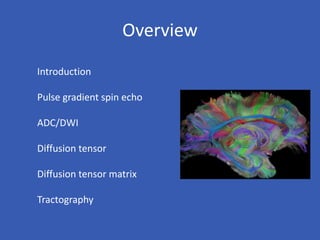
Tractography
DTI
• Non invasive way of understanding brain
structural connectivity
• Macroscopic axonal organization
• Contrast based on the directional rate of
diffusion of water molecules
DTI
• WATER protons = signal in DTI
• Diffusion property of water molecules (D)
• D = diffusion constant
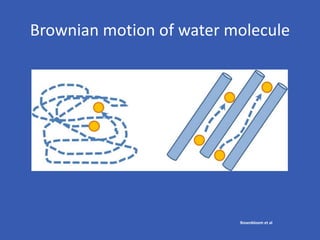
• Move by Brownian motion / Random thermal
motion
• Image intensities inversely related to the
relative mobility of water molecules in tissue
and the direction of the motion
Brownian motion of water molecule
Rosenbloom et al
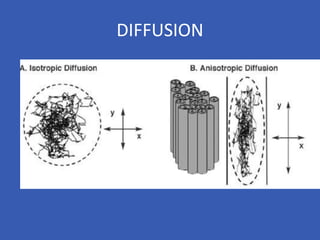
DIFFUSION
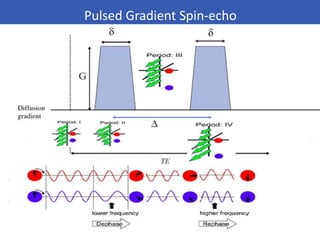
Pulsed Gradient Spin-echo
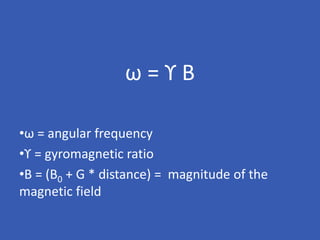
ω = ϒ B
•ω = angular frequency
•ϒ = gyromagnetic ratio
•B = (B0 + G * distance) = magnitude of the
magnetic field
What is b?
• b-value gives the degree of diffusion weighting and is related
to the strength and duration of the pulse gradient as well as
the interval between the gradients
• b changes by lengthening the separation of the 2 gradient
pulses more time for water molecules to move around
more signal loss (imperfect rephasing)
• G= gradient amplitude
• δ = duration
• = trailing to leading edge separation
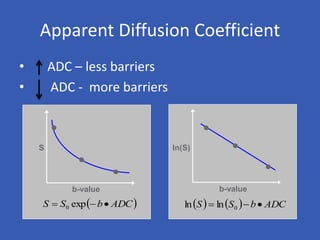
Apparent Diffusion Coefficient
• ADC – less barriers
• ADC - more barriers
b-value
S
 
ADC
b
S
S 

 exp
0



b-value
ln(S)
    ADC
b
S
S 

 0
ln
ln



ADC
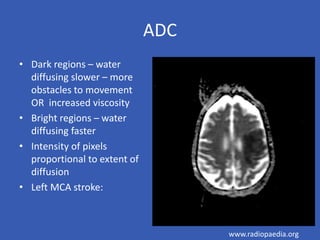
• Dark regions – water
diffusing slower – more
obstacles to movement
OR increased viscosity
• Bright regions – water
diffusing faster
• Intensity of pixels
proportional to extent of
diffusion
• Left MCA stroke:
www.radiopaedia.org
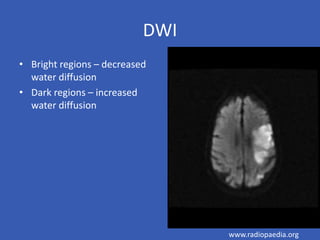
DWI
• Bright regions – decreased
water diffusion
• Dark regions – increased
water diffusion
www.radiopaedia.org
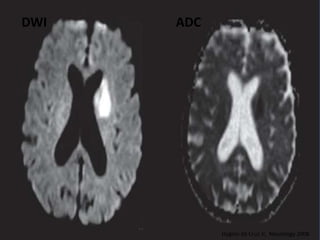
DWI ADC
Hygino da Cruz Jr, Neurology 2008
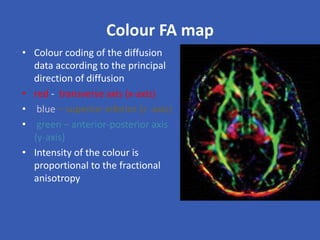
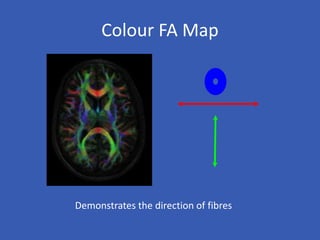
Colour FA map
• Colour coding of the diffusion
data according to the principal
direction of diffusion
• red - transverse axis (x-axis)
• blue – superior-inferior (z -axis)
• green – anterior-posterior axis
(y-axis)
• Intensity of the colour is
proportional to the fractional
anisotropy
Water diffusion in brain tissue
• Depends upon the environment:
- Proportion of intracellular vs extracellular
water: cytotoxic vs vasogenic oedema
- Extracellular structures/large molecules
particularly in disease states
- Physical orientation of tissue e.g.nerve fibre
direction
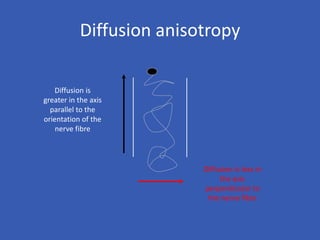
Diffusion anisotropy
Diffusion is
greater in the axis
parallel to the
orientation of the
nerve fibre
Diffusion is less in
the axis
perpendicular to
the nerve fibre
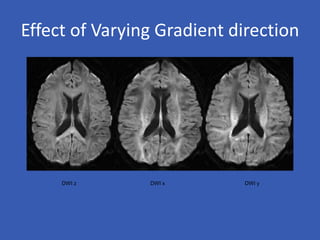
Effect of Varying Gradient direction
DWI z DWI x DWI y
What is the diffusion tensor?
• In the case of anisotropic diffusion: we fit a
model to describe our data: TENSOR MODEL
- This characterises diffusion in which the
displacement of water molecules per unit
time is not the same in all directions
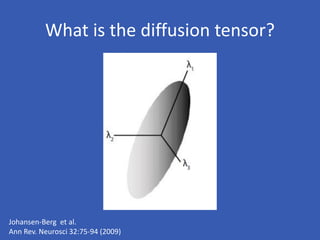
What is the diffusion tensor?
Johansen-Berg et al.
Ann Rev. Neurosci 32:75-94 (2009)
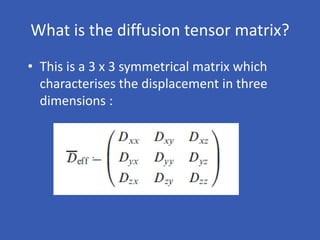
What is the diffusion tensor matrix?
• This is a 3 x 3 symmetrical matrix which
characterises the displacement in three
dimensions :
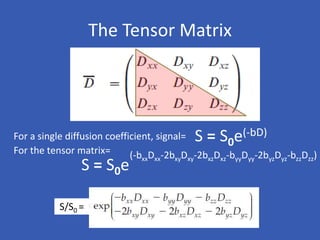
The Tensor Matrix
S = S0e(-bD)
S = S0e
(-bxxDxx-2bxyDxy-2bxzDxz-byyDyy-2byzDyz-bzzDzz)
For a single diffusion coefficient, signal=
For the tensor matrix=
S/S0 =
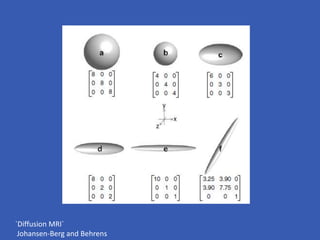
`Diffusion MRI`
Johansen-Berg and Behrens
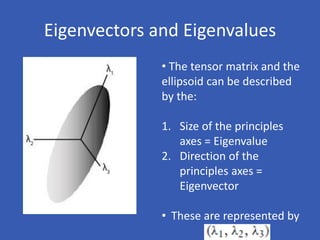
Eigenvectors and Eigenvalues
• The tensor matrix and the
ellipsoid can be described
by the:
1. Size of the principles
axes = Eigenvalue
2. Direction of the
principles axes =
Eigenvector
• These are represented by
The Tensor Matrix
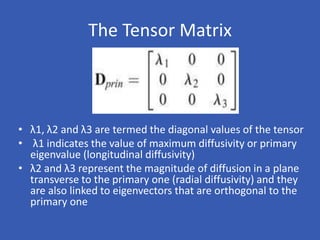
• λ1, λ2 and λ3 are termed the diagonal values of the tensor
• λ1 indicates the value of maximum diffusivity or primary
eigenvalue (longitudinal diffusivity)
• λ2 and λ3 represent the magnitude of diffusion in a plane
transverse to the primary one (radial diffusivity) and they
are also linked to eigenvectors that are orthogonal to the
primary one
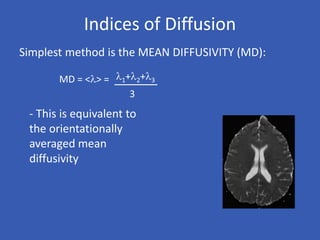
Indices of Diffusion
Simplest method is the MEAN DIFFUSIVITY (MD):
l1+l2+l3
MD = <l> =
3
- This is equivalent to
the orientationally
averaged mean
diffusivity
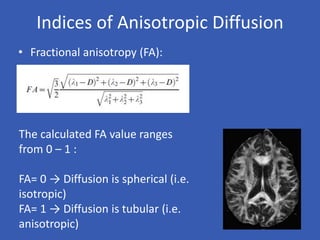
Indices of Anisotropic Diffusion
• Fractional anisotropy (FA):
The calculated FA value ranges
from 0 – 1 :
FA= 0 → Diffusion is spherical (i.e.
isotropic)
FA= 1 → Diffusion is tubular (i.e.
anisotropic)
Colour FA Map
Demonstrates the direction of fibres
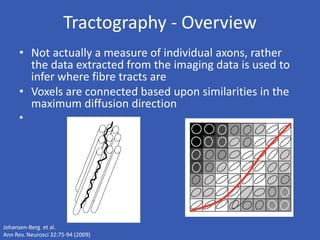
Tractography - Overview
• Not actually a measure of individual axons, rather
the data extracted from the imaging data is used to
infer where fibre tracts are
• Voxels are connected based upon similarities in the
maximum diffusion direction
•
Johansen-Berg et al.
Ann Rev. Neurosci 32:75-94 (2009)
Tractography – Techniques
Degree of anisotropy Streamline tractography Probabilistic tractography
Nucifora et al. Radiology 245:2 (2007)
Streamline (deterministic) tractography
• Connects neighbouring voxels from user defined
voxels (SEED REGIONS) e.g. M1 for the CST
• User can define regions to restrict the output of a
tract e.g. internal capsule for the CST
• Tracts are traced until termination criteria are
met (e.g. anisotropy drops below a certain level
or there is an abrupt angulation)
Probabilistic tractography
• Value of each voxel in the map = the probability
the voxel is included in the diffusion path
between the ROIs
• Run streamlines for each voxel in the seed ROI
• Provides quantitative probability of connection at
each voxel
• Allows tracking into regions where there is low
anisotropy e.g. crossing or kissing fibres
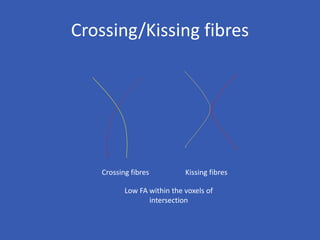
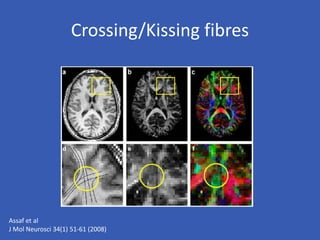
Crossing/Kissing fibres
Crossing fibres Kissing fibres
Low FA within the voxels of
intersection
Crossing/Kissing fibres
Assaf et al
J Mol Neurosci 34(1) 51-61 (2008)
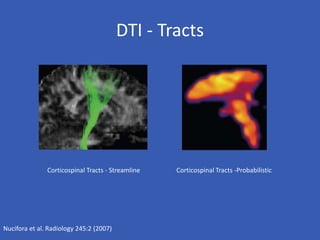
DTI - Tracts
Nucifora et al. Radiology 245:2 (2007)
Corticospinal Tracts -Probabilistic
Corticospinal Tracts - Streamline

DIFFUSION TENSOR IMAGING_MFD .pptx

  • 1.
  • 2.
    Overview Introduction Pulse gradient spinecho ADC/DWI Diffusion tensor Diffusion tensor matrix Tractography
  • 3.
    DTI • Non invasiveway of understanding brain structural connectivity • Macroscopic axonal organization • Contrast based on the directional rate of diffusion of water molecules
  • 4.
    DTI • WATER protons= signal in DTI • Diffusion property of water molecules (D) • D = diffusion constant • Move by Brownian motion / Random thermal motion • Image intensities inversely related to the relative mobility of water molecules in tissue and the direction of the motion
  • 5.
    Brownian motion ofwater molecule Rosenbloom et al
  • 6.
  • 7.
  • 8.
    ω = ϒB •ω = angular frequency •ϒ = gyromagnetic ratio •B = (B0 + G * distance) = magnitude of the magnetic field
  • 9.
    What is b? •b-value gives the degree of diffusion weighting and is related to the strength and duration of the pulse gradient as well as the interval between the gradients • b changes by lengthening the separation of the 2 gradient pulses more time for water molecules to move around more signal loss (imperfect rephasing) • G= gradient amplitude • δ = duration • = trailing to leading edge separation
  • 10.
    Apparent Diffusion Coefficient •ADC – less barriers • ADC - more barriers b-value S   ADC b S S    exp 0    b-value ln(S)     ADC b S S    0 ln ln   
  • 11.
    ADC • Dark regions– water diffusing slower – more obstacles to movement OR increased viscosity • Bright regions – water diffusing faster • Intensity of pixels proportional to extent of diffusion • Left MCA stroke: www.radiopaedia.org
  • 12.
    DWI • Bright regions– decreased water diffusion • Dark regions – increased water diffusion www.radiopaedia.org
  • 13.
    DWI ADC Hygino daCruz Jr, Neurology 2008
  • 14.
    Colour FA map •Colour coding of the diffusion data according to the principal direction of diffusion • red - transverse axis (x-axis) • blue – superior-inferior (z -axis) • green – anterior-posterior axis (y-axis) • Intensity of the colour is proportional to the fractional anisotropy
  • 15.
    Water diffusion inbrain tissue • Depends upon the environment: - Proportion of intracellular vs extracellular water: cytotoxic vs vasogenic oedema - Extracellular structures/large molecules particularly in disease states - Physical orientation of tissue e.g.nerve fibre direction
  • 16.
    Diffusion anisotropy Diffusion is greaterin the axis parallel to the orientation of the nerve fibre Diffusion is less in the axis perpendicular to the nerve fibre
  • 17.
    Effect of VaryingGradient direction DWI z DWI x DWI y
  • 18.
    What is thediffusion tensor? • In the case of anisotropic diffusion: we fit a model to describe our data: TENSOR MODEL - This characterises diffusion in which the displacement of water molecules per unit time is not the same in all directions
  • 19.
    What is thediffusion tensor? Johansen-Berg et al. Ann Rev. Neurosci 32:75-94 (2009)
  • 20.
    What is thediffusion tensor matrix? • This is a 3 x 3 symmetrical matrix which characterises the displacement in three dimensions :
  • 21.
    The Tensor Matrix S= S0e(-bD) S = S0e (-bxxDxx-2bxyDxy-2bxzDxz-byyDyy-2byzDyz-bzzDzz) For a single diffusion coefficient, signal= For the tensor matrix= S/S0 =
  • 22.
  • 23.
    Eigenvectors and Eigenvalues •The tensor matrix and the ellipsoid can be described by the: 1. Size of the principles axes = Eigenvalue 2. Direction of the principles axes = Eigenvector • These are represented by
  • 24.
    The Tensor Matrix •λ1, λ2 and λ3 are termed the diagonal values of the tensor • λ1 indicates the value of maximum diffusivity or primary eigenvalue (longitudinal diffusivity) • λ2 and λ3 represent the magnitude of diffusion in a plane transverse to the primary one (radial diffusivity) and they are also linked to eigenvectors that are orthogonal to the primary one
  • 25.
    Indices of Diffusion Simplestmethod is the MEAN DIFFUSIVITY (MD): l1+l2+l3 MD = <l> = 3 - This is equivalent to the orientationally averaged mean diffusivity
  • 26.
    Indices of AnisotropicDiffusion • Fractional anisotropy (FA): The calculated FA value ranges from 0 – 1 : FA= 0 → Diffusion is spherical (i.e. isotropic) FA= 1 → Diffusion is tubular (i.e. anisotropic)
  • 27.
    Colour FA Map Demonstratesthe direction of fibres
  • 28.
    Tractography - Overview •Not actually a measure of individual axons, rather the data extracted from the imaging data is used to infer where fibre tracts are • Voxels are connected based upon similarities in the maximum diffusion direction • Johansen-Berg et al. Ann Rev. Neurosci 32:75-94 (2009)
  • 29.
    Tractography – Techniques Degreeof anisotropy Streamline tractography Probabilistic tractography Nucifora et al. Radiology 245:2 (2007)
  • 30.
    Streamline (deterministic) tractography •Connects neighbouring voxels from user defined voxels (SEED REGIONS) e.g. M1 for the CST • User can define regions to restrict the output of a tract e.g. internal capsule for the CST • Tracts are traced until termination criteria are met (e.g. anisotropy drops below a certain level or there is an abrupt angulation)
  • 31.
    Probabilistic tractography • Valueof each voxel in the map = the probability the voxel is included in the diffusion path between the ROIs • Run streamlines for each voxel in the seed ROI • Provides quantitative probability of connection at each voxel • Allows tracking into regions where there is low anisotropy e.g. crossing or kissing fibres
  • 32.
    Crossing/Kissing fibres Crossing fibresKissing fibres Low FA within the voxels of intersection
  • 33.
    Crossing/Kissing fibres Assaf etal J Mol Neurosci 34(1) 51-61 (2008)
  • 34.
    DTI - Tracts Nuciforaet al. Radiology 245:2 (2007) Corticospinal Tracts -Probabilistic Corticospinal Tracts - Streamline