The document presents a robust adaptive threshold algorithm based on kernel fuzzy clustering for image segmentation. It proposes using kernel fuzzy c-means clustering (KFCM) to generate adaptive thresholds for segmenting images. KFCM computes fuzzy membership values for pixels to cluster them. The algorithm was tested on MR brain images and showed good performance in detecting large and small objects while also enhancing low contrast images. Experimental results demonstrated the efficiency and accuracy of combining an adaptive threshold algorithm with KFCM for medical image segmentation.
![Natarajan Meghanathan, et al. (Eds): ITCS, SIP, JSE-2012, CS & IT 04, pp. 99–103, 2012.
© CS & IT-CSCP 2012 DOI : 10.5121/csit.2012.2109
Robust Adaptive Threshold Algorithm based
on Kernel Fuzzy Clustering on Image
segmentation
Tara.Saikumar1
, B.K.Anoop2
, P.S.Murthy3
1
Asst Professor, Dept of ECE, CMR Technical Campus, Hyderabad, India.
tara.sai437@gmail.com
2
Lecturer, Dept of ECE, MACE, Kerala, India.
anoopbk2000@gmail.com
3
Professor, Dept of CSE, CMRIT, Hyderabad India.
moorthypsm@gmail.com
ABSTRACT
Using thresholding method to segment an image, a fixed threshold is not suitable if the
background is rough here, we propose a new adaptive thresholding method using KFCM. The
method requires only one parameter to be selected and the adaptive threshold surface can be
found automatically from the original image. An adaptive thresholding scheme using adaptive
tracking and morphological filtering. KFCM algorithm computes the fuzzy membership values
for each pixel. Our method is good for detecting large and small images concurrently. It is also
efficient to denoise and enhance the responses of images with low local contrast can be detected.
The efficiency and accuracy of the algorithm is demonstrated by the experiments on the MR brain
images.
KEYWORDS
Adaptive thresholding , Image segmentation, KFCM.
1. INTRODUCTION
Blind Thresholding techniques are often used to segment images consisting of dark objects
against bright backgrounds, or vice versa. It also offers data compression and fast data processing
[1]. The simplest way is through a technique called global thresholding, where one threshold
value is selected for the entire image, which is obtained from the global information. However,
when the background has non-uniform illumination, a fixed (or global) threshold value will
poorly segment the image. Thus, a local threshold value that changes dynamically over the image
is needed. This technique is called adaptive thresholding. Basically these techniques can be
divided into region-based and edge-based thresholding. Region-based technique uses the whole
image to extract the information for the threshold value computation, while edge-based technique
is based on the attributes along the contour between the object and the background.](https://image.slidesharecdn.com/csit2109-180130063911/85/Robust-Adaptive-Threshold-Algorithm-based-on-Kernel-Fuzzy-Clustering-on-Image-segmentation-1-320.jpg)
![Natarajan Meghanathan, et al. (Eds): ITCS, SIP, JSE-2012, CS & IT 04, pp. 99–103, 2012.
© CS & IT-CSCP 2012 DOI : 10.5121/csit.2012.2109
Robust Adaptive Threshold Algorithm based
on Kernel Fuzzy Clustering on Image
segmentation
Tara.Saikumar1
, B.K.Anoop2
, P.S.Murthy3
1
Asst Professor, Dept of ECE, CMR Technical Campus, Hyderabad, India.
tara.sai437@gmail.com
2
Lecturer, Dept of ECE, MACE, Kerala, India.
anoopbk2000@gmail.com
3
Professor, Dept of CSE, CMRIT, Hyderabad India.
moorthypsm@gmail.com
ABSTRACT
Using thresholding method to segment an image, a fixed threshold is not suitable if the
background is rough here, we propose a new adaptive thresholding method using KFCM. The
method requires only one parameter to be selected and the adaptive threshold surface can be
found automatically from the original image. An adaptive thresholding scheme using adaptive
tracking and morphological filtering. KFCM algorithm computes the fuzzy membership values
for each pixel. Our method is good for detecting large and small images concurrently. It is also
efficient to denoise and enhance the responses of images with low local contrast can be detected.
The efficiency and accuracy of the algorithm is demonstrated by the experiments on the MR brain
images.
KEYWORDS
Adaptive thresholding , Image segmentation, KFCM.
1. INTRODUCTION
Blind Thresholding techniques are often used to segment images consisting of dark objects
against bright backgrounds, or vice versa. It also offers data compression and fast data processing
[1]. The simplest way is through a technique called global thresholding, where one threshold
value is selected for the entire image, which is obtained from the global information. However,
when the background has non-uniform illumination, a fixed (or global) threshold value will
poorly segment the image. Thus, a local threshold value that changes dynamically over the image
is needed. This technique is called adaptive thresholding. Basically these techniques can be
divided into region-based and edge-based thresholding. Region-based technique uses the whole
image to extract the information for the threshold value computation, while edge-based technique
is based on the attributes along the contour between the object and the background.](https://image.slidesharecdn.com/csit2109-180130063911/75/Robust-Adaptive-Threshold-Algorithm-based-on-Kernel-Fuzzy-Clustering-on-Image-segmentation-1-2048.jpg)
![100 Computer Science & Information Technology (CS & IT)
For region-based technique, most of the early introduced techniques are based on the image
histogram. In 1979, Otsu [2] presented a technique that considered the image histogram as having
a two gaussian distribution representing the object and the background. A threshold is selected to
maximize the inter-class separation on the basis of the class Variances. For the edge-based
thresholding technique, the idea of applying the boundary based attributes is based on the fact that
discriminant features exist at the boundary between the object and the background [3]. Thus, the
edge-based thresholding technique has become more popular for exploration. Milgram [10]
applied edge information to segment images by proposing “super slice” method. In this method,
the edge information (gradient) is integrated with the recursive region splitting technique. The
superslice method was also applied and improved in [3, 11].
2. ADAPTIVE THRESHOLDING
We adapt this technique with some optimization. The following outlines Hoover’s adaptive
thresholding:
1) Binarize the image with a single threshold T
2) Thin the thresholded image
3) Erase all branchpoints in the thinned image
4) All remaining endpoints are placed in the probe
queue and are used as a starting point for tracking
5) Track the region with threshold T
6) If the region passed testing, T=T-1, go to 5)
The testing in step 6) is some constraints to guarantee the region is image segment.Very small
segments that remain after thresholding will be “size-filtered”. But this step is preceded by the
application of morphological filter to fill the small gaps between images.
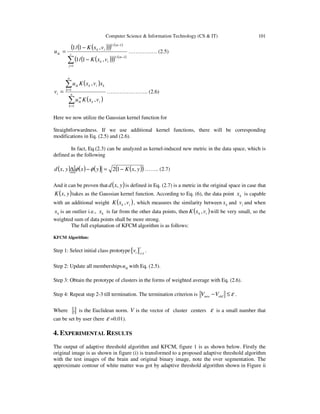
3. Kernel fuzzy c-means clustering (KFCM):
Define a nonlinear map as ( ) Fxx ∈→•
• φφ ,where XXx .∈ denotes the data space and F is the
transformed feature space with higher even infinite dimensions. KFCM minimized the following
objective function:
)( ( ) ( ) 2
1`1
., ii
n
k
m
ik
c
i
m vxuVUJ φφ −≡ ∑∑ −−
…….. (2.2)
Where ( ) ( ) ( ) ( ) ( )ikiikkii vxKvvKxxKvx ,2,,
2
−+=− φφ ………………… (2.3)
Where ( ) ( ) ( )yxyxK
T
φφ=, is an inner product of the kernel function. If we adopt the
Gaussian function as a kernel function, ( ) ( ),2/exp, 22
σyxyxK −−= then ( ) .1, =xxK
according to Eq. (2.3), Eq. (2.2) can be rewritten as
)( ( )( ).,1.2,
1`1
ik
n
k
m
ik
c
i
m vxkuVUJ −≡ ∑∑ −−
………. (2.4)
Minimizing Eq. (2.4) under the constraint of, , 1iku m > . We have](https://image.slidesharecdn.com/csit2109-180130063911/85/Robust-Adaptive-Threshold-Algorithm-based-on-Kernel-Fuzzy-Clustering-on-Image-segmentation-2-320.jpg)
![102 Computer Science & Information Technology (CS & IT)
of Figure 1. The output of adaptive threshold algorithm is given to KFCM clustering to get the
fuzzy image with fuzzy boundaries. The snooping of regions else appear as a result of the in
excess of segmentation.
5. DISCUSSIONS
In this paper, we projected a new method to transform the algorithm. The original image was
partitioned with adaptive threshold algorithm, KFCM and the controlled action of the edge
indicator function was increased. The result of adaptive threshold algorithm and KFCM
segmentation are as shown in Figure: 1.
Alternatively the adaptive threshold algorithm is sensitive to noise; some redundant boundaries
were appeared in the candidates.
6. CONCLUSIONS
In this paper, we proposed an adaptive threshold algorithm, KFCM with a level set method. The
results of this paper confirmed that the mixture of adaptive threshold, KFCM could be used for
the segmentation of low contrast images and medical images. The validity of new algorithm was
verified in the process of exacting details of images. In the future research, noise was added in
images prior information on the object boundary extraction with level set method, such as
boundary, shape, and size, would be further analyzed.
Figure i Figure ii Figure iii
Original Test Image Adaptive Threshold test image KFCM Segmented output
FIGURE: 1
Figure i are the original test images.
Figure ii are the results of Adaptive threshold images, to extracting the white matter.
Figure iii are the results of KFCM Segmented outputs.
REFERENCES
[1] A. Shio, “An Automatic Thresholding Algorithm Based On An Illumination-Independent Contrast
Measure”, IEEE Computer Society Conference on Computer Vision and Pattern Recognition, pp.
632- 637, 4-8 June 1989.](https://image.slidesharecdn.com/csit2109-180130063911/85/Robust-Adaptive-Threshold-Algorithm-based-on-Kernel-Fuzzy-Clustering-on-Image-segmentation-4-320.jpg)
![Computer Science & Information Technology (CS & IT) 103
[2] N. Otsu, “A Threshold Selection Method from Gray-Level Histogram”, IEEE Trans. on System Man
Cybernetics, SMC, vol. 9(I), pp. 62-66, 1979.
[3] F.H.Y. Chan, F.K. Lam, Hui Zhu, “Adaptive Thresholding By Variational Method”, IEEE
Transactions on Image Processing, vol. 7, no. 3, pp. 468-473, March 1998.
[4] Osher S, Scthian J.A,Fronts propagating with curvature dependent speed: algorthim’s based on the
Hamilton-Jacobi formulation.Journal of Computational Physics,1988,pp.12-49.
[5] Malladi,R,Sethain,J., and Vemuri,B., Shape modelling with front propagation: A level set
approach.IEEE Trans.Pattern Anal. Mach.Intell, 1995, pp.158-175.
[6] Staib,L., Zeng,X., Schultz,R., and Duncan,J., Shape constraints in deformablemodels.Handbook of
Medical Imaging,Bankman,I.,ed., 2000,pp.147-157.
[7] D. L. Milgram, “Region Extraction Using Convergent Evidence”, IEEE Trans. on Computer Graphics
and Image Processing, vol. 11 no. 1, 1979.
[8] S. D. Yanowitz and A. M. Bruckstein, “A New Method For Image Segmentation”, IEEE Trans. on
Computer. Vision, Graphic and Image Processing, vol. 46, pp. 82-95, 1989.
[9] J.C.Bezdek ,Pattern Recognition with Fuzzy Objective Function Algorthims,Plenum Press ,New
York,1981.
[10] K.L.Wu,M.S.Yang, Alternative c-means clustering algorthims,Pattern.
[11] Mclnerney T, Terzopouls D,Deformable models in medical image analysis: a survey.Medical
Analysis,1996,pp.91-108.
[12] S. D. Yanowitz and A. M. Bruckstein, “A New Method For Image Segmentation”, IEEE Trans. on
Computer. Vision, Graphic and Image Processing, vol. 46, pp. 82-95, 1989.
[13] Bezedek,J., A convergence theorem for the fuzzy ISODATA clustering algorthims. IEEE
Trans.Pattern Anal.Mach.Intell., 1980,pp 78-82.
[14] L. Zhang, W.D. Zhou, L.C. Jiao. Kernel clustering algorithm. Chinese J. Computers, vol25 (6), pp.
587-590, 2002 (in Chinese).
Authors
Tara. Saikumar, received his M.Tech, degree in Digital communication Engineering
from Kakatiya Institute of Technology and Science, Kakatiya University, Warangal.
He is the university topper in his M.Tech, KITS, Warangal and also received gold
medal from Dr.D.N.Reddy vice-chancellor JNTUH in his B.Tech for his
excellence2004-2008. Presently working as Asst Professor in ECE, CMR Technical
Education Society, Group of Institutions, Hyderabad. He his 34 paper in his credit,
International journal, International and National Conferences. He is a life member of
IAENG, IACSIT, and UAEEE.](https://image.slidesharecdn.com/csit2109-180130063911/85/Robust-Adaptive-Threshold-Algorithm-based-on-Kernel-Fuzzy-Clustering-on-Image-segmentation-5-320.jpg)


