A FRAMEWORK FOR
WORKSHOP FACILITATION
• Director of UX at MTT (soon
to be Travelport Digital)
• Managing design teams for
over 10 years
• Background in research and
information architecture
You can get me @matthewovington
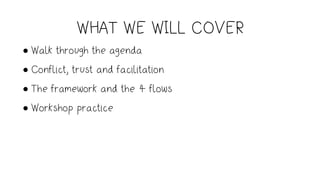
WHAT WE WILL COVER
• Walk through the agenda
• Conflict, trust and facilitation
• The framework and the 4 flows
• Workshop practice
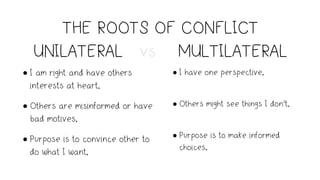
UNILATERAL vs MULTILATERAL
• I am right and have others
interests at heart.
• Others are misinformed or have
bad motives.
• Purpose is to convince other to
do what I want.
• I have one perspective.

• Others might see things I don’t.

• Purpose is to make informed
choices.
THE ROOTS OF CONFLICT
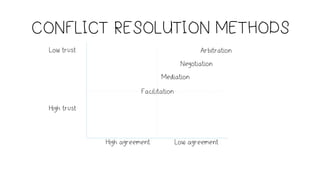
CONFLICT RESOLUTION METHODS
Low trust
High trust
High agreement Low agreement
Negotiation
Mediation
Facilitation
Arbitration
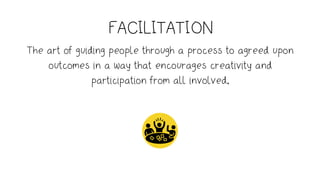
FACILITATION
The art of guiding people through a process to agreed upon
outcomes in a way that encourages creativity and
participation from all involved.
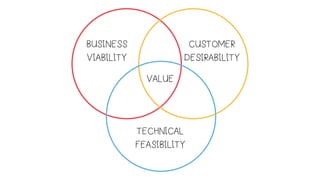
BUSINESS
VIABILITY
CUSTOMER
DESIRABILITY
TECHNICAL
FEASIBILITY
VALUE
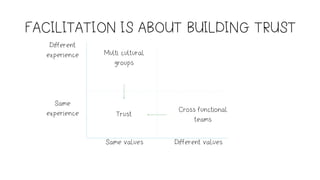
FACILITATION IS ABOUT BUILDING TRUST
Different

experience
Same

experience
Same values Different values
Multi cultural
groups
Cross functional
teams
Trust
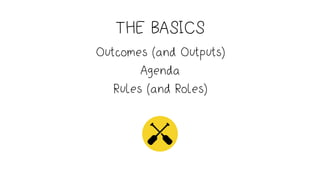
THE BASICS
Outcomes (and Outputs) 

Agenda

Rules (and Roles)
OOARRs
OARs
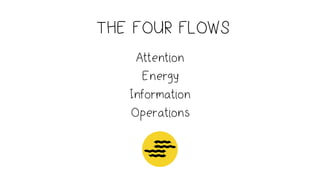
THE FOUR FLOWS
Attention

Energy

Information

Operations
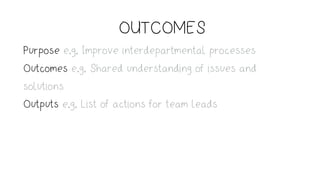
OUTCOMES
Purpose e.g. Improve interdepartmental processes
Outcomes e.g. Shared understanding of issues and
solutions
Outputs e.g. List of actions for team leads
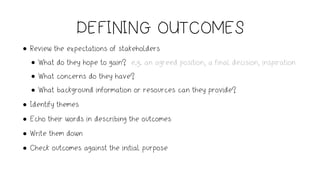
DEFINING OUTCOMES
• Review the expectations of stakeholders
• What do they hope to gain? e.g. an agreed position, a final decision, inspiration
• What concerns do they have?
• What background information or resources can they provide?
• Identify themes
• Echo their words in describing the outcomes
• Write them down
• Check outcomes against the initial purpose
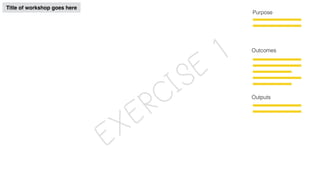
Outcomes
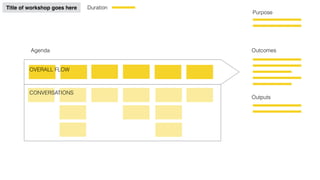
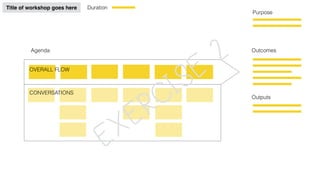
Title of workshop goes here
Outputs
Purpose
EXERCISE 1
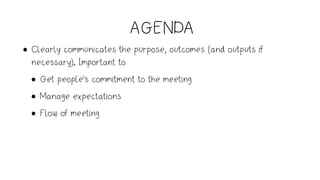
AGENDA
• Clearly communicates the purpose, outcomes (and outputs if
necessary). Important to
• Get people's commitment to the meeting
• Manage expectations
• Flow of meeting
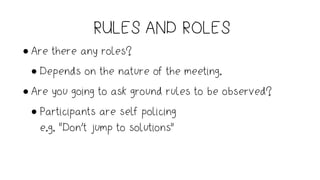
RULES AND ROLES
• Are there any roles?
• Depends on the nature of the meeting.
• Are you going to ask ground rules to be observed?
• Participants are self policing 

e.g. “Don’t jump to solutions”
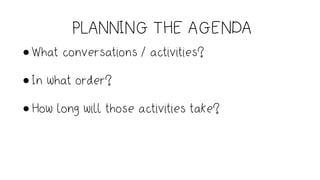
PLANNING THE AGENDA
• What conversations / activities?
• In what order?
• How long will those activities take?
Agenda Outcomes
Outputs
Purpose
OVERALL FLOW
CONVERSATIONS
Title of workshop goes here Duration
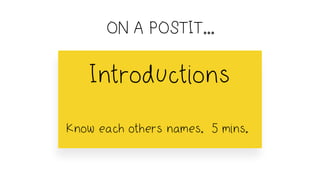
Introductions
Know each others names. 5 mins.
ON A POSTIT...
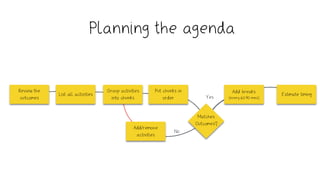
Planning the agenda
Put chunks in
order
Add breaks
(every 60-90 mins)
Add/remove
activities
Review the
outcomes
Matches
Outcomes?
Estimate timing
Yes
No
List all activities
Group activities
into chunks
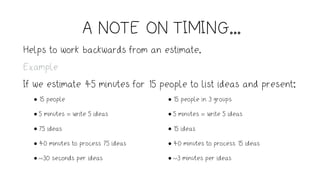
A NOTE ON TIMING...
Helps to work backwards from an estimate.
Example
If we estimate 45 minutes for 15 people to list ideas and present:
• 15 people
• 5 minutes = write 5 ideas
• 75 ideas
• 40 minutes to process 75 ideas
• ~30 seconds per ideas
• 15 people in 3 groups
• 5 minutes = write 5 ideas
• 15 ideas
• 40 minutes to process 15 ideas
• ~3 minutes per ideas
Agenda Outcomes
Outputs
Purpose
OVERALL FLOW
CONVERSATIONS
Title of workshop goes here
EXERCISE 2
Duration
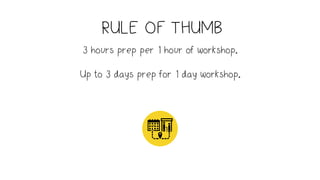
RULE OF THUMB
3 hours prep per 1 hour of workshop.
Up to 3 days prep for 1 day workshop.
THE FOUR FLOWS
Attention

Energy

Information

Operations
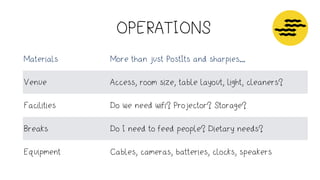
OPERATIONS
Materials More than just PostIts and sharpies...
Venue Access, room size, table layout, light, cleaners?
Facilities Do we need wifi? Projector? Storage?
Breaks Do I need to feed people? Dietary needs?
Equipment Cables, cameras, batteries, clocks, speakers
INFORMATION
Attention
How long?
What time of day?
Information - clarity and understanding
What will I need to prepare in advance?
How much time do they need to read and prepare?
Am I waiting for any information?
Energy - trust and respect
How well do people know one another
Will they have had time to
Operations - support decision making
Good natural light
Room - table size, chairs, arrangement, projectors or monitors, power points, wifi
Confirm breaks
Lunch - dietary needs, venues nearby, ordering food
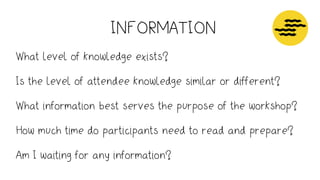
What level of knowledge exists?
Is the level of attendee knowledge similar or different?
What information best serves the purpose of the workshop?
How much time do participants need to read and prepare?
Am I waiting for any information?
ATTENTION
Attention
How long?
What time of day?
Information - clarity and understanding
What will I need to prepare in advance?
How much time do they need to read and prepare?
Am I waiting for any information?
Energy - trust and respect
How well do people know one another
Will they have had time to
Operations - support decision making
Good natural light
Room - table size, chairs, arrangement, projectors or monitors, power points, wifi
Confirm breaks
Lunch - dietary needs, venues nearby, ordering food
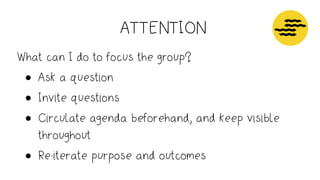
What can I do to focus the group?
• Ask a question
• Invite questions
• Circulate agenda beforehand, and keep visible
throughout
• Re-iterate purpose and outcomes
ENERGY
Attention
How long?
What time of day?
Information - clarity and understanding
What will I need to prepare in advance?
How much time do they need to read and prepare?
Am I waiting for any information?
Energy - trust and respect
How well do people know one another
Will they have had time to
Operations - support decision making
Good natural light
Room - table size, chairs, arrangement, projectors or monitors, power points, wifi
Confirm breaks
Lunch - dietary needs, venues nearby, ordering food
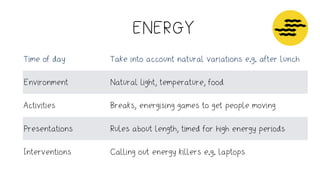
Time of day Take into account natural variations e.g. after lunch
Environment Natural light, temperature, food
Activities Breaks, energising games to get people moving
Presentations Rules about length, timed for high energy periods
Interventions Calling out energy killers e.g. laptops
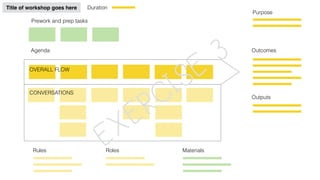
Agenda Outcomes
Outputs
Rules Roles
Purpose
OVERALL FLOW
CONVERSATIONS
Prework and prep tasks
Materials
Title of workshop goes here
EXERCISE 3
Duration
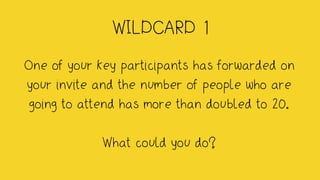
WILDCARD 1
One of your key participants has forwarded on
your invite and the number of people who are
going to attend has more than doubled to 20.
What could you do?
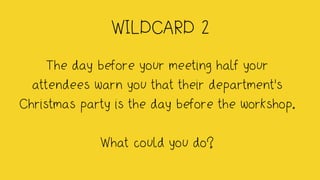
WILDCARD 2
The day before your meeting half your
attendees warn you that their department's
Christmas party is the day before the workshop.
What could you do?
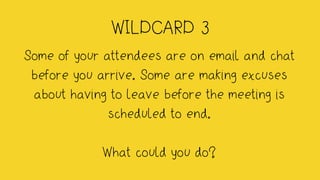
WILDCARD 3
Some of your attendees are on email and chat
before you arrive. Some are making excuses
about having to leave before the meeting is
scheduled to end.
What could you do?
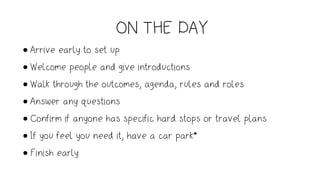
ON THE DAY
• Arrive early to set up
• Welcome people and give introductions
• Walk through the outcomes, agenda, rules and roles
• Answer any questions
• Confirm if anyone has specific hard stops or travel plans
• If you feel you need it, have a car park*
• Finish early
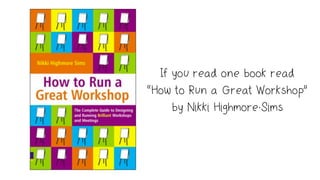
If you read one book read
“How to Run a Great Workshop”
by Nikki Highmore-Sims
VERY LAST THING...
Questions @matthewovington
We’re looking for a Product Designer
http://bit.ly/2eLUPSS
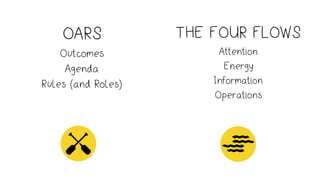
OARS

Outcomes

Agenda

Rules (and Roles)
THE FOUR FLOWS

Attention

Energy

Information

Operations

A framework for workshop facilitation - UX Ireland 2016

  • 1.
  • 2.
    • Director ofUX at MTT (soon to be Travelport Digital) • Managing design teams for over 10 years • Background in research and information architecture You can get me @matthewovington
  • 4.
    WHAT WE WILLCOVER • Walk through the agenda • Conflict, trust and facilitation • The framework and the 4 flows • Workshop practice
  • 5.
    UNILATERAL vs MULTILATERAL •I am right and have others interests at heart. • Others are misinformed or have bad motives. • Purpose is to convince other to do what I want. • I have one perspective.
 • Others might see things I don’t.
 • Purpose is to make informed choices. THE ROOTS OF CONFLICT
  • 6.
    CONFLICT RESOLUTION METHODS Lowtrust High trust High agreement Low agreement Negotiation Mediation Facilitation Arbitration
  • 7.
    FACILITATION The art ofguiding people through a process to agreed upon outcomes in a way that encourages creativity and participation from all involved.
  • 8.
  • 9.
    FACILITATION IS ABOUTBUILDING TRUST Different
 experience Same
 experience Same values Different values Multi cultural groups Cross functional teams Trust
  • 10.
    THE BASICS Outcomes (andOutputs) 
 Agenda
 Rules (and Roles)
  • 11.
  • 12.
  • 13.
  • 15.
    OUTCOMES Purpose e.g. Improveinterdepartmental processes Outcomes e.g. Shared understanding of issues and solutions Outputs e.g. List of actions for team leads
  • 16.
    DEFINING OUTCOMES • Reviewthe expectations of stakeholders • What do they hope to gain? e.g. an agreed position, a final decision, inspiration • What concerns do they have? • What background information or resources can they provide? • Identify themes • Echo their words in describing the outcomes • Write them down • Check outcomes against the initial purpose
  • 17.
    Outcomes Title of workshopgoes here Outputs Purpose EXERCISE 1
  • 18.
    AGENDA • Clearly communicatesthe purpose, outcomes (and outputs if necessary). Important to • Get people's commitment to the meeting • Manage expectations • Flow of meeting
  • 19.
    RULES AND ROLES •Are there any roles? • Depends on the nature of the meeting. • Are you going to ask ground rules to be observed? • Participants are self policing 
 e.g. “Don’t jump to solutions”
  • 20.
    PLANNING THE AGENDA •What conversations / activities? • In what order? • How long will those activities take?
  • 21.
  • 22.
    Introductions Know each othersnames. 5 mins. ON A POSTIT...
  • 23.
    Planning the agenda Putchunks in order Add breaks (every 60-90 mins) Add/remove activities Review the outcomes Matches Outcomes? Estimate timing Yes No List all activities Group activities into chunks
  • 24.
    A NOTE ONTIMING... Helps to work backwards from an estimate. Example If we estimate 45 minutes for 15 people to list ideas and present: • 15 people • 5 minutes = write 5 ideas • 75 ideas • 40 minutes to process 75 ideas • ~30 seconds per ideas • 15 people in 3 groups • 5 minutes = write 5 ideas • 15 ideas • 40 minutes to process 15 ideas • ~3 minutes per ideas
  • 25.
  • 26.
    RULE OF THUMB 3hours prep per 1 hour of workshop. Up to 3 days prep for 1 day workshop.
  • 27.
  • 28.
    OPERATIONS Materials More thanjust PostIts and sharpies... Venue Access, room size, table layout, light, cleaners? Facilities Do we need wifi? Projector? Storage? Breaks Do I need to feed people? Dietary needs? Equipment Cables, cameras, batteries, clocks, speakers
  • 29.
    INFORMATION Attention How long? What timeof day? Information - clarity and understanding What will I need to prepare in advance? How much time do they need to read and prepare? Am I waiting for any information? Energy - trust and respect How well do people know one another Will they have had time to Operations - support decision making Good natural light Room - table size, chairs, arrangement, projectors or monitors, power points, wifi Confirm breaks Lunch - dietary needs, venues nearby, ordering food What level of knowledge exists? Is the level of attendee knowledge similar or different? What information best serves the purpose of the workshop? How much time do participants need to read and prepare? Am I waiting for any information?
  • 30.
    ATTENTION Attention How long? What timeof day? Information - clarity and understanding What will I need to prepare in advance? How much time do they need to read and prepare? Am I waiting for any information? Energy - trust and respect How well do people know one another Will they have had time to Operations - support decision making Good natural light Room - table size, chairs, arrangement, projectors or monitors, power points, wifi Confirm breaks Lunch - dietary needs, venues nearby, ordering food What can I do to focus the group? • Ask a question • Invite questions • Circulate agenda beforehand, and keep visible throughout • Re-iterate purpose and outcomes
  • 31.
    ENERGY Attention How long? What timeof day? Information - clarity and understanding What will I need to prepare in advance? How much time do they need to read and prepare? Am I waiting for any information? Energy - trust and respect How well do people know one another Will they have had time to Operations - support decision making Good natural light Room - table size, chairs, arrangement, projectors or monitors, power points, wifi Confirm breaks Lunch - dietary needs, venues nearby, ordering food Time of day Take into account natural variations e.g. after lunch Environment Natural light, temperature, food Activities Breaks, energising games to get people moving Presentations Rules about length, timed for high energy periods Interventions Calling out energy killers e.g. laptops
  • 32.
    Agenda Outcomes Outputs Rules Roles Purpose OVERALLFLOW CONVERSATIONS Prework and prep tasks Materials Title of workshop goes here EXERCISE 3 Duration
  • 33.
    WILDCARD 1 One ofyour key participants has forwarded on your invite and the number of people who are going to attend has more than doubled to 20. What could you do?
  • 34.
    WILDCARD 2 The daybefore your meeting half your attendees warn you that their department's Christmas party is the day before the workshop. What could you do?
  • 35.
    WILDCARD 3 Some ofyour attendees are on email and chat before you arrive. Some are making excuses about having to leave before the meeting is scheduled to end. What could you do?
  • 36.
    ON THE DAY •Arrive early to set up • Welcome people and give introductions • Walk through the outcomes, agenda, rules and roles • Answer any questions • Confirm if anyone has specific hard stops or travel plans • If you feel you need it, have a car park* • Finish early
  • 37.
    If you readone book read “How to Run a Great Workshop” by Nikki Highmore-Sims
  • 39.
    VERY LAST THING... Questions@matthewovington We’re looking for a Product Designer http://bit.ly/2eLUPSS
  • 40.
    OARS
 Outcomes
 Agenda
 Rules (and Roles) THEFOUR FLOWS
 Attention
 Energy
 Information
 Operations