Facilitation toolkit
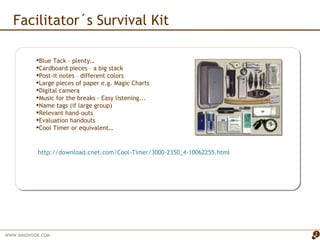
Facilitator´s Survival Kit Blue Tack – plenty… Cardboard pieces – a big stack Post-it notes – different colors Large pieces of paper e.g. Magic Charts Digital camera Music for the breaks - Easy listening...  Name tags (if large group) Relevant hand-outs Evaluation handouts Cool Timer or equivalent… http://download.cnet.com/Cool-Timer/3000-2350_4-10062255.html
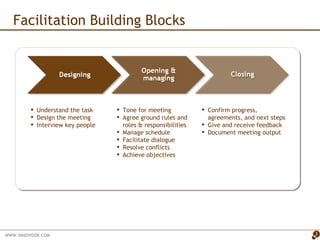
Facilitation Building Blocks Understand the task Design the meeting Interview key people Tone for meeting Agree ground rules and roles & responsibilities Manage schedule Facilitate dialogue Resolve conflicts Achieve objectives Confirm progress, agreements, and next steps Give and receive feedback Document meeting output
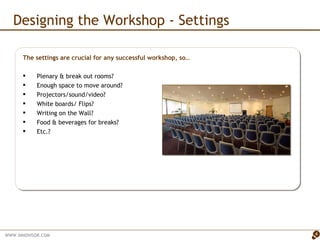
Designing the Workshop - Settings The settings are crucial for any successful workshop, so… Plenary & break out rooms? Enough space to move around? Projectors/sound/video? White boards/ Flips? Writing on the Wall? Food & beverages for breaks? Etc.?
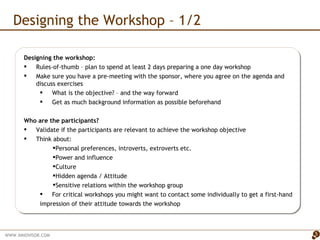
Designing the Workshop – 1/2 Designing the workshop: Rules-of-thumb – plan to spend at least 2 days preparing a one day workshop  Make sure you have a pre-meeting with the sponsor, where you agree on the agenda and discuss exercises  What is the objective? – and the way forward  Get as much background information as possible beforehand Who are the participants?  Validate if the participants are relevant to achieve the workshop objective Think about: Personal preferences, introverts, extroverts etc. Power and influence Culture  Hidden agenda / Attitude Sensitive relations within the workshop group For critical workshops you might want to contact some individually to get a first-hand impression of their attitude towards the workshop
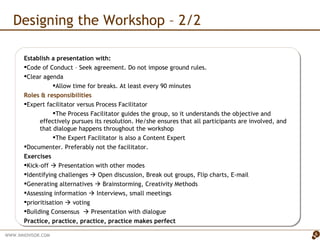
Designing the Workshop – 2/2 Establish a presentation with: Code of Conduct – Seek agreement. Do not impose ground rules. Clear agenda  Allow time for breaks. At least every 90 minutes Roles & responsibilities Expert facilitator versus Process Facilitator The Process Facilitator guides the group, so it understands the objective and effectively pursues its resolution. He/she ensures that all participants are involved, and that dialogue happens throughout the workshop  The Expert Facilitator is also a Content Expert Documenter. Preferably not the facilitator.  Exercises Kick-off    Presentation with other modes  Identifying challenges    Open discussion, Break out groups, Flip charts, E-mail Generating alternatives    Brainstorming, Creativity Methods Assessing information    Interviews, small meetings prioritisation    voting Building Consensus    Presentation with dialogue Practice, practice, practice, practice makes perfect
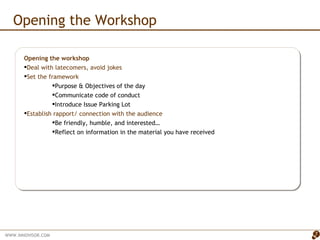
Opening the Workshop  Opening the workshop Deal with latecomers, avoid jokes Set the framework Purpose & Objectives of the day Communicate code of conduct Introduce Issue Parking Lot Establish rapport/ connection with the audience Be friendly, humble, and interested… Reflect on information in the material you have received
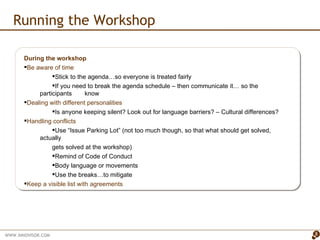
Running the Workshop  During the workshop Be aware of time Stick to the agenda…so everyone is treated fairly  If you need to break the agenda schedule – then communicate it… so the participants  know Dealing with different personalities Is anyone keeping silent? Look out for language barriers? – Cultural differences? Handling conflicts Use “Issue Parking Lot” (not too much though, so that what should get solved, actually gets solved at the workshop)  Remind of Code of Conduct Body language or movements Use the breaks…to mitigate Keep a visible list with agreements
Closing the Workshop Closing the workshop session: Confirm progress, agreements, and next steps Ensure learning Involve audience in wrap-up and conclusions Hand-out evaluation form. Especially if you are going to run similar workshops Touch base with your sponsor immediately after the meeting Document “any writing on the walls” with your digital camera Keep all documentation in a structured fashion Cardboard pieces (Number them, if necessary) Etc. After the workshop: Document the workshop in relevant format, while you can still remember Preferably the same day Make the documentation available to all workshop participants

Innovisor Facilitation Toolkit

  • 1.
  • 2.
    Facilitator´s Survival KitBlue Tack – plenty… Cardboard pieces – a big stack Post-it notes – different colors Large pieces of paper e.g. Magic Charts Digital camera Music for the breaks - Easy listening... Name tags (if large group) Relevant hand-outs Evaluation handouts Cool Timer or equivalent… http://download.cnet.com/Cool-Timer/3000-2350_4-10062255.html
  • 3.
    Facilitation Building BlocksUnderstand the task Design the meeting Interview key people Tone for meeting Agree ground rules and roles & responsibilities Manage schedule Facilitate dialogue Resolve conflicts Achieve objectives Confirm progress, agreements, and next steps Give and receive feedback Document meeting output
  • 4.
    Designing the Workshop- Settings The settings are crucial for any successful workshop, so… Plenary & break out rooms? Enough space to move around? Projectors/sound/video? White boards/ Flips? Writing on the Wall? Food & beverages for breaks? Etc.?
  • 5.
    Designing the Workshop– 1/2 Designing the workshop: Rules-of-thumb – plan to spend at least 2 days preparing a one day workshop Make sure you have a pre-meeting with the sponsor, where you agree on the agenda and discuss exercises What is the objective? – and the way forward Get as much background information as possible beforehand Who are the participants? Validate if the participants are relevant to achieve the workshop objective Think about: Personal preferences, introverts, extroverts etc. Power and influence Culture Hidden agenda / Attitude Sensitive relations within the workshop group For critical workshops you might want to contact some individually to get a first-hand impression of their attitude towards the workshop
  • 6.
    Designing the Workshop– 2/2 Establish a presentation with: Code of Conduct – Seek agreement. Do not impose ground rules. Clear agenda Allow time for breaks. At least every 90 minutes Roles & responsibilities Expert facilitator versus Process Facilitator The Process Facilitator guides the group, so it understands the objective and effectively pursues its resolution. He/she ensures that all participants are involved, and that dialogue happens throughout the workshop The Expert Facilitator is also a Content Expert Documenter. Preferably not the facilitator. Exercises Kick-off  Presentation with other modes Identifying challenges  Open discussion, Break out groups, Flip charts, E-mail Generating alternatives  Brainstorming, Creativity Methods Assessing information  Interviews, small meetings prioritisation  voting Building Consensus  Presentation with dialogue Practice, practice, practice, practice makes perfect
  • 7.
    Opening the Workshop Opening the workshop Deal with latecomers, avoid jokes Set the framework Purpose & Objectives of the day Communicate code of conduct Introduce Issue Parking Lot Establish rapport/ connection with the audience Be friendly, humble, and interested… Reflect on information in the material you have received
  • 8.
    Running the Workshop During the workshop Be aware of time Stick to the agenda…so everyone is treated fairly If you need to break the agenda schedule – then communicate it… so the participants know Dealing with different personalities Is anyone keeping silent? Look out for language barriers? – Cultural differences? Handling conflicts Use “Issue Parking Lot” (not too much though, so that what should get solved, actually gets solved at the workshop) Remind of Code of Conduct Body language or movements Use the breaks…to mitigate Keep a visible list with agreements
  • 9.
    Closing the WorkshopClosing the workshop session: Confirm progress, agreements, and next steps Ensure learning Involve audience in wrap-up and conclusions Hand-out evaluation form. Especially if you are going to run similar workshops Touch base with your sponsor immediately after the meeting Document “any writing on the walls” with your digital camera Keep all documentation in a structured fashion Cardboard pieces (Number them, if necessary) Etc. After the workshop: Document the workshop in relevant format, while you can still remember Preferably the same day Make the documentation available to all workshop participants