MOTIVATION

for Workshop Facilitation
WHAT IS MOTIVATION?

Motivation energises goal-directed behaviour.

Why should I be bothered to do this?

How can I get my colleague to help me?

How can a manager improve employees’ productivity?

How can a facilitator focus a group on project goals?
WORK MOTIVATION

• Work motivation is crucial to productivity
• So, lots of money was spent on finding answers
• The state of the art is very advanced
WORK MOTIVATION

• Work motivation is crucial to productivity
• So, lots of money was spent on finding answers
• The state of the art is very advanced different
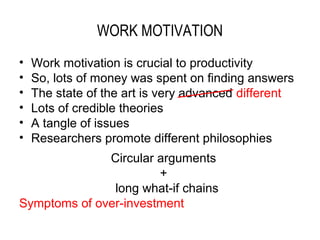
WORK MOTIVATION
•   Work motivation is crucial to productivity
•   So, lots of money was spent on finding answers
•   The state of the art is very advanced different
•   Lots of credible theories
•   A tangle of issues
•   Researchers promote different philosophies
              Circular arguments
                       +
               long what-if chains
Symptoms of over-investment
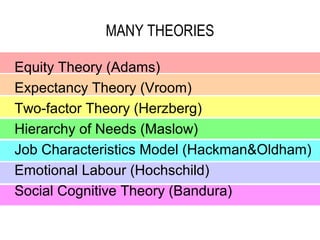
MANY THEORIES

Equity Theory (Adams)
Expectancy Theory (Vroom)
Two-factor Theory (Herzberg)
Hierarchy of Needs (Maslow)
Job Characteristics Model (Hackman&Oldham)
Emotional Labour (Hochschild)
Social Cognitive Theory (Bandura)
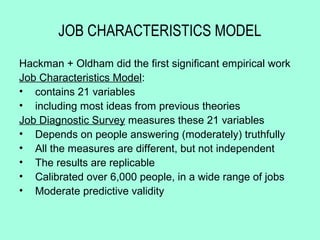
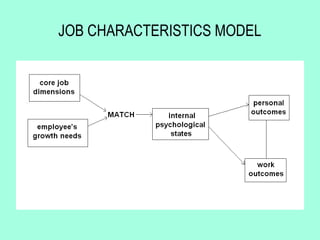
JOB CHARACTERISTICS MODEL
Hackman + Oldham did the first significant empirical work
Job Characteristics Model:
• contains 21 variables
• including most ideas from previous theories
Job Diagnostic Survey measures these 21 variables
• Depends on people answering (moderately) truthfully
• All the measures are different, but not independent
• The results are replicable
• Calibrated over 6,000 people, in a wide range of jobs
• Moderate predictive validity
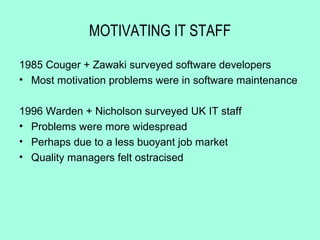
MOTIVATING IT STAFF

1985 Couger + Zawaki surveyed software developers
• Most motivation problems were in software maintenance

1996 Warden + Nicholson surveyed UK IT staff
• Problems were more widespread
• Perhaps due to a less buoyant job market
• Quality managers felt ostracised
MOTIVATION IMPROVEMENT
MOTIVATION IMPROVEMENT PROGRAM
Diagnosis
• Explain improvement process and agree confidentiality
• Administer Job Diagnostic Survey and analyse results
• Feed back data and listen to reactions
• Report on interpretations and recommend actions
Implementation:
• Some things will have changed as a result of the diagnostic process
• To sustain personal / cultural change, monitor progress occasionally
• Visionary / sponsor promotes things that need management support
• Cost-benefit analysis for things that cost money - include intangibles
Verification
• Review repeats JDS and compares to assess long-term effects
• Problems: no benefit to manager who commissioned original work
•            a second JDS isn’t an identical process
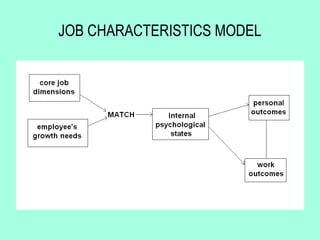
JOB CHARACTERISTICS MODEL
CORE JOB DIMENSIONS
1. Skill variety - different activities requiring different skills
2. Task identity - whole identifiable piece of work with visible outcomes
3. Task significance - impact on the lives and work of others
4. Autonomy - freedom, independence and discretion in:
             scheduling work, designing procedures, specifying criteria
Feedback - two measures:
5. Job Feedback – information about performance is provided
                       in the process of carrying out work

6. People Feedback - supervisors, co-workers etc give performance info
                      if their opinion is valued / respected
EMPLOYEE NEEDS

Strength of this individual’s desire to obtain
  growth satisfaction from work

• would-like needs - absolute
• job - choice needs - relative
• social needs - not in published JDS
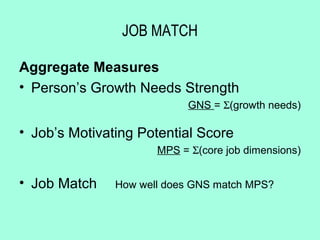
JOB MATCH

Aggregate Measures
• Person’s Growth Needs Strength
                            GNS = Σ(growth needs)

• Job’s Motivating Potential Score
                      MPS = Σ(core job dimensions)


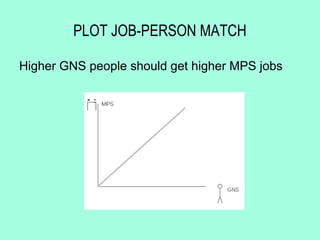
• Job Match    How well does GNS match MPS?
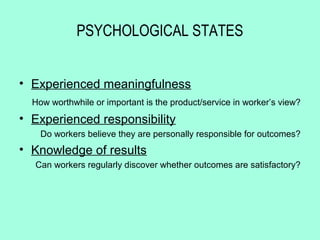
PSYCHOLOGICAL STATES


• Experienced meaningfulness
  How worthwhile or important is the product/service in worker’s view?
• Experienced responsibility
    Do workers believe they are personally responsible for outcomes?
• Knowledge of results
  Can workers regularly discover whether outcomes are satisfactory?
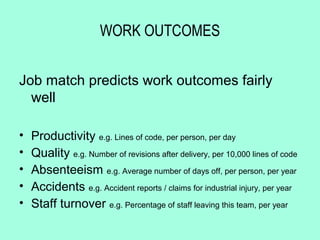
WORK OUTCOMES


Job match predicts work outcomes fairly
  well

•   Productivity e.g. Lines of code, per person, per day
•   Quality e.g. Number of revisions after delivery, per 10,000 lines of code
•   Absenteeism e.g. Average number of days off, per person, per year
•   Accidents e.g. Accident reports / claims for industrial injury, per year
•   Staff turnover e.g. Percentage of staff leaving this team, per year
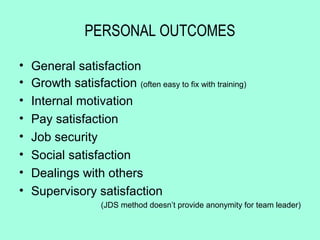
PERSONAL OUTCOMES

•   General satisfaction
•   Growth satisfaction (often easy to fix with training)
•   Internal motivation
•   Pay satisfaction
•   Job security
•   Social satisfaction
•   Dealings with others
•   Supervisory satisfaction
                     (JDS method doesn’t provide anonymity for team leader)
JOB CHARACTERISTICS MODEL
CONFIDENCE IN RESULTS

One team doesn’t give enough data points
                     so we can’t expect statistical significance.
We can ask the team members:
• We see two clusters. Different jobs / people?
• We see an outlier. Is this person/job different?
• Why is this job dimension so low? What can we do to fix it?

For a larger population, we can look for statistical significance
• Are high GNS people given high MPS jobs?
• Does seniority/age/gender influence any of the variables?
• In what way are different job titles statistically different?
PLOT JOB-PERSON MATCH

Higher GNS people should get higher MPS jobs
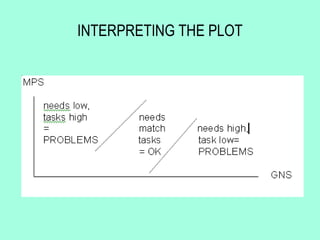
INTERPRETING THE PLOT
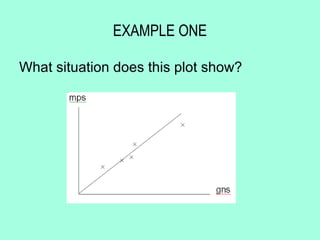
EXAMPLE ONE

What situation does this plot show?
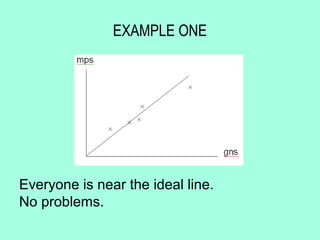
EXAMPLE ONE


Everyone is near the ideal line.
No problems.
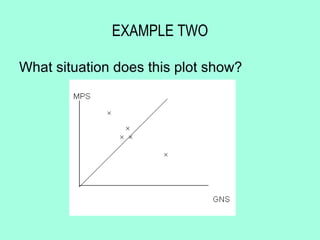
EXAMPLE TWO

What situation does this plot show?
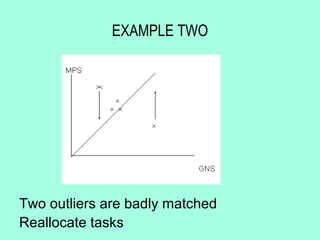
EXAMPLE TWO


Two outliers are badly matched
Reallocate tasks
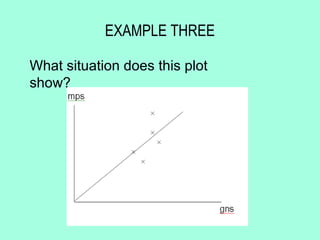
EXAMPLE THREE

What situation does this plot
show?
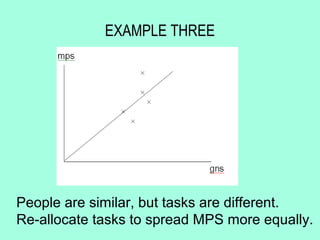
EXAMPLE THREE


People are similar, but tasks are different.
Re-allocate tasks to spread MPS more equally.
EMOTIONAL LABOUR
Emotional Work
  = facial & bodily display of emotion for personal purposes

Emotional Labour
  = facial & bodily display of emotion for wages


Facilitation requires a lot of emotional labour
EMPLOYERS AND EMPLOYEES

Outcomes depend on both employer & employee:

Employers require specific behaviours (display rules)

An employee creates personal behaviours
                 that express his/her distinct identity
OUTCOMES

Emotional labour can be simultaneously
                      both liberating and oppressive
Oppressive outcomes: emotional dissonance >
 emotional numbness, self-estrangement,
  effort to maintain self-esteem, feeling “phoney”,
  physical illness, guilt, burnout
Liberating outcomes: task effectiveness, creativity,
   self-expression, better interaction with customers,
   enjoying one’s own performance
STATEGIES for difficult episodes

Managers’ strategies:
  Requiring adherence to display rules
  Verbal and non-verbal approval disapproval
  Joking and story telling

Employees’ strategies:
  Blaming colleagues, to defuse an argument
  Blowing off afterwards to colleagues or family
  Feeling like altruistic service providers
  Thinking up better strategies for next time
Strategies for FACILITATORS

Facilitation requires emotional labour
• The best facilitators are always considerate
  They seem to not to experience dissonance
  Perhaps this is what makes them better
  They still feel angst about their mistakes
• How can we manage our emotional labour?
  Use limited dissonance to practice behaviours
  Repeat, to feel these behaviours more genuinely
  Air genuine concerns to the group, constructively
SOCIAL COGNITIVE THEORY

Albert Bandura
•   Focussed on individual’s conscious experience
•   Used introspective research methods
Emphasised:
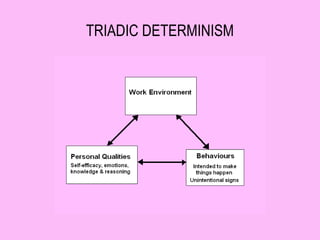
• Reciprocal determinism
           e.g. our environment influences us AND we influence our environment
• Self-efficacy = our belief in our ability to achieve
• Vicarious learning = we learn from observing others
• Self-reflection = we make sense of our experience,
                         explore our thoughts and adapt accordingly
TRIADIC DETERMINISM
APPLICATION OF BANDURA’S THEORY

Bandura’s theories:
  Model the reality of motivation at work rather well
  Used to help individuals change unhelpful habits
  Always quoted in lists of motivation theories

Advice to managers:
 Increase employees’ self-efficacy
 Increase employees’ job satisfaction
 Reduce employees’ role conflict and ambiguity
RECENT DEVELOPMENTS

Recently, research into motivation has declined.
New working conditions will require new theories
For a summary of recent work, see:
            Academy of Management Review volume 29, number 3


Perhaps the term ‘motivation’ is falling into disuse,
  replaced by creativity, quality of working life, etc.
BACK TO EARLIER THEORIES

Early theories tell us what mistakes were being made.
What are these mistakes?
What outcomes could we expect?

Such mistakes are still made.
Assume that you are a facilitator,
  your delegates are being mismanaged as below
  what can you do
    to minimise the effect on your workshop?
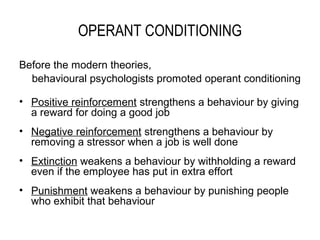
OPERANT CONDITIONING

Before the modern theories,
  behavioural psychologists promoted operant conditioning

• Positive reinforcement strengthens a behaviour by giving
  a reward for doing a good job
• Negative reinforcement strengthens a behaviour by
  removing a stressor when a job is well done
• Extinction weakens a behaviour by withholding a reward
  even if the employee has put in extra effort
• Punishment weakens a behaviour by punishing people
  who exhibit that behaviour
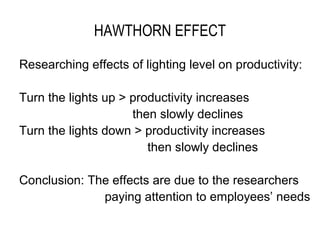
HAWTHORN EFFECT

Researching effects of lighting level on productivity:

Turn the lights up > productivity increases
                     then slowly declines
Turn the lights down > productivity increases
                        then slowly declines

Conclusion: The effects are due to the researchers
              paying attention to employees’ needs
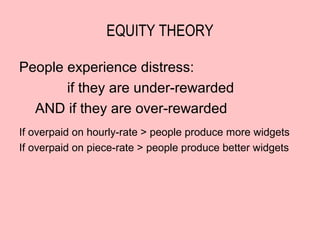
EQUITY THEORY

People experience distress:
       if they are under-rewarded
  AND if they are over-rewarded
If overpaid on hourly-rate > people produce more widgets
If overpaid on piece-rate > people produce better widgets
EQUITY THEORY

People experience distress:
          if they are under-rewarded > anger
          if they are over-rewarded > guilt

If overpaid on hourly-rate > people produce more widgets
If overpaid on piece-rate > people produce better widgets

If underpaid on hourly-rate > fewer widgets, accidents, sick …
If underpaid on piece-rate > worse widgets, accidents, sick …
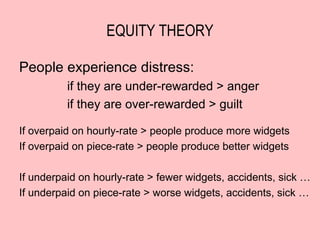
EQUITY THEORY

People experience distress:
          if they are under-rewarded > anger
             if they are over-rewarded > guilt
If overpaid on hourly-rate > people produce more widgets
If overpaid on piece-rate > people produce better widgets

If underpaid on hourly-rate > fewer widgets,
                           absenteeism, sickness, ‘accidents’
If underpaid on piece-rate > worse widgets,
                           absenteeism, sickness, ‘accidents’
EXPECTANCY THEORY

Expectancy Theory (Vroom)
Motivation =
  expectancy (perceived probability that effort ⇒ performance ⇒ success)
  times instrumentality (perceived probability that success ⇒ reward)
  times valence (strength of preference for outcome)


Advises:
• Tie rewards to performance
• Ensure rewards are deserved and wanted
• Provide training to ensure that effort ⇒ productivity
TWO FACTOR THEORY

Hertzberg found two very different types of effect

1. Hygiene factors – if missing will de-motivate
                                      status, job security, salary


2. Motivating factors – give positive satisfaction
                    challenging work, recognition, responsibility


So, managers don’t gain from improving hygiene
    factors above moderately acceptable levels
HIEARACHY OF NEEDS
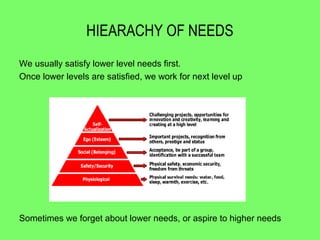
We usually satisfy lower level needs first.
Once lower levels are satisfied, we work for next level up


Sometimes we forget about lower needs, or aspire to higher needs
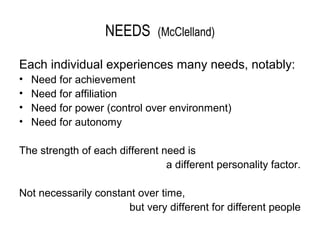
NEEDS       (McClelland)

Each individual experiences many needs, notably:
•   Need for achievement
•   Need for affiliation
•   Need for power (control over environment)
•   Need for autonomy

The strength of each different need is
                                a different personality factor.

Not necessarily constant over time,
                       but very different for different people
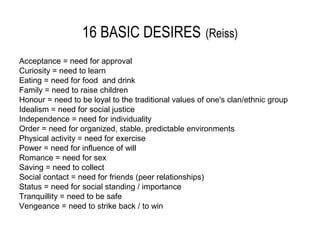
16 BASIC DESIRES (Reiss)
Acceptance = need for approval
Curiosity = need to learn
Eating = need for food and drink
Family = need to raise children
Honour = need to be loyal to the traditional values of one's clan/ethnic group
Idealism = need for social justice
Independence = need for individuality
Order = need for organized, stable, predictable environments
Physical activity = need for exercise
Power = need for influence of will
Romance = need for sex
Saving = need to collect
Social contact = need for friends (peer relationships)
Status = need for social standing / importance
Tranquillity = need to be safe
Vengeance = need to strike back / to win

Motivation for facilitation

  • 1.
  • 2.
    WHAT IS MOTIVATION? Motivationenergises goal-directed behaviour. Why should I be bothered to do this? How can I get my colleague to help me? How can a manager improve employees’ productivity? How can a facilitator focus a group on project goals?
  • 3.
    WORK MOTIVATION • Workmotivation is crucial to productivity • So, lots of money was spent on finding answers • The state of the art is very advanced
  • 4.
    WORK MOTIVATION • Workmotivation is crucial to productivity • So, lots of money was spent on finding answers • The state of the art is very advanced different
  • 5.
    WORK MOTIVATION • Work motivation is crucial to productivity • So, lots of money was spent on finding answers • The state of the art is very advanced different • Lots of credible theories • A tangle of issues • Researchers promote different philosophies Circular arguments + long what-if chains Symptoms of over-investment
  • 6.
    MANY THEORIES Equity Theory(Adams) Expectancy Theory (Vroom) Two-factor Theory (Herzberg) Hierarchy of Needs (Maslow) Job Characteristics Model (Hackman&Oldham) Emotional Labour (Hochschild) Social Cognitive Theory (Bandura)
  • 7.
    JOB CHARACTERISTICS MODEL Hackman+ Oldham did the first significant empirical work Job Characteristics Model: • contains 21 variables • including most ideas from previous theories Job Diagnostic Survey measures these 21 variables • Depends on people answering (moderately) truthfully • All the measures are different, but not independent • The results are replicable • Calibrated over 6,000 people, in a wide range of jobs • Moderate predictive validity
  • 8.
    MOTIVATING IT STAFF 1985Couger + Zawaki surveyed software developers • Most motivation problems were in software maintenance 1996 Warden + Nicholson surveyed UK IT staff • Problems were more widespread • Perhaps due to a less buoyant job market • Quality managers felt ostracised
  • 9.
    MOTIVATION IMPROVEMENT MOTIVATION IMPROVEMENTPROGRAM Diagnosis • Explain improvement process and agree confidentiality • Administer Job Diagnostic Survey and analyse results • Feed back data and listen to reactions • Report on interpretations and recommend actions Implementation: • Some things will have changed as a result of the diagnostic process • To sustain personal / cultural change, monitor progress occasionally • Visionary / sponsor promotes things that need management support • Cost-benefit analysis for things that cost money - include intangibles Verification • Review repeats JDS and compares to assess long-term effects • Problems: no benefit to manager who commissioned original work • a second JDS isn’t an identical process
  • 10.
  • 11.
    CORE JOB DIMENSIONS 1.Skill variety - different activities requiring different skills 2. Task identity - whole identifiable piece of work with visible outcomes 3. Task significance - impact on the lives and work of others 4. Autonomy - freedom, independence and discretion in: scheduling work, designing procedures, specifying criteria Feedback - two measures: 5. Job Feedback – information about performance is provided in the process of carrying out work 6. People Feedback - supervisors, co-workers etc give performance info if their opinion is valued / respected
  • 12.
    EMPLOYEE NEEDS Strength ofthis individual’s desire to obtain growth satisfaction from work • would-like needs - absolute • job - choice needs - relative • social needs - not in published JDS
  • 13.
    JOB MATCH Aggregate Measures •Person’s Growth Needs Strength GNS = Σ(growth needs) • Job’s Motivating Potential Score MPS = Σ(core job dimensions) • Job Match How well does GNS match MPS?
  • 14.
    PSYCHOLOGICAL STATES • Experiencedmeaningfulness How worthwhile or important is the product/service in worker’s view? • Experienced responsibility Do workers believe they are personally responsible for outcomes? • Knowledge of results Can workers regularly discover whether outcomes are satisfactory?
  • 15.
    WORK OUTCOMES Job matchpredicts work outcomes fairly well • Productivity e.g. Lines of code, per person, per day • Quality e.g. Number of revisions after delivery, per 10,000 lines of code • Absenteeism e.g. Average number of days off, per person, per year • Accidents e.g. Accident reports / claims for industrial injury, per year • Staff turnover e.g. Percentage of staff leaving this team, per year
  • 16.
    PERSONAL OUTCOMES • General satisfaction • Growth satisfaction (often easy to fix with training) • Internal motivation • Pay satisfaction • Job security • Social satisfaction • Dealings with others • Supervisory satisfaction (JDS method doesn’t provide anonymity for team leader)
  • 17.
  • 18.
    CONFIDENCE IN RESULTS Oneteam doesn’t give enough data points so we can’t expect statistical significance. We can ask the team members: • We see two clusters. Different jobs / people? • We see an outlier. Is this person/job different? • Why is this job dimension so low? What can we do to fix it? For a larger population, we can look for statistical significance • Are high GNS people given high MPS jobs? • Does seniority/age/gender influence any of the variables? • In what way are different job titles statistically different?
  • 19.
    PLOT JOB-PERSON MATCH HigherGNS people should get higher MPS jobs
  • 20.
  • 21.
    EXAMPLE ONE What situationdoes this plot show?
  • 22.
    EXAMPLE ONE Everyone isnear the ideal line. No problems.
  • 23.
    EXAMPLE TWO What situationdoes this plot show?
  • 24.
    EXAMPLE TWO Two outliersare badly matched Reallocate tasks
  • 25.
    EXAMPLE THREE What situationdoes this plot show?
  • 26.
    EXAMPLE THREE People aresimilar, but tasks are different. Re-allocate tasks to spread MPS more equally.
  • 27.
    EMOTIONAL LABOUR Emotional Work = facial & bodily display of emotion for personal purposes Emotional Labour = facial & bodily display of emotion for wages Facilitation requires a lot of emotional labour
  • 28.
    EMPLOYERS AND EMPLOYEES Outcomesdepend on both employer & employee: Employers require specific behaviours (display rules) An employee creates personal behaviours that express his/her distinct identity
  • 29.
    OUTCOMES Emotional labour canbe simultaneously both liberating and oppressive Oppressive outcomes: emotional dissonance > emotional numbness, self-estrangement, effort to maintain self-esteem, feeling “phoney”, physical illness, guilt, burnout Liberating outcomes: task effectiveness, creativity, self-expression, better interaction with customers, enjoying one’s own performance
  • 30.
    STATEGIES for difficultepisodes Managers’ strategies: Requiring adherence to display rules Verbal and non-verbal approval disapproval Joking and story telling Employees’ strategies: Blaming colleagues, to defuse an argument Blowing off afterwards to colleagues or family Feeling like altruistic service providers Thinking up better strategies for next time
  • 31.
    Strategies for FACILITATORS Facilitationrequires emotional labour • The best facilitators are always considerate They seem to not to experience dissonance Perhaps this is what makes them better They still feel angst about their mistakes • How can we manage our emotional labour? Use limited dissonance to practice behaviours Repeat, to feel these behaviours more genuinely Air genuine concerns to the group, constructively
  • 32.
    SOCIAL COGNITIVE THEORY AlbertBandura • Focussed on individual’s conscious experience • Used introspective research methods Emphasised: • Reciprocal determinism e.g. our environment influences us AND we influence our environment • Self-efficacy = our belief in our ability to achieve • Vicarious learning = we learn from observing others • Self-reflection = we make sense of our experience, explore our thoughts and adapt accordingly
  • 33.
  • 34.
    APPLICATION OF BANDURA’STHEORY Bandura’s theories: Model the reality of motivation at work rather well Used to help individuals change unhelpful habits Always quoted in lists of motivation theories Advice to managers: Increase employees’ self-efficacy Increase employees’ job satisfaction Reduce employees’ role conflict and ambiguity
  • 35.
    RECENT DEVELOPMENTS Recently, researchinto motivation has declined. New working conditions will require new theories For a summary of recent work, see: Academy of Management Review volume 29, number 3 Perhaps the term ‘motivation’ is falling into disuse, replaced by creativity, quality of working life, etc.
  • 36.
    BACK TO EARLIERTHEORIES Early theories tell us what mistakes were being made. What are these mistakes? What outcomes could we expect? Such mistakes are still made. Assume that you are a facilitator, your delegates are being mismanaged as below what can you do to minimise the effect on your workshop?
  • 37.
    OPERANT CONDITIONING Before themodern theories, behavioural psychologists promoted operant conditioning • Positive reinforcement strengthens a behaviour by giving a reward for doing a good job • Negative reinforcement strengthens a behaviour by removing a stressor when a job is well done • Extinction weakens a behaviour by withholding a reward even if the employee has put in extra effort • Punishment weakens a behaviour by punishing people who exhibit that behaviour
  • 38.
    HAWTHORN EFFECT Researching effectsof lighting level on productivity: Turn the lights up > productivity increases then slowly declines Turn the lights down > productivity increases then slowly declines Conclusion: The effects are due to the researchers paying attention to employees’ needs
  • 39.
    EQUITY THEORY People experiencedistress: if they are under-rewarded AND if they are over-rewarded If overpaid on hourly-rate > people produce more widgets If overpaid on piece-rate > people produce better widgets
  • 40.
    EQUITY THEORY People experiencedistress: if they are under-rewarded > anger if they are over-rewarded > guilt If overpaid on hourly-rate > people produce more widgets If overpaid on piece-rate > people produce better widgets If underpaid on hourly-rate > fewer widgets, accidents, sick … If underpaid on piece-rate > worse widgets, accidents, sick …
  • 41.
    EQUITY THEORY People experiencedistress: if they are under-rewarded > anger if they are over-rewarded > guilt If overpaid on hourly-rate > people produce more widgets If overpaid on piece-rate > people produce better widgets If underpaid on hourly-rate > fewer widgets, absenteeism, sickness, ‘accidents’ If underpaid on piece-rate > worse widgets, absenteeism, sickness, ‘accidents’
  • 42.
    EXPECTANCY THEORY Expectancy Theory(Vroom) Motivation = expectancy (perceived probability that effort ⇒ performance ⇒ success) times instrumentality (perceived probability that success ⇒ reward) times valence (strength of preference for outcome) Advises: • Tie rewards to performance • Ensure rewards are deserved and wanted • Provide training to ensure that effort ⇒ productivity
  • 43.
    TWO FACTOR THEORY Hertzbergfound two very different types of effect 1. Hygiene factors – if missing will de-motivate status, job security, salary 2. Motivating factors – give positive satisfaction challenging work, recognition, responsibility So, managers don’t gain from improving hygiene factors above moderately acceptable levels
  • 44.
    HIEARACHY OF NEEDS Weusually satisfy lower level needs first. Once lower levels are satisfied, we work for next level up Sometimes we forget about lower needs, or aspire to higher needs
  • 45.
    NEEDS (McClelland) Each individual experiences many needs, notably: • Need for achievement • Need for affiliation • Need for power (control over environment) • Need for autonomy The strength of each different need is a different personality factor. Not necessarily constant over time, but very different for different people
  • 46.
    16 BASIC DESIRES(Reiss) Acceptance = need for approval Curiosity = need to learn Eating = need for food and drink Family = need to raise children Honour = need to be loyal to the traditional values of one's clan/ethnic group Idealism = need for social justice Independence = need for individuality Order = need for organized, stable, predictable environments Physical activity = need for exercise Power = need for influence of will Romance = need for sex Saving = need to collect Social contact = need for friends (peer relationships) Status = need for social standing / importance Tranquillity = need to be safe Vengeance = need to strike back / to win