STRUCTURED
CONTENT
Bonny Colville-Hyde
UX IRELAND 2016
Hello
I’ve 10 years of experience working in UX
(usability, information architecture, research
and content strategy) for diverse clients
including global ecommerce sites, financial
systems, medical software & charities.
I’m now a Product Manager at Immediate
Media, where I look after BikeRadar.com,
Cyclingnews.com, HistoryExtra.com,
Countryfile.com and a host of other passion-
driven brand sites.
USER EXPERIENCE &
DIGITAL CONTENT
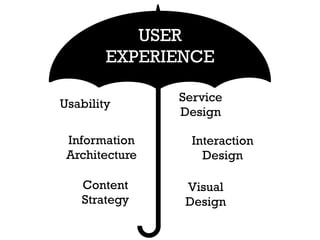
USER
EXPERIENCE
Usability
Information
Architecture
Interaction
Design
Content
Strategy
Visual
Design
Service
Design
The problem with UX & content
•  We forget that content matters most
•  Without good quality, appropriate,
findable content, digital services are not
fit for purpose
•  No matter how much stylish design
patterns you layer on bad content, it
stays bad content
“It’s pointless to design a user
experience without a deep
understanding of the content that will
fuel that experience”
- KRISTINA HALVORSON
Digital Content
•  Digital media (images, videos, audio etc)
•  Words! Written text is the MOST
IMPORTANT part of the internet
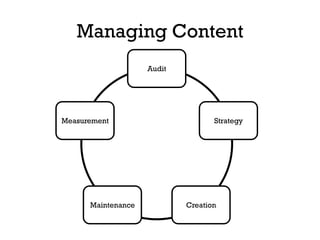
Managing Content
Audit
Strategy
CreationMaintenance
Measurement
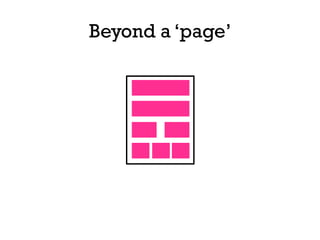
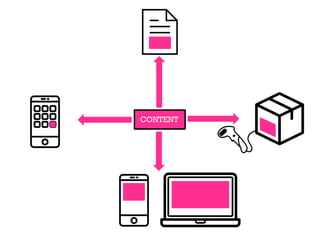
Beyond a ‘page’
CONTENT
STRUCTURED CONTENT:
•  Organisation
•  Labeling
•  Relationships
•  Data
WHAT IS STRUCTURED
CONTENT?
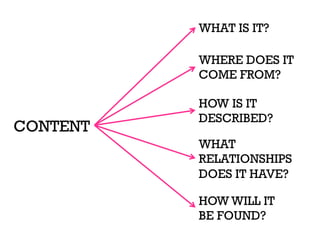
CONTENT
WHAT IS IT?
HOW IS IT
DESCRIBED?
WHAT
RELATIONSHIPS
DOES IT HAVE?
HOW WILL IT
BE FOUND?
WHERE DOES IT
COME FROM?
Structured Content:
•  High level: the site wide structure, how
all the content is structured
•  Grouped: How a group of content types
are structured
•  Specific: How a piece of content is
structured
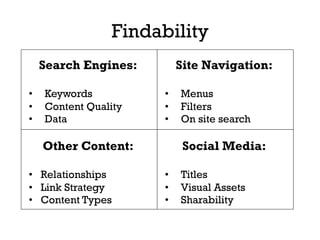
Findability
Search Engines:
•  Keywords
•  Content Quality
•  Data
Site Navigation:
•  Menus
•  Filters
•  On site search
Other Content:
•  Relationships
•  Link Strategy
•  Content Types
Social Media:
•  Titles
•  Visual Assets
•  Sharability
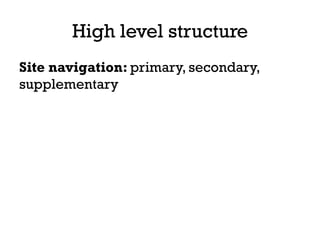
High level structure
Site navigation: primary, secondary,
supplementary
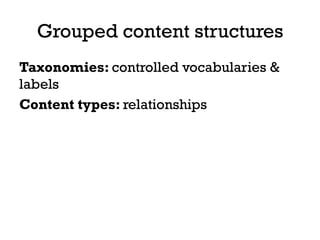
Grouped content structures
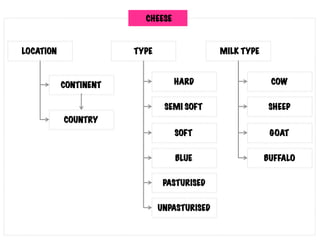
Taxonomies: controlled vocabularies &
labels
Content types: relationships
ACTIVITY #1
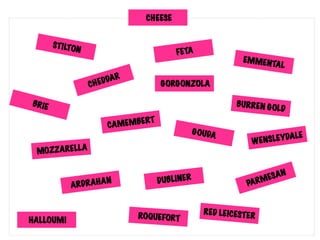
We are going to create a list of CHEESES.
Tell me a name of a cheese…
CHEDDAR
BRIE
MOZZARELLA
CAMEMBERT
RED LEICESTER
PARMESAN
STILTON
ROQUEFORT
WENSLEYDALE
FETA
GORGONZOLA
EMMENTAL
HALLOUMI
GOUDA
ARDRAHAN
BURREN GOLD
DUBLINER
CHEESE
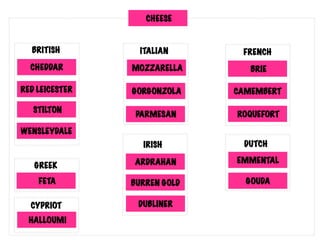
CHEESE
CHEDDAR BRIEMOZZARELLA
CAMEMBERTRED LEICESTER
PARMESAN
STILTON
ROQUEFORT
WENSLEYDALE
FETA
GORGONZOLA
EMMENTAL
HALLOUMI
GOUDA
ARDRAHAN
BURREN GOLD
DUBLINER
BRITISH ITALIAN FRENCH
DUTCH
GREEK
IRISH
CYPRIOT
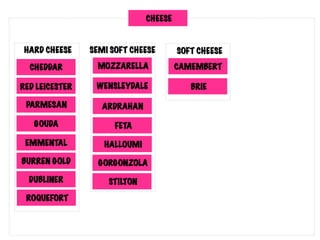
CHEESE
CHEDDAR
BRIE
MOZZARELLA CAMEMBERT
RED LEICESTER
PARMESAN
STILTON
ROQUEFORT
WENSLEYDALE
FETA
GORGONZOLA
EMMENTAL HALLOUMI
GOUDA
ARDRAHAN
BURREN GOLD
DUBLINER
HARD CHEESE SOFT CHEESESEMI SOFT CHEESE
CHEESE
CHEDDAR BRIE
MOZZARELLA
CAMEMBERTRED LEICESTER
PARMESAN
STILTON
ROQUEFORT
WENSLEYDALE
FETA
GORGONZOLA
EMMENTAL
HALLOUMI
GOUDA
ARDRAHAN
BURREN GOLD
DUBLINER
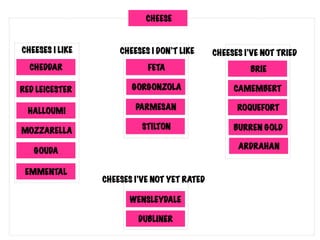
CHEESES I LIKE CHEESES I DON’T LIKE CHEESES I’VE NOT TRIED
CHEESES I’VE NOT YET RATED
TAXONOMIES
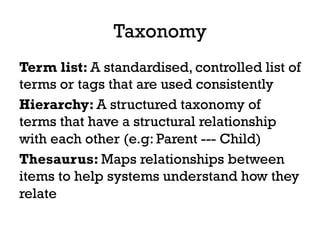
Taxonomy
Term list: A standardised, controlled list of
terms or tags that are used consistently
Hierarchy: A structured taxonomy of
terms that have a structural relationship
with each other (e.g: Parent --- Child)
Thesaurus: Maps relationships between
items to help systems understand how they
relate
CYAN
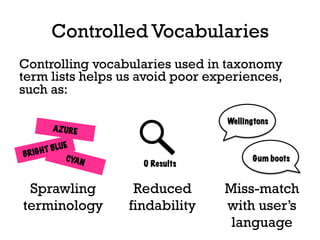
Controlled Vocabularies
Controlling vocabularies used in taxonomy
term lists helps us avoid poor experiences,
such as:
Sprawling
terminology
Reduced
findability
Miss-match
with user’s
language
BRIGHT BLUE
0 Results
Wellingtons
Gum boots
AZURE
CHEESE
LOCATION
CONTINENT
COUNTRY
TYPE
HARD
SEMI SOFT
SOFT
BLUE
MILK TYPE
COW
SHEEP
GOAT
BUFFALO
PASTURISED
UNPASTURISED
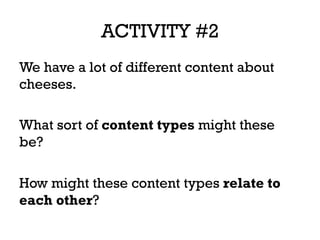
ACTIVITY #2
We have a lot of different content about
cheeses.
What sort of content types might these
be?
How might these content types relate to
each other?
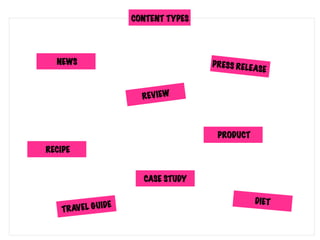
REVIEW
NEWS PRESS RELEASE
PRODUCT
RECIPE
CASE STUDY
TRAVEL GUIDE DIET
CONTENT TYPES
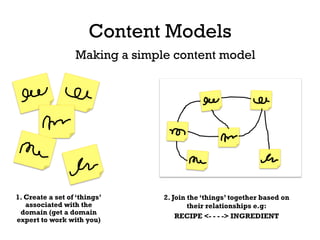
Content Models
1. Create a set of ‘things’
associated with the
domain (get a domain
expert to work with you)
2. Join the ‘things’ together based on
their relationships e.g:
RECIPE <- - - -> INGREDIENT
Making a simple content model
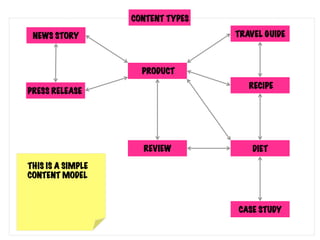
REVIEW
NEWS STORY
PRESS RELEASE
PRODUCT
RECIPE
CASE STUDY
TRAVEL GUIDE
DIET
CONTENT TYPES
THIS IS A SIMPLE
CONTENT MODEL
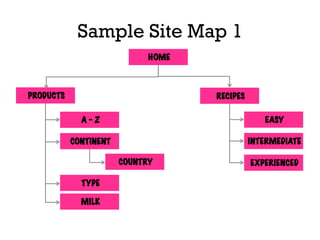
Sample Site Map 1
PRODUCTS RECIPES
A – Z
CONTINENT
COUNTRY
TYPE
MILK
EASY
INTERMEDIATE
EXPERIENCED
HOME
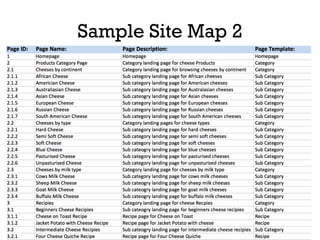
Sample Site Map 2
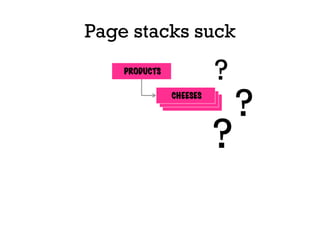
Page stacks suck
PRODUCTS
CHEESES
?
?
?
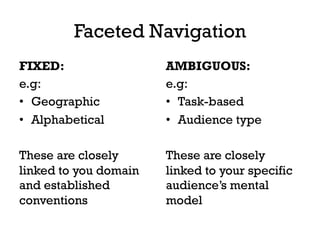
Faceted Navigation
FIXED:
e.g:
•  Geographic
•  Alphabetical
These are closely
linked to you domain
and established
conventions
AMBIGUOUS:
e.g:
•  Task-based
•  Audience type
These are closely
linked to your specific
audience’s mental
model
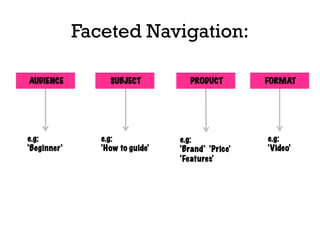
Faceted Navigation:
AUDIENCE SUBJECT PRODUCT FORMAT
e.g:
‘Beginner’
e.g:
‘How to guide’
e.g:
‘Brand’ ‘Price’
‘Features’
e.g:
‘Video’
In Summary
You need to plan:
How to group content together
How to label those groups
How to navigate those groups
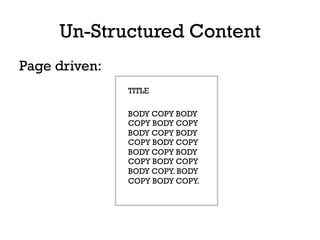
Un-Structured Content
Page driven:
TITLE
BODY COPY BODY
COPY BODY COPY
BODY COPY BODY
COPY BODY COPY
BODY COPY BODY
COPY BODY COPY
BODY COPY. BODY
COPY BODY COPY.
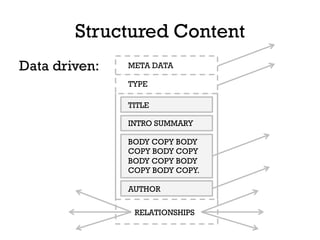
Structured Content
Data driven:
TITLE
META DATA
RELATIONSHIPS
TYPE
INTRO SUMMARY
BODY COPY BODY
COPY BODY COPY
BODY COPY BODY
COPY BODY COPY.
AUTHOR
Specific content structure
Data: Information about content
Specific template requirements:
purpose and requirements
WORKING WITH REAL
CONTENT
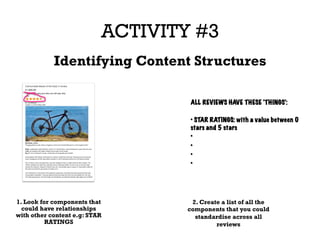
ACTIVITY #3
Identifying Content Structures
1. Look for components that
could have relationships
with other content e.g: STAR
RATINGS
2. Create a list of all the
components that you could
standardise across all
reviews
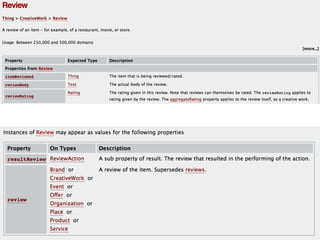
ALL REVIEWS HAVE THESE ‘THINGS’:
• STAR RATINGS: with a value between 0
stars and 5 stars
•
•
•
•
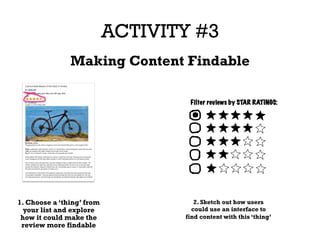
ACTIVITY #3
Making Content Findable
1. Choose a ‘thing’ from
your list and explore
how it could make the
review more findable
2. Sketch out how users
could use an interface to
find content with this ‘thing’
Filter reviews by STAR RATINGS:
HELPING MACHINES
UNDERSTAND CONTENT
Metadata & Microdata
Metadata and Microdata help search
engines, APIs, feeds and content
management systems make sense of
content and improve its findability
They use controlled vocabularies to ensure
they are consistent.
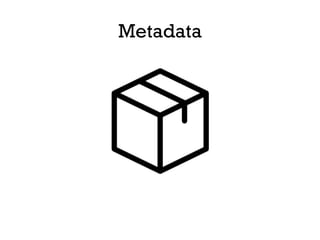
METADATA
Metadata
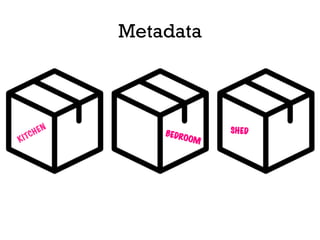
Metadata
BEDROOM
SHED
Metadata
•  Data about data
•  Essential for findability: it makes
content understandable to search
engines and content management
systems
•  Describes relationships between content
through taxonomies and content types
MICRODATA
Microdata
•  Stores data about content in context:
specific pieces of information are given a
structure so machines can take more
meaning from them
•  Different standardised schemas exist e.g:
RDF, Schema.org, Dublin Core etc
Schema.org
Enables you to tag specific things within
HTML to give more context.
“Itemscope”: Broadly identifies the theme
of the thing
“Itemprop”: Provides the detail about the
thing
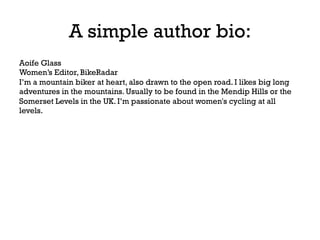
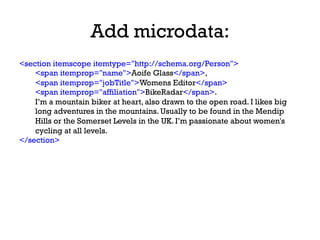
A simple author bio:
Aoife Glass
Women’s Editor, BikeRadar
I’m a mountain biker at heart, also drawn to the open road. I likes big long
adventures in the mountains. Usually to be found in the Mendip Hills or the
Somerset Levels in the UK. I’m passionate about women's cycling at all
levels.
<section itemscope itemtype="http://schema.org/Person">
<span itemprop="name">Aoife Glass</span>,
<span itemprop="jobTitle">Womens Editor</span>
<span itemprop="affiliation">BikeRadar</span>.
I’m a mountain biker at heart, also drawn to the open road. I likes big
long adventures in the mountains. Usually to be found in the Mendip
Hills or the Somerset Levels in the UK. I’m passionate about women's
cycling at all levels.
</section>
Add microdata:
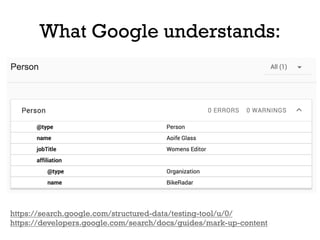
What Google understands:
https://search.google.com/structured-data/testing-tool/u/0/
https://developers.google.com/search/docs/guides/mark-up-content
To Close:
Structured content makes content more
findable which is essential to any user
experience.
It blends multiple disciplines including IA,
content strategy, usability and SEO is
something UX PR actioners should
absolutely care about ;-)
Useful Tools
Trim: Content audit tool coming soon
Gettrim.co | @Trimvincible
Gather Content: Fabulous content workflow
tool
Gathercontent.com | @GatherContent
Hemmingway App: Lovely tool to test your
content readability
Hemmingwayapp.com
Google: Structured Data test tool
https://search.google.com/structured-data/
testing-tool/u/0/
Glossary
Content Modelling: The process of mapping the relationships between
pieces of content or information. A content model can include high level
relationships within a domain and more detailed relationships between
pieces of content.
Structuring Content: The process of taking content and breaking it into
parts to make it more findable and reusable for humans and machines.
Data Modelling: The process of modeling a database inline with the type of
queries it will need to handle.This is done by a developer.
Service Oriented Architecture: A development architecture that separates
data, processes/tasks and interfaces to make it more flexible. A service or
API (Application Programing Interface) acts as a middleman that processes
requests from the editorial interface and user interface with the information
stored in databases.
Content Management System: A system that enables a group of people to
manage content in a fairly straightforward way. Each CMS has its own way of
dealing with content types and favours a specific one, e.g:‘Posts’ in
WordPress. Some CMS platforms are much more flexible than others, for
instance Sitecore will enable you to build anything but it comes with the
challenge that it has to be built, whereas WordPress is restrictive but is ready
to go, out-of-the-box.
Glossary
Metadata: Data about data. Metadata describes information about the
content, such as structural information like author, publishing date, ID, or
taxonomy items in a format either defined by the CMS, or a universal
schema, or a mix of both. Metadata is used to find content based on specific
queries, so tools like search rely heavily on it.
Glossary
Taxonomy: In the context of creating and managing digital content a
taxonomy is a controlled vocabulary that is used consistently to describe
pieces of content. A taxonomy can have a hierarchical element to it, to
describe the relationship between different taxonomy items.
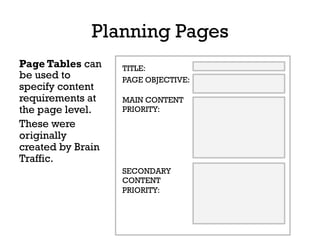
Planning Pages
Page Tables can
be used to
specify content
requirements at
the page level.
These were
originally
created by Brain
Traffic.
TITLE:
MAIN CONTENT
PRIORITY:
SECONDARY
CONTENT
PRIORITY:
PAGE OBJECTIVE:

Structured Content UX Ireland