



Agile Team Facilitation 
Luxoft Agile Practice 
December 14, 2014 
Svetlana Mukhina
2 
Who Is Facilitator ? 
 A facilitator is someone who helps a group of 
people understand their common objectives and 
assists them to achieve it without taking a 
particular position in the discussion. 
December 14, 2014
3 
Gathering 
Information 
December 14, 2014
4 
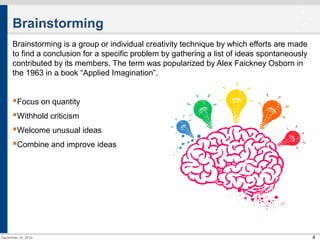
Brainstorming 
Brainstorming is a group or individual creativity technique by which efforts are made 
to find a conclusion for a specific problem by gathering a list of ideas spontaneously 
contributed by its members. The term was popularized by Alex Faickney Osborn in 
the 1963 in a book “Applied Imagination”. 
Focus on quantity 
Withhold criticism 
Welcome unusual ideas 
Combine and improve ideas 
December 14, 2014
5 
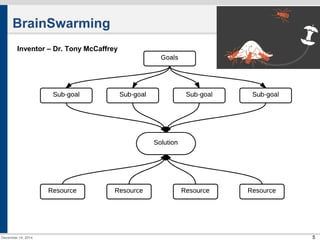
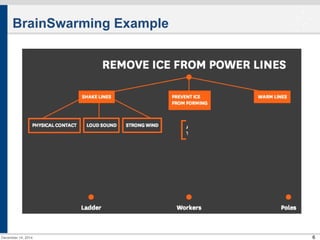
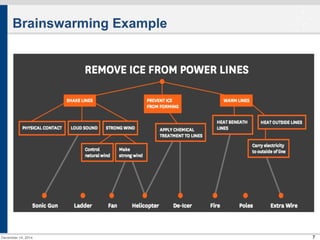
BrainSwarming 
Inventor – Dr. Tony McCaffrey 
December 14, 2014
6 
BrainSwarming Example 
December 14, 2014
7 
Brainswarming Example 
December 14, 2014
8 
Mindwriting 
The technique involves continuous writing, usually for a predetermined period of 
time. The person writes without regard to spelling, grammar, etc., and makes no 
corrections. The person uses the technique to collect initial thoughts and ideas on a 
topic. 
The rules 
Give yourself a time limit; 
Keep your hand moving until the time is up. 
Pay no attention to grammar, spelling, punctuation, neatness, or style. 
If you get off the topic or run out of ideas, keep writing anyway. 
If you feel bored or uncomfortable as you're writing, ask yourself what's bothering 
you and write about that. 
When the time is up, look over what you've written, analyze the ideas 
December 14, 2014
9 
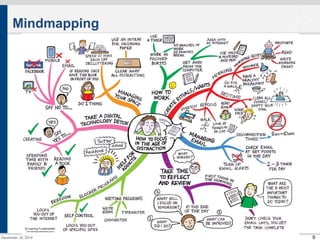
Mindmapping 
December 14, 2014
10 
Powerful Questions 
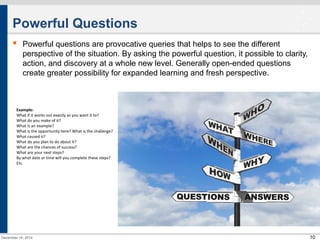
 Powerful questions are provocative queries that helps to see the different 
perspective of the situation. By asking the powerful question, it possible to clarity, 
action, and discovery at a whole new level. Generally open-ended questions 
create greater possibility for expanded learning and fresh perspective. 
Example: 
What if it works out exactly as you want it to? 
What do you make of it? 
What is an example? 
What is the opportunity here? What is the challenge? 
What caused it? 
What do you plan to do about it? 
What are the chances of success? 
What are your next steps? 
By what date or time will you complete these steps? 
Etc. 
December 14, 2014
11 
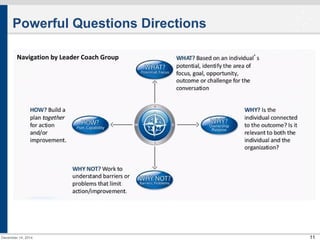
Powerful Questions Directions 
Navigation by Leader Coach Group 
December 14, 2014
12 
Interview 
 Location 
 The interviewers 
 Time-scales 
 Preparation 
 Introduction 
 Q/A session 
 Closing the interview 
 Review 
December 14, 2014
13 
Survey 
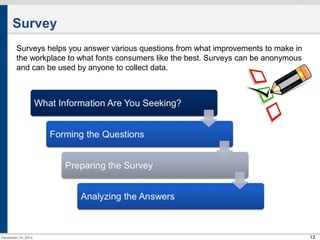
Surveys helps you answer various questions from what improvements to make in 
the workplace to what fonts consumers like the best. Surveys can be anonymous 
and can be used by anyone to collect data. 
December 14, 2014
14 
Exploring 
Information 
December 14, 2014
15 
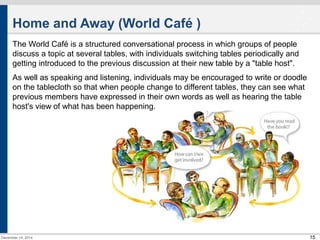
Home and Away (World Café ) 
The World Café is a structured conversational process in which groups of people 
discuss a topic at several tables, with individuals switching tables periodically and 
getting introduced to the previous discussion at their new table by a "table host". 
As well as speaking and listening, individuals may be encouraged to write or doodle 
on the tablecloth so that when people change to different tables, they can see what 
previous members have expressed in their own words as well as hearing the table 
host's view of what has been happening. 
December 14, 2014
16 
World Café Structure 
December 14, 2014
17 
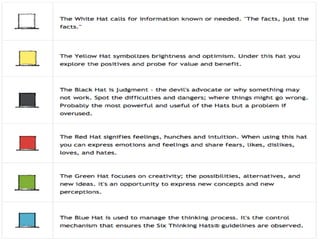
Six Thinking Hats 
Six Thinking Hats is a book by Edward de Bono which describes a tool for group 
discussion and individual thinking involving six colored hats. 
December 14, 2014
December 14, 2014 18
19 
Groupping 
December 14, 2014
20 
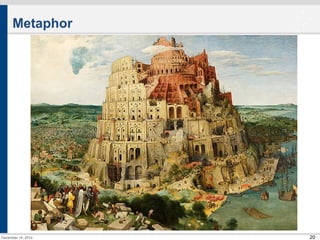
Metaphor 
December 14, 2014
21 
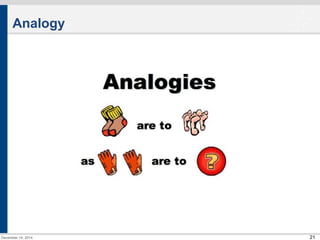
Analogy 
December 14, 2014
22 
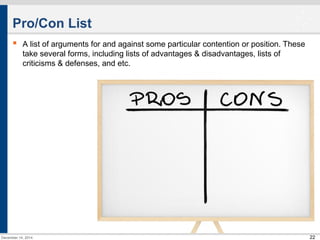
Pro/Con List 
 A list of arguments for and against some particular contention or position. These 
take several forms, including lists of advantages & disadvantages, lists of 
criticisms & defenses, and etc. 
December 14, 2014
23 
Evaluating 
Information 
December 14, 2014
24 
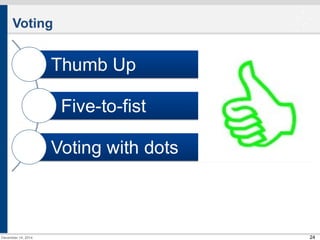
Voting 
December 14, 2014
25 
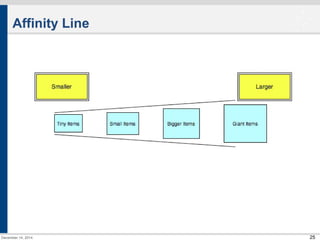
Affinity Line 
December 14, 2014
26 
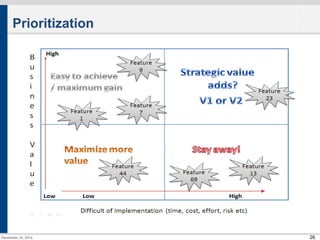
Prioritization 
December 14, 2014
27 
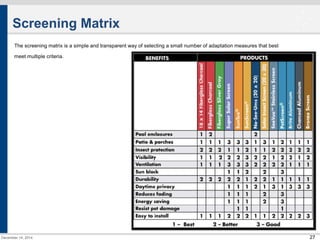
Screening Matrix 
The screening matrix is a simple and transparent way of selecting a small number of adaptation measures that best 
meet multiple criteria. 
December 14, 2014
28 
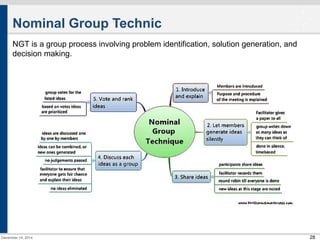
Nominal Group Technic 
NGT is a group process involving problem identification, solution generation, and 
decision making. 
December 14, 2014
December 14, 2014

Facilitation Workshop

  • 1.
    Agile Team Facilitation Luxoft Agile Practice December 14, 2014 Svetlana Mukhina
  • 2.
    2 Who IsFacilitator ?  A facilitator is someone who helps a group of people understand their common objectives and assists them to achieve it without taking a particular position in the discussion. December 14, 2014
  • 3.
    3 Gathering Information December 14, 2014
  • 4.
    4 Brainstorming Brainstormingis a group or individual creativity technique by which efforts are made to find a conclusion for a specific problem by gathering a list of ideas spontaneously contributed by its members. The term was popularized by Alex Faickney Osborn in the 1963 in a book “Applied Imagination”. Focus on quantity Withhold criticism Welcome unusual ideas Combine and improve ideas December 14, 2014
  • 5.
    5 BrainSwarming Inventor– Dr. Tony McCaffrey December 14, 2014
  • 6.
    6 BrainSwarming Example December 14, 2014
  • 7.
    7 Brainswarming Example December 14, 2014
  • 8.
    8 Mindwriting Thetechnique involves continuous writing, usually for a predetermined period of time. The person writes without regard to spelling, grammar, etc., and makes no corrections. The person uses the technique to collect initial thoughts and ideas on a topic. The rules Give yourself a time limit; Keep your hand moving until the time is up. Pay no attention to grammar, spelling, punctuation, neatness, or style. If you get off the topic or run out of ideas, keep writing anyway. If you feel bored or uncomfortable as you're writing, ask yourself what's bothering you and write about that. When the time is up, look over what you've written, analyze the ideas December 14, 2014
  • 9.
  • 10.
    10 Powerful Questions  Powerful questions are provocative queries that helps to see the different perspective of the situation. By asking the powerful question, it possible to clarity, action, and discovery at a whole new level. Generally open-ended questions create greater possibility for expanded learning and fresh perspective. Example: What if it works out exactly as you want it to? What do you make of it? What is an example? What is the opportunity here? What is the challenge? What caused it? What do you plan to do about it? What are the chances of success? What are your next steps? By what date or time will you complete these steps? Etc. December 14, 2014
  • 11.
    11 Powerful QuestionsDirections Navigation by Leader Coach Group December 14, 2014
  • 12.
    12 Interview Location  The interviewers  Time-scales  Preparation  Introduction  Q/A session  Closing the interview  Review December 14, 2014
  • 13.
    13 Survey Surveyshelps you answer various questions from what improvements to make in the workplace to what fonts consumers like the best. Surveys can be anonymous and can be used by anyone to collect data. December 14, 2014
  • 14.
    14 Exploring Information December 14, 2014
  • 15.
    15 Home andAway (World Café ) The World Café is a structured conversational process in which groups of people discuss a topic at several tables, with individuals switching tables periodically and getting introduced to the previous discussion at their new table by a "table host". As well as speaking and listening, individuals may be encouraged to write or doodle on the tablecloth so that when people change to different tables, they can see what previous members have expressed in their own words as well as hearing the table host's view of what has been happening. December 14, 2014
  • 16.
    16 World CaféStructure December 14, 2014
  • 17.
    17 Six ThinkingHats Six Thinking Hats is a book by Edward de Bono which describes a tool for group discussion and individual thinking involving six colored hats. December 14, 2014
  • 18.
  • 19.
  • 20.
  • 21.
  • 22.
    22 Pro/Con List  A list of arguments for and against some particular contention or position. These take several forms, including lists of advantages & disadvantages, lists of criticisms & defenses, and etc. December 14, 2014
  • 23.
    23 Evaluating Information December 14, 2014
  • 24.
  • 25.
    25 Affinity Line December 14, 2014
  • 26.
  • 27.
    27 Screening Matrix The screening matrix is a simple and transparent way of selecting a small number of adaptation measures that best meet multiple criteria. December 14, 2014
  • 28.
    28 Nominal GroupTechnic NGT is a group process involving problem identification, solution generation, and decision making. December 14, 2014
  • 29.

Editor's Notes

  • #13 Gathering info on the project Gathering info from the client and team members
  • #15 7) Exploring information technics 10m: home and away, five hats, grouping, information, group discussion, associations, metaphors, group information, discuss information with hats 
  • #16 1) Setting: Create a "special" environment, most often modelled after a café, i.e. small round tables covered with a checkered tablecloth, butcher block paper, colored pens, a vase of flowers, and optional "talking stick" item. There should be four chairs at each table. 2) Welcome and Introduction: The host begins with a warm welcome and an introduction to the World Café process, setting the context, sharing the Cafe Etiquette, and putting participants at ease. 3) Small Group Rounds: The process begins with the first of three or more twenty minute rounds of conversation for the small group seated around a table. At the end of the twenty minutes, each member of the group moves to a different new table. They may or may not choose to leave one person as the "table host" for the next round, who welcomes the next group and briefly fills them in on what happened in the previous round. 4) Questions: each round is prefaced with a question designed for the specific context and desired purpose of the session. The same questions can be used for more than one round, or they can be built upon each other to focus the conversation or guide its direction. 5) Harvest: After the small groups (and/or in between rounds, as desired) individuals are invited to share insights or other results from their conversations with the rest of the large group. These results are reflected visually in a variety of ways, most often using graphic recorders in the front of the room.