S U S A N S C H O E N I A N
S H E E P & G O A T S P E C I A L I S T
U N I V E R S I T Y O F M A R Y L A N D E X T E N S I O N
S S C H O E N @ U M D . E D U
W W W . S H E E P A N D G O A T . C O M
A Beginner’s Guide to EBVs
What is an EBV?
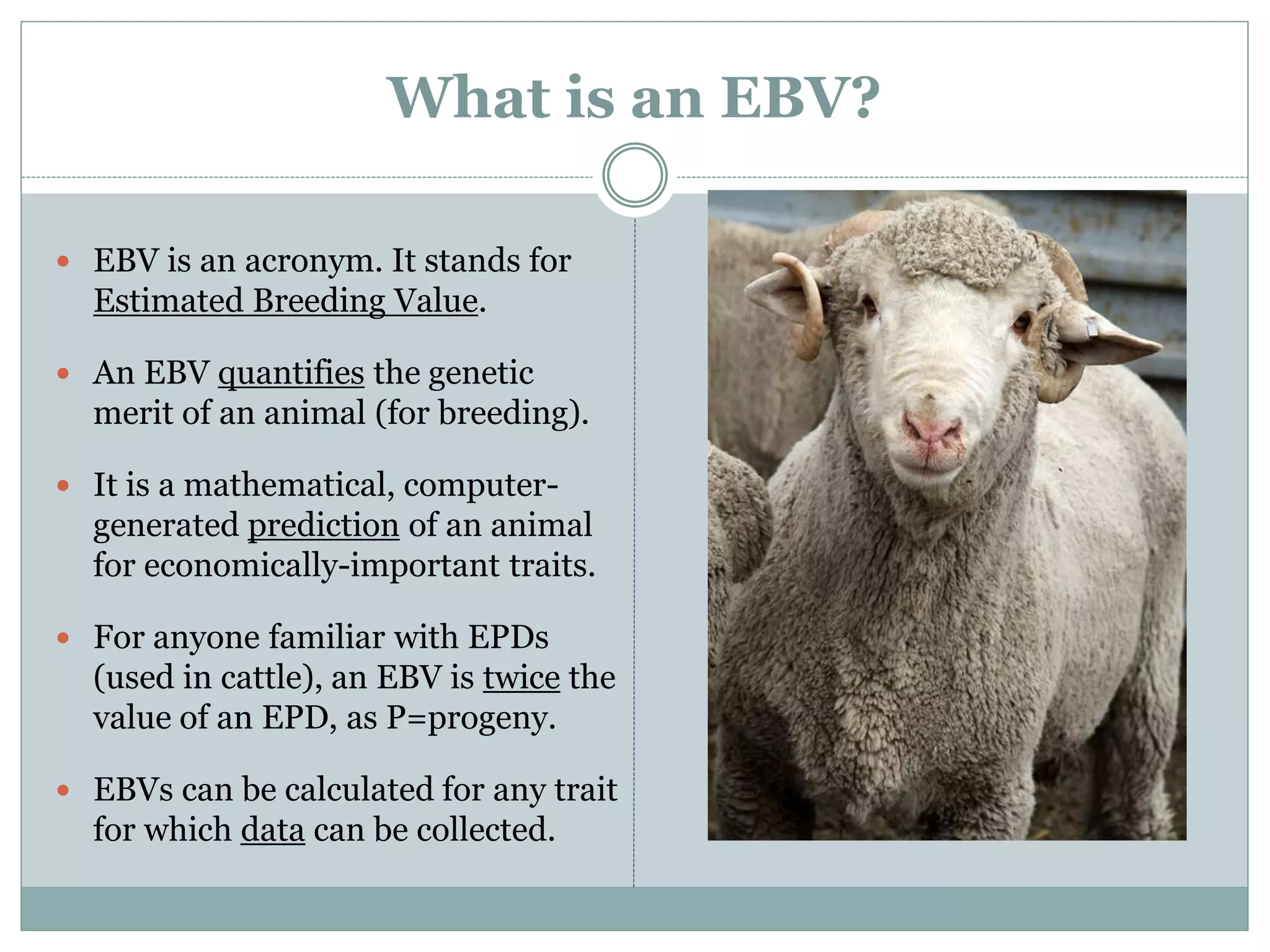
 EBV is an acronym. It stands for
Estimated Breeding Value.
 An EBV quantifies the genetic
merit of an animal (for breeding).
 It is a mathematical, computer-
generated prediction of an animal
for economically-important traits.
 For anyone familiar with EPDs
(used in cattle), an EBV is twice the
value of an EPD, as P=progeny.
 EBVs can be calculated for any trait
for which data can be collected.
Another acronym. What is NSIP?
 NSIP stands for National Sheep
Improvement Program.
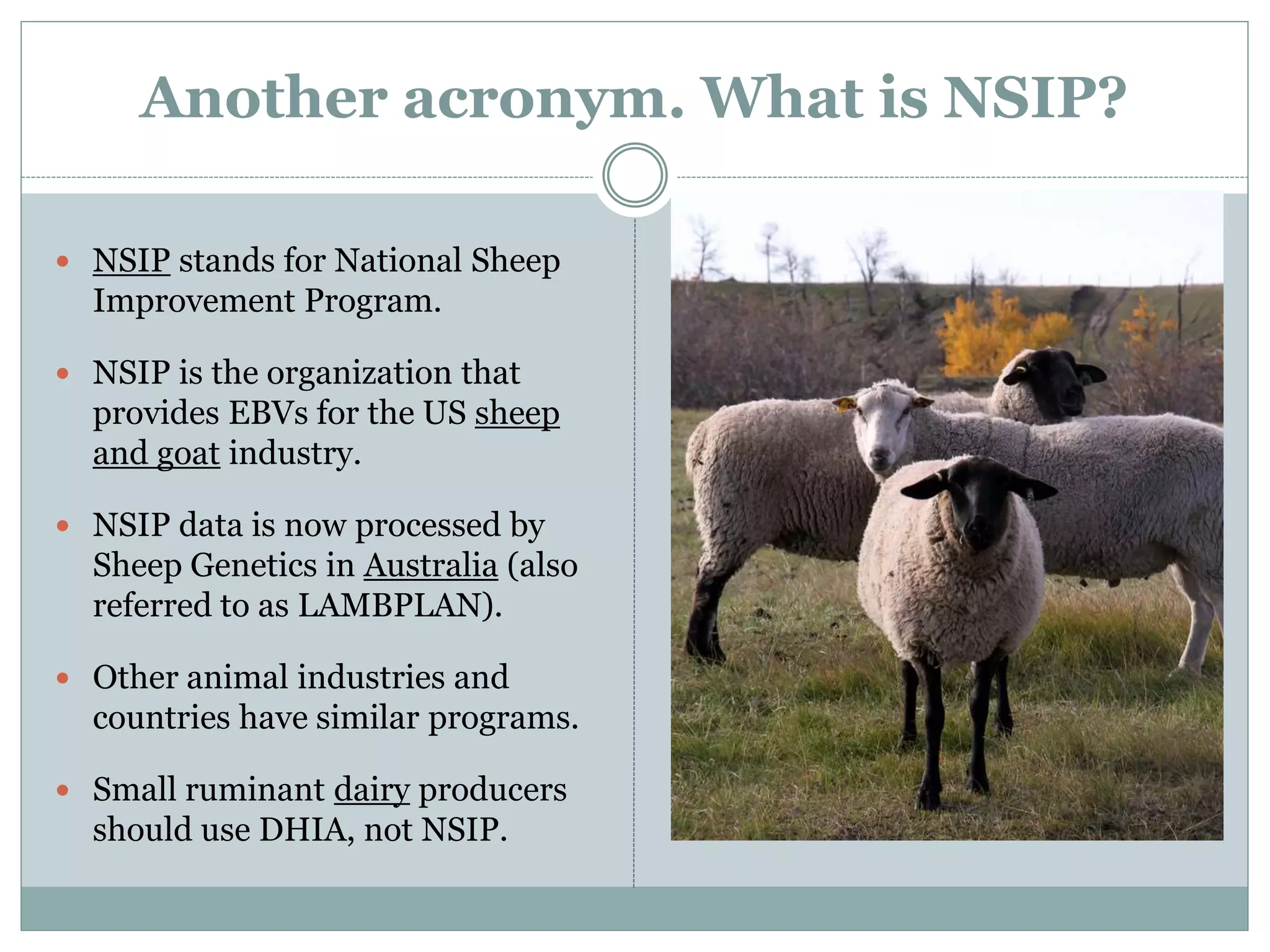
 NSIP is the organization that
provides EBVs for the US sheep
and goat industry.
 NSIP data is now processed by
Sheep Genetics in Australia (also
referred to as LAMBPLAN).
 Other animal industries and
countries have similar programs.
 Small ruminant dairy producers
should use DHIA, not NSIP.
What traits does NSIP measure?
EBVs currently available for US sheep and goats
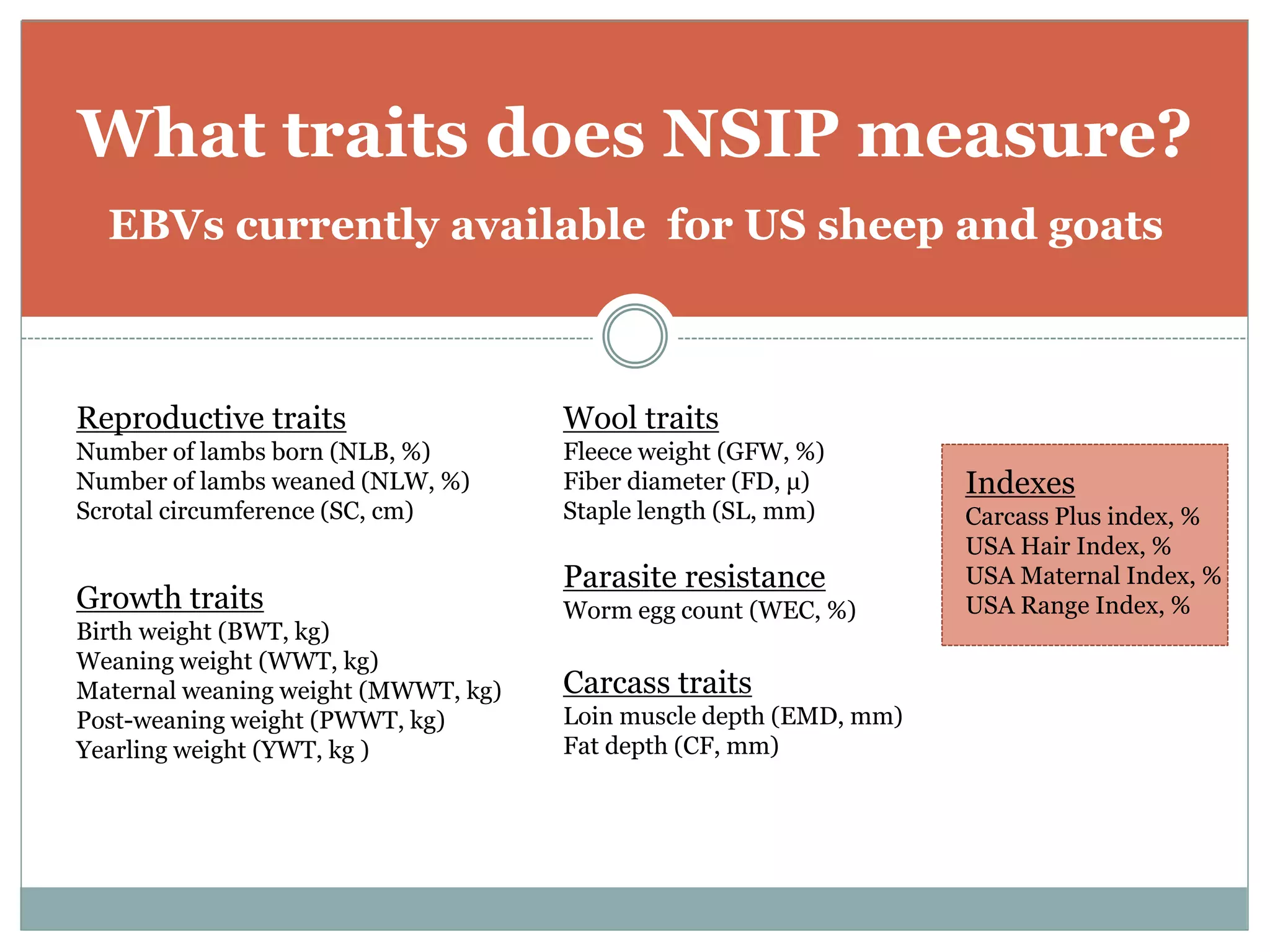
Reproductive traits
Number of lambs born (NLB, %)
Number of lambs weaned (NLW, %)
Scrotal circumference (SC, cm)
Growth traits
Birth weight (BWT, kg)
Weaning weight (WWT, kg)
Maternal weaning weight (MWWT, kg)
Post-weaning weight (PWWT, kg)
Yearling weight (YWT, kg )
Carcass traits
Loin muscle depth (EMD, mm)
Fat depth (CF, mm)
Wool traits
Fleece weight (GFW, %)
Fiber diameter (FD, μ)
Staple length (SL, mm)
Parasite resistance
Worm egg count (WEC, %)
Indexes
Carcass Plus index, %
USA Hair Index, %
USA Maternal Index, %
USA Range Index, %
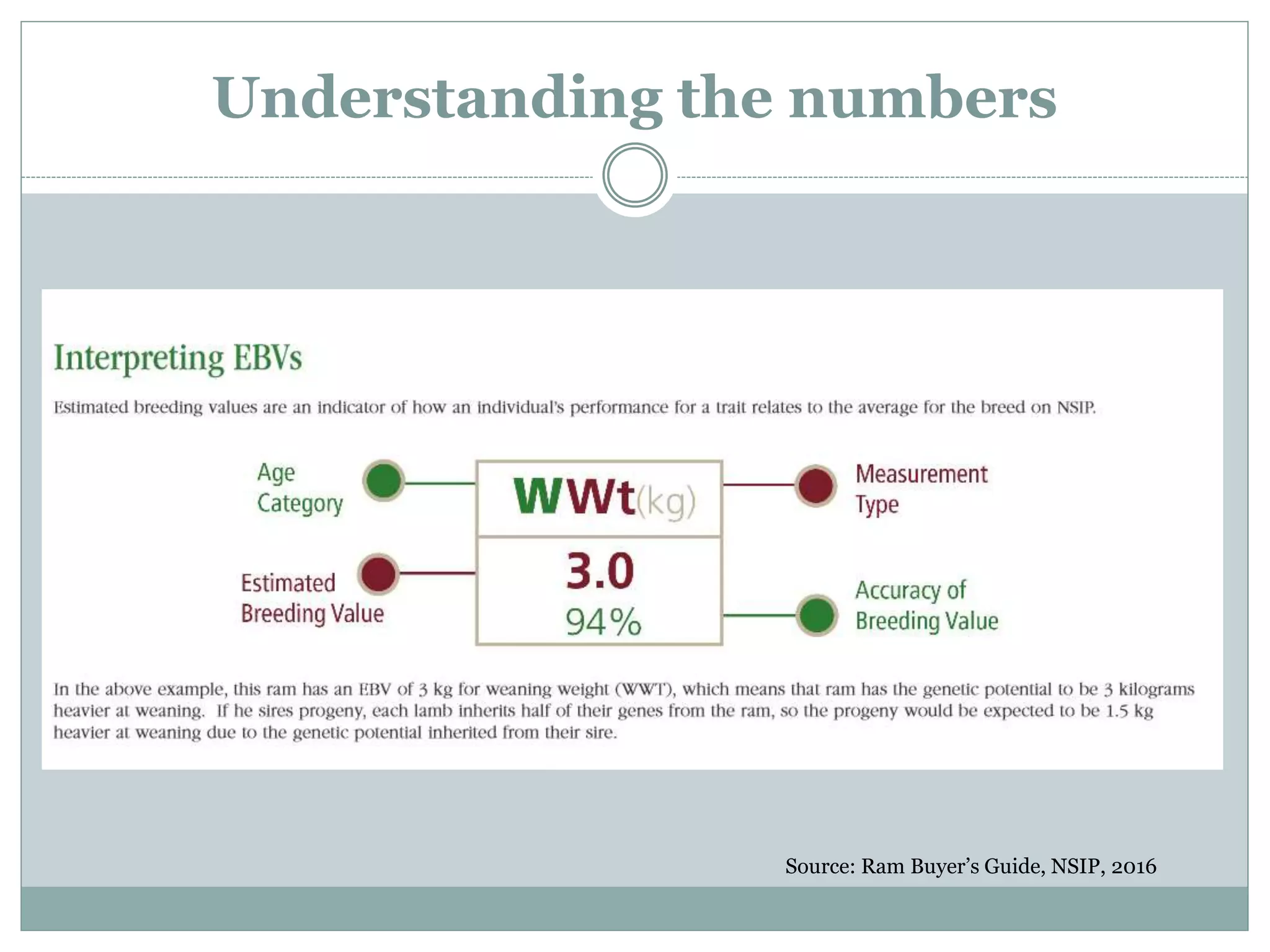
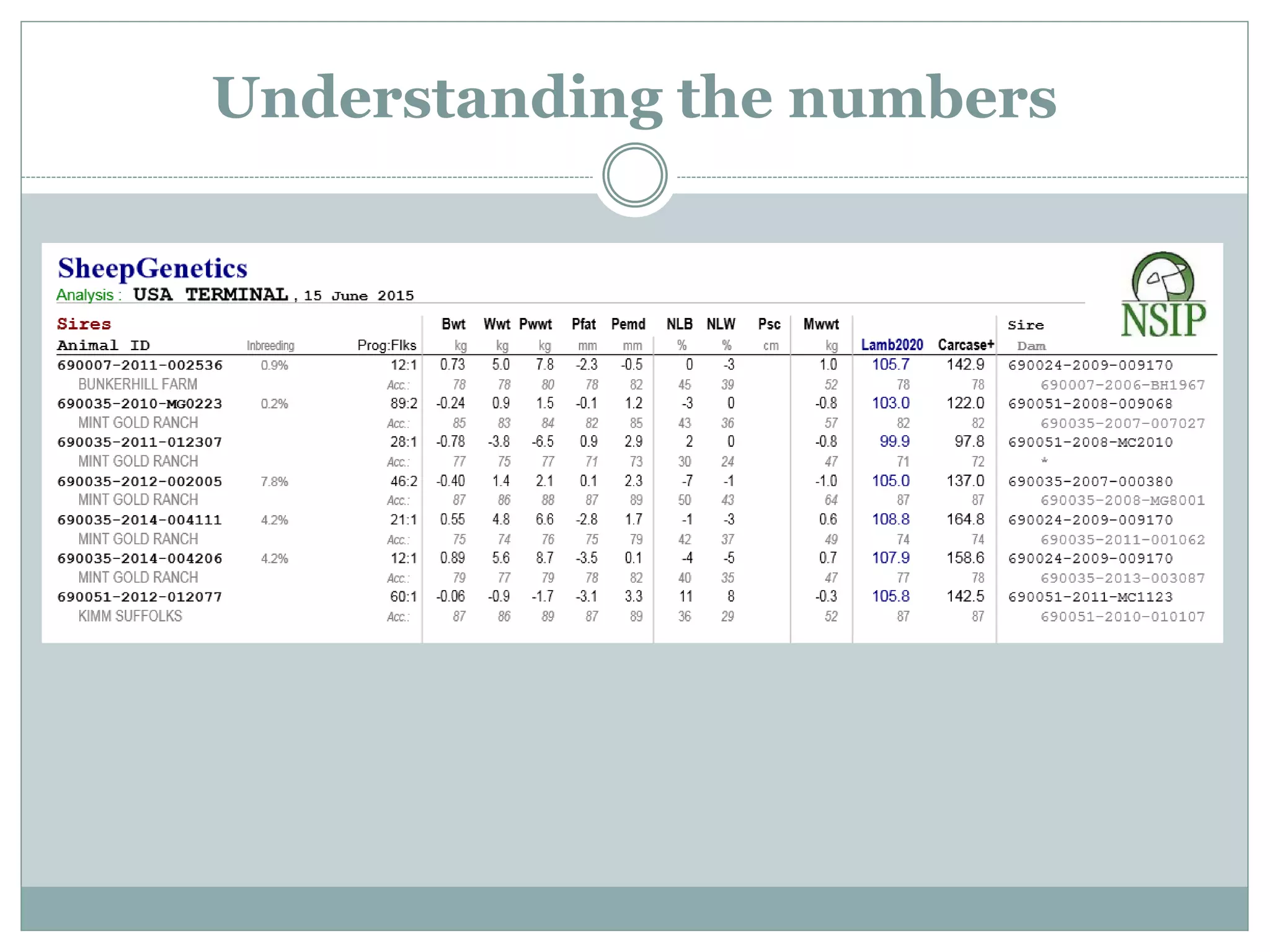
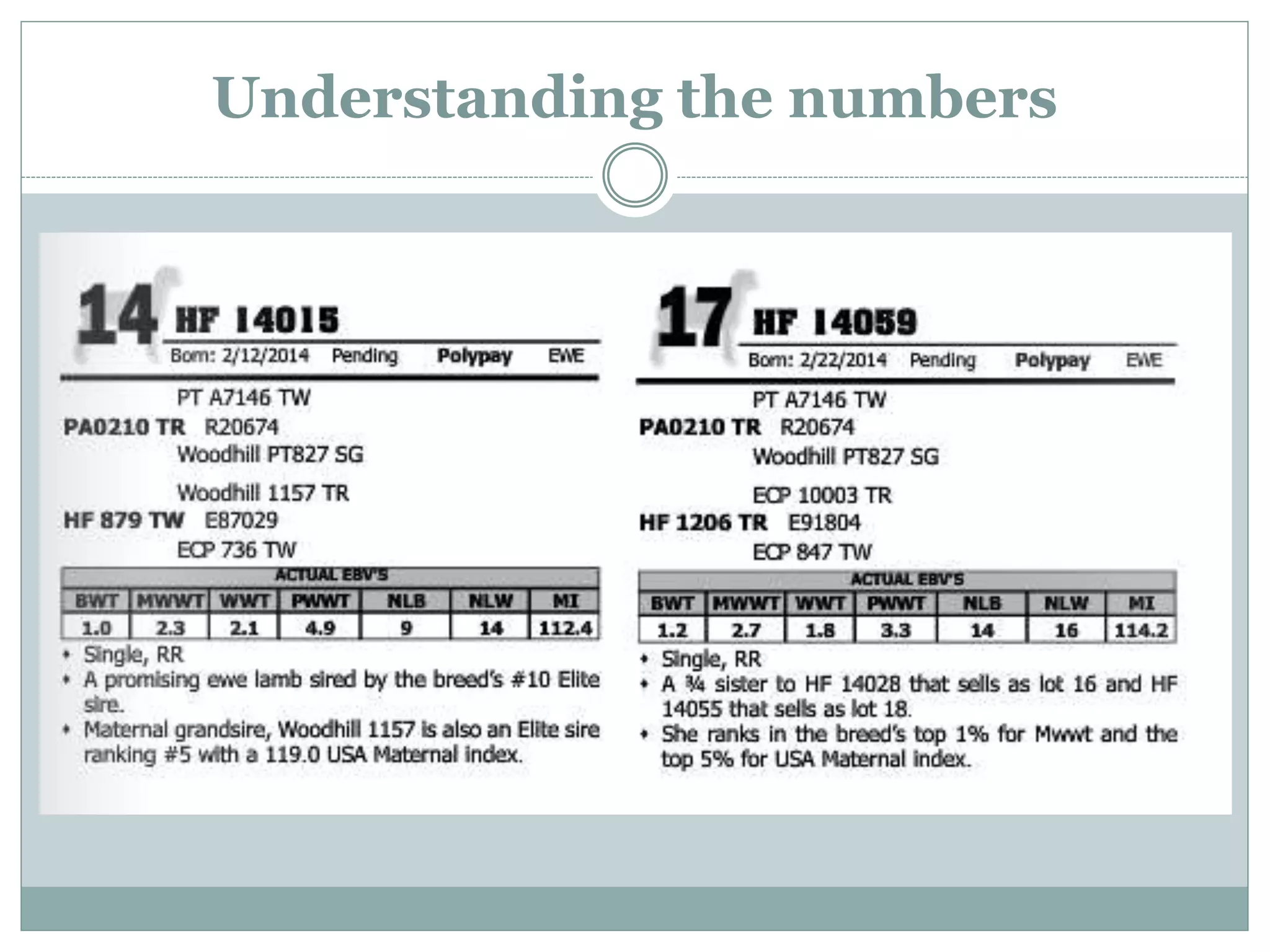
Understanding the numbers
Source: Ram Buyer’s Guide, NSIP, 2016
Understanding the numbers
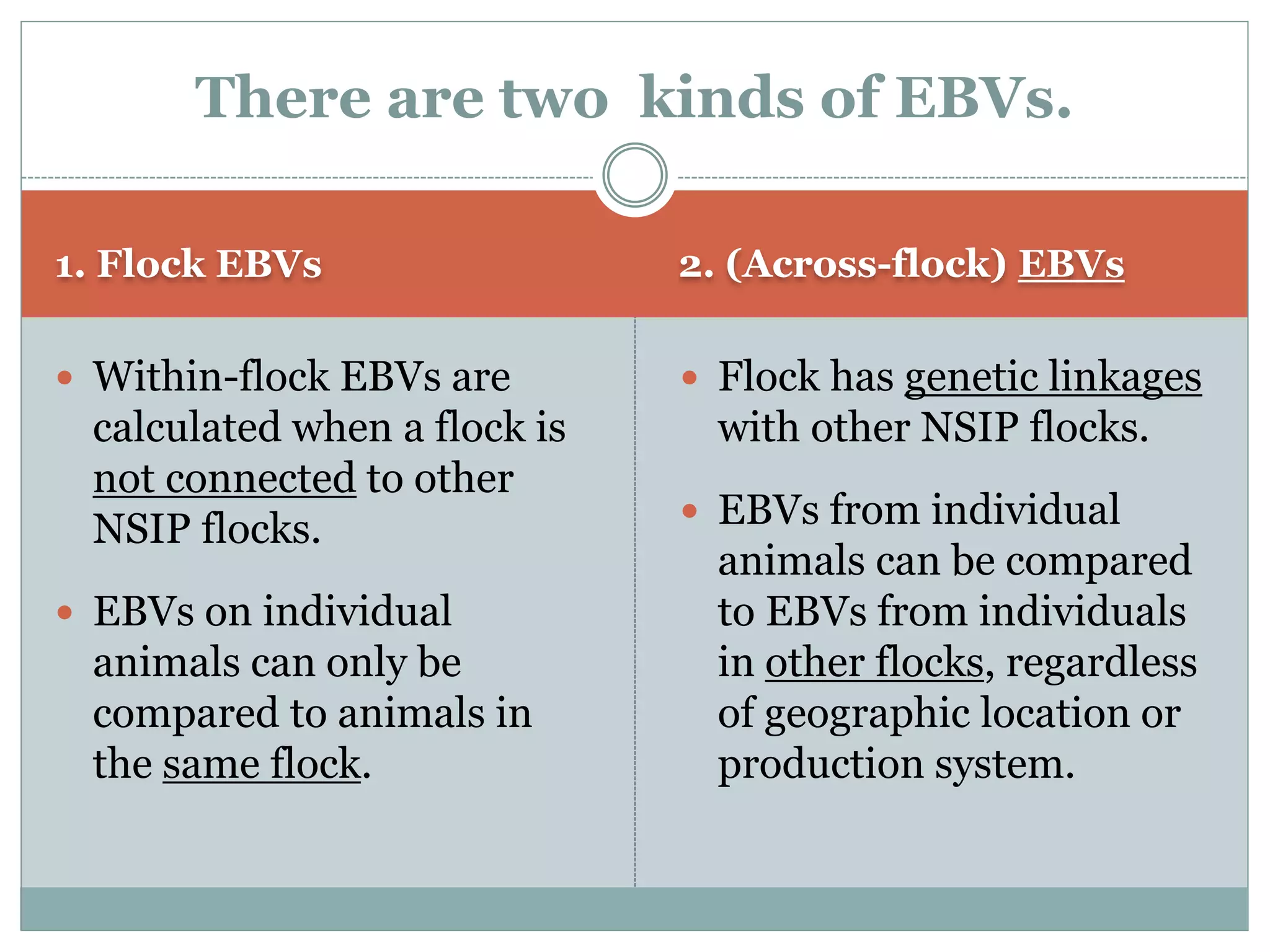
1. Flock EBVs 2. (Across-flock) EBVs
 Within-flock EBVs are
calculated when a flock is
not connected to other
NSIP flocks.
 EBVs on individual
animals can only be
compared to animals in
the same flock.
 Flock has genetic linkages
with other NSIP flocks.
 EBVs from individual
animals can be compared
to EBVs from individuals
in other flocks, regardless
of geographic location or
production system.
There are two kinds of EBVs.
T H E S E C H A R A C T E R I S T I C S A R E T H E A N I M A L ’ S
P H E N O T Y P E . T H E Y I N C L U D E T R A I T S W H I C H
W E C A N M E A S U R E O R O B S E R V E .
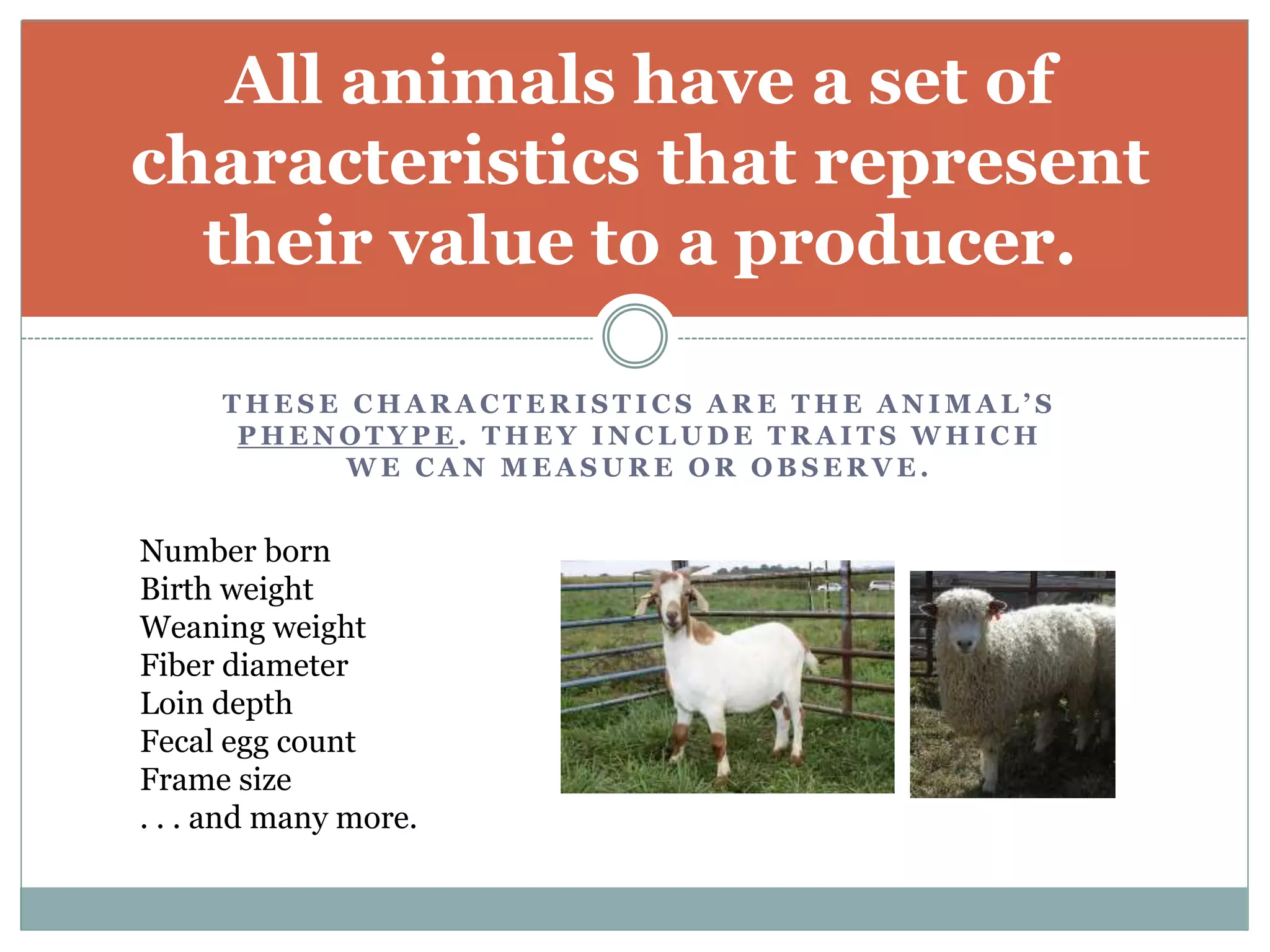
All animals have a set of
characteristics that represent
their value to a producer.
Number born
Birth weight
Weaning weight
Fiber diameter
Loin depth
Fecal egg count
Frame size
. . . and many more.
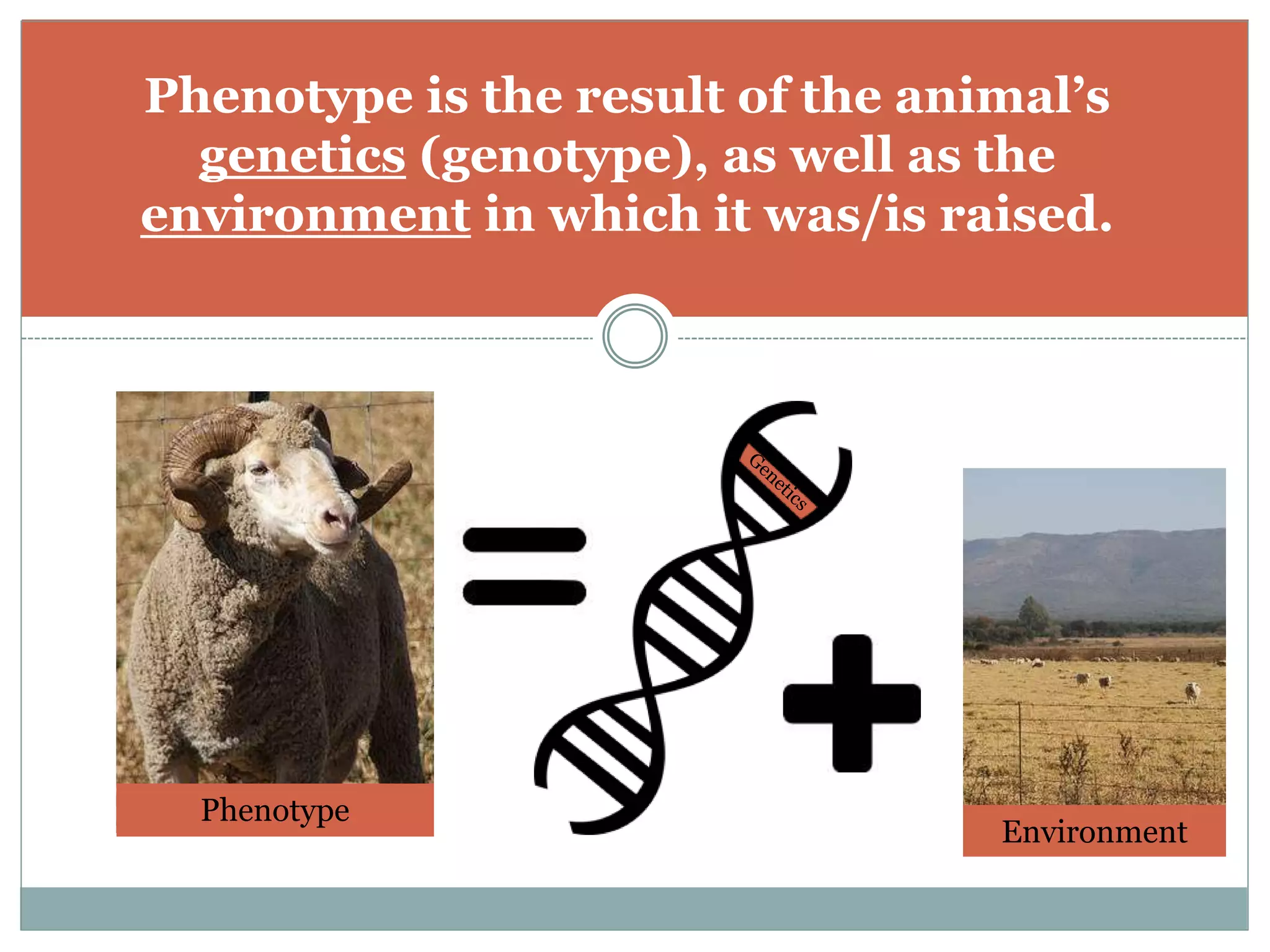
Phenotype is the result of the animal’s
genetics (genotype), as well as the
environment in which it was/is raised.
Phenotype
Environment
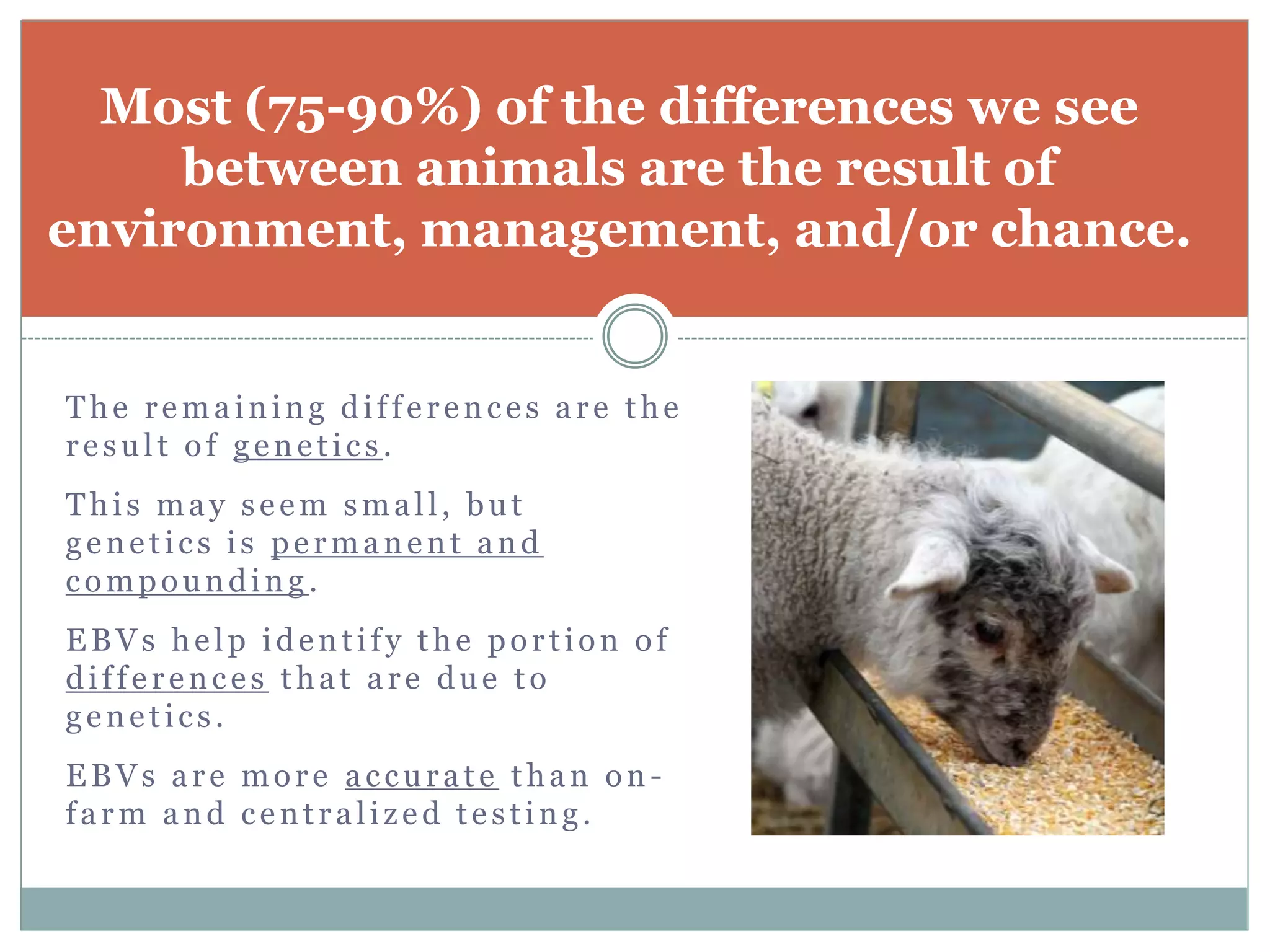
Most (75-90%) of the differences we see
between animals are the result of
environment, management, and/or chance.
The remaining differences are the
result of genetics.
This may seem small, but
genetics is permanent and
compounding .
EBVs help identify the portion of
differences that are due to
genetics.
EBVs are more accurate than on-
farm and centralized testing.
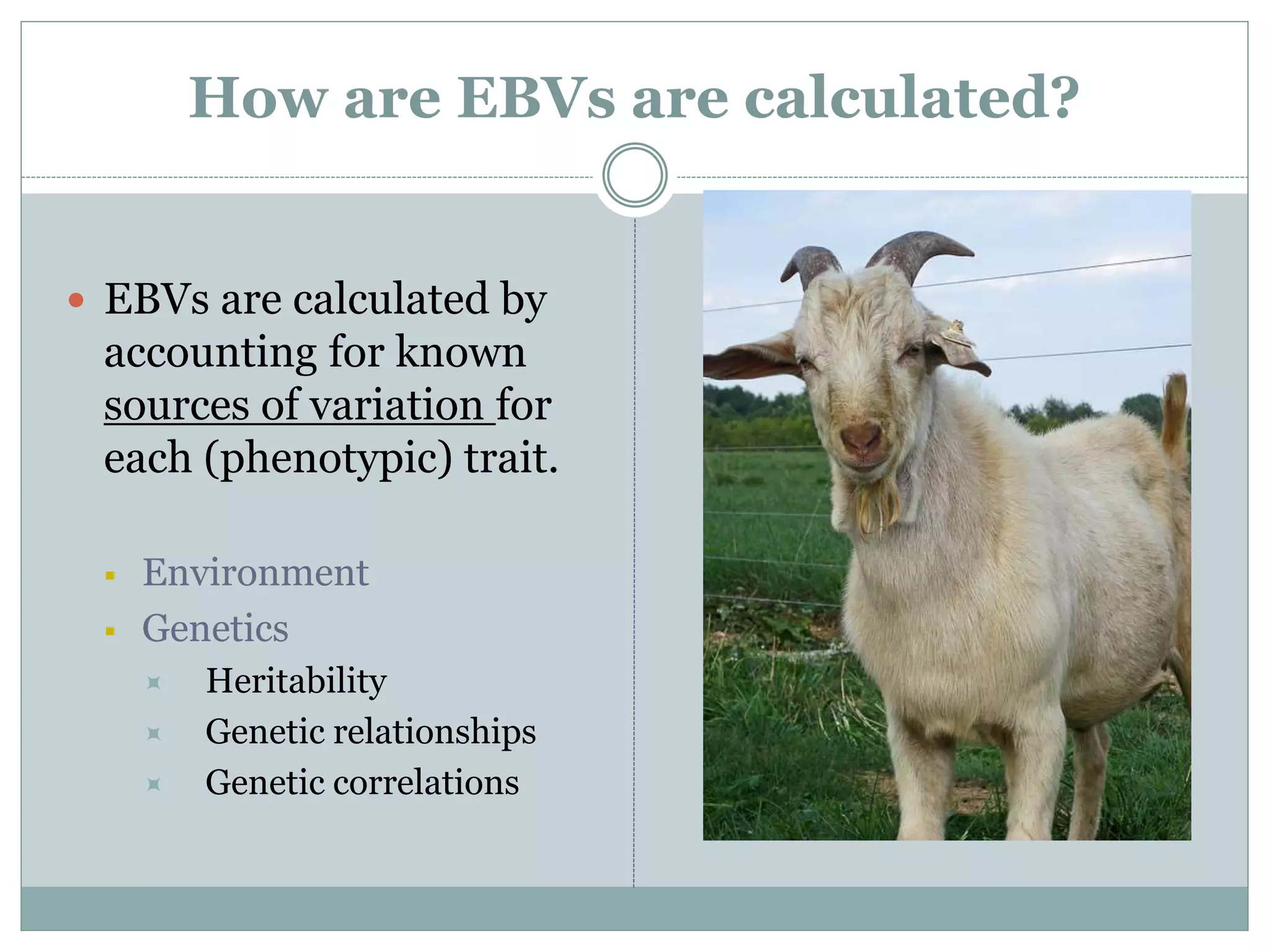
How are EBVs are calculated?
 EBVs are calculated by
accounting for known
sources of variation for
each (phenotypic) trait.
 Environment
 Genetics
 Heritability
 Genetic relationships
 Genetic correlations
Production environment Fixed effects
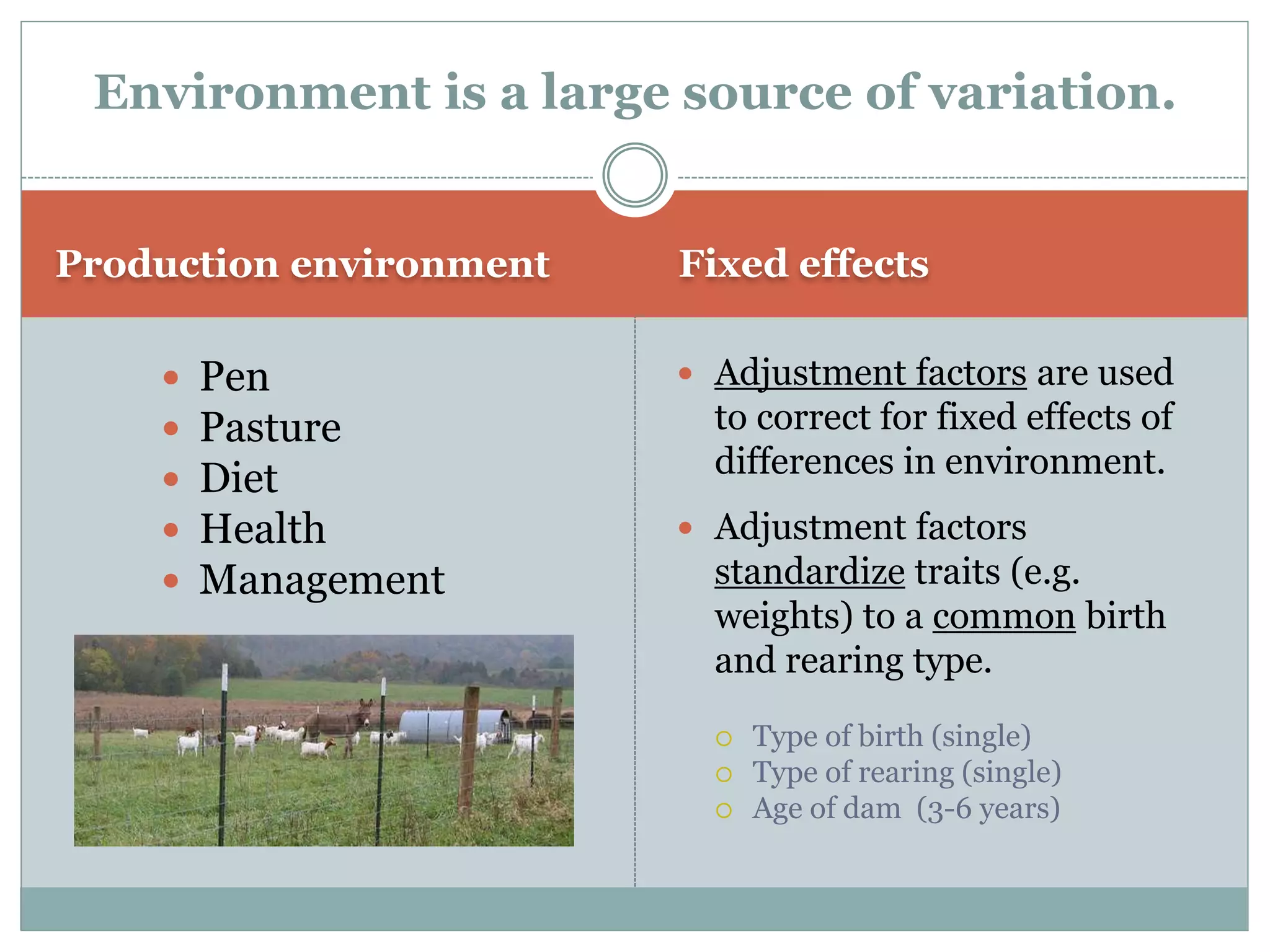
 Pen
 Pasture
 Diet
 Health
 Management
 Adjustment factors are used
to correct for fixed effects of
differences in environment.
 Adjustment factors
standardize traits (e.g.
weights) to a common birth
and rearing type.
 Type of birth (single)
 Type of rearing (single)
 Age of dam (3-6 years)
Environment is a large source of variation.
The effect of genetics on a trait varies.
 The variation in the
proportion of genetics on
a certain trait is called
heritability (h2).
 Reproductive
Low (5-20%)
 Growth
Moderate (10-50%)
 Carcass
Moderate (10-45%)
 Wool
Moderate to high (25-55%)
 Lactation
Moderate (15-35%)
 Parasite resistance
Moderate to high (25-50%)
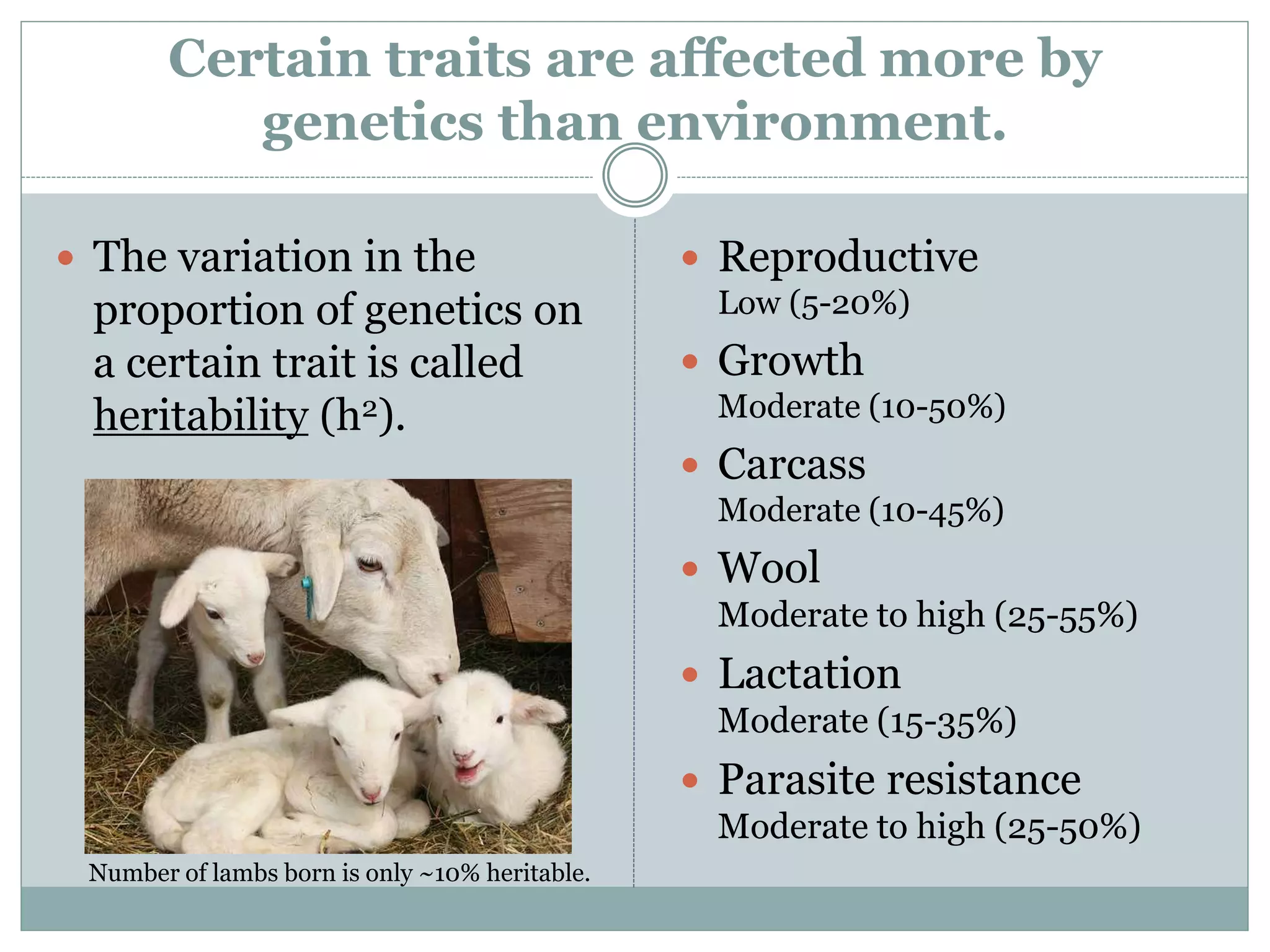
Number of lambs born is only ~10% heritable.
EBVs account for relationships between animals.
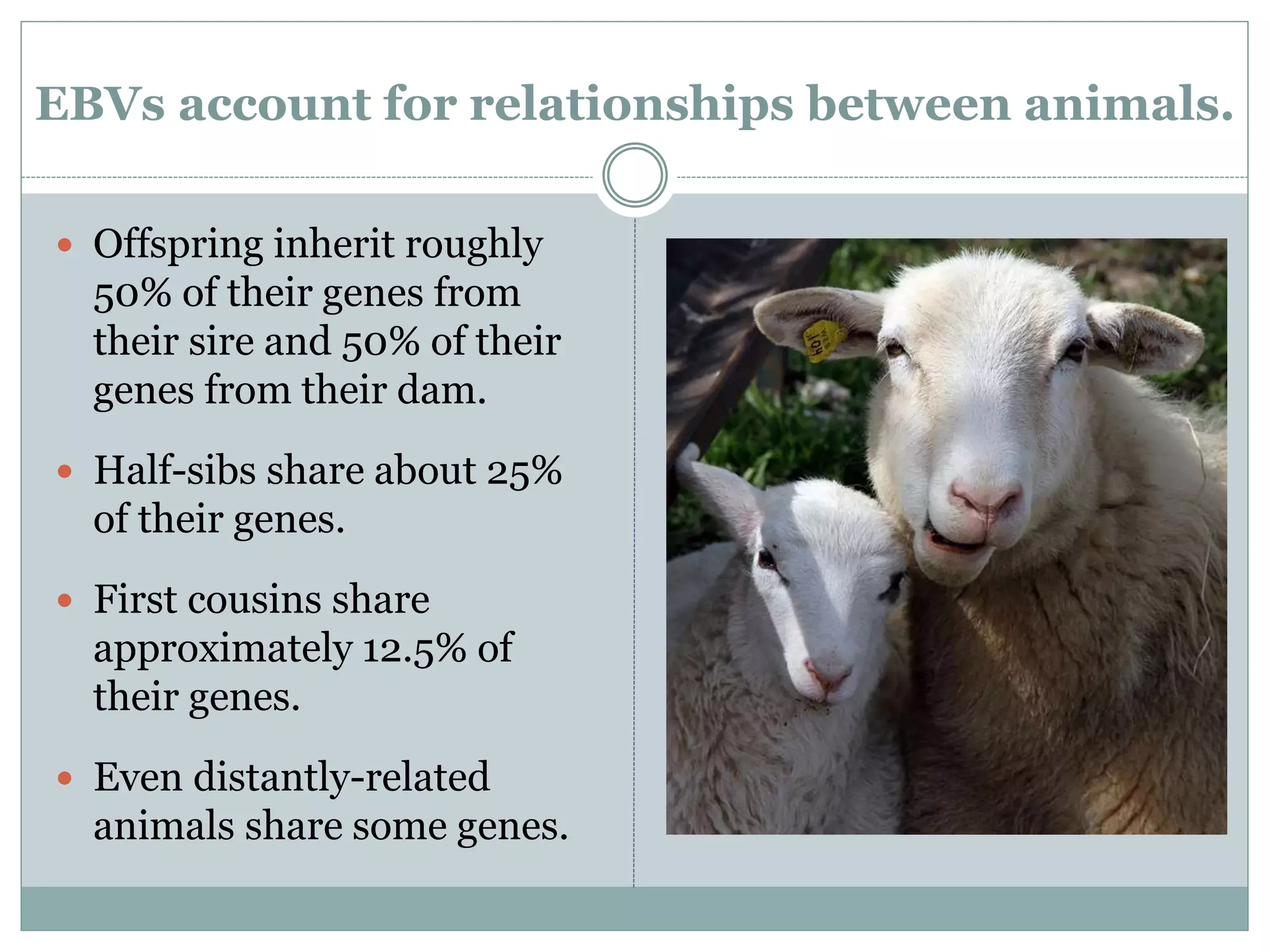
 Offspring inherit roughly
50% of their genes from
their sire and 50% of their
genes from their dam.
 Half-sibs share about 25%
of their genes.
 First cousins share
approximately 12.5% of
their genes.
 Even distantly-related
animals share some genes.
EBVs account for genetic correlations.
 Most performance traits are not
controlled by a single gene, but
rather have multiple genes that
control the genetic portion of
trait expression.
 Positive correlations mean that
increases in one trait will result
in increases in another trait.
 For example: birth weight (BWT)
and weaning weight (WWT) have
a genetic correlation of 0.3.
 On the other hand, some traits
have negative genetic correlations,
such as staple length (SL) and
fiber diameter (FD).
EBVs are calculated from…
1. Data for trait measured.
E.g. weaning weight
2. Data from correlated
traits.
birth weight, post-weaning weight
3. Date from relatives.
sire, dam, siblings, cousins, distant relatives
4. Factoring in heritability.
10-50%
 EBVs are comparisons to
the flock or NSIP breed
average.
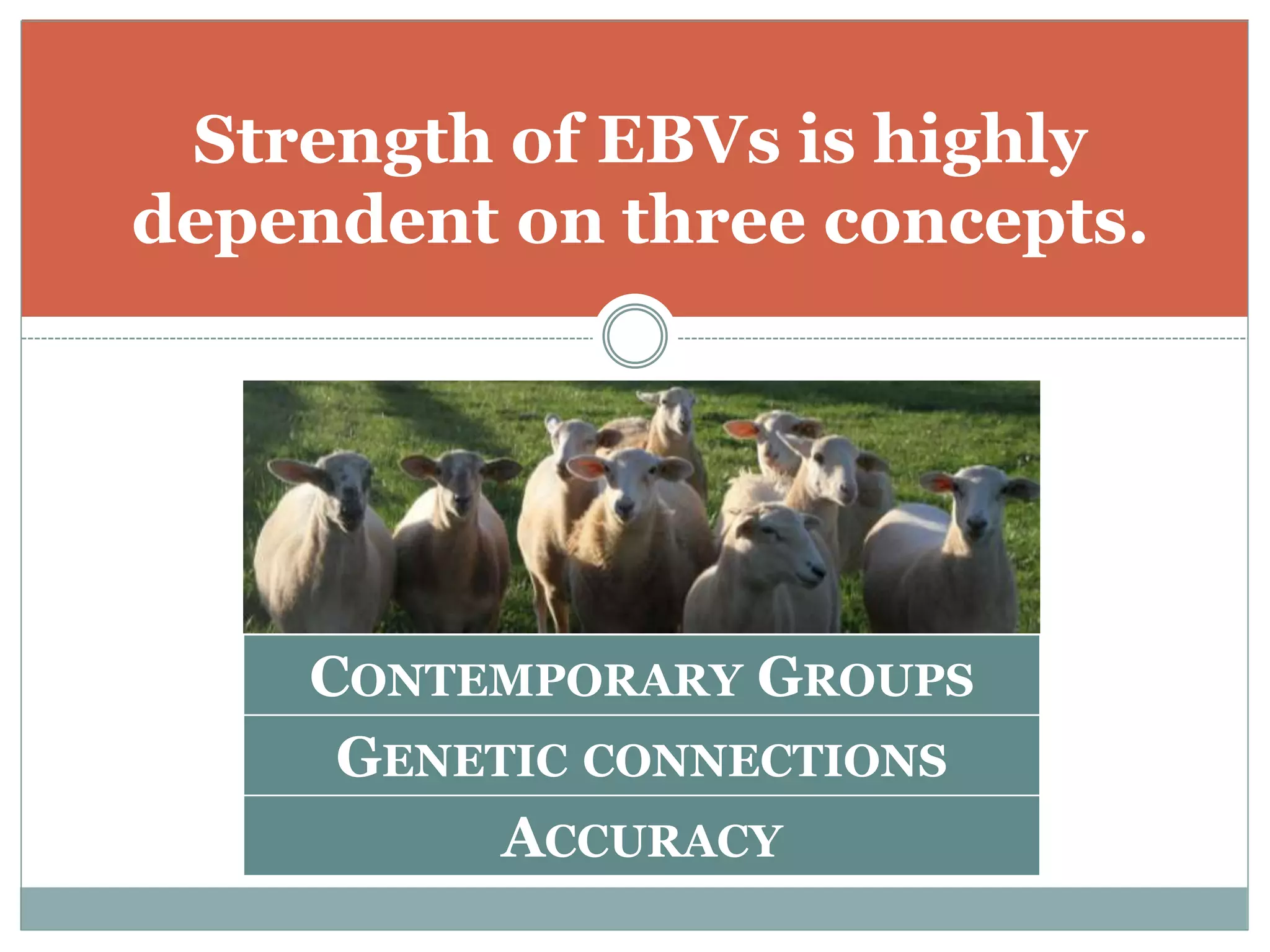
Strength of EBVs is highly
dependent on three concepts.
CONTEMPORARY GROUPS
GENETIC CONNECTIONS
ACCURACY
What is a contemporary group?
 A group of lambs or kids that
are born within 45 days of
each other and have been
managed the same way.
 Same feed
 Same pasture
 Same health protocol
 Good contemporary groups
have at least two sires and
enough offspring (usually at
least 20) from each sire.
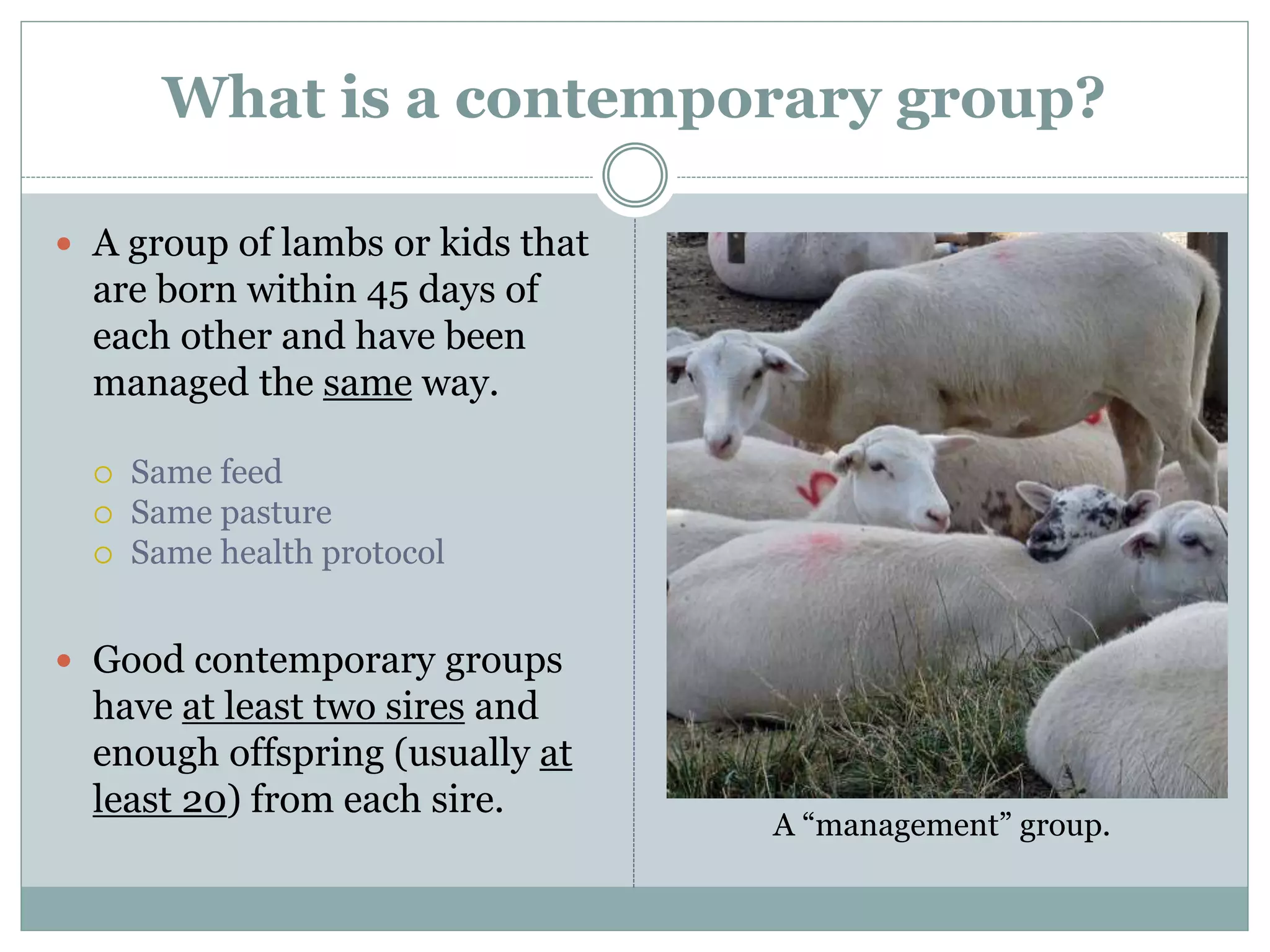
A “management” group.
These aren’t contemporary groups.
 Different breeds.
 Offspring born in different seasons
or more than 45 days apart.
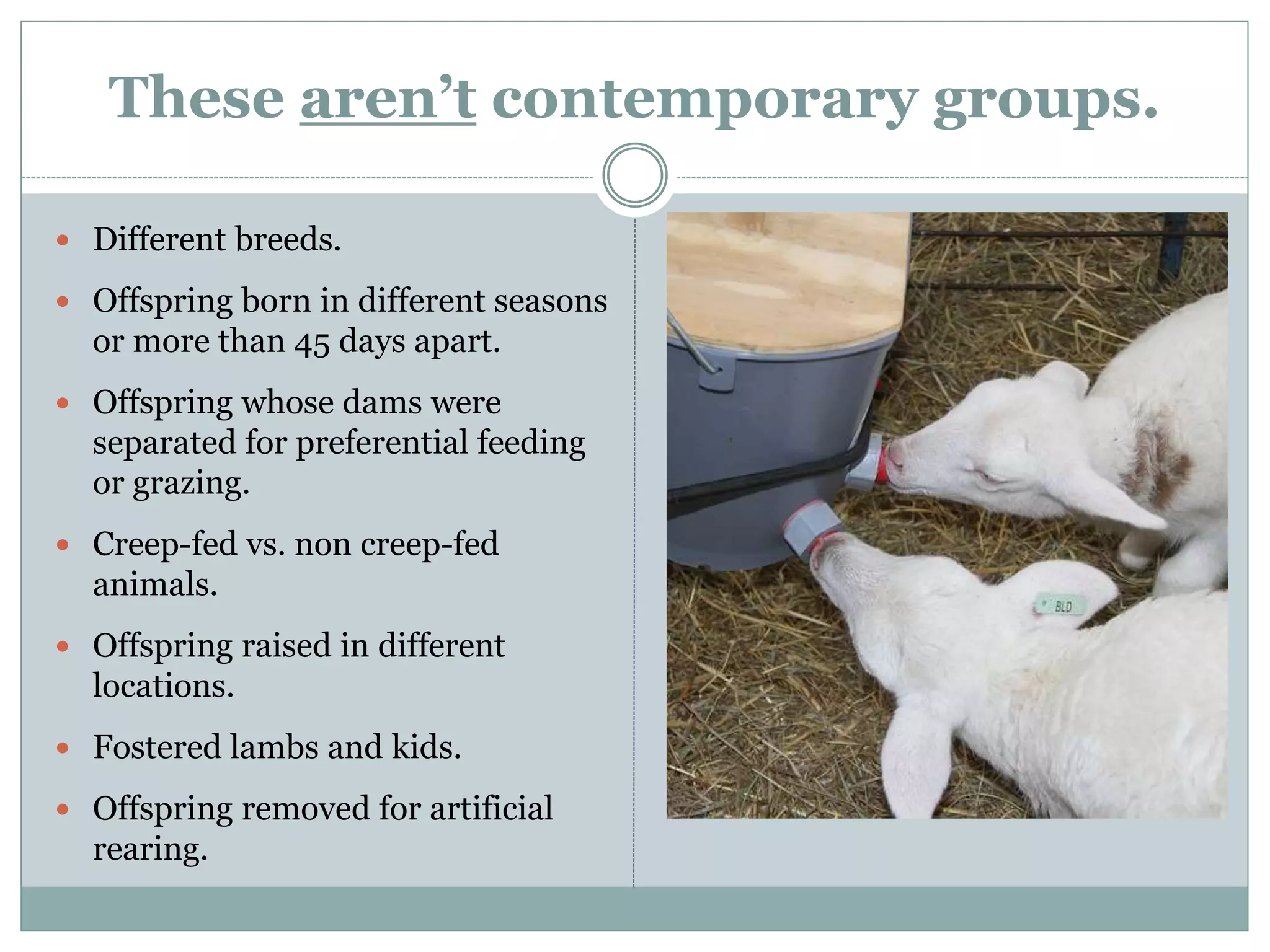
 Offspring whose dams were
separated for preferential feeding
or grazing.
 Creep-fed vs. non creep-fed
animals.
 Offspring raised in different
locations.
 Fostered lambs and kids.
 Offspring removed for artificial
rearing.
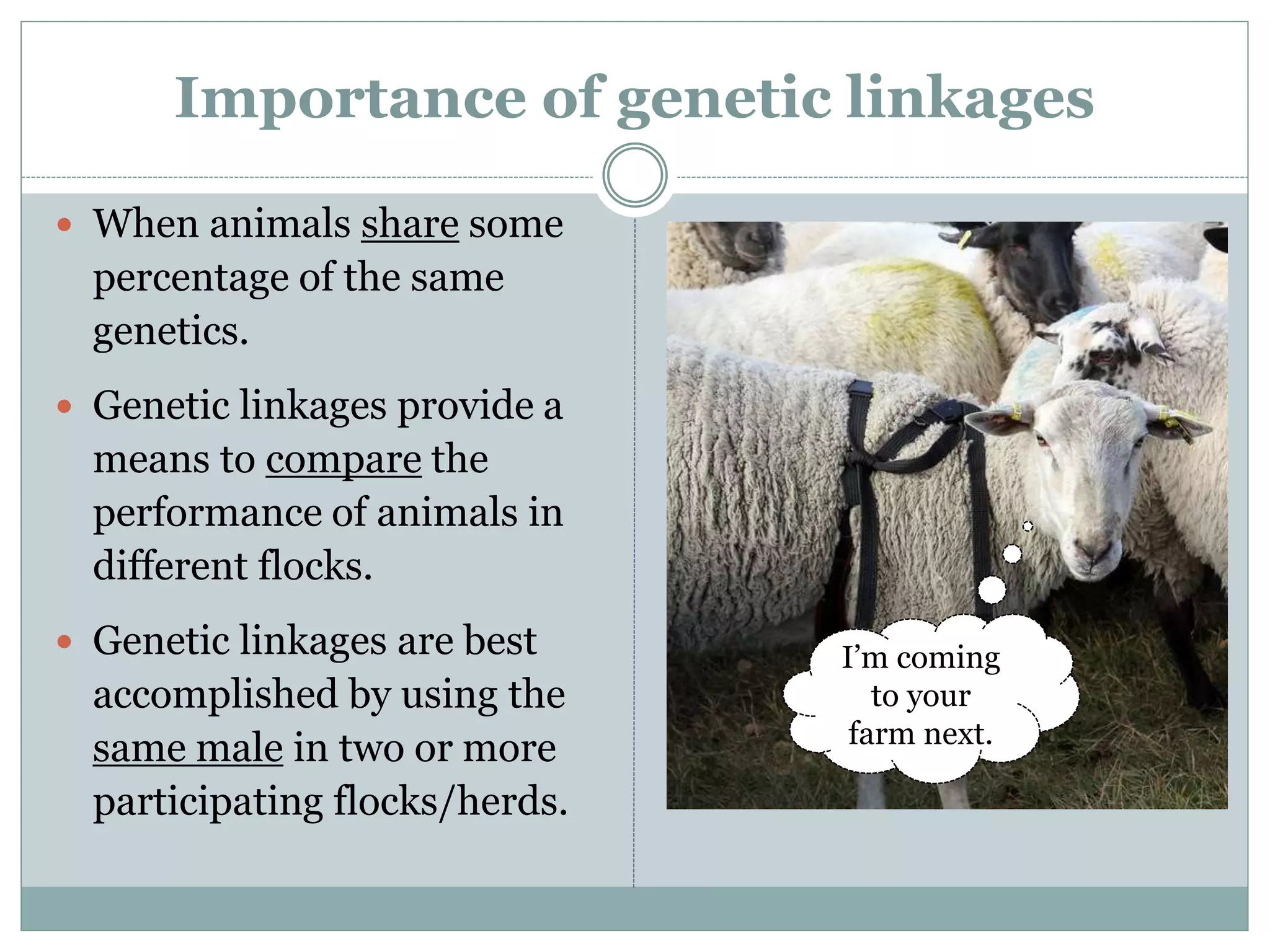
Importance of genetic linkages
 When animals share some
percentage of the same
genetics.
 Genetic linkages provide a
means to compare the
performance of animals in
different flocks.
 Genetic linkages are best
accomplished by using the
same male in two or more
participating flocks/herds.
I’m coming
to your
farm next.
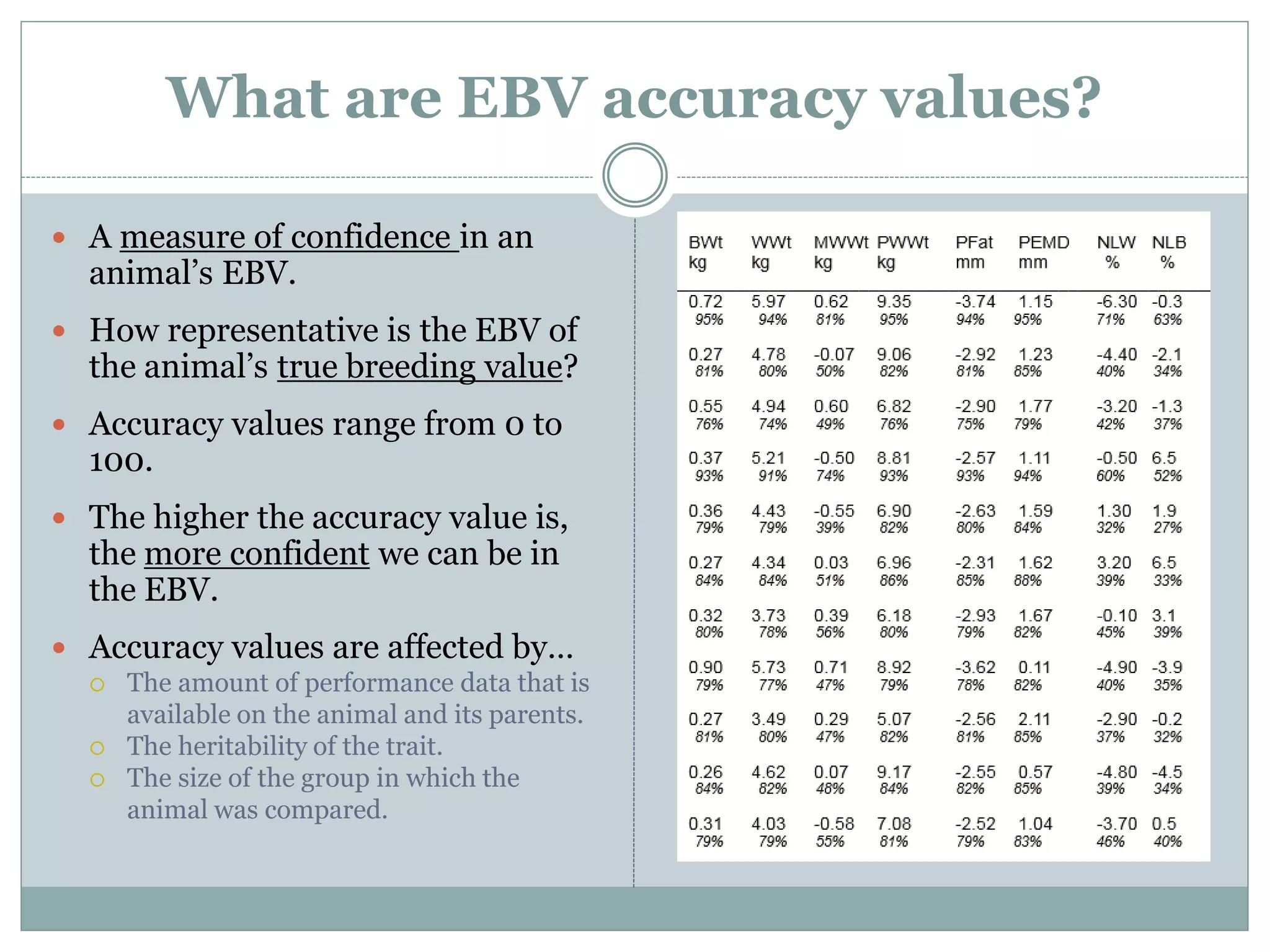
What are EBV accuracy values?
 A measure of confidence in an
animal’s EBV.
 How representative is the EBV of
the animal’s true breeding value?
 Accuracy values range from 0 to
100.
 The higher the accuracy value is,
the more confident we can be in
the EBV.
 Accuracy values are affected by…
 The amount of performance data that is
available on the animal and its parents.
 The heritability of the trait.
 The size of the group in which the
animal was compared.
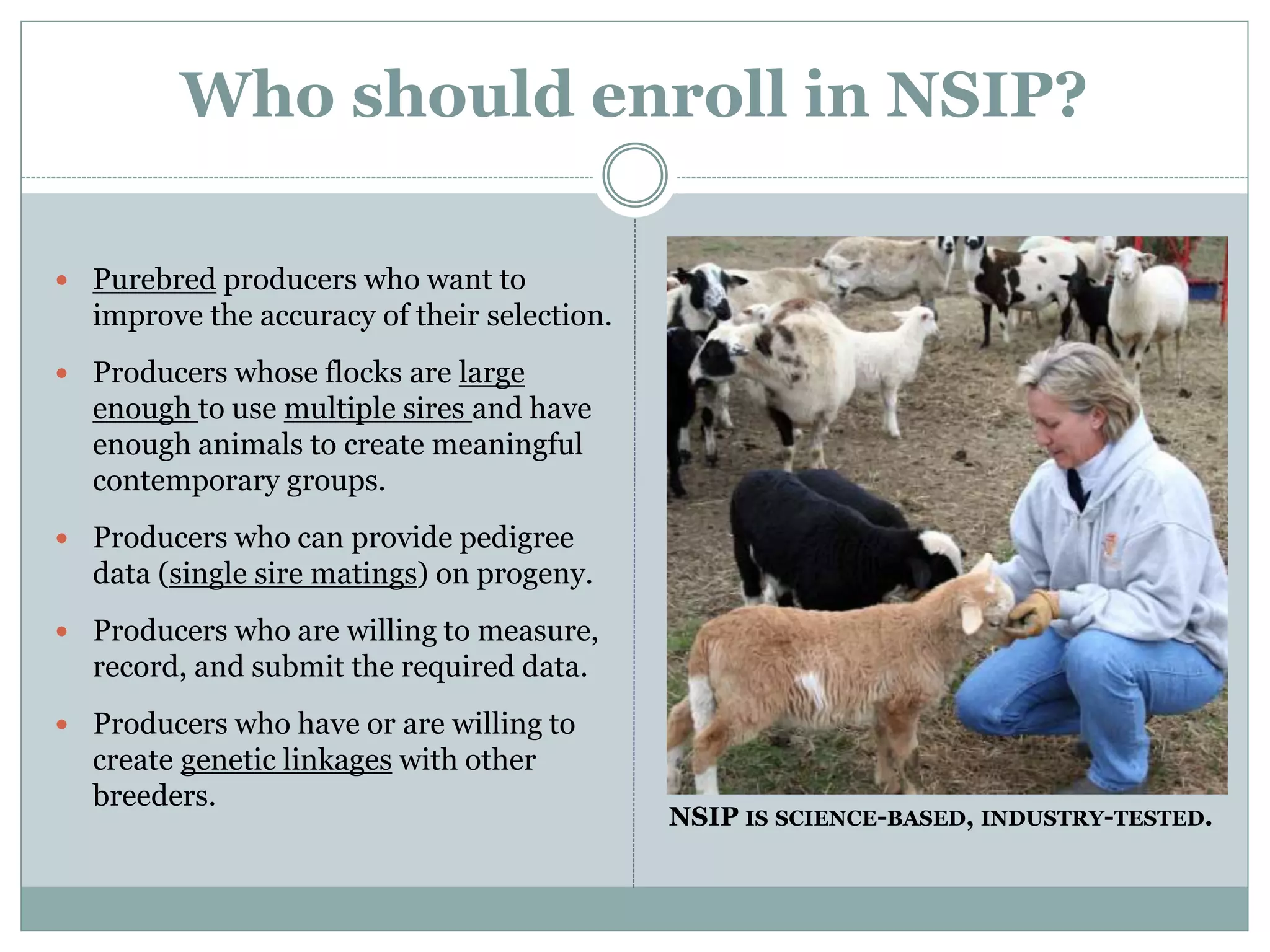
Who should enroll in NSIP?
 Purebred producers who want to
improve the accuracy of their selection.
 Producers whose flocks are large
enough to use multiple sires and have
enough animals to create meaningful
contemporary groups.
 Producers who can provide pedigree
data (single sire matings) on progeny.
 Producers who are willing to measure,
record, and submit the required data.
 Producers who have or are willing to
create genetic linkages with other
breeders.
NSIP IS SCIENCE-BASED, INDUSTRY-TESTED.
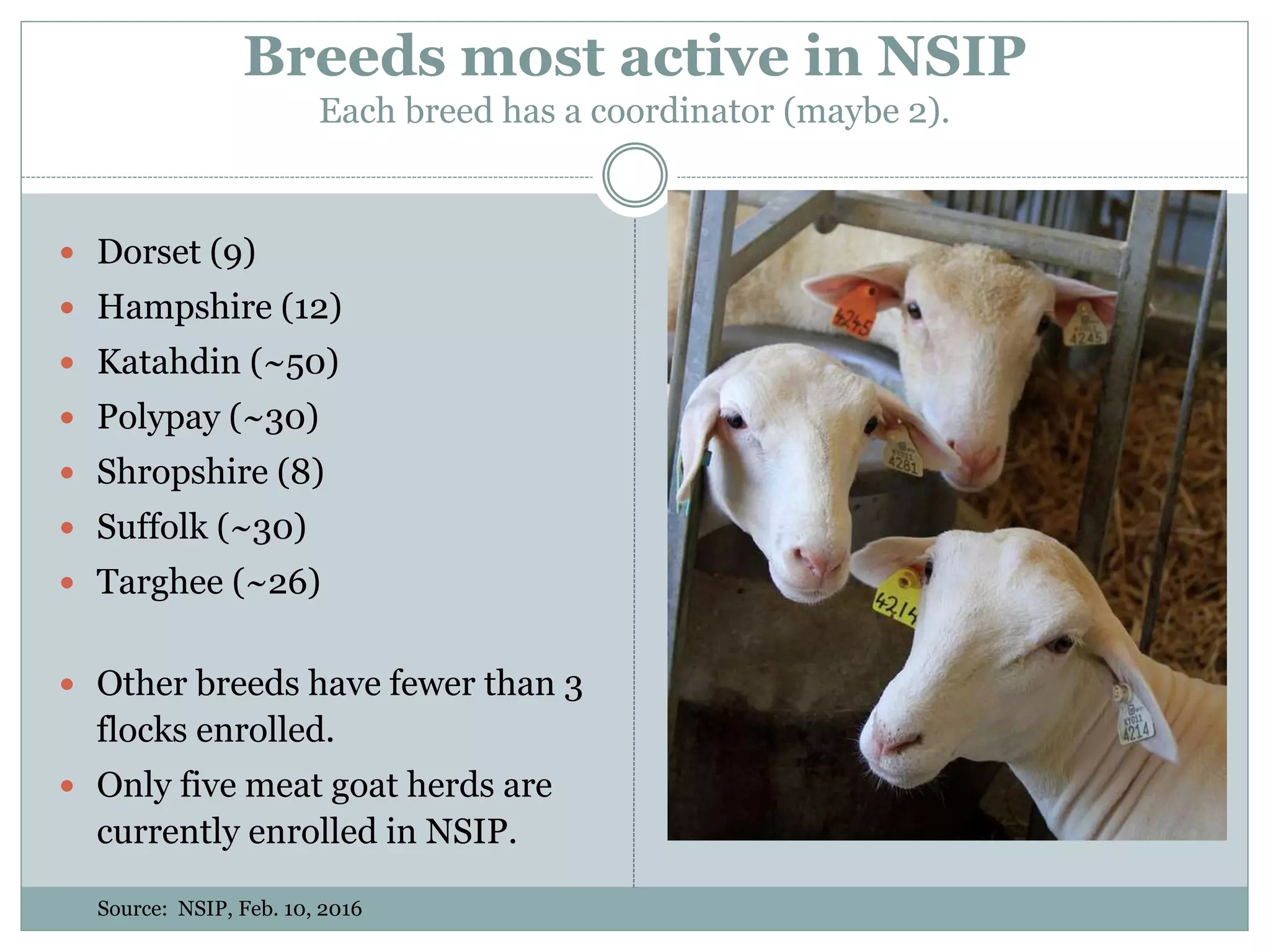
Breeds most active in NSIP
Each breed has a coordinator (maybe 2).
 Dorset (9)
 Hampshire (12)
 Katahdin (~50)
 Polypay (~30)
 Shropshire (8)
 Suffolk (~30)
 Targhee (~26)
 Other breeds have fewer than 3
flocks enrolled.
 Only five meat goat herds are
currently enrolled in NSIP.
Source: NSIP, Feb. 10, 2016
Can producers with small flocks enroll in NSIP?
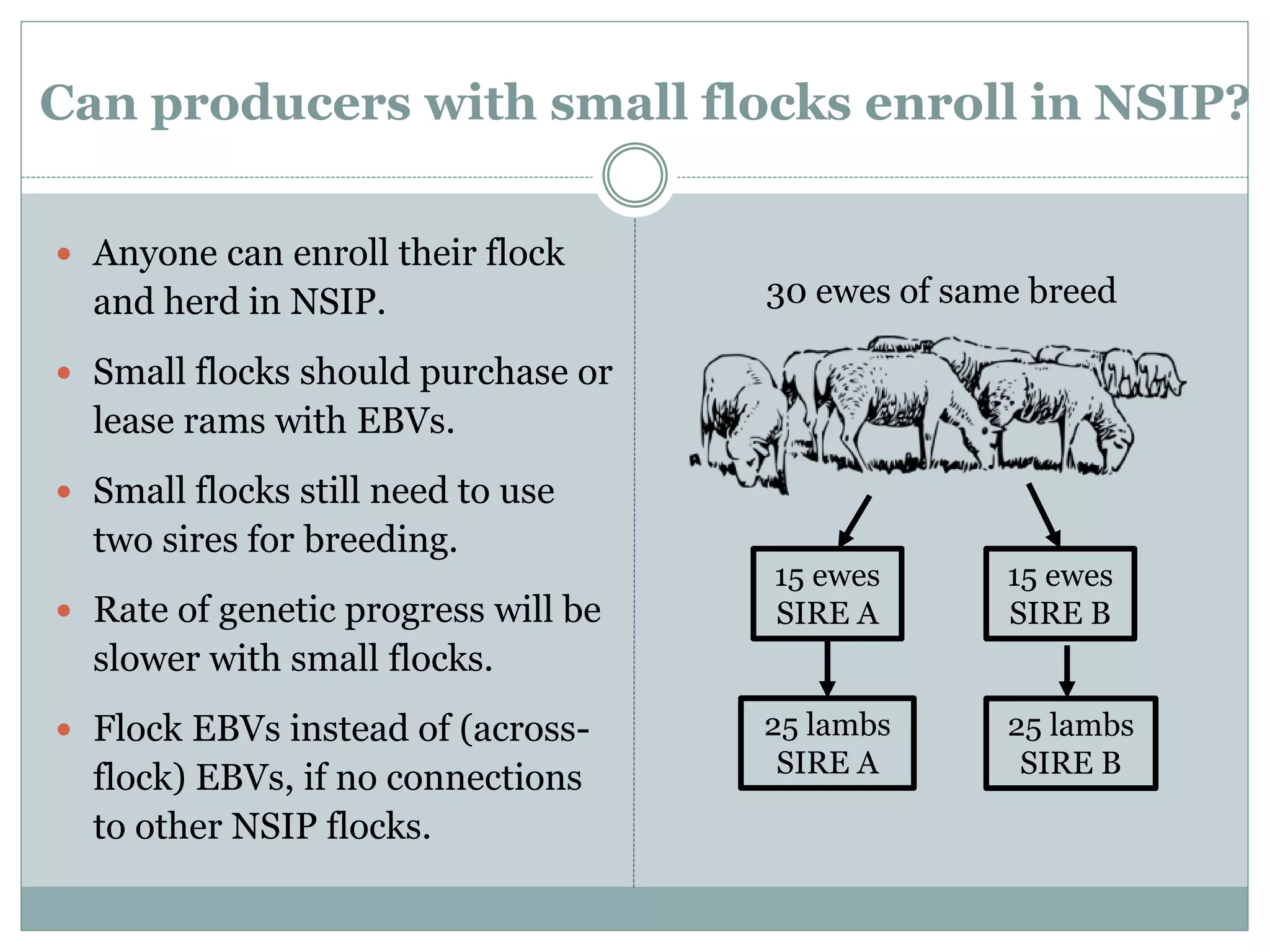
 Anyone can enroll their flock
and herd in NSIP.
 Small flocks should purchase or
lease rams with EBVs.
 Small flocks still need to use
two sires for breeding.
 Rate of genetic progress will be
slower with small flocks.
 Flock EBVs instead of (across-
flock) EBVs, if no connections
to other NSIP flocks.
15 ewes
SIRE A
15 ewes
SIRE B
25 lambs
SIRE A
25 lambs
SIRE B
30 ewes of same breed
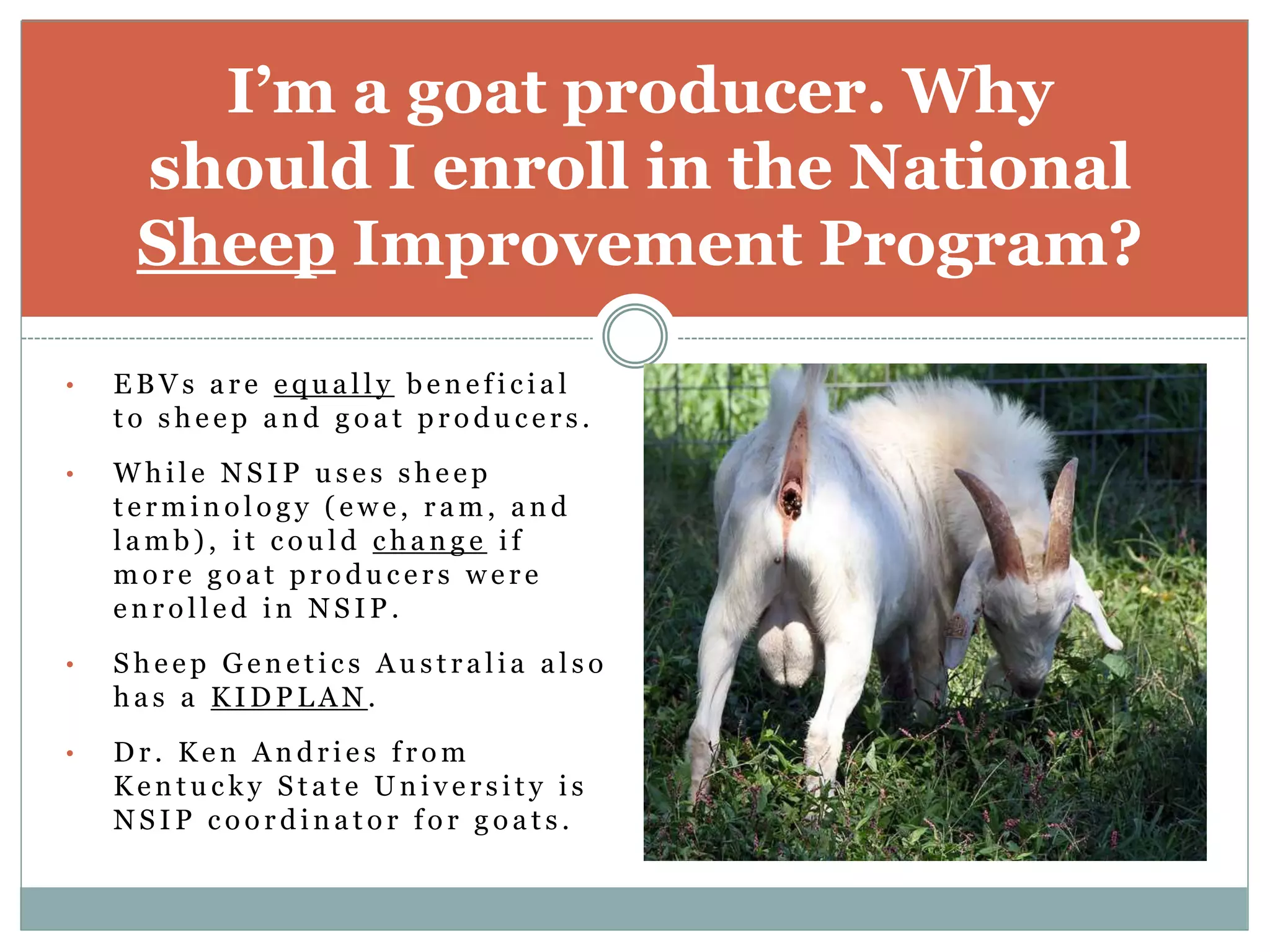
• E B V s a r e e q u a l l y b e n e f i c i a l
t o s h e e p a n d g o a t p r o d u c e r s .
• W h i l e N S I P u s e s s h e e p
t e r m i n o l o g y ( e w e , r a m , a n d
l a m b ) , i t c o u l d c h a n g e i f
m o r e g o a t p r o d u c e r s w e r e
e n r o l l e d i n N S I P .
• S h e e p G e n e t i c s A u s t r a l i a a l s o
h a s a K I D P L A N .
• D r . K e n A n d r i e s f r o m
K e n t u c k y S t a t e U n i v e r s i t y i s
N S I P c o o r d i n a t o r f o r g o a t s .
I’m a goat producer. Why
should I enroll in the National
Sheep Improvement Program?
Purebred producer Commercial producer
 Enroll your flock in NSIP and
use EBVs to improve your
accuracy of selection for
economically important traits.
 Purchase breeding stock,
especially rams, with above
average EBVs or indexes
(enrolled and non-enrolled
flocks; small flocks).
 Establish values for your
breeding stock.
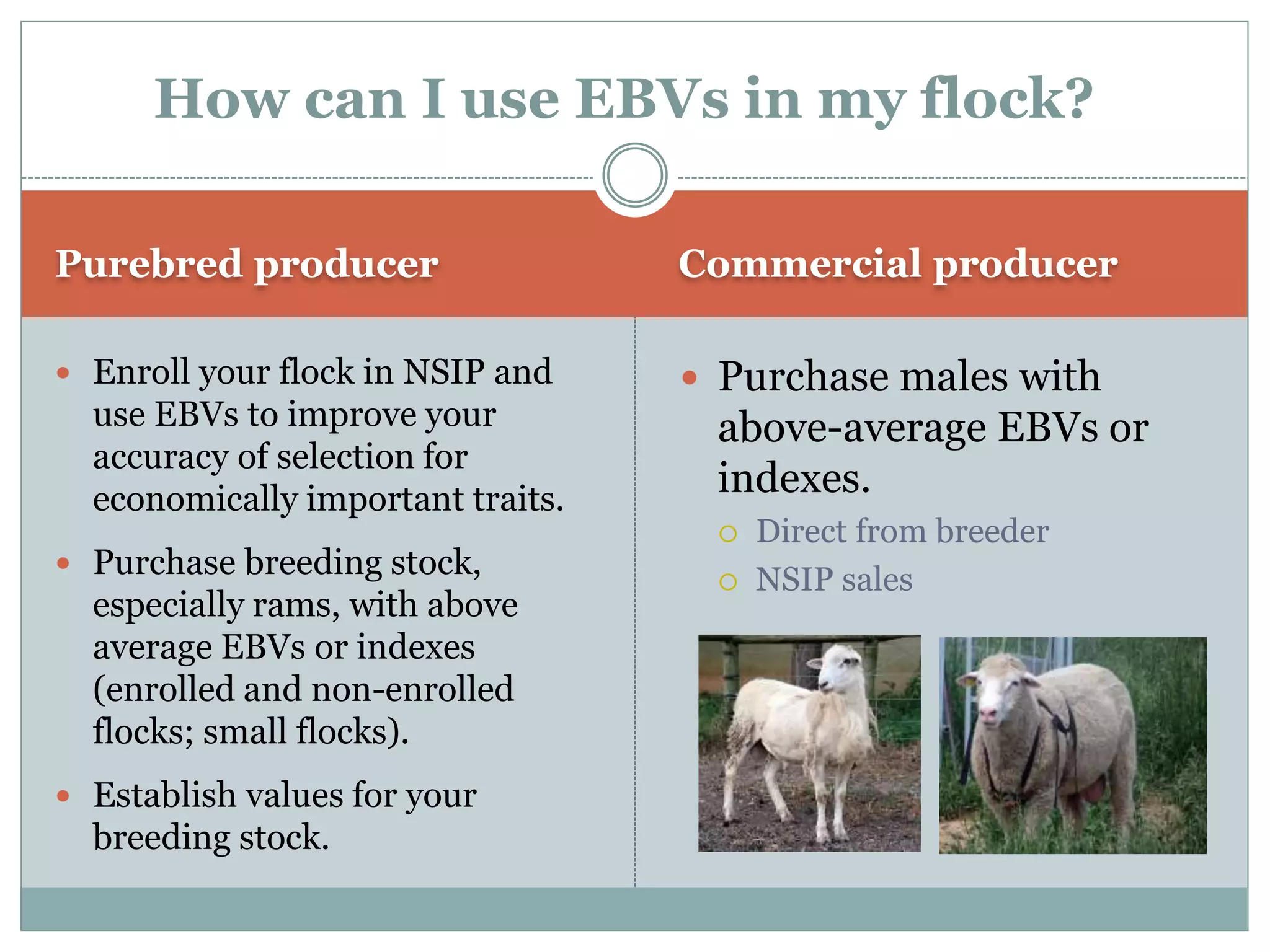
 Purchase males with
above-average EBVs or
indexes.
 Direct from breeder
 NSIP sales
How can I use EBVs in my flock?
Balanced selection Single trait selection
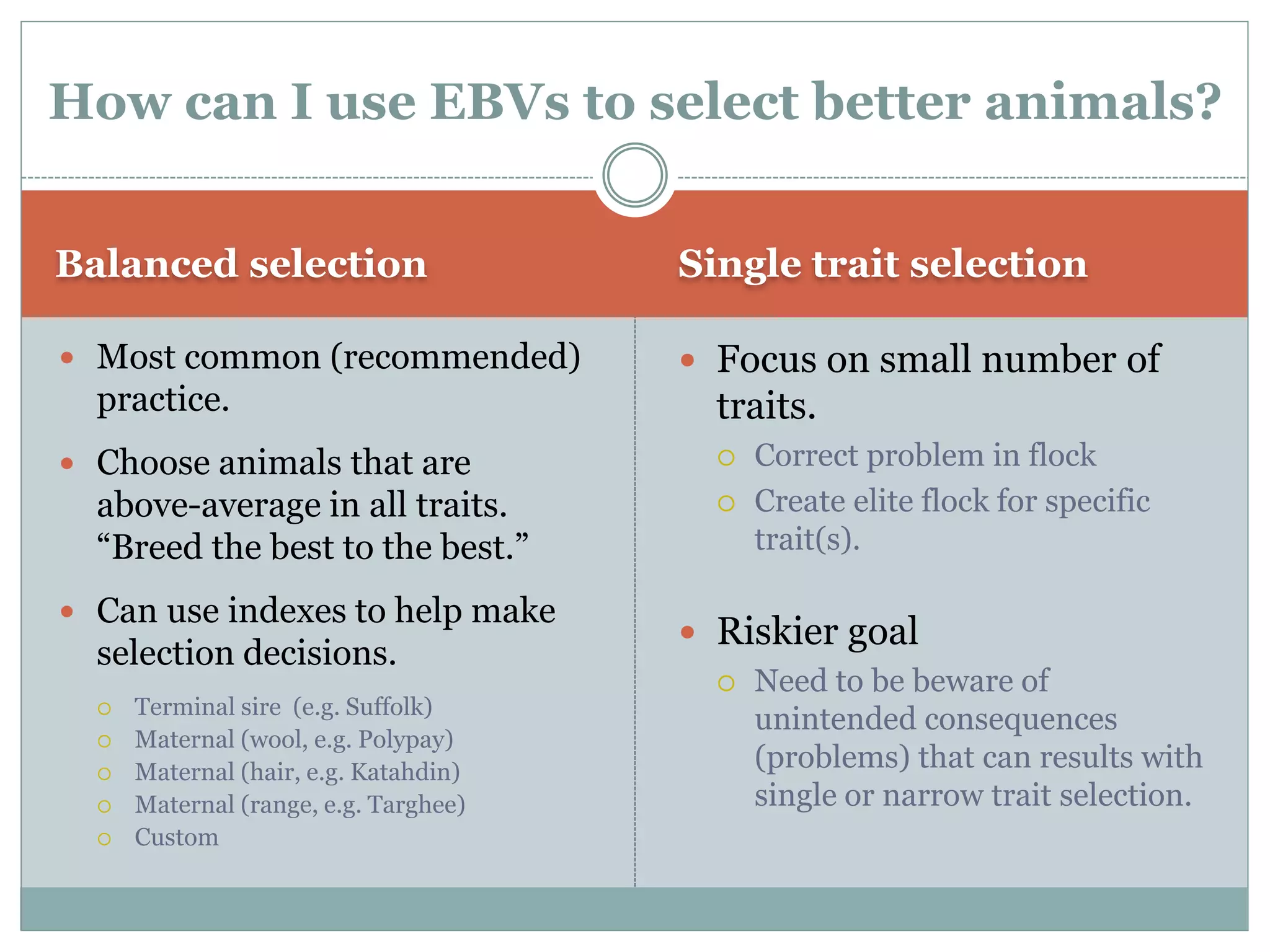
 Most common (recommended)
practice.
 Choose animals that are
above-average in all traits.
“Breed the best to the best.”
 Can use indexes to help make
selection decisions.
 Terminal sire (e.g. Suffolk)
 Maternal (wool, e.g. Polypay)
 Maternal (hair, e.g. Katahdin)
 Maternal (range, e.g. Targhee)
 Custom
 Focus on small number of
traits.
 Correct problem in flock
 Create elite flock for specific
trait(s).
 Riskier goal
 Need to be beware of
unintended consequences
(problems) that can results with
single or narrow trait selection.
How can I use EBVs to select better animals?
Match production system and goals to EBVs.
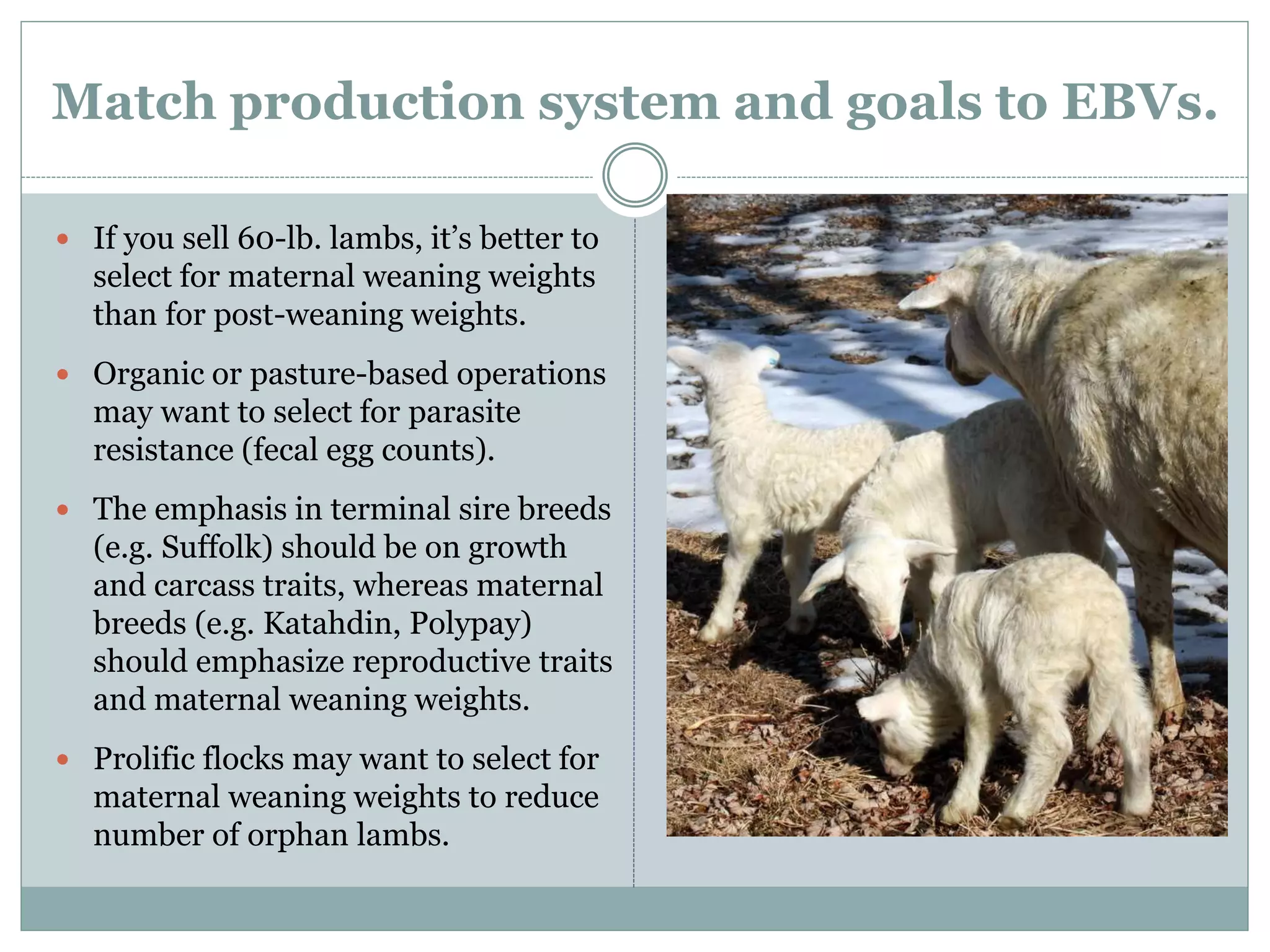
 If you sell 60-lb. lambs, it’s better to
select for maternal weaning weights
than for post-weaning weights.
 Organic or pasture-based operations
may want to select for parasite
resistance (fecal egg counts).
 The emphasis in terminal sire breeds
(e.g. Suffolk) should be on growth
and carcass traits, whereas maternal
breeds (e.g. Katahdin, Polypay)
should emphasize reproductive traits
and maternal weaning weights.
 Prolific flocks may want to select for
maternal weaning weights to reduce
number of orphan lambs.
Required Optional
 Date of birth
 Birth type
 Rear type
 Sire and dam info
 Contemporary (or
(management) groups
 Birth weight
(within 24 hours)
 Weaning weight
(avg. 60 days, 45-90 days)
 Post weaning weight
(90-150 days)
 Fleece traits
 Fecal egg counts
(weaning, 120 days of age)
 Scrotal circumference
(150-240 days)
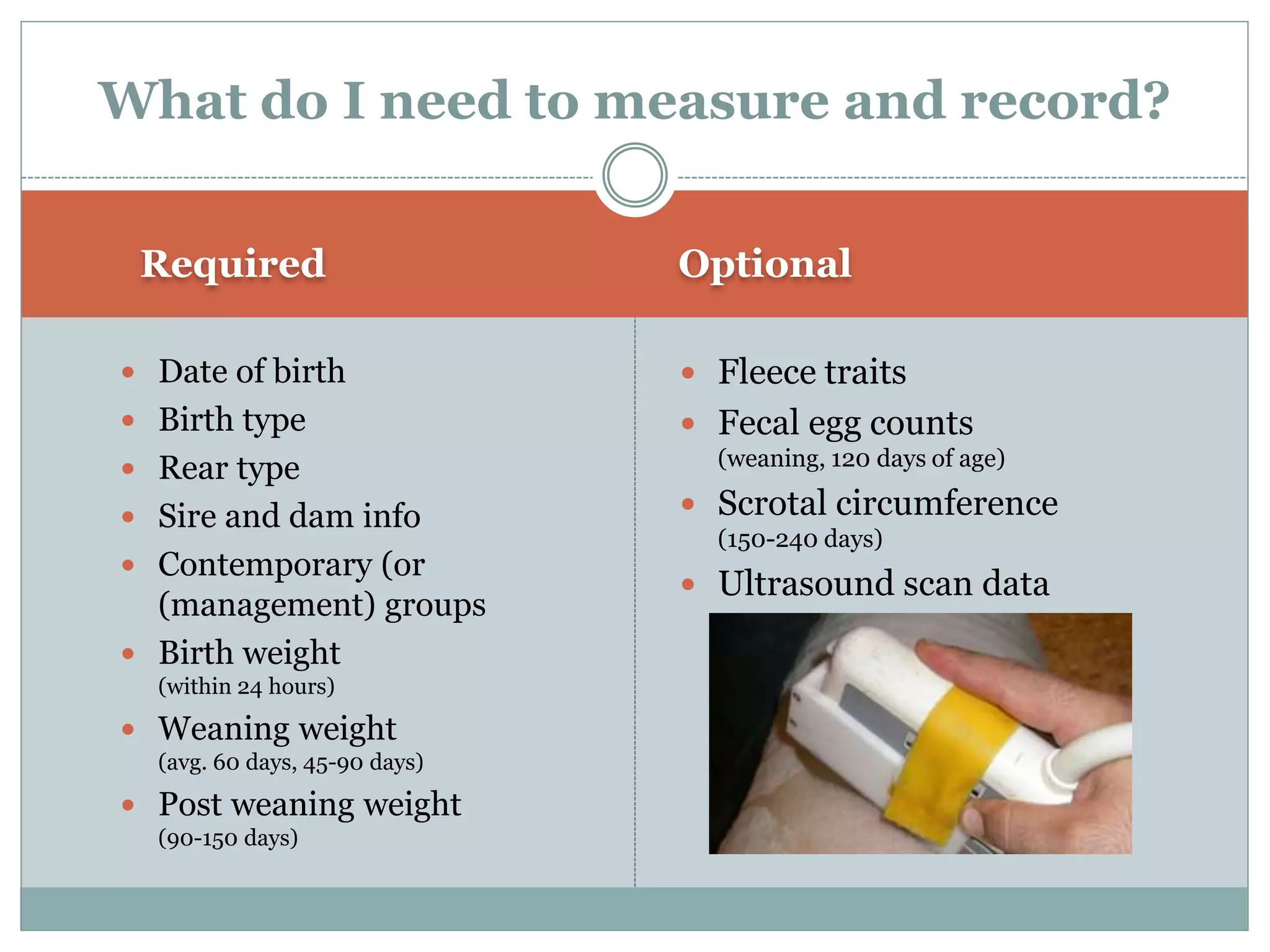
 Ultrasound scan data
What do I need to measure and record?
How do I enroll my flock or herd in NSIP?
 Go to NSIP.org
 Print and fill out the enrollment
form.
 Send with check to NSIP.
 Enrollment fees are waived for
first year members and for three
years for members younger than
22 (as of 1/1/16).
 However, there is a $100 data
fee deposit (is refunded after
data is submitted).
 Start collecting and entering
data.
Annual enrollment Data fee
 Based on size of flock
 $100
 $2.50 x ewe/doe
 $25 for additional breed
• Capped at $400
- $25 early bird credit
 Based on number of
lambs (or kids) with post
birth measurement.
 $2.85 per animal,
excluding animals
designated as culls or
commercials.
 Covers lifetime of animal.
How much do EBVs cost?
Flock with 40 ewes or does
$100 + (40 x $2.50) = $200
Will EBVs make me money?
 The primary purpose of EBVs is
to make genetic improvements
in your own flock or herd (i.e. to
increase profitability).
 There is an increasing
demand for sheep with EBVs.
 SW Virginia Ram Test
 Center of the Nation
NSIP Sale (Iowa)
 Montana Ram Sale
 NSIP sale in East [?]
 Goats (eventually ?)Ram with an EBV of +5.0 for NLW
Daughters will produce 0.05 more lambs
That’s 5 more lambs per 100 lambings
5 extra lambs x $150/lamb = $750
Ram with EBV of +5.0 for WWT
Progeny will be 2.5 kg (5.5 lbs) heavier at
weaning than average
5.5 lbs x $2/lb = $11/lamb
50 lambs x $11 = $550
100 lambs x $11 = $1100
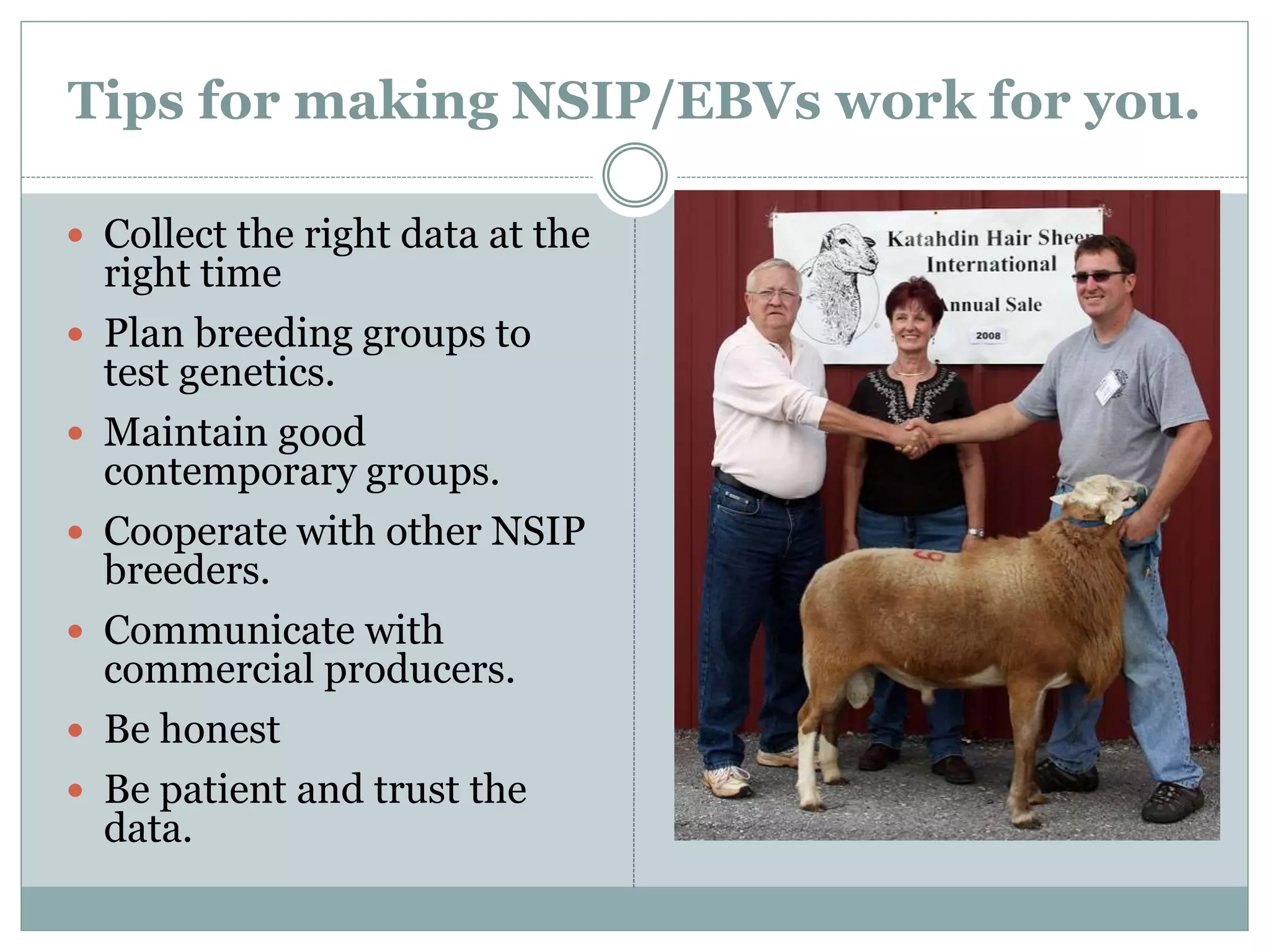
Tips for making NSIP/EBVs work for you.
 Collect the right data at the
right time
 Plan breeding groups to
test genetics.
 Maintain good
contemporary groups.
 Cooperate with other NSIP
breeders.
 Communicate with
commercial producers.
 Be honest
 Be patient and trust the
data.
CAN CAN’T
 Select ewe and doe replacements for
economically-important traits.
 Make purchasing decisions.
 Make culling decisions.
 Select flock sire(s)
 Increase the accuracy of selection for
superior performance.
 Set value of breeding stock.
 Increase profitability of enterprise.
 Improve productivity of breed.
 Tell if an animal is structurally
connect.
 Tell if an animal has good
conformation.
 Tell if an animal has good breed
character.
 Tell if an animal has a genetic
defect (e.g. bad bite).
 Replace visual appraisal.
 Force you to make the right
breeding decisions.
What EBVs can and can’t do
MAYBE, MAYBE NOT
EBVs identify poor
performing animals .
Animals without EBVs
could be genetically
superior (or inferior), but
there is no way of knowing.
Are animals with EBVs better
than animals without EBVs?
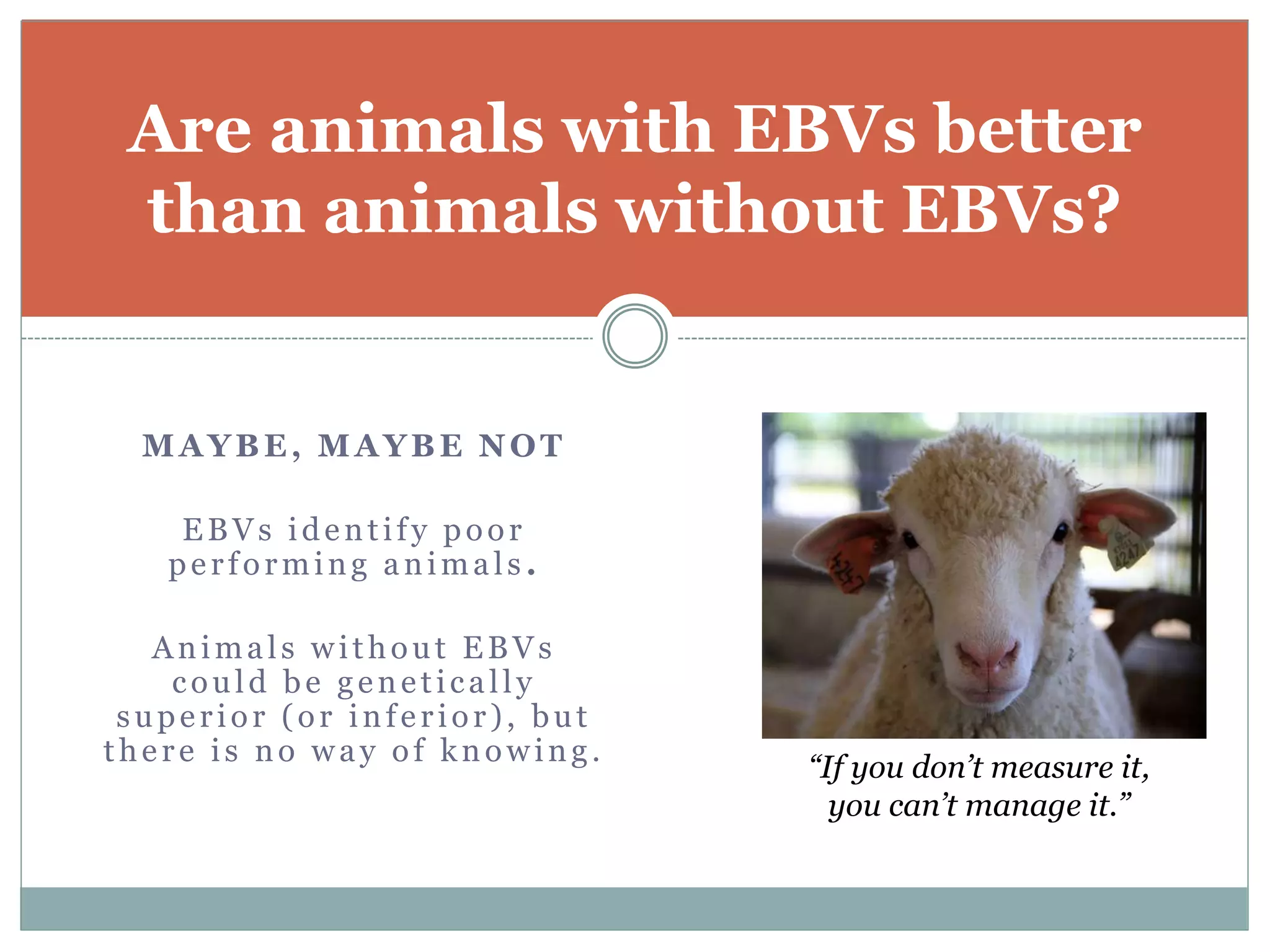
“If you don’t measure it,
you can’t manage it.”
N A T I O N A L S H E E P I M P R O V E M E N T P R O G R A M
h t t p : / / n s i p . o r g
K A T A H D I N N A T I O N A L S H E E P I M P R O V E M E N T P R O G R A M
h t t p : / / w w w . k a t n s i p . c o m /
R A M B U Y I N G G U I D E ( n e w p u b l i c a t i o n )
h t t p : / / n s i p . o r g / w p - c o n t e n t / u p l o a d s / 2 0 1 5 / 0 1 /
N S I P - R a m - B u y i n g - G u i d e - F I N A L - 1 2 - 2 1 - 1 5 . p d f
S H E E P G E N E T I C S A U S T R A L I A
h t t p : / / w w w . s h e e p g e n e t i c s . o r g . a u / H o m e
There is lots of information
about EBVs (and NSIP) online.

A beginner’s guide to EBVs

  • 1.
    S U SA N S C H O E N I A N S H E E P & G O A T S P E C I A L I S T U N I V E R S I T Y O F M A R Y L A N D E X T E N S I O N S S C H O E N @ U M D . E D U W W W . S H E E P A N D G O A T . C O M A Beginner’s Guide to EBVs
  • 2.
    What is anEBV?  EBV is an acronym. It stands for Estimated Breeding Value.  An EBV quantifies the genetic merit of an animal (for breeding).  It is a mathematical, computer- generated prediction of an animal for economically-important traits.  For anyone familiar with EPDs (used in cattle), an EBV is twice the value of an EPD, as P=progeny.  EBVs can be calculated for any trait for which data can be collected.
  • 3.
    Another acronym. Whatis NSIP?  NSIP stands for National Sheep Improvement Program.  NSIP is the organization that provides EBVs for the US sheep and goat industry.  NSIP data is now processed by Sheep Genetics in Australia (also referred to as LAMBPLAN).  Other animal industries and countries have similar programs.  Small ruminant dairy producers should use DHIA, not NSIP.
  • 4.
    What traits doesNSIP measure? EBVs currently available for US sheep and goats Reproductive traits Number of lambs born (NLB, %) Number of lambs weaned (NLW, %) Scrotal circumference (SC, cm) Growth traits Birth weight (BWT, kg) Weaning weight (WWT, kg) Maternal weaning weight (MWWT, kg) Post-weaning weight (PWWT, kg) Yearling weight (YWT, kg ) Carcass traits Loin muscle depth (EMD, mm) Fat depth (CF, mm) Wool traits Fleece weight (GFW, %) Fiber diameter (FD, μ) Staple length (SL, mm) Parasite resistance Worm egg count (WEC, %) Indexes Carcass Plus index, % USA Hair Index, % USA Maternal Index, % USA Range Index, %
  • 5.
    Understanding the numbers Source:Ram Buyer’s Guide, NSIP, 2016
  • 6.
  • 7.
  • 8.
    1. Flock EBVs2. (Across-flock) EBVs  Within-flock EBVs are calculated when a flock is not connected to other NSIP flocks.  EBVs on individual animals can only be compared to animals in the same flock.  Flock has genetic linkages with other NSIP flocks.  EBVs from individual animals can be compared to EBVs from individuals in other flocks, regardless of geographic location or production system. There are two kinds of EBVs.
  • 9.
    T H ES E C H A R A C T E R I S T I C S A R E T H E A N I M A L ’ S P H E N O T Y P E . T H E Y I N C L U D E T R A I T S W H I C H W E C A N M E A S U R E O R O B S E R V E . All animals have a set of characteristics that represent their value to a producer. Number born Birth weight Weaning weight Fiber diameter Loin depth Fecal egg count Frame size . . . and many more.
  • 10.
    Phenotype is theresult of the animal’s genetics (genotype), as well as the environment in which it was/is raised. Phenotype Environment
  • 11.
    Most (75-90%) ofthe differences we see between animals are the result of environment, management, and/or chance. The remaining differences are the result of genetics. This may seem small, but genetics is permanent and compounding . EBVs help identify the portion of differences that are due to genetics. EBVs are more accurate than on- farm and centralized testing.
  • 12.
    How are EBVsare calculated?  EBVs are calculated by accounting for known sources of variation for each (phenotypic) trait.  Environment  Genetics  Heritability  Genetic relationships  Genetic correlations
  • 13.
    Production environment Fixedeffects  Pen  Pasture  Diet  Health  Management  Adjustment factors are used to correct for fixed effects of differences in environment.  Adjustment factors standardize traits (e.g. weights) to a common birth and rearing type.  Type of birth (single)  Type of rearing (single)  Age of dam (3-6 years) Environment is a large source of variation.
  • 14.
    The effect ofgenetics on a trait varies.  The variation in the proportion of genetics on a certain trait is called heritability (h2).  Reproductive Low (5-20%)  Growth Moderate (10-50%)  Carcass Moderate (10-45%)  Wool Moderate to high (25-55%)  Lactation Moderate (15-35%)  Parasite resistance Moderate to high (25-50%) Number of lambs born is only ~10% heritable.
  • 15.
    EBVs account forrelationships between animals.  Offspring inherit roughly 50% of their genes from their sire and 50% of their genes from their dam.  Half-sibs share about 25% of their genes.  First cousins share approximately 12.5% of their genes.  Even distantly-related animals share some genes.
  • 16.
    EBVs account forgenetic correlations.  Most performance traits are not controlled by a single gene, but rather have multiple genes that control the genetic portion of trait expression.  Positive correlations mean that increases in one trait will result in increases in another trait.  For example: birth weight (BWT) and weaning weight (WWT) have a genetic correlation of 0.3.  On the other hand, some traits have negative genetic correlations, such as staple length (SL) and fiber diameter (FD).
  • 17.
    EBVs are calculatedfrom… 1. Data for trait measured. E.g. weaning weight 2. Data from correlated traits. birth weight, post-weaning weight 3. Date from relatives. sire, dam, siblings, cousins, distant relatives 4. Factoring in heritability. 10-50%  EBVs are comparisons to the flock or NSIP breed average.
  • 18.
    Strength of EBVsis highly dependent on three concepts. CONTEMPORARY GROUPS GENETIC CONNECTIONS ACCURACY
  • 19.
    What is acontemporary group?  A group of lambs or kids that are born within 45 days of each other and have been managed the same way.  Same feed  Same pasture  Same health protocol  Good contemporary groups have at least two sires and enough offspring (usually at least 20) from each sire. A “management” group.
  • 20.
    These aren’t contemporarygroups.  Different breeds.  Offspring born in different seasons or more than 45 days apart.  Offspring whose dams were separated for preferential feeding or grazing.  Creep-fed vs. non creep-fed animals.  Offspring raised in different locations.  Fostered lambs and kids.  Offspring removed for artificial rearing.
  • 21.
    Importance of geneticlinkages  When animals share some percentage of the same genetics.  Genetic linkages provide a means to compare the performance of animals in different flocks.  Genetic linkages are best accomplished by using the same male in two or more participating flocks/herds. I’m coming to your farm next.
  • 22.
    What are EBVaccuracy values?  A measure of confidence in an animal’s EBV.  How representative is the EBV of the animal’s true breeding value?  Accuracy values range from 0 to 100.  The higher the accuracy value is, the more confident we can be in the EBV.  Accuracy values are affected by…  The amount of performance data that is available on the animal and its parents.  The heritability of the trait.  The size of the group in which the animal was compared.
  • 23.
    Who should enrollin NSIP?  Purebred producers who want to improve the accuracy of their selection.  Producers whose flocks are large enough to use multiple sires and have enough animals to create meaningful contemporary groups.  Producers who can provide pedigree data (single sire matings) on progeny.  Producers who are willing to measure, record, and submit the required data.  Producers who have or are willing to create genetic linkages with other breeders. NSIP IS SCIENCE-BASED, INDUSTRY-TESTED.
  • 24.
    Breeds most activein NSIP Each breed has a coordinator (maybe 2).  Dorset (9)  Hampshire (12)  Katahdin (~50)  Polypay (~30)  Shropshire (8)  Suffolk (~30)  Targhee (~26)  Other breeds have fewer than 3 flocks enrolled.  Only five meat goat herds are currently enrolled in NSIP. Source: NSIP, Feb. 10, 2016
  • 25.
    Can producers withsmall flocks enroll in NSIP?  Anyone can enroll their flock and herd in NSIP.  Small flocks should purchase or lease rams with EBVs.  Small flocks still need to use two sires for breeding.  Rate of genetic progress will be slower with small flocks.  Flock EBVs instead of (across- flock) EBVs, if no connections to other NSIP flocks. 15 ewes SIRE A 15 ewes SIRE B 25 lambs SIRE A 25 lambs SIRE B 30 ewes of same breed
  • 26.
    • E BV s a r e e q u a l l y b e n e f i c i a l t o s h e e p a n d g o a t p r o d u c e r s . • W h i l e N S I P u s e s s h e e p t e r m i n o l o g y ( e w e , r a m , a n d l a m b ) , i t c o u l d c h a n g e i f m o r e g o a t p r o d u c e r s w e r e e n r o l l e d i n N S I P . • S h e e p G e n e t i c s A u s t r a l i a a l s o h a s a K I D P L A N . • D r . K e n A n d r i e s f r o m K e n t u c k y S t a t e U n i v e r s i t y i s N S I P c o o r d i n a t o r f o r g o a t s . I’m a goat producer. Why should I enroll in the National Sheep Improvement Program?
  • 27.
    Purebred producer Commercialproducer  Enroll your flock in NSIP and use EBVs to improve your accuracy of selection for economically important traits.  Purchase breeding stock, especially rams, with above average EBVs or indexes (enrolled and non-enrolled flocks; small flocks).  Establish values for your breeding stock.  Purchase males with above-average EBVs or indexes.  Direct from breeder  NSIP sales How can I use EBVs in my flock?
  • 28.
    Balanced selection Singletrait selection  Most common (recommended) practice.  Choose animals that are above-average in all traits. “Breed the best to the best.”  Can use indexes to help make selection decisions.  Terminal sire (e.g. Suffolk)  Maternal (wool, e.g. Polypay)  Maternal (hair, e.g. Katahdin)  Maternal (range, e.g. Targhee)  Custom  Focus on small number of traits.  Correct problem in flock  Create elite flock for specific trait(s).  Riskier goal  Need to be beware of unintended consequences (problems) that can results with single or narrow trait selection. How can I use EBVs to select better animals?
  • 29.
    Match production systemand goals to EBVs.  If you sell 60-lb. lambs, it’s better to select for maternal weaning weights than for post-weaning weights.  Organic or pasture-based operations may want to select for parasite resistance (fecal egg counts).  The emphasis in terminal sire breeds (e.g. Suffolk) should be on growth and carcass traits, whereas maternal breeds (e.g. Katahdin, Polypay) should emphasize reproductive traits and maternal weaning weights.  Prolific flocks may want to select for maternal weaning weights to reduce number of orphan lambs.
  • 30.
    Required Optional  Dateof birth  Birth type  Rear type  Sire and dam info  Contemporary (or (management) groups  Birth weight (within 24 hours)  Weaning weight (avg. 60 days, 45-90 days)  Post weaning weight (90-150 days)  Fleece traits  Fecal egg counts (weaning, 120 days of age)  Scrotal circumference (150-240 days)  Ultrasound scan data What do I need to measure and record?
  • 31.
    How do Ienroll my flock or herd in NSIP?  Go to NSIP.org  Print and fill out the enrollment form.  Send with check to NSIP.  Enrollment fees are waived for first year members and for three years for members younger than 22 (as of 1/1/16).  However, there is a $100 data fee deposit (is refunded after data is submitted).  Start collecting and entering data.
  • 32.
    Annual enrollment Datafee  Based on size of flock  $100  $2.50 x ewe/doe  $25 for additional breed • Capped at $400 - $25 early bird credit  Based on number of lambs (or kids) with post birth measurement.  $2.85 per animal, excluding animals designated as culls or commercials.  Covers lifetime of animal. How much do EBVs cost? Flock with 40 ewes or does $100 + (40 x $2.50) = $200
  • 33.
    Will EBVs makeme money?  The primary purpose of EBVs is to make genetic improvements in your own flock or herd (i.e. to increase profitability).  There is an increasing demand for sheep with EBVs.  SW Virginia Ram Test  Center of the Nation NSIP Sale (Iowa)  Montana Ram Sale  NSIP sale in East [?]  Goats (eventually ?)Ram with an EBV of +5.0 for NLW Daughters will produce 0.05 more lambs That’s 5 more lambs per 100 lambings 5 extra lambs x $150/lamb = $750 Ram with EBV of +5.0 for WWT Progeny will be 2.5 kg (5.5 lbs) heavier at weaning than average 5.5 lbs x $2/lb = $11/lamb 50 lambs x $11 = $550 100 lambs x $11 = $1100
  • 34.
    Tips for makingNSIP/EBVs work for you.  Collect the right data at the right time  Plan breeding groups to test genetics.  Maintain good contemporary groups.  Cooperate with other NSIP breeders.  Communicate with commercial producers.  Be honest  Be patient and trust the data.
  • 35.
    CAN CAN’T  Selectewe and doe replacements for economically-important traits.  Make purchasing decisions.  Make culling decisions.  Select flock sire(s)  Increase the accuracy of selection for superior performance.  Set value of breeding stock.  Increase profitability of enterprise.  Improve productivity of breed.  Tell if an animal is structurally connect.  Tell if an animal has good conformation.  Tell if an animal has good breed character.  Tell if an animal has a genetic defect (e.g. bad bite).  Replace visual appraisal.  Force you to make the right breeding decisions. What EBVs can and can’t do
  • 36.
    MAYBE, MAYBE NOT EBVsidentify poor performing animals . Animals without EBVs could be genetically superior (or inferior), but there is no way of knowing. Are animals with EBVs better than animals without EBVs? “If you don’t measure it, you can’t manage it.”
  • 37.
    N A TI O N A L S H E E P I M P R O V E M E N T P R O G R A M h t t p : / / n s i p . o r g K A T A H D I N N A T I O N A L S H E E P I M P R O V E M E N T P R O G R A M h t t p : / / w w w . k a t n s i p . c o m / R A M B U Y I N G G U I D E ( n e w p u b l i c a t i o n ) h t t p : / / n s i p . o r g / w p - c o n t e n t / u p l o a d s / 2 0 1 5 / 0 1 / N S I P - R a m - B u y i n g - G u i d e - F I N A L - 1 2 - 2 1 - 1 5 . p d f S H E E P G E N E T I C S A U S T R A L I A h t t p : / / w w w . s h e e p g e n e t i c s . o r g . a u / H o m e There is lots of information about EBVs (and NSIP) online.