2013 Winter Webinar Series: Breeding Better Sheep & Goats


   Performance Evaluation

              SUSAN SCHOENIAN
            Sheep & Goat Specialist
        University of Maryland Extension
  sschoen@umd.edu - www.sheepandgoat.com
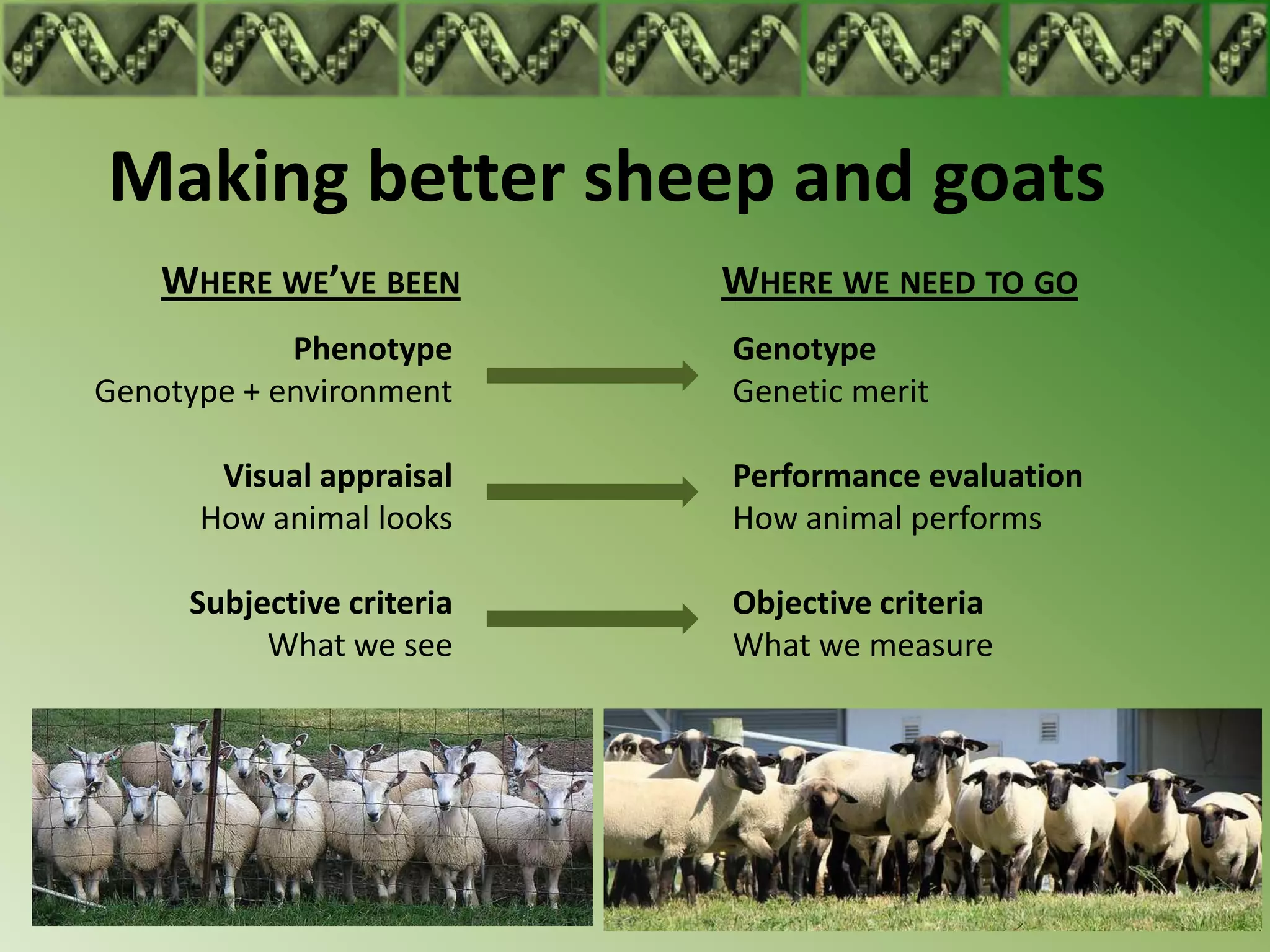
Making better sheep and goats
    WHERE WE’VE BEEN       WHERE WE NEED TO GO
            Phenotype      Genotype
Genotype + environment     Genetic merit

       Visual appraisal    Performance evaluation
      How animal looks     How animal performs

     Subjective criteria   Objective criteria
          What we see      What we measure
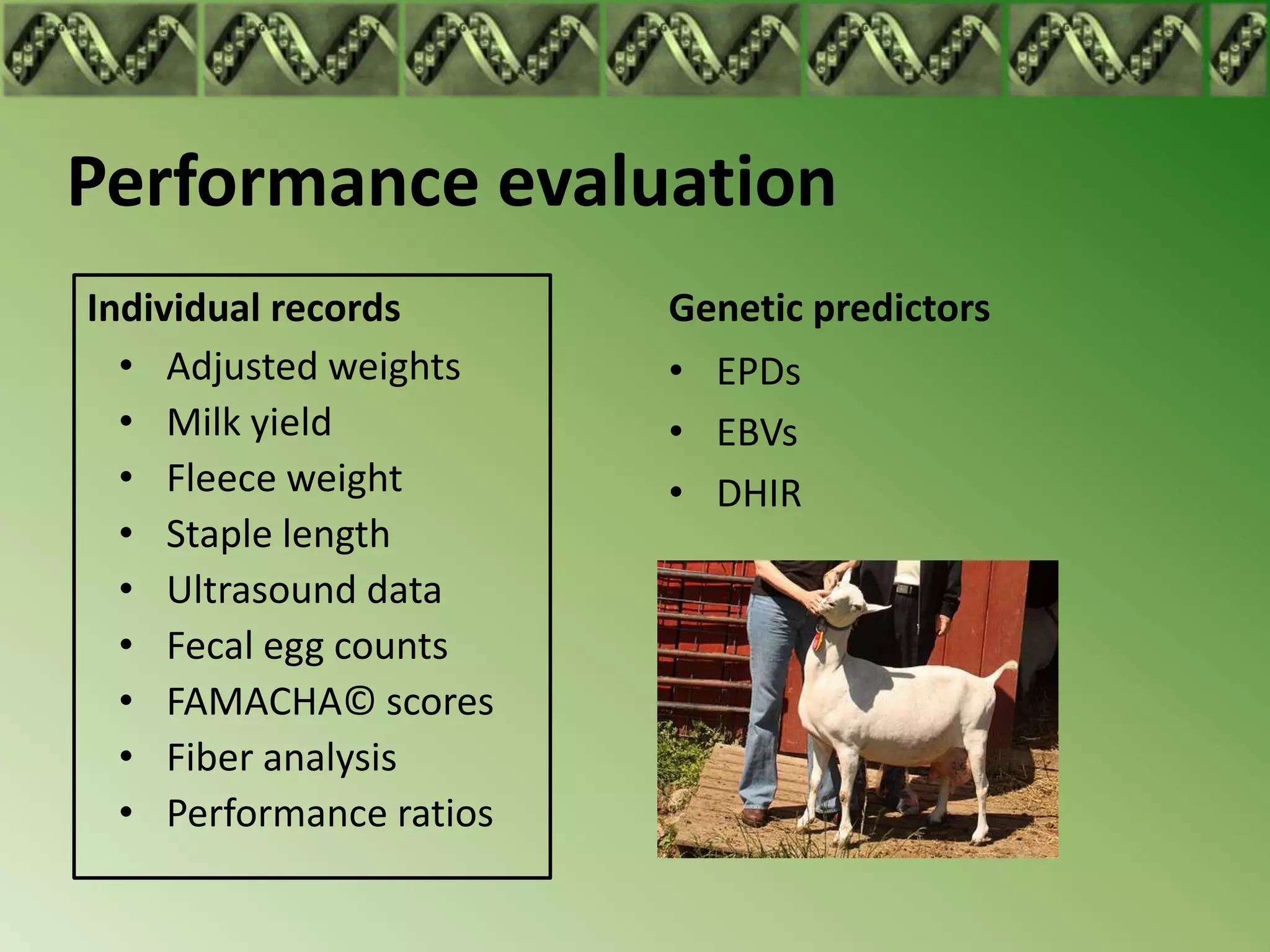
Performance evaluation
Individual records       Genetic predictors
  • Adjusted weights     • EPDs
  • Milk yield           • EBVs
  • Fleece weight        • DHIR
  • Staple length
  • Ultrasound data
  • Fecal egg counts
  • FAMACHA© scores
  • Fiber analysis
  • Performance ratios
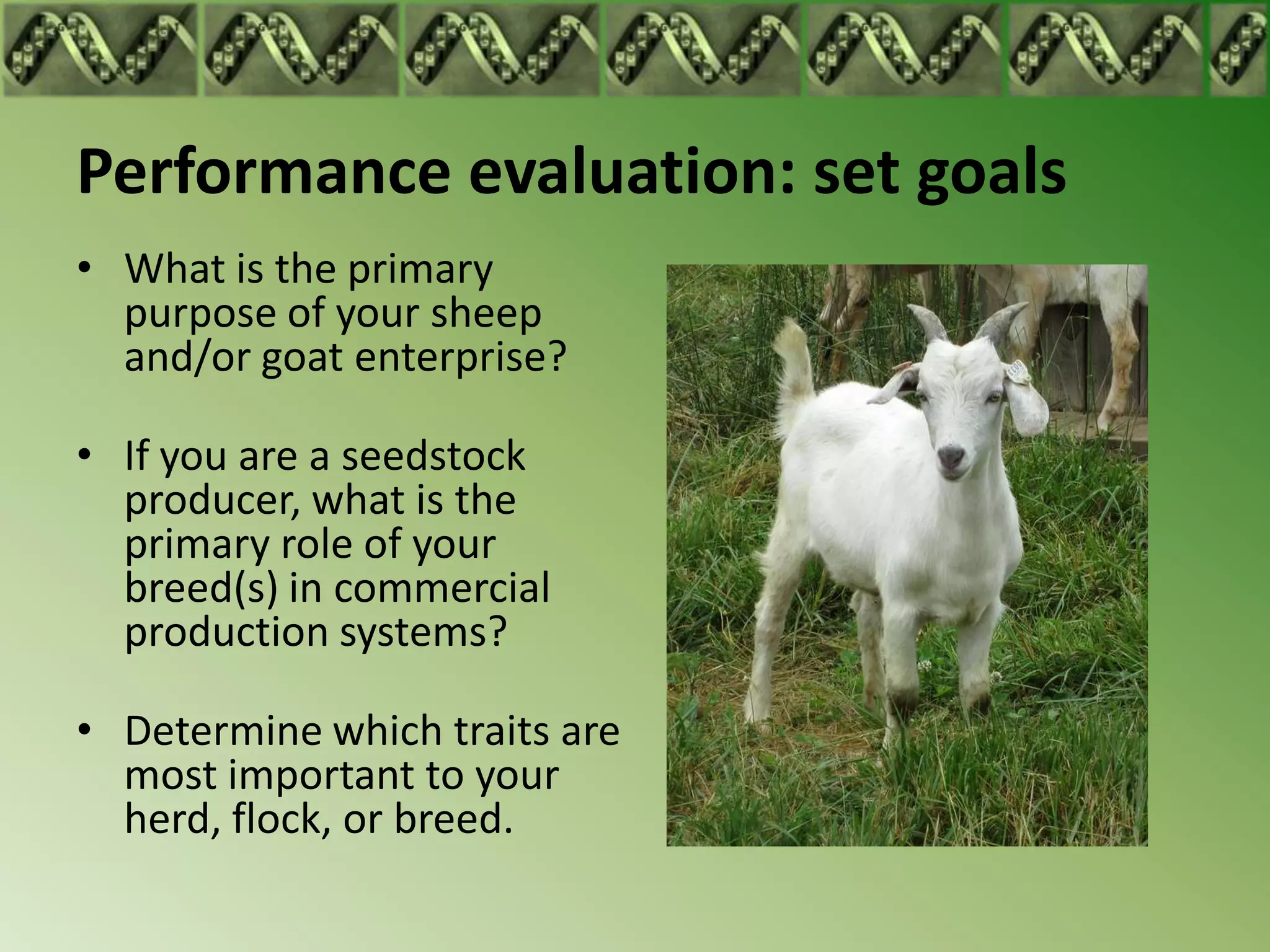
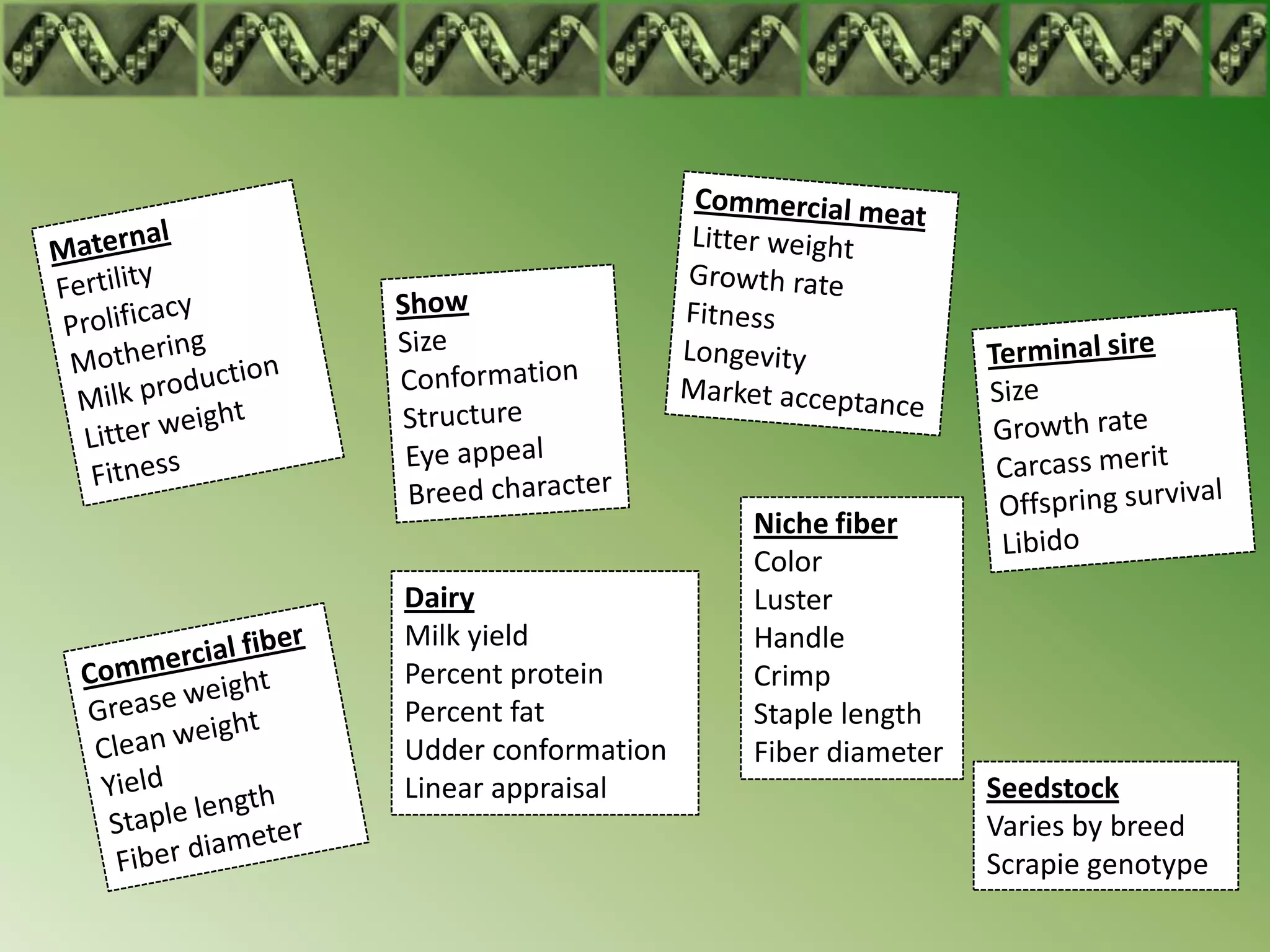
Performance evaluation: set goals
• What is the primary
  purpose of your sheep
  and/or goat enterprise?

• If you are a seedstock
  producer, what is the
  primary role of your
  breed(s) in commercial
  production systems?

• Determine which traits are
  most important to your
  herd, flock, or breed.
Niche fiber
                     Color
Dairy                Luster
Milk yield           Handle
Percent protein      Crimp
Percent fat          Staple length
Udder conformation   Fiber diameter
Linear appraisal                      Seedstock
                                      Varies by breed
                                      Scrapie genotype
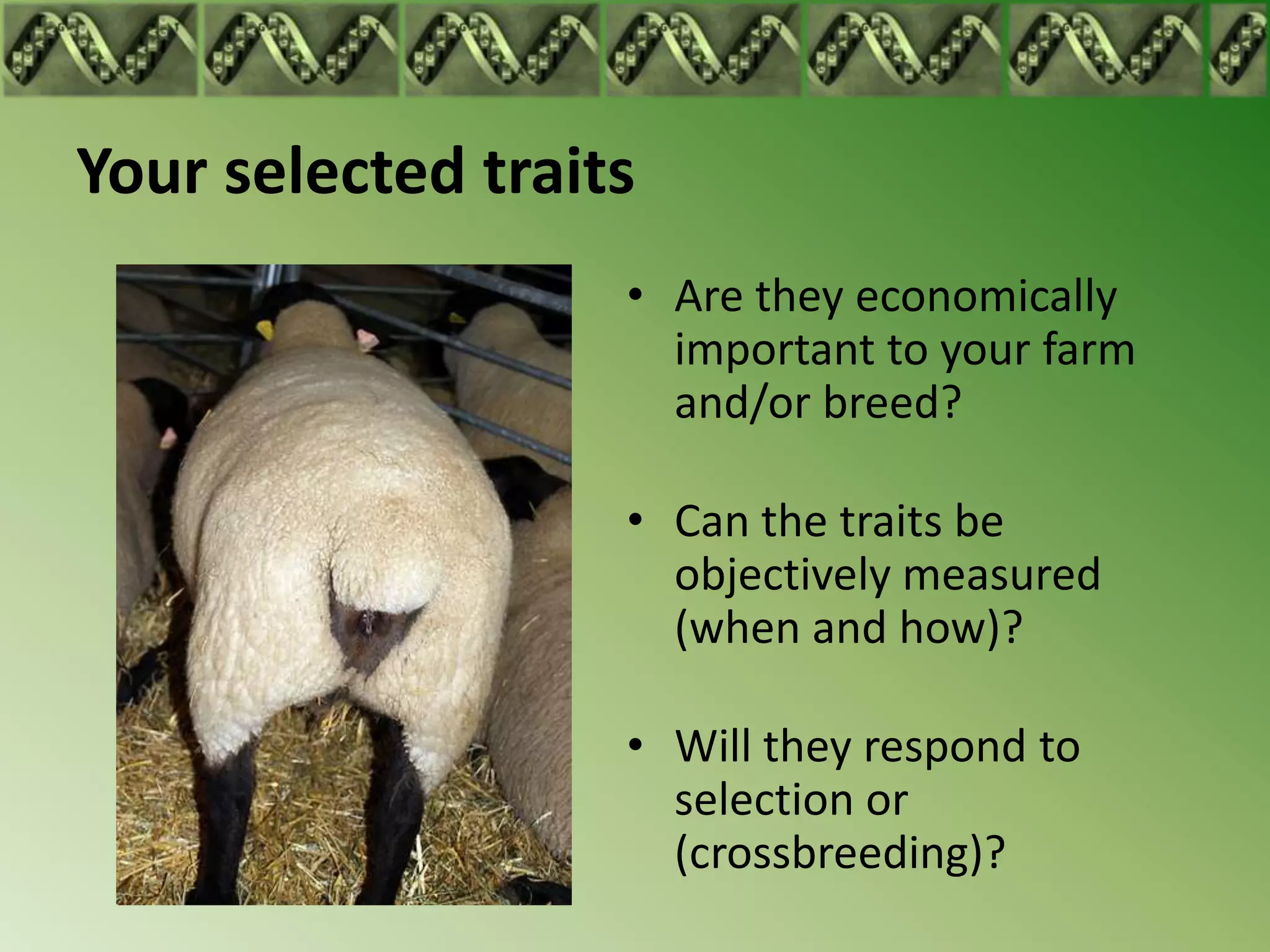
Your selected traits
                   • Are they economically
                     important to your farm
                     and/or breed?

                   • Can the traits be
                     objectively measured
                     (when and how)?

                   • Will they respond to
                     selection or
                     (crossbreeding)?
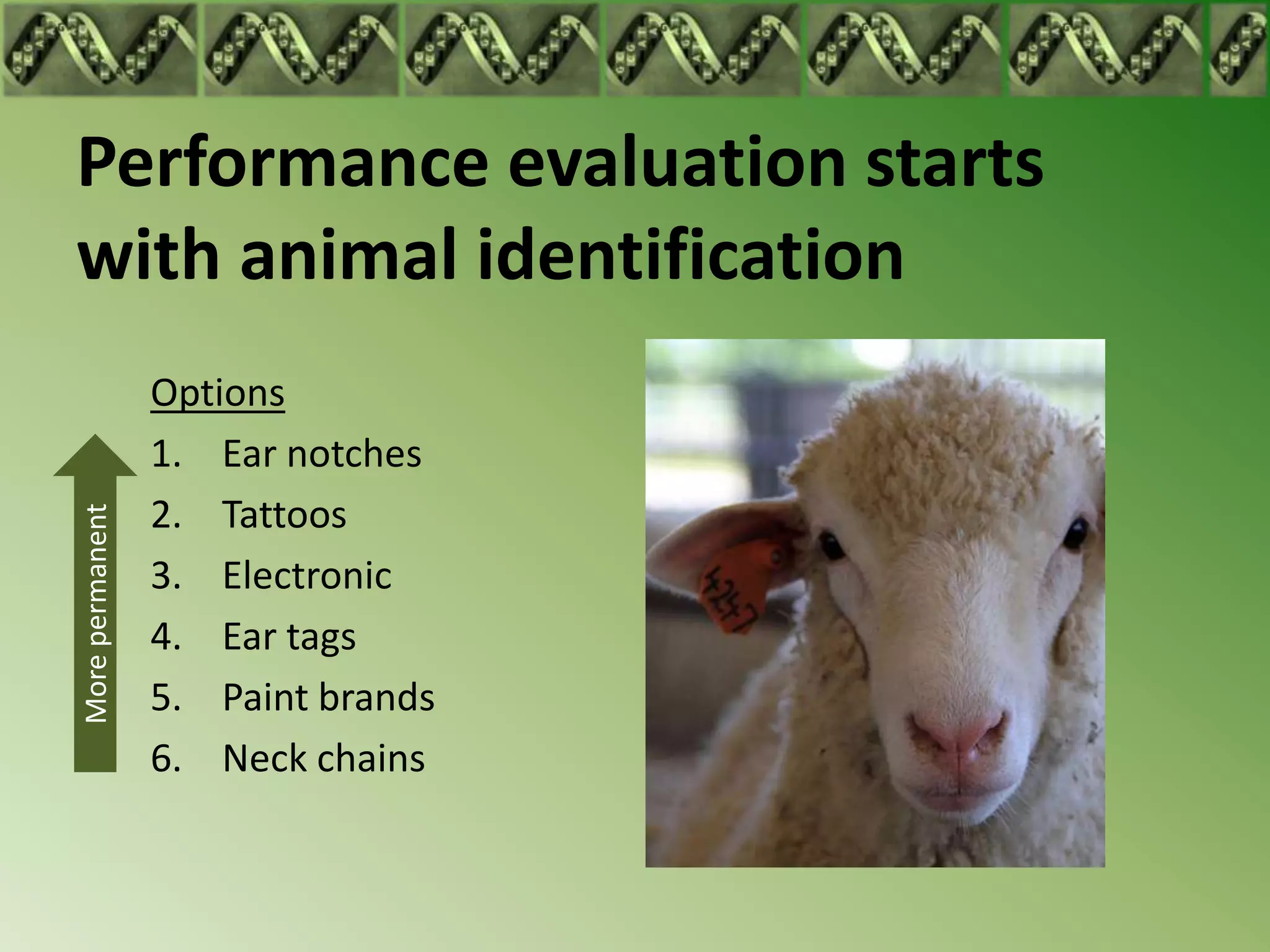
Performance evaluation starts
with animal identification
                 Options
                 1. Ear notches
                 2. Tattoos
More permanent


                 3. Electronic
                 4. Ear tags
                 5. Paint brands
                 6. Neck chains
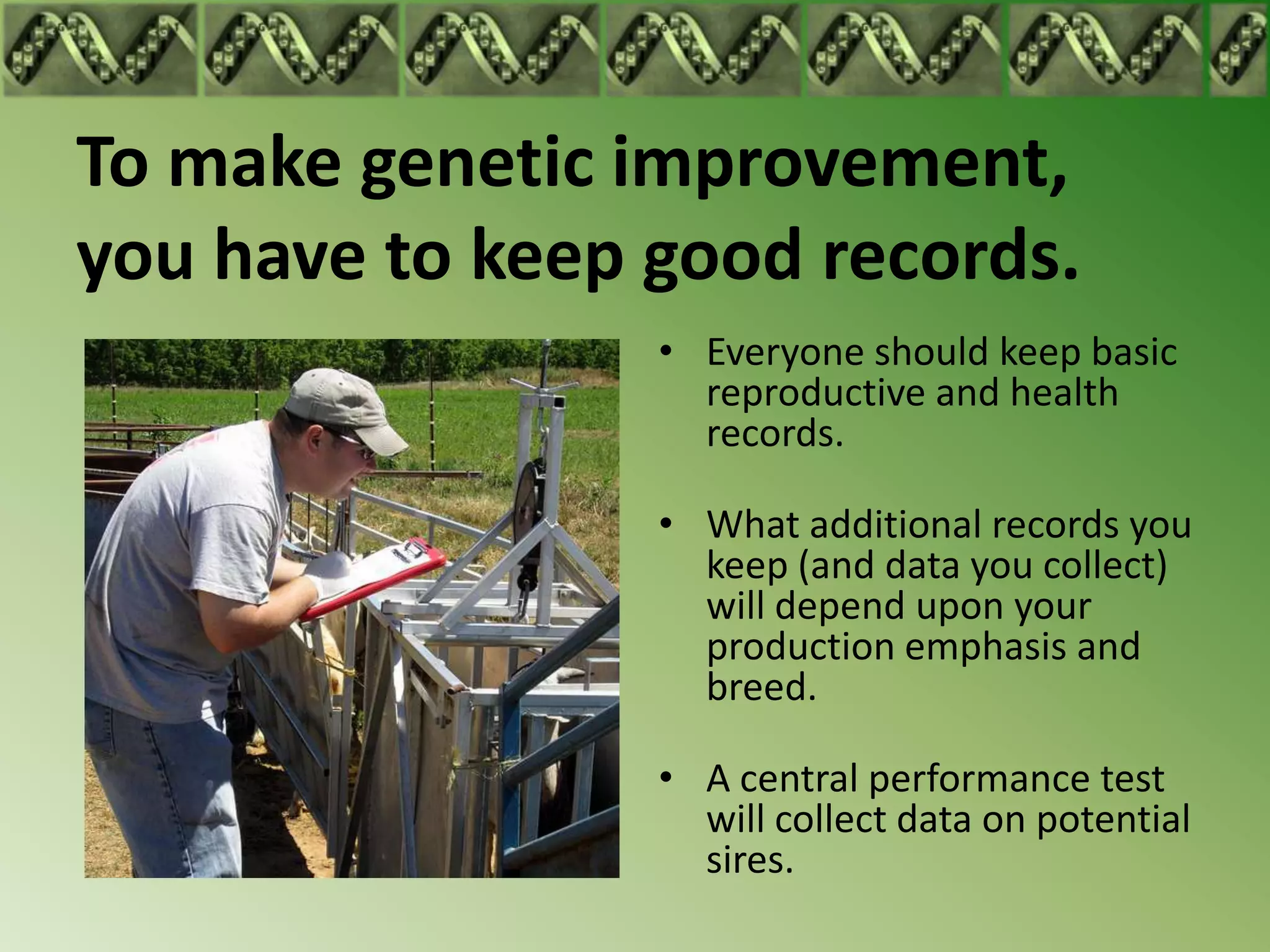
To make genetic improvement,
you have to keep good records.
                 • Everyone should keep basic
                   reproductive and health
                   records.

                 • What additional records you
                   keep (and data you collect)
                   will depend upon your
                   production emphasis and
                   breed.

                 • A central performance test
                   will collect data on potential
                   sires.
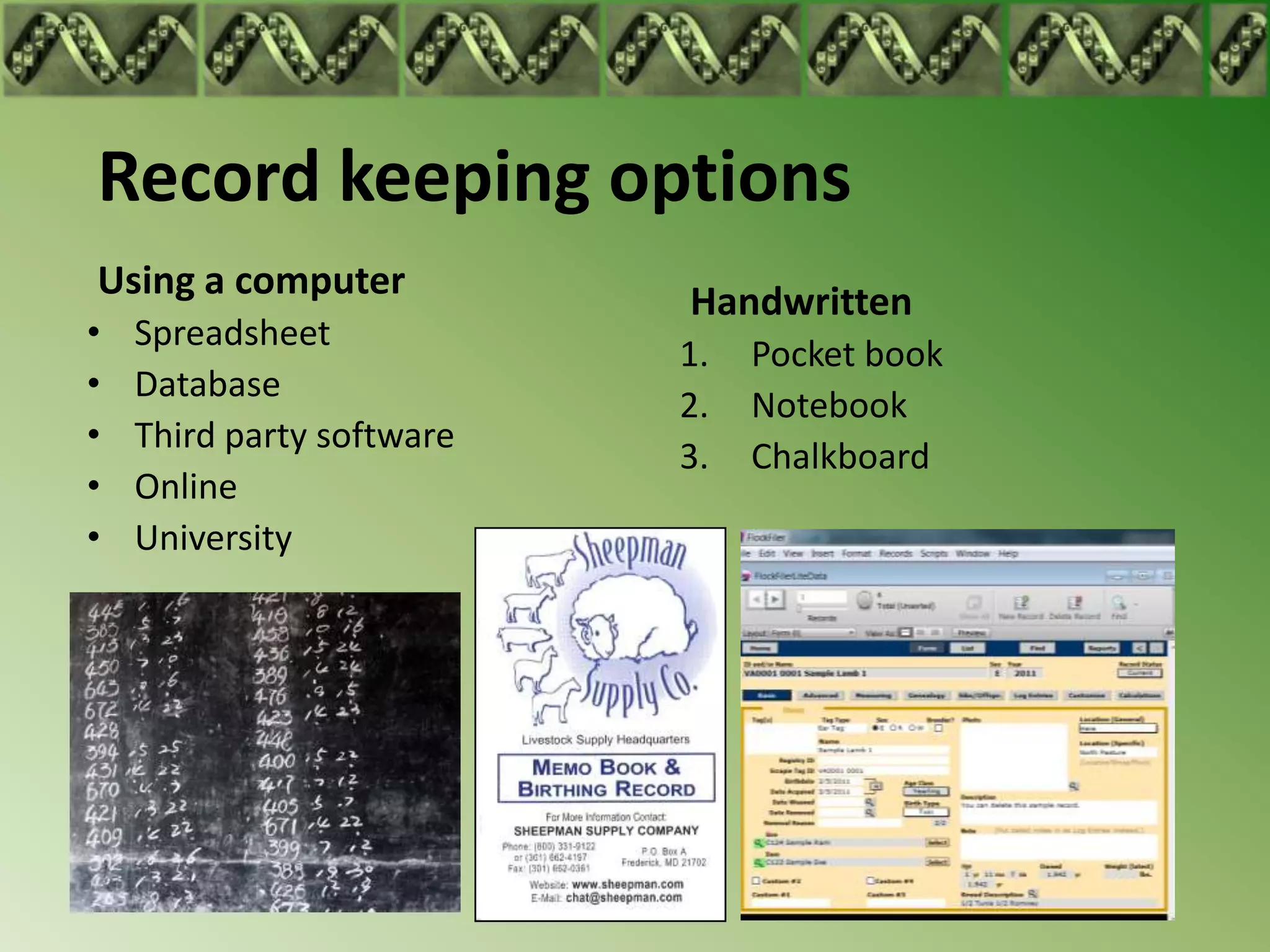
Record keeping options
Using a computer           Handwritten
•   Spreadsheet
                           1.   Pocket book
•   Database
                           2.   Notebook
•   Third party software
                           3.   Chalkboard
•   Online
•   University
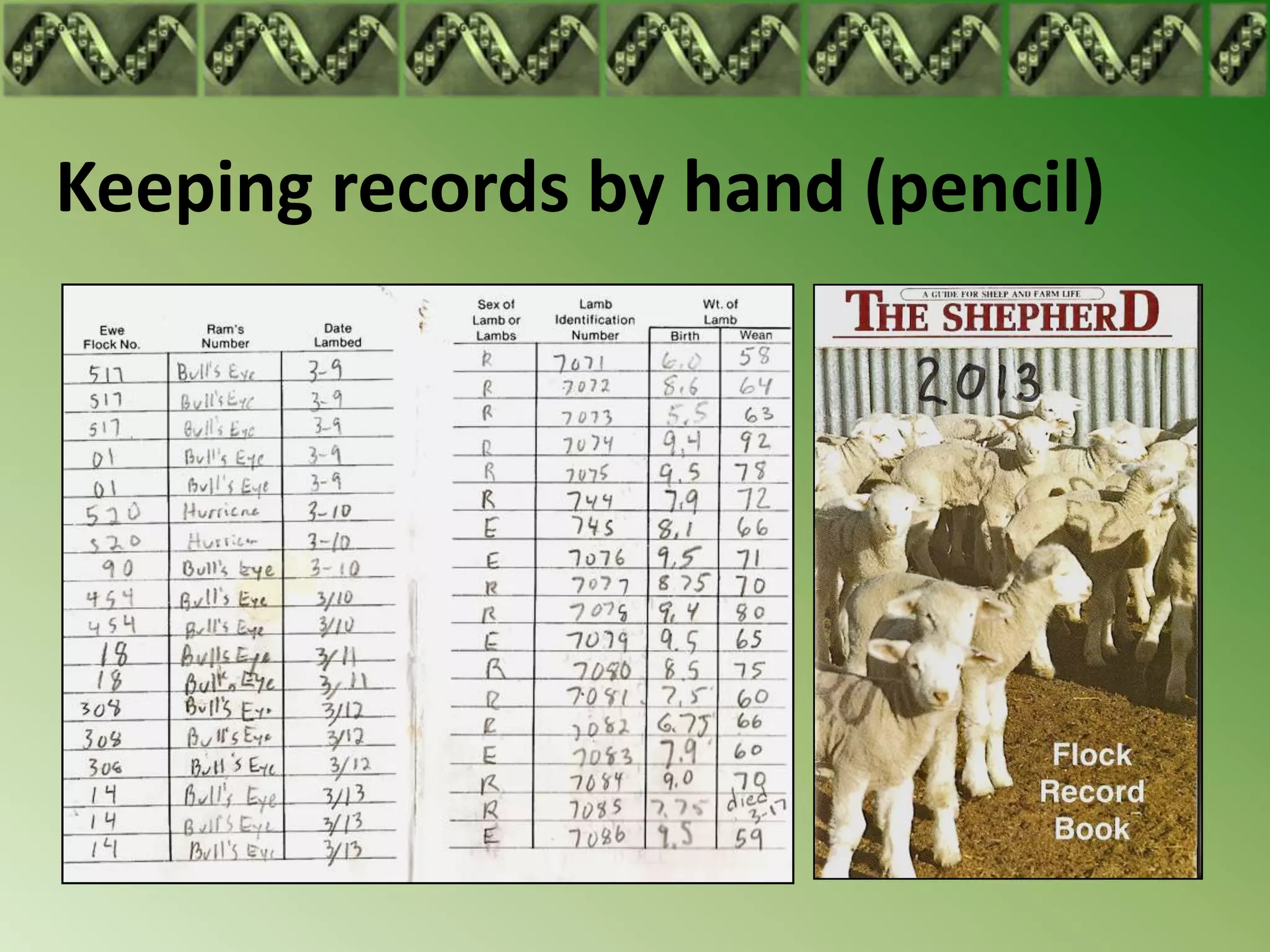
Keeping records by hand (pencil)
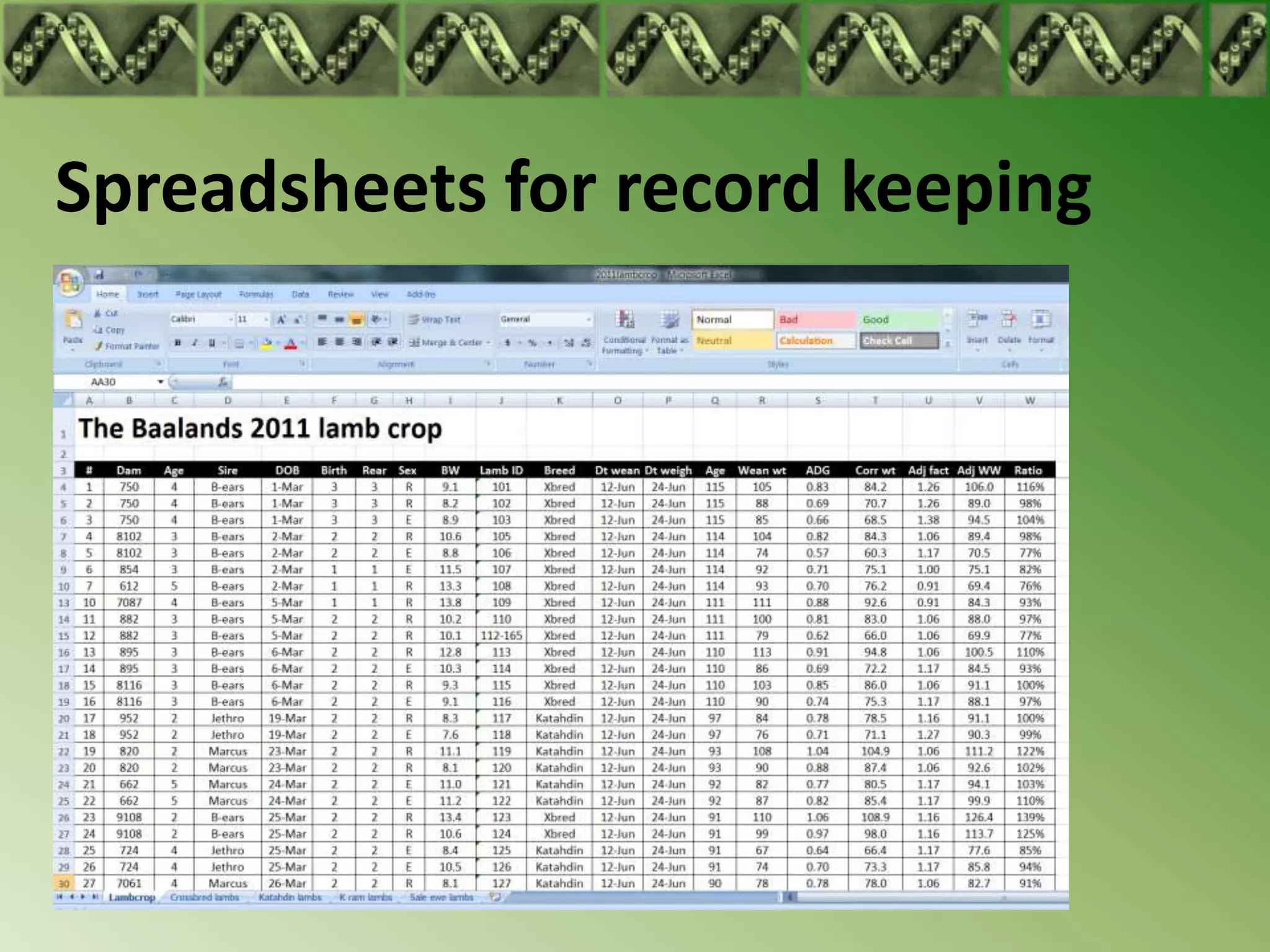
Spreadsheets for record keeping
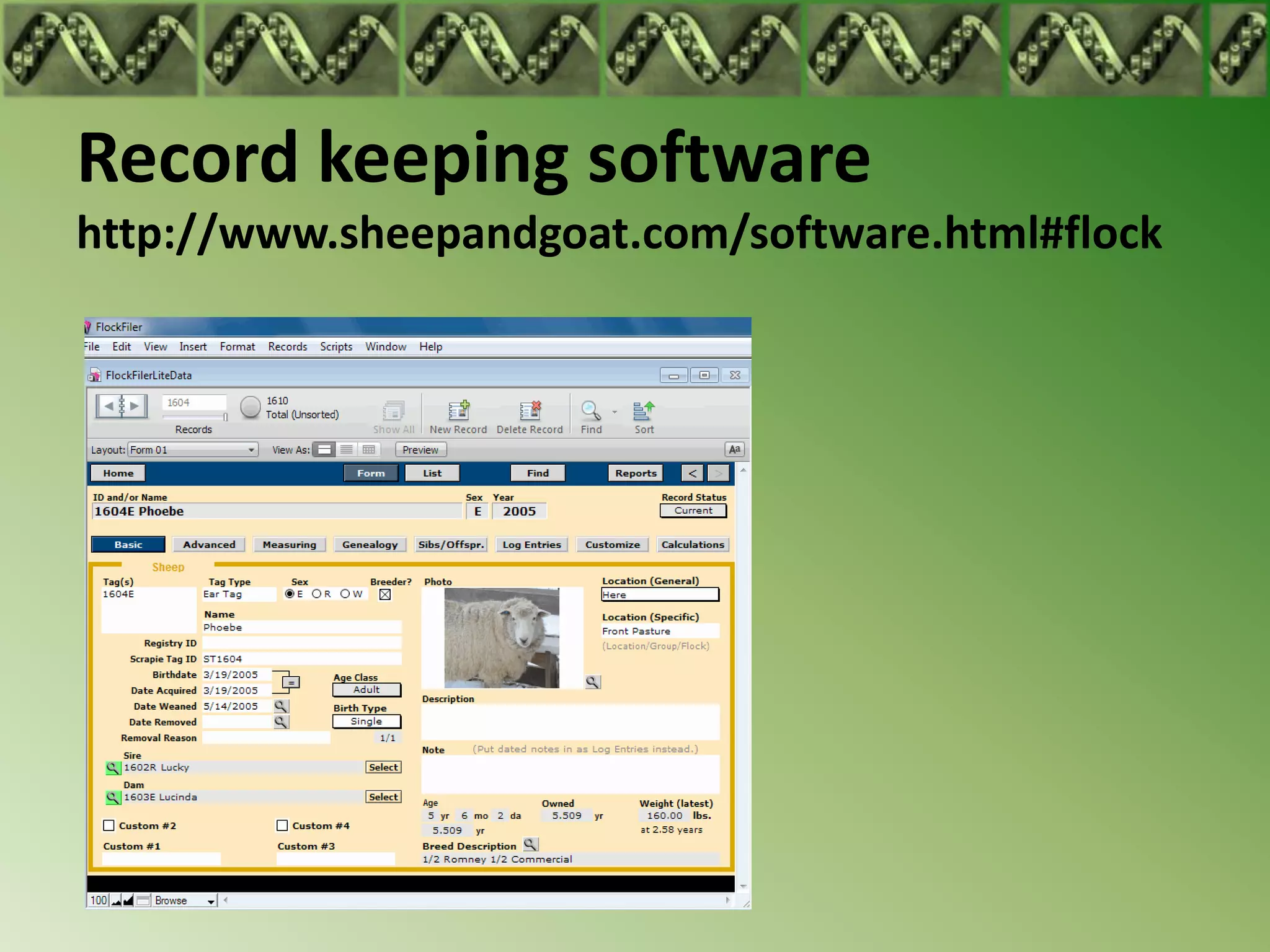
Record keeping software
http://www.sheepandgoat.com/software.html#flock
Performance evaluation
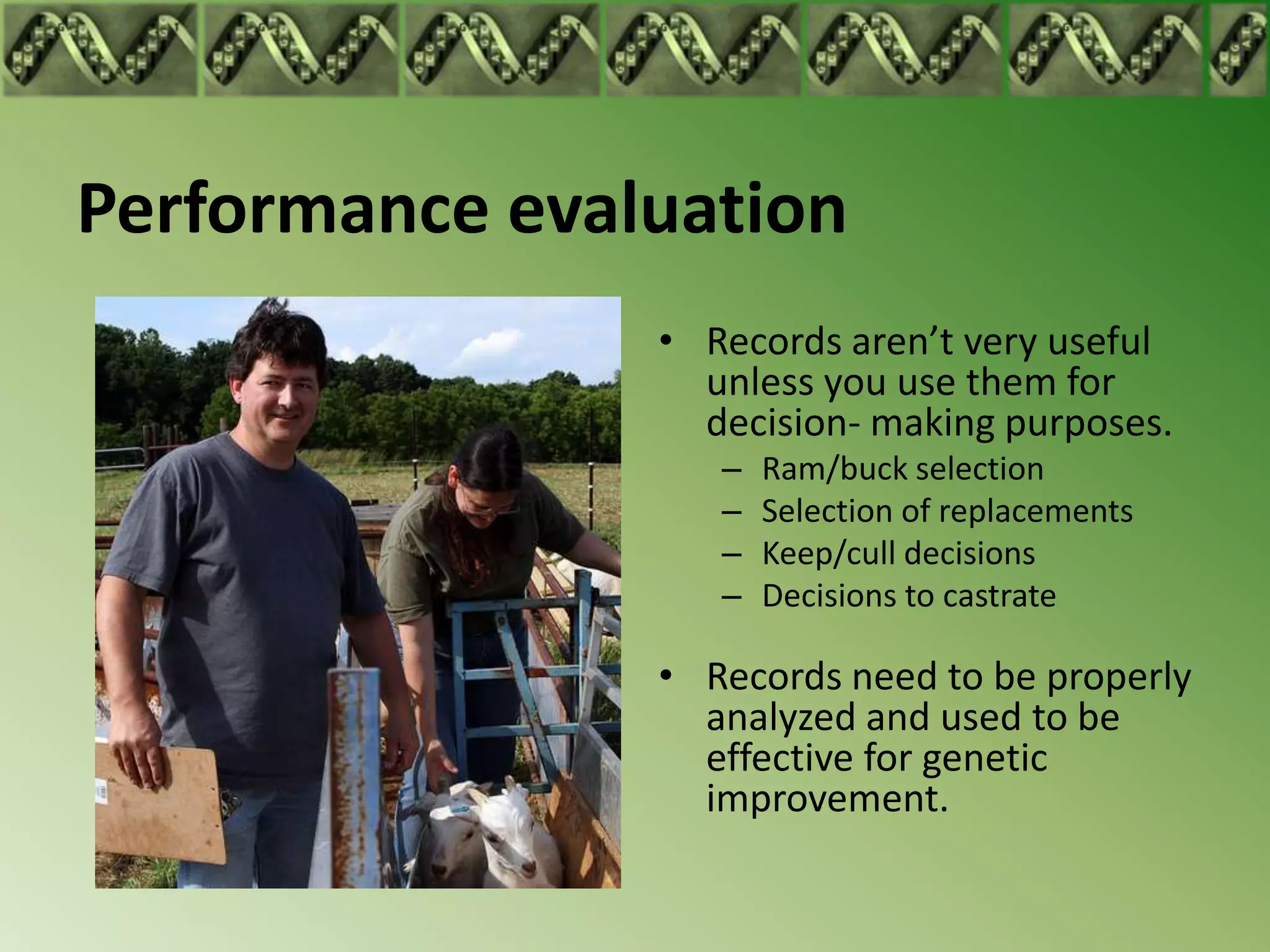
                • Records aren’t very useful
                  unless you use them for
                  decision- making purposes.
                   –   Ram/buck selection
                   –   Selection of replacements
                   –   Keep/cull decisions
                   –   Decisions to castrate

                • Records need to be properly
                  analyzed and used to be
                  effective for genetic
                  improvement.
An important aspect of performance evaluation
Contemporary group
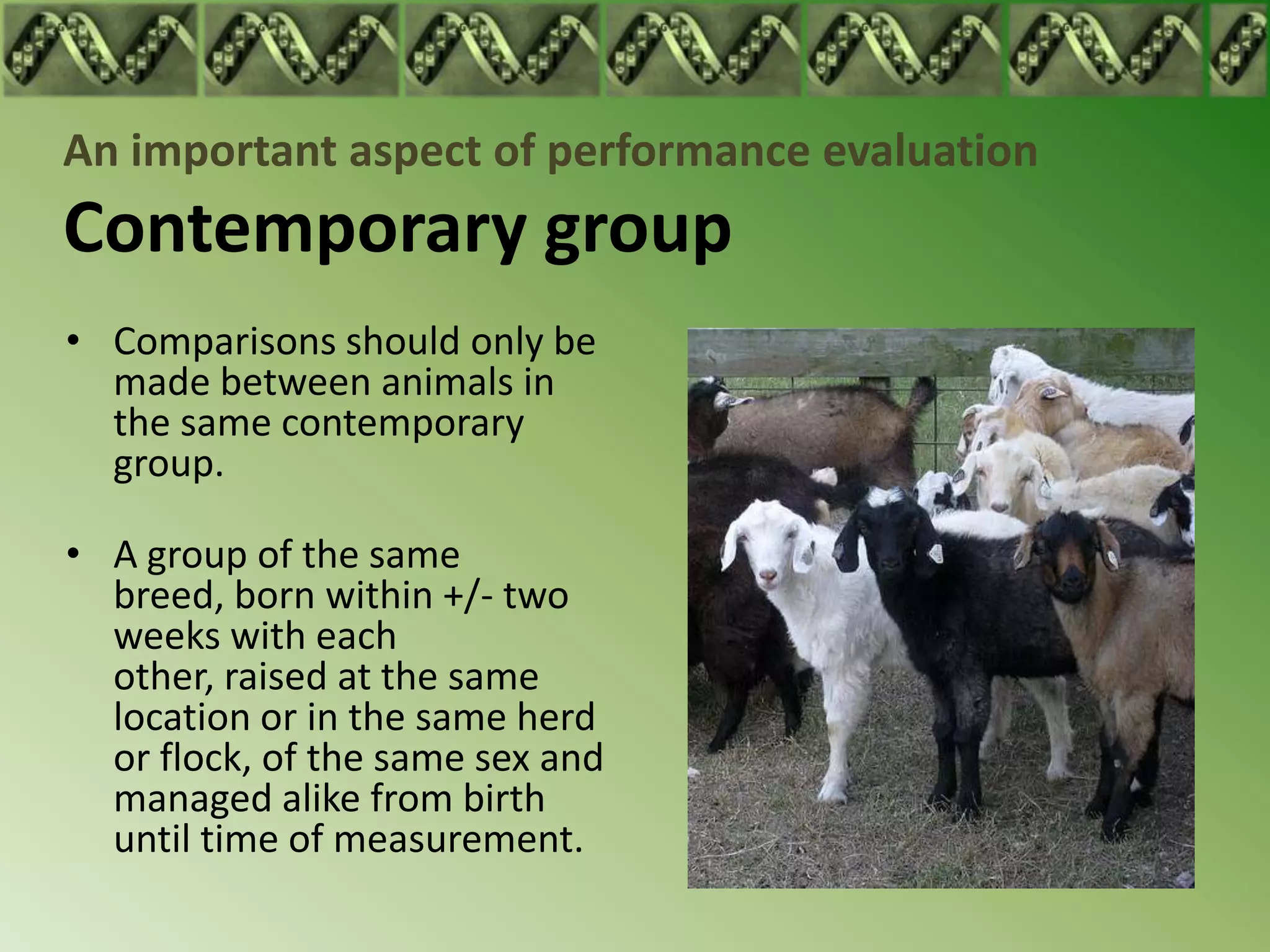
• Comparisons should only be
  made between animals in
  the same contemporary
  group.

• A group of the same
  breed, born within +/- two
  weeks with each
  other, raised at the same
  location or in the same herd
  or flock, of the same sex and
  managed alike from birth
  until time of measurement.
Factors affecting contemporary groups

 •   Breed percentage
 •   Sex
 •   Lambing/kidding period
 •   Location
 •   Management factors
     – Health
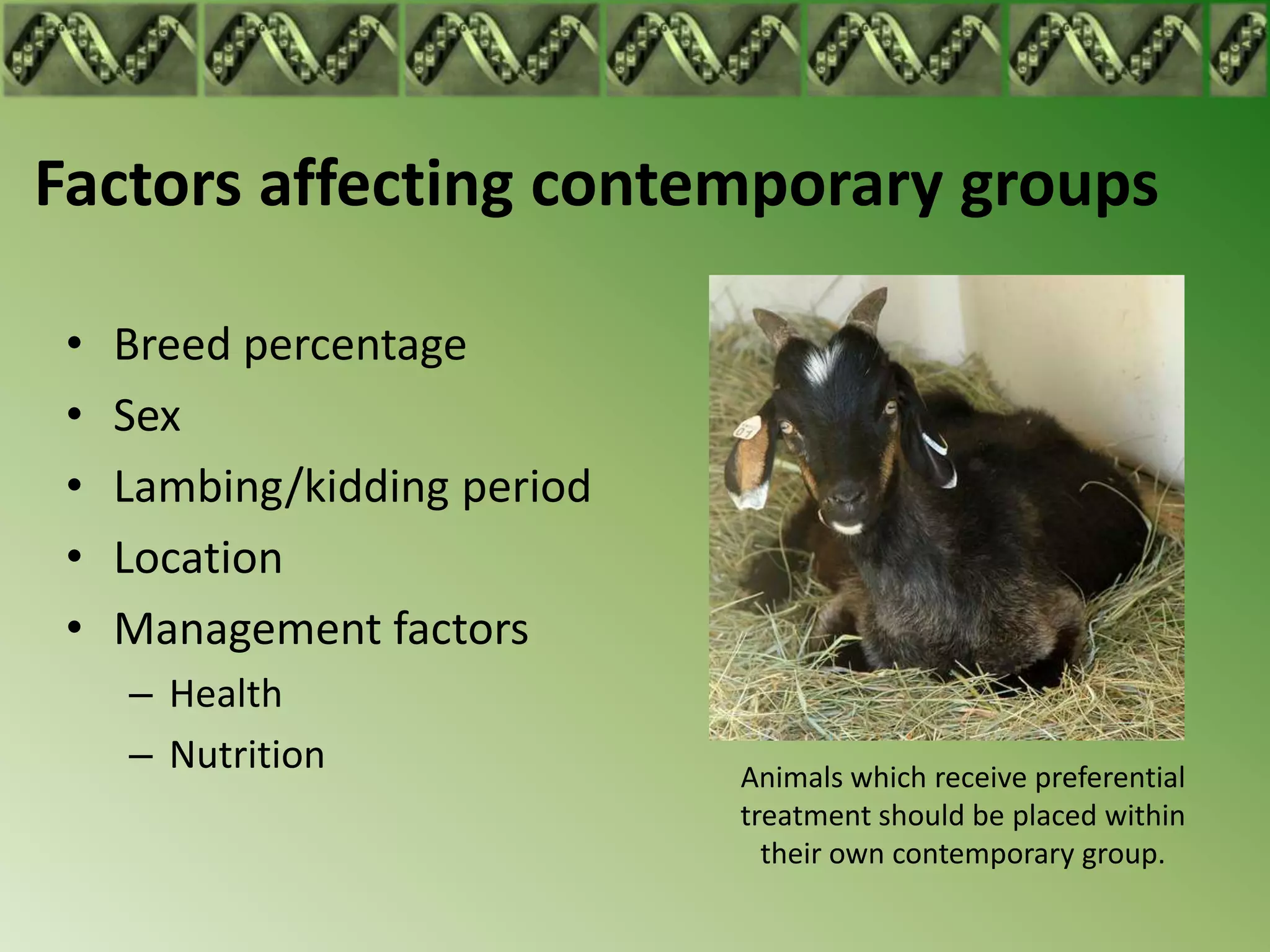
     – Nutrition              Animals which receive preferential
                              treatment should be placed within
                                their own contemporary group.
Another important aspect of performance evaluation
 Adjustments
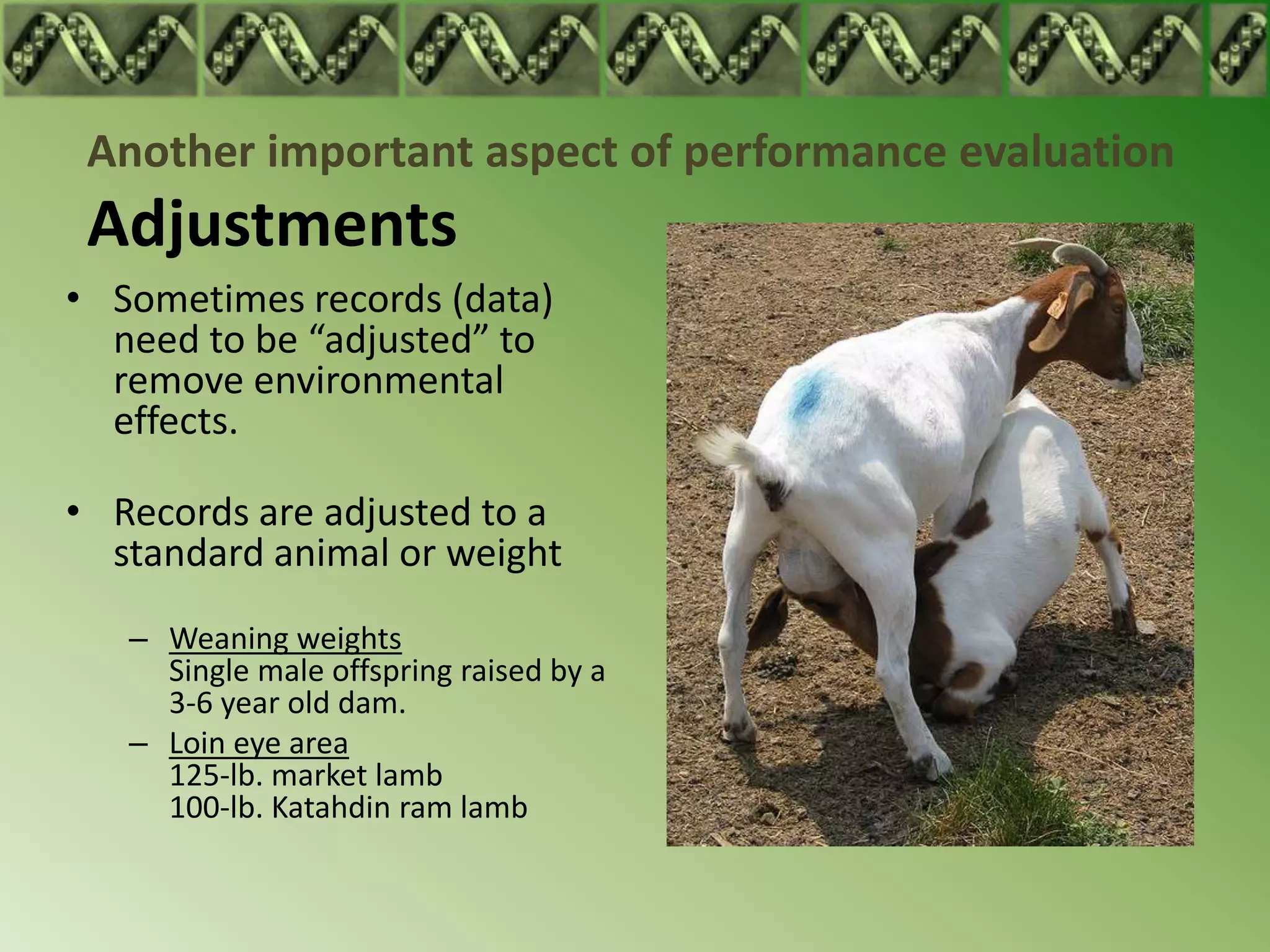
• Sometimes records (data)
  need to be “adjusted” to
  remove environmental
  effects.

• Records are adjusted to a
  standard animal or weight
   – Weaning weights
     Single male offspring raised by a
     3-6 year old dam.
   – Loin eye area
     125-lb. market lamb
     100-lb. Katahdin ram lamb
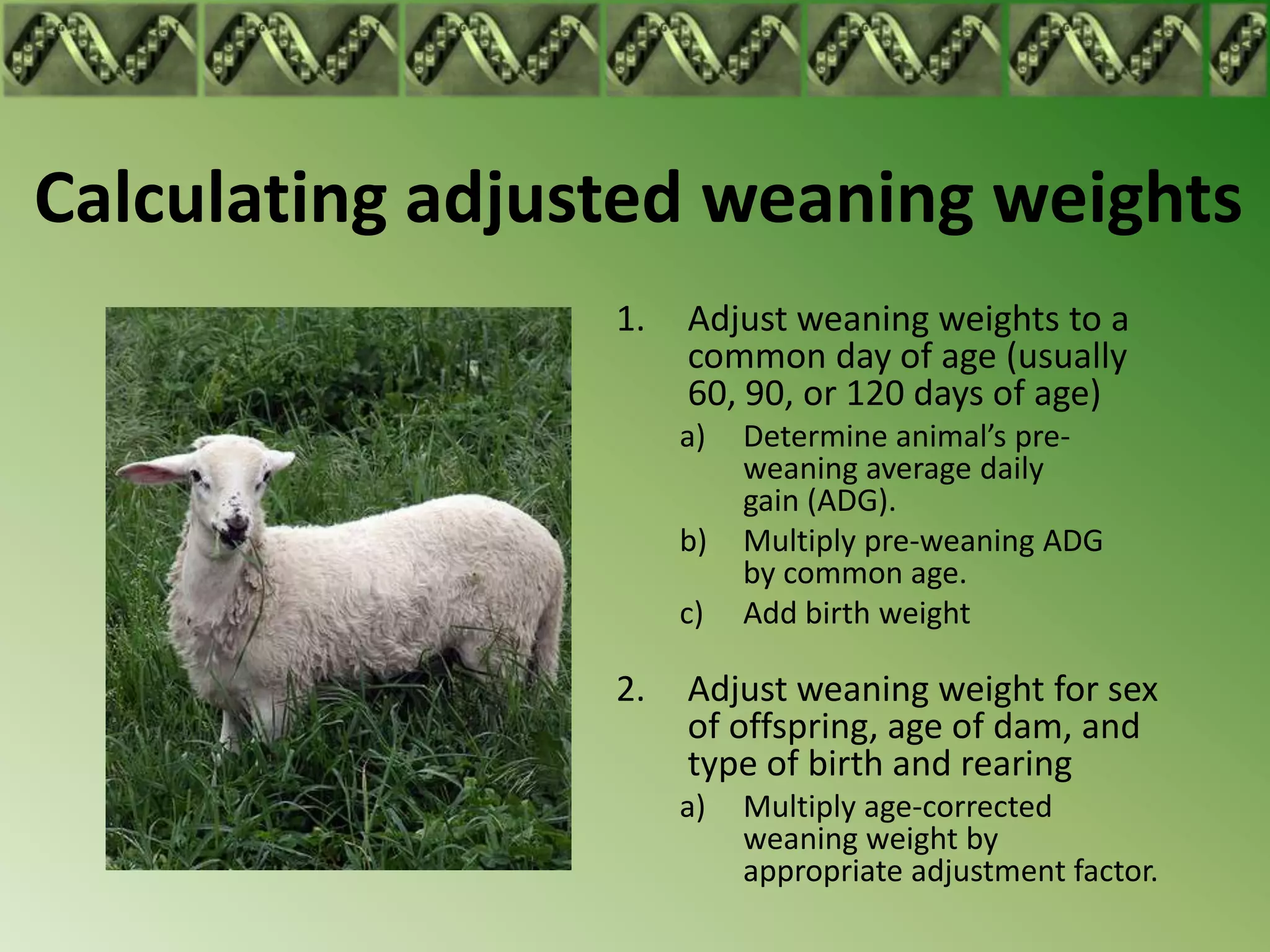
Calculating adjusted weaning weights
                 1.   Adjust weaning weights to a
                      common day of age (usually
                      60, 90, or 120 days of age)
                      a)   Determine animal’s pre-
                           weaning average daily
                           gain (ADG).
                      b)   Multiply pre-weaning ADG
                           by common age.
                      c)   Add birth weight

                 2.   Adjust weaning weight for sex
                      of offspring, age of dam, and
                      type of birth and rearing
                      a)   Multiply age-corrected
                           weaning weight by
                           appropriate adjustment factor.
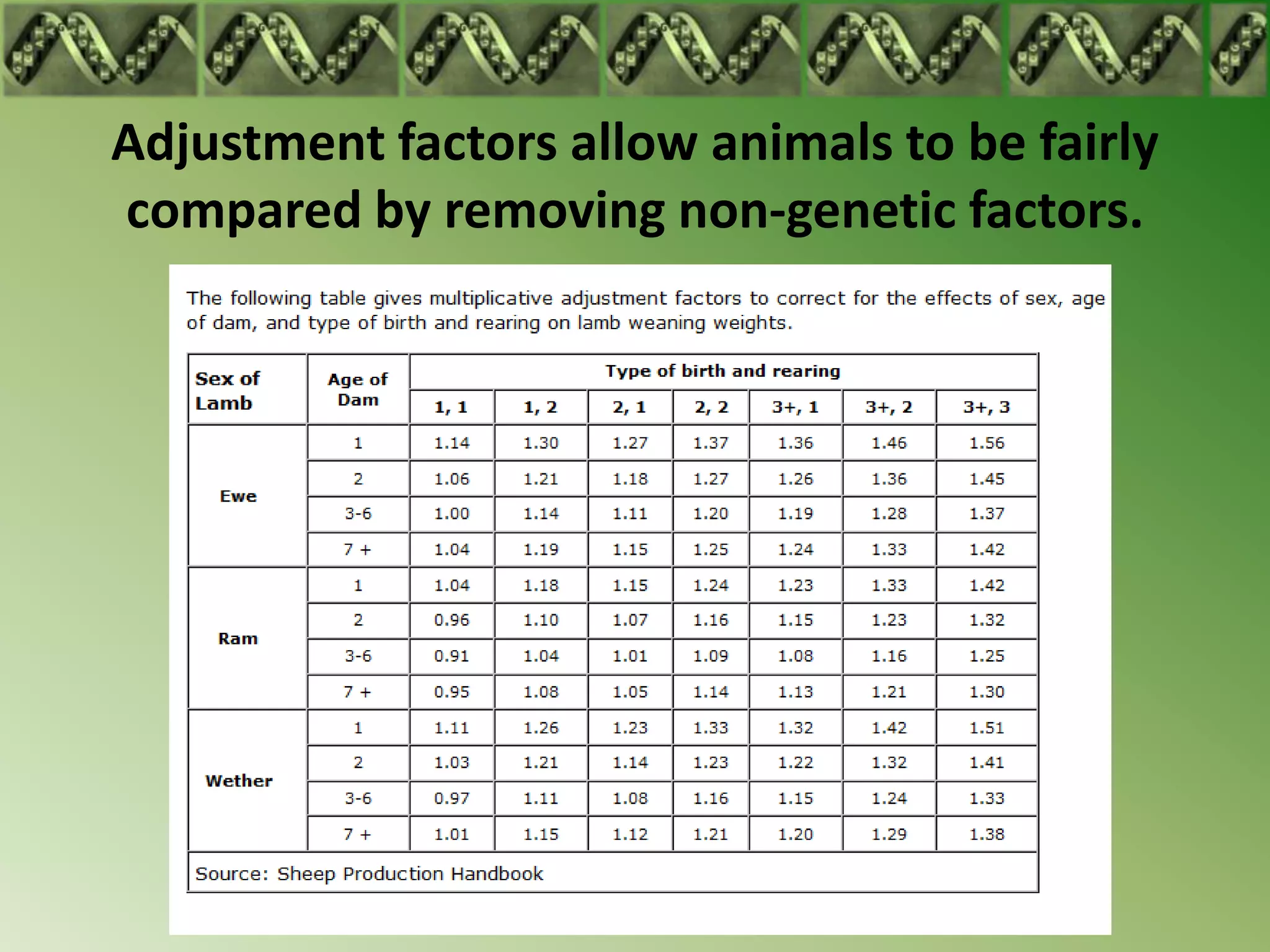
Adjustment factors allow animals to be fairly
compared by removing non-genetic factors.
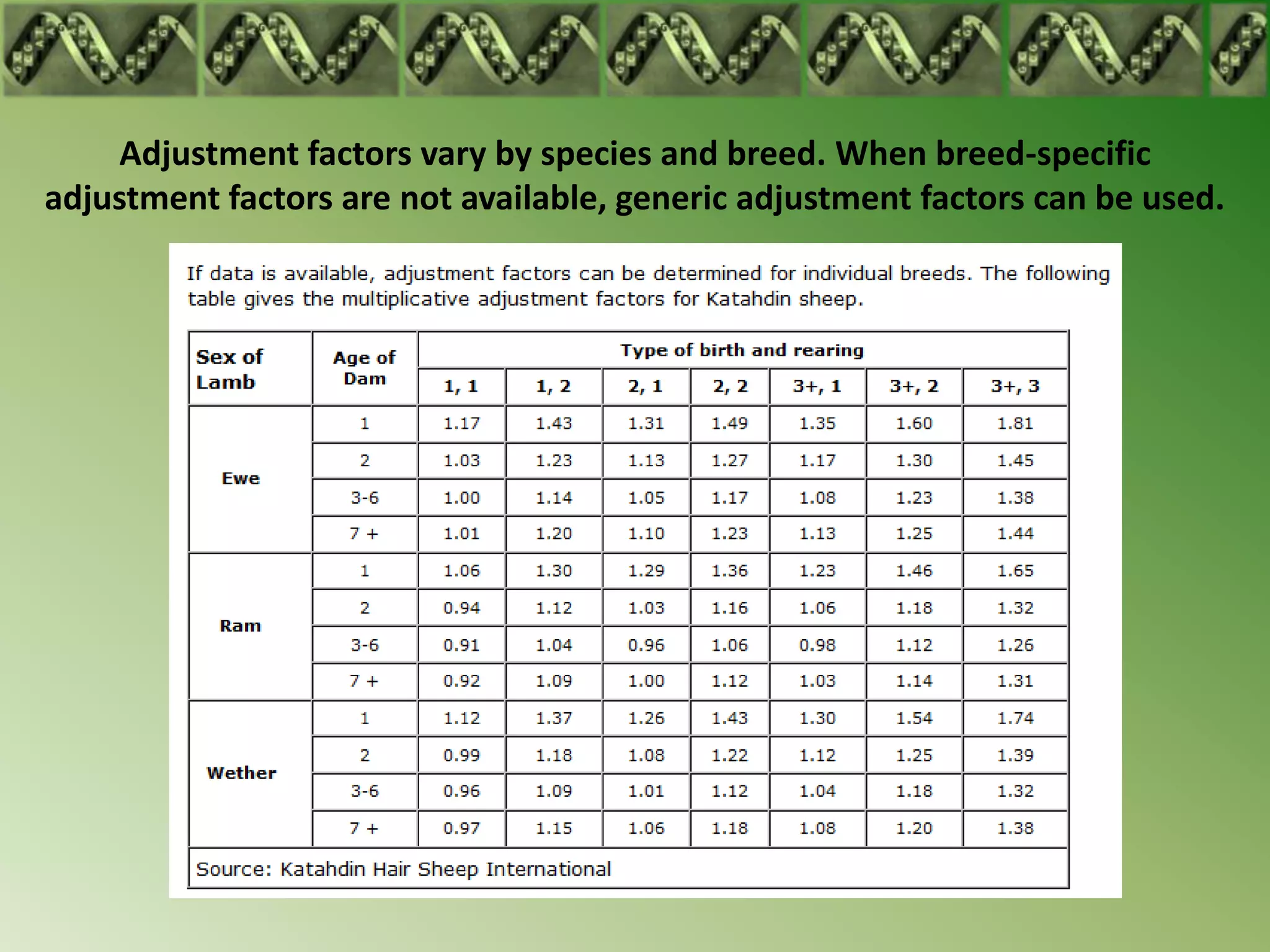
Adjustment factors vary by species and breed. When breed-specific
adjustment factors are not available, generic adjustment factors can be used.
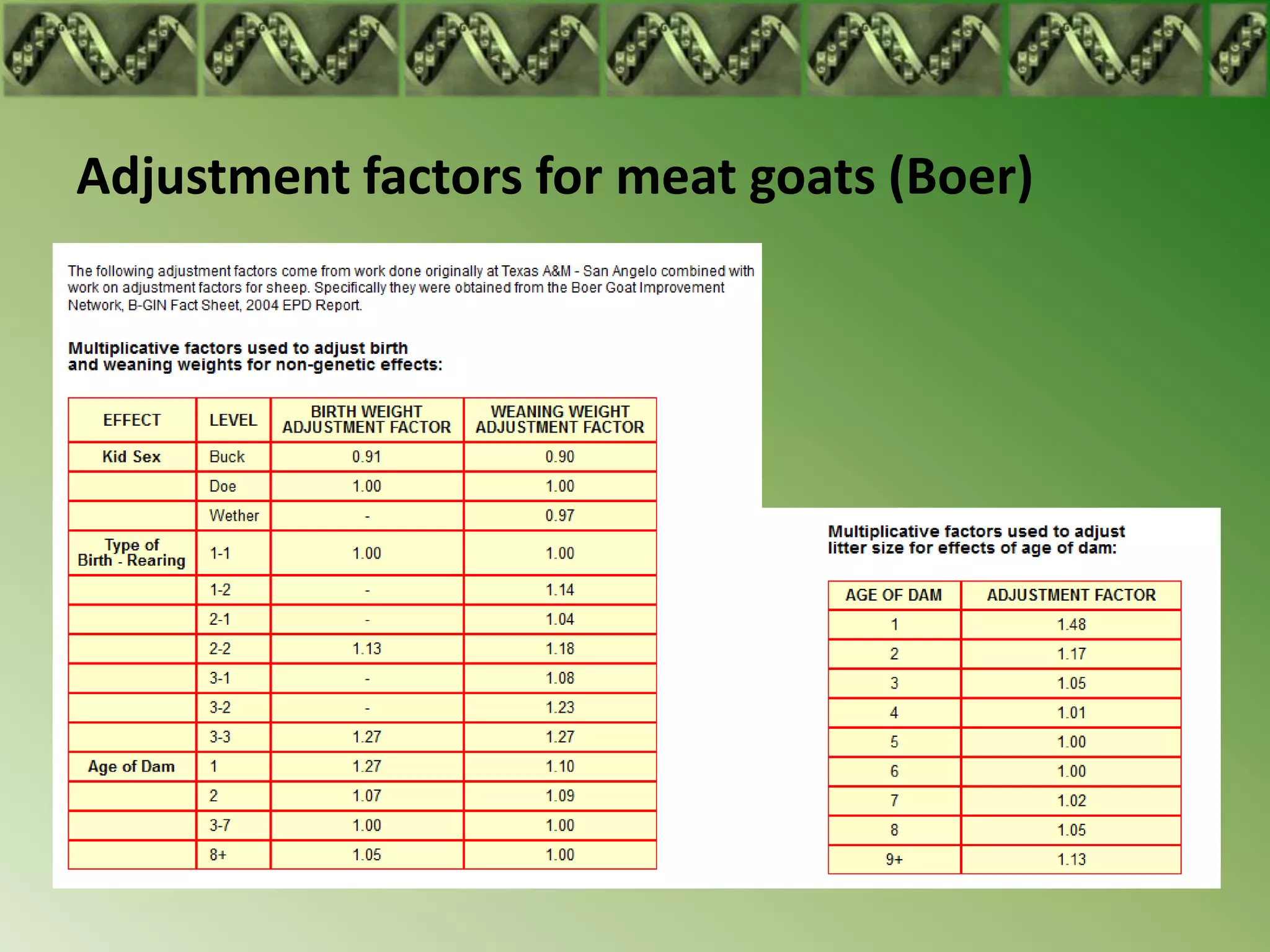
Adjustment factors for meat goats (Boer)
Example
•   Calculate the 60-day adjusted weaning weight for a Dorset
    ram lamb born on March 1 and weaned on June 10. The
    lamb was born and raised as a twin. His birth weight was 10
    lbs. He weighed 70 lbs at weaning. His dam was 2 years old.

    1)   Determine pre-weaning ADG
    2)   Multiply pre-weaning ADG weight by common age
    3)   Add birth weight back in
    4)   Multiply age-corrected weight by adjustment factor (see TABLE)
Born March 1
                                                                      Born/raised twin
                                                                      Weaned June 10
                                                                      Birth weight - 10 #
                                                                      Weaning weight - 70 #
  Example                                                             Age of dam - 2 yrs


    1) Determine pre-weaning ADG

          (weaning weight - birth weight*)                       age (in days)

          (70 - 10)        71 d = 0.85 lb/d


*If birth weight is not known, a weight per day of age (WDA) can be calculated instead.
Born March 1
                                                                      Born/raised twin
                                                                      Weaned June 10
                                                                      Birth weight - 10 #
 Example                                                              Weaning weight - 70 #
                                                                      Age of dam - 2 yrs


 2) Multiply pre-weaning ADG weight by common age
    (0.85 x 60 d) = 51.0 lbs.

 3) Add birth weight back in*
    51.0 lbs. + 10 lbs. + 61.0 lbs.


*If WDA was calculated instead of pre-weaning ADG, do not add a birth weight back in.
Born March 1
                                         Born/raised twin
                                         Weaned June 10
                                         Birth weight - 10 #
Example                                  Weaning weight - 70 #
                                         Age of dam - 2 yrs


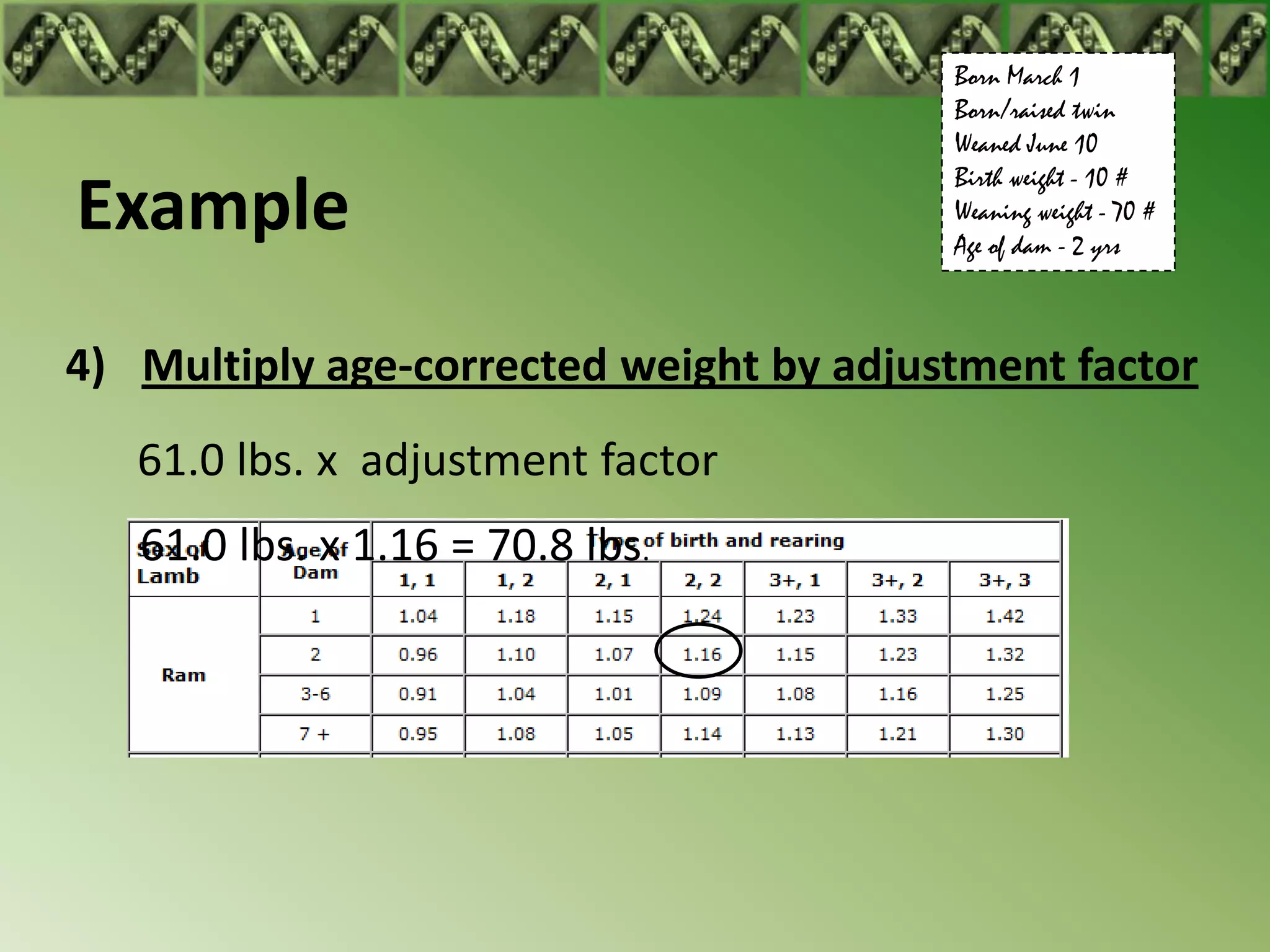
4) Multiply age-corrected weight by adjustment factor
   61.0 lbs. x adjustment factor
   61.0 lbs. x 1.16 = 70.8 lbs.
Performance ratios
• The percent above or below the average of the
  contemporary group.

• Performance ratio
  Individual performance average performance of group x 100
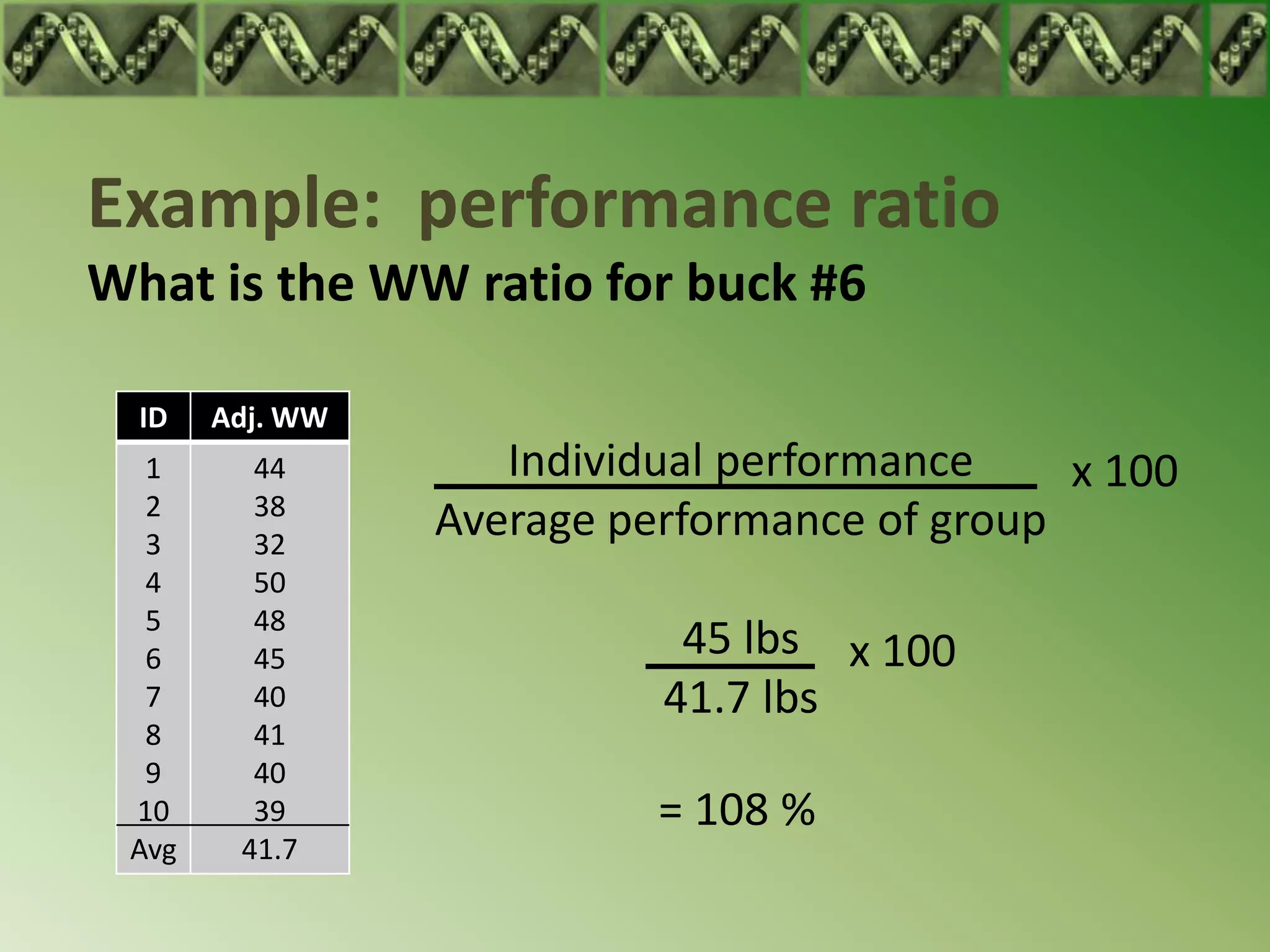
Example: performance ratio
What is the WW ratio for buck #6

  ID   Adj. WW
  1      44         Individual performance    x 100
  2      38
  3      32
                 Average performance of group
  4      50
  5      48
  6      45                 45 lbs x 100
  7      40                41.7 lbs
  8      41
  9      40
 10      39                = 108 %
 Avg    41.7
Selecting for parasite resistance
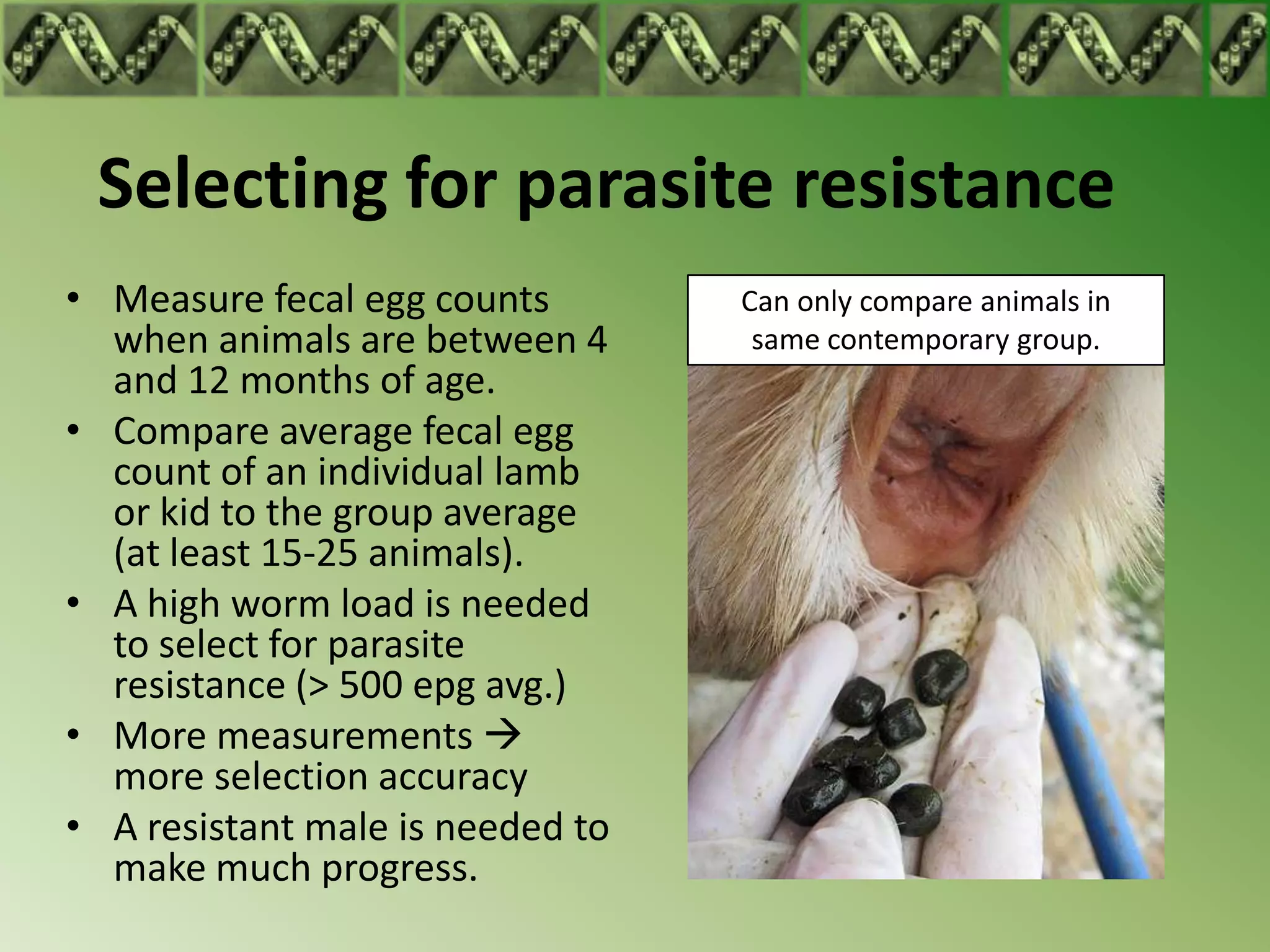
• Measure fecal egg counts        Can only compare animals in
  when animals are between 4       same contemporary group.
  and 12 months of age.
• Compare average fecal egg
  count of an individual lamb
  or kid to the group average
  (at least 15-25 animals).
• A high worm load is needed
  to select for parasite
  resistance (> 500 epg avg.)
• More measurements 
  more selection accuracy
• A resistant male is needed to
  make much progress.
Selecting for parasite resistance
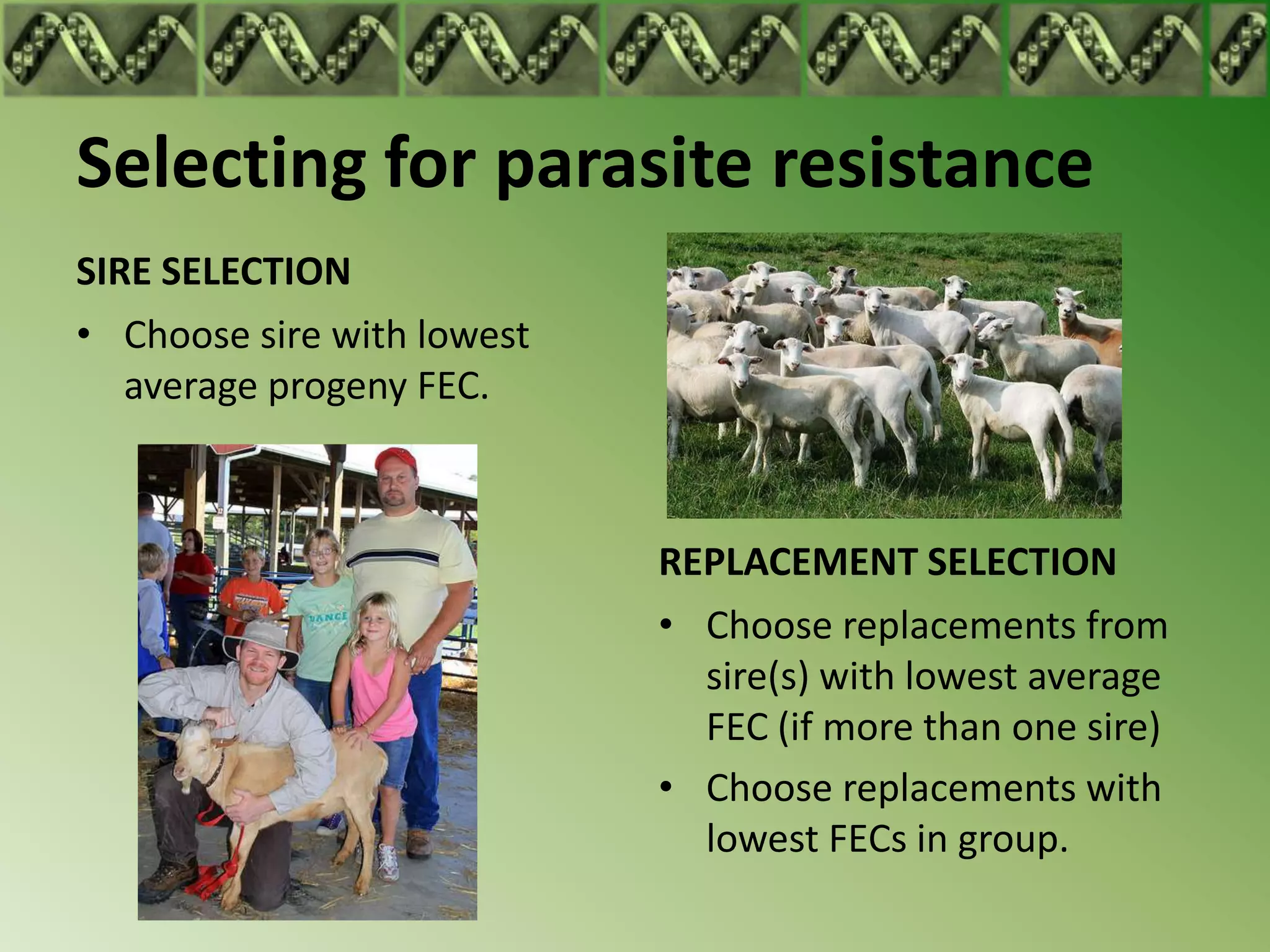
SIRE SELECTION
• Choose sire with lowest
   average progeny FEC.


                            REPLACEMENT SELECTION
                            • Choose replacements from
                              sire(s) with lowest average
                              FEC (if more than one sire)
                            • Choose replacements with
                              lowest FECs in group.
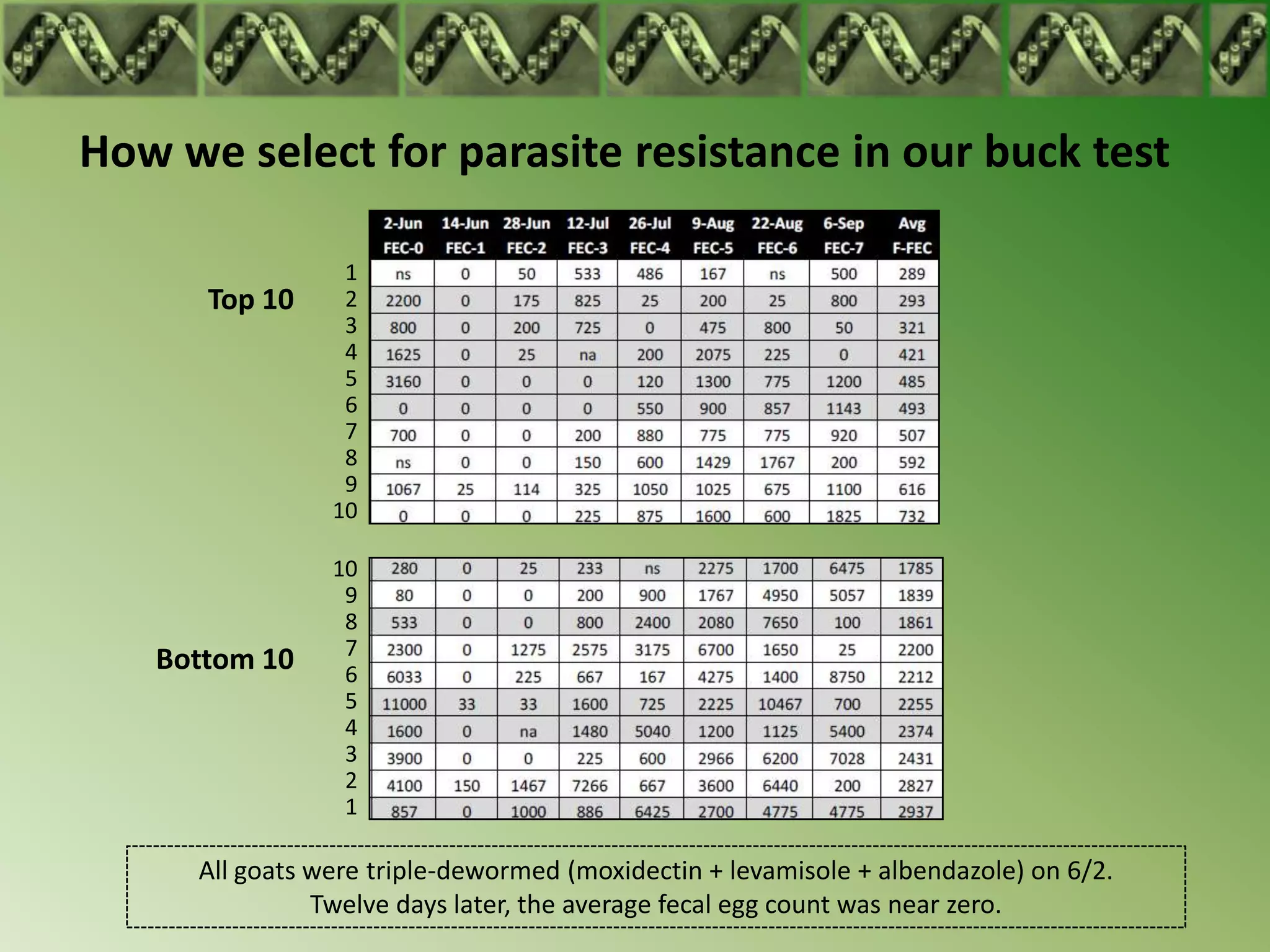
How we select for parasite resistance in our buck test

                 1
      Top 10     2
                 3
                 4
                 5
                 6
                 7
                 8
                 9
                10

                10
                 9
                 8
                 7
   Bottom 10     6
                 5
                 4
                 3
                 2
                 1

     All goats were triple-dewormed (moxidectin + levamisole + albendazole) on 6/2.
               Twelve days later, the average fecal egg count was near zero.
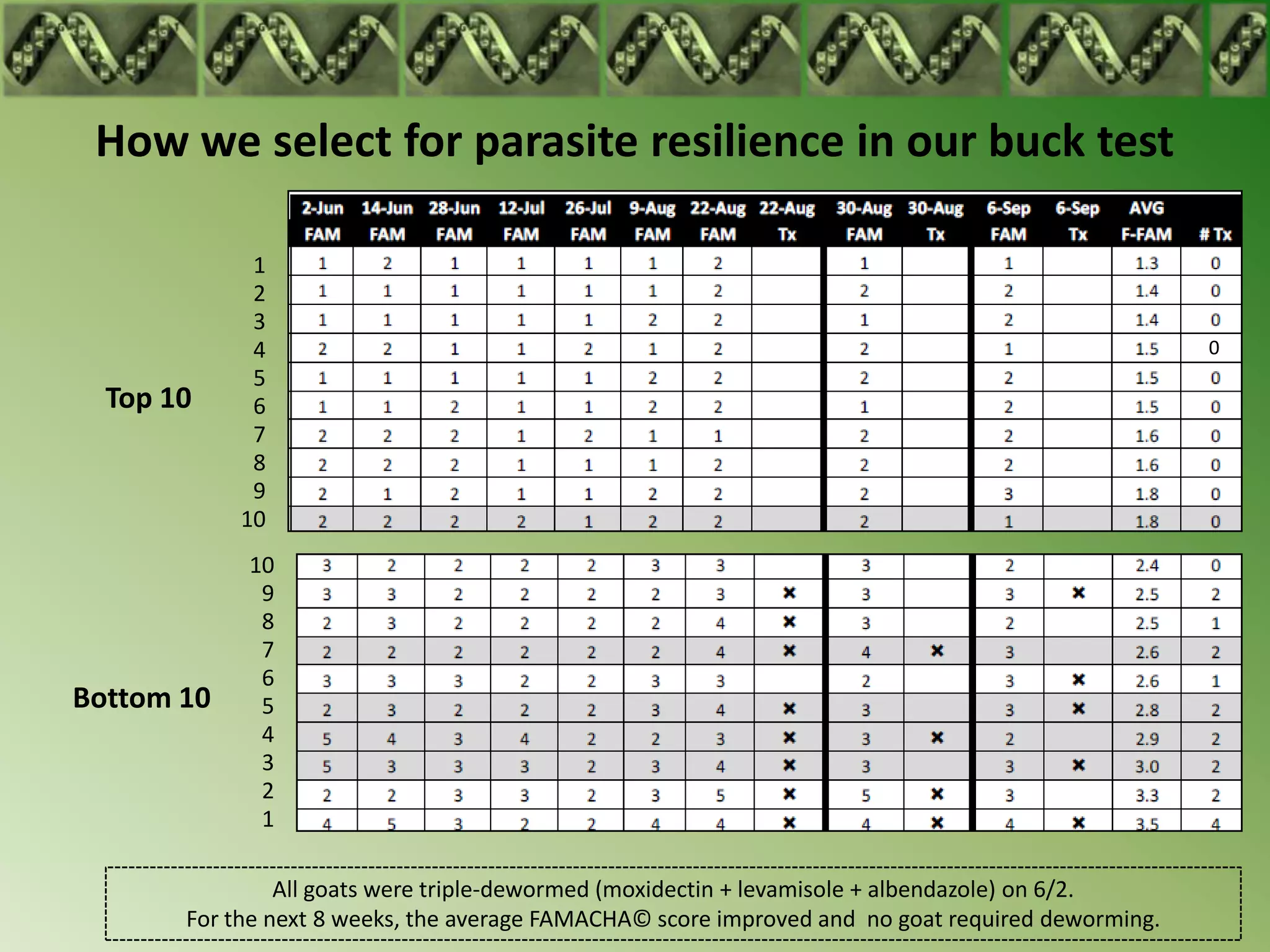
How we select for parasite resilience in our buck test

             1
             2
             3
             4                                                                                     0
             5
  Top 10     6
             7
             8
             9
            10
            10
             9
             8
             7
             6
Bottom 10    5
             4
             3
             2
             1

                All goats were triple-dewormed (moxidectin + levamisole + albendazole) on 6/2.
       For the next 8 weeks, the average FAMACHA© score improved and no goat required deworming.
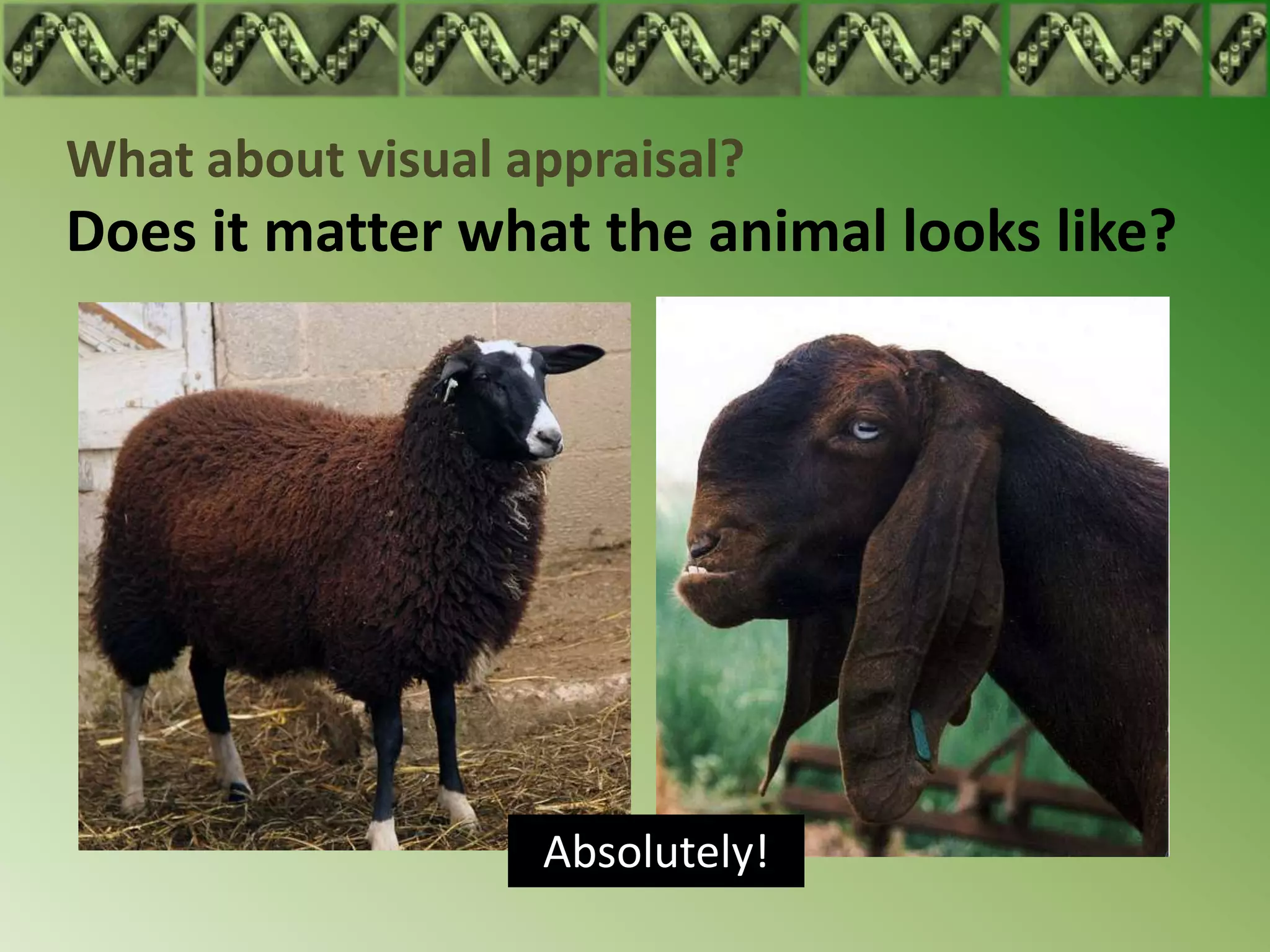
What about visual appraisal?
Does it matter what the animal looks like?


                   Absolutely!
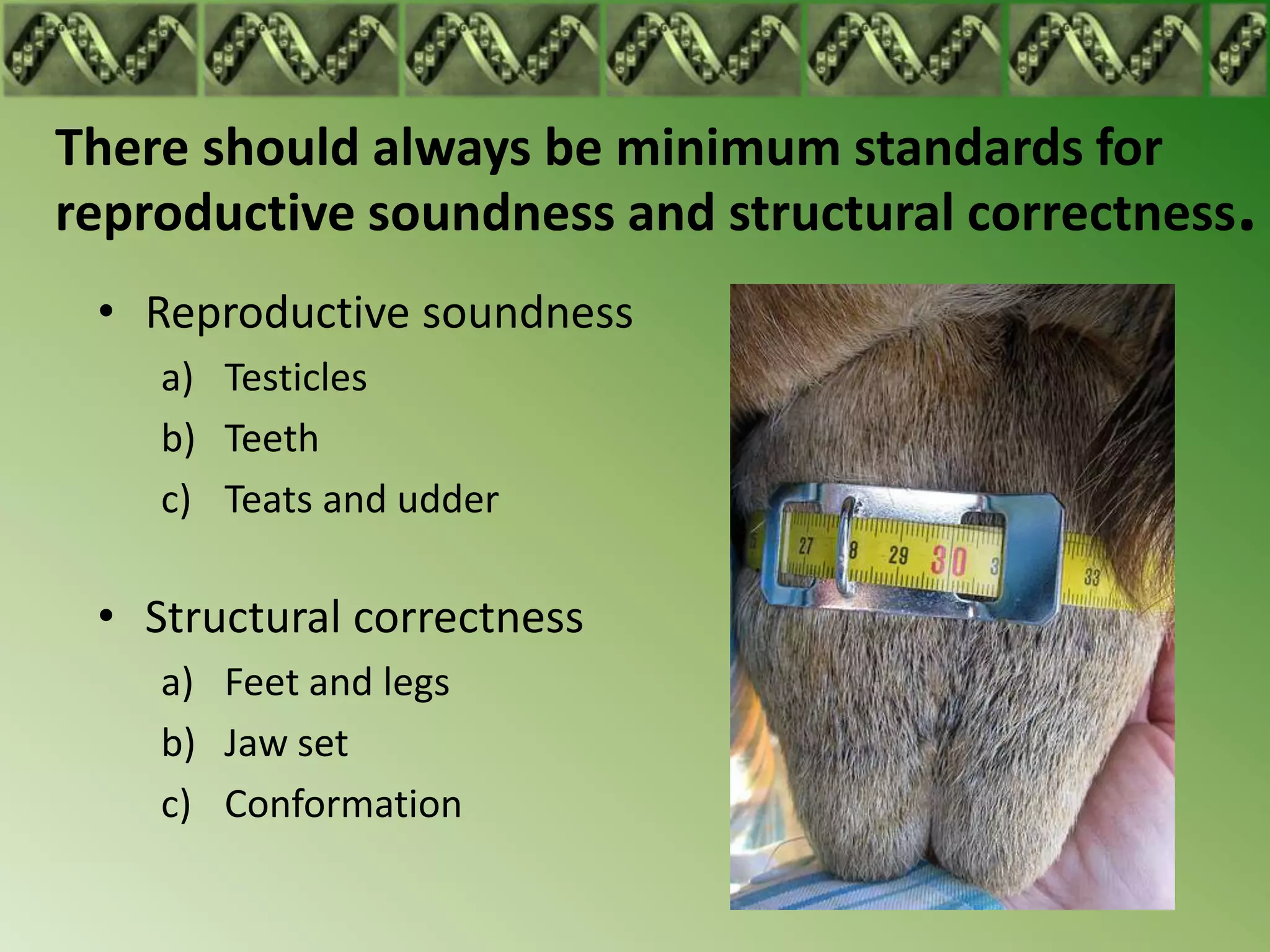
There should always be minimum standards for
reproductive soundness and structural correctness.
 • Reproductive soundness
    a) Testicles
    b) Teeth
    c) Teats and udder

 • Structural correctness
    a) Feet and legs
    b) Jaw set
    c) Conformation
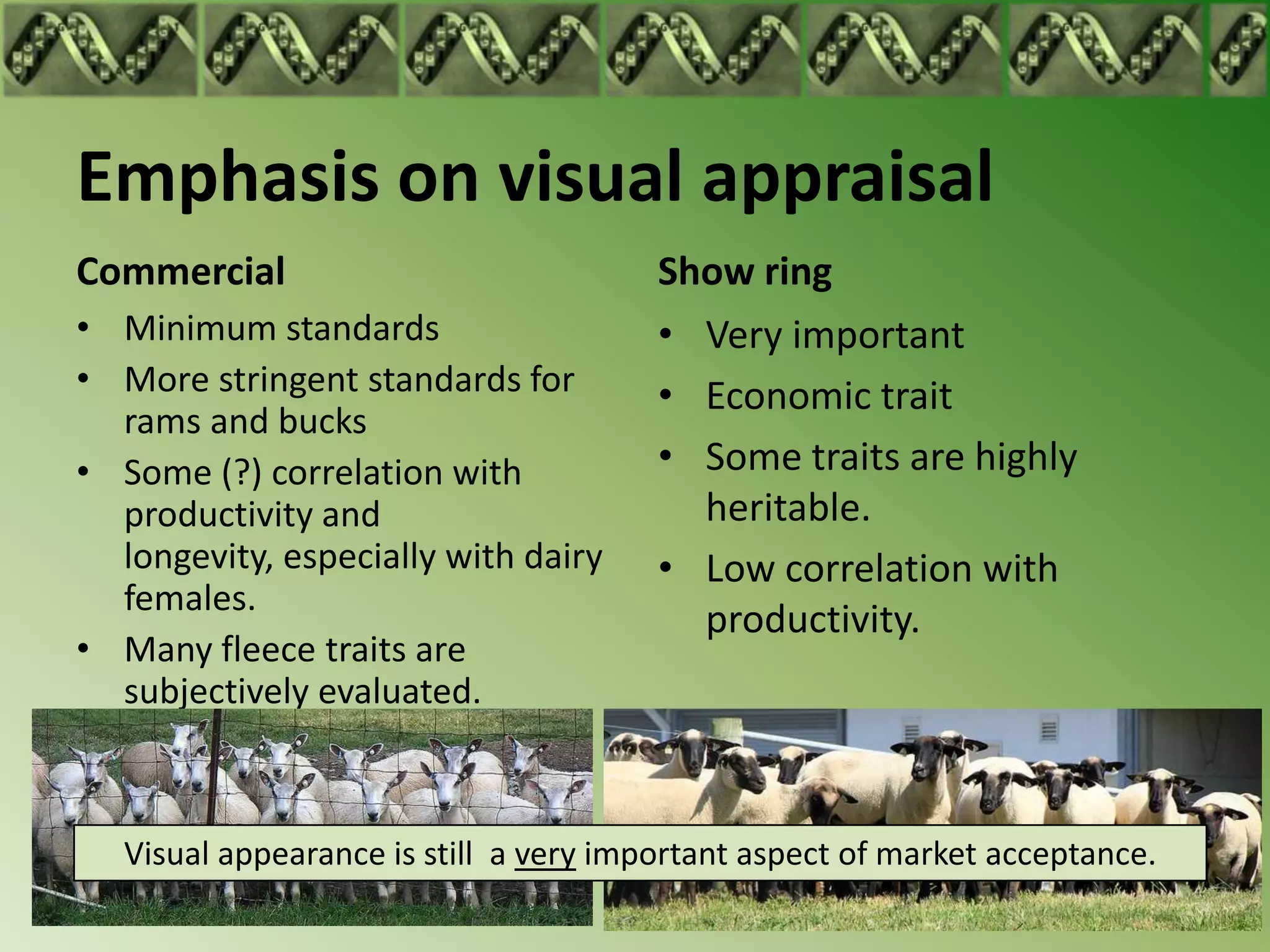
Emphasis on visual appraisal
Commercial                              Show ring
• Minimum standards                     • Very important
• More stringent standards for          • Economic trait
  rams and bucks
• Some (?) correlation with             • Some traits are highly
  productivity and                        heritable.
  longevity, especially with dairy      • Low correlation with
  females.
                                          productivity.
• Many fleece traits are
  subjectively evaluated.


   Visual appearance is still a very important aspect of market acceptance.
Final webinar: Feb 19, 7 pm EST
“Advanced Genetic Improvement”

Performance evaluation

  • 1.
    2013 Winter WebinarSeries: Breeding Better Sheep & Goats Performance Evaluation SUSAN SCHOENIAN Sheep & Goat Specialist University of Maryland Extension sschoen@umd.edu - www.sheepandgoat.com
  • 2.
    Making better sheepand goats WHERE WE’VE BEEN WHERE WE NEED TO GO Phenotype Genotype Genotype + environment Genetic merit Visual appraisal Performance evaluation How animal looks How animal performs Subjective criteria Objective criteria What we see What we measure
  • 3.
    Performance evaluation Individual records Genetic predictors • Adjusted weights • EPDs • Milk yield • EBVs • Fleece weight • DHIR • Staple length • Ultrasound data • Fecal egg counts • FAMACHA© scores • Fiber analysis • Performance ratios
  • 4.
    Performance evaluation: setgoals • What is the primary purpose of your sheep and/or goat enterprise? • If you are a seedstock producer, what is the primary role of your breed(s) in commercial production systems? • Determine which traits are most important to your herd, flock, or breed.
  • 5.
    Niche fiber Color Dairy Luster Milk yield Handle Percent protein Crimp Percent fat Staple length Udder conformation Fiber diameter Linear appraisal Seedstock Varies by breed Scrapie genotype
  • 6.
    Your selected traits • Are they economically important to your farm and/or breed? • Can the traits be objectively measured (when and how)? • Will they respond to selection or (crossbreeding)?
  • 7.
    Performance evaluation starts withanimal identification Options 1. Ear notches 2. Tattoos More permanent 3. Electronic 4. Ear tags 5. Paint brands 6. Neck chains
  • 8.
    To make geneticimprovement, you have to keep good records. • Everyone should keep basic reproductive and health records. • What additional records you keep (and data you collect) will depend upon your production emphasis and breed. • A central performance test will collect data on potential sires.
  • 9.
    Record keeping options Usinga computer Handwritten • Spreadsheet 1. Pocket book • Database 2. Notebook • Third party software 3. Chalkboard • Online • University
  • 10.
    Keeping records byhand (pencil)
  • 11.
  • 12.
  • 13.
    Performance evaluation • Records aren’t very useful unless you use them for decision- making purposes. – Ram/buck selection – Selection of replacements – Keep/cull decisions – Decisions to castrate • Records need to be properly analyzed and used to be effective for genetic improvement.
  • 14.
    An important aspectof performance evaluation Contemporary group • Comparisons should only be made between animals in the same contemporary group. • A group of the same breed, born within +/- two weeks with each other, raised at the same location or in the same herd or flock, of the same sex and managed alike from birth until time of measurement.
  • 15.
    Factors affecting contemporarygroups • Breed percentage • Sex • Lambing/kidding period • Location • Management factors – Health – Nutrition Animals which receive preferential treatment should be placed within their own contemporary group.
  • 16.
    Another important aspectof performance evaluation Adjustments • Sometimes records (data) need to be “adjusted” to remove environmental effects. • Records are adjusted to a standard animal or weight – Weaning weights Single male offspring raised by a 3-6 year old dam. – Loin eye area 125-lb. market lamb 100-lb. Katahdin ram lamb
  • 17.
    Calculating adjusted weaningweights 1. Adjust weaning weights to a common day of age (usually 60, 90, or 120 days of age) a) Determine animal’s pre- weaning average daily gain (ADG). b) Multiply pre-weaning ADG by common age. c) Add birth weight 2. Adjust weaning weight for sex of offspring, age of dam, and type of birth and rearing a) Multiply age-corrected weaning weight by appropriate adjustment factor.
  • 18.
    Adjustment factors allowanimals to be fairly compared by removing non-genetic factors.
  • 19.
    Adjustment factors varyby species and breed. When breed-specific adjustment factors are not available, generic adjustment factors can be used.
  • 20.
    Adjustment factors formeat goats (Boer)
  • 21.
    Example • Calculate the 60-day adjusted weaning weight for a Dorset ram lamb born on March 1 and weaned on June 10. The lamb was born and raised as a twin. His birth weight was 10 lbs. He weighed 70 lbs at weaning. His dam was 2 years old. 1) Determine pre-weaning ADG 2) Multiply pre-weaning ADG weight by common age 3) Add birth weight back in 4) Multiply age-corrected weight by adjustment factor (see TABLE)
  • 22.
    Born March 1 Born/raised twin Weaned June 10 Birth weight - 10 # Weaning weight - 70 # Example Age of dam - 2 yrs 1) Determine pre-weaning ADG (weaning weight - birth weight*) age (in days) (70 - 10) 71 d = 0.85 lb/d *If birth weight is not known, a weight per day of age (WDA) can be calculated instead.
  • 23.
    Born March 1 Born/raised twin Weaned June 10 Birth weight - 10 # Example Weaning weight - 70 # Age of dam - 2 yrs 2) Multiply pre-weaning ADG weight by common age (0.85 x 60 d) = 51.0 lbs. 3) Add birth weight back in* 51.0 lbs. + 10 lbs. + 61.0 lbs. *If WDA was calculated instead of pre-weaning ADG, do not add a birth weight back in.
  • 24.
    Born March 1 Born/raised twin Weaned June 10 Birth weight - 10 # Example Weaning weight - 70 # Age of dam - 2 yrs 4) Multiply age-corrected weight by adjustment factor 61.0 lbs. x adjustment factor 61.0 lbs. x 1.16 = 70.8 lbs.
  • 25.
    Performance ratios • Thepercent above or below the average of the contemporary group. • Performance ratio Individual performance average performance of group x 100
  • 26.
    Example: performance ratio Whatis the WW ratio for buck #6 ID Adj. WW 1 44 Individual performance x 100 2 38 3 32 Average performance of group 4 50 5 48 6 45 45 lbs x 100 7 40 41.7 lbs 8 41 9 40 10 39 = 108 % Avg 41.7
  • 27.
    Selecting for parasiteresistance • Measure fecal egg counts Can only compare animals in when animals are between 4 same contemporary group. and 12 months of age. • Compare average fecal egg count of an individual lamb or kid to the group average (at least 15-25 animals). • A high worm load is needed to select for parasite resistance (> 500 epg avg.) • More measurements  more selection accuracy • A resistant male is needed to make much progress.
  • 28.
    Selecting for parasiteresistance SIRE SELECTION • Choose sire with lowest average progeny FEC. REPLACEMENT SELECTION • Choose replacements from sire(s) with lowest average FEC (if more than one sire) • Choose replacements with lowest FECs in group.
  • 29.
    How we selectfor parasite resistance in our buck test 1 Top 10 2 3 4 5 6 7 8 9 10 10 9 8 7 Bottom 10 6 5 4 3 2 1 All goats were triple-dewormed (moxidectin + levamisole + albendazole) on 6/2. Twelve days later, the average fecal egg count was near zero.
  • 30.
    How we selectfor parasite resilience in our buck test 1 2 3 4 0 5 Top 10 6 7 8 9 10 10 9 8 7 6 Bottom 10 5 4 3 2 1 All goats were triple-dewormed (moxidectin + levamisole + albendazole) on 6/2. For the next 8 weeks, the average FAMACHA© score improved and no goat required deworming.
  • 31.
    What about visualappraisal? Does it matter what the animal looks like? Absolutely!
  • 32.
    There should alwaysbe minimum standards for reproductive soundness and structural correctness. • Reproductive soundness a) Testicles b) Teeth c) Teats and udder • Structural correctness a) Feet and legs b) Jaw set c) Conformation
  • 33.
    Emphasis on visualappraisal Commercial Show ring • Minimum standards • Very important • More stringent standards for • Economic trait rams and bucks • Some (?) correlation with • Some traits are highly productivity and heritable. longevity, especially with dairy • Low correlation with females. productivity. • Many fleece traits are subjectively evaluated. Visual appearance is still a very important aspect of market acceptance.
  • 34.
    Final webinar: Feb19, 7 pm EST “Advanced Genetic Improvement”