Breeding “better” sheepSUSAN SCHOENIANSheep & Goat SpecialistWestern Maryland Research & Education CenterUniversity of Maryland Extensionsschoen@umd.edu – www.sheepandgoat.com
Defining “better”Better for what?Nature vs. nurtureGenetics vs. environmentWays to genetically improve sheepCrossbreedingSelection Today’s topics
What is “better”?(according to Google™)Something superior in quality, condition, or effect.From a position of superiority or authority.The superior one of two alternatives.Superior to another (of the same class or kind) in excellence, quality, desirability, or suitability.
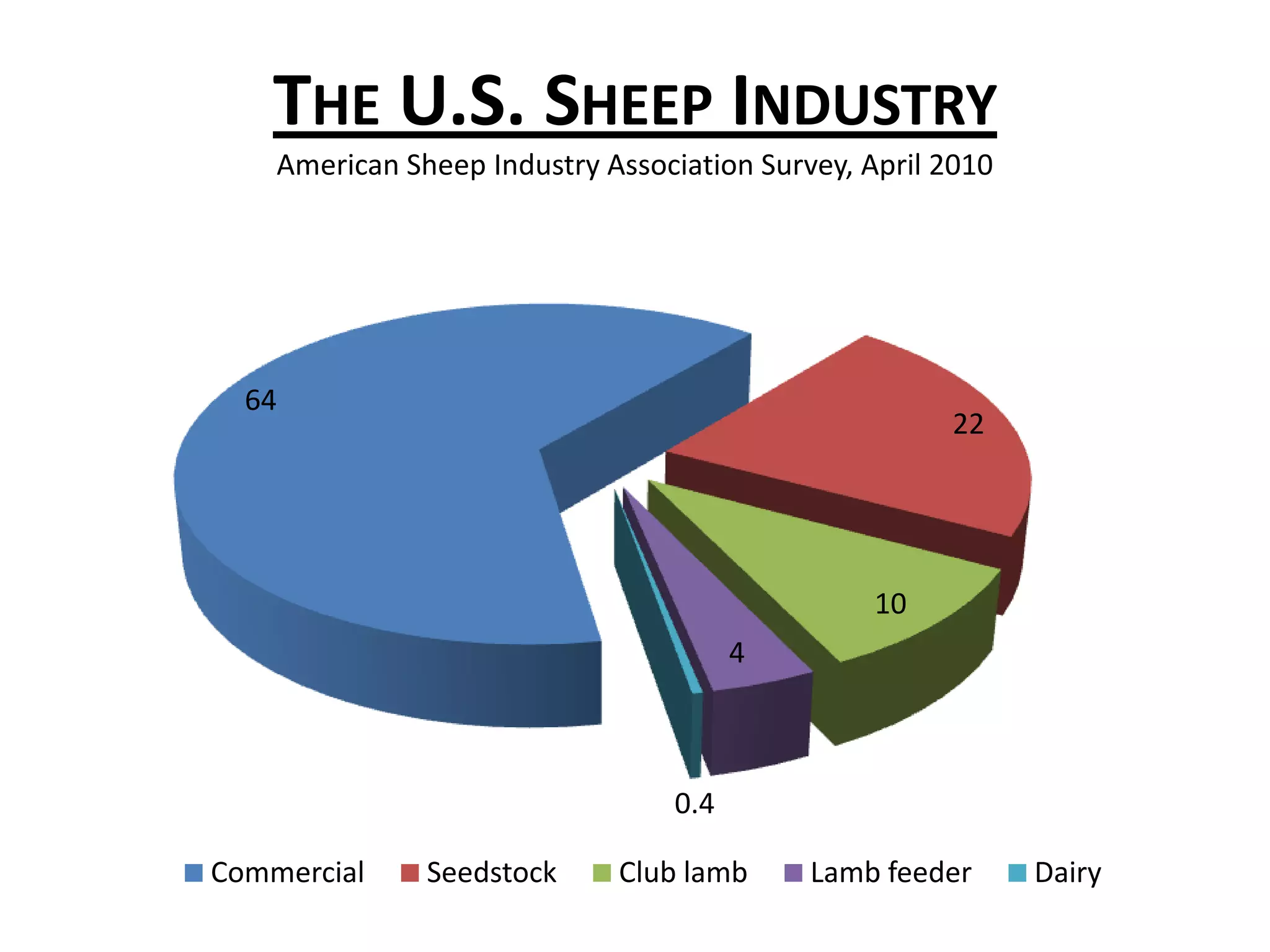
The U.S. Sheep IndustryAmerican Sheep Industry Association Survey, April 2010
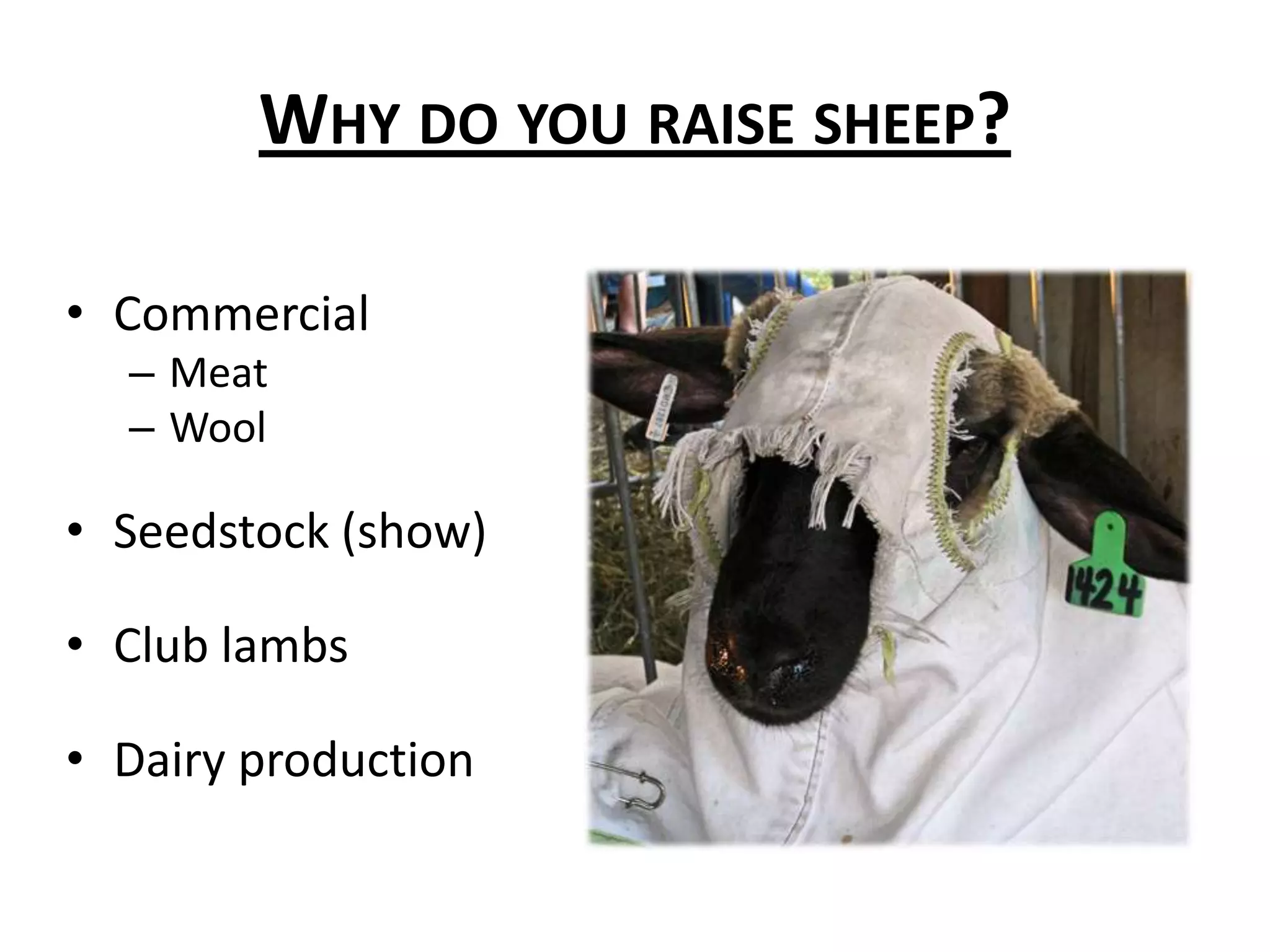
Why do you raise sheep?Commercial MeatWoolSeedstock (show)Club lambsDairy production
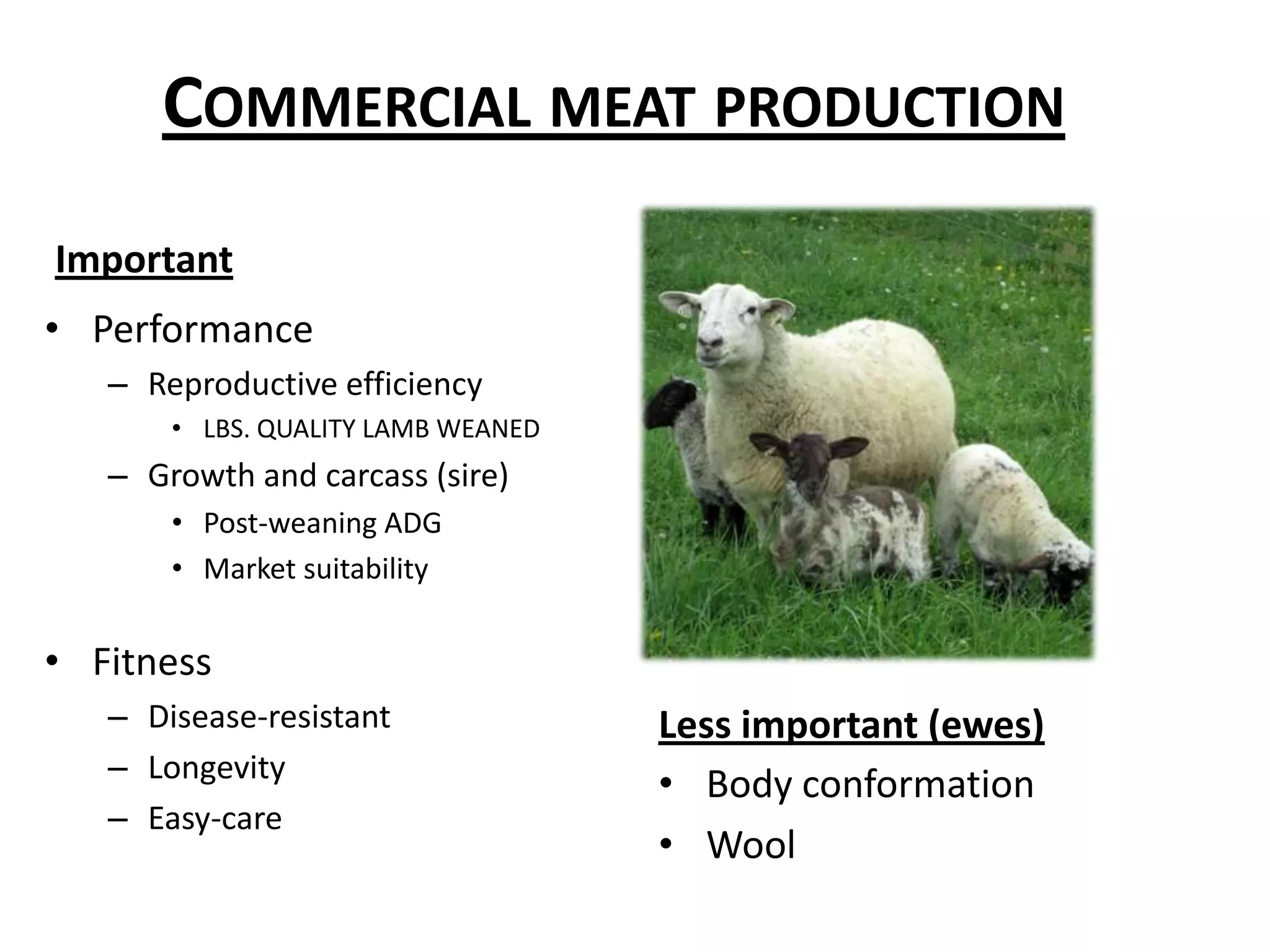
Commercial meat productionImportantPerformanceReproductive efficiencyLBS. QUALITY LAMB WEANEDGrowth and carcass (sire)Post-weaning ADGMarket suitabilityFitnessDisease-resistantLongevityEasy-careLess important (ewes)Body conformationWool
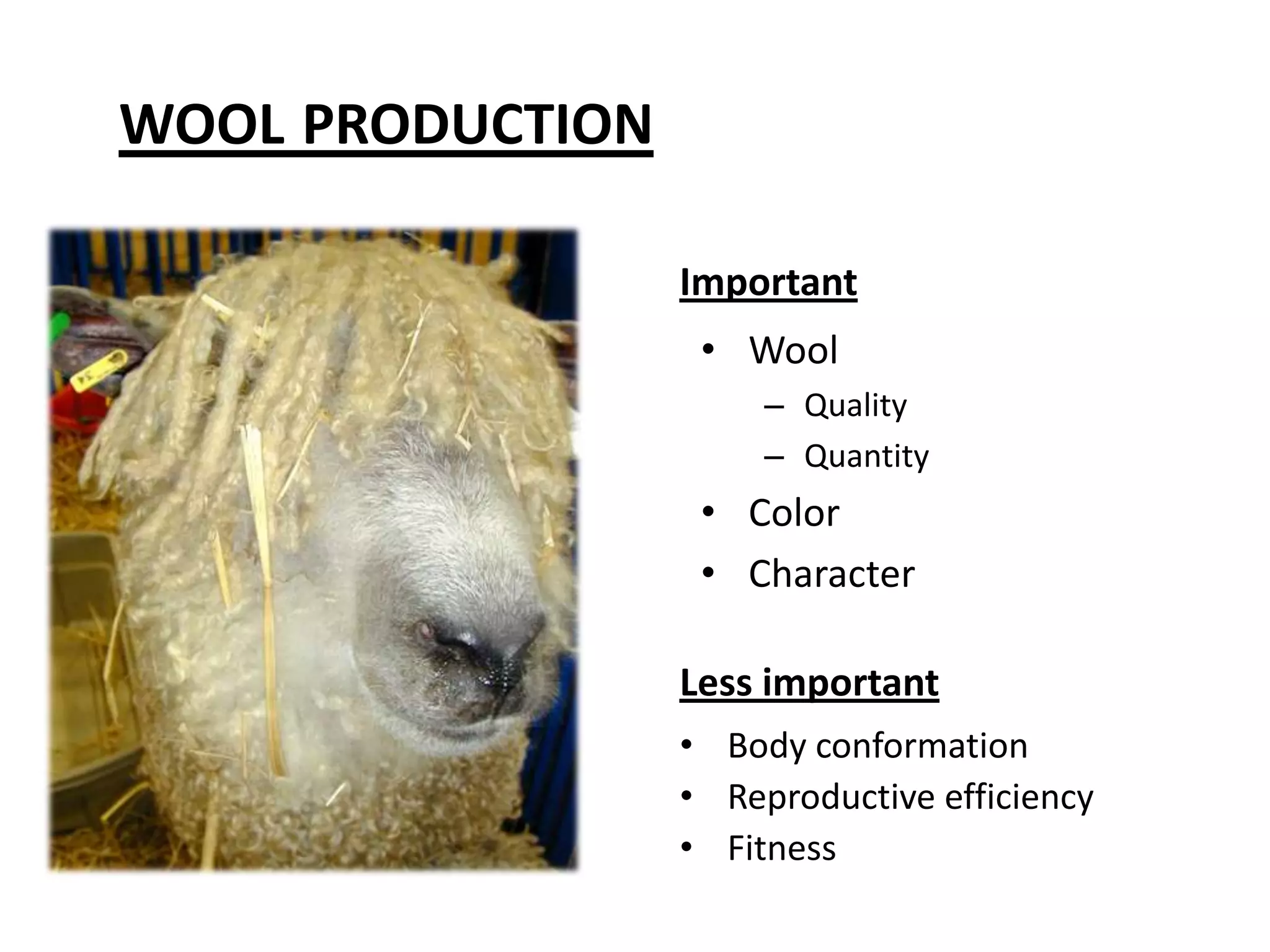
wool productionImportantWool Quality Quantity ColorCharacterLess importantBody conformationReproductive efficiencyFitness
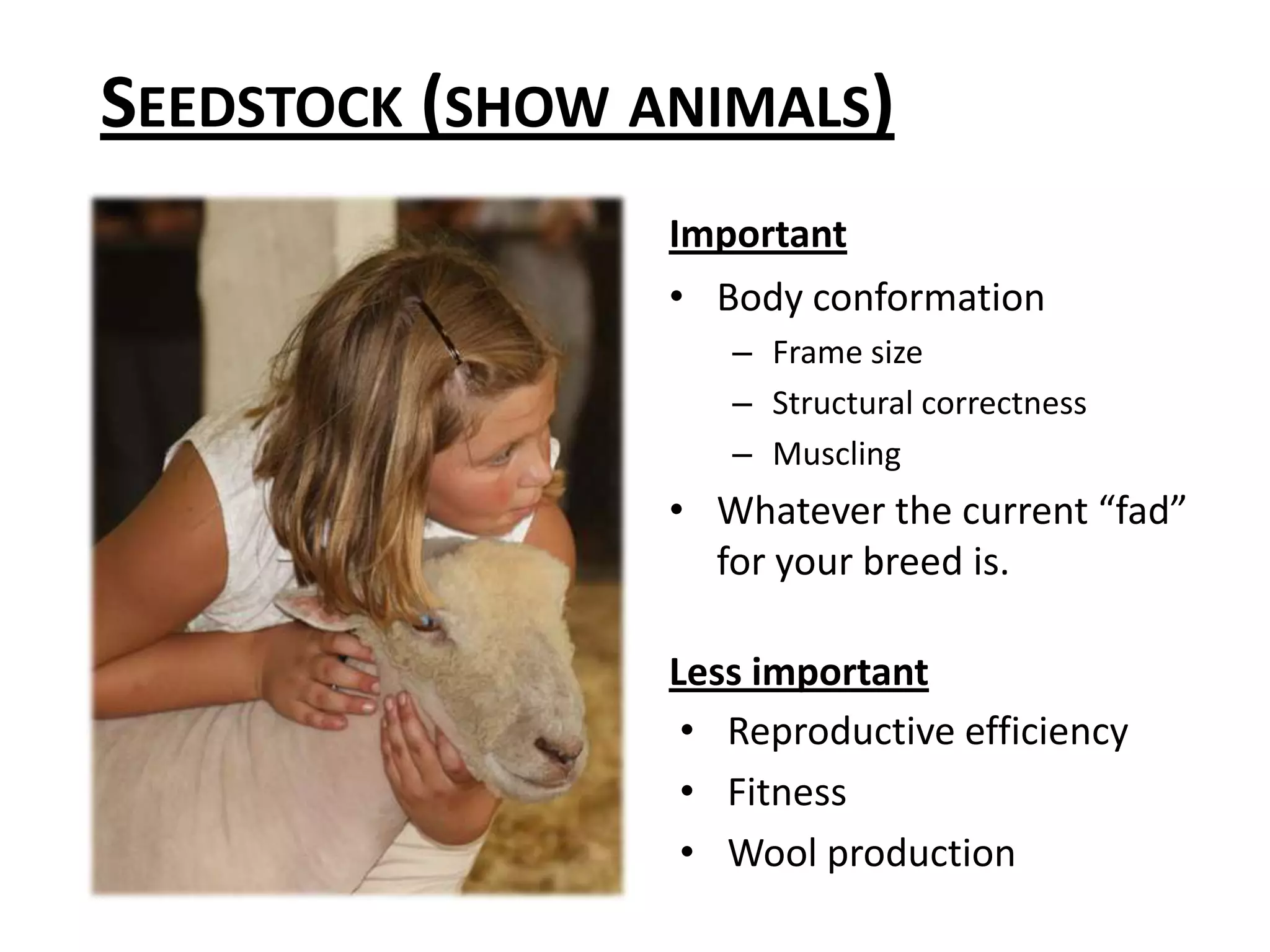
Seedstock (show animals)ImportantBody conformationFrame sizeStructural correctnessMusclingWhatever the current “fad” for your breed is.Less importantReproductive efficiencyFitnessWool production
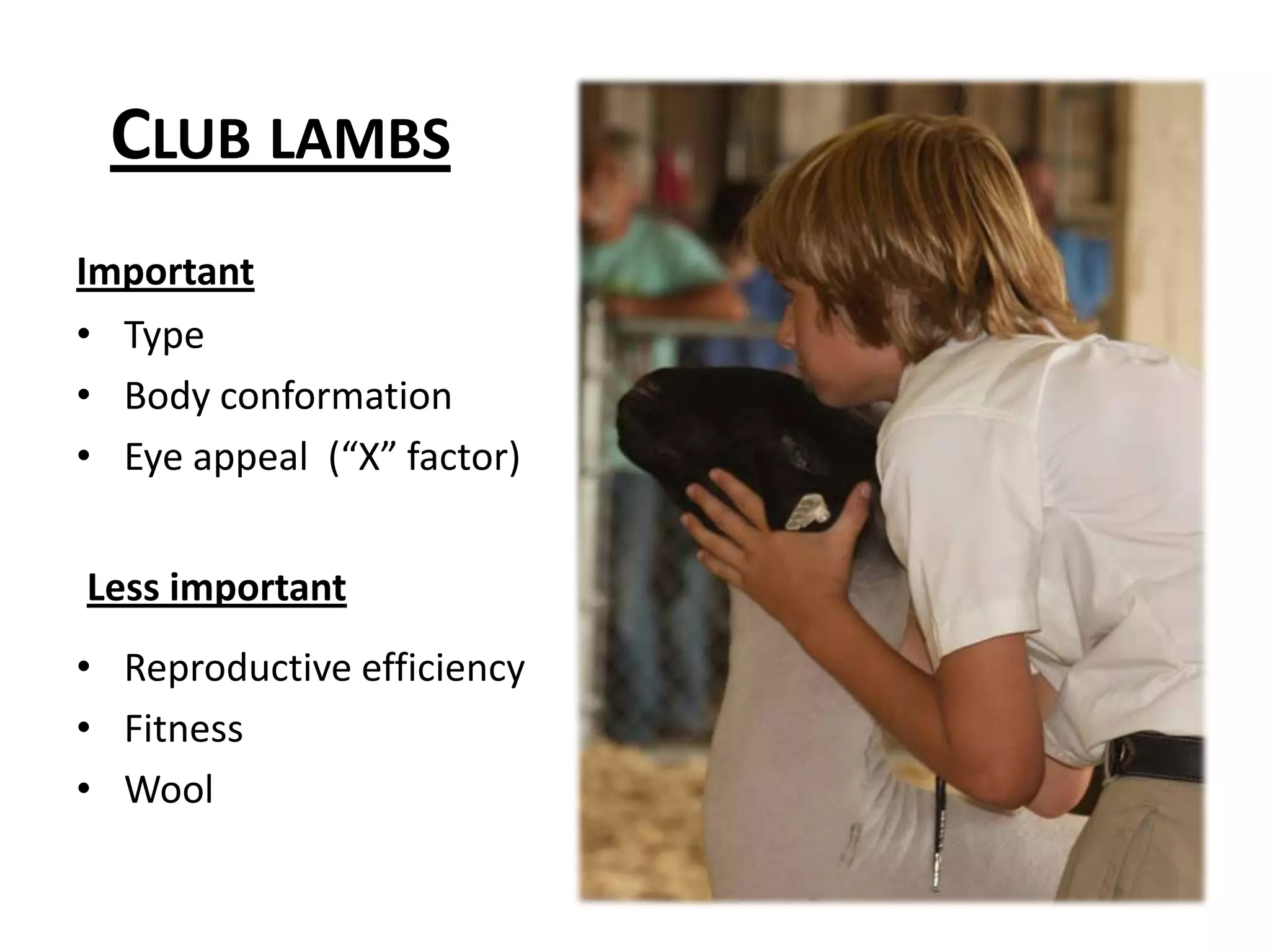
Club lambsImportantTypeBody conformationEye appeal  (“X” factor)Less importantReproductive efficiencyFitnessWool
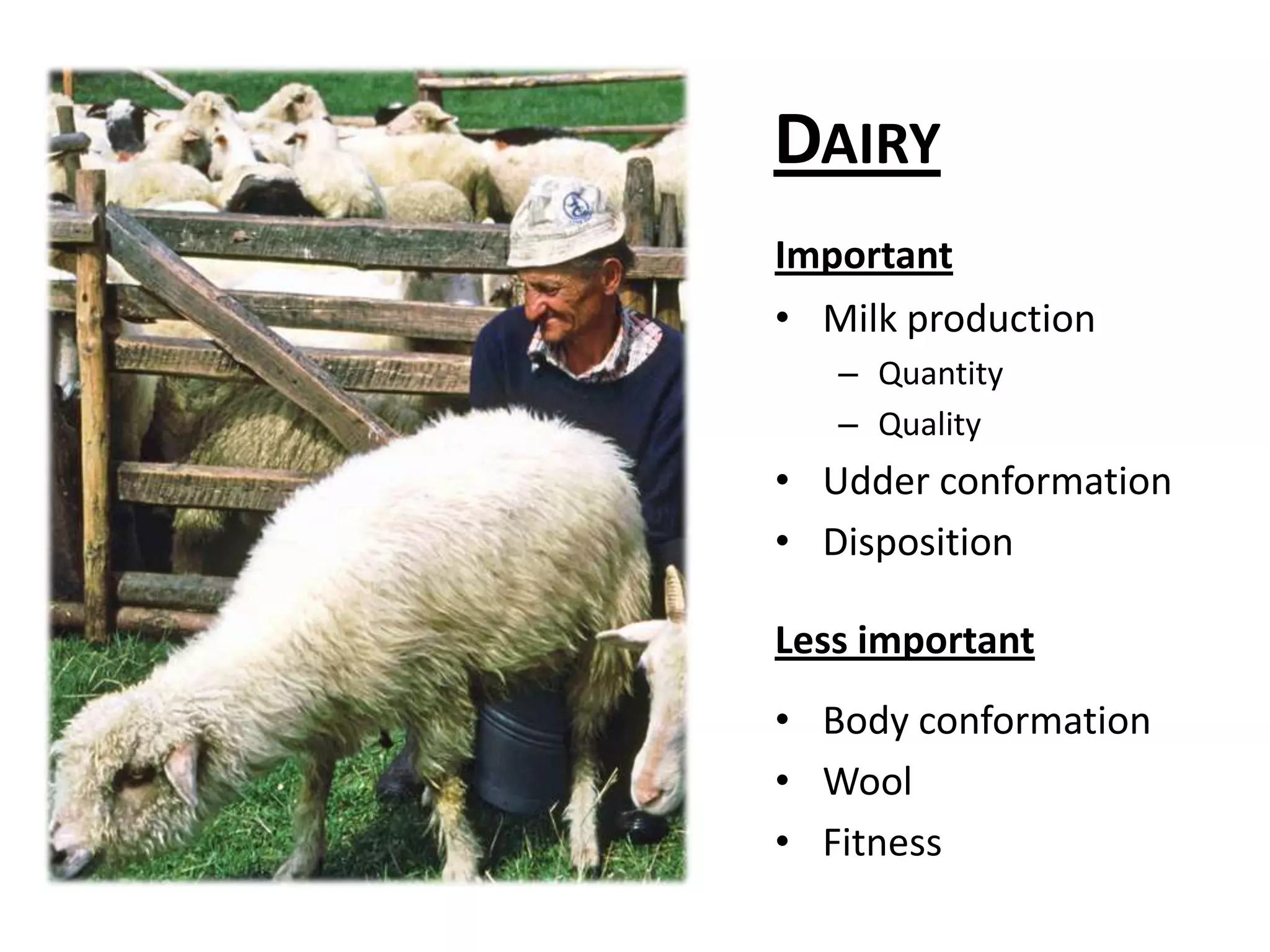
DairyImportantMilk productionQuantityQualityUdder conformationDispositionLess importantBody conformationWoolFitness
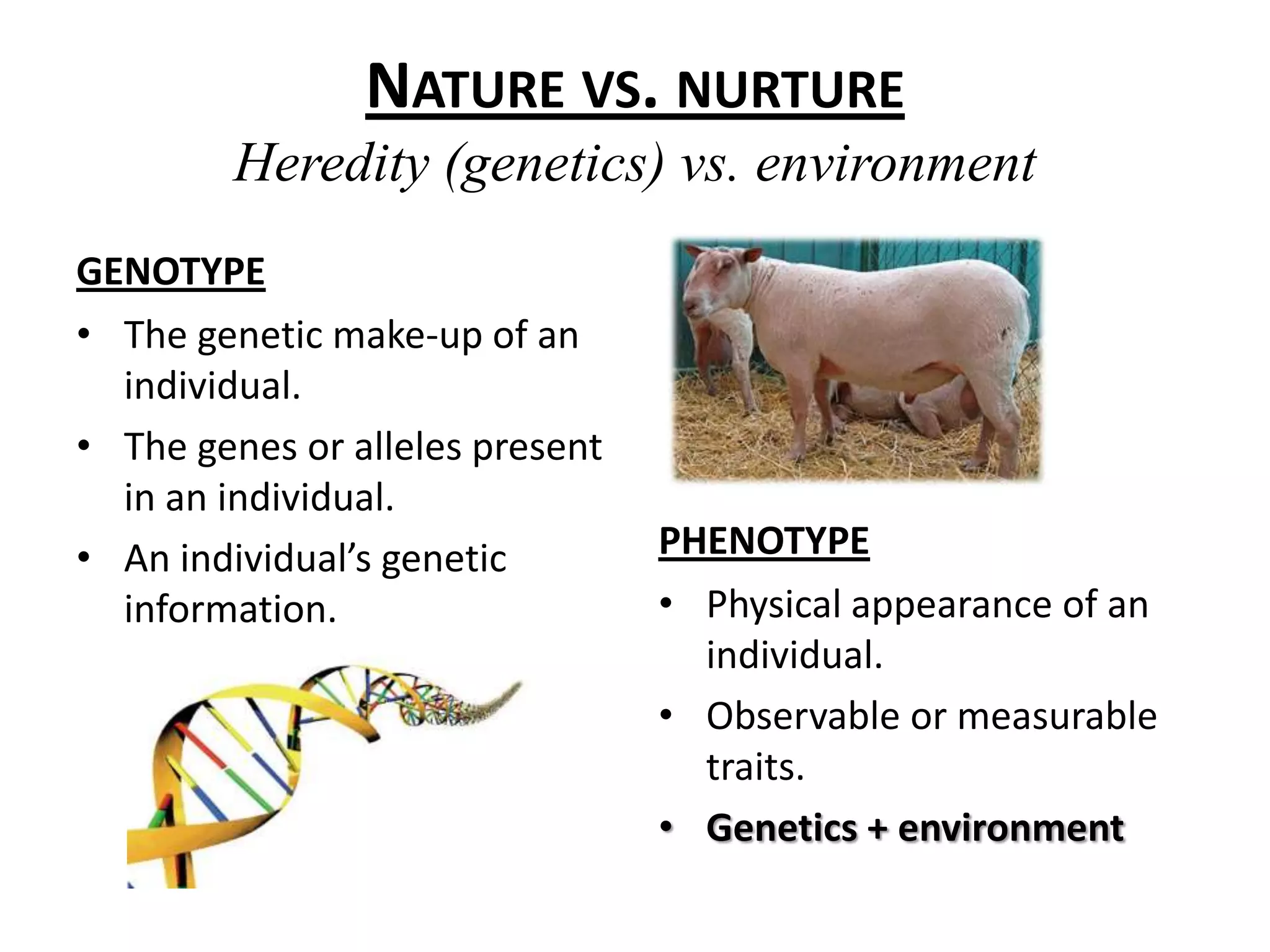
Nature vs. nurtureHeredity (genetics) vs. environmentGENOTYPEThe genetic make-up of an individual.The genes or alleles present in an individual.An individual’s genetic information.PHENOTYPEPhysical appearance of an individual.Observable or measurable traits.Genetics + environment
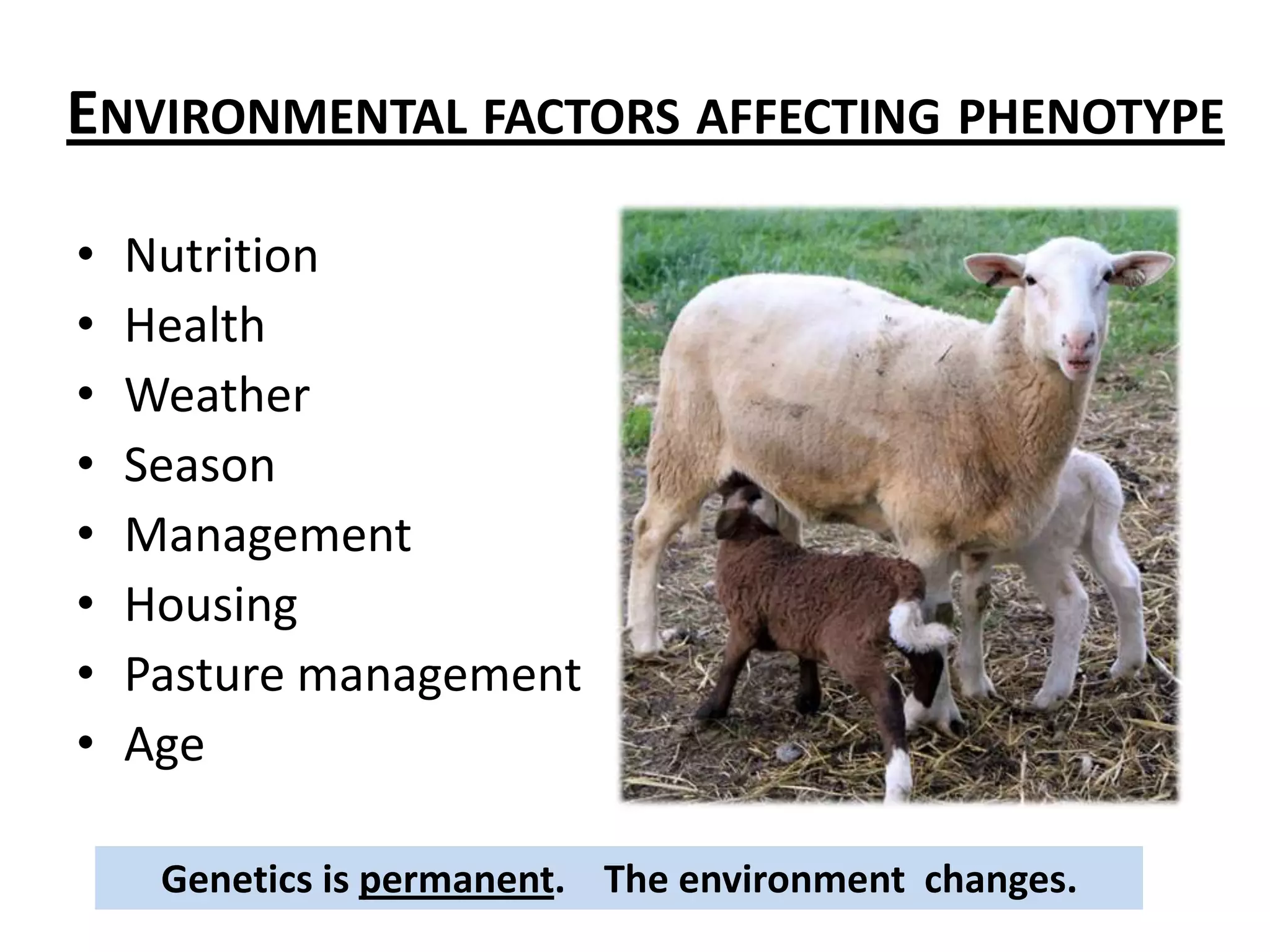
Environmental factors affecting phenotypeNutritionHealthWeatherSeasonManagementHousingPasture managementAgeGenetics is permanent.    The environment  changes.
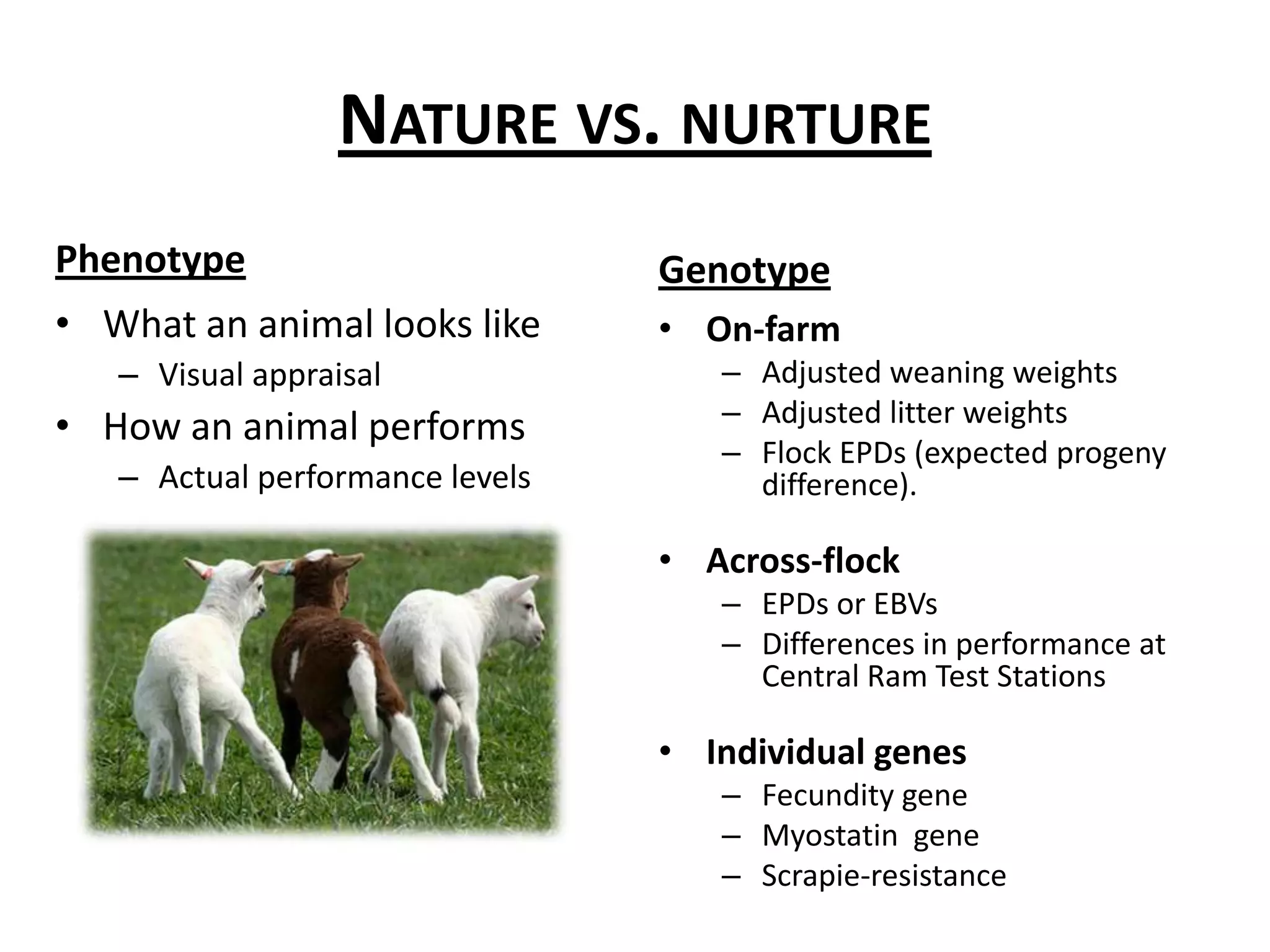
Nature vs. nurturePhenotypeGenotypeWhat an animal looks likeVisual appraisalHow an animal performsActual performance levelsOn-farm Adjusted weaning weightsAdjusted litter weightsFlock EPDs (expected progeny difference).Across-flockEPDs or EBVsDifferences in performance at Central Ram Test StationsIndividual genesFecundity geneMyostatin  geneScrapie-resistance
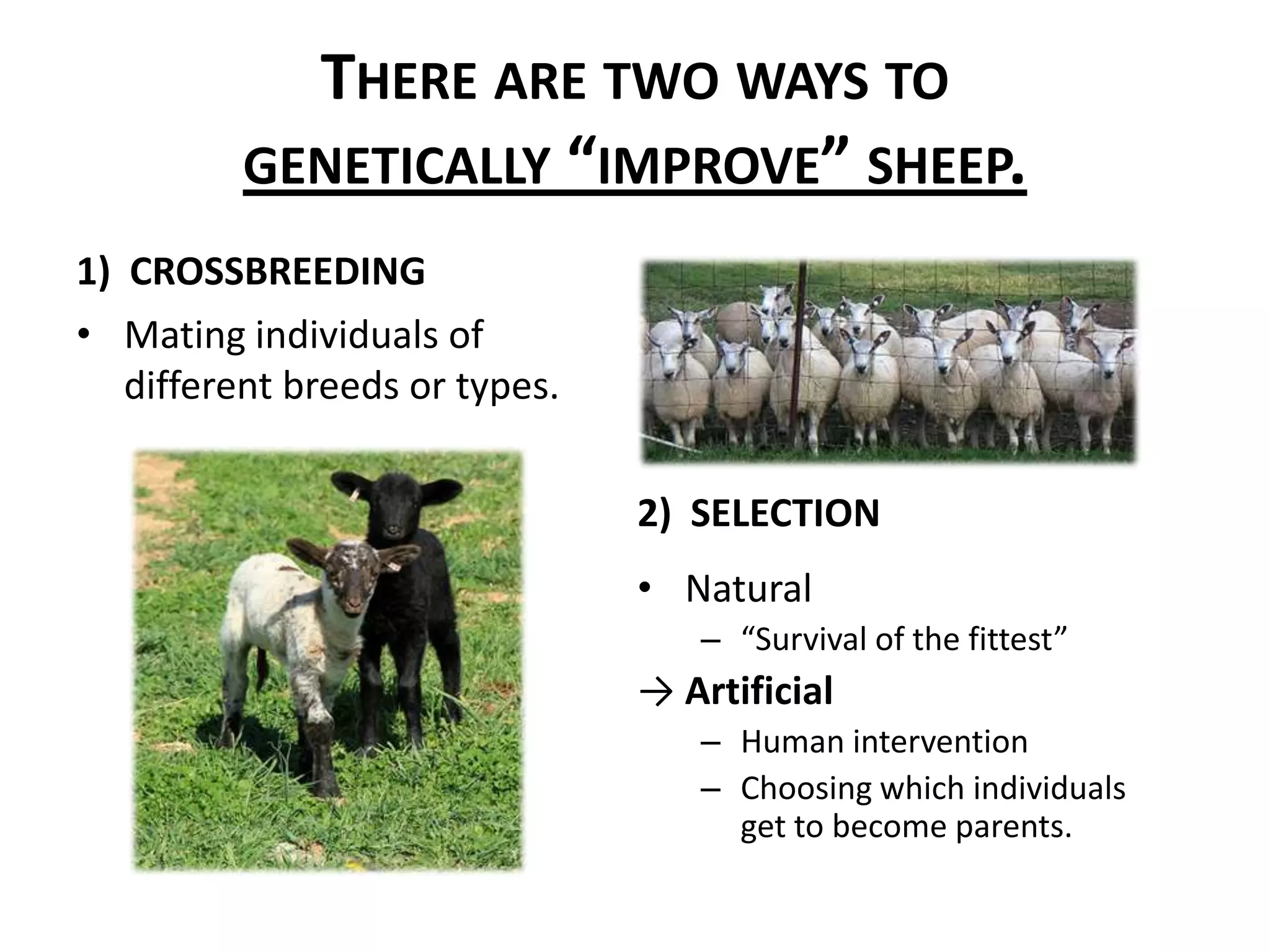
There are two ways to genetically “improve” sheep.1)  CROSSBREEDINGMating individuals of different breeds or types.2)  SELECTIONNatural“Survival of the fittest”ArtificialHuman interventionChoosing which individuals get to become parents.
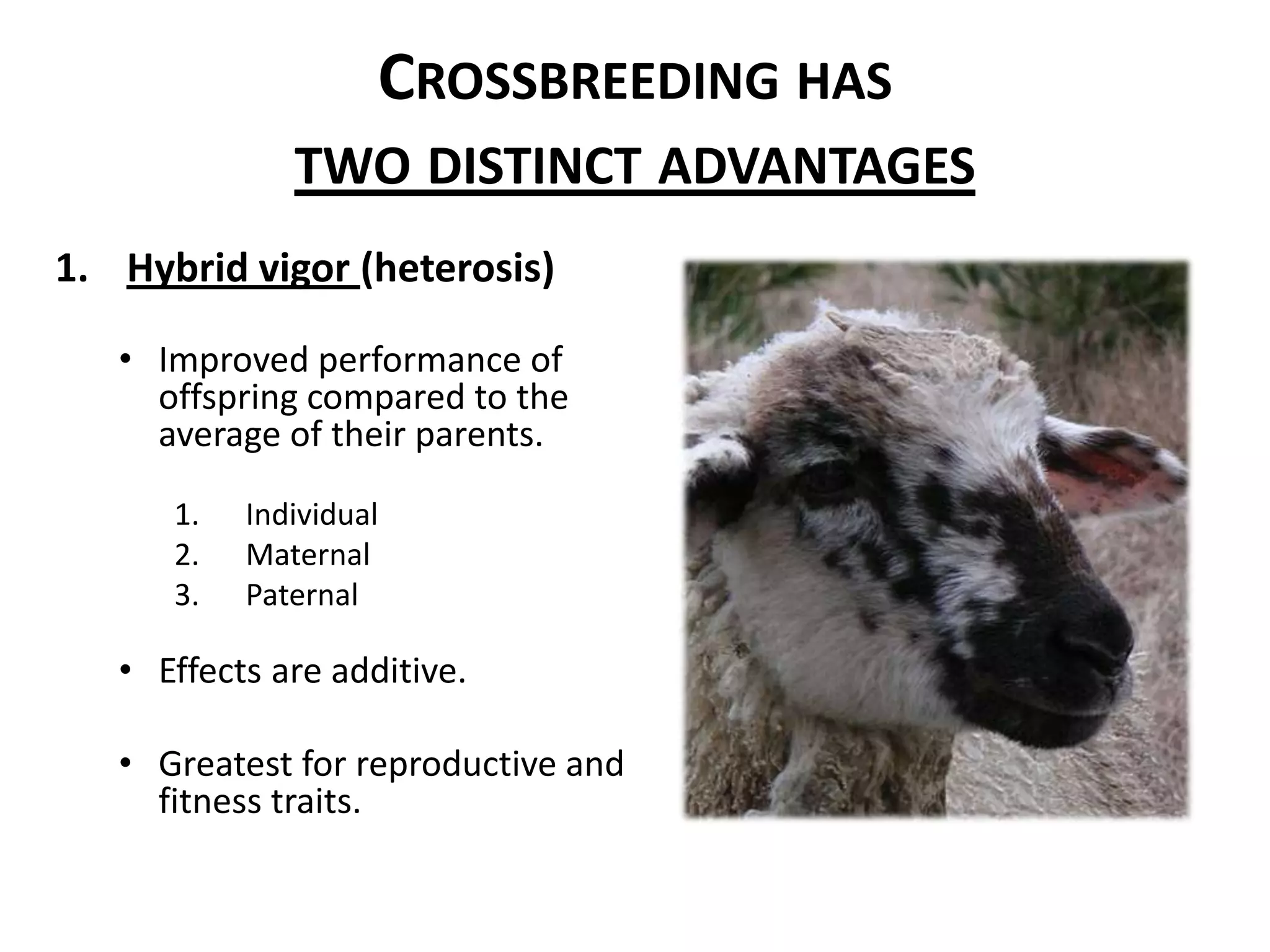
Crossbreeding has two distinct advantagesHybrid vigor (heterosis)Improved performance of offspring compared to the average of their parents.IndividualMaternalPaternalEffects are additive.
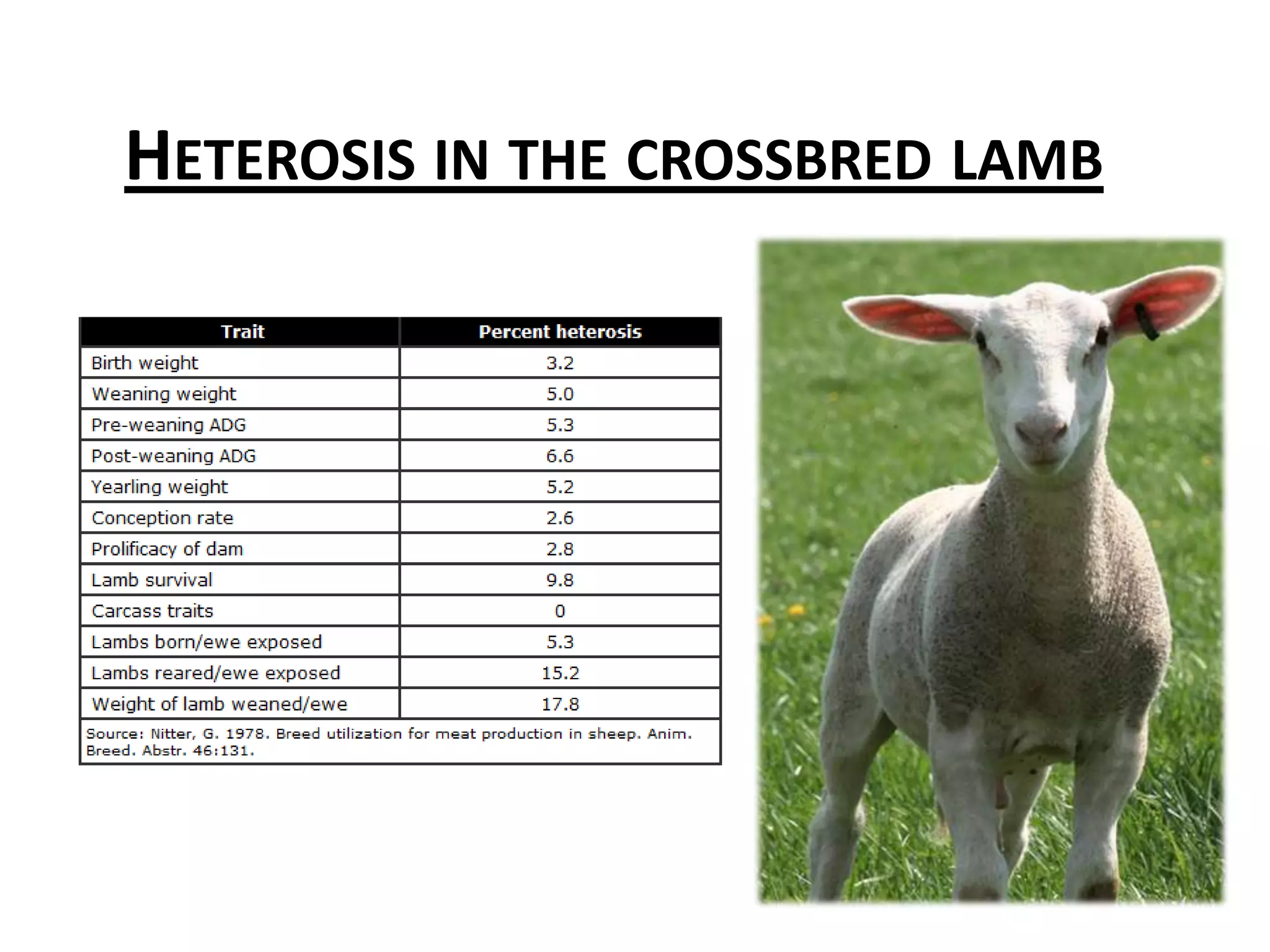
Greatest for reproductive and fitness traits.Heterosis in the crossbred lamb
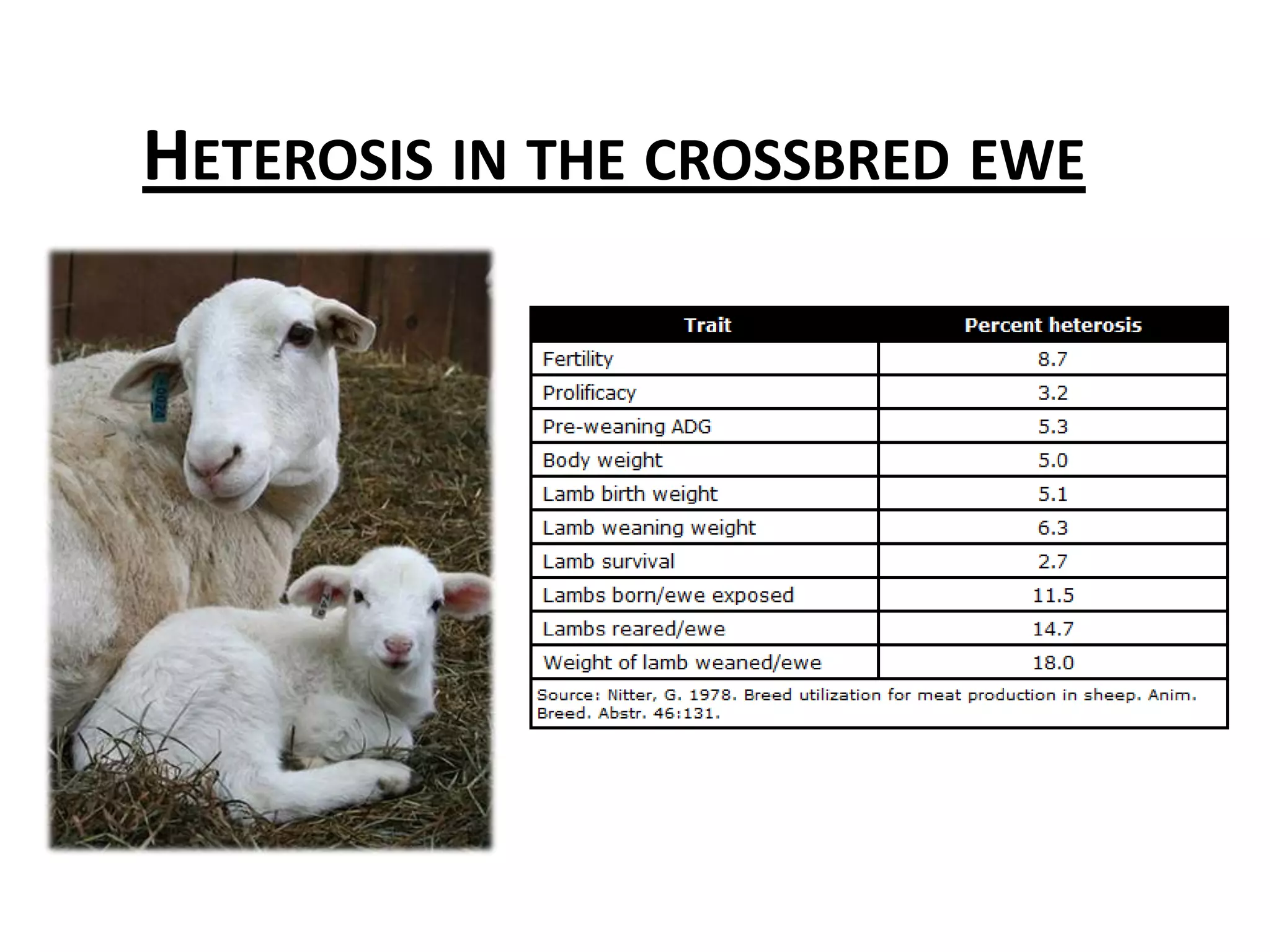
Heterosis in the crossbred ewe
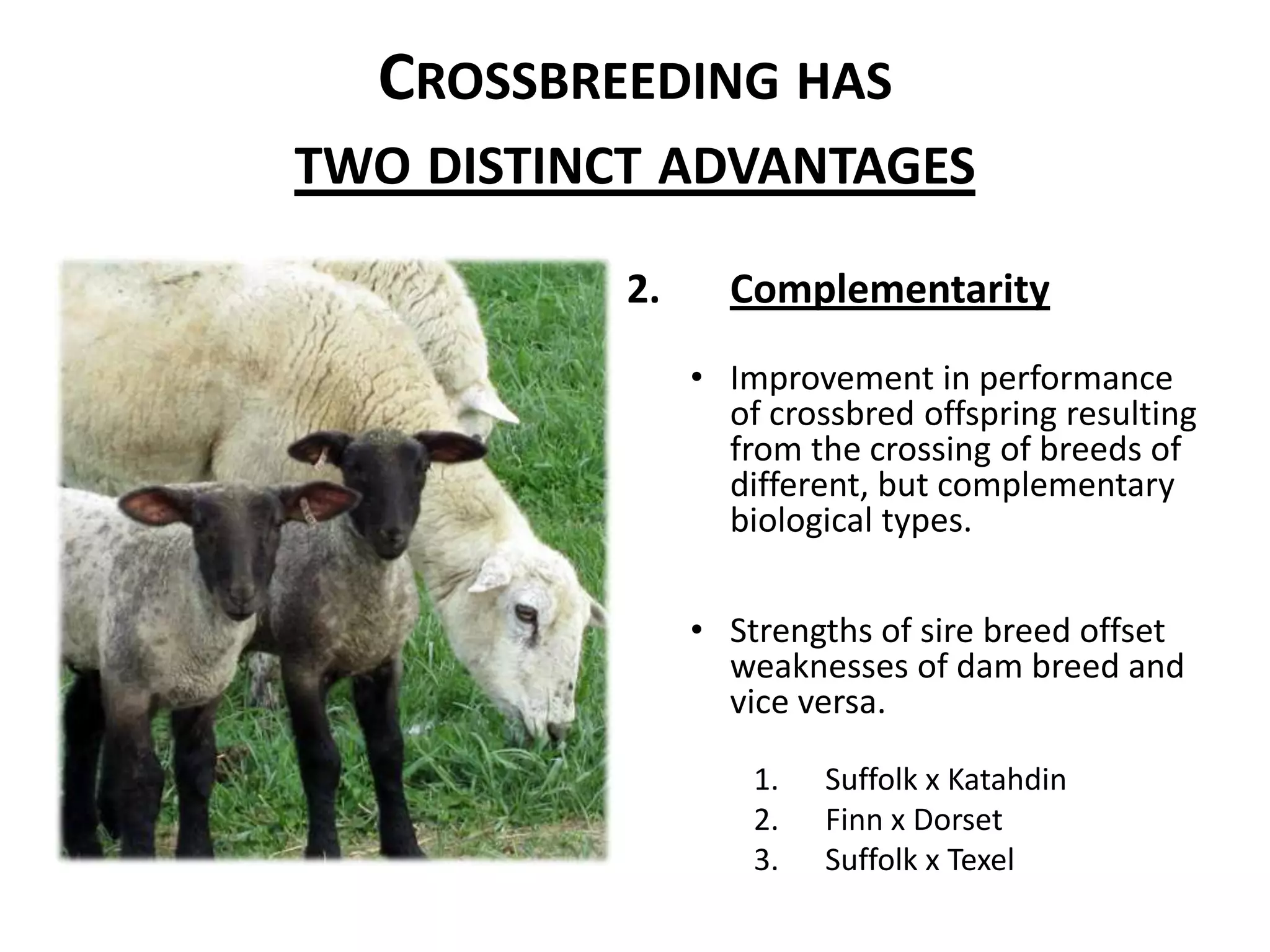
Crossbreeding has two distinct advantagesComplementarityImprovement in performance of crossbred offspring resulting from the crossing of breeds of different, but complementary biological types.
Strengths of sire breed offset weaknesses of dam breed and vice versa.Suffolk x KatahdinFinn x DorsetSuffolk x Texel
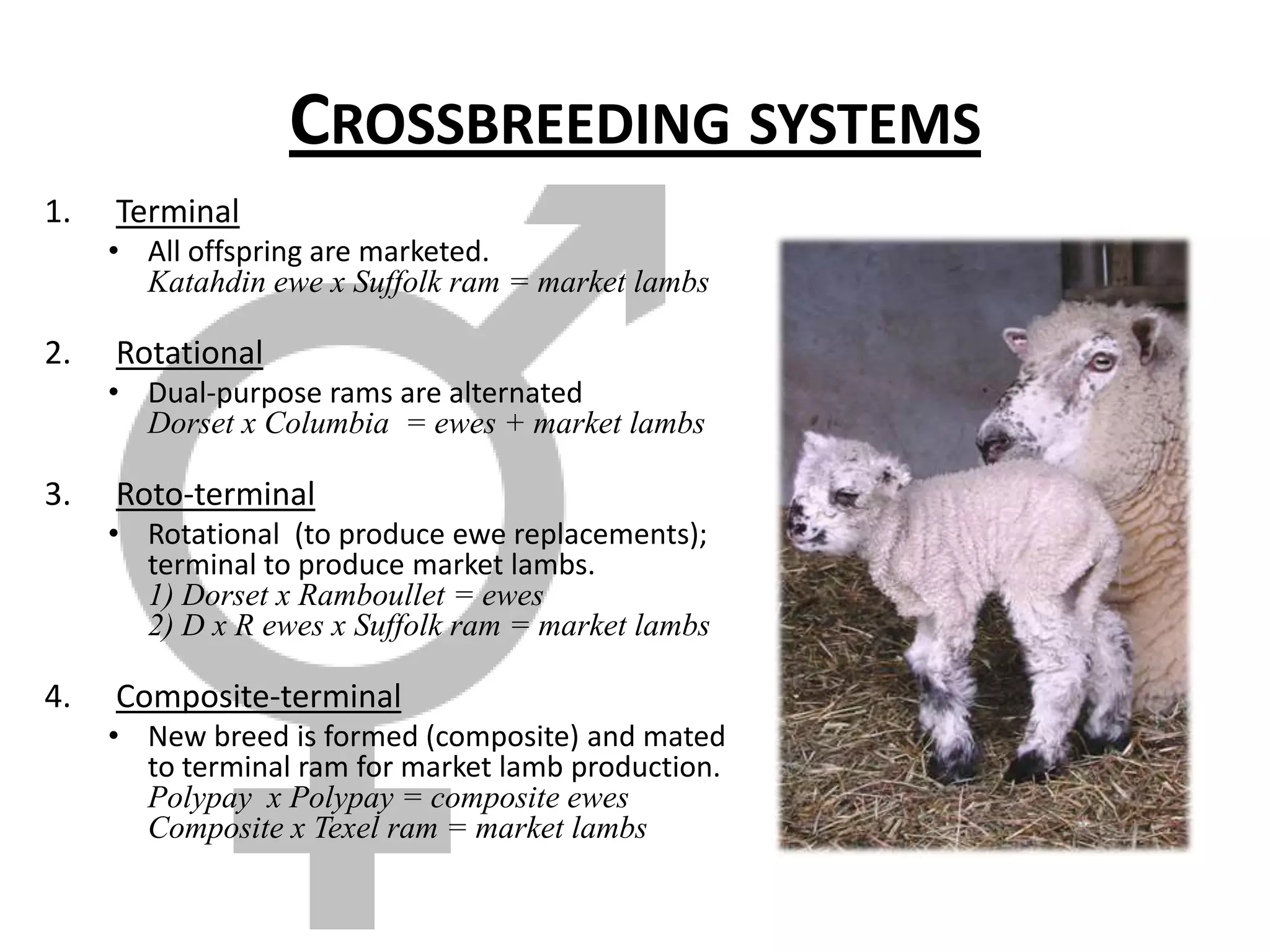
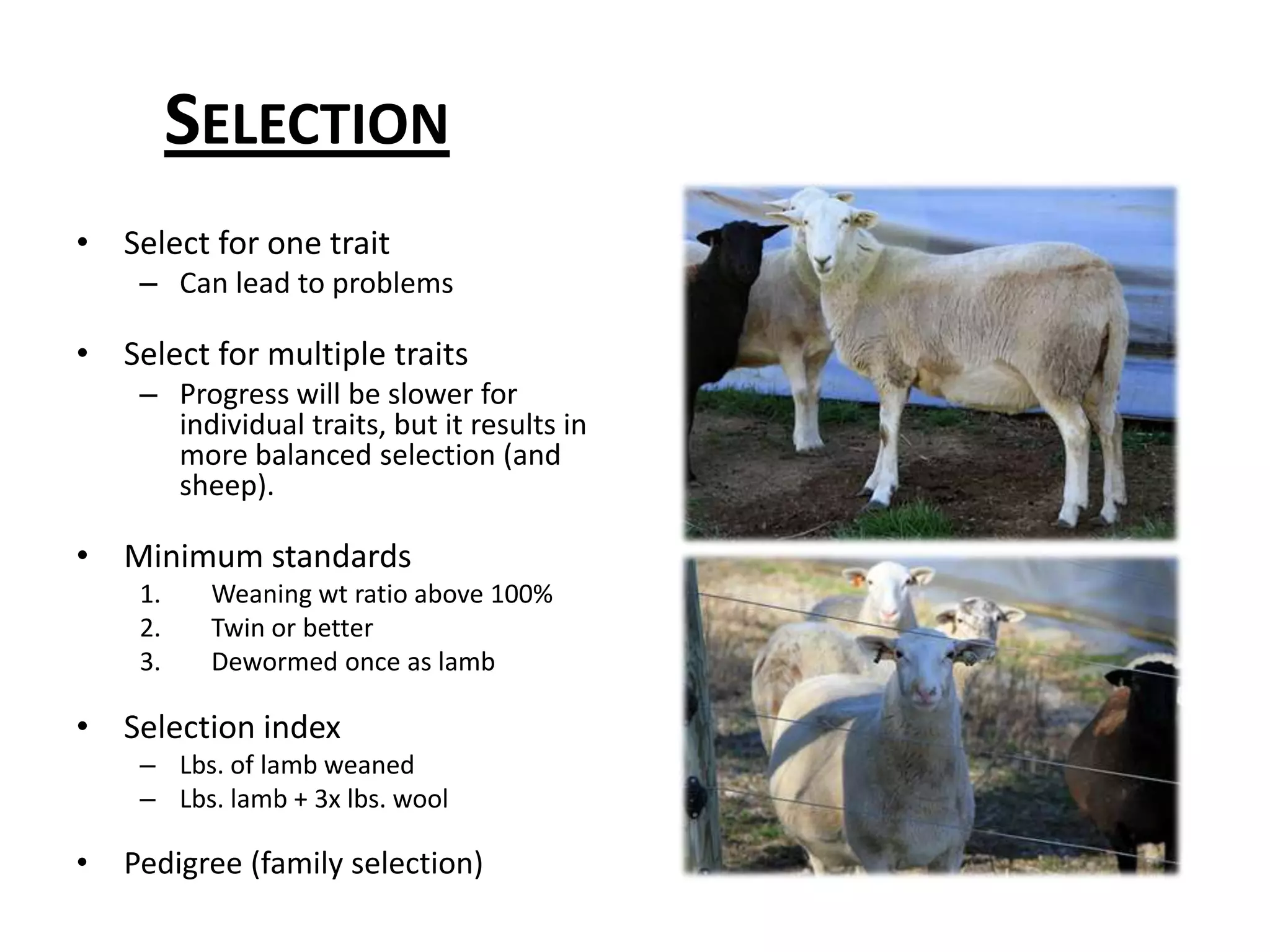
Sheep Crossbreeding programsShould be a planned program to produce desired types of animals or fleeces.Should optimize performance of flock.Should use breeds in appropriate roles.Does not imply indiscriminate mixing of breeds or types.Crossbreeding systemsTerminalAll offspring are marketed.Katahdin ewe x Suffolk ram = market lambsRotationalDual-purpose rams are alternatedDorset x Columbia  = ewes + market lambsRoto-terminalRotational  (to produce ewe replacements); terminal to produce market lambs.1) Dorset x Ramboullet = ewes2) D x R ewes x Suffolk ram = market lambsComposite-terminalNew breed is formed (composite) and mated to terminal ram for market lamb production.Polypay  x Polypay = composite ewesComposite x Texel ram = market lambsSelectionSelect for one traitCan lead to problemsSelect for multiple traitsProgress will be slower for individual traits, but it results in more balanced selection (and sheep). Minimum standardsWeaning wt ratio above 100%Twin or betterDewormed once as lambSelection indexLbs. of lamb weanedLbs. lamb + 3x lbs. woolPedigree (family selection)
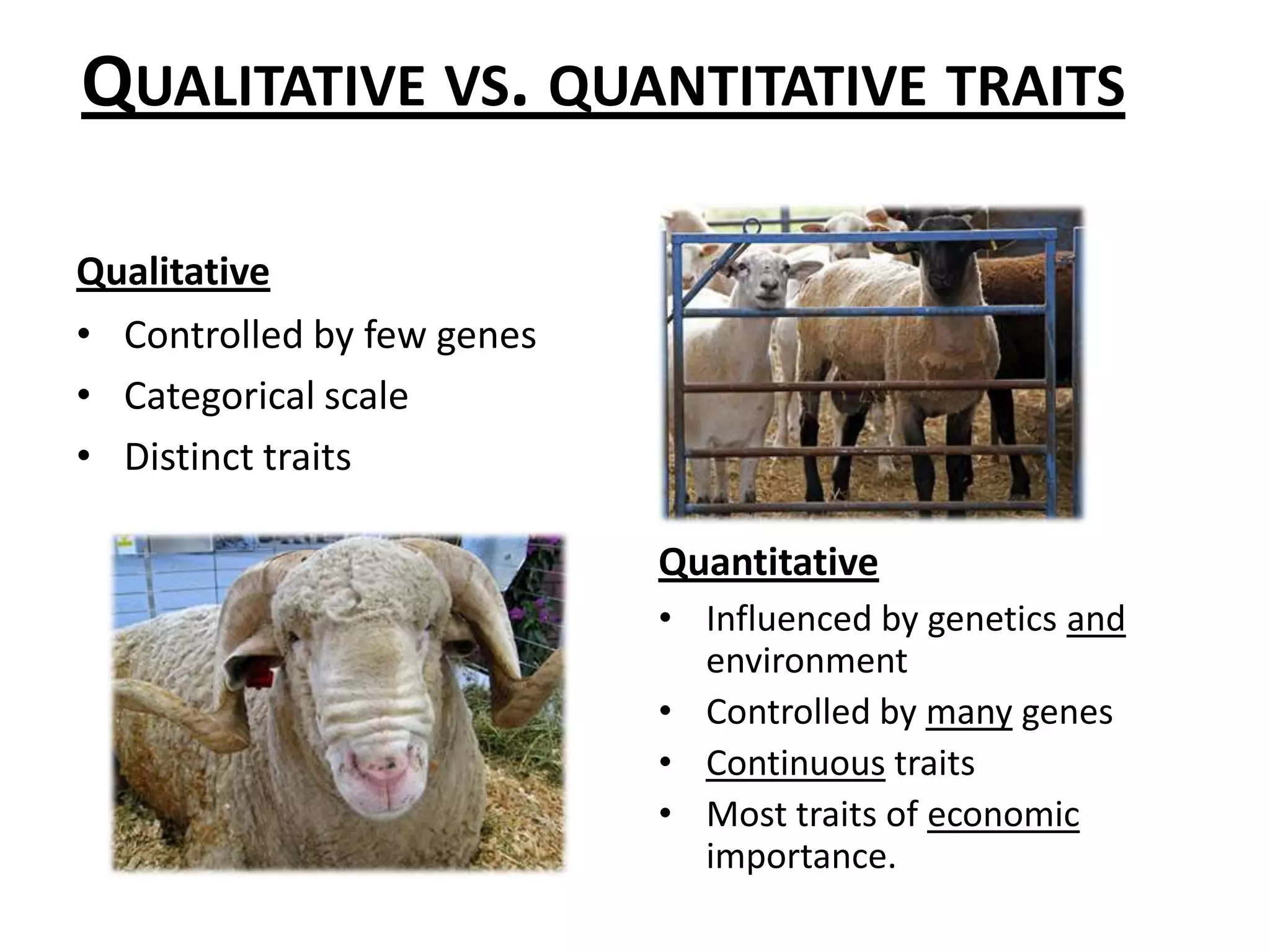
Qualitative vs. quantitative traitsQualitativeControlled by few genesCategorical scaleDistinct traitsQuantitativeInfluenced by genetics and environmentControlled by many genesContinuous traitsMost traits of economic importance.
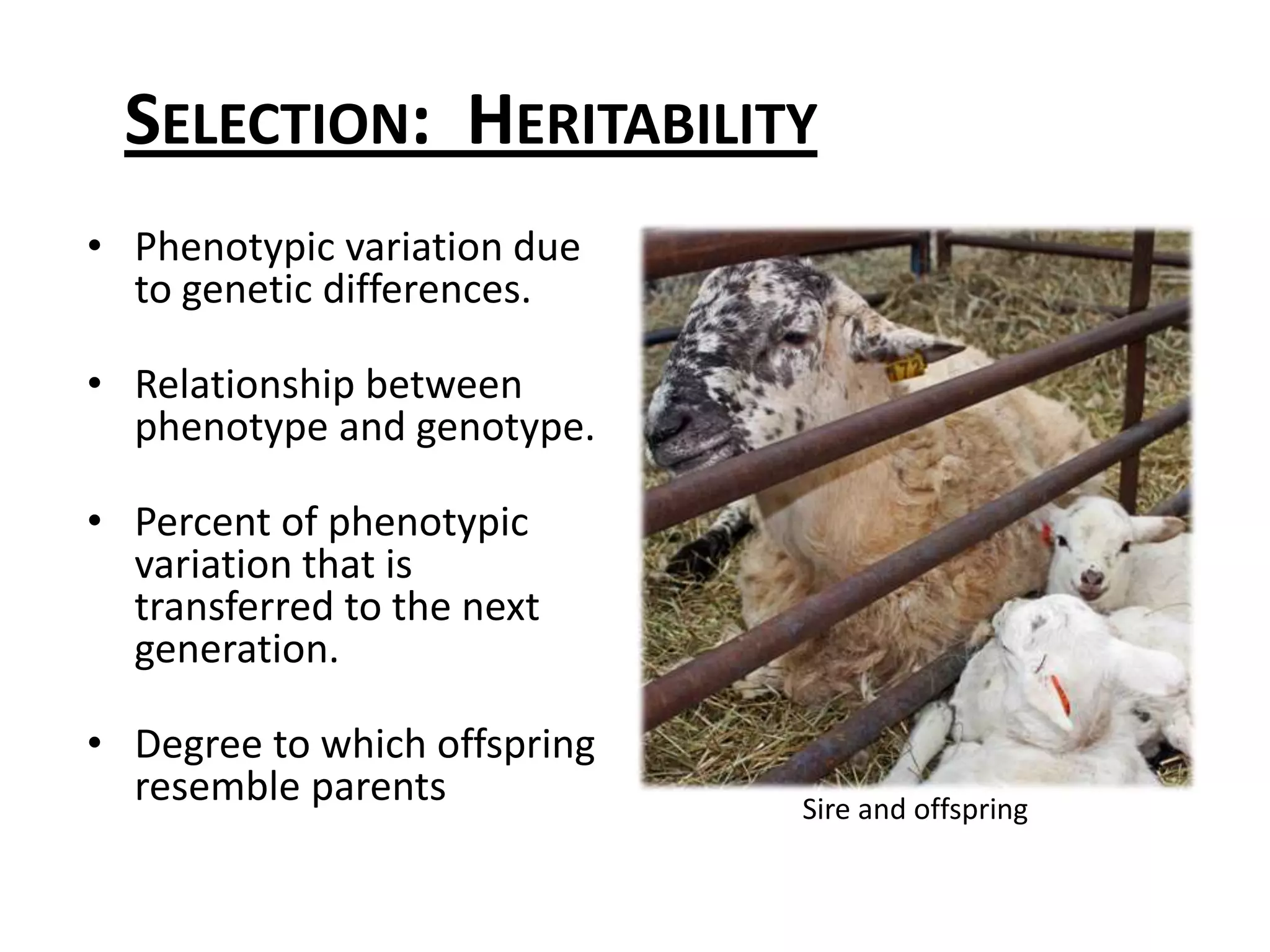
Selection:  HeritabilityPhenotypic variation due to genetic differences.Relationship between phenotype and genotype.Percent of phenotypic variation that is transferred to the next generation.Degree to which offspring resemble parentsSire and offspring
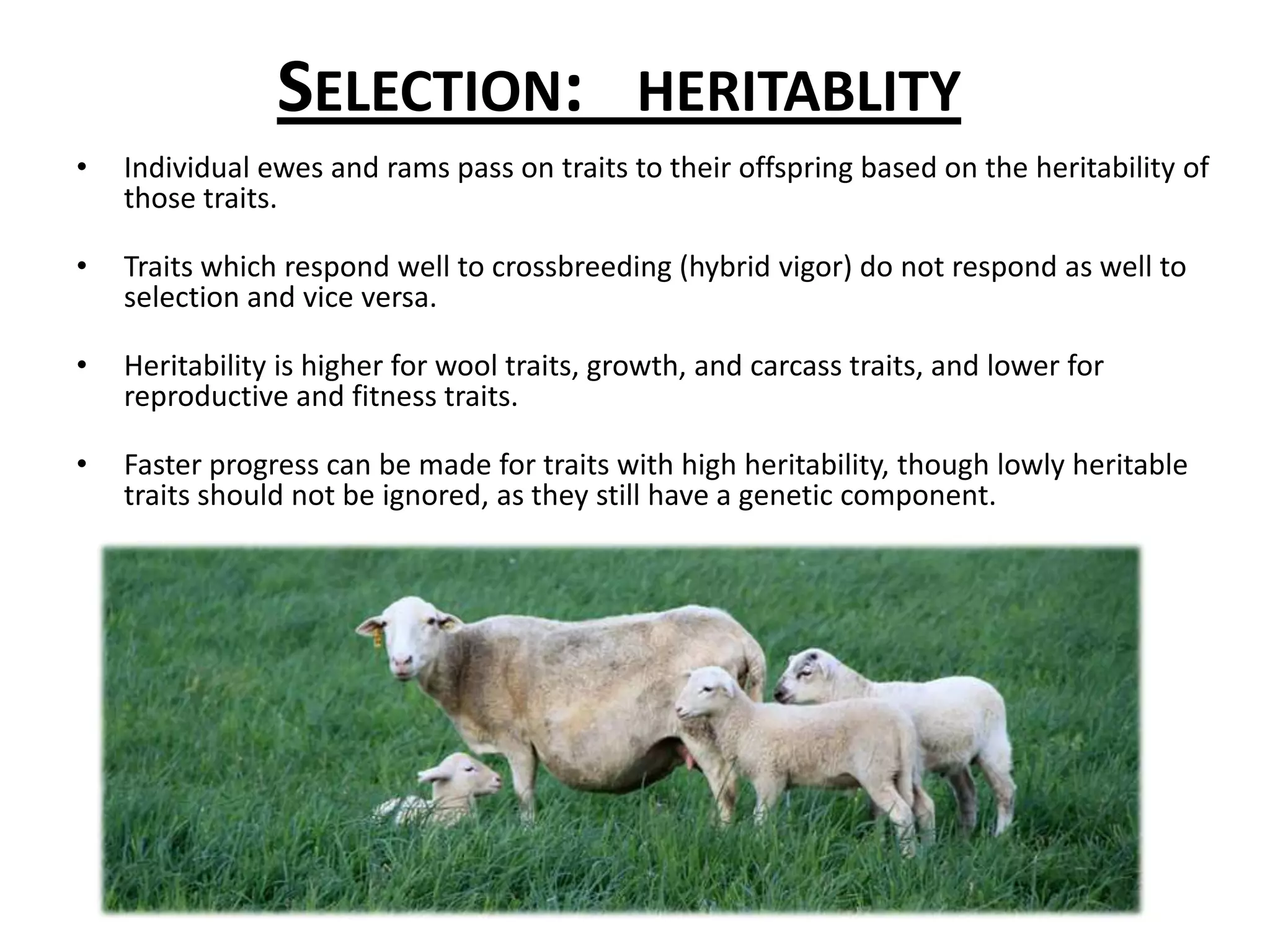
Selection:   heritablityIndividual ewes and rams pass on traits to their offspring based on the heritability of those traits.Traits which respond well to crossbreeding (hybrid vigor) do not respond as well to selection and vice versa.Heritability is higher for wool traits, growth, and carcass traits, and lower for reproductive and fitness traits.Faster progress can be made for traits with high heritability, though lowly heritable traits should not be ignored, as they still have a genetic component.
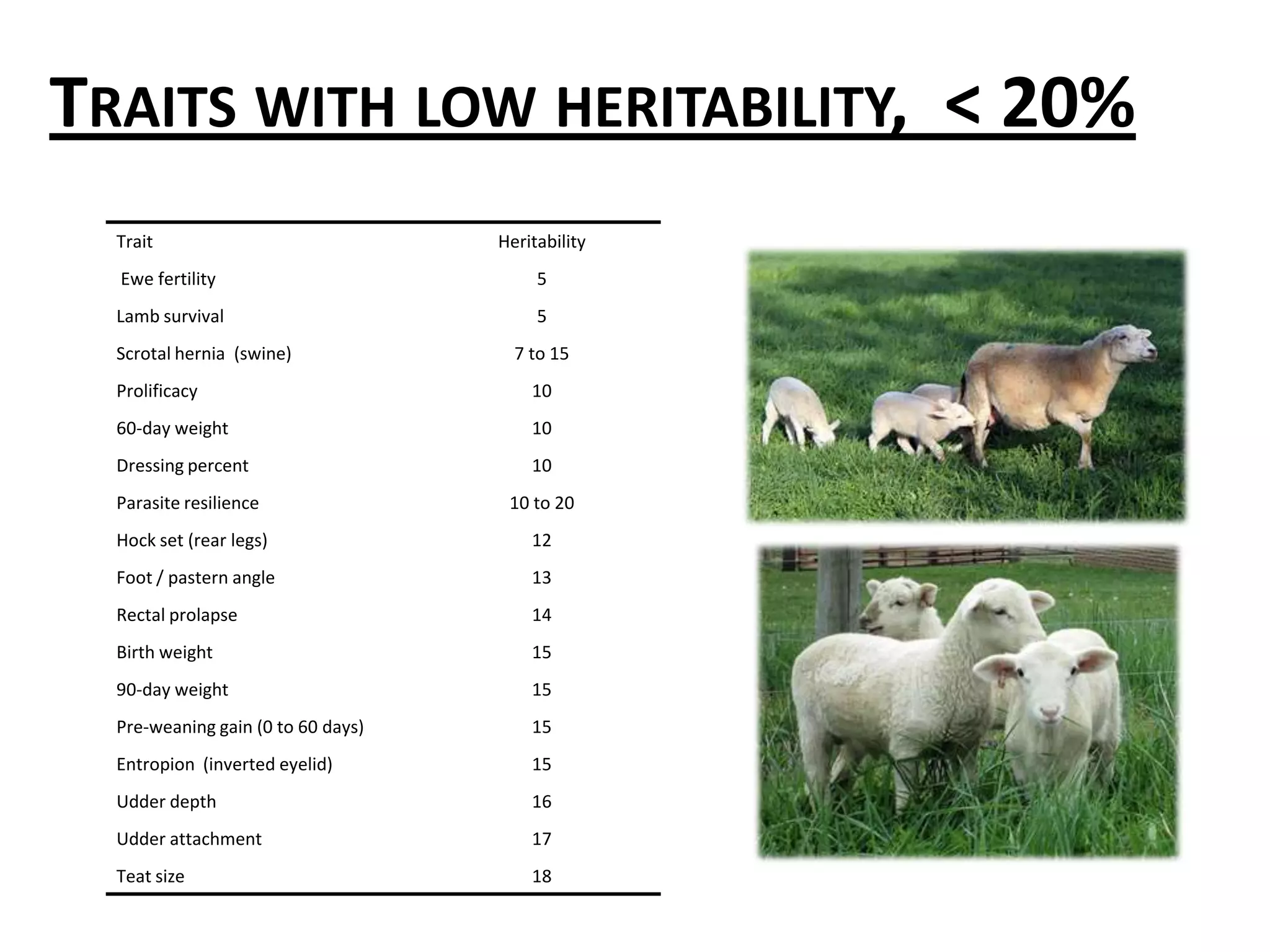
Traits with low heritability,  < 20%
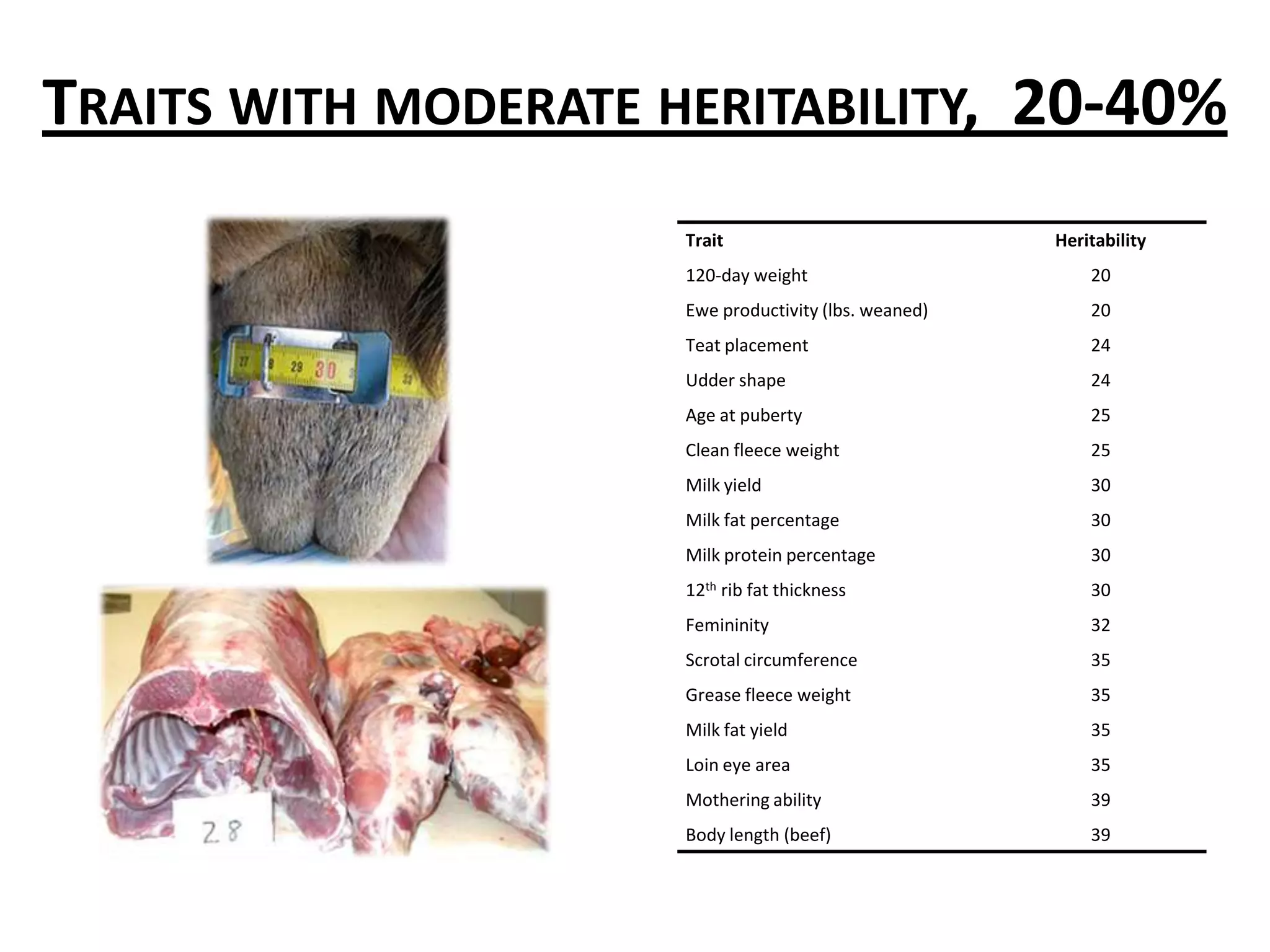
Traits with moderate heritability,  20-40%
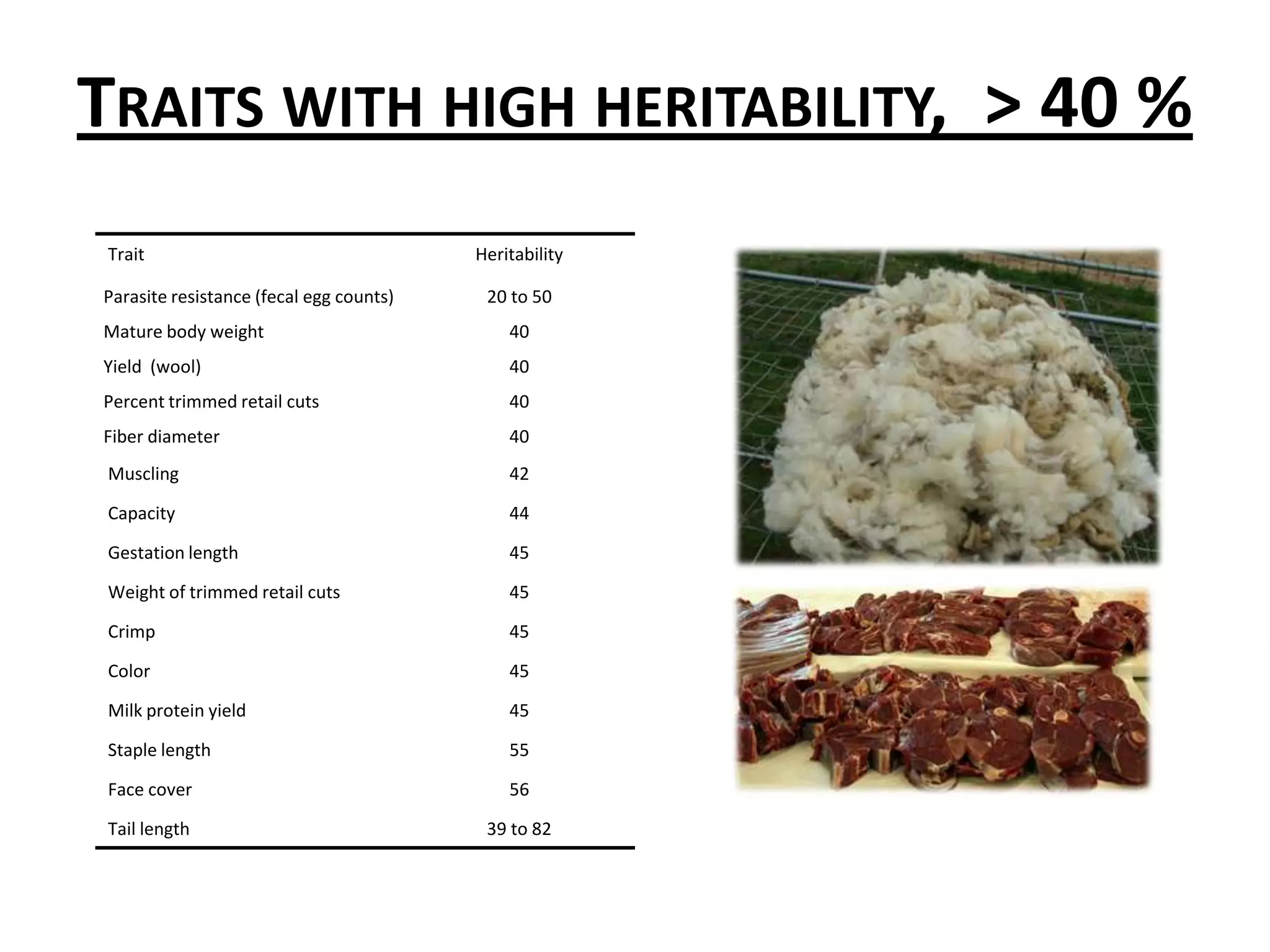
Traits with high heritability,  > 40 %
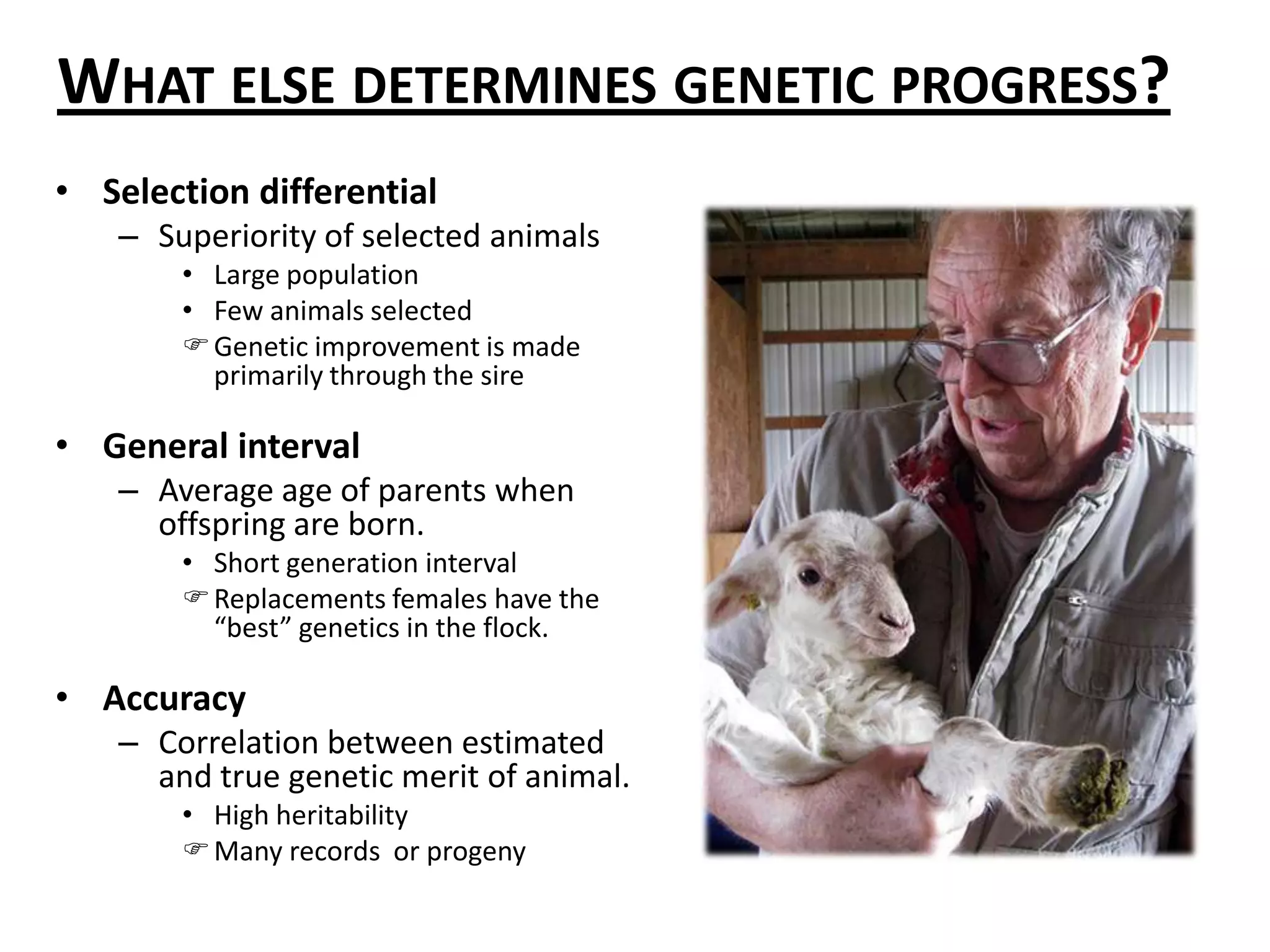
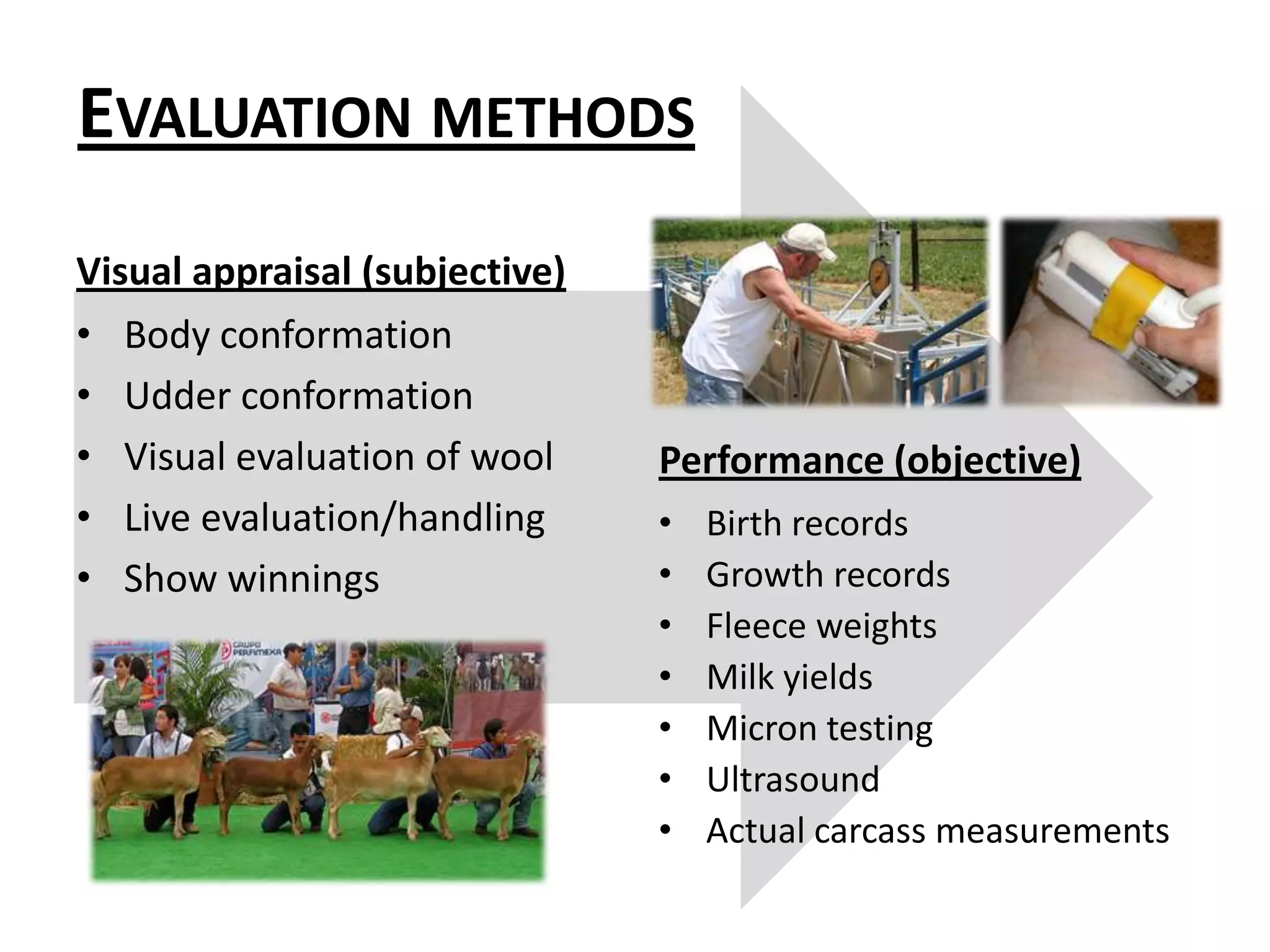
What else determines genetic progress?Selection differential Superiority of selected animalsLarge population	Few animals selectedGenetic improvement is made primarily through the sireGeneral interval Average age of parents when offspring are born.Short generation intervalReplacements females have the “best” genetics in the flock.AccuracyCorrelation between estimated and true genetic merit of animal.High heritabilityMany records  or progeny	Evaluation methodsVisual appraisal (subjective)Body conformationUdder conformationVisual evaluation of woolLive evaluation/handlingShow winningsPerformance (objective)Birth recordsGrowth recordsFleece weightsMilk yieldsMicron testingUltrasoundActual carcass measurements
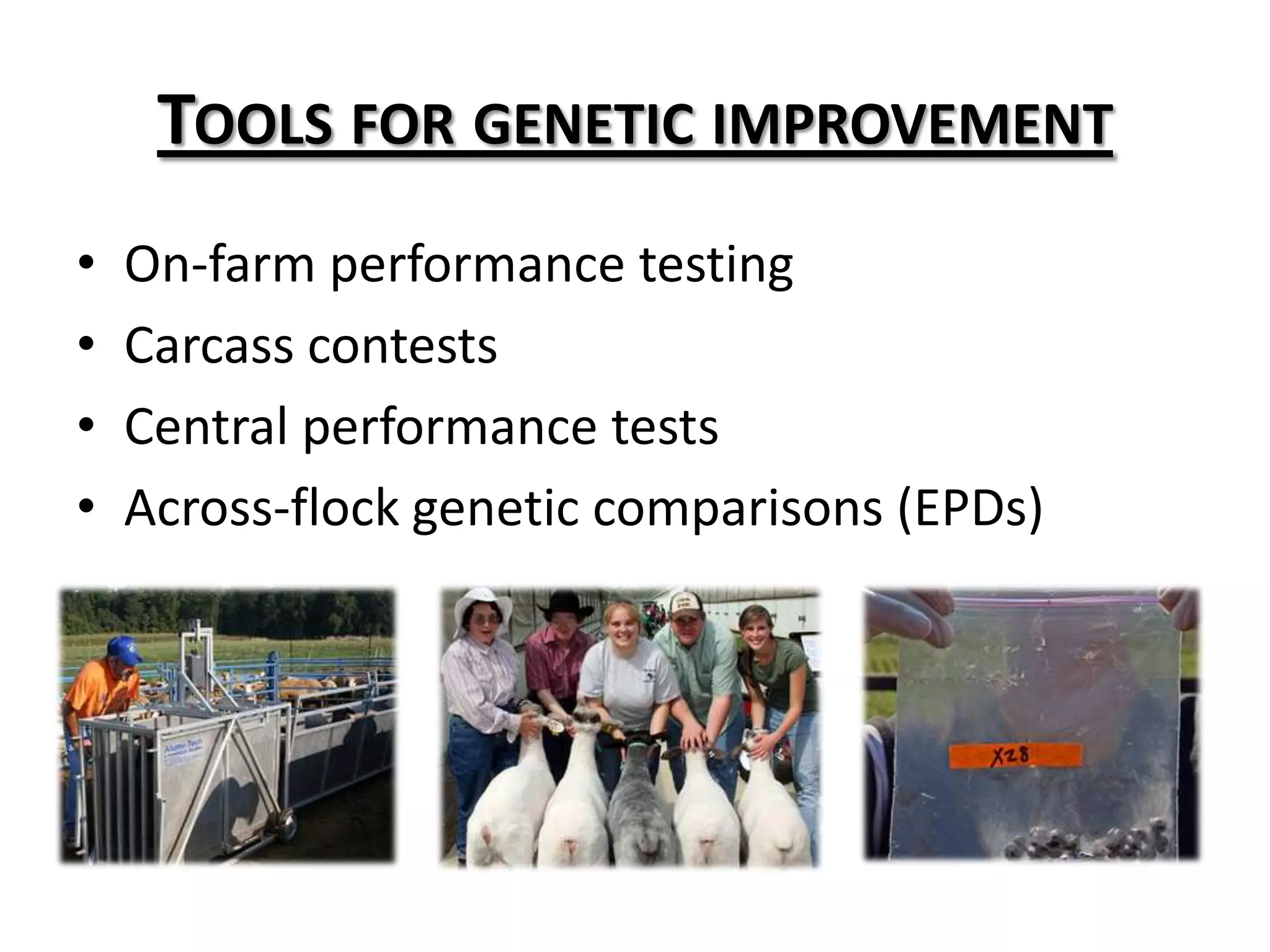
Tools for genetic improvementOn-farm performance testingCarcass contestsCentral performance testsAcross-flock genetic comparisons (EPDs)
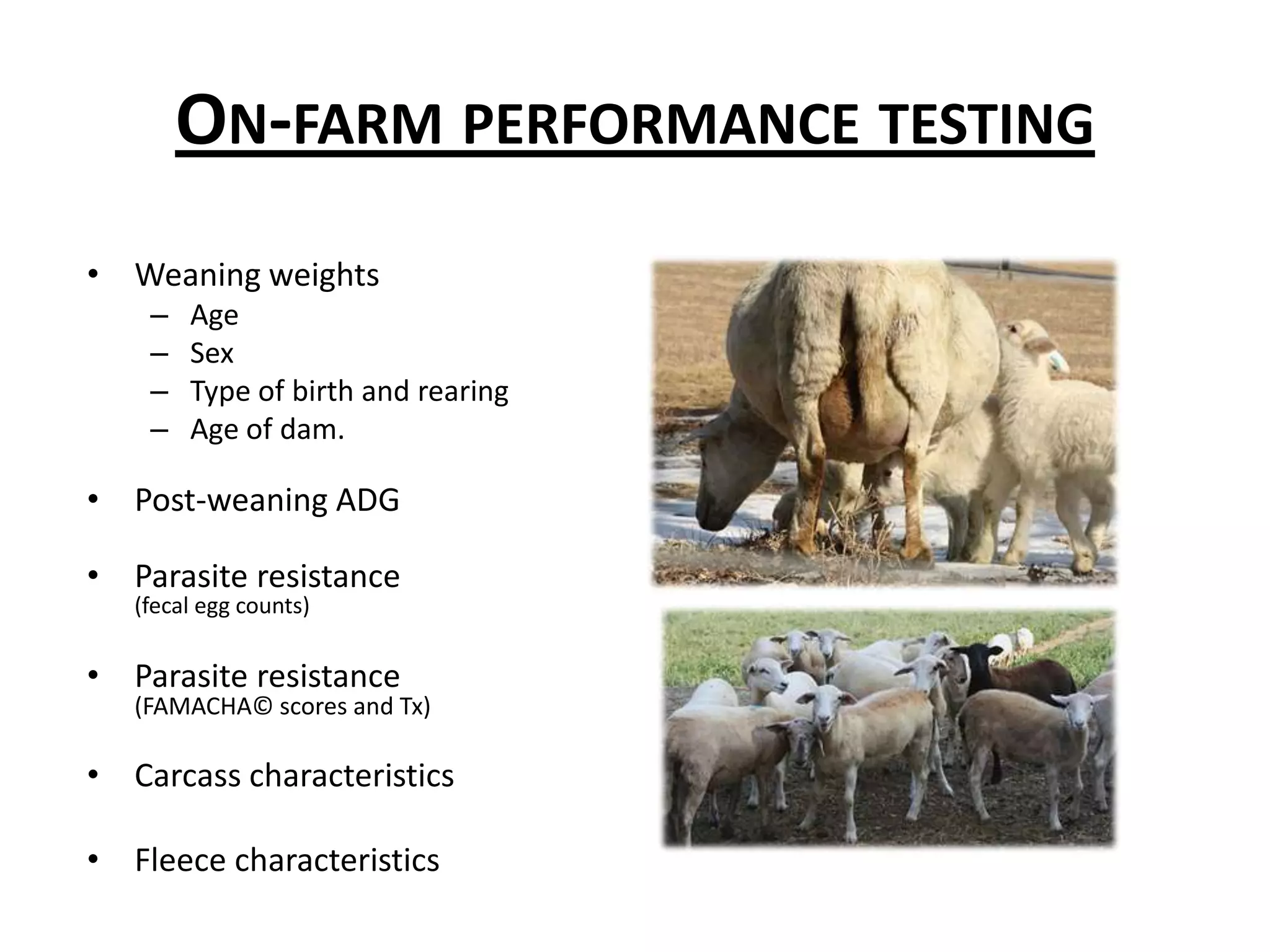
On-farm performance testingWeaning weightsAgeSexType of birth and rearingAge of dam.Post-weaning ADGParasite resistance (fecal egg counts)Parasite resistance (FAMACHA© scores and Tx)Carcass characteristicsFleece characteristics
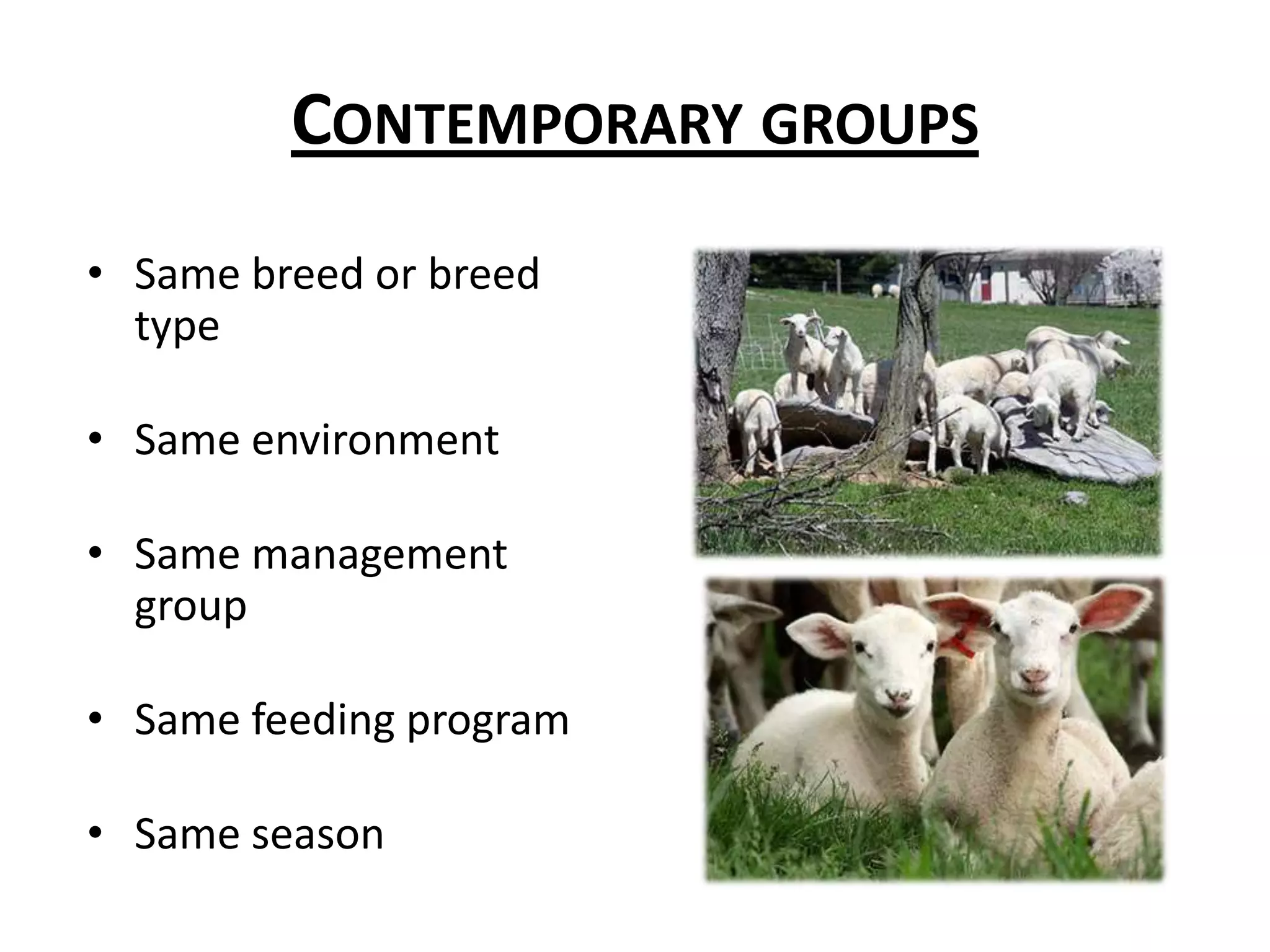
Contemporary groupsSame breed or breed typeSame environmentSame management groupSame feeding programSame season
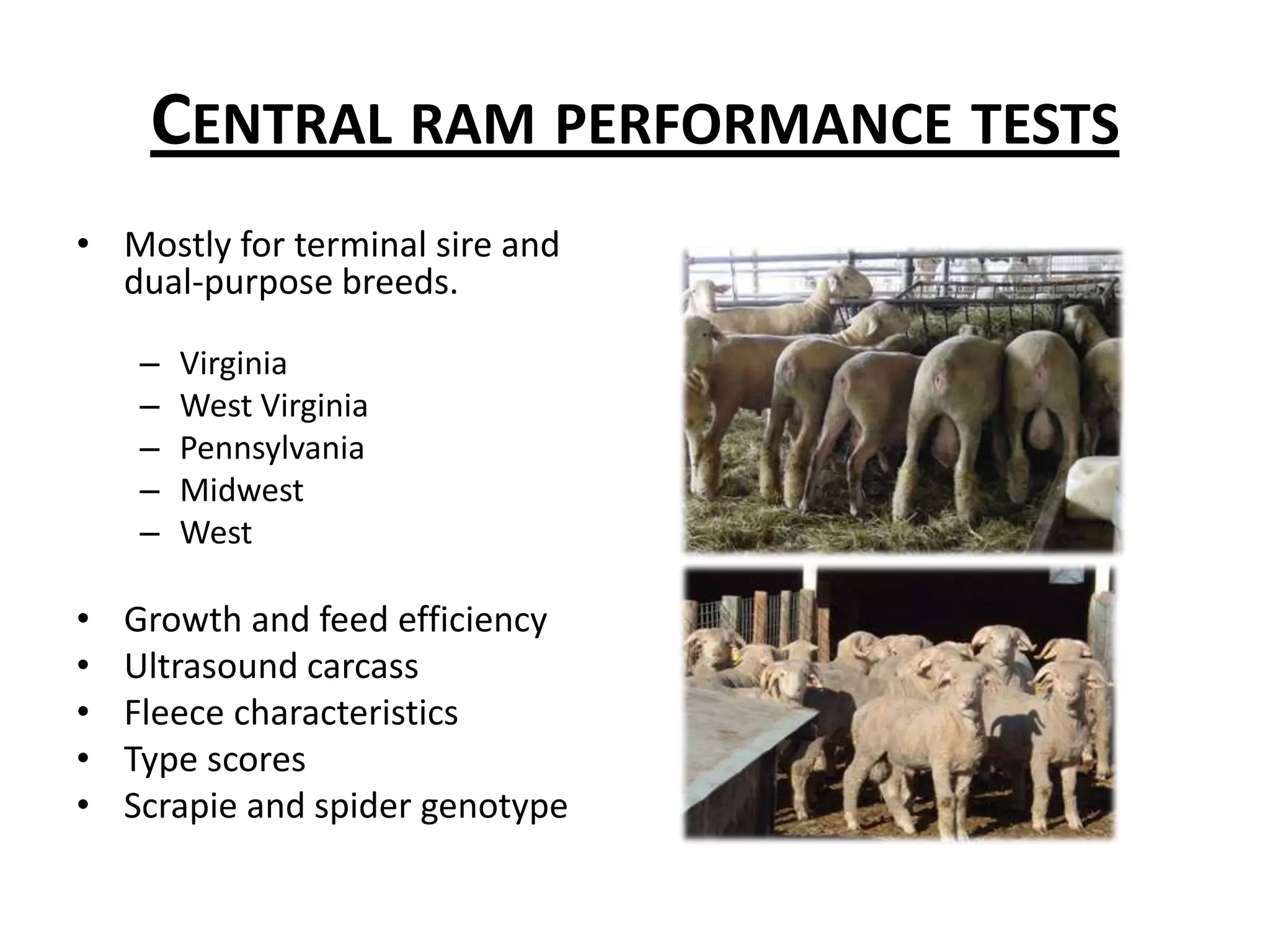
Central ram performance testsMostly for terminal sire and dual-purpose breeds.VirginiaWest VirginiaPennsylvaniaMidwestWestGrowth and feed efficiencyUltrasound carcassFleece characteristicsType scoresScrapie and spider genotype
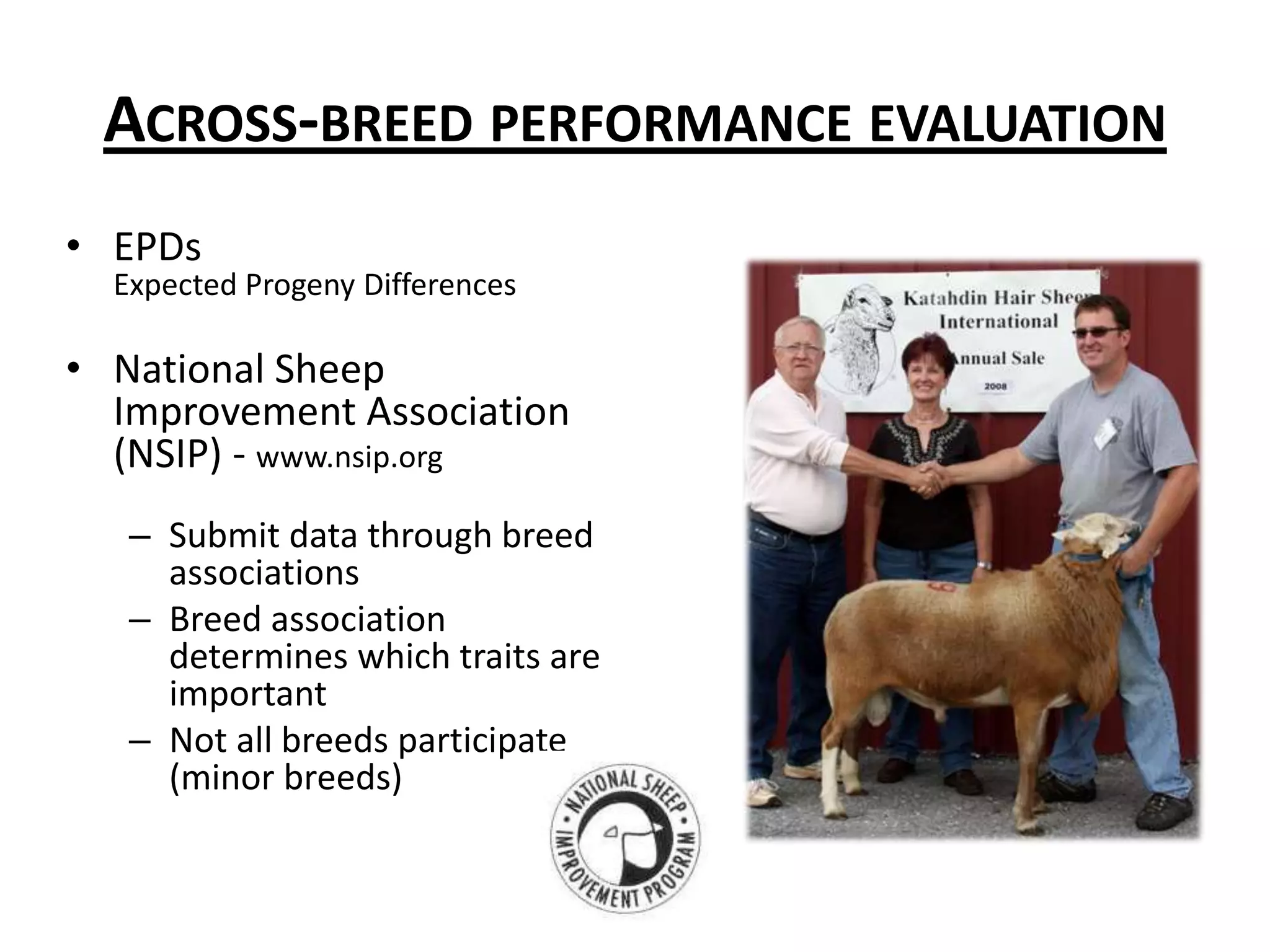
EPDs Expected Progeny DifferencesNational Sheep Improvement Association (NSIP) - www.nsip.orgSubmit data through breed associationsBreed association determines which traits are importantNot all breeds participate (minor breeds)Across-breed performance evaluation
Thank you for  your attention.Do you have any questions?
Breeding better sheep

Breeding better sheep

  • 1.
    Breeding “better” sheepSUSANSCHOENIANSheep & Goat SpecialistWestern Maryland Research & Education CenterUniversity of Maryland Extensionsschoen@umd.edu – www.sheepandgoat.com
  • 2.
    Defining “better”Better forwhat?Nature vs. nurtureGenetics vs. environmentWays to genetically improve sheepCrossbreedingSelection Today’s topics
  • 3.
    What is “better”?(accordingto Google™)Something superior in quality, condition, or effect.From a position of superiority or authority.The superior one of two alternatives.Superior to another (of the same class or kind) in excellence, quality, desirability, or suitability.
  • 4.
    The U.S. SheepIndustryAmerican Sheep Industry Association Survey, April 2010
  • 5.
    Why do youraise sheep?Commercial MeatWoolSeedstock (show)Club lambsDairy production
  • 6.
    Commercial meat productionImportantPerformanceReproductiveefficiencyLBS. QUALITY LAMB WEANEDGrowth and carcass (sire)Post-weaning ADGMarket suitabilityFitnessDisease-resistantLongevityEasy-careLess important (ewes)Body conformationWool
  • 7.
    wool productionImportantWool QualityQuantity ColorCharacterLess importantBody conformationReproductive efficiencyFitness
  • 8.
    Seedstock (show animals)ImportantBodyconformationFrame sizeStructural correctnessMusclingWhatever the current “fad” for your breed is.Less importantReproductive efficiencyFitnessWool production
  • 9.
    Club lambsImportantTypeBody conformationEyeappeal (“X” factor)Less importantReproductive efficiencyFitnessWool
  • 10.
  • 11.
    Nature vs. nurtureHeredity(genetics) vs. environmentGENOTYPEThe genetic make-up of an individual.The genes or alleles present in an individual.An individual’s genetic information.PHENOTYPEPhysical appearance of an individual.Observable or measurable traits.Genetics + environment
  • 12.
    Environmental factors affectingphenotypeNutritionHealthWeatherSeasonManagementHousingPasture managementAgeGenetics is permanent. The environment changes.
  • 13.
    Nature vs. nurturePhenotypeGenotypeWhatan animal looks likeVisual appraisalHow an animal performsActual performance levelsOn-farm Adjusted weaning weightsAdjusted litter weightsFlock EPDs (expected progeny difference).Across-flockEPDs or EBVsDifferences in performance at Central Ram Test StationsIndividual genesFecundity geneMyostatin geneScrapie-resistance
  • 14.
    There are twoways to genetically “improve” sheep.1) CROSSBREEDINGMating individuals of different breeds or types.2) SELECTIONNatural“Survival of the fittest”ArtificialHuman interventionChoosing which individuals get to become parents.
  • 15.
    Crossbreeding has twodistinct advantagesHybrid vigor (heterosis)Improved performance of offspring compared to the average of their parents.IndividualMaternalPaternalEffects are additive.
  • 16.
    Greatest for reproductiveand fitness traits.Heterosis in the crossbred lamb
  • 17.
    Heterosis in thecrossbred ewe
  • 18.
    Crossbreeding has twodistinct advantagesComplementarityImprovement in performance of crossbred offspring resulting from the crossing of breeds of different, but complementary biological types.
  • 19.
    Strengths of sirebreed offset weaknesses of dam breed and vice versa.Suffolk x KatahdinFinn x DorsetSuffolk x Texel
  • 20.
    Sheep Crossbreeding programsShouldbe a planned program to produce desired types of animals or fleeces.Should optimize performance of flock.Should use breeds in appropriate roles.Does not imply indiscriminate mixing of breeds or types.Crossbreeding systemsTerminalAll offspring are marketed.Katahdin ewe x Suffolk ram = market lambsRotationalDual-purpose rams are alternatedDorset x Columbia = ewes + market lambsRoto-terminalRotational (to produce ewe replacements); terminal to produce market lambs.1) Dorset x Ramboullet = ewes2) D x R ewes x Suffolk ram = market lambsComposite-terminalNew breed is formed (composite) and mated to terminal ram for market lamb production.Polypay x Polypay = composite ewesComposite x Texel ram = market lambsSelectionSelect for one traitCan lead to problemsSelect for multiple traitsProgress will be slower for individual traits, but it results in more balanced selection (and sheep). Minimum standardsWeaning wt ratio above 100%Twin or betterDewormed once as lambSelection indexLbs. of lamb weanedLbs. lamb + 3x lbs. woolPedigree (family selection)
  • 21.
    Qualitative vs. quantitativetraitsQualitativeControlled by few genesCategorical scaleDistinct traitsQuantitativeInfluenced by genetics and environmentControlled by many genesContinuous traitsMost traits of economic importance.
  • 22.
    Selection: HeritabilityPhenotypicvariation due to genetic differences.Relationship between phenotype and genotype.Percent of phenotypic variation that is transferred to the next generation.Degree to which offspring resemble parentsSire and offspring
  • 23.
    Selection: heritablityIndividual ewes and rams pass on traits to their offspring based on the heritability of those traits.Traits which respond well to crossbreeding (hybrid vigor) do not respond as well to selection and vice versa.Heritability is higher for wool traits, growth, and carcass traits, and lower for reproductive and fitness traits.Faster progress can be made for traits with high heritability, though lowly heritable traits should not be ignored, as they still have a genetic component.
  • 24.
    Traits with lowheritability, < 20%
  • 25.
    Traits with moderateheritability, 20-40%
  • 26.
    Traits with highheritability, > 40 %
  • 27.
    What else determinesgenetic progress?Selection differential Superiority of selected animalsLarge population Few animals selectedGenetic improvement is made primarily through the sireGeneral interval Average age of parents when offspring are born.Short generation intervalReplacements females have the “best” genetics in the flock.AccuracyCorrelation between estimated and true genetic merit of animal.High heritabilityMany records or progeny Evaluation methodsVisual appraisal (subjective)Body conformationUdder conformationVisual evaluation of woolLive evaluation/handlingShow winningsPerformance (objective)Birth recordsGrowth recordsFleece weightsMilk yieldsMicron testingUltrasoundActual carcass measurements
  • 28.
    Tools for geneticimprovementOn-farm performance testingCarcass contestsCentral performance testsAcross-flock genetic comparisons (EPDs)
  • 29.
    On-farm performance testingWeaningweightsAgeSexType of birth and rearingAge of dam.Post-weaning ADGParasite resistance (fecal egg counts)Parasite resistance (FAMACHA© scores and Tx)Carcass characteristicsFleece characteristics
  • 30.
    Contemporary groupsSame breedor breed typeSame environmentSame management groupSame feeding programSame season
  • 31.
    Central ram performancetestsMostly for terminal sire and dual-purpose breeds.VirginiaWest VirginiaPennsylvaniaMidwestWestGrowth and feed efficiencyUltrasound carcassFleece characteristicsType scoresScrapie and spider genotype
  • 32.
    EPDs Expected ProgenyDifferencesNational Sheep Improvement Association (NSIP) - www.nsip.orgSubmit data through breed associationsBreed association determines which traits are importantNot all breeds participate (minor breeds)Across-breed performance evaluation
  • 33.
    Thank you for your attention.Do you have any questions?