Basic Genetics
and Selection
Norelie O. Ibacarra, DVM
Basic Genetics
• The basic unit of inheritance is the gene, located on
chromosomes which are made up of strands of
complex molecules called DNA.
• In mammals, these chromosomes contain about 60,000
genes, the entire set of which is called a genome.
• Different forms of the same gene are called alleles. If an
individual’s two alleles (one from each parent) are the
same they are homozygous. If different they are
heterozygous. This genetic makeup is called genotype.
What can be seen or measured is called phenotype.
• Progeny are created by the union of gametes (sperm
from the male and egg from the female). Each gamete
produced by an individual is unique. Patterns of
inheritance depend on:
– The gametes produced by the parents.
– The possible combination of gametes.
– The action of different alleles.
Types of Inheritance
• Qualitative - One pair or relatively few alleles generally
involved. Traits have distinct differences in phenotype,
such as color, horns, etc. Usually not influenced by the
environment.
• Quantitative - Many pairs of genes involved, acting
additively. There is continuous variation in phenotypes.
Virtually all of the economically important traits result
from this type of inheritance. Generally influenced by the
environment.
Causes of Phenotypic
Variation
• Heredity:
Animals genetic background for
phenotype
• Environment:
Conditions under which the animals are
born and raised; climate, nutrition,
disease, general management, etc.
Heritability
• Degree of relationship between genotype and
phenotype. Generally reported as a percentage.
• Production traits vary in heritability. Most reproductive
traits (conception rate, etc.) are low (< 20%),
production traits (weight, etc.) are medium (20% to
40%), and product traits (lean tenderness, etc.) are
high (> 40%).
SELECTION
• Process that determines which individuals become parents,
how many offspring they produce, and how long they remain
in the population.
• Man practices “artificial” selection. Nature (the environment)
practices “natural” selection, which is always present and may
be the major influence on phenotype in some instances.
• Single trait selection
– Most rapid genetic progress
– May be least adapted to the environment
• Multiple trait selection
– The more traits the less progress
– Animals raised outside of confinement will need more multiple
trait selection
Factors Affecting Rate of
Improvement Through Selection
• Heritability level
• Selection differential
– difference between performance of individuals selected as parents
and the average of the group they were selected from. Relatively
few sires are needed, so they have more effect than dams
• Generation interval – average age of parents when progeny
are born
– cattle > sheep and goats > rabbits
• Rate of improvement per year from selection =
(heritability x selection differential) / generation intervals
Selection Methods
• Selection on appearance is strictly subjective.
• Selection on pedigree is done strictly on the basis of an
individual’s ancestors.
• Selection on individual performance relies on measuring
production traits, and selecting on that basis.
• Selection on progeny performance can be more accurate but
also is the slowest.
• Combining pedigree, individual performance, and progeny
performance, using Expected Progeny Difference (EPD,
discussed later), is most effective.
Matching Genetic
Programs to
Existing Conditions
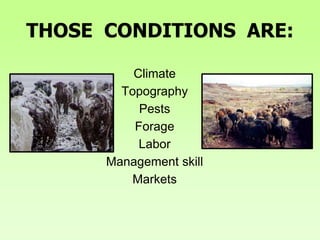
THOSE CONDITIONS ARE:
Climate
Topography
Pests
Forage
Labor
Management skill
Markets
Genetics and Forage
• Forage availability is the main determinant
of optimum mature body size. Larger
animals need more forage.
• Forage quality is the main determinant of
optimum milking ability. Higher-milking
females need higher-quality forage.
Mating Plans
and Breeding
Systems
Mating Plans
• Random – no effort to control relationship of parents.
• Inbreeding – mating animals more closely related than
the average of the population. Main use is linebreeding,
to increase genetic influence of superior sires or dams.
• Outbreeding – mating animals less closely related than
the average of the population. Outcrossing is
outbreeding within a breed. Crossbreeding is
outbreeding of animals of different breeds.
Effects of Mating Plans
• Inbreeding is often detrimental to overall vigor and
fitness. It tends to result in more homozygous gene
pairs. Does not increase the number of possibly
undesirable recessive genes, just increases the chance
they will be expressed in progeny.
• Outbreeding, especially crossbreeding, generally
improves vigor and fitness. Tends to result in more
heterozygous gene pairs.
Continuous Systems
• Straightbreeding - same breed of sire and dam, can be
carried out in one breeding group.
• True rotation - two or more breeds, same number of
breeding groups, females bred to breed of sire to which
they are least related.
• Sire rotation - two or more breeds, one breeding group,
one sire breed used at a time, changed periodically,
before breeding back to daughters.
Example 2-Breed True Rotation
• Start with Angus females, breed to Hereford.
• Rotate saved Hereford-sired heifers to another breeding
group using Angus sires.
• Rotate saved Angus-sired heifers to original breeding group
using Hereford sires.
• Females rotated once in their life, to group using sire breed
they are least related to. Once the rotation is completed, both
breeding groups are maintained. After several generations,
each group contains about 2/3 of the influence of breed of sire
and 1/3 of the other breed.
Benefits of Crossbreeding
1) Heterosis or “hybrid vigor”
• Difference in performance of crosses relative to the
average of purebred parents.
• Highest in progeny of parents least related genetically
(for example, higher in Hereford X Brahman than
Hereford X Angus)
• Highest in reproduction/maternal traits, medium in
production traits, lowest in product traits.
• Can not be transmitted from parent to offspring.
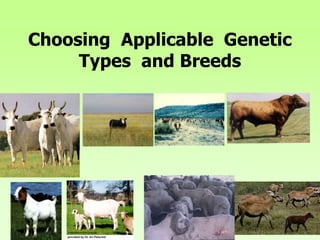
Choosing Applicable Genetic
Types and Breeds
Genetic Classes
• Cattle: Genetic Classes
– Bos taurus - non-humped types, originating in Continental
Europe and the British Isles, most cold tolerant
– Bos indicus - humped types, also called Zebu; originating in
south central Asia, most heat tolerant
• Sheep: Genetic Classes
– Hair Sheep
– Wool Sheep
– Over 200 breeds world-wide
Types and Breeds
• Can be placed into functional-type breed groups based
on genetic classification, body size, milking potential,
and body composition (lean-to-fat ratio).
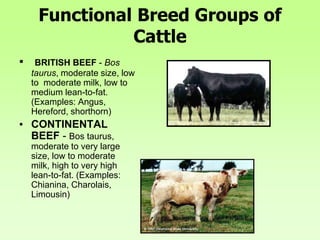
Functional Breed Groups of
Cattle
▪ BRITISH BEEF - Bos
taurus, moderate size, low
to moderate milk, low to
medium lean-to-fat.
(Examples: Angus,
Hereford, shorthorn)
▪ CONTINENTAL
BEEF - Bos taurus,
moderate to very large
size, low to moderate
milk, high to very high
lean-to-fat. (Examples:
Chianina, Charolais,
Limousin)
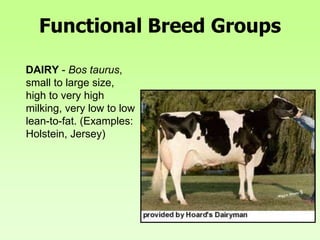
Functional Breed Groups
DAIRY - Bos taurus,
small to large size,
high to very high
milking, very low to low
lean-to-fat. (Examples:
Holstein, Jersey)
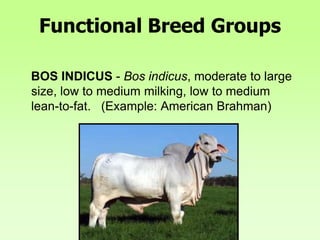
Functional Breed Groups
BOS INDICUS - Bos indicus, moderate to large
size, low to medium milking, low to medium
lean-to-fat. (Example: American Brahman)
Functional Breed Groups
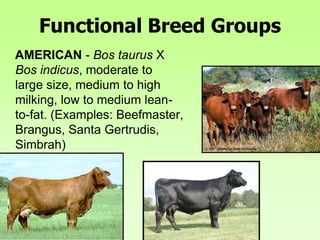
AMERICAN - Bos taurus X
Bos indicus, moderate to
large size, medium to high
milking, low to medium lean-
to-fat. (Examples: Beefmaster,
Brangus, Santa Gertrudis,
Simbrah)
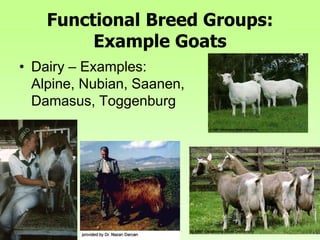
Functional Breed Groups:
Example Goats
• Dairy – Examples:
Alpine, Nubian, Saanen,
Damasus, Toggenburg
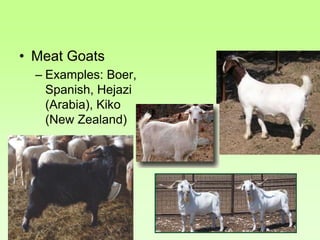
• Meat Goats
– Examples: Boer,
Spanish, Hejazi
(Arabia), Kiko
(New Zealand)
• Dual purpose goats: meat and milk
– Probably most of the species in the world are
dual purpose
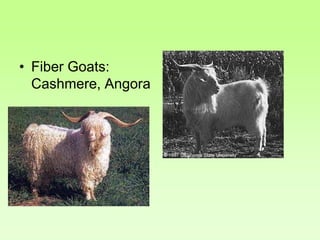
• Fiber Goats:
Cashmere, Angora
For more complete information on
breeds of livestock go to the
Oklahoma State University breeds
page at:
http://www.ansi.okstate.edu/breeds/
Matching Breeds to Markets
• Breeds should be chosen primarily on the
basis of climatic adaptability and
compatibility with other production
conditions, but performance and
marketability should also be considered.
Selection of
Individuals for
Breeding
• Select only for traits that have some bearing on herd
or flock profit or objectives.
• Use the most objective measures when available.
• If there are no objective measures, be sure any
visual methods are meaningful and affect profit.
Most Important Traits
• Reproductive performance - highest economic value
• Maternal ability - including milk production
• Growth and efficiency - weaning weight, postweaning gain,
yearling weight, feed conversion
• Market price - with traditional live methods by weight, or
carcass grids, or by the head as replacements
• Temperament (cattle) Flocking instinct (sheep goats) -
ease of handling
• Longevity - length of productive life
In dairy and beef cattle,
selection can be most accurate
and most effective using
Expected Progeny Difference
(EPD)
EPD
• Adjusts for differences in environment, such as
climate and nutrition.
• Can be compared within a breed for all individuals
(males and females) in all locations and
management systems across all years. Also can be
used to compare EPDs within one breed for
crossbreeding, such as comparing Angus sires to be
used on Hereford cows.
• Procedures have been developed for comparing
EPDs of different breeds, but these are less reliable
than within-breed EPD.
EPD ACCURACY
• Every EPD has a value for Accuracy.
• Accuracy is a measure of confidence that the EPD is the true
genetic value.
• Accuracy ranges between 0 and 1.
• High Accuracy requires significant number of progeny records on
an individual. Young animals with pedigree data only have low
Accuracy, but the EPD is still useful for selection.
SELECTING
WITHOUT
GENETIC DATA
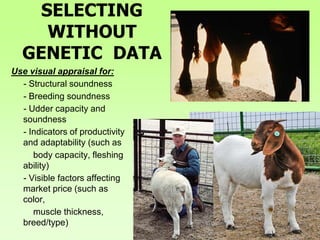
Use visual appraisal for:
- Structural soundness
- Breeding soundness
- Udder capacity and
soundness
- Indicators of productivity
and adaptability (such as
body capacity, fleshing
ability)
- Visible factors affecting
market price (such as
color,
muscle thickness,
breed/type)

GeneticsandBreeding.pptx

  • 1.
  • 2.
    Basic Genetics • Thebasic unit of inheritance is the gene, located on chromosomes which are made up of strands of complex molecules called DNA. • In mammals, these chromosomes contain about 60,000 genes, the entire set of which is called a genome.
  • 3.
    • Different formsof the same gene are called alleles. If an individual’s two alleles (one from each parent) are the same they are homozygous. If different they are heterozygous. This genetic makeup is called genotype. What can be seen or measured is called phenotype. • Progeny are created by the union of gametes (sperm from the male and egg from the female). Each gamete produced by an individual is unique. Patterns of inheritance depend on: – The gametes produced by the parents. – The possible combination of gametes. – The action of different alleles.
  • 4.
    Types of Inheritance •Qualitative - One pair or relatively few alleles generally involved. Traits have distinct differences in phenotype, such as color, horns, etc. Usually not influenced by the environment. • Quantitative - Many pairs of genes involved, acting additively. There is continuous variation in phenotypes. Virtually all of the economically important traits result from this type of inheritance. Generally influenced by the environment.
  • 5.
    Causes of Phenotypic Variation •Heredity: Animals genetic background for phenotype • Environment: Conditions under which the animals are born and raised; climate, nutrition, disease, general management, etc.
  • 6.
    Heritability • Degree ofrelationship between genotype and phenotype. Generally reported as a percentage. • Production traits vary in heritability. Most reproductive traits (conception rate, etc.) are low (< 20%), production traits (weight, etc.) are medium (20% to 40%), and product traits (lean tenderness, etc.) are high (> 40%).
  • 7.
    SELECTION • Process thatdetermines which individuals become parents, how many offspring they produce, and how long they remain in the population. • Man practices “artificial” selection. Nature (the environment) practices “natural” selection, which is always present and may be the major influence on phenotype in some instances. • Single trait selection – Most rapid genetic progress – May be least adapted to the environment • Multiple trait selection – The more traits the less progress – Animals raised outside of confinement will need more multiple trait selection
  • 8.
    Factors Affecting Rateof Improvement Through Selection • Heritability level • Selection differential – difference between performance of individuals selected as parents and the average of the group they were selected from. Relatively few sires are needed, so they have more effect than dams • Generation interval – average age of parents when progeny are born – cattle > sheep and goats > rabbits • Rate of improvement per year from selection = (heritability x selection differential) / generation intervals
  • 9.
    Selection Methods • Selectionon appearance is strictly subjective. • Selection on pedigree is done strictly on the basis of an individual’s ancestors. • Selection on individual performance relies on measuring production traits, and selecting on that basis. • Selection on progeny performance can be more accurate but also is the slowest. • Combining pedigree, individual performance, and progeny performance, using Expected Progeny Difference (EPD, discussed later), is most effective.
  • 10.
  • 11.
  • 12.
    Genetics and Forage •Forage availability is the main determinant of optimum mature body size. Larger animals need more forage. • Forage quality is the main determinant of optimum milking ability. Higher-milking females need higher-quality forage.
  • 13.
  • 14.
    Mating Plans • Random– no effort to control relationship of parents. • Inbreeding – mating animals more closely related than the average of the population. Main use is linebreeding, to increase genetic influence of superior sires or dams. • Outbreeding – mating animals less closely related than the average of the population. Outcrossing is outbreeding within a breed. Crossbreeding is outbreeding of animals of different breeds.
  • 15.
    Effects of MatingPlans • Inbreeding is often detrimental to overall vigor and fitness. It tends to result in more homozygous gene pairs. Does not increase the number of possibly undesirable recessive genes, just increases the chance they will be expressed in progeny. • Outbreeding, especially crossbreeding, generally improves vigor and fitness. Tends to result in more heterozygous gene pairs.
  • 16.
    Continuous Systems • Straightbreeding- same breed of sire and dam, can be carried out in one breeding group. • True rotation - two or more breeds, same number of breeding groups, females bred to breed of sire to which they are least related. • Sire rotation - two or more breeds, one breeding group, one sire breed used at a time, changed periodically, before breeding back to daughters.
  • 17.
    Example 2-Breed TrueRotation • Start with Angus females, breed to Hereford. • Rotate saved Hereford-sired heifers to another breeding group using Angus sires. • Rotate saved Angus-sired heifers to original breeding group using Hereford sires. • Females rotated once in their life, to group using sire breed they are least related to. Once the rotation is completed, both breeding groups are maintained. After several generations, each group contains about 2/3 of the influence of breed of sire and 1/3 of the other breed.
  • 18.
    Benefits of Crossbreeding 1)Heterosis or “hybrid vigor” • Difference in performance of crosses relative to the average of purebred parents. • Highest in progeny of parents least related genetically (for example, higher in Hereford X Brahman than Hereford X Angus) • Highest in reproduction/maternal traits, medium in production traits, lowest in product traits. • Can not be transmitted from parent to offspring.
  • 19.
  • 20.
    Genetic Classes • Cattle:Genetic Classes – Bos taurus - non-humped types, originating in Continental Europe and the British Isles, most cold tolerant – Bos indicus - humped types, also called Zebu; originating in south central Asia, most heat tolerant • Sheep: Genetic Classes – Hair Sheep – Wool Sheep – Over 200 breeds world-wide
  • 21.
    Types and Breeds •Can be placed into functional-type breed groups based on genetic classification, body size, milking potential, and body composition (lean-to-fat ratio).
  • 22.
    Functional Breed Groupsof Cattle ▪ BRITISH BEEF - Bos taurus, moderate size, low to moderate milk, low to medium lean-to-fat. (Examples: Angus, Hereford, shorthorn) ▪ CONTINENTAL BEEF - Bos taurus, moderate to very large size, low to moderate milk, high to very high lean-to-fat. (Examples: Chianina, Charolais, Limousin)
  • 23.
    Functional Breed Groups DAIRY- Bos taurus, small to large size, high to very high milking, very low to low lean-to-fat. (Examples: Holstein, Jersey)
  • 24.
    Functional Breed Groups BOSINDICUS - Bos indicus, moderate to large size, low to medium milking, low to medium lean-to-fat. (Example: American Brahman)
  • 25.
    Functional Breed Groups AMERICAN- Bos taurus X Bos indicus, moderate to large size, medium to high milking, low to medium lean- to-fat. (Examples: Beefmaster, Brangus, Santa Gertrudis, Simbrah)
  • 26.
    Functional Breed Groups: ExampleGoats • Dairy – Examples: Alpine, Nubian, Saanen, Damasus, Toggenburg
  • 27.
    • Meat Goats –Examples: Boer, Spanish, Hejazi (Arabia), Kiko (New Zealand)
  • 28.
    • Dual purposegoats: meat and milk – Probably most of the species in the world are dual purpose
  • 29.
  • 30.
    For more completeinformation on breeds of livestock go to the Oklahoma State University breeds page at: http://www.ansi.okstate.edu/breeds/
  • 31.
    Matching Breeds toMarkets • Breeds should be chosen primarily on the basis of climatic adaptability and compatibility with other production conditions, but performance and marketability should also be considered.
  • 32.
  • 33.
    • Select onlyfor traits that have some bearing on herd or flock profit or objectives. • Use the most objective measures when available. • If there are no objective measures, be sure any visual methods are meaningful and affect profit.
  • 34.
    Most Important Traits •Reproductive performance - highest economic value • Maternal ability - including milk production • Growth and efficiency - weaning weight, postweaning gain, yearling weight, feed conversion • Market price - with traditional live methods by weight, or carcass grids, or by the head as replacements • Temperament (cattle) Flocking instinct (sheep goats) - ease of handling • Longevity - length of productive life
  • 35.
    In dairy andbeef cattle, selection can be most accurate and most effective using Expected Progeny Difference (EPD)
  • 36.
    EPD • Adjusts fordifferences in environment, such as climate and nutrition. • Can be compared within a breed for all individuals (males and females) in all locations and management systems across all years. Also can be used to compare EPDs within one breed for crossbreeding, such as comparing Angus sires to be used on Hereford cows. • Procedures have been developed for comparing EPDs of different breeds, but these are less reliable than within-breed EPD.
  • 37.
    EPD ACCURACY • EveryEPD has a value for Accuracy. • Accuracy is a measure of confidence that the EPD is the true genetic value. • Accuracy ranges between 0 and 1. • High Accuracy requires significant number of progeny records on an individual. Young animals with pedigree data only have low Accuracy, but the EPD is still useful for selection.
  • 38.
    SELECTING WITHOUT GENETIC DATA Use visualappraisal for: - Structural soundness - Breeding soundness - Udder capacity and soundness - Indicators of productivity and adaptability (such as body capacity, fleshing ability) - Visible factors affecting market price (such as color, muscle thickness, breed/type)